
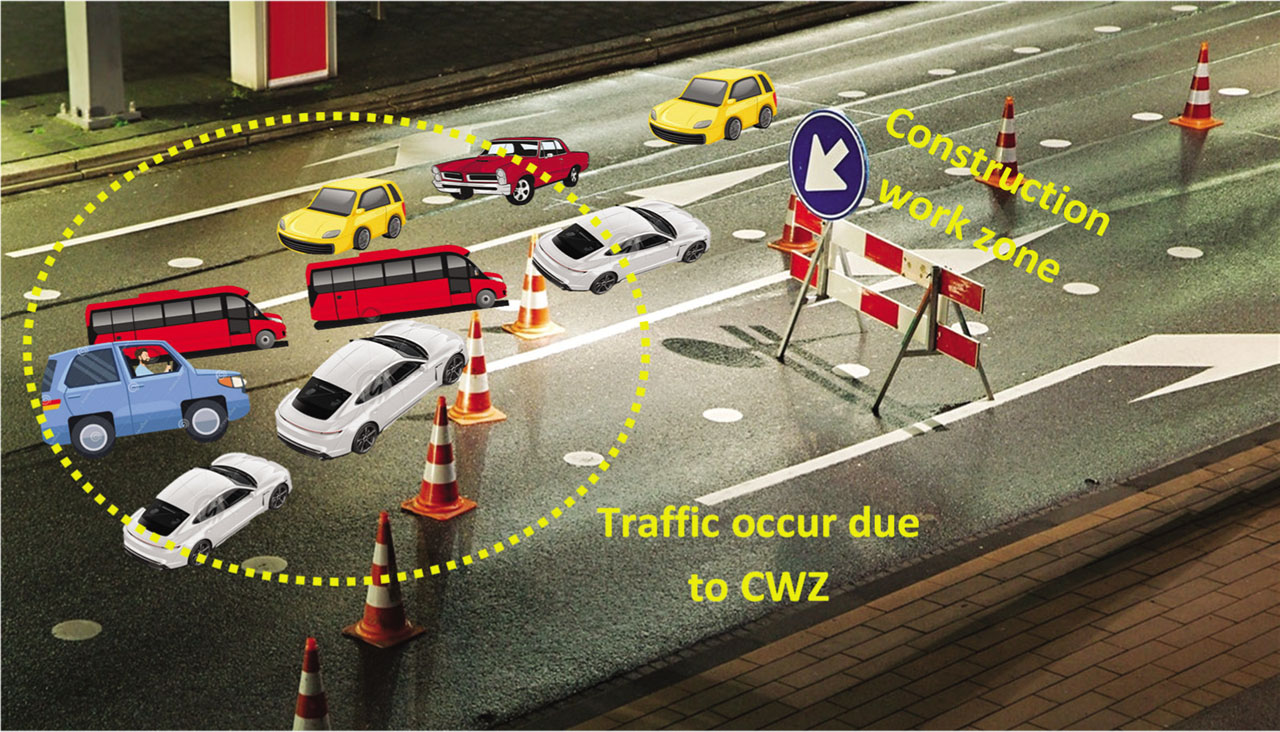
Figure 1.
Layout of CWZ. CWZ, construction work zone.
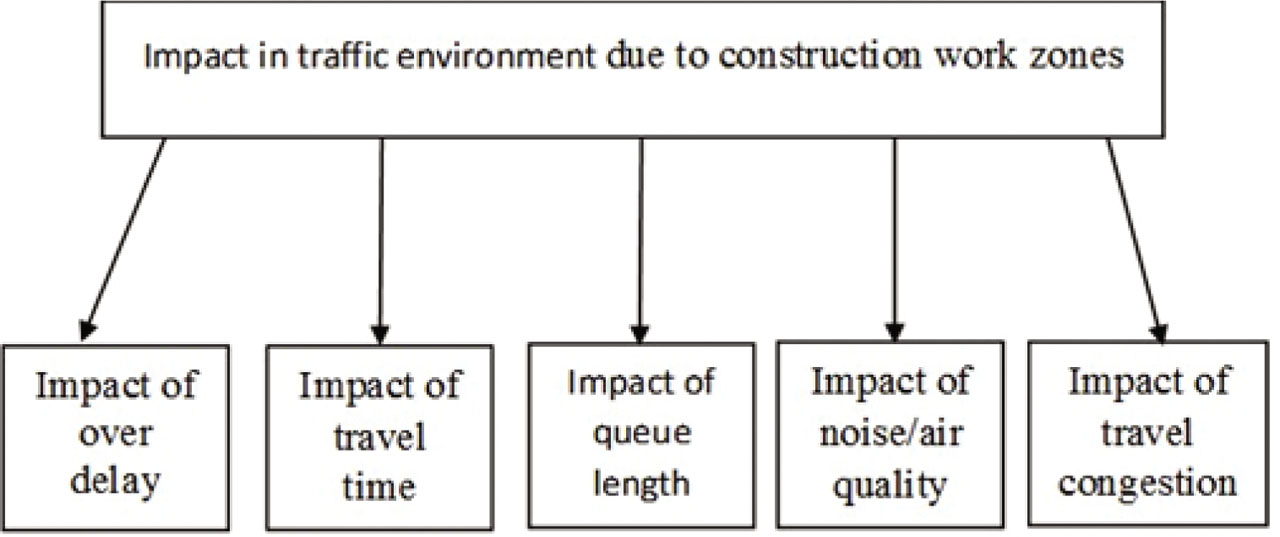
Figure 2.
Guidelines for examining different impacts in the traffic environment.
Table 1.
Impact on travel time in traffic environment due to CWZ
| Reference No. | Method/Tool | Significance | Limitations |
|---|---|---|---|
| [11] | Agent-based modeling framework | Determines the impact of changing MP and traffic flow rates on the advantages of mobility | Needs high computational power to apply higher traffic volume |
| [12] | TIMS | Determines how a road construction project will affect the highway and any connecting arterial streets’ link-level traffic times | No information on the amount of construction activity or the times when it really occurred |
| [13] | Cooperative traffic control technique | Makes merging control easier when vehicles are coming up in the obstructed lane | Ignores the safety issues such as the safety of the workforce in a work zone |
| [14] | Statistical methods | Determines the severity of the speeding issue in HWZs | Not consistently statistically significant |
| [15] | PARAMICS | Predicts the trip time through a work zone to assist users in choosing more efficient routes | Does not explore the vehicle penetration rates and work-zone types |
| [16] | SUMO, DFROUTER | Outlines the street segments in Valencia in terms of trip times under various levels of traffic congestion | The traffic management system must be improved. |
| [17] | HCM6 TTD | Predicts the distribution of average travel time in the urban streets | Inaccuracy in analyzing the traffic parameters |
| [18] | VISSIM | Examines how work-zone advisory systems affect safety | Does not accurately portray how drivers will respond to DMS and CV warning signs in the real world |
[i] CV, connected vehicle; CWZ, construction work zone; DMS, dynamic message sign; HWZ, highway work zone; TIMS, traffic incident management systems.
Table 2.
Impact on overall delay in traffic environment due to CWZ
| Reference No. | Method/Tool | Significance | Limitations |
|---|---|---|---|
| [19] | HWZ optimization model | Measures the effects of HWZs on worker safety, mobility, and costs | Does not consider the effects on traffic flow |
| [20] | VISSIM | Minimizes traffic delays in the construction zone in the case of a 3-to-1 lane closure | During the 3-to-1 lane restrictions at the project, traffic diversion are not considered |
| [21] | MGORP | Serves as a tool using which to observe the impact of variables like the speed limit and the number of lanes in various work-zone designs | Does not consider the work-zone duration and specific work-zone speed limit |
| [22] | Time-varying mixed logit model | Determines how a vehicle is behaving when entering a work zone | Does not account for the impact of work-zone configuration |
| [23] | TES | Ascertains the safety-enhanced method for various traffic volume scenarios | Needs to enhance the work-zone truck egress safety |
| [24] | Video-based experimental design | Investigates the impact of apparent roadwork activities on work-zone speed | Uses only two work zones to predict the roadwork activity |
| [25] | ED-STCA LC model | Estimates the traffic performance of the work zone | Requires more computation time |
| [26] | Online video-based experiment | Investigates if the presence of obvious roadwork activity affected the predicted link between personality characteristics and speed in work zones | More research is needed to investigate other variables |
[i] CWZ, construction work zone; ED-STCA, expected distance-based symmetric two-lane cellular automated; HWZ, highway work zone; LC, lane-changing; MGORP, Mixed Generalized Ordered Response Probit; TES, truck egress system.
Table 3.
Impact on queue length in traffic environment due to CWZ
| Reference No. | Method/Tool | Significance | Limitations |
|---|---|---|---|
| [27] | VASL | Significantly reduces queue length, enhancing compliance with overall safety regulations in congested areas | The effects of lowered speed limits and shorter lines on travel time are not studied. |
| [28] | Hybrid machine-learning model | Has been used to anticipate traffic delays on certain highway portions upstream of a work zone in New Jersey | The work zones are not concentrated on arterials with signalized junctions. |
| [29] | Multi-objective optimization model | Finds and recognizes a collection of Pareto-optimal work-zone designs that offer a variety of optimal trade-offs between reducing traffic delays and the risk of accidents | Does not consider how this optimization would affect the cost of the work zone |
| [30] | VISSIM | Enhances the control systems for two-lane highway lane-closure work zones | The flagger control approach requires an improved mathematical delay model. |
| [31] | VISSIM | Serves as a tool using which to find a late merge system with and without CVs | Does not focus on the safety aspect of cooperative merging in work zones |
| [32] | LiDAR | Serves as a tool using which to identify problems encountered in queue length detection, as well as carry out improvement of detection accuracy | Needs to improve detection accuracy by reducing the number of assumptions |
| [33] | IM approach | Demonstrates excellent stability in response to parameter changes | Heavy vehicle percentage affects the performance of the IM |
[i] CV, connected vehicle; CWZ, construction work zone; VASL, variable advisory speed limit.
Table 4.
Effects of noise and air quality on the traffic environment in a work zone
| Reference No. | Method/Tool | Significance | Limitations |
|---|---|---|---|
| [34] | Investigation of the urban morphology features | Ascertains how urban morphology affects the environmental noise such as TN | Does not investigate the time delay, queen length, and capacity of the traffic environment |
| [35] | FRAGSTATS | Investigates the influences of UEN in the Shenzhen Metropolitan Region of China | Needs improvement to estimate new types of noises |
| [36] | Highly annoyed (%HA) and highly sleep disturbed (%HSD) | Calculates the noise levels brought on by traffic during both day and night, as well as evaluates the negative effects on people's health | Needs to improve the prediction of noise levels |
| [37] | CALMET | Evaluates the air impact in highways | Pertains only to motorways |
| [38] | Standardized Nordic noise prediction approach | Discovers a 13%–29% decrease in the population exposed to levels over 55 dB equivalent | Does not estimate the noise level |
| [39] | TransCAD | Estimates air pollution due to increased traffic during and after the construction of the A-25 expansion project | More information is needed to fully understand how increased traffic may affect air quality |
| [40] | ANFIS, FFNN, SVR, and MLR | Estimates TN level in Nicosia City using three AI-based models | Needs to improve the prediction accuracy of TN |
| [41] | MOVES | Evaluates the fuel use and GHG emissions produced by on-road vehicles under various CWZ conditions | Needs to reduce the simulation cost |
[i] CWZ, construction work zone; GHG, greenhouse gas; MLR, multilinear regression; TN, traffic noise; UEN, urban environmental noise.
Table 5.
Impact on traffic congestion in traffic environment due to CWZ
| Reference No. | Method/Tool | Significance | Limitations |
|---|---|---|---|
| [42] | Analytical model | Optimizes the work zone to increase the road capacity | Needs to consider the maintenance cost |
| [43] | Fault-tolerant VSL control system | Detects and diagnoses the stationary sensor failures online utilizing real-time traffic data | Only considers the stationary sensor faults and ignores the concurrent faults and probe sensor faults |
| [44] | Multi-source data fusion and data analytical tool | Ascertains the factors having a maximum impact in terms of influencing traffic congestion | Needs a combined strategy for reducing the traffic congestion |
| [45] | Investigation of the significant variations in congestion levels | Offers helpful insights into the means of creating a traffic management system | Needs more depth analysis for congestion prediction |
| [46] | Mathematical decision model | Measures the network's work-zone disturbances’ mutually interacting impact on traffic and delay | Does not investigate the working complexity |
| [47] | Investigation of the effects of several temporary traffic management techniques | Estimates the impacts of changes in traffic volumes, work-zone length, and construction period duration | Needs additional research for arriving at a better understanding concerning the specific factors applying to work-zone safety |
[i] CWZ, construction work zone; VSL, variable speed limits.
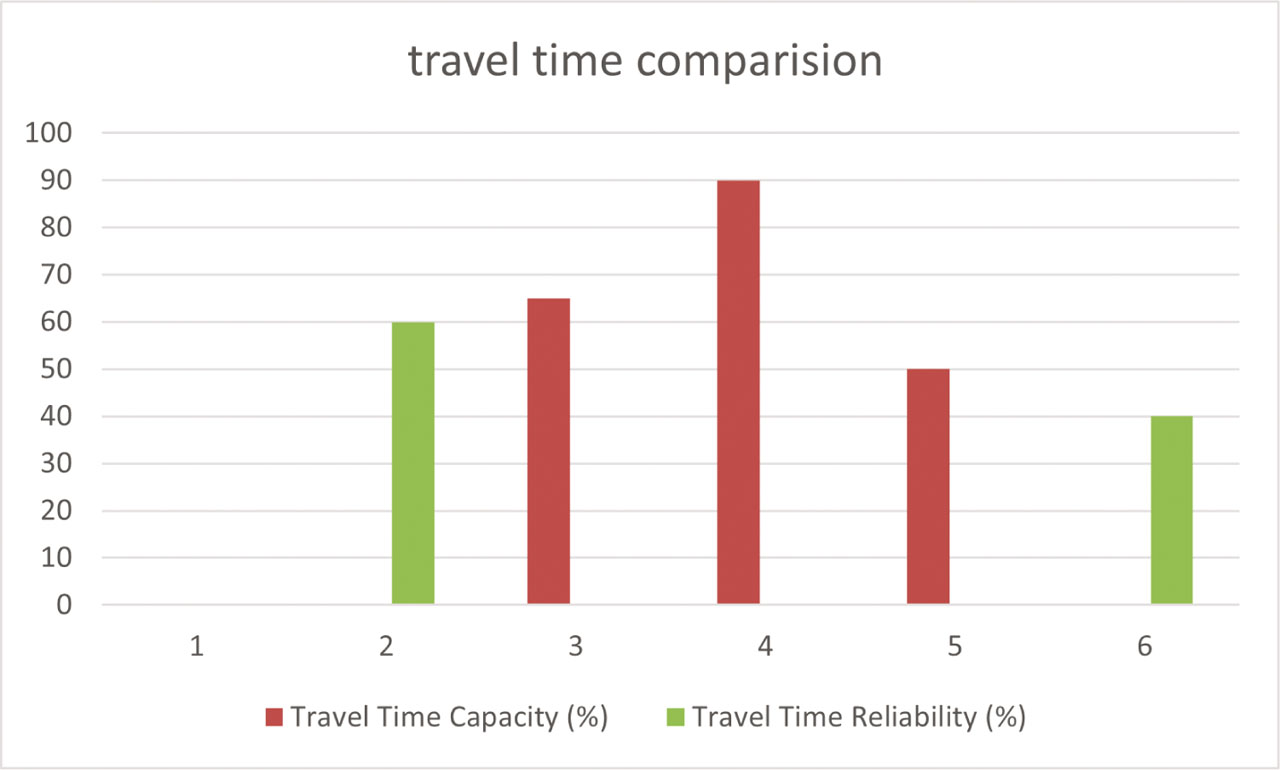
Figure 3.
Comparison of travel time.
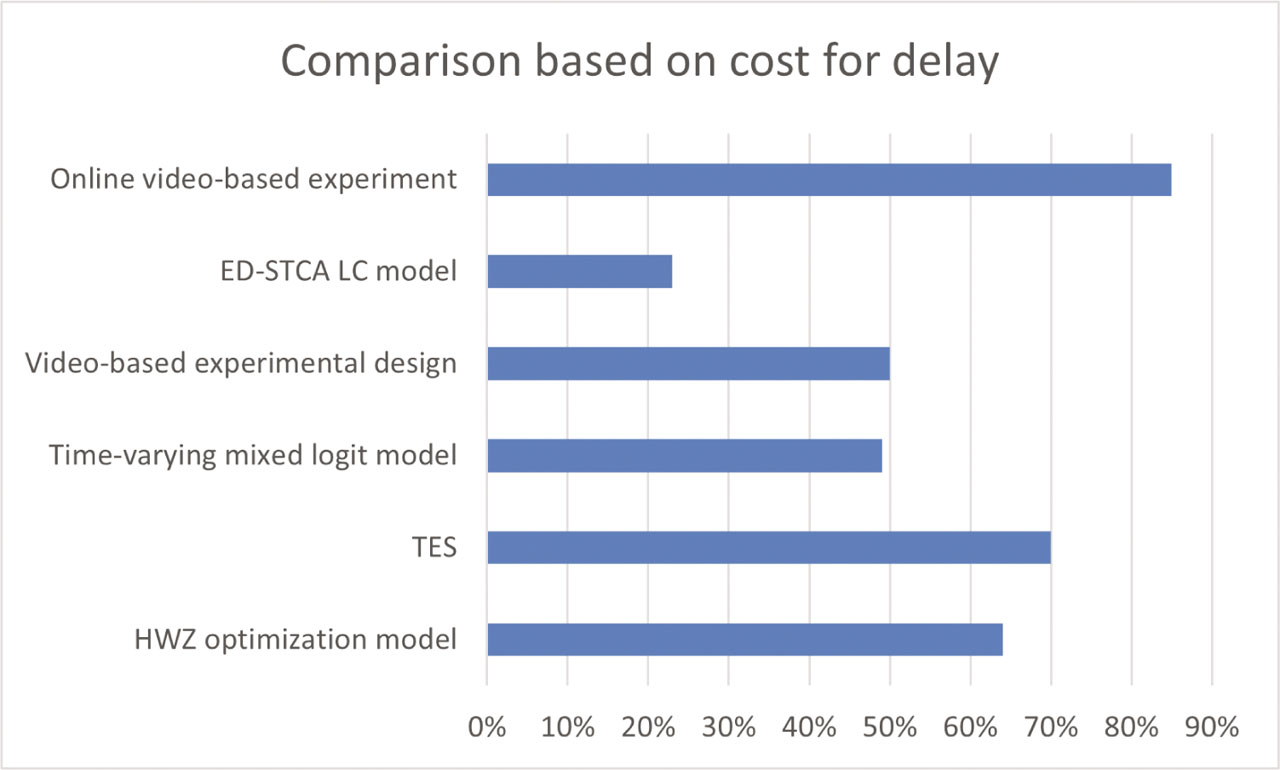
Figure 4.
Comparison of delay.
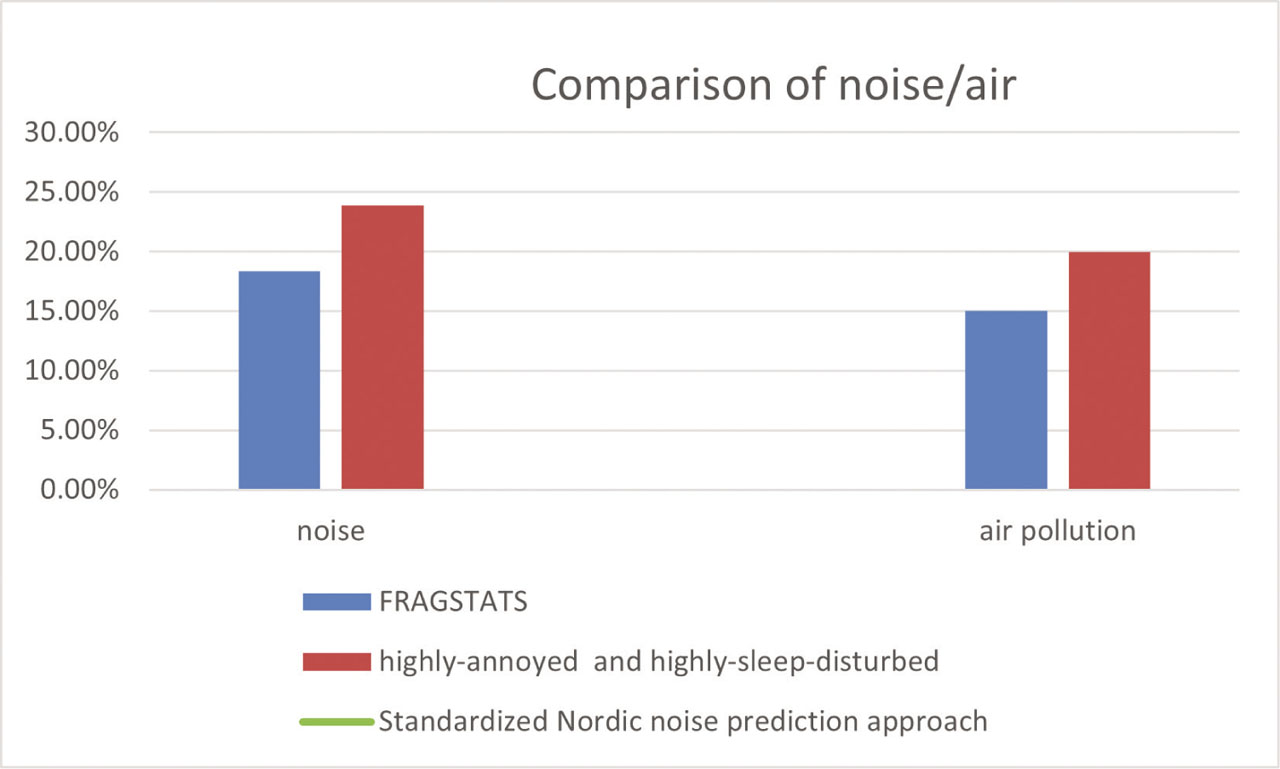
Figure 5.
Comparison of air/noise.