
Figure 1
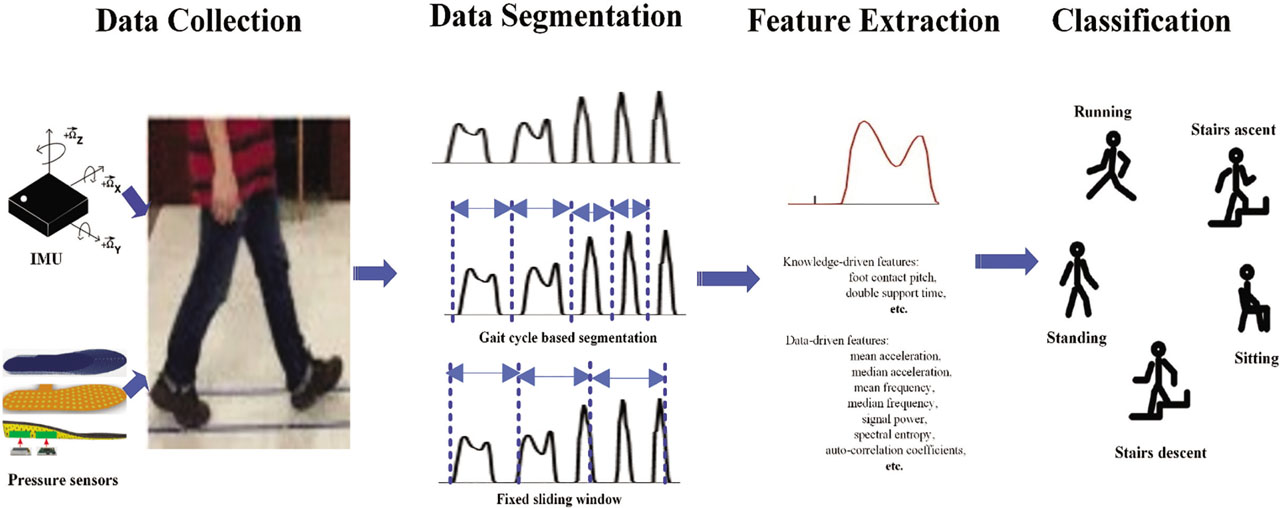
Four main steps for WGA-based activity recognition. The pressure sensors and IMU in the “Data Collection” section represent the commonly used wearable sensors in WGA-based activity recognition systems. The plots in the “Data Segmentation” section represent the gait cycle-based method which involves the segmentation of data through the detection of gait cycles and, the fixed non-overlapping sliding window approach which involves the segmentation of data using fixed time windows. To extract features for activity recognition, knowledge-driven features and data-driven features are frequently used. The icons in the “Classification” section represent examples of activities that can be recognized by activity recognition systems during the classification phase.
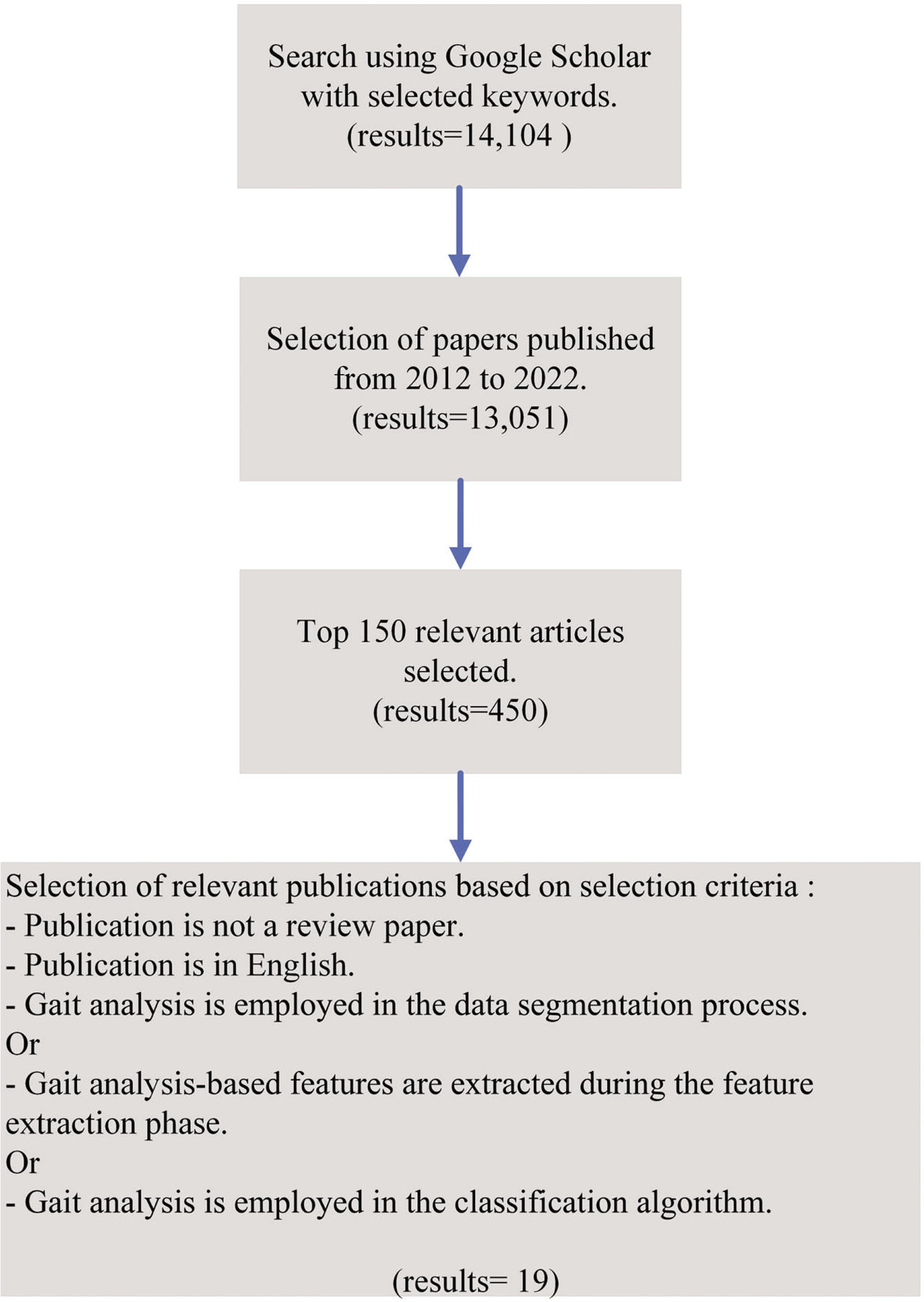
Figure 2
Flow Chart of the Article Selection Process.
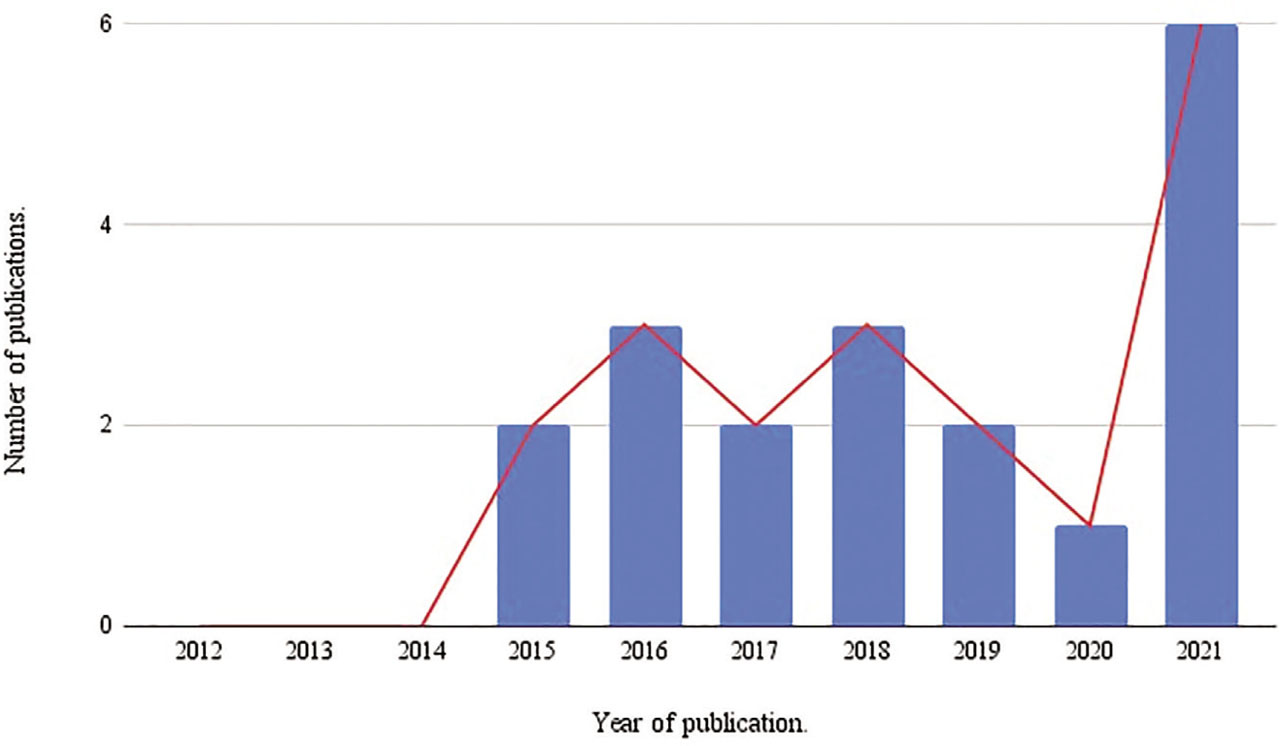
Figure 3
Distribution of the WGA-Based Activity Recognition Publications Over Time.
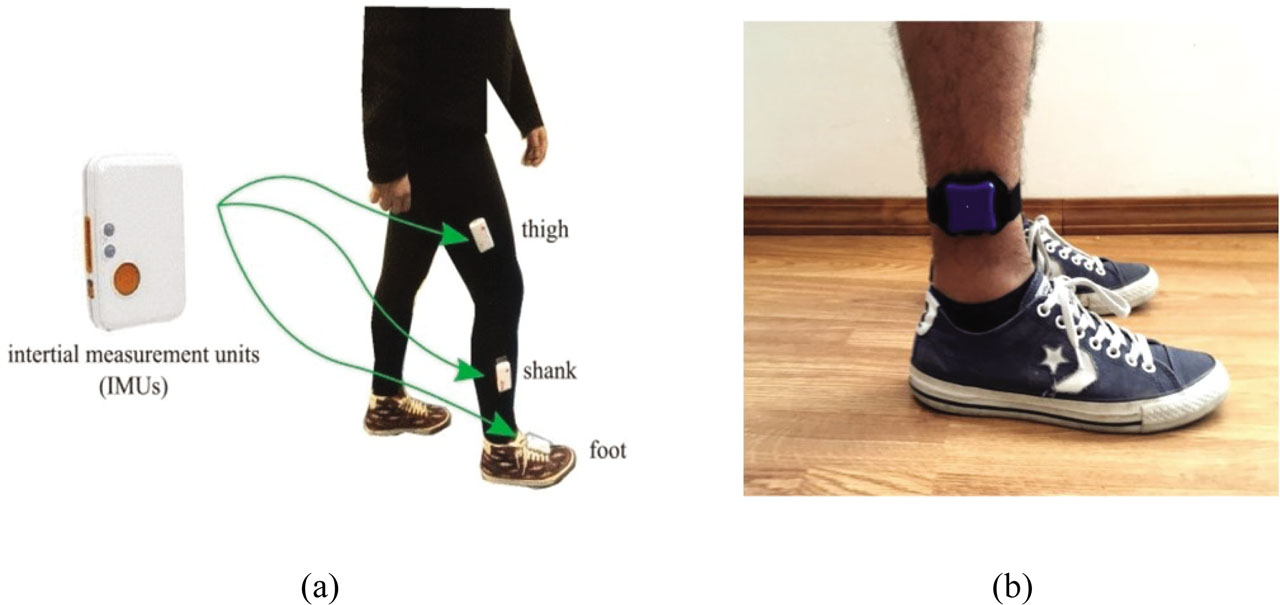
Figure 4
Commonly used IMU sensor positions. a) Three IMU sensors positioned at the thigh, shank, and foot to capture data for activity recognition [32]. b) A single IMU sensor worn at the ankle for activity recognition [29].
Table 1
Summary of WGA-based Activity Récognition Techniques
| Références | Recognized Activities | Wearable Sensors | Data Segmentation | Extracted Features | Activity Recognition |
|---|---|---|---|---|---|
| Martinez et al. [32] | Level-ground walking, ramp ascent, and ramp descent. | 3-axis gyroscope and pressure sensors. | Gait cycle-based method | Time-domain features | Adaptive Bayesian Inference method |
| McCalmont et al. [35] | Slow walking, normal walking, Fast walking, stair ascent, and stair descent. | 3-axis accelerometer, 3-axis gyroscope, 3-axis magnetometer, Pressure sensor array. | Gait cycle-based method | Time-domain features and gait-based features. | Artificial neural network, K-nearest neighbour (KNN), and Random Forest. |
| Ng et al. [42] | Walking, sitting, lying, and falling. | Sensor tags | Gait cycle-based method | Raw sensor data | KNN and Random |
| Lopez et al. [29] | Level-ground walking, Stair ascent, stair descent, Ramp ascent, and ramp descent. | 3-axis accelerometer | Gait cycle-based method. | Time-domain features and frequency-domain features. | KNN |
| Chenet al. [14] | Walking, running, standing, sitting, stair ascent, and Stair descent. | 3-axis accelerometer, 3-axis gyroscope, Pressure sensor array. | Gait cycle-based method | Gait-based features | Support vector machine (SVM) |
| Jeong et al. [23] | Level-ground walking, ascent. and stair descent. | Pressure sensors | Gait cycle-based method | Raw sensor data | SVM |
| Truong et al. [59] | Level-ground walking, stair ascent. and stair descent. | Pressure sensors | Gait cycle-based method | Time-domain features | SVM |
| Martinez et al. [33] | Level-ground walking, ramp ascent, and ramp descent. | 3-axis accelerometer, 3-axis gyroscope, and Pressure sensors. | Gait cycle-based method | Time-domain features | Bayesian formulation Based approach |
| Achkaretal. [38] | Level-ground walking, standing, sitting, stair ascent, stair descent, Ramp ascent, and ramp descent. | 3-axis accelerometer, 3-axis gyroscope, 3-axis magnetometer, Pressure sensors, and barometric sensor. | Gait cycle-based method | Gait-based features. | Rule-based method. |
| Zhao et al. [66] | Level-ground walking, Stair ascent. stair descent. Ramp ascent, and ramp descent. | Pressure sensors and electromyography sensors. | Gait cycle-based method | Time-domain features. | SVM |
| Mazumder et al. [34] | Level-ground walking, fast walking, standing, sitting, Stair ascent, stair descent, and ramp ascent. | 3-axis accelerometer, 3-xis gyroscope, and pressure sensors. | Gait cycle-based method | Time-domain features, Polynomial coefficients Extracted from hip angle Trajectory and centre-of-pressure (CoP) trajectory. | SVM |
| Camargo et al. [10] | Level-ground walking, Stair ascent, stair descent, Ramp ascent, and ramp descent. | 3-axis accelerometer, 3-axis gyroscope, goniometer, and îlectromyography sensor. | Gait cycle-based method | Time-domain features and frequency-domain features. | Dynamic Bayesian network |
| Ershadi et al. [20] | Toe level ground walking, Normal level-ground walking, Sitting, and standing. | Pressure sensors. | Gait cycle-based method | Time-domain features. | Rule based method |
| Martindale et al. [31] | Level-ground walking, sitting, stair ascent, stair descent, jogging, running, cycling, and jumping. | 3-axis accelerometer, 3-axis gyroscope, and pressure sensors. | Gait cycle-based method | Raw sensor data. | Convolutional Neural Networks (CNN) and Récurrent Neural Network (RNN). |
| Benson et al. [8] | Normal running and fast running. | 3-axis accelerometer, 3-axis gyroscope | Gait cycle-based method | Time-domain features, frequency-domain features, and wavelet-based features. | SVM |
| Hamdi et al. [22] | Level-ground walking, Stair ascent, stair descent, ramp ascent, and ramp descent. | 3-axis accelerometer, and 3-axis gyroscope | Gait cycle-based method | Gait-based features, time-domain features, frequency-domain, and wavelet-based features. | Random Forest |
| Achkar et al. [39] | Level-ground walking, standing, sitting, Stair ascent, stair descent, Ramp ascent, and ramp descent. | 3-axis accelerometer, 3-axis gyroscope, 3-axis magnetometer, pressure sensors, and barometric sensor. | Gait cycle-based method | Gait-based features and time-domain features. | Rule based method |
| Xiuhua et al. [27] | Level-ground walking, Ramp ascent, and ramp descent. | 3-axis accelerometer, 3-axis gyroscope, and pressure sensors. | Gait cycle-based method | Gait-based features. | Class incrémental learning method. |
| Ngo et al. [2] | Level-ground walking, Stair ascent, stair descent, Ramp ascent, and ramp descent. | 3-axis accelerometer and 3-axis gyroscope. | Gait cycle-based method | Time-domain features. | KNN and SVM. |
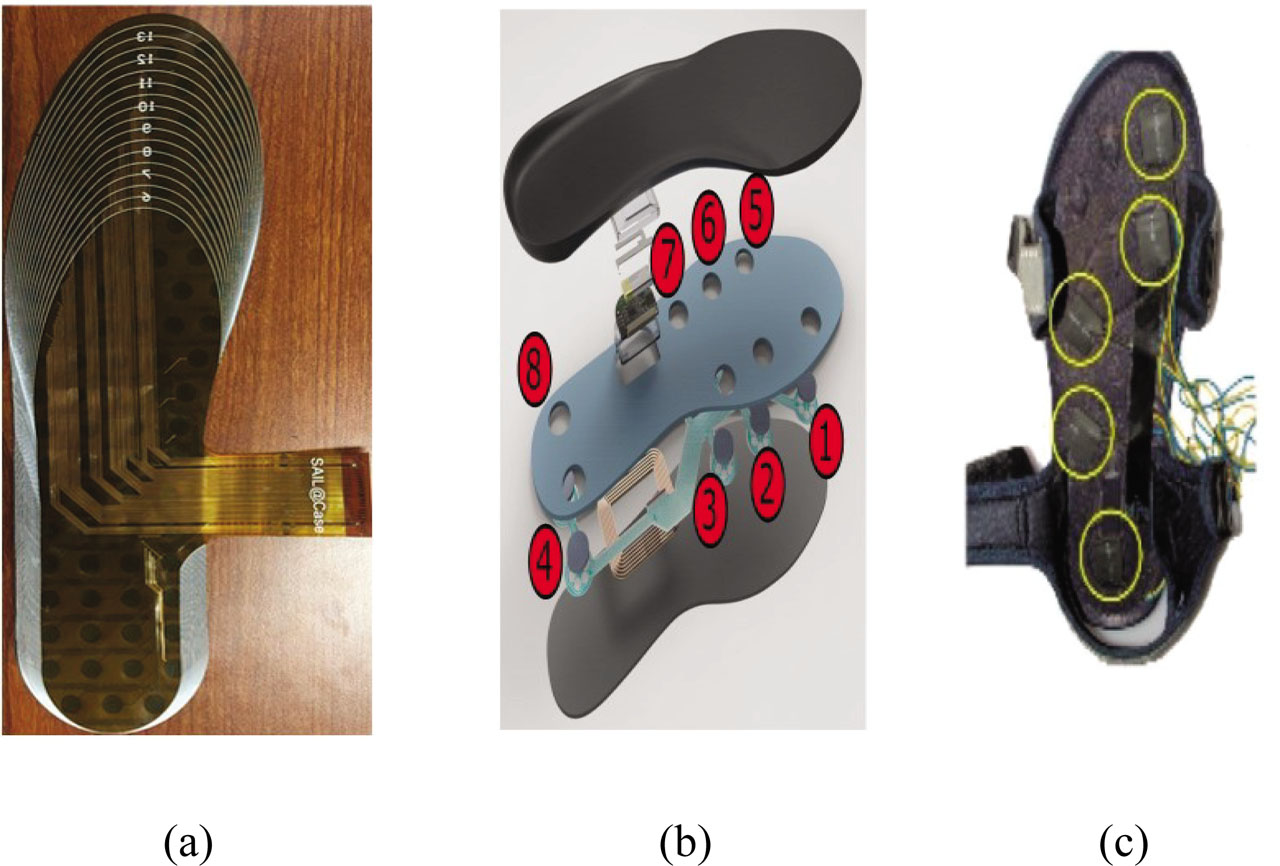
Figure 5
Different numbers and locations of pressure sensors used in WGA-based activity recognition systems. a) A pressure sensor array with 96 pressure sensors evenly distributed on it [14]. b) Eight pressure sensors distributed at the big toe, metatarsal, and heel [23, 59]. c) Five pressure sensors placed at the toe, metatarsal, and heel [34].
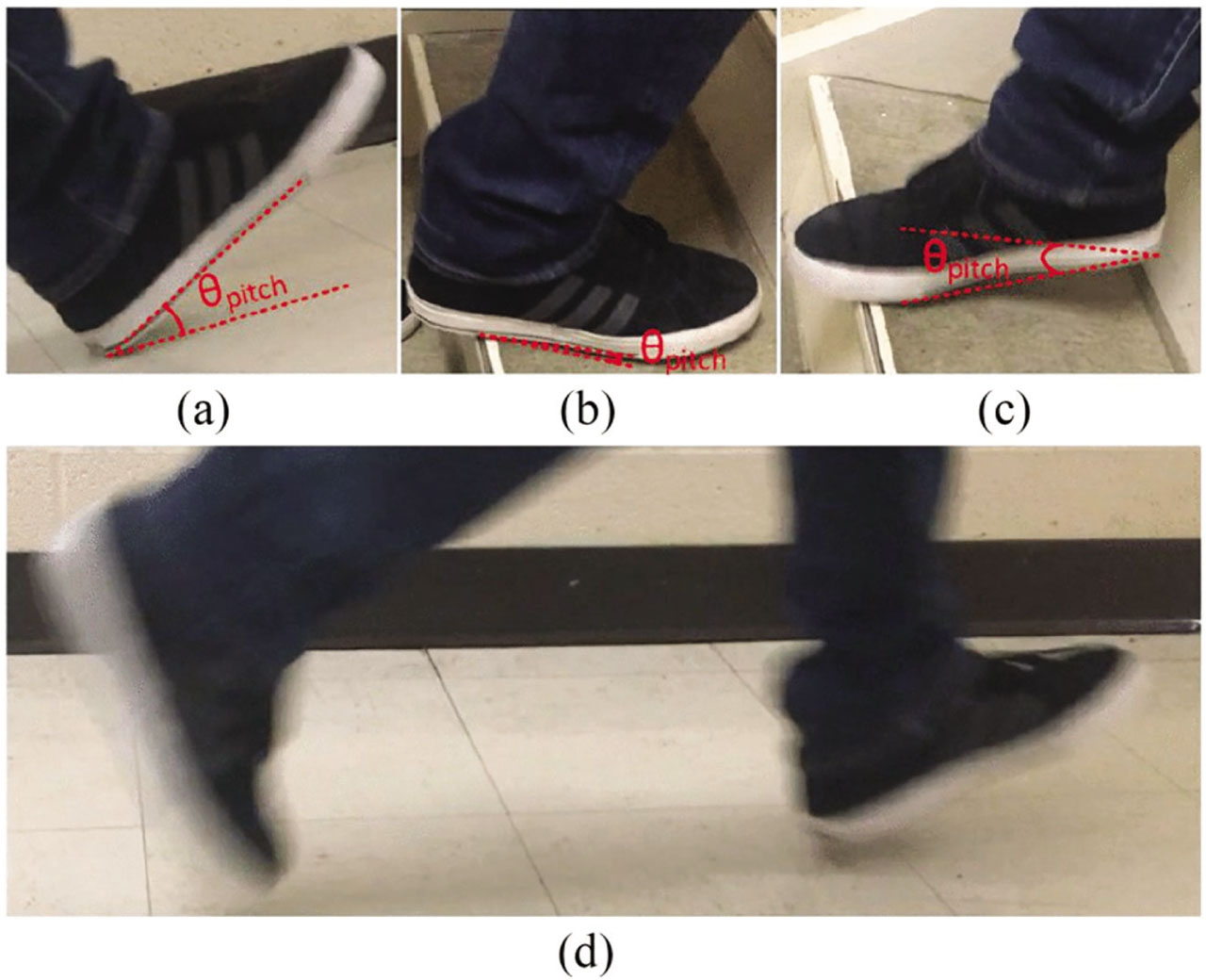
Figure 6
Foot contact pitch during (a) walking, (b) stair ascent, (c) stair descent, and (d) the double float phase during running. This gait-analysis-based parameter was used by Chen et al. [14] in the recognition of activities.
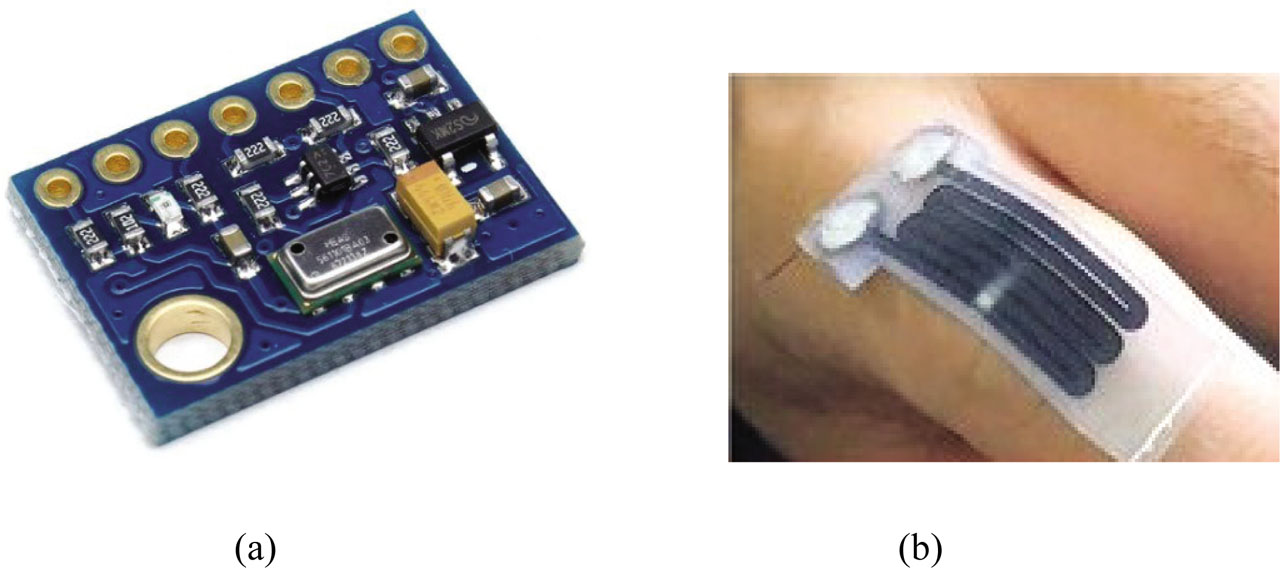
Figure 7
Other wearable sensor types which can be employed in activity recognition. a) Barometer [1] b) Strain sensor [28].