
1. Introduction
Mergers and acquisitions (M&A) of companies are a risky tool for the development of an organization. Schoenberg [2006, pp. 361–370] noted that failure rates for M&A are estimated at 50%–75%. Analyses of factors that affect the success or failure of company acquisition processes are usually focused on strategic or financial aspects. However, neither of these perspectives affords a full explanation of the actual causes of failure [Graebner et al., 2017]. As noted by Caraballo [2006], in many cases, the failure to achieve the expected results is associated with problems in the area of human resource management (HRM). According to McIntyre, “66% of the characteristics of failed acquisitions are related to a lack of HRM activity” [2004, p. 176]. Therefore, the M&A research should be expanded to include analyses related to aspects associated with HRM [Hajro, 2015; Sarala et al., 2016; Graebner et al., 2017; Tarba et al., 2020]. The key importance of HRM at every stage of the acquisition process is pointed out by Tian et al. [2021], Malik and Bebenroth [2018], Marks and Vansteenkiste [2008], among others. Cooke et al. [2021] and Vazirani [2012] stressed that the most sensitive issues concerning people are ignored in acquisition processes. This applies to both the pre-transaction and post-transaction phases, in which integration activities in the sphere of human resources are postponed. An 8-year study of acquisitions by Marks and Vansteenkiste [2008] found that the areas of the personnel function were usually not integrated at all, which raises the question of when the HR integration process should begin and what pace of HR integration would be optimal for the effectiveness of the acquisition deal. Łupina-Wegener [2013] proved that the timing depends on the nature of the acquisition.
For “friendly” acquisitions, integration requires 5–7 years, and for “hostile” acquisitions, it can take as long as 10. From the standpoint of both the dynamics and the scope of HR activities that accompany acquisition transactions, the issue of process maturity in the HR area at the companies involved in the acquisition and its impact on the post-merger integration process implemented is very important. The aim of this study was to identify the level of maturity of the HR process carried out at the companies participating in the transactions, as well as its significance for the course of post-mergers integration. It was also important to determine how integration activities affected the level of HR maturity after the integration was completed. Thus, the research reported in this paper sought answers to the following research questions:
RQ1. What was the level of HR process maturity at the companies involved in the acquisitions at the time of concluding the transaction?
RQ2. How does the maturity of the HR process affect the course of integration in the HR area after the acquisition?
RQ3. How does the acquisition affect the change in process maturity in the HR area in the acquiring and the acquired companies after full integration?
2. Process maturity models
The concept of maturity was first proposed by Crosby who defined maturity as “the state of being complete, perfect, or ready” [1979, p. 2]. Process maturity, on the contrary, means the ability of an organization to effectively manage processes, i.e., the ability to define, measure, quantify, and continuously improve the process [Szewczyk, 2018]. It can be demonstrated to the extent to which processes are formally defined, managed, flexible, measured, and effective [Santos-Neto and Costa, 2019]. A mature process is characterized by consistency with the organization’s strategy. McCormack and Johnson pointed out that process maturity includes “the stages that an organization must go through to become fully business-oriented in order to ultimately meet the goal of full process integration” [2001, p. 51]. The issue of process maturity includes the design of the process architecture supporting the achievement of strategic goals and taking into account the needs of customers and contractors’ capabilities. It is also important to continuously monitor the effectiveness of processes, take systematic actions to improve both the process architecture and individual processes, and implement the philosophy of continuous improvement at every level of process management [Frings et al., 2023]. For the purposes of empirical research, researchers usually build models of process maturity. Such models are defined as “ordered sets of elements that describe the characteristics of effective processes at different stages of development. They also indicate the points demarcating the various stages and methods of moving from one level to another” [Pullen, 2007, p. 11]. From a scientific perspective, conceptual maturity models map out a sequence of process maturity levels for one or more business fields to illustrate a typical, desirable, or predictable path of evolution of the process. According to the Association of Business Process Management Professionals, more than a 100 different process maturity models have been created [Benraad et al., 2022]. Among the most well-known ones are the five-stage capability maturity model integration (CMMI), the model developed at Carnegie Melon University [Humphrey, 1995], the Process and Enterprise Maturity Model (PEMM) by Hammer [2007], and Fisher’s process maturity model [2004]. They are focused on continuous process improvement, and the dominant criteria for assessing maturity are qualitative in nature. Process maturity models could be grouped into those that refer to the state of individual processes in the organization and those that relate to the process maturity of the organization as a whole [Von Zedtwitz, 2023]. An example of a model from the first group, on which a large number of process maturity models have been modeled, is the capability maturity model (CMM). It served as inspiration for the development of the Business Process Maturity Model (BPMM) by the Object Management Group. In their model, similar to the CMM model, five levels of process maturity of the organization are identified [Couckuyt and Van Looy, 2021]. In contrast to the levels specified in the CMMI model, the levels in the BPMM model refer not only to the aspect of processes but also consider the management method and the primary goal assumed. As noted by Gałuszka [2011, p. 72], the differences between the above-mentioned models mainly concern the way in which attributes are assigned to the appropriate level of maturity and the approach to the issue of organizational structures, especially in the context of moving from functional structures to process structures. From the standpoint of the subject matter of this study, the key issue is the process of HRM. The model that is frequently employed to optimize the HRM process is the Human Resources Capability Maturity Model (HR CMM). It is based on the CMM developed by the Carnegie Mellon Software Engineering Institute [Dangmei, 2017] and includes the following five levels:
Initial, which describes a poorly executed personnel function, focused on administrative aspects with undocumented strategies, manual management processes, lack of integrated systems, based on spreadsheets, and often paper documents.
Repetitive, which describes a loosely coupled personnel function supported by informal rules applied to processes performed by staff with different skill levels.
The process is defined. The strategic management structure and supporting processes are described.
Process management is introduced. HR functions are consistent with the organization’s strategic plan and personnel strategy.
Optimized, which describes a management process implemented at an optimal level with full use of best practices. At this stage, the organization has integrated business processes and has prepared personnel strategies linked to the strategy and forward-looking internal reports.
The HR CMM model affords several advantages conducive to achieving the goals of the organization. It enables the alignment of the organization’s HR strategy with its vision, mission, and values, thereby linking HR functions to the organization’s goals and objectives. It fosters innovation and creativity and helps build and maintain a culture of quality. The model is very close to the People Capability Maturity Model (P-CMM), which also contains five levels: initiating, managing, defining, predicting, and optimizing [Curtis et al., 2002; Chen and Wang, 2018]. It offers a strategy for transforming an organization by gradually optimizing its HR practices [Curtis et al., 2009; Mizrak, 2023]. For the purposes of this study, the model of process maturity by McCormack and Johnson [2001] was used. It includes four levels: occasional ad hoc HR processes, the level of defined and repetitive HRM processes, the level of “measured” HR processes and continuous measurement of their effectiveness, and the level of integrated HR processes.
3. Challenges for the HRM process in the integration phase after the acquisition
In the processes of integration after acquisitions, the flexibility of both HR policy and practices is of crucial importance [Rouzies et al., 2019; Colman, 2020, King et al., 2021; Safavi, 2021]. The manner in which HR processes are carried out after an acquisition is largely determined by the level of centralization of management in the organization and the nature of the organizational culture in the companies – transaction partners [Sarala et al., 2016; Gomes, 2020]. In the current situation of the tremendous dynamics of the organizational environment, synchronous management is the most effective, integrating the involvement of contractors and striving to adapt personnel solutions to the conditions of the organization’s functioning after the merger [Kroon et al., 2021]. Bureaucratic management, on the contrary, which is based on planning and centralization, is the least recommended. Acquisitions force a shift in the role of HR toward proactivity [Marks and Vansteenkiste 2008; Tarba et al., 2020]. The desire to achieve the efficiency in the HRM process during M&A primarily requires changes in the HRM architecture to handle the integration of new employees [Dao and Bauer, 2021]. They are defined in terms of a configuration of functions, entities, and tools oriented toward creating or contributing value to internal and external customers and shareholders [Luo et al., 2020]. Typically, the following solutions are introduced [Gołembski, 2012]:
Shared service centers, the main goal of which is to reduce costs and increase operational efficiency. It is an optimal solution, combining the features of a centralized and decentralized organization model.
Expert knowledge centers (also called expert centers), used to create and improve innovative solutions for strategies and processes in HRM.
e-HR (self-service in the area of the personnel function).
Appointment of HR Business Partners who work closely with line managers and Chief executive officers (CEOs) in the implementation of strategies and design of HR systems and processes.
The measures presented above point to two currently observable tendencies: on the one hand, the integration of internal HRM functions; whereas, on the other hand, activities referred to by Caldwell and Storey [2007, p. 25] as fragmentation resulting from the “externalization of the personnel function” through the use of external resources. The shape of the HR strategy after an acquisition and the level of maturity of the HR process are clearly influenced by the processes of globalization and the phenomenon of capital migration. Decisions related to the issue of integration in the HRM area result primarily from the adopted personnel strategy related to the overall integration strategy. Bodner and Capron [2018] listed four categories of post-acquisition strategies. Companies can follow an adaptation strategy that involves implementing the specific practices used in the parent company at the local unit while adapting the overall HR strategy of the parent company to the local needs. Adoption, which consists of adjusting the personnel solutions of the parent company to the local conditions, may also be used, with the general assumptions of the personnel strategy implemented in local units. A globalization strategy may be introduced, which consists of transferring general and specific solutions used in the area of the personnel function from the parent company to the local branches. Another strategy, known as “localization”, may also be opted for, which means adapting the practices of the parent company to the local solutions [Stankiewicz-Mróz, 2021]. The choice of which of the outlined strategies is employed after the acquisition is influenced by various factors, e.g., the pressure to respond to the local idiosyncrasies or the pressure to reduce costs. Nevertheless, each acquisition transaction entails consequences in the area of HRM, and they should be considered already at the stage of developing the overall integration strategy. The critical issue in acquisition processes is to what extent local practices (the so-called “local isomorphism”) should be implemented in subsidiaries and to what extent these practices should be a transfer of practices from the parent company, a kind of global standard (“internal consistency”) [Siegenthaler, 2011; Devers et al., 2020; Safavi, 2021]. The model of transferring HRM practices in international companies is determined by both national factors (institutional distance) and organizational factors (strategic role of the subsidiary, structure of the international organization, and compatibility of organizational cultures) [Liu, 2004]. Integration practices in individual areas applied by acquiring companies are conditioned in particular by the origin of capital [Diduc, 2022]. An important issue to consider is the division of tasks and competences in the area of HR between the parent company and its subsidiaries, or its transfer to an external entity. The scope of cooperation of the entities also depends on the type of the capital group. Zając [2012] drew attention to the issues of localization of the HRM process in capital groups, taking into account two parameters, i.e., centralization and concentration, which determine the division of powers and decision-making areas within the group entities. The human resource department should play an important role both at the integration planning stage [Teerikangas et al., 2011] and at the post-merger integration stage.
4. Research methodology
4.1. Research sample
This research concerns 58 acquisition transactions. They are part of a larger study on acquisition processes carried out on the Polish capital market. For the purpose of constructing the research sample, a dedicated database of Euromoney Institutional Investor Company (EMIS) was purchased. The database includes all transactions that took place in the years 2014–2019 on the Warsaw Stock Exchange. For the purpose of conducting the study, a research sample was constructed, and the size of which was determined using an algorithm, allowing to calculate the minimum size [Matejun, 2023]. The minimum sample size was calculated as n = 189 transactions. The difficulties that arose during the research caused that the final analysis of stock exchange transactions made for the purposes of this study concerns only 18 acquisitions. The maneuverability in the investigation in this group of companies was 9.52%. Therefore, there was a need to increase the sample to include transactions concluded on the nonpublic market. For this purpose, a list of transactions completed on the private market was created. The minimum sample size was calculated as n = 300. The survey received answers from respondents representing 40 companies. The maneuverability in the group of transactions on the private market amounted to 13.3%. The selection for the sample was purposive. In purposive selection, cases are usually selected on the basis of typicality, diversity, accessibility, or uniqueness [Creswell, 1998, p. 62). Purposive selection thus ignores the criterion of representativeness, which is a limitation from the perspective of applicability. This research was guided by the principle of accessibility. In the sample, 22 transactions were completed through the purchase of shares, 28 through the purchase of a company, and 8 took the form of privatization. Most of the examined transactions were carried out in the production of industrial goods and services sector (32), the agri-food sector (15), and the Technology, Media, Telecommunications sector (7). The remaining transactions were placed in the “Other” category (4), which included: medical services (2), real estate (1), and tourism and hotel industry (1). All of the transactions took place within an industry or within a sector, and therefore they are examples of horizontal concentration. This type of concentration reduces the business risk associated with undertaking activities different from those previously carried out by the surveyed companies. The research was longitudinal and was carried out in 2017–2022.
The respondents were directors of HR departments or HR managers of the acquiring company. The research method was based on the interview and utilized two research techniques: Face-to-Face (F2F) personal questionnaire interviews and traditional telephone interviews. Out of the total number of 58 questionnaire interviews, 36 were conducted F2F, while 22 over telephone interviews. In addition, for the purpose of assessing the maturity of the HRM process, document analysis was conducted. The analysis of the course of integration processes is possible only within a longer time perspective, necessary for the effects to occur and lend themselves to evaluation. Therefore, in each case, the research was retrospective and was carried out approximately 3 years after the acquisition. The time horizon of 3 years or more that was adopted in the study is typically used in research on post-acquisition integration processes. Due to the small size of the research sample, descriptive statistics tools were used to describe the structure of responses and their variation. Statistical measures such as the arithmetic mean (M), median (Me), and the interquartile range (IQR), which is a measure of distribution variation, were also employed.
4.2. Research model
For the purposes of analyzing the impact of HR maturity on the course of PMI and identifying maturity after the completion of integration, the author’s research model was used (Figure 1).
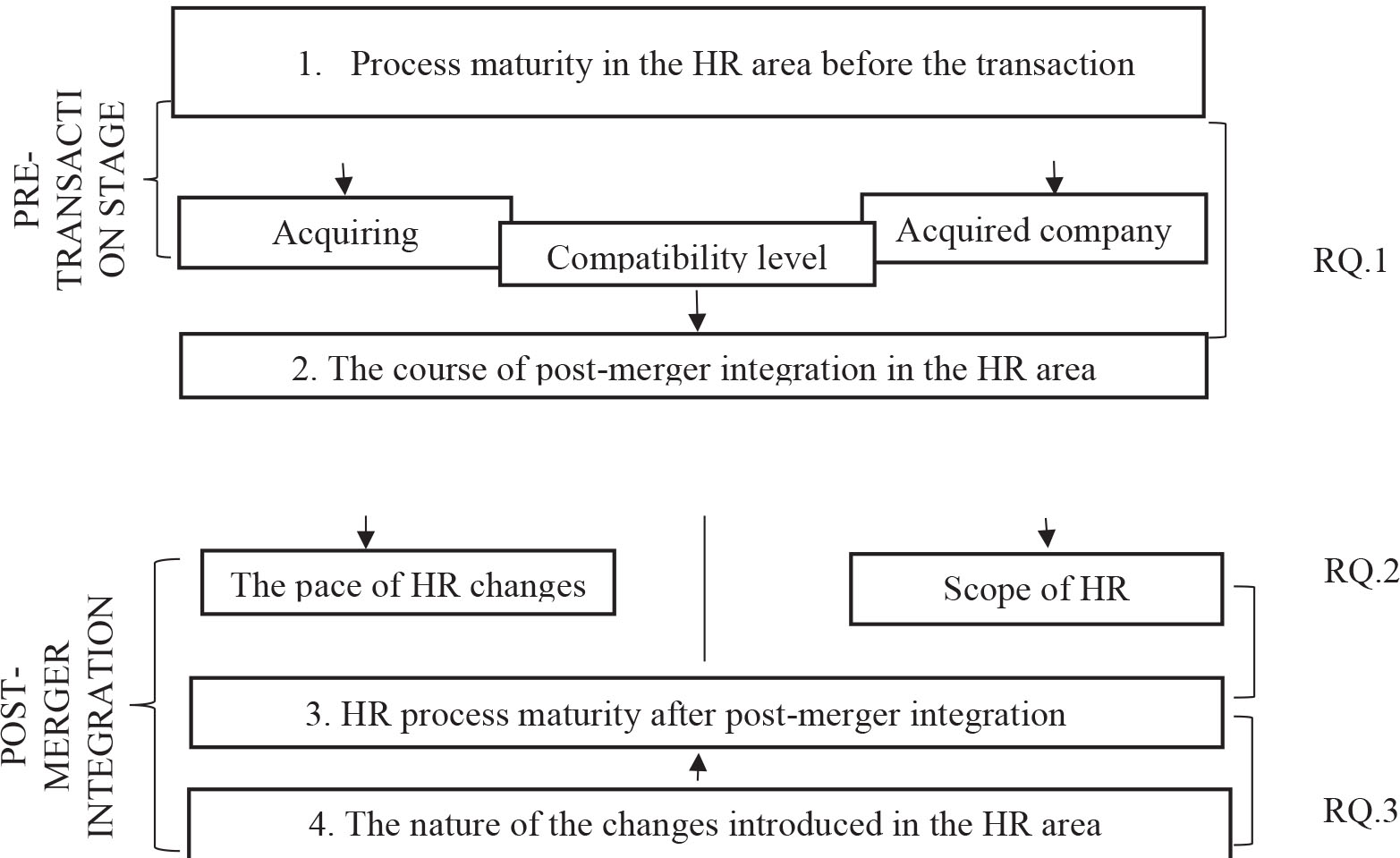
Figure 1.
Conceptual framework for analyzing the impact of the maturity level of the HR function on the course of HR integration and the maturity of the HR process after PMI.
Source: own.
In this research, four levels of HR process maturity were adopted. The first model that described four levels of process maturity was the McCormack and Johnson [2001] model. The authors highlight the internal consistency of process execution within an organization. The processes are related to the needs of internal and external stakeholders. The processes can reflect the strategy, mission, and vision of the company. The McCormack and Johnson [2001]’s model is universal and has been used and developed many times in the research of other authors (e.g., Bitkowska, 2013; Milanović, 2020; Benraad et al., 2022; Guthrie and Reid, 2022). For the purposes of assessing the level of process maturity in the HR area, the presented research also adapted the model – Business Process Orientation by, McCormack and Johnson 2001, p. 52], was applied (Table 1).
Table 1.
HRM process maturity levels adopted for this study
| HR process maturity level | Characteristics of the HR process maturity level |
|---|---|
| 1. | The level of sporadic HRM processes, carried out ad hoc The HR process is carried out spontaneously, poorly managed, and of a reactive nature. However, it is not defined and documented. Actions are taken on the basis of current events. There is a shortage of owners (responsible persons) for both the tasks carried out within the subprocesses and the processes as a whole. Processes are not being improved. Usually, personnel administration activities dominate. |
| 2. | Level of defined and repeatable HRM processes Basic HR processes are described, and there are formalized procedures. However, the prepared “reference models” are not related to the organization’s strategy or its mission. Processes are carried out in a repetitive manner, and tasks have permanently assigned owners (although they are not responsible for the entire process). Only basic tools and methods are used to carry out the processes. The level of efficiency still depends on the commitment of employees and the degree of cooperation between them. |
| 3. | The level of ‘measured’ processes and HRM efficiency measurements HRM is carried out at the strategic level. Managers use a process approach, linked to the strategic goals and performance of the organization. Processes are defined and documented and have assigned process owners. The tasks are broadly defined. HR effectiveness is measured, and the internal structure of processes is visible, as well as reference models (benchmarks). Processes are updated, both based on legal regulations and internal needs of the organization, but they are still not subject to improvement. |
| 4. | Level of integrated HR processes Strategic international HRM is conducted. The processes are integrated and used for daily cooperation with internal and external customers. Process owners work with designated executives to ensure that processes are executed as efficiently as possible. Process optimization takes place. Continuous improvement of processes occurs on the basis of feedback: their implementation and projects aimed at improving them. |
1 Source: own based on: Mc Cormack, K.P., Johnson, W.C. (2001), Business process orientation. Gaining the business competitive advantage. St. Lucie Press, New York.
5. Results
For the purpose of assessing maturity before the conclusion of the transaction, the activities carried out as part of the HR process were identified based on the information obtained during the interviews and analysis of the available documents. The analysis showed that the acquiring and the acquired companies usually were at different levels of process maturity.
The assessment of the activities carried out by the contractors of the process, presented in Table 2, shows that in the case of eight acquiring companies, the HR process was at the lowest level of maturity, in 20 companies – at the second level, in 12 companies – at the third level, and in 16 companies, it was at the highest, the fourth level of maturity. In the case of the acquired companies, their HR process was less mature. In every third of the analyzed companies, it was at the first, lowest level of maturity. In the surveyed group, a higher level of HR process maturity was observed for companies that participated in the transactions carried out on the Warsaw Stock Exchange. Detailed results are presented in Chart 1.
Table 2.
Pre-transaction HRM processes, describing the maturity level of the HR function
| HRM area and activities | Acquiring company [N = 58] | Acquired company [N = 58] | |
|---|---|---|---|
| 1. | HRM strategy developed in the form of a document | 28 | 16 |
| 2. | Job descriptions | 38 | 16 |
| 3. | Workforce planning | 28 | 16 |
| 4. | Onboarding | 28 | 12 |
| 5. | Competency models | 28 | 9 |
| 6. | Competency management system | 28 | 9 |
| 7. | Periodic evaluation system | 38 | 16 |
| 8. | Remuneration system based on the results of job evaluation | 21 | 6 |
| 9. | Employee training system with effectiveness evaluation | 28 | 9 |
| 10. | Career planning/high potential programs | 16 | 1 |
| 11. | Personnel function monitoring and evaluation system | 28 | 6 |
| 12. | HRM audit/process documentation | 18 | 6 |
| 13. | HR effectiveness measurement | 16 | 6 |
| 14. | Continuous improvement of the HR process | 16 | 6 |
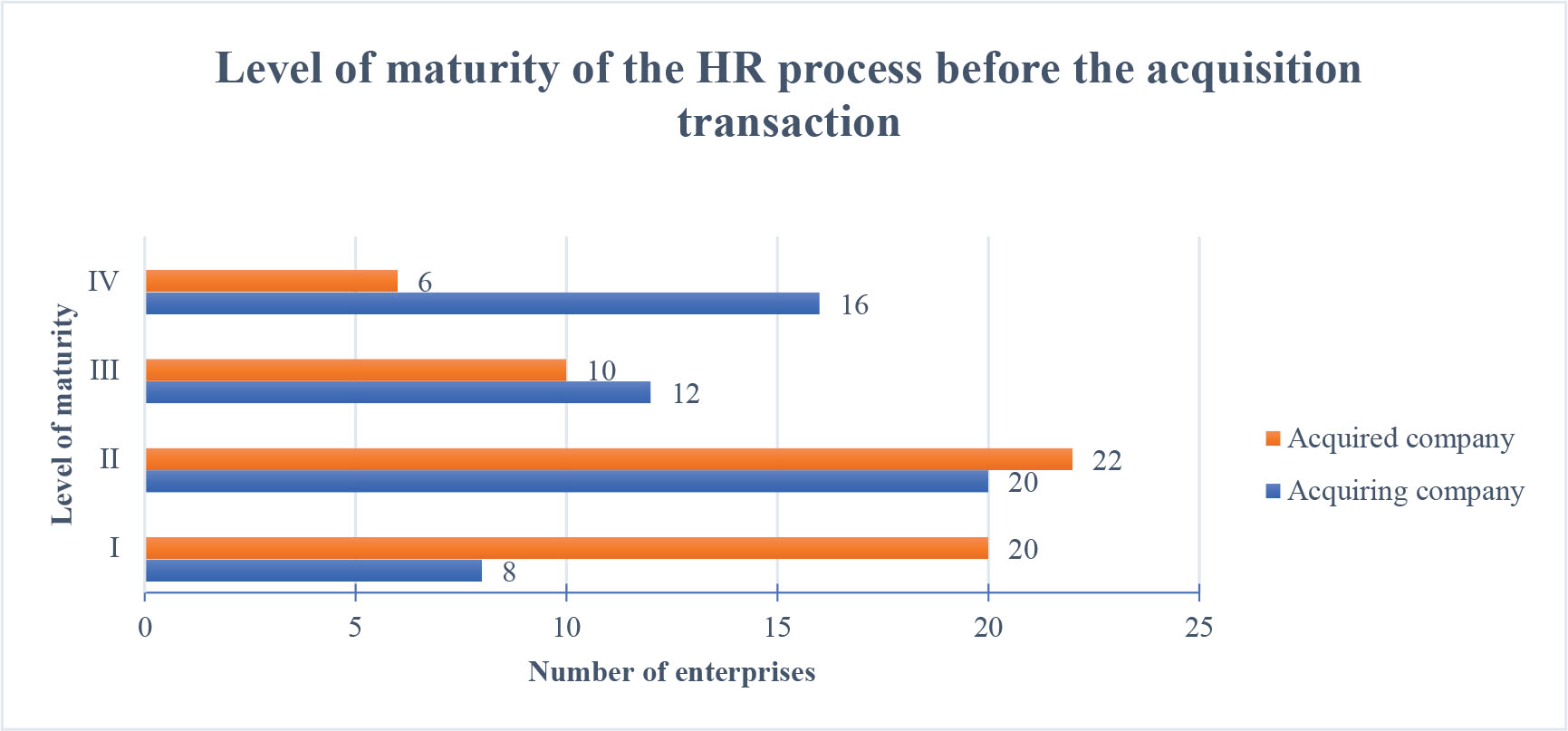
Chart 1.
Declared level of maturity of the HR process in the acquiring and acquired companies at the time of joining the acquisition transaction.
Source: own research.
Out of the total number of 18 transactions that took place on the public market, the highest level of HR process maturity, level IV, occurred in the case of 10 acquiring companies and 6 acquired companies. For 40 transactions carried out on the private market, the highest level of maturity of the HR process was observed in the case of 6 acquiring companies and none of the acquired companies. An important issue from the standpoint of post-transaction integration is the alignment of the maturity of the HR process carried out in the companies participating in the transaction. For the purpose of assessing its level, it was assumed that a high level of alignment occurs when the acquiring and the acquired companies perform the process at the same level of sophistication, and the participants of the transaction use similar HR tools and procedures as the basis for their HRM process. In this study, the respondents were asked to assess the alignment of the maturity of individual elements of the HR process using a five-point Likert scale, which included the following categories: 5 “very high”, 4 “high”, 3 “moderate”, 2 “low”, and 1 “very low”. The results obtained are presented in Table 3.
Table 3.
Declared level of compliance of subprocesses in the acquiring and the acquired companies before the transaction
| Elements of the HRM process | Assessment of the level of compliance of selected HRM subprocesses | ||
|---|---|---|---|
| M | Me | IQR | |
| Personnel recruitment system | 3,12 | 3 | 1 |
| Remuneration system | 2,62 | 2 | 2 |
| Staff motivation systems | 2,82 | 2 | 2 |
| Staff development system | 2,52 | 2 | 1 |
| Incentive system for monitoring the effectiveness of incentive | 2,21 | 2 | 1 |
| systems | |||
| Training effectiveness monitoring system | 2,21 | 2 | 1 |
| Job evaluation system | 2,21 | 2 | 1 |
| HR effectiveness measurement | 2,12 | 2 | 1 |
| Continuous improvement of the HR process | 2,21 | 2 | 1 |
The analysis showed that the level of alignment varied within individual subprocesses. The highest level of similarity was observed for personnel acquisition systems (M = 3.12), and the opinions of the respondents in this area were convergent (IQR = 1). The lowest level of similarity concerned the analysis of the effectiveness of the HR process (M = 2.12). In the further part of the study, an answer was sought to the question how the level of compatibility of the maturity of the HR process in the acquiring and the acquired companies affects the course of post-transaction integration in the analyzed area. It was found that high compatibility of HR process maturity levels in the acquired and acquiring companies accelerates the integration process and expands the scope of integration activities; whereas, with poor alignment in maturity levels, integration is usually either not carried out at all or it is spread over an extended timeframe (Table 4). The integration activities of the HR process at approximately 36 months after the transaction were described as fully implemented in 18 cases. In 22 of the surveyed companies, the integration had been carried out to a moderate extent and only with reference to selected HR subprocesses. The respondents emphasized either that the HRM area was not given high priority in the integration process or that the integration strategy in the HRM area included the autonomy of the acquired entity.
Table 4.
Level of compatibility of HR process maturity in the companies involved in the acquisition and the course of integration in the HR area
| The declared compatibility of the maturity of the HR process | Scope of HR process integration | Speed of integration of the HR process | ||||
|---|---|---|---|---|---|---|
| Full [18] | Moderate [22] | Low [18] | High [10] | Moderate [30] | Low [18] | |
| High [11] | 6 | 5 | - | 5 | 6 | - |
| Moderate [33] | 11 | 16 | 6 | 3 | 21 | 8 |
| Low [14] | 1 | 1 | 12 | 1 | 3 | 10 |
The last research question concerned the impact of post-transaction integration on the level of maturity of the HR process in the companies – partners in the transaction after the completion of the integration stage. This study allowed us to identify where the solutions that take the HR process to a higher level of maturity are usually created. It also provided insight into how new HR tools and procedures are implemented. They primarily involve introduction of predictive analytics in HR, monitoring employee performance and engagement and examining the effectiveness of the HR process. This study found that in the case of the acquiring companies, 40 transitioned to a higher level of maturity as a result of the integration. All of the surveyed companies that at the time of the transaction were at the first level of maturity had reached a higher level of process maturity after the 3 years of integration activities. In the case of 18 acquired companies, the introduction of changes in the HR process resulted in the level of its maturity reaching level two and, in the case of two companies, level three. In the group of the acquiring companies, all of the surveyed companies that were at the first level of process maturity at the time of the transaction advanced to the second level as a result of integration. In this group of the companies, eight companies introduced such significant changes in the HR process that the highest, fourth level of the process maturity was achieved. The changes in the HR process maturity that resulted from the integration activities are summarized in Table 5.
Table 5.
Assessment of the level of maturity of the HR process after the completion of the integration stage
| Evaluation of the maturity level of the HR process after approximately 3 years of the transaction | Acquiring company [N = 58] | Acquired company [N = 58] |
|---|---|---|
| Higher | 40 | 42 |
| No change | 18 | 8 |
| I have no opinion | – | 8 |
In the case of 20 companies, the changes were adaptive: they resulted from the need to adapt the HR system to the changes that occurred in the organizational environment. This was usually the case for transactions on the private market. In the case of 18 transactions, the changes in the HR process were of an integrative nature and concerned the introduction of uniform procedures, tools, and practices across the acquiring and the acquired companies. This predominantly took place in the group of transactions carried out on the WSE. In the group of the 18 stock exchange transactions, integration changes occurred in 7 cases. On the contrary, in the group of the 40 transactions concluded on the private market, in 11 cases, it was declared that the changes in the HR process that resulted from the integration activities constituted the prevailing category of the transformations. In the surveyed group of companies, the dominant category of changes driven by integration activities were those that involved the introduction of completely new systems or tools that took the HR process to a higher level of maturity.
6. Conclusions and discussion
The topic addressed in this study appears to be topical, and its importance is growing. Although post-transaction integration in the HR area is treated as one of the key success factors in acquisition transactions, the literature shows a lack of research using the process approach. There is also a lack of research that illustrates the impact of acquisitions on HR process maturity and analyzes the importance of HR process maturity for the course of integration in the area studied. The results of the research presented in this study are therefore part of the identified cognitive gap. In general, in the area of HRM after acquisitions, two categories of changes are distinguishable: changes in the state of human resources (number of employees, their competence, and position structure) and changes in the implementation of the HRM process. This study focused on the analysis of process implementation and on a thorough analysis of the issue of HR process maturity and its significance for the course of integration after acquisitions of enterprises. The research showed that at the time of entering into a transaction, the HR processes carried out in the acquiring and the acquired companies usually vary in the maturity level.
The similarity of the maturity HR process in the companies involved in the transaction is important for the course of integration in this area. If the companies participating in the acquisition transaction are at a similar level of maturity and when this level of maturity of the HR process is high, then the integration activities proceed faster, and the scope of integration of the HR process is greater. A high level of maturity in the acquiring company at the time of entering into the transaction also induces a change in the level of maturity and the HRM architecture in the acquired company after the completion of the post-transaction integration. The question that one could ask at this point is to what extent higher maturity of the HR process is a result of takeover and integration and to what extent it is influenced by other factors that may force or accelerate certain HR activities. The process optimization and introduction of changes in the organization are usually aimed at adapting to the changes that take place in the company’s environment. In the presented cases, adaptive changes were declared as the dominant category in just 20 of the surveyed transactions, and therefore they did not constitute the prevailing category of changes. It should be emphasized that, especially for the managers and employees of the company being taken over, acquisitions are an imposed change, a forced, directive, and a top-down change. This type of change is predominantly a directive approach characterized by a very strong goal – and task – orientation and no care taken to involve managers at lower levels of the organizational structure. The imposed changes, as Rutka and Czerska pointed out, are comprehensive and profound, and they are “a kind of revolution experienced in the organization”, assuming a long-time horizon of “their consumption” [2008, p. 384]. That is why, previously in this study, it was emphasized that the integration process in the HR area, regardless of the passage of 3 years, was not yet a closed process, and that changes occurring here are much slower than in other functional areas of the merged companies. The course of post-merger integration and the transition to a higher level of maturity of HR processes in companies leads to a higher standard of people management practices. This is important from the point of view of reducing the problem of key employees leaving after the acquisition [Kempton and Sarala, 2021]. Given the small size of the research sample and its nonrepresentativeness, the conclusions are limited to the sample under the study. Even though the problem of process maturity and its impact on the course of post-merger integration is a meaningful one with its relevance extending beyond the HR area, it has, nevertheless, rarely been the subject of study and analysis. Therefore, research in this area should be continued. From the standpoint of the analysis of integration processes, the effects of which are often visible only after an extended period, it would be advisable for future research to be longitudinal in nature.