
1. Introduction
The main objective of the European Union (EU) for the coming years is to improve and transform waste management into sustainable materials management to protect the environment, human health, and the rational use of natural resources [Directive, 2018]. Municipal solid waste (MSW) is a specific type of waste stream defined as waste from households and waste from other sources that is similar in nature and composition to waste from households [Directive, 2018]. MSW represents about 10% of the total waste generated in the EU. However, as noted in Directive [2018], “that waste stream, however, is amongst the most complex ones to manage, and the way it is managed generally gives a good indication of the quality of the overall waste management system in a country” [Directive, 2018, p. 2]. Indeed, municipal waste is a vital part of any economy, and finding an effective way to manage municipal waste (MSWM) is considered a major determinant of environmental and public health problems [Lacko and Hajduova, 2018; Yang et al., 2018; Molinos-Senante et al., 2023].
The vast majority of papers use Data Envelopment Analysis (DEA) to calculate MSWM efficiency scores and traditional regression analysis to identify factors affecting this efficiency. The results presented in the literature are ambiguous in terms of external factors that significantly affect MSWM efficiency. Pappas and Woodside [2021] pointed out that traditional regression analysis is not suitable for a group of objects with contrarian effects. Thus, regression analysis (i.e., variable-oriented research techniques and variance-based models) identifies a single best solution (one equation) that explains cases represented by main effects, focuses on the unique net contribution of each variable, and assumes that relationships are symmetric. In addition, variables compete with each other to explain the largest percentage of variance, which means that some important paths may never be discovered.
A method that is free from these limitations is Qualitative Comparative Analysis (QCA) proposed by Ragin [1987]. QCA is a group of comparative, case-oriented, and research techniques that allow to identify different combinations of factors influencing the outcome from a set of objects. In contrast to regression analysis, QCA assumes: multifinality (a combination of factors leads to an outcome), equifinality (several combinations of factors can lead to the same outcome), multiple conjunctural causation (in one configuration the presence of a factor leads to an outcome, in another the absence of the same factor can lead to the same outcome), and asymmetry (if the presence of some factors leads to an outcome, the absence of those factors does not necessarily imply the absence of this outcome).
QCA therefore boils down to the identification of some patterns of relationships in a set of objects (of any sample size), with the possibility of systematic comparison of these objects and variable recoding during the research process. As noted by Marx and Dusa [2011, p. 104], following Gerring [2001], QCA “is one of the few genuine methodological innovations of the last few decades.”
QCA comes in three main variants: crisp-set QCA (csQCA), multi-value QCA (mvQCA), and fuzzy-set QCA (fsQCA). FsQCA offers a more realistic approach than csQCA and mvQCA and has recently received increased attention [Pappas and Woodside, 2021]. Pappas and Woodside [2021] suggest that QCA is useful in quantitative studies because it allows the researcher to gain deep insight into their data through a quantitative analysis that also has some characteristics of qualitative analysis.
The main purpose of this research is to present how fsQCA can be used to assess the conditions of MSW treatment efficiency in EU countries as a complement to quantitative methods widely used in the literature. To our knowledge, fsQCA has not been applied in this area before. The following research hypothesis (RH) has been formulated:
RH: The QCA model is a useful tool for assessing the determinants of MSW treatment efficiency and for complementing traditional regression with case study analysis.
2. Literature review
The vast majority of papers that focus on assessing MSWM efficiency are mainly conducted for municipalities, regions, provinces, or cities [Halkos and Papageorgiou, 2014; Struk, 2014; Guerrini et al., 2017; Yang et al., 2018; Storto, 2021b; Sala-Garrido et al., 2022]. There are not many studies analyzing the efficiency of MSWM at the country level, except, for example, research by Lacko and Hajduova [2018], Halkos and Petrou [2018], and Rios and Picazo-Tadeo [2021].
In addition, most studies do not take greenhoue gas emission (GGE) into account when assessing the efficiency of MSWM [Halkos and Petrou, 2018; Lacko and Hajduova, 2018]. Some researchers simply mention the need to consider this in further research. Guerrini et al. [2017] point out that the GGE from MSW treatment reflects 3%–5% of the global GGE that “further research should link eco-efficiency to economic efficiency” [Guerrini et al., 2017, p. 440].
In general, MSWM efficiency studies are carried out in two stages. The first stage focuses on calculating MSWM efficiency scores, and the second stage focuses on identifying factors that significantly affect this efficiency.
The most popular method for calculating MSWM efficiency scores is DEA [Halkos and Papageorgiou, 2014; Struk, 2014; Halkos and Petrou, 2018; Lacko and Hajduova, 2018; Yang et al., 2018; Rios and Picazo-Tadeo, 2021; Storto, 2021a,b; Sala-Garrido et al., 2022; Molinos-Senante et al., 2023] with different sets of inputs and outputs describing the MSWM process. In fact, this process consists of several activities, such as waste generation, transport, collection, treatment (recycling, energy recovery, incineration, composting, etc.), and storage. The majority of studies focus on assessing MSWM efficiency from the point of view of MSW collection, but even in this case, no coherent list of inputs and outputs of this process has been produced [Guerrini et al., 2017; Storto, 2021a,b; Sala-Garrido et al., 2022; Molinos-Senante et al., 2023]. There are few studies that focus on assessing the efficiency of MSW treatment.
The vast majority of papers use traditional quantitative analysis to identify factors that significantly affect MSWM efficiency, such as tobit regression modeling (TRM) [Rios and Picazo-Tadeo, 2021; Storto, 2021b; Sala-Garrido et al., 2022], truncated regression [Lacko and Hajduova, 2018; Molinos-Senante et al., 2023], non-parametric smoothed regression [Guerrini et al., 2017], stochastic frontier analysis [Yang et al., 2018], and correlation analysis [Struk, 2014; Storto, 2021a]. The results obtained at this stage are ambiguous for at least two reasons.
First, the sets of inputs and outputs used to calculate MSWM efficiency scores are very different. Sala-Garrido et al. [2022] evaluated the MSWM process using one input and three different sets of outputs, estimating three variants of efficiency: technological efficiency, environmental efficiency, and ecoefficiency. They analyzed three factors (population density, waste generation, tourist index) that potentially affect these efficiencies and finally showed that technological, environmental, and eco-efficiency are significantly determined by different sets of factors.
Second, the contrarian effects in the group of objects are noticeable. For example, the relationship between a factor and MSWM efficiency may vary in subsets of regions created based on some criteria, such as the size of the regions, their geographical location, the wealth of the region, or the level of efficiency. Guerrini et al. [2017] showed that the direction and strength of the relationship between external factors and MSWM efficiency vary in groups of municipalities with different levels of factors. We considered the following factors that may affect MSWM efficiency: percentage of non-residential customers, population, population density, average household size, waste collected, tourist flows, waste collection method, and number of years of curbside collection. In addition, Lacko and Hajduova [2018] considered the following external factors: energy consumption, fertilizer use, logarithm of the productivity index, road freight transport, waste generated, income, resource productivity, and environmental taxes. The results show that the MSWM efficiency of more efficient EU countries is determined by a different set of factors compared with less efficient EU countries. In addition, MSWM efficiency in Eastern EU countries is influenced by a different set of factors than MSWM efficiency in Western EU countries.
These research findings and the comments made in the “Introduction” section confirm the need to use QCA to assess MSW treatment efficiency.
3. Methodology and data collection
The research was carried out for 25 EU countries. Two countries were excluded from the study: Luxembourg (due to its size) and Malta (due to a lack of data). All data refer to 2021. The data source is the Eurostat database (access date: February 8, 2024).
3.1. Calculation of MSW treatment efficiency scores (DEA-BCC)
The first step in the research was to calculate MSW treatment efficiency scores. DEA is a group of non-parametric methods that allow the calculation of technical efficiency scores (θ) of the production process that transforms multiple inputs into multiple outputs. In particular, 0 ≤ θ ≤ 1 reflects the level of input reduction that allows the object to maintain outputs at least at the current level, so θ = 1 indicates that the object is efficient.
DEA methods are popular and widely used in many research areas for three main reasons. First, DEA allows the calculation of efficiency scores without the need to normalize variables reflecting inputs and outputs. Second, it does not assume the shape of the efficiency frontier. Finally, it can identify efficient objects and the source of inefficiency.
There are many DEA models that allow to calculate θ. The basic DEA model is the input-oriented, radial CCR model proposed by Charnes et al. [1978]. The main limitation of the CCR model is that it reduces the efficiency score θCCR of an object due to its size. This means that the CCR assumes a constant return to scale (CRS) [Cooper et al., 2006]. An extension of the CCR model that is free from this limitation is the BCC model. The BCC model is more appropriate for a group of objects with a large diversification of activity scale because it assumes a variable return to scale (VRS). This means that the efficiency scores θBCC are not reduced simply because of the scale of activity. More information on DEA can be found in Guzik [2009], Dellnitz et al. [2018], and Pai et al. [2020].
Due to the great diversity of EU countries, the BCC model was used in this study. The MSW treatment process in the EU has been described by two inputs: the amount of MSW generated (1,000 tonnes), and the number of persons employed in the waste treatment and disposal sector. There are three outputs: the amount of MSW treated by recycling – material (1,000 tonnes), the amount of MSW treated by energy recovery (1,000 tonnes), and the total GGE from the waste management sector (1,000 tonnes). In fact, Directive [2008] introduces the waste treatment hierarchy, making preparation for reuse, recycling, and energy recovery the most desirable treatment methods.
The third output (total GGE) is recognized as an undesirable output (bad output) that is a by-product of the MSW treatment process. In traditional DEA models, increasing outputs and decreasing inputs are desirable. A decrease in bad output is more desirable than an increase, which is contrary to the assumptions of the model. Seiford and Zhu [2002] proposed a linear monotonic decreasing transformation, which is commonly used in the literature and was also applied to the current research. The MSW treatment efficiency scores θBCC were calculated using R [package “deaR” – function model.basic()] [Col-Serrano et al., 2023].
3.2. Identification of factors affecting MSW treatment efficiency
The second step in the research was to identify the external factors that determine MSW treatment efficiency. This was done twice: first with TRM and next with fsQCA.
3.2.1. TRM
TRM, developed by Tobin [1958], is used to analyze a dependent variable with a limited range. In fact, 0 ≤ θBCC ≤ 1. The main assumption of TRM is that the objects with θBCC = 1 are different from each other, which can be observed through the differences in external factors. It is said that this method is “more appropriate than the statistical approach which constrains the estimated parameters to be fixed across observations” [Storto, 2021b, p. 5]. More on the TRM estimation procedure can be found in Tobin [1958], Kostrzewska [2011], Storto [2021b], and Michels and Musshoff [2022].
As potential factors influencing MSW treatment efficiency, the following four variables were analyzed:
EA – educational attainment – Percentage of the population aged 15–64 years with tertiary education levels 5–8. The factor was chosen following the results of Rios and Picazo-Tadeo [2021] and Osińska [2024] and the suggestions by Storto [2021a].
RD – R&D expenditure – Research and development expenditure as a percentage of gross domestic product (GDP). This factor was chosen following the results achieved by Derej [2017], Yang et al. [2018], and Osińska [2024] and the suggestions by Lacko and Hajduova [2018].
INW – Private investment – Private investment within circular economy sectors as a percentage of GDP. Private investment was selected according to the results of Struk [2014].
CMU – circular material use – circular use of materials as a percentage of total material use. This factor was chosen following the results obtained for resource productivity by Lacko and Hajduova [2018].
This phase of the research was carried out using R – package “AER” – function tobit() [Kleiber and Zeileis, 2024], with a significance of the factors tested using a bootstrap approach in package ‘boot’ – function boot() [Canty and Ripley, 2022].
3.2.2. fsQCA
QCA is a technique for identifying necessary and sufficient factors that influence the outcome by mapping differences and similarities between different combinations of conditions and cases [Marx and Dusa, 2011]. QCA differs from traditional regression because traditional regression considers variables, whereas QCA operationalizes conditions [Pappas and Woodside, 2021]. For example, the variable EA has a definition “percentage of population aged 15–64 years with tertiary education levels 5–8” can take any value from 0% to 100%, while the condition EA is defined as a “high percentage of population aged 15–64 years with tertiary education levels 5–8” can take two values. Each object can be classified into the subset of objects with high (1) or low (0) EA. Thus, QCA is a technique based on set theory and Boolean algebra. QCA focuses on identifying necessary and sufficient conditions that affect the outcome (see Figures 1A and 1B below).
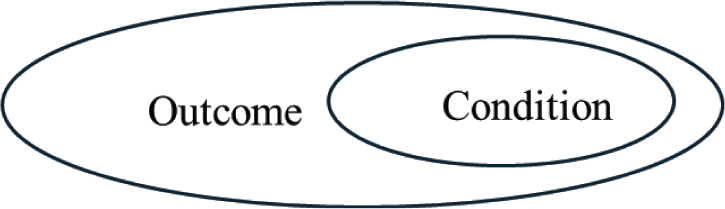
Figure 1A.
A sufficient condition for an outcome
Source: Author’s work.
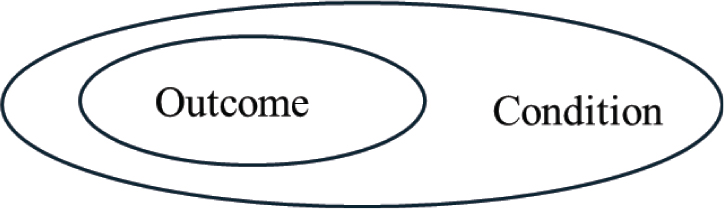
Figure 1B.
A necessary condition for an outcome.
Source: Author’s work.
In Figure 1A, a subset of objects with the presence of the condition is covered 100% by a subset of objects with the presence of the outcome. This means that all objects with the presence of the condition notice the presence of the outcome. Thus, the condition is sufficient for the outcome, which can be written as Condition → Outcome. In QCA, this degree of consistency can also be set to 75% instead of 100%. In Figure 1B, a subset of objects with the presence of the outcome is covered 100% by a subset of objects with the presence of the condition. This means that all objects with the presence of the outcome notice the presence of the condition. Thus, the condition is necessary for the outcome, which can be written as Outcome → Condition.
The basic QCA model – csQCA (crisp-set QCA) – assumes that each object can be either a full non-member (0) or a full member (1) of a subset of objects with the presence of a condition (outcome). For variables that are not perfectly binary, there are two main extensions of this model. The first is called mvQCA (multi-value QCA) that takes into account the partial membership of the object. For each condition (outcome), several membership thresholds are set by the researcher. The second, called fsQCA, is considered the most realistic approach because each condition (outcome) can take any value from the range < 0; 1 >, also known as the degree of membership.
The fsQCA research process consists of several steps:
1. Calibration of the variables. The variables are calibrated using a logistic function with 0.05, 0.5, and 0.95 percentiles as thresholds for non-, intermediate, and full membership, respectively. After this step, each calibrated variable takes the value < 0; 1 >.
2. Create the truth table. with dichotomous values assigned to objects according to the procedure: 0 if the calibrated variable is <0.5, and 1 if the calibrated variable is >0.5. The number of rows in the truth table is 2k (K – number of factors). Configurations are subsets of objects, but not all of them are represented by empirical observations. Configurations that are not represented by any object are called logical reminders. The solution is a sum of these configurations from a truth table that are covered by a result to a minimum sufficient degree. The degree of consistency was set to 80% for the analysis of high MSW treatment efficiency, and to 75% for the analysis of low MSW treatment efficiency.
3. The minimalization of the truth table is a step to transform the solution into the most parsimonious one and is performed according to the following principle: if two configurations that affect the outcome differ by only one factor, then this factor is considered irrelevant and is removed from the solution. Depending on how logical remainders are treated in the minimalization process, three variants of the solution can be distinguished:
Conservative solution (the most complex) assumes that logical remainders (non-empirical cases) do not affect the outcome and are not taken into account.
Parsimonious solution (the least complex) assumes that logical remainders affect the outcome and are taken into account.
Intermediate solution is the most commonly used option, and it assumes that not all logical remainders affect the outcome. The logical remainders are chosen based on directional expectations about the direction of the relationship between factors and outcomes introduced by the researchers.
The intermediate solution is compared with the parsimonious solution to identify the core and peripheral factors. The core factor is one that is present in the parsimonious solution, whereas the peripheral factor is one that is observed in the intermediate solution only. Based on this division, the fsQCA results are presented in some specific table using circles-based notation, which is considered to be easier to read [Pappas and Woodsite, 2021]. There are two types of circles: a black circle ● (the presence of a factor in the solution) and a crossed-out circle ⊗(the absence of a factor). An empty space in a table means the “do not care factor” [Pappas and Woodsite, 2021]. To distinguish between core and peripheral factors, large and small circles are used, respectively. In addition, core factors indicate a strong relationship between the factors and an outcome, whereas peripheral factors indicate a weaker relationship.
4. Presentation, evaluation, and interpretation of the obtained solutions. Three indices are used to evaluate the quality of solutions [Suder, 2022]:
Consistency index – the degree to which a subset of objects with the presence of a configuration is covered by a subset of objects with the presence of an outcome. A low consistency index means that the model is poorly specified or does not make theoretical sense [Marx and Dusa, 2011]. The consistency index should be >0.75.
PRI index (proportional reduction in inconsistency) – an alternative to the consistency index – used only for fuzzy sets. As noted by Pappas and Woodsite [2021], PRI is used to avoid simultaneous subset relations of configurations in both outcome and absence of outcome. The PRI should be >0.7 (values <0.5 indicate significant inconsistency).
Coverage index – the degree to which a subset of objects with the presence of a configuration covers a subset of objects with the presence of an outcome. A low coverage index means that the solution does not satisfactorily explain the outcome. The coverage index should be >0.25.
In the literature, the consistency index is compared with a correlation coefficient, while the coverage index is compared with R2. Despite the use of these analogies, QCA is said to be different from quantitative methods. The following four characteristics are commonly cited:
Asymmetry – if several different configurations affect the outcome, the absence of these configurations does not necessarily mean that the outcome is absent – it may still be present. The interpretation of regression coefficients is based on the assumption of a symmetric relationship between variables.
Equifinality – several different configurations of factors affect the outcome. Regression analysis estimates only one equation representing the relationship between variables.
Multifinality – a configuration of factors – rather than a single factor – influences the outcome. Regression analysis focuses on estimating coefficients that reflect the independent influence of each independent variable on the dependent variable.
Multiple conjunctural causation – In one configuration, the presence of a factor affects the outcome, while in another configuration its absence leads to an outcome. In regression analysis, the sign of each coefficient is estimated before regression modeling begins.
This phase of the research was carried out using R – package “QCA” [Dusa et al., 2024].
4. Results of the research and discussion
The results of the application of the BCC model can be seen in Figure 2.
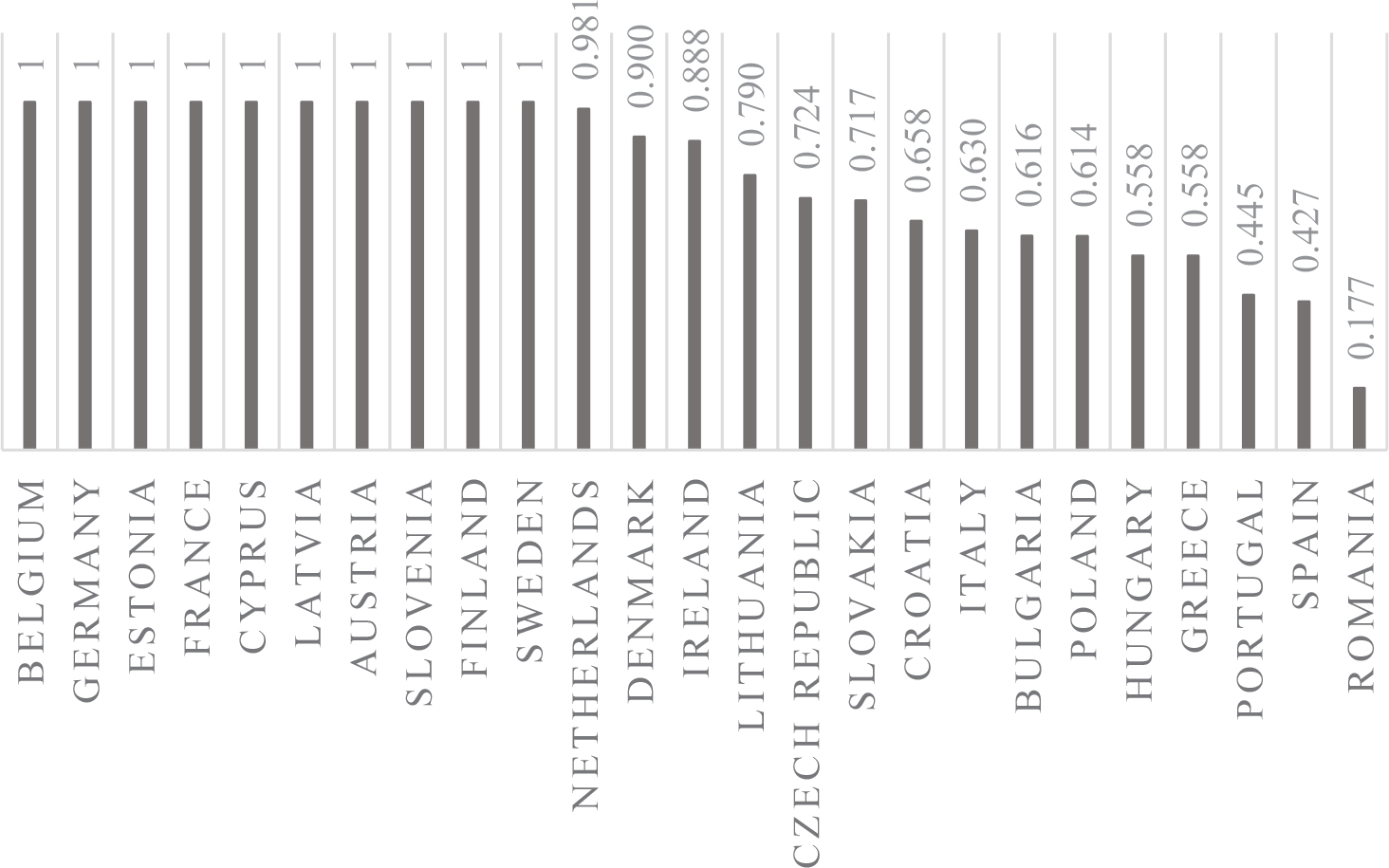
Figure 2.
MSW treatment efficiency scores in EU countries.
Source: Author’s work based on Eurostat database calculated in Excel. EU, European Union; MSW, municipal solid waste.
In total, 10 EU countries appear to be efficient (θBCC = 1), whereas 15 countries are inefficient (θBCC < 1). It is worth noting that the group of efficient countries includes countries that joined the EU before 2000 as well as countries that joined after 2000, such as Estonia, Latvia, Slovenia, and Cyprus. However, the results obtained are in line with those presented in the literature, in particular with the conclusions of the report identifying Member States at risk of not achieving the 2025 target for preparing for the reuse and recycling of municipal waste and packaging waste [European Commission, 2023]. The EU countries classified as being on track to meet both municipal and packaging waste targets (Belgium, Germany, Austria, Czech Republic, Denmark, Italy, Luxembourg, the Netherlands, and Slovenia) consist mainly of countries that were found to be highly efficient. Moreover, the EU countries classified as being at risk of missing both targets (Bulgaria, Croatia, Cyprus, Greece, Hungary, Lithuania, Malta, Poland, Romania, and Slovakia) are mainly low efficient countries.
4.1. TRM
The TRM results are presented in Table 1. There are only two factors that significantly explain the MSW treatment efficiency of EU countries: EA and R&D expenditure (RD).
Table 1.
The results of TRM
| Factor | Coefficient | Sth. error | z-Statistic |
|---|---|---|---|
| Constant | −0.141 | 0.198 | 0.710 |
| EA (level 5–8) | 0.021*** | 0.007 | 3.095 |
| RD – R&D expenditure | 0.161* | 0.091 | 1.770 |
| INW – private investment in circular economy sectors | −0.064 | 0.218 | 0.295 |
| CMU | 0.009 | 0.013 | 0.706 |
The results obtained are partly consistent with those presented in the literature. Rios and Picazo-Tadeo [2021] showed a positive indirect effect of EA on the MSW treatment efficiency of EU countries. Osińska [2024] showed that EA is a significant factor in MSW treatment efficiency of EU countries after the introduction of the Directive [2018]. Regarding R&D expenditure, Derej [2017] pointed out that a higher technological level of the economy (measured by R&D expenditure) means a higher level of waste treatment. Yang et al. [2018] showed a positive influence of patent authorization on the efficiency of MSWM. Osińska [2024] proved that patent authorization was significant before the introduction of the Directive [2018], while R&D expenditures became a significant positive factor of MSWM efficiency after the introduction of the Directive [2018].
Two factors directly related to the MSW treatment process (private investment in circular economy sectors and CMU) turned out to be insignificant. To our knowledge, these variables have not been considered so far. Struk [2014] analyzed public or private ownership of waste collection companies instead of private investment on MSWM efficiency and showed that it was not significant. However, he also pointed out – based on other research – that the influence of the private sector on MSWM efficiency is not clear and that studies on this topic can give mixed results. On the contrary, Lacko and Hajduova [2018] analyzed resource productivity instead of CMU, which turned out to have a positive and significant impact on MSWM efficiency in EU countries.
4.2. QCA
The first step in QCA is to define conditions by calibrating variables. The following conditions were defined: EA/~EA (a high/low level of EA), RD/~RD (a high/low level of R&D expenditures), INW/~INW (a high/low level of private investment), CMU/~CMU (a high/low level of CMU), and Eff/~Eff (a high/low level of MSW treatment efficiency).
QCA was performed under the following assumption: if the consistency index for a configuration is ≥ 0.8 (incl.cut = 0.8) and a configuration is represented by at least one case (n.cut=1)‚‚ then a configuration is sufficient to observe high MSW treatment efficiency. With four external factors (EA, RD, INW, CMU), there are 24 = 16 possible configurations, which are presented in Table 2 (the truth table). Configurations 1–4 are sufficient for high MSW treatment efficiency in some countries (the values of the consistency index are at least 0.8). In fact, each country listed in positions 1–4 has the high MSW treatment efficiency score.
Table 2.
A truth table (n.cut = 1; incl.cut = 0.8) with the MSW treatment efficiency scores in brackets
| L.p. | EA | RD | INW | CMU | Eff | n | Consistency index | Countries |
|---|---|---|---|---|---|---|---|---|
| 1 | 1 | 1 | 1 | 1 | 1 | 4 | 0.931 | Belgium (1), Denmark (0.9), France (1), Netherlands (0.98) |
| 2 | 1 | 1 | 0 | 1 | 1 | 2 | 0.883 | Estonia (1), Slovenia (1) |
| 3 | 1 | 1 | 0 | 0 | 1 | 2 | 0.813 | Finland (1), Sweden (1) |
| 4 | 0 | 1 | 1 | 1 | 1 | 2 | 0.807 | Germany (1), Austria (1) |
| 5 | 1 | 0 | 1 | 0 | 0 | 1 | 0.771 | Lithuania (0.79) |
| 6 | 1 | 0 | 0 | 0 | 0 | 3 | 0.759 | Ireland (0.89), Spain (0.43), Cyprus (1) |
| 7 | 0 | 1 | 0 | 1 | 0 | 1 | 0.7 | Czech Republic (0.72) |
| 8 | 0 | 1 | 1 | 0 | 0 | 1 | 0.682 | Portugal (0.445) |
| 9 | 0 | 0 | 0 | 1 | 0 | 3 | 0.631 | Italy (0.63), Poland (0.61), Slovakia (0.72) |
| 10 | 0 | 0 | 1 | 0 | 0 | 2 | 0.553 | Croatia (0.66), Latvia (1) |
| 11 | 0 | 0 | 0 | 0 | 0 | 4 | 0.465 | Bulgaria (0.62), Greece (0.56), Hungary (0.56), Romania (0.18) |
| 12 | 0 | 1 | 0 | 0 | ? | |||
| 13 | 1 | 1 | 1 | 0 | ? | |||
| 14 | 1 | 0 | 1 | 1 | ? | |||
| 15 | 1 | 0 | 0 | 1 | ? | |||
| 16 | 0 | 0 | 1 | 1 | ? |
Considering the factors independently, one factor (RD) is necessary for high MSW treatment efficiency. This means that every country with a high level of MSW treatment efficiency also has a high level of R&D expenditure. But it is not sufficient, because there are some countries (Czech Republic, Portugal) that have a high level of R&D expenditure and are not highly efficient. Configurations 12–16 are logical reminders. It should be noted that the QCA result contradicts the TRM result. The TRM result clearly shows that an increase in R&D expenditure leads to an increase in MSW treatment efficiency. The QCA clearly shows that without a high level of R&D expenditure, it is not possible to achieve a high level of MSW treatment efficiency. However, a high level of R&D expenditure alone does not guarantee a high level of MSW treatment efficiency.
After analyzing the truth table, its reduction is carried out. To identify the intermediate solution, based on the TRM results, we assumed that the influence of a high level of EA and a high level of R&D expenditure (RD) on a high level of MSW treatment efficiency is more likely to be positive than negative. There were no directional expectations about a high level of private investment (INW) and a high level of CMU. The overall intermediate solution is as follows (“” means “and”, “+” means “or”):
The detailed information on these solutions is presented in Table 3. A high level of MSW treatment efficiency is the result of two alternative solutions/configurations (EA · RD · ~INW or RD · INW · CMU). A high level of R&D expenditure is found in each of these solutions, confirming the conclusions reached at the earlier stage of analysis of the necessary conditions in the truth table. In addition, a high level of R&D expenditure on any solution must be accompanied by other factors to ensure that a given configuration is considered sufficient for a high level of MSW treatment efficiency.
Table 3.
The intermediate solution for Eff (n.cut = 1; incl.cut = 0.8)
| Factor | Solution 1 | Solution 2 |
|---|---|---|
| EA |  | |
| RD |  |  |
| INW |  |  |
| CMU |  | |
| Cases | Finland, Sweden Estonia, Slovenia | Belgium, Denmark, France, Netherlands Germany, Austria |
| Consistency | 0.848 | 0.869 |
| PRI | 0.768 | 0.814 |
| Coverage | 0.362 | 0.492 |
 – The presence of a core factor.
 – The absence of a core factor.
 – The presence of a peripheral factor.
 – The absence of a peripheral factor.
The first solution EA · RD · ~INW means that a high level of EA, a high level of R&D expenditure, and a low level of private investment influence a high level of MSW treatment efficiency. The consistency index and the PRI are 0.848 (> 0.75) and 0.768 (> 0.7) respectively, while the coverage index is 0.362 (> 0.25). This solution is represented by four EU countries: Finland, Sweden, Estonia, and Slovenia, and has two core factors (EA and RD). This means that these factors indicate a strong relationship with a high level of MSW treatment efficiency, while the relationship between a low level of private investment and a high level of MSW treatment efficiency is weaker. It can be said that a high level of EA and a high level of R&D expenditure are indispensable for a high level of MSW treatment efficiency. Based on this result, some recommendations can be formulated for some inefficient countries. For example, Spain with θBCC = 0.43 has a high level of EA, a low level of R&D expenditure, and a low level of private investment. To become a highly efficient country, it should be sufficient to increase its level of R&D expenditure.
The second solution RD · INW · CMU means that a high level of R&D expenditure, a high level of private investment, and a high level of CMU are sufficient for a high level of MSW treatment efficiency. The consistency index and the PRI are 0.869 (> 0.75) and 0.814 (> 0.7), respectively, while the coverage index is 0.492 (> 0.25). This solution is represented by six EU countries: Germany, Austria, Belgium, Denmark, France, and the Netherlands, and has two core factors (INW and CMU). This means that these conditions indicate a strong relationship with a high level of MSW treatment efficiency, while the relationship between a high level of R&D expenditure and a high level of MSW treatment efficiency is weaker. It can be said that a high level of private investment and a high level of CMU are indispensable for a high level of MSW treatment efficiency. Thus, other recommendations can be formulated for some inefficient countries. For example, Portugal with θBCC = 0.445 has a high level of R&D expenditure, a high level of private investment, and a low level of CMU. To become a highly efficient country, Portugal should increase its level of CMU.
The existence of several solutions makes it possible to formulate alternative recommendations for some inefficient countries. For example, the Czech Republic with θBCC = 0.72 has a low level of EA, a high level of R&D expenditure, a low level of private investment, and a high level of CMU. To become a highly efficient country, the Czech Republic can choose between two paths. The first path, related to the first solution, is to increase the level of EA while maintaining a low level of private investment. The second path, related to the second solution, is to increase the level of private investment while maintaining a low level of EA.
Unlike the regression analysis, QCA showed that not only high levels of EA and R&D expenditure determine a high level of MSW treatment efficiency. Only in a few countries (Finland, Sweden, Estonia, and Slovenia), these factors are indispensable for a high level of MSW treatment efficiency. In other countries, a high level of MSW treatment efficiency is the result of different configurations with a high level of private investment and a high level of CMU as core factors and a high level of R&D expenditure as a peripheral condition (Belgium, Denmark, France, the Netherlands, Germany, and Austria). TRM assumes symmetric relationships between each of the independent and dependent variables. This means that an increase in the level of R&D expenditure or the level of EA affects an increase in the level of MSW treatment efficiency. On the contrary, a decrease in these variables causes a decrease in the level of MSW treatment efficiency. QCA assumes an asymmetric relationship, which means that to identify the factors that determine a low level of MSW treatment efficiency, it is necessary to apply QCA for ~Eff.
The intermediate solution for a low level of MSW treatment efficiency is shown in Table 4. In both solutions, a low level of EA and a low level of R&D expenditure are found as key reasons for a low level of MSW treatment efficiency. It confirms the TRM results. In the first solution, these factors are accompanied by a low level of private investment as a peripheral factor. This configuration is observed in seven EU countries: Bulgaria, Greece, Hungary, Romania, Italy, Poland, and Slovakia. In the second solution, low levels of EA and R&D expenditure are accompanied by a low level of CMU as the peripheral factor. This configuration is presented by six countries: Bulgaria, Greece, Hungary, Romania, Croatia, and Latvia.
Table 4.
The intermediate solution for ~Eff (n.cut = 2; incl.cut = 0.75)
| Factor | Solution 1 | Solution 2 |
|---|---|---|
| EA |  |  |
| RD |  |  |
| INW | ⊗ | |
| CMU | ⊗ | |
| Consistency | 0.833 | 0.870 |
| PRI | 0.765 | 0.816 |
| Coverage | 0.547 | 0.547 |
| Cases | Bulgaria, Greece, Hungary, Romania Italy, Poland, Slovakia | Bulgaria, Greece, Hungary, Romania Croatia, Latvia* |
| Consistency (total) | 0.837 | |
| PRI (total) | 0.780 | |
| Coverage (total) | 0.624 |
 – The absence of a core factor.
5. Conclusions
The research confirmed the RH, that is, fsQCA is a useful tool for identifying factors that influence high MSW treatment efficiency. Traditional regression analysis (TRM in this case) used for the same purpose has some limitations that can be overcome by using QCA. Some of these are described below in the context of the results achieved.
The first is the mechanics of regression analysis, which focuses on finding a single best solution and assumes symmetric relationships. TRM showed that MSW treatment efficiency (both its increase and decrease) is mainly determined by two variables: EA and R&D expenditure. FsQCA showed that a high level of R&D expenditure is a necessary but not sufficient condition for a high level of MSW treatment efficiency. In fact, a high level of MSW treatment efficiency is the result of two different configurations of factors. The first solution is partially consistent with the results obtained from TRM and indicates that a high level of MSW treatment efficiency is driven by high levels of EA and R&D expenditure as core factors. However, this path only works for four highly efficient EU countries (Finland, Sweden, Estonia, and Slovenia), where these conditions occur simultaneously with a low level of private investment as the peripheral factor. The second solution shows that a high level of MSW treatment efficiency is driven by the following two core factors: high levels of private investment and CMU (Germany, Austria, Belgium, Denmark, France, and the Netherlands), with a high level of R&D expenditure as the peripheral factor. On the contrary, a low level of MSW treatment efficiency is determined by two solutions with low levels of EA and R&D expenditure as core factors.
The second limitation is that the sign of each coefficient in the regression analysis is set by hypothesis before the regression modeling starts. EU countries represent a contrarian effect of private investment. This variable was found to be insignificant in TRM while the results obtained from fsQCA show that both low and high levels of private investment can affect a high level of MSW treatment efficiency, depending on the configuration of other factors.
The third limitation is that regression analysis is a variable-oriented method based on finding some main effects that may not be common to all EU countries analyzed. QCA is a case-oriented method that allows to identify a subset of EU countries with a high level of MSW treatment efficiency where the solution is present. It also allowed us to formulate specific recommendations for countries with a low level of MSW treatment efficiency by indicating a case-specific path to improve this efficiency.
Yet there are some limitations of this study too, which are related to fsQCA. Before starting fsQCA, many assumptions have to be made, for example, it is necessary to determine the thresholds for the calibration function, the minimum number of cases, and the minimum value of the consistency index assigned to the configuration sufficient for the outcome. These assumptions strongly influence the solutions obtained. Knowledge about the analyzed cases is therefore very important when applying this method.
The presented approach can be potentially reused to measure other objects and the type of MSWM activity. As mentioned in the “Literature review” section, the vast majority of studies focus on the analysis of MSW collection efficiency and are conducted for municipalities. It may be strongly valuable to carry out a similar studies for other areas of research in the literature and compare the results.