
Table 1.
Recent research on local government sustainability disclosures
| Reference | Research objects | Data collection methods | Results |
|---|---|---|---|
| Marcuccio and Steccolini [2009] | 12 Italian local authorities | Interviews | Increased reporting is “management fashion”; reporting can be a tool to appear innovative and progressive |
| Bellringer et al. [2011] | 5 Local government councils in New Zealand | Semi-structured exploratory interviews | The importance of leadership by setting an example for the community; sustainability reporting ensures transparency and accountability to the public; financial incentives can help to encourage commitment to sustainability reporting; using reports to inform and reassure employees and taxpayers about the council’s commitment to sustainability |
| Williams et al. [2011] | Australian local governments | Mail survey | Half of the respondents report on at least one sustainability area; 40% of non-reporters indicate willingness to report in future |
| Greco et al. [2012] | 10 Italian and Australian city councils | Interviews | Large degree of discretion in sustainability reports of cities; societal norms, values, and culture can influence an organization to take action to reporting; institutional isomorphism has an influential role in the decision to undertake sustainability reporting; the need of developing a sustainability reporting framework to improve; reporting practices and meet the needs of the community and other stakeholders |
| Navarro-Galera et al. [2014] | 33 European local governments | Content analysis of websites | Local governments are reasonably transparent; no link between disclosure and (financial) development |
| 55 Spanish towns | Content analysis of websites; regression analysis | The motivation behind sharing information is often rooted in the personal objectives of leaders and policy creators | |
| Alcaraz-Quiles et al. [2014] | Western Australian local government authorities | Content analysis of websites | Moderate engagement in sustainability reporting, with greater emphasis on waste management, biodiversity, energy, and water management, metropolitan councils have better reporting performance than rural councils; local councils are under pressure to meet stakeholder expectations and sustainability reporting would meet these demands |
| Hossain [2018] | Amsterdam, Basel, Dublin, Freiburg, Nuremberg, Zurich | Mixed methods: document analysis, interviews | Sustainability reporting can benefit organizational change, management, and communication, but it can also lead to “fatigue” and abandonment; different practices have emerged based on unique choices about formats, periodicity, authorship, and dissemination efforts |
| Manes-Rossi et al. [2021] | Sample of 18 European SOEs from 8 countries | Manual content analysis of integrated reports | Government ownership, external audit, investor protection, and adoption of GRI guidelines positively influence IR (integrated reporting) disclosure; SOE size negatively influences IR disclosure; the overall level of IR disclosure among the sampled SOEs increased from an average score of 0.52 in 2013 to 0.68 in 2017 |
Table 2.
ESG disclosure metrics and number of cities reporting on individual ESG metrics
| Area | Category | Score | Number of reporting cities |
|---|---|---|---|
| General information | 10 | ||
| GI | Business model (description) | 1 | 15 |
| GI | Integration of sustainability issues (description of the company’s objectives that enable the achievement of SDGs) | 1 | 0 |
| GI | Management of sustainability issues (description of the role of the management and administration regarding sustainability) | 1 | 13 |
| GI | Significant impact, risk and opportunities (description) | 1 | 14 |
| GI | Stakeholder engagement (description) | 1 | 14 |
| GI | Description of the company’s policies concerning SDGs (in the context of value chains) | 1 | 14 |
| GI | Information about incentive systems offered to supervisory bodies and administration for achieving SDGs | 1 | 5 |
| GI | Description of the due diligence process | 1 | 10 |
| GI | Identification of the potential negative impact of the company’s activities on the environment across the entire value chain | 1 | 12 |
| GI | Description of actions taken by the company to prevent or end actual or potential adverse effects | 1 | 13 |
| Environmental indicators climate change | 4 | ||
| E | Management of climate change issues (description) | 1 | 15 |
| E | Greenhouse gas emissions in tons of CO2 equivalent | 1 | 12 |
| E | Greenhouse gas emissions intensity (in Tons of CO2) | 1 | 1 |
| E | Energy consumption and sources (in MWh) | 1 | 13 |
| Other environmental issues | 5 | ||
| E | Environmental policy | 1 | 15 |
| E | Water consumption (in m3) | 1 | 3 |
| E | Water resource management | 1 | 13 |
| E | Impact on biodiversity | 1 | 14 |
| E | Waste management | 1 | 12 |
| Social indicators employment | 7 | ||
| S | Diversity policy | 1 | 15 |
| S | Employment policy | 1 | 15 |
| S | Work-life balance policy | 1 | 9 |
| S | Reintegration policy | 1 | 7 |
| S | Equal pay index | 1 | 7 |
| S | Employment turnover (in %) | 1 | 7 |
| S | Freedom of association and collective bargaining (in %) | 1 | 1 |
| Occupational health and safety | 1 | ||
| S | Occupational health and safety | 1 | 3 |
| Human rights | 2 | ||
| S | Human rights policy | 1 | 6 |
| S | Human rights due diligence procedures | 1 | 7 |
| Governance indicators corporate governance | 3 | ||
| G | Company governing bodies structure | 1 | 1 |
| G | Independent members of governing bodies | 1 | 0 |
| G | Diversity in the composition of governing bodies | 1 | 3 |
| Business ethics | 3 | ||
| G | Code of ethics | 1 | 4 |
| G | Anti-corruption policy | 1 | 11 |
| G | Whistleblowing mechanism | 1 | 14 |
| Data security and protection | 1 | ||
| 36 | Data protection policy | 1 | 15 |
| ESG disclosure index | 36 |
1 Source: [ESG Reporting Guidelines Guide for Issuers, 2023].
Table 3.
Additional questions analyzed
| Additional questions |
|---|
|
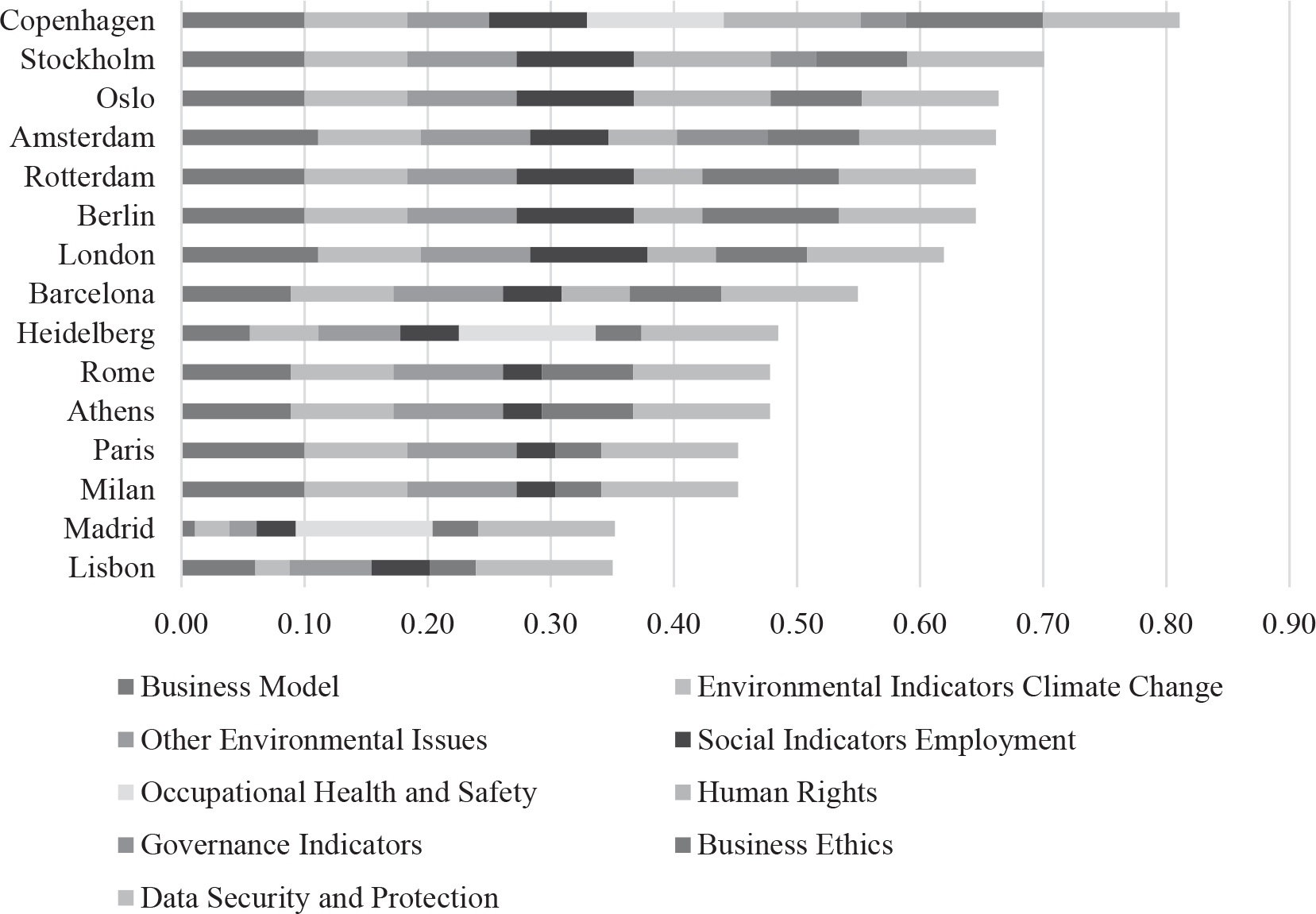
Figure 1.
ESG disclosure indices of the analyzed cities.
Source: Own calculations. ESG, Environmental, Social, and Governance.