
1. Introduction. History and the concept of sustainable development
According to the principles of the circular economy, the priority is the direction of development and improvement of the levers of preservation and full restoration of the natural environment. For this purpose, it is necessary to significantly reduce the consumption of natural resources by using newly introduced resource-saving technologies. Also, reducing emissions of pollutants and their negative impact on the environment is necessary. So, it is advisable to analyze the indicators of the regional development of the Polish economy and their quantitative assessment. The negative environmental impact of economic growth was already described in the ancient Roman, Greek, Egyptian, and Mesopotamian civilizations [Du Pisani, 2007]. Nevertheless, the concept of sustainable development (as we understand it now) dates back to the 18th century when it solely concerned foresting [Meadows, 1972]. The German forestry scientist Hans Carl von Carlowitz described in 1713 in his book Sylvicultura Oeconomica the phenomenon of the massive consumption of wood for shipbuilding, construction, mining, and others leading to a risk of shortages of wood in Europe [Van Zon and Kuipers, 2002]. The 19th century shifted to coal and the 20th century to oil as the most important natural resource and energy source and brought the subject of non-renewable resources [Du Pisani, 2007]. For two centuries, the concept of sustainability evolved but it was only in the second half of the 20th century that its significance raised drastically. At that time, the Oxford Dictionary defined sustainability as “The ability to be maintained at a certain rate or level” [Paris Agreement prepared in November, 2015]. In 1987, the World Commission on Environment and Development defined SD as an ethical concept and provided its definition: “Sustainable Development is a development that meets the needs of the present without compromising the ability of future generations to meet their own needs” [Ebner and Baumgartner, 2014]. The definition contains two key concepts: the concepts of “needs” and the concepts of “ability” [Durbach and Lixinski, 2017]. The needs on the one hand are the needs of the world’s poor and on the other hand the needs of unlimited development of organizations with the use of technology. At the same time, it defines the ability of the environment to meet changes by technology over a long time horizon, concerning not only current abilities and needs but also those of future generations. Thus, the goals of economic and social development must be defined in terms of sustainability in developed countries as well as in developing ones [Ebner and Baumgartner, 2014].
2. Literature review
Discussion about sustainability has emerged in recent years as a consequence of the growing ecological and social awareness after years of focus primarily on economic growth. The imminent ecological crisis as well as the global wealth inequality have led to a new focus on sustainability in global terms and on three dimensions (ecological, social, and economic). This resulted in the Paris Agreement [Paris Agreement prepared in November, 2015] within the United Nations Framework Convention on Climate Change (UNFCCC), dealing with greenhouse-gas-emissions mitigation, adaptation, and finance. The member countries adopted the 2030 Agenda for Sustainable Development and its 17 Sustainable Development Goals. For that purpose, the United Nations has adopted the same definition of sustainable development as the World Commission on Environment and Development [The Sustainable Development Goals Report, UNSD, 2017]. The subject of sustainability is also widely described in scientific literature. N. J. Schrijver states that in a relatively short time the concept of sustainable development has become firmly established in the field of international law and proves that without grounding the concept in the law of the states as well as in the international law, sustainable development cannot be achieved [Schrijver, 2008]. M. Ziolo, B. S. Sergi, and N. Shmygol tackle the issue of assessing the efficiency of sustainable development financing from a theoretical and methodical point of view, sustainable finance and sustainable financial systems, environmental, social, and governmental risk and individual and institutional motivations of financial managers in the sustainability concept [Ziolo and Sergi, 2019; Shmygol et al., 2021a, b]. The sustainable development goals though signed by majority of countries, cannot be reached without corporate involvement. G. Blokdyk proves in Sustainable Development Goals A Complete Guide, how important is sustainable development goal to the organization’s mission and how companies should be involved in the process [Blokdyk, 2000]. O. Osuji, F. N. Ngwu, D. Jamali in Corporate Social Responsibility in Developing and Emerging Markets: Institutions, Actors and Sustainable Development, show linkages between corporate social responsibility and sustainable development and how it has emerged as a tool for public and private institutions to promote sustainable development in developing and emerging markets [Osuji et al., 2020]. They also describe it with normative factors, theoretical models, policy strategies as well as corporate practices that best facilitate effective corporate social responsibility and sustainable development [Chyba and Pałucka, 2022].
2.1. The research objective
Attempts to solve the problem of sustainable economic development on a scientific basis are attributed even before the advent of classical political economy in the 17th century. Since then, various schools of classical economic theory, Keynesianism and Institutionalism, responding to constant global challenges, have been dealing with it on a permanent basis. The imperfection of modern developments in recent decades is confirmed by the fact that not a single developed country in the world has been able to achieve sustainable dynamics of socio-economic growth that would not obey the theory of long waves and cyclical fluctuations in business activity. Therefore, in the democratic world, we see a constant change in the ruling elites, whose economic policy is based on rethinking the concepts, roles, functions, and methods of public administration. On the other hand, at the end of the 20th century, the world economy faced a new global challenge related to the depletion of natural resources and the problem of environmental pollution. The dilemma was to choose what was more important: to ensure a stable and sustainable state of the existing ecosystem for future generations or to maintain the existing scale of globalization and growth rates today. The scientific answer was the concept of circular economy, emphasizing the relevance and timeliness of this study. Sustainable regional development should occur based on the full reproduction of the environment.
The article’s purpose is to develop and test a model for assessing the state of sustainable ecological and economic development in Poland, taking into account the regional aspect.
2.2. Analysis of research and publications
The problem of researching sustainable development in economic theory and practice of public administration has a global character due to the understanding that in the modern globalized world, it is impossible to build a separate open-type economy based on sustainable growth. Numerous international organizations emphasize that sustainable development is a problem for all of humanity, not a specific region. In order to confirm this, Latoszek [2016] cites the UN definition, according to which: “sustainable development must meet the basic needs of all humanity, preserve, protect and reproduce the integrity of the Earth’s ecosystem without threats to future generations”. That is why the priority role in ensuring the specified goal is given to world institutions and intergovernmental associations. Proczek [2014] draws attention to the activities of the International Monetary Fund as the main institution for the balanced economic development of the world economy and member states. Zajączkowski [2016] develops the concept of global public goods of the World Trade Organization based on the liberalization of trade relations and the use of the principle of comparative advantages. Kurczewska [2016] emphasizes the role of the European Union in the global redistribution of public goods for the implementation of sustainable development policy.
Protecting and restoring the integrity of the environment requires significant public costs, which cannot but affect the well-being of the population, especially at the stage of their implementation. Zakrzewska [2019] raises the issue of sustainable development and quality of life in her work. According to the author, society is obliged to pay an additional price for reducing environmental risks. Wodzikowski [2012] emphasizes that nowadays not only the implementation of program principles and long-term development strategies from world institutions but also the legal support of the relevant national strategies remains an urgent problem. In his opinion, the state policy of sustainable development in the social, economic, and environmental spheres must be enshrined in the legal sphere of Poland and other countries. Thus, the author starts from a systemic approach, when the goals of the development of the entire system can be achieved only under effective and coordinated functioning of its elements. As a continuation of this trend, we can cite the work of Świdyński [2014], where the author focuses on sustainable regional development within one country. He notes that in recent decades, Poland has followed this strategy and offers a system of indicators for comparing voivodships (provinces) with each other in order to identify those that need modernization. However, direct results of the calculations are not presented in the work.
The practical embodiment of this concept is a cyclical or circular economy, the peculiarities of its implementation and limitations are highlighted by such scientists as Korhonen et al. [2018]. The authors emphasize that this process is associated with deep innovative and technological changes in society, the results of which are competitive advantages in the form of social responsibility of business to society. However, no business model can guarantee the success of such a transformation for all companies without exception. Kwiecień [2018] also agrees with this statement and notes that the circular economy poses significant challenges for enterprises. Jastrzębska [2019] emphasizes the need to change the public perception of the concept of the life cycle of goods. In the circular economy, no product do have an expiration date but must be recycled, restored, and reused.
The analysis of the studies of modern scientists proved the relevance of this direction of research but showed that to a greater extent, they are of a theoretical nature. At the same time, government regulation is associated with a continuous decision-making process. Therefore, there is a need for more active use of the economic and mathematical apparatus.
3. Conceptual model and research methods
The criteria for sustainable regional development and the economy of Poland as a whole were based on the conceptual foundations of the functioning of the circular economy. The statistical evaluation of the identified indicators is based on the methods of analysis of dynamic series and average values: dynamic series and average values: the dynamics of time series was measured using average growth rates. The assessment of regional competitive advantages was carried out using the index method. Scientifically based classification of voivodships (provinces) according to homogeneous characteristics was carried out using the hierarchical method of cluster analysis. The adequacy of the conducted classification was checked using the silhouette measure criterion and using modern information and analytical tools. The primary criterion for selecting statistical methods is their alignment with the research objectives, such as identifying trends, determining relationships between indicators, and classifying regions. For example, regression analysis can be used for time series analysis, as it allows the assessment of indicator dynamics over time. Cluster analysis can be chosen to classify regions based on their similarity in key sustainability indicators.
4. Research findings
The closed-loop economy or circular economy is officially recognized as a priority area of strategic development for the countries of the European Union. According to their conceptual foundations, the preservation and complete restoration of the natural environment should be achieved by:
– a significant reduction in the consumption of natural resources through the introduction of resource-efficient technologies that allow the recycling of end products and waste;
– emissions of pollutants and their negative anthropogenic impact should be minimized.
In this study, sustainable ecological and economic development is defined as a type of development that ensures balanced economic growth and improved quality of life for the population while simultaneously preserving and restoring natural resources and ecosystems for future generations. This involves socio-economic development that reduces anthropogenic impact on the environment, decreases resource and energy intensity of production, and implements innovative technologies for rational use of natural resources and waste minimization.
For this reason, the indicators of sustainable regional development of the Polish economy should comprehensively consider these factors and allow them to be quantified. It should also be noted that the implementation of this strategy is designed for the long term since the corresponding structural and technological changes require a significant concentration of financial, intellectual, and production resources. From the point of view of the organization of statistical observations, in this case, it is advisable to consider a long-term period. The reason for this is also the fact that random factors often play a decisive role in the basis of short-term trends, which may not reflect the general trend.
Therefore, the actual statistical data used in this study were calculated on the basis of 2010–2020 [Ochrona środowiska, 2021; Rocznik Statystyczny Rzeczypospolitej Polskiej, 2021].
[Ekonomiczne aspekty ochrony środowiska, 2021]. To measure the dynamics of the target indicators, the average annual growth rates in comparable prices were used. The criteria for sustainable regional development were included, see Figure 1.
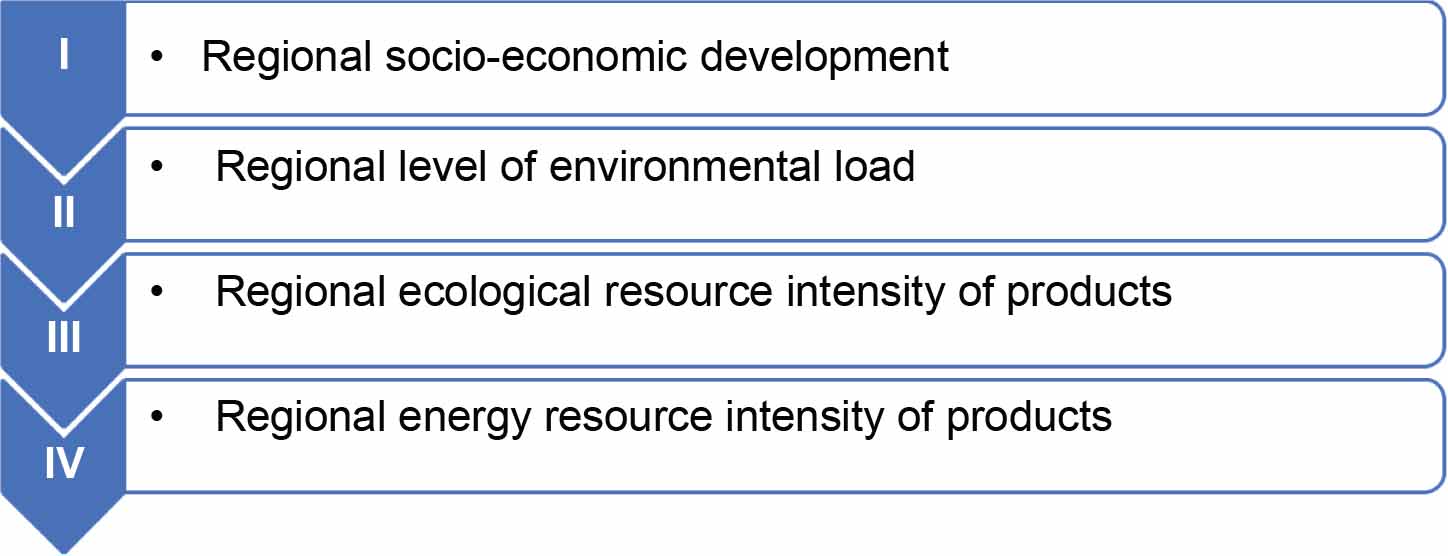
Figure 1.
Criteria for sustainable regional development of the country’s economy.
Source: Own elaboration.
First of all, the main goal of public administration in any democratic country is socio-economic growth capable of improving the standard of living of the population. At the same time, the ecological load of the regions should ensure the reproduction of the ecosystem on a permanent basis. Industrial sources of pollution, in this case, should include atmospheric emissions, solid waste, intake and discharge of untreated water, loss of fertility of agricultural land and their disposal, etc.
A necessary condition for the simultaneous socio-economic development and improvement of the environmental situation in the region is the excess of the rate of reduction of harmful emissions per unit of production over the corresponding growth rates of social production. Therefore, the next criterion, according to Figure 1 is the environmental resource intensity of products, which should tend to a minimum. Also, the structure of the energy balance of each country is directly related to both national security and rational environmental management. In general, the share of energy losses per unit of output should decrease over time.
Each of the criteria considered requires a quantitative assessment using a specific system of indicators. Let’s consider the rationale for its composition in more detail.
Regional socio-economic development (K1):
– Today, in macroeconomics, the gross domestic product (K11) is the most common generalizing indicator of the economic development of countries. Its wide distribution allows it to be used in international comparisons. Then at the level of the i-th voivodeship we will have the volume of the gross regional product (K11,i), which should strive for growth;
– the condition for improving the average standard of living of the population is the outpacing growth rates of the country’s gross or regional domestic product (GDP) over its size. Otherwise, the quality of life will deteriorate, even with an increase in K11. For this reason, the relative volumes of gross domestic product (K12) and regional products (K12,i) per capita were included in the indicators. Their positive growth rates are evidence of an increase in labor productivity, and also create the necessary conditions for wage growth;
– the average level of income per capita (K13) and by region (K13,i) should also be maximized.
As mentioned above, the assessment of sustainable development involves the analysis of the dynamics of the economic system according to key indicators. Therefore, for each of the considered indicators, average annual growth rates of Total Cost were calculated, and for 2010–2020.
According to the methodology of statistical analysis, the generalization of individual relative dynamics indicators should occur according to the formulas of simple or weighted geometric mean (1). Growth rates do not need to be rationed.
where Tij, αij – respectively, the average annual growth rate of the j-th individual indicator of the i-th group and its weighting factor; – average annual generalized growth rate of the i-th group of individual indicators; and n – is the number of indicators.The first formula (1) is used in the case when all n individual indicators must have the same effect on the performance or effective indicator. The second formula is if the expert assigns a weight to each individual indicator 0 < αj < 1, moreover, . To substantiate their values, the method of paired comparisons should be used, which allows for transforming the qualitative judgments of experts into a quantitative assessment. In our case, all calculations were carried out under conditions of equivalent influence. The results of the level of social and economic development in Poland in 2010–2020 are shown in Figure 1.
As can be seen from Figure 1, in the last decade, the economy of Poland grew by an average of +3.19% every year. Under the conditions of minor changes in the number of the population, the second indicator had comparable growth rates. As for the average salary, its dynamics exceeded the previous indicators and equaled +3.31% every year. This means a gradual increase in the cost of labor. As a result, the general indicator of socio-economic development was equal to 1.0322, or +3.22%.
2. Regional environmental load (K2). The existing statistical reporting [11] operates with natural indicators of the volume of environmental pollution in the country as a whole and in the regions. However, they do not allow us to estimate the intensity of anthropogenic impact for each voivodeship, since the latter differ in area. Therefore, relative indicators of environmental load will be calculated according to the formula:
Taking into account environmental statistics and formula (2), the indicators of the second group were attributed to:
– relative volumes of atmospheric emissions of sulfur dioxide (K21), nitrogen oxide (K22), carbon dioxide (K23), and carbon monoxide (K24) by industry to the area of the regions;
– relative volumes of waste generated (K25) to the area of the regions;
– relative volumes of water intake (K26) and discharge of untreated water (K27) to the area of the regions;
– regional shares of agricultural land that have lost fertility as a result of irrational nature management (K28).
Based on the economic content, all indicators of this group should strive to a minimum.
The calculation of general indicators based on individual growth rates was also performed on the basis of formula (1) in the following areas: atmospheric emissions, industrial waste, water resources, and agricultural land. The corresponding calculation results are shown in Figure 2.
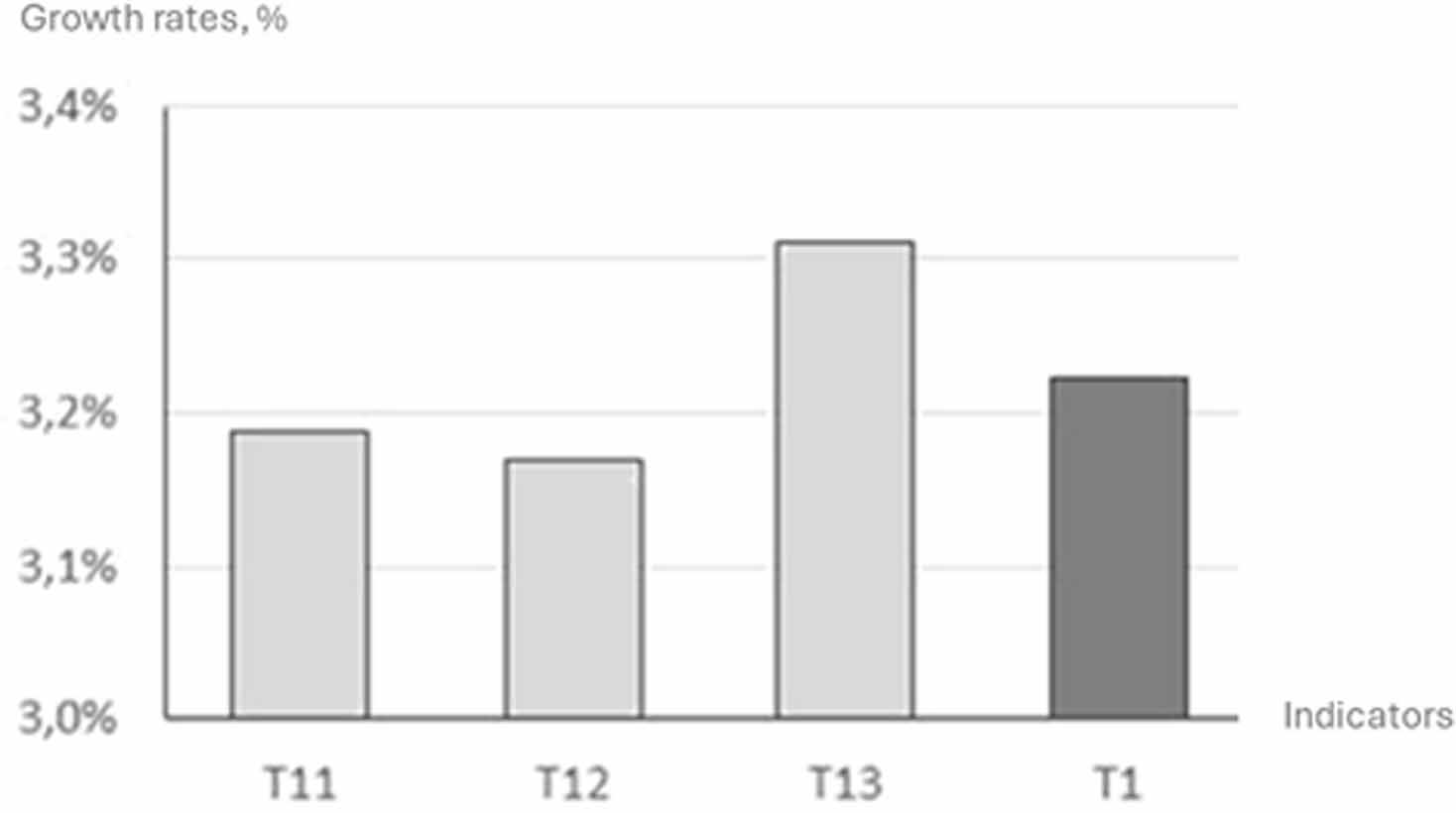
Figure 2.
Average annual growth rates of social and economic development indicators in Poland in 2010–2020.
A positive trend toward the reduction of anthropogenic impact was observed for all types of pollution. The best dynamics took place in reducing atmospheric emissions and rational water use. Thus, among the largest air pollutants, emissions of sulfur dioxide, per unit of area, decreased every year by –6.3%, nitrogen oxide by –2.5%, carbon dioxide by –0.5%, and carbon monoxide by –3.4%. As a result, the group indicator of the rate of reduction of ecological burden was equal to 0.983, or –1.7%.
Thus, we have a positive trend of simultaneous growth of the social and economic status in the country with a decrease in environmental pollution, which generally meets the criteria of sustainable development.
3. Regional ecological resource intensity of products (K3). In the analysis of economic activity, indicators of resource intensity are characterized by the volume of resources consumed per unit of output and should tend to decrease. In our case, the beneficial effect will be measured by gross domestic or regional product. And resource consumption will become the equivalent of pollutant emissions. Accordingly, all indicators of this group will be calculated:
The third group in the model of sustainable regional development included the following indicators:
– relative volumes of industrial emissions of sulfur dioxide (K31), nitrogen oxide (K32), carbon dioxide (K33), and carbon monoxide (K34) to GDP;
– relative volumes of waste generated (K35) to GDP;
– relative volumes of water intake (K36) and discharge of untreated water (K37) in GDP.
By analogy, these indicators should also be minimized. Their generalized growth rates are shown in Figure 3.
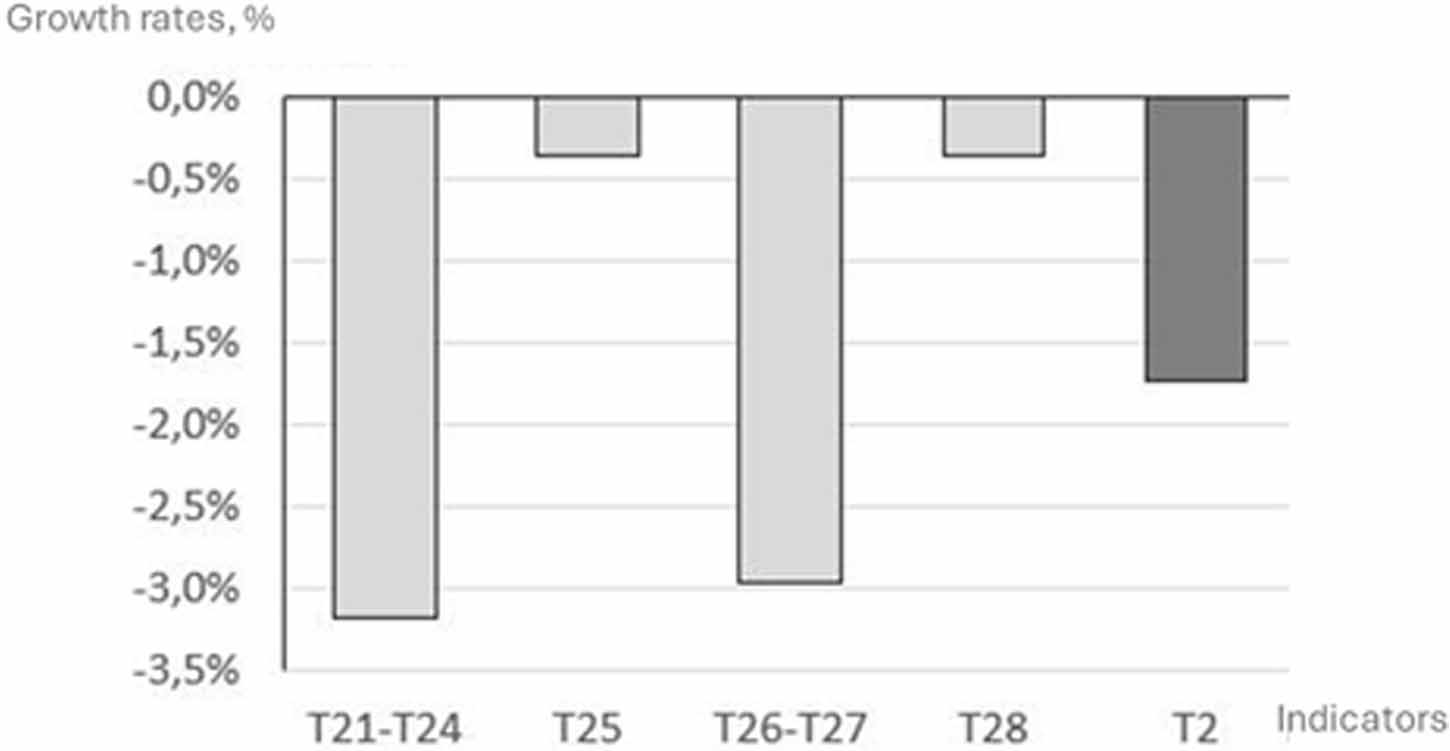
Figure 3.
Average annual rates of growth of environmental burden indicators in Poland in 2010–2020.
The Figure 3 shows that the volume of environmental pollution by all types, per unit of production, has been decreasing rapidly in recent years. Such dynamics fully meet the criteria of sustainable development, taking into account the previous directions of assessment.
4. Regional energy resource intensity of products (K4). As modern political experience shows, the energy factor in national security is a priority component of any country on the European continent. The development of green energy, energy-saving technologies, and the reuse of waste contributes to the preservation and reproduction of the natural environment and also allows you to eliminate external economic influence. That is why the model of sustainable regional development should contain this group of factors calculated by the formula:
The indicators of the fourth group include:
– relative volumes of consumption of coal (K41), oil (K42), coke, gasoline, fuel and fuel oil (K43), and natural gas (K44) to GDP;
– relative volumes of electricity consumption (K45) to GDP;
– the share of non-renewable natural sources of electricity, as part of geothermal, biomass, wind, and hydropower, in the total volume of its consumption (K46).
These indicators of energy resource intensity should tend to a minimum. It should also be noted that relevant statistical data are provided in open sources only for Poland in general. Therefore, the assessment of sustainable development from regional aspect does not include this group of indicators.
The Figure 4 and The Figure 5 data indicate a decrease in the average level of consumption of energy resources per unit of production. The economy reduced the relative consumption of hard coal, coke, and fuel oil at the fastest pace, which is positive. In addition, the share of renewable energy in total consumption increased during 2010–2020 from 6.8% to 10.1%.
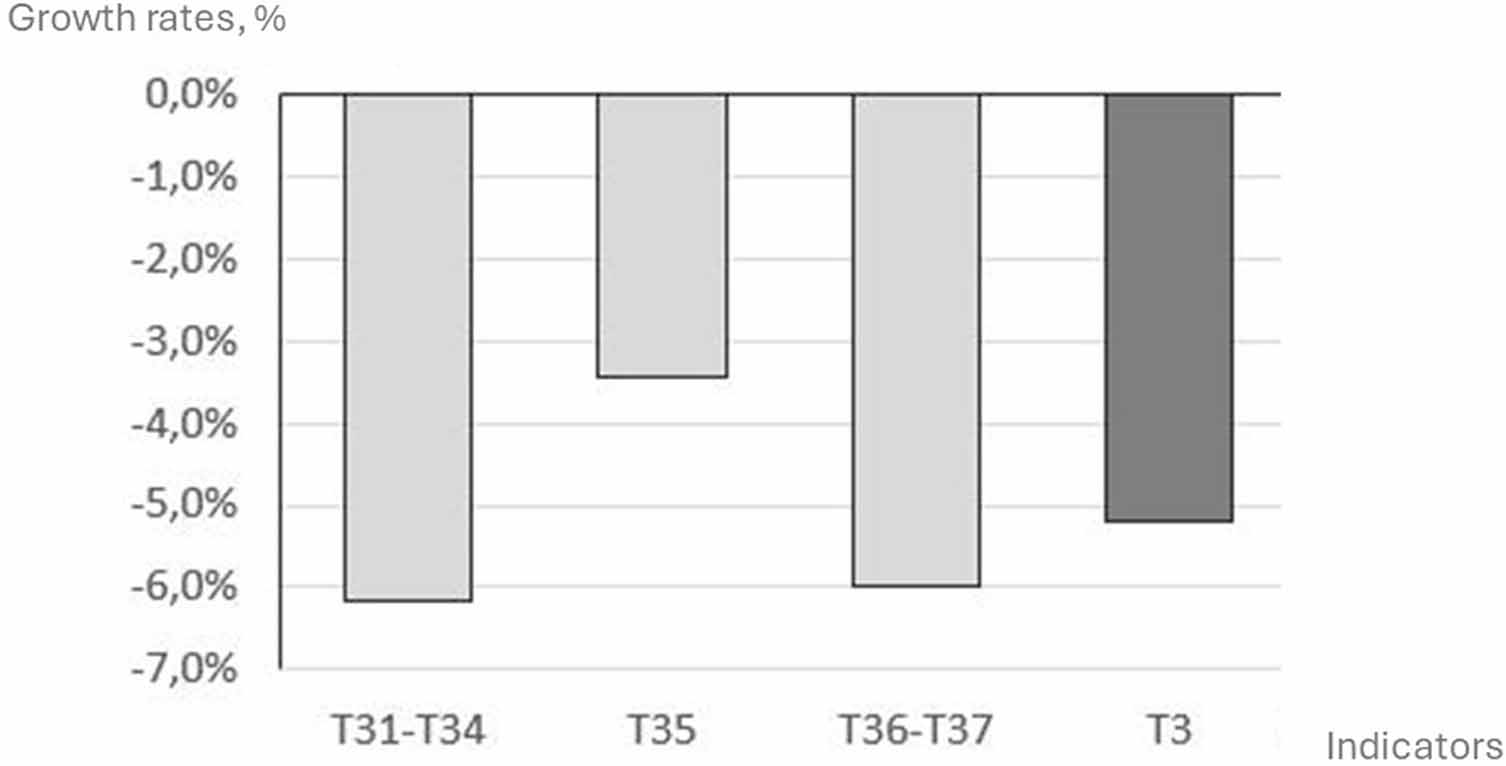
Figure 4.
Average annual growth rates of indicators of ecological resource intensity of products in Poland in 2010–2020.
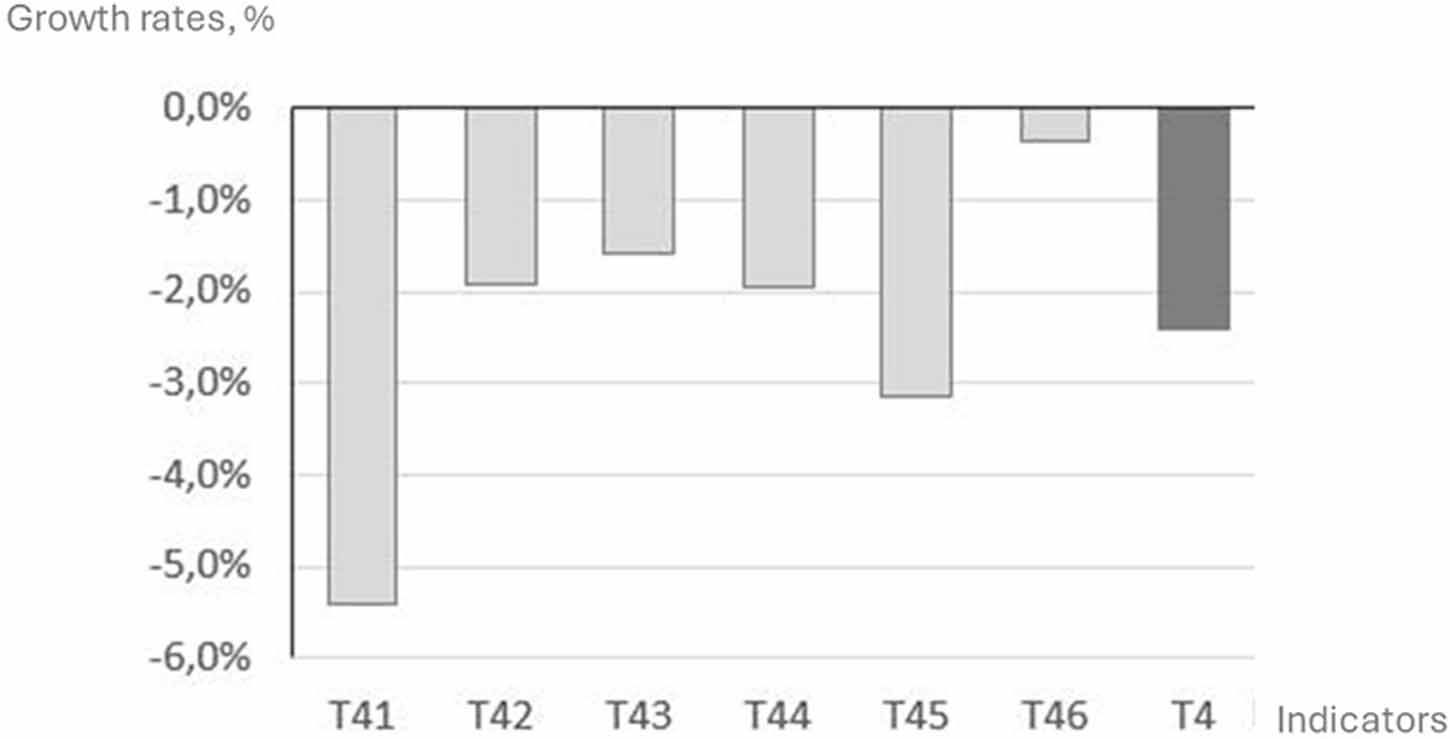
Figure 5.
Average annual growth rates of indicators of energy resource intensity of products in Poland in 2010–2020.
Based on the results of a comprehensive assessment, it can be concluded that in the last decade, the Polish economy followed a strategy of sustainable social and economic growth with a simultaneous reduction of the anthropogenic impact on the environment and improvement of the environmental friendliness of products. At the same time, regional development is not homogeneous and is related to the structure of production and labor resources. The assessment of individual indicators of each voivodeship according to the data of 2020 was carried out using the index method according to formulas (5) and (6).
where Kij, Kijq – relatively, is the j-th individual indicator of the sustainable development of i-th group in Poland in general and in q voivodship (province); Iijq – development index of the q voivodeship according to the Kijq indicator, relative to the national average level.The Iijq index calculated in this way shows the competitive advantages of the q voivodeship (province) according to the Kijq indicator. If Iijq > 1, this means the presence of such an advantage, if Iijq < 1 – lagging behind the national average level. Then, the summary assessment of regional development for each i-th group of indicators will be calculated according to the geometric mean formula (7).
where – the generalized index of competitive advantage of the q-th voivodeship (province) according to the i-th group of individual indicators.By analogy with (1), the first formula (7) is used in the case when the selected areas of assessment of sustainable regional development have the same priority, the second – if the expert wants to allocate a certain area with greater weight. In our case, the calculation was made according to the first formula. The results of the assessment of regional development indices according to the data of 2020 are shown in Table 1, columns (1)–(5).
Table 1.
Indices of regional sustainable development according to 2020 data
| Voivodships (provinces) | Social and economic development | Ecological burden of the regions | Ecological resource intensity of products | Total | Cluster |
|---|---|---|---|---|---|
| 1 | 2 | 3 | 4 | 5 | 6 |
| Dolnośląskie | 1.060 | 0.940 | 0.907 | 0.967 | I |
| Kujawsko-pomorskie | 0.837 | 1.259 | 1.401 | 1.139 | III |
| Lubelskie | 0.781 | 1.722 | 0.998 | 1.103 | II |
| Lubuskie | 0.843 | 1.591 | 1.686 | 1.313 | III |
| Łódzkie | 0.936 | 1.141 | 0.974 | 1.013 | I |
| Małopolskie | 0.953 | 0.977 | 1.285 | 1.062 | III |
| Mazowieckie | 1.391 | 1.070 | 1.448 | 1.292 | III |
| Opolskie | 0.852 | 1.571 | 1.178 | 1.164 | II |
| Podkarpackie | 0.781 | 1.808 | 1.555 | 1.300 | II |
| Podlaskie | 0.805 | 1.450 | 1.285 | 1.144 | III |
| Pomorskie | 0.979 | 1.285 | 1.717 | 1.293 | III |
| Śląskie | 1.007 | 0.405 | 0.723 | 0.666 | I |
| Świętokrzyskie | 0.787 | 0.886 | 0.414 | 0.661 | I |
| Warmińsko-mazurskie | 0.765 | 1.403 | 1.295 | 1.116 | III |
| Wielkopolskie | 0.995 | 1.356 | 1.395 | 1.235 | III |
| Zachodniopomorskie | 0.869 | 0.984 | 0.768 | 0.869 | I |
The data from Table 1 depicts the uneven regional social and economic, and ecological development. Also, among voivodeships (provinces) there is no clear leader or regions lagging behind others in all indicators. Despite this, certain voivodships (provinces) have common features of sustainable development, which can be identified by classification.
Paying sufficient attention to the unique economic, cultural, or geographical contexts of these regions it should be noted that in the economic context, Mazowieckie Voivodship (1.292) shows the highest index for social and economic development (1.391) and a relatively high ecological resource intensity of products (1.448). So, as the capital region, Mazowieckie benefits from significant economic activities, including a concentration of services, industry, and administrative functions. The high economic activity contributes to better social and economic development metrics. The substantial improvement in social and economic development is critical as it indicates robust economic growth and improved quality of life. However, it also leads to increased resource intensity, highlighting the need for sustainable practices in economic activities. As for policymakers, they should incentivize industries in this region to adopt green technologies and energy-efficient practices. Implementing stricter environmental regulations and offering subsidies for renewable energy projects could help reduce the ecological impact without hampering economic growth.
Małopolskie Voivodship (1.062) is known for its cultural heritage and tourism, so in the cultural context, Małopolskie has a balanced approach to sustainability. The region’s moderate social and economic development index (0.953) and ecological indices reflect its efforts to maintain cultural sites while promoting sustainable tourism. This balance is crucial for preserving the region’s cultural heritage while fostering economic growth.
Lubelskie Voivodship (1.103) has a high ecological burden of the region index (1.722) due to its extensive agricultural activities. The region’s fertile soils support intensive farming, which contributes to higher ecological burdens. Although the economic development index is relatively low (0.781), the severe ecological burden signifies a critical area where even minor improvements in sustainable agricultural practices could have a significant positive impact on overall sustainability. Efforts to implement sustainable agricultural practices could mitigate these impacts while maintaining productivity. As for sustainable agriculture initiatives, introducing sustainable agricultural practices, such as precision farming, crop rotation, and organic farming, can mitigate environmental stress. Training programs and financial support for farmers transitioning to sustainable methods will be crucial. Additionally, investing in research and development for sustainable agriculture technologies will support long-term improvements.
Kujawsko-pomorskie Voivodship (1.139) has high ecological resource intensity of products (1.401) suggesting a reliance on resource-intensive industries. While the social and economic development index is lower (0.837), policies aimed at reducing resource intensity could result in substantial long-term sustainability benefits, outweighing the smaller-scale economic improvements. Policies promoting energy efficiency and the adoption of green technologies in industrial processes could enhance sustainability metrics.
Podkarpackie Voivodship (1.300) with high ecological burden (1.808) and resource intensity (1.555), faces significant sustainability challenges. Targeted investments in renewable energy and sustainable land use practices could reduce these ecological pressures. Support for small and medium-sized enterprises (SMEs) in adopting renewable energy solutions will also be beneficial. Additionally, educational campaigns to raise awareness about the benefits of renewable energy can encourage community support and participation.
Śląskie Voivodship (0.666) has a low ecological burden index (0.405) but also a low social and economic development index (1.007). This indicates that while the region may not face significant environmental stress, there is a critical need for economic development policies that can boost social and economic metrics without compromising ecological stability. To boost economic development, the region should attract investments in clean energy and green infrastructure projects. Development programs focusing on education, vocational training, and innovation hubs can stimulate economic growth while maintaining ecological stability.
Mazowieckie and Pomorskie Voivodships benefit from strong economic activities and policies promoting industrial growth and technological advancements. The high indices in social and economic development (1.391 for Mazowieckie and 0.979 for Pomorskie) highlight the positive impact of national economic trends favoring innovation and infrastructure development. However, these regions also exhibit high ecological indices, necessitating policies that balance economic growth with environmental sustainability. A critical evaluation of these policies indicates a need for a more balanced approach that integrates both economic and environmental goals.
Scientifically based classification of research objects is carried out using the clustering procedure. The Euclidean distance indicator, formula (8), serves as a criterion for their unification into homogeneous groups or clusters.
where Dqz – Euclidean distance between voivodeships (provinces) q and z; αk – weighing coefficient of k-th indicator; and n – number of indicators.
The smaller the distance Dqz, the more the regions q and z have common features, which is the main prerequisite for their grouping into common clusters. The input parameter of the hierarchical clustering method is the accuracy of the classification R, determined by the expert. Its value affects the maximum permissible distance Dqz, when different objects can be combined into a single group. The classification quality is checked using the silhouette measure criterion, formula (9).
where SMi – silhouette measure indicator for the i-th voivodeship (province); SM – the averaged silhouette measure of the clustering performed; m – number of voivodships (provinces); Dmin,i – the distance of the i-th voivodship (province) to the center of gravity of the nearest cluster; and Di – the distance of the i-th voivodship (province) to the center of gravity of its own cluster.The silhouette measure of SM takes values from –1 to 1 and should approach the upper limit. This classification of regions will be considered more qualitative, since each of them will be located in close proximity to the center of gravity of its own cluster and at a significant distance from the others:
– SM ϵ [0,5; 1) – high quality of clustering;
– SM ϵ [0,2; 0,5) – an acceptable level of clustering, the results of which can be used in further research;
– SM ϵ [–1; 0,2) – the clustering result is unsatisfactory.
According to the data in columns (1–4) of Table 1, the clustering of regions was carried out with a classification accuracy of R = 8. As a result, 3 groups of homogeneous objects were formed, which are listed in column (6) of Table 1. The indicator of the silhouette measure SM = 0.49, which almost corresponds to the lower limit of the interval with a high quality of clustering. Therefore, the results of the conducted grouping can be used for the analysis of sustainable development in the regions.
The first cluster included voivodeships (provinces) such as Dolnośląskie, Łódzkie, Śląskie, Świętokrzyskie, and Zachodniopomorskie. Their distinguishing feature is the level of social and economic development close to the Polish average. However, the ecological resource intensity of products and the level of environmental pollution are significantly inferior to other regions. The reasons for this are both non-ecological production and its high concentration in small areas. This especially applies to the Śląskie and Świętokrzyskie voivodships (provinces).
The second cluster includes Lubelskie, Opolskie and Podkarpackie voivodeships (provinces) with the best level of ecological resource intensity of products. The center of gravity of the cluster in this direction of evaluation was equal to 1.7, compared to the average value for the economy, which is positive. The high environmental friendliness of production also contributed to the reduction of anthropogenic impact on the environment. However, according to indicators of social and economic development, these regions were 10%–20% inferior to others.
The third cluster included all other voivodeships (provinces). They are the main driving force of sustainable development in Poland, ensuring the country’s average level of social and economic indicators. At the same time, in terms of environmental friendliness, they often have an advantage of 20%–40%.
5. Conclusions
During the development and practical testing of the model for assessing sustainable ecological and economic development in Poland, the following results were obtained:
Criteria for sustainable regional development, involving the preservation and full reproduction of existing ecosystems for future generations, as required by the circular economy. According to them, regional socio-economic development should be accompanied by a simultaneous reduction in the anthropogenic impact on the natural environment, the energy and environmental resource intensity of social production.
These criteria allowed us to determine the appropriate system of indicators, which were tested according to the statistical data of Poland, during 2010–2020. The analysis of time series showed that in the last decade, the economy of Poland adhered to the strategy of sustainable ecological and economic growth. At the same time, regional development is not homogeneous and is related to the structure of production.
According to the results of the assessment of regional sustainable development using the method of cluster analysis, voivodships (provinces) were classified into three homogeneous groups. It was found that Dolnośląskie, Łódzkie, Śląskie, Świętokrzyskie, and Zachodniopomorskie (provinces) need additional measures to preserve natural environment, in particular, purification of atmospheric emissions and discharged water and implementation of waste reuse technologies. In addition, high indicators of ecological resource intensity of products require improvement of production technologies, from the standpoint of rational nature management, or structural restructuring, which involves a gradual rejection of traditional production in favor of highly ecological activities. Otherwise, it will be impossible to ensure sustainable long-term development of these territories. As for Lubelskie, Opolskie, and Podkarpackie voivodships (provinces), the results of the conducted analysis indicate that in order to ensure indicators of social and economic development, they need state support to increase the level of business activity and attract investment capital.
Thus, the model for assessing sustainable ecological and economic development in Poland on the basis of the circular economy concept was further developed in the study, which, unlike the existing ones, evaluates not only the dynamics of key indicators for the economy in general, but also takes into account the regional aspect using the index method and allows you to formulate recommendations for improving the ecological and economic condition of territories based on their clustering.
The results of this study can be extended and utilized in various fields, development of regional planning and development strategies. The model for assessing sustainable ecological and economic development can be applied in the formulation and implementation of sustainable development programs, as well as in the creation of standards and regulations that will help preserve ecosystems and improve the environmental situation in regions. The study has demonstrated the potential for use by investors and business structures to evaluate the environmental sustainability and investment attractiveness of regions. This will assist in making decisions about investing capital in environmentally friendly and sustainable projects. Additionally, this model can be valuable for international organizations and programs, such as the European Union or the United Nations, which address issues of sustainable development. It will aid in the development and implementation of international projects and initiatives.
As directions for further development, we also plan to consider and compare different weighting methods, such as expert assessments and the Analytic Hierarchy Process (AHP), to determine the most suitable approach for specific conditions. The discussion of potential implications and a comparative analysis of weighting methods will be included in future publications.