
1. Introduction
One of the basic tools for implementing various policies is, of course, the law. It is important that it be of adequate quality and that it be enforced efficiently. Within the subject literature, an interdisciplinary strand known as law & economics, which uses economic methods to analyze the current law and create new legal regulations, has been developed [Cooter and Ulen, 2016]. For example, an important determinant of the efficiency of the judicial system, alongside the quality of the law, is the duration of court proceedings [Mora-Sanguinetti, 2013]. Many authors suggest that even the best law that fully safeguards the interests of the participants in the proceedings will not ensure the efficient administration of justice if not effectively enforced [Richter, 2008; Lee et al., 2011; Smrčka et al., 2013; Smrčka et al., 2014; Shah et al., 2017; Detotto et al., 2019]. Although there are many studies on the efficiency of the common judicial system, the literature review has shown that in general, with very few exceptions [Bris et al., 2006; Covitz et al., 2006; Cepec et al., 2017; Smrčka et al., 2017; Kruczalak-Jankowska et al., 2019; Banasik et al., 2020], no research aimed at the identification of factors that determine the duration of insolvency proceedings has been undertaken. There is a need to fill the cognitive gap in this area for several reasons. Above all, the efficient management of insolvency proceedings has a positive impact on enterprise development [Fu et al., 2020] and the stability of the international financial system, and determines global economic growth [Plaček et al., 2016]. This has been recognized by EU regulators, who in recent years have increasingly taken steps to harmonize the insolvency law systems of EU Member States. An example of this can be the activities carried out within the auspices of one of the public policies, the so-called New Opportunity Policy1, which involves the promotion of the debtor’s interests and the priority of restructuring over bankruptcy.
The New Opportunity Policy aims to support entrepreneurs who, despite financial difficulties or even insolvency, still wish to participate in economic turnover [Tajti, 2018]. The New Opportunity Policy is a relatively new public policy. It is, however, a key policy which – if implemented effectively – would, in principle, solve the problem of companies at risk of insolvency and the negative consequences of their bankruptcy. The New Opportunity Policy applies a variety of measures designed to limit the risk of liquidation and smoothly conduct company bankruptcies and restructuring [Tokarski and Tokarski, 2019]. One such measure was the adoption of the so-called directive on restructuring and insolvency [Directive 2019/1023 (EU) of the European Parliament and of the Council of June 20, 2019 on preventive restructuring frameworks, on discharge of debt and disqualifications, and on measures to increase the efficiency of procedures concerning restructuring, insolvency and discharge of debt, and amending Directive (EU) 2017/1132 (2019)], which provides failing entrepreneurs with access to preventive restructuring frameworks at a sufficiently early stage. One of the main goals of this legislation is to prevent financially distressed entrepreneurs from bankruptcy and simultaneously in the case of honest insolvent or over-indebted entrepreneurs benefit from a full or partial discharge of debt after a reasonable period. Shortening the duration of insolvency proceedings is also a key factor affecting the implementation of the New Opportunity Policy. According to research conducted by Kruczalak-Jankowska et al. [2019], excessive lengthy bankruptcy and restructuring proceedings translate into low recovery rates and consequently render insolvency law inefficient. Smrčka et al. [2014] drew similar conclusions based on theoretical research. Therefore, it is important to determine whether insolvency proceedings in countries where the debtor-friendly New Opportunity Policy has been implemented are indeed more efficient, i.e., shorter.
The aim is to investigate the existence of a relationship between the efficiency of insolvency proceedings, as measured by their duration, and variables determining the severity/friendliness of bankruptcy law toward debtors. The study uses an original index – the Bankruptcy Law Severity Index (BLSI), introduced by Morawska et al. [2020], which includes a total of 10 variables concerning legal situation whose values were determined for 27 countries and a variable for one of the dimensions of efficiency of the proceedings, i.e., the duration of insolvency proceedings (Time; which is given in years). The quantitative analysis carried out in this paper is divided into three stages, the first stage includes the verification of dependencies between explanatory variables and the response variable Time, and then between the independent variables themselves. This allows for the identification of the relationships that are relevant to the study and the determination of the variables used in the subsequent stages. The next step was the estimation of panel regression models, which made it possible to quantify the impact of the explanatory variables on the efficiency of proceedings in each country. The study is complemented by Granger causality analysis, which confirmed the causality of variable impact.
Apart from the introduction, the article consists of the following sections: a literature review, research methodology, research results, and conclusions. The first section, based on an analysis of the literature, introduces the factors affecting the duration of court proceedings, with particular emphasis on insolvency proceedings. The next stage shows how the low efficiency of insolvency proceedings can influence the situation of creditors, debtors, and consequently the economic processes. The methodology section presents the course of the study, including the method of data selection and information on the research period and research methods. Subsequently, the results of the research, which are mainly in the form of models, are presented. The article ends with conclusions drawn from the research undertaken, based on which relevant practical and social implications are presented. Moreover, the limitations of the research and proposed directions for further research are also provided.
2. Literature review
2.1. Factors affecting the duration of proceedings in common courts
Existing research on the determinants of the duration of court proceedings primarily concerns civil and criminal proceedings. The literature review allowed for the identification of five main determinants of the efficiency of proceedings pending in common courts, i.e., the complexity of the legal system, as measured by the number of laws in force [Epstein, 1997; Vereeck and Mühl 2000; Di Vita, 2010; Economides et al., 2013]; a judge’s workload index [Lind et al., 1991; LoPucki, 2005; Di Vita, 2010; Örkényi, 2012; Aysun, 2015]; case complexity level [Luskin and Luskin, 1987; Sipes et al., 1988; Goerdt, 1992; Chan and Barnes, 1995; Spurr, 1997; Heise, 2000; Wan and Weatherburn, 2017], the level of wealth in society [Messick, 1999; Aldashev, 2009; Di Vita, 2010; Arltová et al., 2016]; and legal culture [Economides et al., 2013]. An increase in the level of the first three factors has a negative impact on the duration of court proceedings. As claimed by Economides et al. [2013] and Di Vita [2010], with an increasing number of laws in force and the related increasing complexity of the legal system, the duration of court proceedings becomes longer. According to research conducted by Di Vita [2010] and Oliveira et al. [2017], the greater the number of cases to be heard by a judge, the longer the duration of the court proceedings conducted by that judge. In contrast to the above studies, LoPucki [2005] and Aysun [2015] concluded that as the workload of a judge increases, they spend less time resolving each case, which in turn reduces the average duration of the proceedings. Meanwhile, Örkényi [2012] pointed out that in addition to the number of cases to be resolved, a judge’s workload is also influenced by the level of complexity of the cases, as expressed by the total judicial working time needed to resolve the case. Lind et al. [1991] reached similar conclusions. Furthermore, research conducted by Wan and Weatherburn [2017] and Wan and Weatherburn [2017] in the NSW District Criminal Court shows that the duration of criminal proceedings differs significantly not only due to the type of case but also the level of complexity (e.g., proceedings pertaining to corporate crimes have a longer average duration than crimes related to social security fraud). These conclusions are in line with the results of previous studies [Heise, 2000; Vereeck and Mühl, 2000; CEPEJ, 2006; Jiang, 2006].
According to Di Vita [2010], apart from the above-mentioned factors, the duration of court proceedings is also affected by the level of citizens’ wealth, as measured by GDP per capita and consumption levels. The author claims that the duration of court proceedings becomes shorter as the level of wealth in society increases. These conclusions are in line with the theory proposed by Djankov et al. [2003] according to which courts, like many other public institutions, operate more efficiently in economically developed countries. The average duration of court proceedings is also determined by the local legal culture which, in addition to formal practices and rules of conduct, consists of, inter alia, deeply rooted attitudes of lawyers and judges [Economides et al., 2013]. In particular, this concerns the level of strictness of judges in their approach to compliance with procedural and court time limits among the participants in the proceedings [Gallas, 1976; Sipes et al., 1988; Blacksell et al., 1991; Ostrom et al., 2005].
However, there is a dispute in the literature as to whether the increased number of judges reduces the duration of court proceedings or indeed has precisely the opposite effect. Supporters of administrative reforms promoting wide access to justice suggest that as the number of judges increases, the duration of court proceedings shortens [Connolly and Planet, 1982]. This conclusion, however, was criticized by Priest [1989] and Posner [1972], among others. According to their theory, as the number of judges grows, so does the supply of judicial services. The public begins to perceive them as an attractive form of dispute resolution, and as a result, demand for such services grows. Ultimately, in the long term, reform consisting of increasing the number of judges may prove ineffective.
Smuda et al. [2015] reached interesting conclusions when examining the relationship between the level of severity of sanctions and the duration of appeal proceedings in cartel cases. According to the authors, imposing lenient sanctions in return for cooperating with the judicial authorities increases the efficiency of court proceedings, because competent authorities acquire information on the actual status of the case earlier. In view of the fact that the study quoted concerned only one type of court proceedings, it is necessary to build on the research conducted by Smuda et al. [2015] and cover different types of proceedings in order to obtain reliable results on the impact of sanctions on the duration of court proceedings.
2.2. Factors affecting the duration of proceedings in bankruptcy courts
Previous studies on the efficiency of insolvency proceedings in economic terms mainly concerned the effectiveness of bankruptcy courts [Buscaglia and Ulen, 1997; Schneider, 2005; Mitsopoulos and Pelagidis, 2007; Rosales-Lopez, 2008; Voigt and El-Bialy, 2016]. As already indicated, there is a large gap in research on the determinants of the duration of insolvency proceedings. The literature review revealed that only a limited number of studies provide knowledge about the determinants of the efficiency of insolvency proceedings. According to Kruczalak-Jankowska et al. [2019], the professional experience of the judge or official receiver has a crucial impact on the duration of insolvency proceedings, which is only subsequently affected by the time limits for the resolution of the case guaranteed by law. Moreover, according to the authors, even if insolvency proceedings become excessively long but result in the satisfaction of creditors, they should not be deemed ineffective. Similarly, according to Cepec et al. [2017], the duration of insolvency proceedings is affected by the professional experience of the receiver. In turn, a study conducted by Smrčka et al. [2017] concludes that, by analogy with civil proceedings [Di Vita, 2010], the duration of insolvency proceedings is positively affected by the GDP per capita index, the increase of which results in the improved efficiency of bankruptcy courts. Covitz et al. [2006] found out that in the case of restructuring proceedings, there is a nonlinear relationship between the time firms spend restructuring and firm value, which means the existence of optimal execution time for these proceedings. According to Bris et al. [2006], the duration of restructuring proceedings of smaller and bigger enterprises is, however, differently correlated with the size of the debtor’s assets. A negative relationship was recorded for the former, while a positive relationship was observed for the latter.
2.3. Weakening the position of creditors as a result of the prolixity of insolvency proceedings
Prolonged court proceedings are a problem for many countries, including highly developed ones [Djankov et al., 2006]. The unnecessary prolixity of insolvency proceedings makes creditors more willing to seek conflict resolution outside the judicial system, for example through agreements with debtors [Gilson et al., 1990; Morrison, 2008; Boughanmi, 2017]. According to García-Posada and Mora-Sanguinetti [2012], in view of the low efficiency of bankruptcy courts, agreeing with the debtor is more cost-effective for the creditor than the judicial recovery of debts. Research conducted by Mruk et al. [2019] in Spanish bankruptcy courts shows that creditors more often decide to initiate court proceedings in those regions where the effectiveness of the judicial system is higher. Creditors are also more likely to resolve disputes amicably because the process of out-of-court restructuring is, in principle, shorter than formal insolvency proceedings [White, 1983; García-Posada and Mora-Sanguinetti, 2014; Yemelyanov, 2017]. According to research conducted by Cepec et al. [2017], the longer the insolvency proceedings, the higher the costs, which, in turn, are financed from the assets of the debtor; hence, the growth in this figure results in lower satisfaction among creditors [Smrčka et al., 2014]. Another reason why prolonged court proceedings are unfavorable to creditors is that the better informed of the disputing parties – in the case of insolvency proceedings, usually the debtor [Smrčka et al., 2017] – can more easily force the other party (in this case, the creditors) to accept a resolution that is unfavorable to them or even withdraw from the dispute [Galanter, 1974]. According to research conducted by Aysun [2015], if bankruptcy proceedings take a long time, a bankrupt entrepreneur withdraws from economic turnover gradually, thus not triggering financial shocks e.g., for their contractors.
The literature review allowed for the identification of a gap in research on the determinants of the duration of insolvency proceedings. The findings of previous research make it possible to conclude that the duration of insolvency proceedings is, along with the quality of insolvency law, an important determinant of the effectiveness and productivity of commercial courts, and thus also of the efficiency of the New Opportunity Policy, the core assumption of which is shortening the duration of insolvency proceedings.
3. Empirical research
3.1. Methodology
Keeping in mind the identified research gap, the study aims to verify the relationship between the efficiency of insolvency proceedings and the variables describing the level of severity/friendliness of insolvency law toward debtors. This will make it possible to identify the factors that affect the efficiency of insolvency proceedings and consequently positively influence the implementation of the New Opportunity Policy. The study covered 27 countries, i.e., EU member countries (Austria – AT, Croatia – HR, Estonia – EST, Finland – FI, Greece – GR, Lithuania – LT, Latvia – LV, Sweden – SE, Germany – DE, Bulgaria – BG, the Czech Republic – CZ, France – FR, Spain – ES, Poland – PL, Portugal – PT, Romania – RO, Slovakia – SK, Slovenia – SLO, Hungary – HU, Denmark – DK, the Netherlands – NL, Ireland – IRL, Italy – IT), the United Kingdom – UK (small EU countries and countries for which the authors were unable to obtain information about insolvency law were not included), the United States – USA, Canada – CA, and Australia – AUS. The last three countries are characterized by a relatively high level of efficiency in insolvency proceedings, which is why they were included in the study along with European countries. The response variable, illustrating the efficiency of insolvency proceedings, is the duration of insolvency proceedings (Time; given in years). Information on this variable for individual countries is derived from the Doing Business – Resolving Insolvency database of the World Bank [Doing Business, 2020]. The explanatory variables are the original Bankruptcy Law Severity Index along with the 10 factors included therein, i.e., sanctions for failure to file for bankruptcy in the required period or for the debtor’s lack of cooperation with the court (variable: Sanctions); the suspension of bankruptcy proceedings in the event of an application to open a restructuring proceeding; the number and types of restructuring paths; regulations regarding the release from debts after the end of bankruptcy or restructuring proceedings; accelerated restructuring and/or bankruptcy path for small and mediumsized enterprises (SME) entrepreneurs; pre-pack regulations; debtor in possession regulations; new financing regulations in bankruptcy and restructuring proceedings; the maximum time allowed for filing a bankruptcy petition upon the occurrence of the premise (variable: The maximum time allowed for filing a bankruptcy petition); and the rules for voting among creditors on a restructuring plan or arrangement. In line with the BLSI concept, the explanatory variables in the models take values from the bilaterally closed interval [0,1], where: 0 – debtor-friendly insolvency law, 1 – harsh insolvency law (unfriendly for debtors) [Morawska et al., 2020]. The cross-sectional data used in the study comes from 2019, which stems from the fact that research on the BLSI index was conducted by the authors based on the insolvency laws in force at the end of 2019. Moreover, the World Bank stopped issuing the Doing Business reports, resulting in the lack of access to data for subsequent research periods.
The first step was conducting Pearson’s correlation analysis, which allowed for the identification of the factors that are relevant to the response variable Time and was aimed at an appropriate selection of explanatory variables for the estimated models. In addition, the statistical significance of the correlation of the variables used in the study was tested at the α = 0.01 level, using the Student’s t–test. The statistical null hypothesis of the test implies a correlation of zero, against the alternative hypothesis that it is statistically significantly different from 0. The form of the test is shown in Eq. (1) [Aczel, 2000].
where: t(n–2) – test statistic, r – sample correlation coefficient, n – sample size.
In the next step, pooled panel regression models were suggested and estimated using the Classical Least Squares Method (CLSM). These are static models based on 2019 cross-sectional data for the 27 countries analyzed in this study. Linear regression (including forward stepwise regression) was used in the design of the models, which was expected to identify the type of model that best describes the analyzed phenomenon based on the data used. Moreover, the Granger causality analysis was conducted based on the two-step procedure proposed by Osińska [2008]. Firstly, this procedure consists of verifying the statistical significance of the parameters of variables in the model using the Student’s t-test (H0:αi = 0), and then testing the causality of the whole vector X using the F-test (H0: α1 = α2 =⋯ αi = 0). Therefore, these models can verify the relationship between variables, but also confirm the direction of the impact of the variables.
3.2. Results
In the first stage of the study, a correlation analysis was conducted between explanatory variables and the response variable Time, the results of which are shown in Table 1.
Table 1.
The correlation analysis of BLSI with the response variable Time
| Statistical significance | Time (years) | Correlations |
|---|---|---|
| *** | 0.5341 | Sanctions for failure to file for bankruptcy in the required period or for the debtor’s lack of cooperation with the court (Sanctions) |
| 0.0846 | Suspension of bankruptcy proceedings in the event of an application to open restructuring proceedings | |
| –0.1840 | Number and types of restru | |
| 0.2781 | Regulations regarding the release from debts after the end of bankruptcy proceedings or restructuring proceedings | |
| –0.2245 | Accelerated restructuring and/or bankruptcy path for SME entrepreneurs | |
| 0.1111 | Pre-pack regulations | |
| –0.2049 | Debtor in possession regulations | |
| –0.3743 | New financing regulations in bankruptcy proceedings and restructuring proceedings | |
| *** | 0.6240 | The maximum time allowed for filing a bankruptcy petition upon the occurrence of the premise (The maximum time allowed for filing a bankruptcy petition) |
| 0.1319 | Rules for voting in creditors over a restructuring plan or arrangement | |
| 0.1738 | BLSI |
Given the data shown in Table 1, significant correlations with Time at the level α1 = 0.01 were found for the following explanatory variables: The maximum time allowed for filing a bankruptcy petition (positive correlation, the highest of the factors analyzed) and Sanctions (positive correlation). In the case of the other explanatory variables, there was no significant statistical correlation with Time at the level adopted in this study α. Therefore, the independent variables such as Sanctions and The maximum time allowed for filing a bankruptcy petition were included in further research. The interpretation of the above-mentioned results for the countries and groups of variables under analysis leads to the conclusion that the efficiency of insolvency proceedings due to their duration depends mainly on the level of sanctions for not filing a bankruptcy petition or not cooperating with the court and on the maximum time allowed for filing a bankruptcy petition. Both stricter sanctions for debtors and more restrictive (i.e., shorter) time available to file for bankruptcy upon the occurrence of the premise means that it takes longer to complete insolvency proceedings.
The use of explanatory variables distinguished based on correlation testing in a single model entails examining the relationships between them. Due to the linear form of the model used in the next part of the study, it was necessary to conduct a correlation analysis of the distinguished factors of the BLSI, namely Sanctions and The maximum time allowed for filing a bankruptcy petition.
The analysis of the correlation data reveals that due to the relatively high and significant correlation (0.67, significance level 0.01), the variables such as Sanctions and The maximum time allowed for filing a bankruptcy petition cannot be explanatory variables at the same time. In view of this, the analysis was further based on two univariate models containing only one of the above-mentioned variables on the right side of the equation – Models 1.1 and 1.2 shown below.
In Model 1.1, the variable Sanctions is statistically significant. Moreover, the fit of R2 is >28%. An interpretation of the estimated parameters allows one to conclude that a theoretical increase in Sanctions by one unit will result in an approximate increase in the variable Time by 1.84 years. Certainly, such a large change in the explanatory variable is largely only theoretical, since the explanatory variables in this study adopt values from a both-closed interval [0,1]. Therefore, the explanatory variable included in the model provides a type of relative measure of sanctions in the countries under analysis. In Model 1.1, the Granger causality can be further confirmed in a two-step process, based on the significance of the parameter estimate for Sanctions (Table 2 – p-values <0.01 and the estimate of the F-test statistic, which allows one to conclude the statistical significance of the combined effect of all explanatory variables on the response variable. This analysis provides evidence for the assumptions of this study regarding the direction of the impact of Sanctions on the response variable Time. The data used in Model 1.1 are shown in Figure 1.
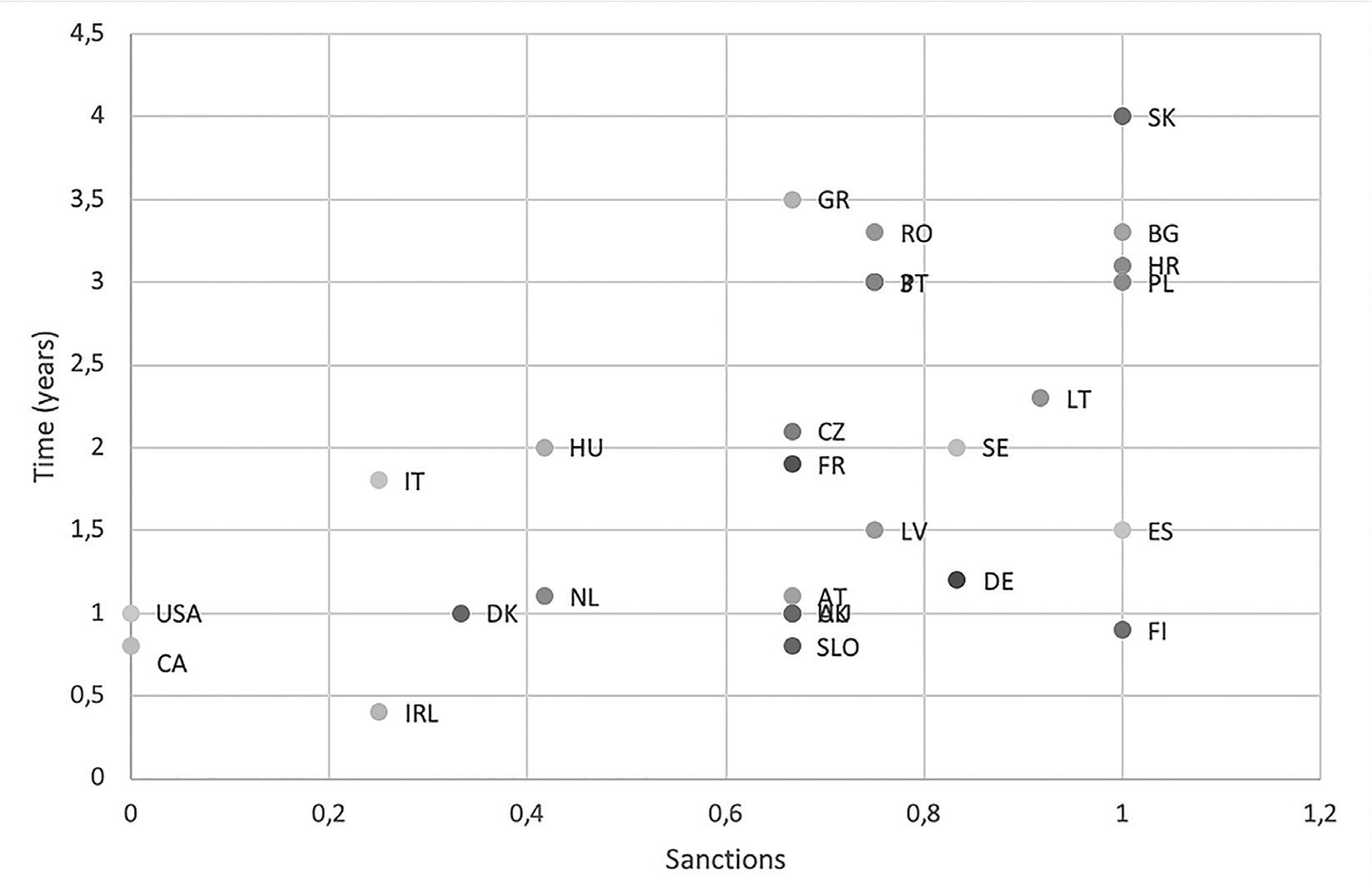
Figure 1.
The relationship between Time and Sanctions for the countries under study.
Source: Authors’ own work.
Table 2.
Model 1.1 parameters for the dependent variable Time
| Coefficients | Standard error | t-stat | p-value | |
|---|---|---|---|---|
| Intercept | 0.68842603 | 0.42261232 | 1.62897767 | 0.11585559 |
| Sanctions for failure to file for bankruptcy in the required period or for the debtor’s lack of cooperation with the court (Sanctions) | 1.84255798 | 0.58328899 | 3.15891097 | 0.00410886 |
| R2 | 0.285279705 | |||
| F Statistic | Significance F | |||
| F | 9.9787185 | 0.00410886 |
In the next stage of the study, the model was estimated for the dependent variable Time and the independent variable The maximum time allowed for filing a bankruptcy petition - Model 1.2.
Model 1.2. A study of the effect of The maximum time allowed for filing a bankruptcy petition on the dependent variable Time.
For Model 1.2 (Table 3), the significance of the independent variable is also found, and the Granger causality is confirmed via a two-step process (based on the statistical significance of the variable and the F-statistic), which leads to the conclusion that The maximum time allowed for filing a bankruptcy petition is indeed the cause of changes in the dependent variable Time. However, Model 1.2 has a better fit to the data compared to Model 1.1 (R2 of nearly 39%). The parameter analysis allows us to find, based on Model 1.2, a positive effect of The maximum time allowed for filing bankruptcy petition on Time. Moreover, any theoretical increase by a measure of one unit will increase the variable Time by 1.39 years. The data used in Model 1.2 are shown in Figure 2. In view of the above, the combined analysis of Models 1.1 and 1.2 allows the researchers to simultaneously analyze the impact of both factors on the efficiency of proceedings.
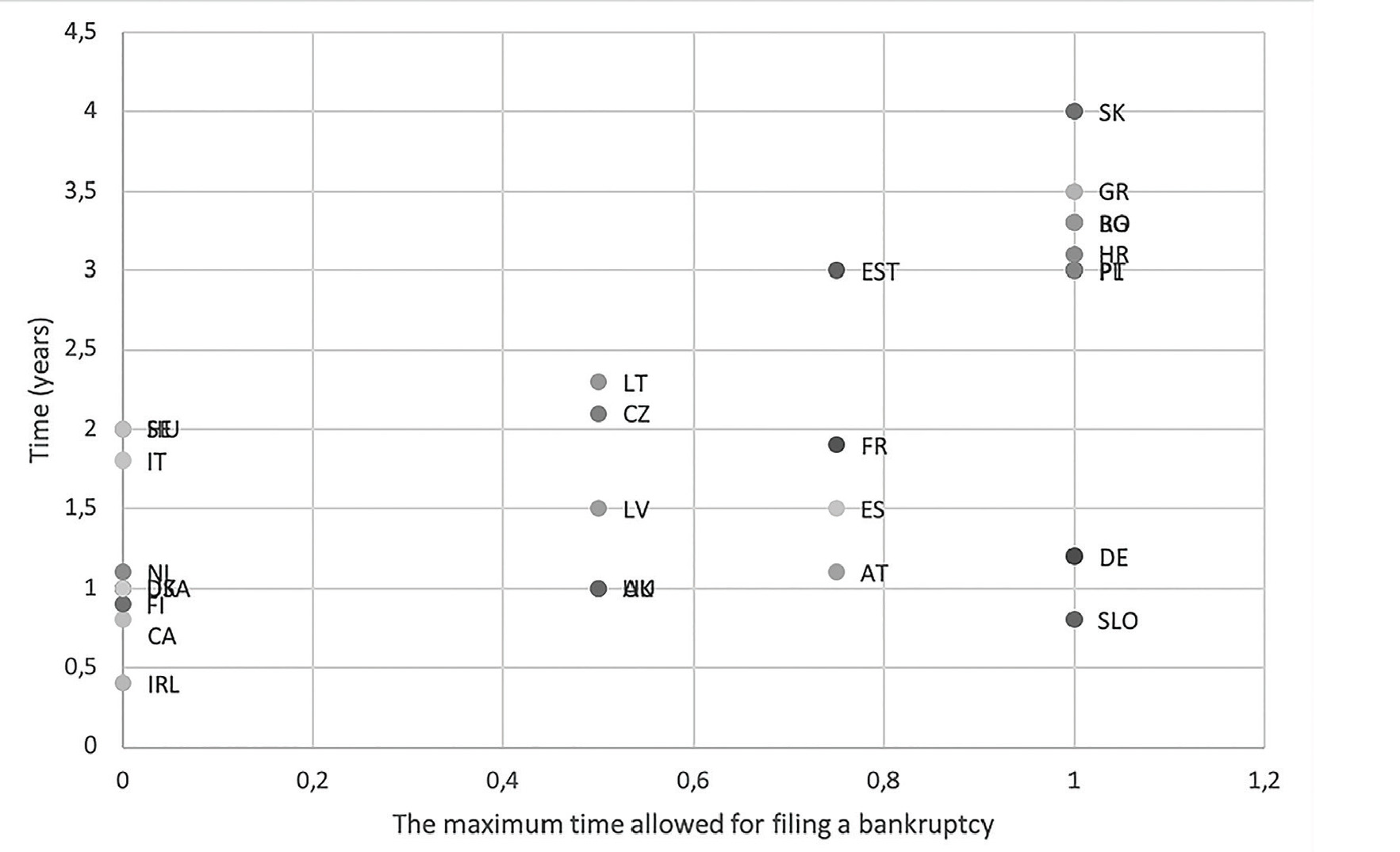
Figure 2.
The relationship between Time and The maximum time allowed for filing bankruptcy petitions for the countries under study.
Source: Authors’ own work.
Table 3.
Model 1.2 parameters for the dependent variable Time
| Coefficients | Standard error | t-stat | p-value | |
|---|---|---|---|---|
| Intercept | 1.10618861 | 0.25538722 | 4.3314172 | 0.00021075 |
| The maximum time allowed for filing a bankruptcy petition upon the occurrence of the premise (The maximum time allowed for filing a bankruptcy petition) | 1.49882122 | 0.37534103 | 3.99322511 | 0.00050414 |
| R2 | 0.389437465 | |||
| F-statistic | Significance F | |||
| F | 15.9458468 | 0.00050414 |
In the next step, based on the remaining BLSI and forward stepwise regression, an attempt was made to extend Models 1.1 and 1.2 to include additional variables; however, the estimation results were not satisfactory due to the insignificance of additional variables, so the conclusions in this article were based on the initial Models 1.1 and 1.2. It should be noted that the estimated models are based on panel data and, consequently, average the impact of individual variables for the entire panel, not taking into account other factors that are not included in this study. This means that countries with positive response variables (Time) may, in special cases, have explanatory variables at 0 (Sanctions or The maximum time allowed for filing a bankruptcy petition).
4. Conclusions
The study reveals that for the countries under analysis, there is no relationship between the measure of severity/friendliness of bankruptcy law toward debtors (BLSI) and the efficiency of insolvency proceedings (Time). However, in-depth research reveals that two specific factors that describe BLSI are affected by their impact on the length of time taken to complete insolvency proceedings:
The less stringent the conditions concerning the time to file a bankruptcy petition, the shorter the duration of insolvency proceedings.
Less severe sanctions have the effect of reducing the amount of time it takes to complete insolvency proceedings.
Sanctions for failure to comply with the deadline for filing a bankruptcy petition generally exist in those countries that have chosen to regulate the deadline for filing a bankruptcy petition. Countries that do not specify a filing deadline have no sanctions for noncompliance either. Hence, these two factors are closely related. The introduction of the requirement to file a bankruptcy petition and the deadline for its filing, as well as sanctions and their extensive nature (criminal, administrative, and civil law sanctions), determine the strictness of the bankruptcy law. In terms of strict – pro-creditor – bankruptcy law, the regulator intends to shape an attitude in entrepreneurs that is beneficial to the protection of creditors’ rights. This attitude is often in conflict with the interests of the entrepreneur – a debtor, who may want to continue the business at all costs, considering it the source of their and their employees’ livelihoods. Undoubtedly, an entrepreneur (manager) considers filing for bankruptcy a failure associated with loss of reputation and conducting a successful restructuring process as a success.
The findings indicate that introducing a requirement to file a bankruptcy petition, as well as setting a deadline for filing this petition and sanctioning this order, into the regulations is not entirely advisable because proceedings take longer as a result. Managers should decide for themselves at what point to file for bankruptcy – when it makes economic sense to do so, not when it is forced by legal considerations. Forcing a bankruptcy petition to be filed and a deadline for filing this petition may have a deterrent effect on managers, making them less likely to disclose that the company is in poor financial condition (and thus lengthening the proceedings). Sanctions, especially the inevitability thereof, can function as a deterrent to managers. It may turn out that even if a bankruptcy petition is filed, the court may find that the deadline has not been met. Such a situation could expose managers to sanctions. To minimize the risk of incurring sanctions, managers may delay filing for bankruptcy, even when it makes economic sense to do so.
On that basis, it is suggested that the EU regulator’s activities under the New Opportunity Policy be directed toward relaxing the legal requirements for filing a bankruptcy petition, the deadline for filing it, and consequently sanctions for failure to file on time. Business failures are part of how the market works. The steps taken by the EU regulator should focus on strengthening the efficiency of sanctions against those who deliberately drive themselves into insolvency, thereby avoiding the need for repayment of liabilities. Such efforts distort the market, thereby making it intentionally more difficult to enforce contracts.
There are also some limitations associated with the study. The present study was based on data from a single period and covered only a limited number of countries. This is due to the extremely limited access to some data, or indeed the lack thereof, and the fact that few countries translate their bankruptcy and restructuring laws into English.
Notes
[6] The New Opportunity Policy responds to the needs of companies that have fallen on hard economic times and require support in the process of change. The New Opportunity Policy is an aid program directed to entrepreneurs in a difficult economic situation. November 12, 2020 by decision on. Public Aid C(2020)7937 European Commission approves extension of aid program New Opportunity Policy to 2021-2026. State aid under the program is addressed to micro-, small, medium, and large enterprises. For large entrepreneurs, it is obligatory to notify public aid to the European Commission.
Support is granted within aid instruments:
1) Rescue aid.
2) Temporary restructuring support.
3) Aid for restructuring.