
1. Introduction
In the last decades, the Polish economy has been experiencing strong economic growth and increasing social welfare. Improved purchasing power expanded the products and services demand and lifted economic standards as well as social conditions. Also, private passenger cars ownerships moved into the spotlight of normal “average” persons and to the middle of society. Increasing supply of producer-dependent and independent car dealers allowed, together with better financial capabilities, larger population shares for emancipation from former public transport restrictions. The “promise of individual mobility” appealed to the people in Poland as much as in the other European transition economies after 1990. However, in the following decades, the Polish car market development was mainly driven by the influx of old-aged cars, whereas the new cars segments remained in a minor position. As a result, despite the increased individual mobility, the Polish car stocks aged substantially, with negative consequences with respect to traffic safety, individual health, and the environment. The main factors for this regressive development are seen predominantly, first, in the expansion of the used cars imports and, second, in high new cars prices. Against this background, the present paper analyses the Polish passenger car market developments with a focus on new cars since 1999 (Chapter 3). Results indicate the lack of long-run growth of new passenger cars registrations in Poland. In nonperfect markets, price discrimination by suppliers can, according to the economic theory, improve the market supply efficiency and thus, increase social welfare. Hence, optimal discrimination may also contribute to the new cars market developments in Poland (Chapter 2). By means of developing a suitable framework for the analysis of Polish new car prices (Chapter 4), the present paper identifies regional price discrimination patterns for new passenger cars in 2004–2021 in Poland with respect to Germany as the reference market (Chapter 5). The observed price discriminations are analyzed for their economic impacts on car market developments (Chapter 6). Finally, the analysis closes by summarizing the analysis findings (Chapter 7). The major contributions that this analysis has made to the economic literature include: First, the long run analysis of the Polish car market development in the period 1999–2019. Second, the empirical analysis of price discriminations in the car markets, citing the example of regional discriminations between Poland and Germany in the period 2004–2021. Third, the analysis of the impacts the price discrimination has had on the car markets development, in general, and here with respect to the regional discriminations between Poland and Germany. Economic literature still lacks an analysis with in-depth insights linking the observed price discrimination patterns in new cars with market developments. Hence, the present paper serves to explore this gap using the example of Poland. The data sources used are Eurostat, Główny Urząd Statystyczny (GUS), Deutsches Statistisches Bundesamt (Destatis), and Deutsches Kraftfahrtbundesamt (KBA). New car prices in 2004–2011 are based on the monitoring of the European Commission’s new cars markets and in 2012–2021, they are based on the author’s surveys. The present paper applies quantitative methods for the data analysis.
2. Price discrimination and its role in the new passenger car markets
Price discrimination is a common strategy of a firm’s price policy in various product and service markets and is widely analyzed in economic literature [e.g., Pigou, 1920/1932; Machlup, 1955; Mussa and Rosen, 1978; Schmalensee, 1981; Holmes, 1989; Knetter, 1993; Armstong et al., 1995; Corts, 1998]. It is defined as a firm’s supply of a homogeneous good to different purchasers at different price conditions and without legitimation on the basis of cost differences [Helmedag, 2001, p. 10]. Separate from price discrimination is product differentiation, which characterizes the supply policy for goods based on different costs, such as different prices for cars with standard paintwork and for those with chargeable paintwork options. The suppliers’ potential to differentiate prices is based on several conditions, e.g. market power. Hence, monopolists apply price discrimination to maximize profits by consumer surplus absorption [Pindyck and Rubinfeld, 2003, p. 523 f.]. They expand the goods quantity, thereby increasing economic welfare due to larger availability. However, price discrimination is bound to comprehensive arbitrage prevention, first, among customers and, second, based on customer selections concerning available goods options [Tirole, 1999, pp. 292–294]. Here, suppliers consider the constraints for incentive compatibility of price–quality combinations offered in product portfolios. Accordingly, Pigou suppliers adapt to market conditions by choosing personalized pricing (first-degree differentiation), product versioning (second-degree differentiation), or group pricing (third-degree differentiation) [Pigou, 1920/1932, Chapter XVII § 5, p. 201]. Enterprises exercise command on different discrimination patterns: regional discrimination, temporal discrimination, discrimination based on objective grounds, and personal discrimination [Woll, 2003, p. 244], with each of the overlapping areas between specific forms. In some product markets, blurring boundaries between price discrimination and product differentiation are found. Producers can also combine price discrimination and information discrimination [Wei and Green, 2022]. For profit maximization, suppliers segment markets either in the horizontal or the vertical perspective (deglomerative vs. agglomerative differentiation) [Helmedag, 2001, p. 11f.; Woll, 2003, pp. 245–251]. Price discrimination redistributes consumer surpluses from consumer segments with smaller price elasticities of demand to more price elastic-reacting consumers and to monopolists [Tirole, 1999, p. 304]. Hence, we find besides positive allocation effects, the distribution effects also, which can be subject to political market regulations. However, to examine the welfare impact, comparisons of consumer surplus losses in low-elasticity segments with gains of consumer surpluses in high-elasticity segments and monopoly profit increases are required. Distributive price discrimination regulations can cause welfare losses, e.g., monopolists can restrict high-elasticity market segments supply and, hence, harm society. In contrast, efficient application of price discrimination patterns by enterprises can enhance the supply of products and services on markets, thereby improving the welfare position of a society through the better availability of valuable goods. However, in practice, economic policy succumbs to temptations of distributive arguments in especially if they are accompanied by normative perfect markets visions and almost always not compatible to real market situations. In Europe, policymakers assumed that the realization of the European Single Market would create a mechanism whose forces would converge with commodity prices. Hence, the success of the competition policy is indicated by EU price convergence. But, in light of price discrimination, uniform price axioms are misleading if transaction costs and inhomogeneous consumer preferences exist. However, the EU competition policy adhered to the uniform prices credo and monitored the product prices in EU markets regularly [Dominguez-Torreiro and Becker, 2016, p. 16], among others of new passenger cars in the period 1993–2011 [EU Commission, 2004-2011]. After the monitoring reports confirmed certain convergence of car prices and increased market transparency, further monitoring declined. However, according to research analysis, discrimination is still prevailing in the European Union. Thus, Degryse and Verboven (2000, p. 20 f.) found in the year 2000, significant systematic price differentials for new cars in the European Union, and other analyses confirm these results. Dvir and Strasser (2017, p. 33 f.) analyze EU price dispersions between 2003 and 2011 and find signs of systematic manufacturer’s price discrimination manipulating the menus of included car features by bundling strategies. Comparable results refer to Ginsburgh (1997, p. 20), explaining major price differentials by exemptions from Article 85 of the European Common Market Treaty. Gual (1987) investigates EU car price disparities determinants, finding value-added tax differentials and import restraints as the most important factors, but transportation costs as not being significant. Radoias (2016) finds hints on direct and indirect car price discrimination in the EU automotive sector. Other studies find car dealers’ price discrimination based on individual clients’ characteristics [D’Haultfoeuille et al., 2014, p. 31 f.]. To summarize, empirical studies find large evidence of price discrimination in the EU new car markets, some with further explorations of its economic determinants. According to these studies, in the automotive sector, especially, personal and regional price discrimination is important. However, long run discrimination analyses still lack for post EU car price monitoring in 2011. Also, with respect to Poland, no discrimination analysis with the evaluation of the domestic car market impacts is available; hence, after an analysis of the Polish passenger car market development in 1999–2011, the present paper fills this gap using a price discrimination case study for 2004–2021.
3. Passenger car market in Poland 1999–2019
Development in transition of the Polish car market mirrors a socio-economic success story of a strong and growing Polish economy. Dramatically increasing registered passenger car stocks reflected prospering economic welfare as well as raising individual mobility needs [GUS, 2004–2021]. Since 1999, there were only 9.283 million registered cars. In the following years, unit numbers increased fast. In 2001, the 10 million registrations milestone was reached; in 2007, nearly 15 million; in 2014, 20 million; and in 2019, 24.360 million vehicles were registered. The largest car stock expansions were experienced in Poland in 2000–2008, fostered by EU accession in 2004, with maximum growth by 10.2% in 2008. After this, market expansion slowed down with an average annual growth by 4.7% in 2009–2019, in comparison with 6.3% previously. During the first years after transition, prior backlog needs fostered rapid market expansions as a major driver. In the following years, the market showed stable growth with no signs of saturation. In total, registered car stocks expanded in 1999–2019 by a considerable 162%, with a average annual growth by 5.44%. At the transition outset, the market economy’s welfare promises seemed fulfilled, at least in terms of individual cars disposals.
A more differentiated picture provides the analysis of the car market against international backgrounds, which reflects population sizes thereby giving insights into coverage rates. Measured by registered passenger cars per the 1,000 inhabitants indicator, Poland experienced impressive catch up growth with respect to western European countries in the long run [Eurostat, 2021]. In 1990, coverage rates were found to be 138 cars per 1,000 inhabitants comparable with other transition countries. In 2019, Poland was placed with 642 cars per 1,000 inhabitants and ranked third in Europe, and hence, is disposed today with one of largest coverages in Europe. However, on the downside, rapid cars stocks development in Poland also caused problems. A major issue is with regard to the age of the registered cars and is intensively discussed in Poland [Wybór Kierowców, 2018]. During transition, cars stocks experienced continuous aging that accelerated after EU accession. As a result, Polish society also faced immense social costs due to growing motorization in favor of old cars, characterized by increased environmental pollution with resulting health injuries, and also rising traffic accidents with injured persons, road fatalities, and property damages caused by the lack of safety standards. This aging process illustrates the analysis of the cars age compositions in 2003–2019 [GUS, 2004–2021]. Before the EU accession, in 2003, young cars (up to 2 years of age) represented with 638,188 vehicles as the second smallest market segment before very old cars (from 31 years up). Until 2019, young cars numbers increased by 5.2% per annum to 1,412,619 units (5.80% of total cars stock) at decreasing shares (with minimum of 3.80% in 2011) (own calculations on the basis of GUS, 2004–2021). The smallest segment in 2019 were the relatively young cars (between 3 and 5 years of age), which covered in 2003 with 1,406,197 vehicles and having a share of 12.5%. However, it experienced until 2019 with only 1,323,901 registered cars, a drastic share decline by −0.37% per annum to 5.4%. Dramatic consequences are visible in higher cars age segments. In 2003–2019, medium age segments shares (6–10 years of age and 11–15 years of age) declined jointly from 25.3% to 14.3%, respectively, to 19.9% to 16.3% and covered in 2019 only 30.6% altogether. However, the most serious consequences of market changes were observable in the old car segments. There, 16 to 20-years-old vehicles expanded shares from 15.1% to 20.2%, 21 to 30-years-old cars from 18.3 to 22.2, and the oldest cars segment above 31 years increased even from 3.3% to 15.7%. In 2019, 14,143,990 cars (58.1% of cars stocks) were older than 15 years in comparison with 4,122,544 units (36.7%) in 2003. In 2019, in Poland, 90% of the registered cars exceeded the age of 5 years, that is, they are associated with increased technical exhaustion, lowered safety standards and increased fuel consumption and pollutants emissions. The major factor of aging cars stocks is the expanding inflow of used cars from abroad after the EU accession [GUS, 2013b–2020b; PIBJA, 2020]. Polish EU accession with customs barriers abolition in car markets leveraged the used cars imports to high levels. Imports shot up from 35,736 units in 2003 to 828,142 in 2004, and retained afterward large dynamics (maximum 1,103,970 in 2008; minimum 617,695 in 2015). Since 2004, the used cars imports of almost 820,000 units per annum provided a considerable supply channel to the Polish cars market and established an affordable alternative to the new cars segment with respect to product prices. In 2003–2019, 13,131,117 used cars of mainly higher ages were imported to Poland, thereby not only fostering comprehensive cars coverages, but contributed also to problematic cars stock age compositions that induce excess economic and social costs.
Large used cars inflows affected the market development in Poland strongly [GUS, 2004–2021]. From 2003 to 2004, the first registrations increased from 176,028 by 373.2% to 833,021 units (own calculations on basis of GUS, 2004–2021), with a continuation of growth until 2019. In 2008, the intermediate peak 1,280,633 first registrations were recorded; however, only 317,912 or less than 25% concerned new cars (GUS new cars registrations statistics are available since 2008). In the following years, the cars market revealed almost stable differentials between the first registrations and the first new cars registrations. Although there were substantially higher growth rates of new cars first registrations by 9.4% per annum than of first registrations (5.5%) in 2010–2019, the new cars segment dynamics were not sufficient to reduce the distances to the total market. In 2019, the first registrations amounted to 1,453,505 units, where 555,598 out of them were new cars (38.2%). However, in the current years also, some improvements were recorded. In 2016, for first time, above 400,000 new cars were registered in Poland and in 2018, more than half a million units, hinting on the ongoing structural changes in the passenger cars market with, potentially, a more prominent role for the younger cars segments.
However, solely new cars registrations provide only limited insights into the longer-term market developments that are dominated by cars age compositions of the total stock. New passenger cars registrations shares at total passenger cars stocks allow for more concrete impact evaluations of the new cars segment in the market (own calculations on the basis of GUS, 2004–2021). In 2008–2019, the new cars first registration shares were retained in Poland at very low levels, developing, after the first decline until 2010, from 1.98% to 2.3%. With this minor position, the new cars first registrations influenced cars market developments only on a marginal basis and, hence, achieved in the long run no significant effect on stock age compositions. Seen against international backgrounds, the new cars minor role in the Polish cars market becomes evident. Comparing with Germany as the neighbored and the largest European cars market, Poland trailed in 2008–2019 with considerable lags in the new cars first registration shares, ranging from 5.52 to 5.4 percentage points behind this reference [own calculations on the basis of Destatis, 2021a, 2021b; KBA, 2021a, 2021b]. The above findings suggest structural reasons for the new cars minor role in the Polish cars market. According to the economic theory in the stream of Industrial Economics, major economic determinants can be found in factors describing market structures, market conduct, or market performance [Schmidt, 2005, pp. 56–62]. In the case of the new cars market, they are constituted among others by consumer preferences, supply capacities, potential substitutes, market structures, and resulting market power. However, one of the most decisive factors for product purchases is price, that is, both, applied as an instrument in the market conduct and also as a market performance result and indicator. Hence, this contribution analyses new cars price structures in Poland as important factors for potential demand impacts. Excessive prices in the car markets induce frictions, hampering new cars market developments. In a case study, new cars prices in Poland are examined on regional price discrimination. For this, Germany as the largest European car market is used as a reference market due to the market size, maturity, and market depth as well as for strong closeness to and exchange with the Polish market.
4. Analysis design of new cars market prices
Price discrimination by suppliers is applied for profit maximization of products and services sales. One common form is regional discrimination based on the local markets division. The analysis uses an author’s price dataset for Poland and Germany from 2004 to 2021. Data for 2004–2011 stem from the European Commission car price monitoring [EU Commission, 2004–2011]. After Poland’s EU accession in 2004,the Polish car market prices were also covered by the EU monitoring scope until 2011, where monitoring was declined for reasons of workable competition on the European new car markets [EU Commission, 2021]. However, comparison of car retail prices in Poland and Germany in 2004–2011 still revealed considerable differentials that hint on regional discrimination patterns in both the countries. To analyze further pricing structures, an author dataset collected recommended retail prices of new cars of the main brand car models in Poland and Germany from 2012 to 2021 in annual surveys. Data contain the most popular car models of the five largest suppliers in Poland in basic entry level versions adjusted for additionally chargeable feature options. Models selection is based on the polish market shares but also considers long-run analysis consistency, which is especially important with respect to occurring model changes between 2004 and 2021. For bilateral comparisons, prices are adjusted for different equipment of national versioning, e.g., air conditioning, and in case of deviating technical configurations, like engine version or car body construction, commonly available models at the lowest price range are selected. Compared with complex modern diesel aggregates, the productions costs of gasoline engines as well as market prices for new gasoline driven cars are lower; hence, they represent the lowest entry costs cars segment available for customers among comparable models. As a result, collected car prices refer with minor exceptions to gasoline models. The new cars customers majority still adheres, according to registration statistics, to traditional car segments. Most car sales in 2019 were registered in small cars, followed by compacts and medium-sized cars (according to German car classification: Kleinwagen, Kompaktwagen, and Mittelklasse; according to European car classification: with some overlaps categories B, C, and D). Hence, price monitoring for analysis focused on these main segments. For long-run comparability analysis, the focus was on most popular models of main suppliers. Five producers with the largest new registrations in 2011–2021 were selected: Ford with 30,132 cars in 2019, Opel with 33,805, Volkswagen with 53,845, Toyota with 62,771, and Skoda with 68,646 units [GUS, 2011c–2021c]. For analysis, the supplier data are anonymized and referred as producers 1, 2, 3, 4, and 5. Data originating from the EU Commission car price monitoring in Poland in 2004–2011 are converted back into Polish currency on the basis of annual ECB reference rates. Data for the following years stem from market surveys in Poland and Germany on brands websites. The resulting final dataset is referred to as Car Price Database 2004–2021 and contains the time series of recommended retail prices of selected car models of Top 5 suppliers in Poland and Germany in domestic currency (presentation of cars analyzed as well as descriptives statistics of price data available at author on request).
5. Analysis of new car prices and regional price discrimination in Poland 2004–2021
In the following, first, a descriptive empirical analysis of new car prices in Poland in 2004–2021 is applied. Second, regional price discrimination between Germany and Poland in the above-described car segments as well as for defined producers are analyzed. Finally, the main findings are summarized at the end of the chapter. In all segments, the average prices increased in the whole period substantially, but not steadily. In the first period 2004–2018, the average prices of all cars oscillated in a narrow array of 65,000–70,000 PLN, afterward witnessing rapid growth by 30.4% until 2021 (own calculation on the basis of the Car Price Database 2004–2021). This fast expansion was contributed by especially medium car prices with increases by 32.2%. For the whole period 2004–2021, however, the annual growth was still moderate at 2.7%. Lower car segments contributed less to general price increases. Compact cars recorded in 2004–2018 even negative average price developments by −4.3%, followed by an increase in 2018–2021 by 23.3%. Hence, in total, compact prices grew by a small 1.1% per annum, which is the smallest increase of all car segments. The most volatile price developments were confronted by small car customers, with average price decreases in 2004–2018 by 12.2% followed by an increase by 37.1% in the following years, what equals an annual growth rate of 1.2%. In sum, the largest, but still moderate price increases, were recorded by medium-sized cars, reflecting changes in demand toward larger cars driven by increased purchasing power in Poland. However, the general average prices of new cars increased only by small rates. Car prices in Poland reflect the producers’ product price policy, and also when producers contributed differently to the general trend. In 2004–2021, all the producers increased the average prices considerably (own calculations on the basis of the Car Price Database 2004–2021). However, producers’ policies differed in terms of price levels and dynamics. As an example, the cars prices of producer 5 converged in 2004 close to more expensive brands at average price rank 4. In 2009–2014, the producer’s prices increased substantially, thereby advancing its products to be the most expensive. Finally, in 2017–2020, products of the producer recorded the smallest average prices among competitors. In contrast, other producers applied more stable price policies. Prices of producer 4 models assumed high levels during the whole period, whereas those of producer 1 maintained low levels. With respect to price dynamics and final price positioning, in 2004–2021, producer 3 recorded the largest price increases by 53.5% to 94,533 PLN, followed by no. 5 with 30.7% to 88,797 PLN, no. 4 with 26.6% to 88,837 PLN, no. 2 with 25.8% to 88,590 PLN, and no. 1 with the smallest increase by 17.6% to 81,617 PLN. The observed producers’ price segmentations are associated also with certain public brand recognitions thereby attributing products from the budget range to the premium model range, and they may differ between Poland and Germany partially. In this context, the model prices of producer 3 are remarkable, which advanced in 2004–2021 from the budget to the premium level; however, price shifts are underpinned by strong upgrading efforts of equipment features so as to increase the leads in the competition field. To analyze car prices based on regional price discrimination applied by producers’ prices in Germany, they are converted with EUR–PLN ECB annual reference rates into Polish currency and the tax is adjusted. Hence, differences between resulting car prices in Germany and Poland are indicators for regional price discrimination by car producers. The relevant analysis of the results of car prices in both countries in 2004– 2021 revealed no convergence of prices, and they differed substantially. In 2004, the average price differential between Germany and Poland was 13,428 PLN, which was reduced in the first period after the Polish EU accession to −902 PLN in 2008 by a short reversal of regional price advantages. However, they widened again in the following years to 24,989 PLN in 2021 (own calculations on the basis of the Car Price Database 2004–2021). The average price differentials of the car segments between Germany and Poland in 2004–2021 (see Figure 1) were, with minor exceptions, positive. Hence, the same car models were costlier in Germany, with the largest differentials in medium-sized cars and were the smallest, since 2009, for small cars. Price differentials decreased in 2004–2008 and expanded in the following years. Out of all the segments, the largest differential increases were experienced by compact cars in total by 13,910–21,875 PLN in 2021, followed by medium-sized cars with increases by 5,506– 26,953 PLN, and small cars by 3,234–14,105 PLN. In relative terms, compacts also recorded with a huge lead the largest increase by 175.6% in the whole period, deriving from a 138.0% decrease in 2004–2008 and an 824.5% expansion in the following years. The second following segment of small cars revealed substantially a smaller growth of price differentials by a total 29.7%, with −119.9% in 2004–2008 and 762.2% in 2008–2021. Not much lower than for small cars, mediums recorded total increases of differentials in 2004–2021 by 25.7% (’04–08: –88.6, ’08–21: 1,036%), keeping price differences in the positive range for the whole period. In sum, results reveal persistent regional price discrimination for new cars between Poland and Germany at the aggregated market level as well as in the monitored cars segments. Prices in Poland are, with minor exceptions in 2008, smaller than in Germany. The largest discrimination concerns medium-sized cars, followed by compacts and small cars. According to results, price differentials vary during time and have increased in 2004–2021 substantially, especially for compact cars. Focusing on producers’ average price, the differentials analysis results reveal a clear general trend (see Figure 2). Differentials developed in 2004–2008 a sharp decrease jointly, recording for Producers nos. 1, 4, and 5 even negative values in 2008, and followed by strong increases until 2021, with remarkable recovery from crisis in the year 2009 (own calculations on basis of Car Price Database 2004–2021). Also, if differentials applied by single producers varied in the whole period substantially, pricing was for most cases strictly oriented with the next competitors. However, despite the interdependent price policies, some producers revealed persistent price discrimination patterns. Producer 3 applied in 2004–2021 stronger regional discrimination than others by retaining larger differentials. In contrast, producer 4’s differentials remained almost in the lower range of the competitors. Hence, the average model prices in both countries did not differ as much for other brands. Also, in terms of differential dynamics, this producer was the least active with differentials increasing by 4,037 PLN or 23.4% in 2004–2021 to the final 21,301 PLN. Out of all, the largest dynamics recorded by producer 2 with strong increases by 189.6% or 18.384–28,082 PLN in 2021.
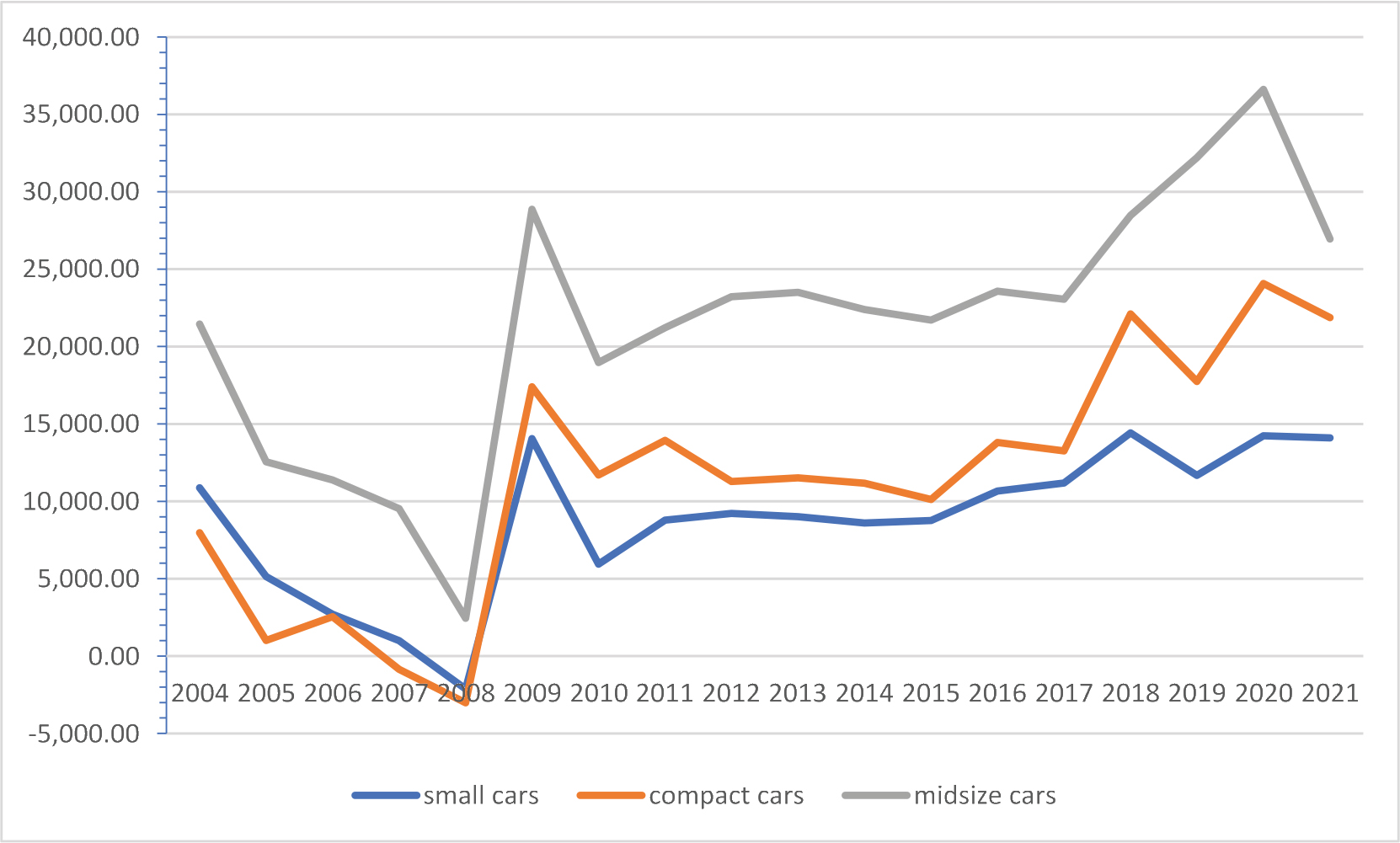
Figure 1.
Average price differences for purchases abroad (Germany) of new passenger cars in the segments of small cars, compact cars, and mid-sized cars in Poland 2004–2021, with basic entry-level models of the five largest producers (PLN).
Source: own calculations and depiction on the basis of the Car Price Database 2004–2021.
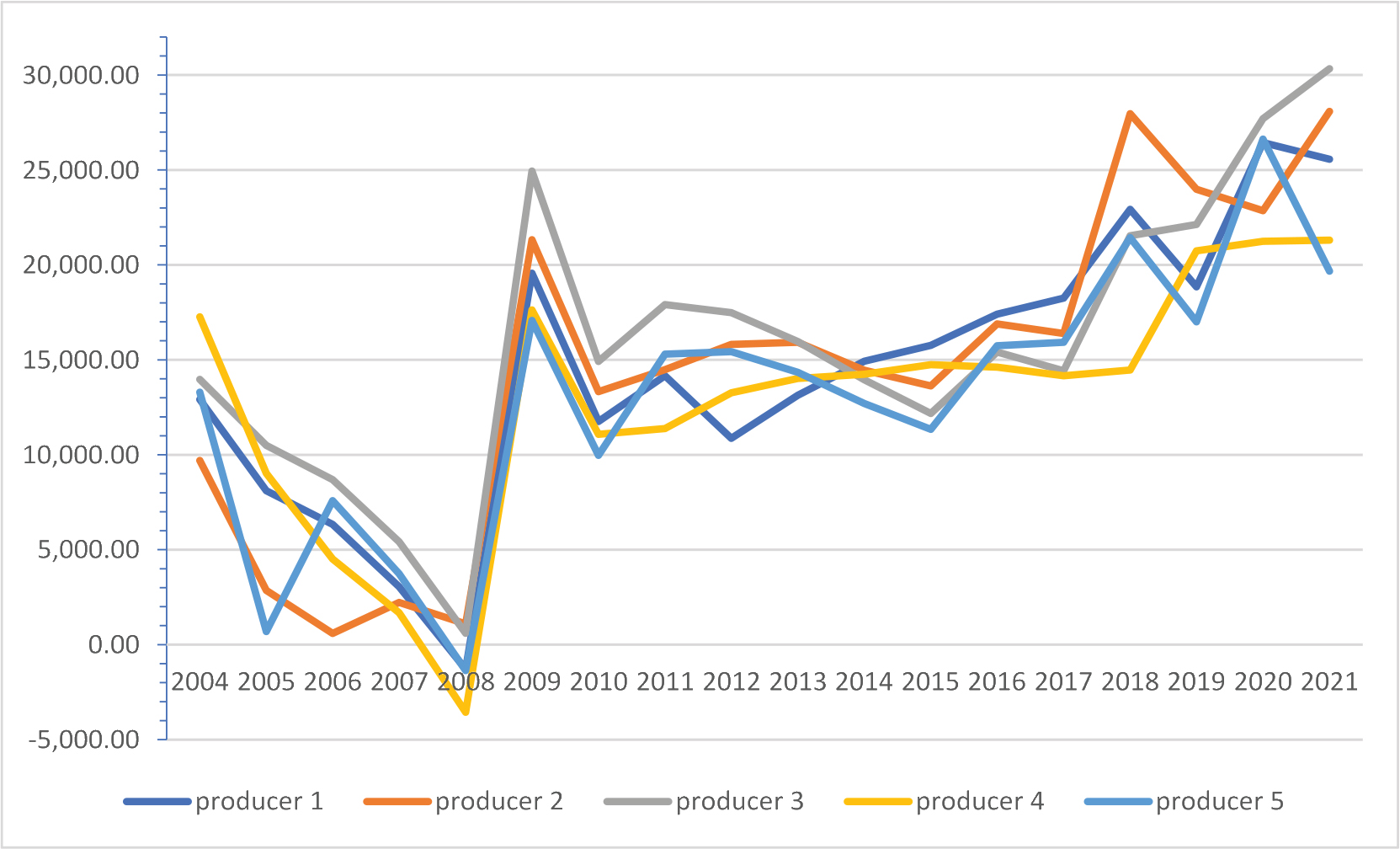
Figure 2.
Average price differences for purchases abroad (Germany) of new passenger cars of the five largest producers in Poland 2004–2021, for basic entry-level models in the segments of small cars, compact cars, and mid-sized cars (PLN).
Source: own calculation and depiction on basis of Car Price Database 2004–2021.
Pricing of this producer developed from the smallest discrimination applied in 2004 to being the second-largest discrimination among competitors in 2021. The second-largest discrimination dynamics recorded producer 3. Its price differentials increased by 117.2% or 16,366 PLN to 30,331 PLN. Comparable dynamics were experienced by producer 1, which increased differentials by 98.0% or 12,652 PLN to 25,566 PLN. Like for producer 4, producer 5 was the second supplier with a pricing policy combining relative small discrimination levels with small dynamics. Still maintaining in 2004, a large discrimination with differentials of 13,297 PLN, the producer reduced relative discrimination intensity in comparison to its competitors by slowing down the differentials’ annual dynamics. These increased in 2004–2021 by a moderate 47.9% or 6,371 PLN to 19,668 PLN. As a result, in 2004–2021, the producers’ average price differentials were, with minor exceptions, positive, indicating persistent regional price discrimination patterns between Germany and Poland, which increased during time that challenged assumptions of price convergence by markets. Some producers (nos. 2, 3, and 1) tightened their pricing policy with time substantially, whereas others increased differentials only at a lower pace. Among competitors, some producers apply strong discrimination policy, observable in persistent large differentials (no. 3); others apply price discrimination only to a lesser degree (no. 4). The results indicate that the regional price discrimination applied by producers for new cars as a prevalent market phenomenon and as a common producer practice at least since 2004, with smaller prices in Poland than for equivalent model versions in Germany. The largest differentials are revealed for lead medium-sized cars, followed by compacts and small cars. Producers interact in their pricing in an interdependent way closely with their near competitors, resulting in joint price differentials adjustments that can be described as ex post collusive pricing behavior. The observed increases of price differentials with time indicate also the growing influence of price discrimination on the new cars market in Poland. Hence, they lead to market impacts of producers’ price policy as discussed in the following.
6. Results and Discussions
The analysis results show that for the Polish car market in 1999–2019, expensive cars endowments with strong increases of registered cars. Similar to 2019, Poland revealed the third rank in the EU of registered cars per thousand inhabitants. However, fast-growing cars endowments were accompanied by challenges, e.g., increasingly problematic age composition of registered cars stocks. Since 2003, the average car ages increased continuously transforming the Polish cars stock into a rolling veteran cars museum. One major cause is the large used cars imports from western European countries; hence, inflows of mostly higher aged vehicles contributed negatively to the aging process of total cars stocks. Secondly, the numbers of new cars at first registrations in Poland are only small, such that even in the long run, no age composition impact on the total market is visible. Given the fact that from an economic perspective, one major product demand factor is product price, the new car price development in Poland strongly influences customers purchasing decisions, hence, contributing also to long-term age compositions of registered car stocks. According to results of the analysis, new cars prices in Poland recorded strong increases in 2004–2021 for all segments and main producers, but in especially in the medium-sized segment. To verify regional price discrimination in Poland for observed cars segments and producers, price differentials for equivalent car models in Germany, as the European reference market, and Poland were analyzed. Here, all segments and producers showed patterns of substantial discrimination with positive differentials increasing during time, hence indicating intensifications of applied discriminations between both countries by moving car prices in Germany away from those in Poland. Findings suggest that discriminating producers adjust prices according to national markets systematically, with smaller prices in Poland to cope with differences in the structural market characteristics, e.g., purchasing power and consumer preferences or competition intensity. Following the economic theory, price discrimination can improve the market supply; hence, the applied discrimination could contribute to new cars demand in Poland. However, as described above, new cars first registrations in Poland still lag in the long run, far behind the used vehicles. New cars shares at total car stock are found only marginal. At first glance, counterintuitive seen against empirical backgrounds of Poland, the above discrimination analysis results provide specific insights into producers’ price policy as applied in both neighbored car markets. Also, if the disclosed discrimination pattern reveals individual producers’ motivations to improve supply conditions by price adjustments to regional markets, then the discrimination efficiency depends on the basic conditions. First, the producer’s ability to prevent arbitrage transactions between markets with different prices has major a influence on discrimination efficiency. Increased producers’ price differentials widen also third parties arbitrage potentials. Hence, incentives to profit from price differences increase as long as transaction costs of arbitrage are lower than the price differences. Competition by arbitrage forces suppliers to adjust car prices toward a uniform level in both national markets. As a result, producers have strong incentives to apply efficient price differentiation between Poland and Germany, thereby, improving supply conditions in Poland but, at same time, seeing themselves confronted with price competition by arbitrage dealers. One of the major producer instruments to serve and control their product markets and fight arbitrage are brand dealer networks. In both countries, most producers dispose, beside of separate importers infrastructures in case, on regional networks of brand authorized dealers with privileged supply conditions on basis of contractual commitments in exchange for compliance with producers intra-dealer and retail business policies. The latter apply, in general, among others to recommended retail prices, discounts, chargeable options pricing, car financing, or related mobility services. However, a strict supply control to maintain producers’ regional price discrimination between Poland and Germany is challenged by dealers with access to new brand models and, hence, they possess the opportunity to serve gray product markets [Cespedes et al., 1988]. This is with respect to especially brand-independent dealers; but, potentially, brand network dealers may also have incentives to act as free riders by undermining maintenance of recommended retail prices if there is a prevalent principal agent problem in the brand dealers’ network. With respect to Poland’s car market, a serious friction for efficient price discrimination by producers in this context is due to especially reimports of new cars from lower priced markets to those with higher prices, according to the above-given analysis results, from Poland to Germany [for analyses of reimports in economic literature, see e.g. Malueg and Schwartz, 1994; Maskus, 2000; Szymanski and Valletti, 2005; Grossman and Lai, 2008]. Professional market observers, like the German Automobile Club ADAC, estimate price advantages for reimport by new cars purchasers in Germany of up to 30% [ADAC, 2023] or higher [Bussgeldkatalog, 2023]. In addition, specialized digital online services have improved market transparency and lower transaction costs for reimports substantially [Autoblog-im.net, 2017], turning the former exotic market niches into competitors taken more and more seriously by official dealers’ networks. Since 2009, all new large-volume cars in the EU with vehicle type approval receive Certificates of Conformity (COC), currently according to Regulation (EU) 2018/858, which standardizes technical requirements and, hence, facilitates registrations in the other member states [EU, 2018]. Factual but also potential threats of reimports restrict producers’ ability of regional price discrimination in Poland if arbitrage-prevention opportunities are limited. The latter would impose structural increases of transaction costs on both segmented markets that exceed arbitrage gains. Potential transaction costs barriers could consist, e.g., of legal, organizational, or technical measures to maintain producers’ market segmentations. However, de facto market restrictions infringe principles of the European Single Market policy [European Parliament, 2023a] and its free movement-of-goods rule [European Parliament, 2023b]. But, they can also contradict market efficiency concerns and competition policy. Hence, in market economies, potentials of producers’ price discrimination (must) find their limitations in a balance to the positive welfare effects of workable competition found on free markets. As a result, given a certain new cars price level in Germany as the reference market, potentials of regional discrimination are limited with effect of smaller price differentials in Poland. Producers adjust to the above-described obstacles to optimal market segmentation by less intensive price discrimination measures. Hence, as a (negative) consequence, prices in Poland are by tendency higher than in cases without impediments that hampers consumer demand for new cars. As second major factor, among others is that the producers’ discrimination abilities are influenced also by market power exercise in terms of competition parameters, e.g., product prices, quantities, supply and retail conditions, discounts, or qualities. Analysis results reveal that the car prices in Poland in 2004–2021 became highly interdependent in the competition field. Producers’ brand products compete in their market segments intensively on price basis. Hence, producers’ new cars pricing and applied price differentials reflect near competitors’ price policies changes. In result, the market for new cars in Poland shows close joint developments of car prices and differentials in respective segments indicating workable competition with a limitation of single producers’ market power. Domestic price competition can even distort producers’ regional discrimination efficiency by coercing lower market prices and larger differentials than in autonomous discrimination cases under consideration of potential arbitrage transactions. Consistent with the above-mentioned aspects are empirical results of price differentials increases of new cars in Poland that are associated with both, price discrimination patterns applied by producers to improve supply conditions by adapting to regional market characteristics as well as with competition forces coercing larger price differences to the German market. However, after 2018, the polish car market recorded also substantial price increases, after a long period of relative price stability, which challenge price-reducing effects of market competition and raise awareness for market power exercises in new cars segments. From the perspective of regional price discrimination, increasing domestic cars price levels counteract arbitrage transactions by reducing their profit potential. In Polish new cars market characterized by nonprohibitive transaction costs and frequent arbitrage design of producers’ price policies, it is required to balance both, measures of regional market expansion by price discrimination and, simultaneously, limitations of arbitrage potentials by controlling excess differentials. If this scenario applies to all producers, price competition effects are limited to the partial deceleration of product prices increases only. Hence, impacts of regional price discrimination patterns on the new cars market deviate from optimal supply policy substantially. Here, the automotive industry has several options for future supply policy design at its disposal. To mention three strategic aspects as examples: First, support intensification of applied regional price discrimination by national product versioning may improve allocation. Instruments use by automotive suppliers will enhance in scope by electromobility transition and digitalization. Second, improvement of tailor-made financing provisions can compensate efficiency losses in suppliers price policy that is especially important in markets with margins declining under price competition pressure. Third, expansion into downstream value creation, like intermodal transport or mobility services financing, promotes business by improved diversification as well as scale and network effects. Today, the automotive industry stands at its historic turning point challenged by rapid technological change, ongoing market transition, and changed public awareness. Hence, adequate response requires careful and balanced foresight in decision-making in close cooperation of industry and policy. With respect to effects on new cars demand in Poland, the above analysis results show that, despite the observed regional discrimination pattern, under the specific market conditions, namely frequent reimports, limitations to producer market segmentations, and large used car imports, price levels are still too high to stimulate demand sufficiently for the sustainable modernization of private passenger cars stock. The above analysis reveals shortcomings that mark potentials for future research. The car prices survey focuses on car models regarded as the most representative for discrimination analysis in the long run between Poland and Germany in entry level versions. Broader market range in terms of suppliers, models, and versioning may alter the analysis results but restrict also the comparability of prices. Today, the automotive industry is undergoing rapid transition triggered by disruptive technological innovations that may destroy traditional products and services markets associated and squeeze out competitors having small abilities to learn about and respond to emerging challenges. E-mobility and digitalization now transform traditional car markets at a fast pace. They have large potential to foster processes of cars stock rejuvenation, but will require also major changes in producers’ price discrimination. Changing customer expectations will drive comprehensive adjustments of brand positioning, product range, and price formation. Interlinked with transition processes are new intermodal mobility services that enhance private mobility, especially, in metropolitan areas but can improve mobility also in rural regions. Last but not least, financing proves as important mobility enabler. Hence, transition from traditional cash purchases via credit financing to leasing models or even short-term rentals and commercial car sharing may have huge potential to contribute to the modernization of the car market in Poland.
7. Summary
Poland has one of the largest private passenger cars stocks in Europe that consists, however, of mostly elder cars fed from used car imports. In contrast, until today, younger cars segments play only a minor role in Polish individual mobility. The present paper seeks the reasons for the lagging modernization of cars stocks by focusing on new cars prices with respect to regional price discrimination, which adjusts prices to local markets conditions. For comparative analysis, an author dataset of recommended retail prices for the Top 5 car suppliers in Poland and Germany is used [Car Price Database, 2004–2021]. The above analysis finds in the Polish new cars market substantially increasing prices and regional price discrimination in 2004–2021 between Poland and Germany. Price differentials were positive, with lower prices in Poland, and they increased with time. Producers not only discriminated by prices increasingly but also limited arbitrage transactions by controlling excess differentials. Optimal regional price discrimination in Poland could support car markets developments by stock age compositions shifts toward younger cars. However, the applied discrimination proves in observed market environments that it is not sufficient to achieve a great car market transition in the near future.