
Table 1.
Elements of the IDI scenario in relation to the research hypotheses
| Elements of the interview scenario and their relation to the research hypotheses | Research hypothesis no. |
|---|---|
| General questions about the growth of the leasing market: | H1–H4 |
| What is the growth potential of the leasing market in Poland? Are we facing market saturation? | |
| Is there still room for growth? | |
| If so, when might this occur? | |
| If not—what could be the catalyst for further growth? | |
| General questions about leased assets: | H1–H4 |
| Currently, leasing is mainly used to finance purchases of movable property, including, in particular, means of transportation, machinery, etc. Only a small part of financing concerns real property. | |
| Will this structure persist in the future? Can we expect new trends to emerge in this area? | |
| Can we expect real property leasing to grow in importance in the coming years? | |
| Questions about specific trends: | |
| What is your opinion on each of these trends? Is it really taking place, and if so, how is it affecting the leasing sector? | |
| In your opinion, are there any trends not mentioned here that are relevant to the leasing industry? | |
| Questions asked after a specific trend was indicated: | |
| The conducted analysis has led us to identify trends currently affecting the leasing sector, including: | |
| External shocks, including COVID-19, and more recently, the war in Ukraine, and, consequently, inter alia, the pursuit of security and shortening of supply chains; | H1 |
| Striving to transition into the circular and collaborative consumption model (subscription of any goods, i.e., anything as a service [XaaS]); | H2 |
| digitalization, automation, and robotization and their impact on: | H3 |
| leased assets (including the growing demand for less numerous but more advanced and expensive machinery and equipment), | |
| the manner of service performance (to be discussed in more detail in the last section); | |
| Changes in customer service methods: | |
| integration of web-based customer service modules (interfaces) for various services offered in a financial group–banks + leasing companies (management of a company account, leasing products, credits, etc.), use of telematics (offers better tailored to customer needs, cost reduction and improving the quality of customer service), | |
| development of innovations in the financial sector (fintech), including on-line leasing (e.g., on-line executing lease contracts). | |
| Development of the EV segment | H4 |
Table 2.
Anonymized information about the in-depth interview participants
| Position | Type of entity | Specialization |
|---|---|---|
| President of the Management Board | National Association of Leasing Companies | Association of 31 leasing companies and one organization; it represents its members, delivers opinions of draft legal acts, prepares expert opinions, and offers educational and training activities |
| Chairman | National Association of Leasing Companies | Association of 31 leasing companies and one organization; it represents its members, delivers opinions of draft legal acts, prepares expert opinions, and offers educational and training activities |
| Managing Director | Company | Long-term leasing |
| President of the Management Board | Company | Leasing of means of road transport |
| Regional director | Company | Leasing of heavy transport machinery and equipment; medium and large enterprises (customers) |
| Regional Department Director | Company | Leasing of means of transport; SMEs (customers) |
| President of the Management Board | Company | Leasing of means of road transport |
| Member of the Management Board | Company | Leasing of means of road transport |
| Management Board Advisor | Company | Leasing of means of road transport |
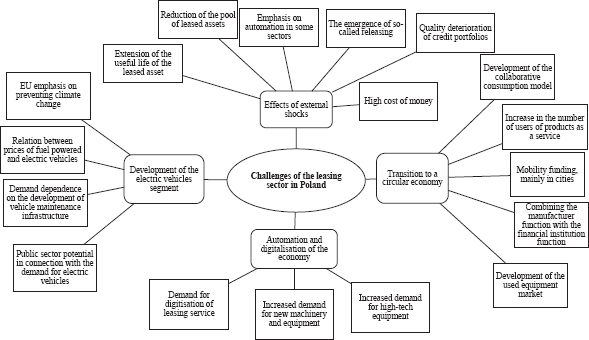
Figure 1.
Framework of challenges faced by the leasing sector in Poland.
Source: Own study.