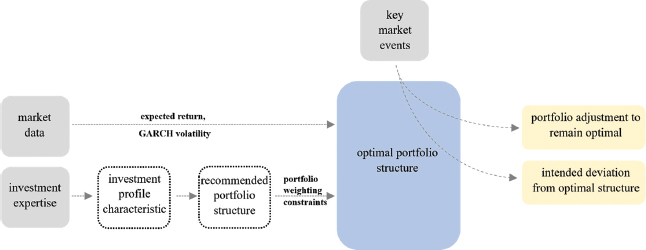
Scheme 1.
Research methodology concept.
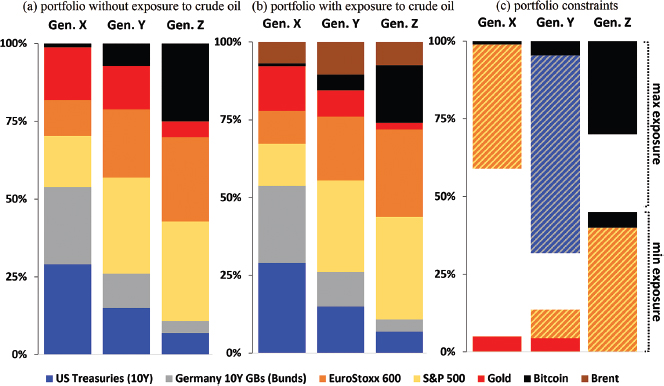
Figure 1.
Portfolios dedicated to generations X, Y, and Z. (A) Portfolio without exposure to crude oil. (B) Portfolio with exposure to crude oil. (C) Portfolio constraints.
Note: Portfolio exposures presented in panels (A) and (B) refer to the averages, while the formulated constraints rely additionally on the dispersion of the proposed structures; in panel (C), the columns starting from the bottom denote the constraint applied to the minimum share of the given asset, the columns starting from the top indicate the maximum share of the asset, and the striped columns denote constraints on an aggregate exposure to two assets, with no distinction between European and US assets.
Source: own work.
Table 1.
Heatmap of events’ impacts on returns from asset classes (2000–2021H1)
1 Note: Heatmap presents the change in average asset returns in the short term, that is, during the period with a high probability that it does not include the impacts of other factors that should be proxied. Therefore, we included time windows of -/+5, -/+21, and -/+63 days before and after the day when an event of a given type occurred; red indicates an average decrease in returns, while green denotes an average increase in returns.
Source: own work.
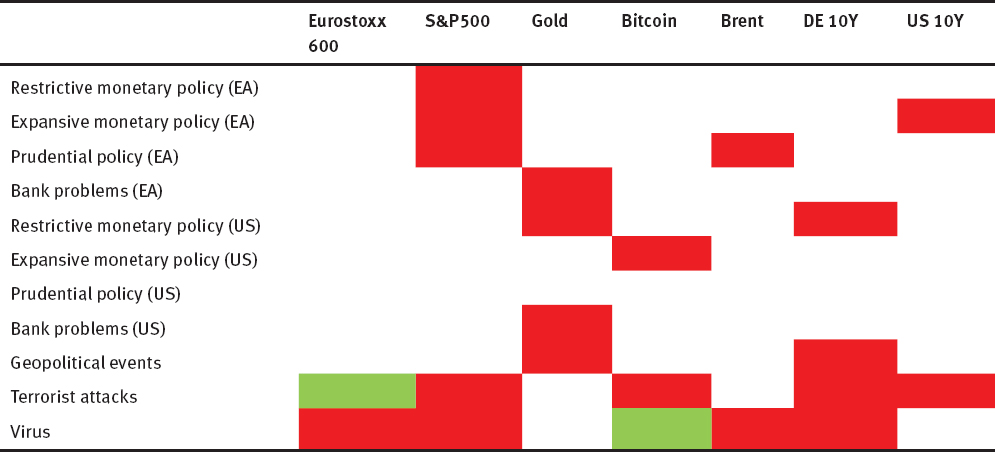
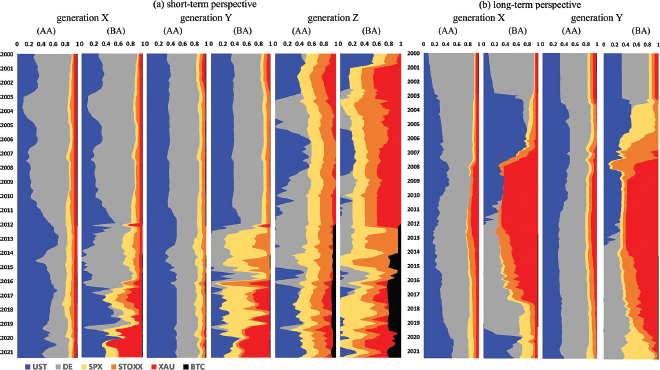
Figure 2.
Evolution of the optimal portfolio structure over time, generations, and investment horizons.
Note: The graph shows the evolution of the optimal portfolio structures over time. Each structure is estimated independently at a given point in time. The evolution is implemented using a rolling-window estimation that reflects the investment horizon. We consider the short-term portfolio to have a 3-year perspective, while the long-term portfolio has a 10-year perspective. Generations reflect the portfolio constraints discussed 3.2. Above-average risk aversion refers to λ = 2, while below-average risk indicates λ = 7.
Source: own work. AA – above-average risk aversion; BA – below-average risk aversion; BTC – Bitcoin; DE – DE 10Y Bunds; SPX – S&P500 stock index; STOXX – Eurostoxx 600 stock index; UST – US 10Y Treasuries; XAU – gold.
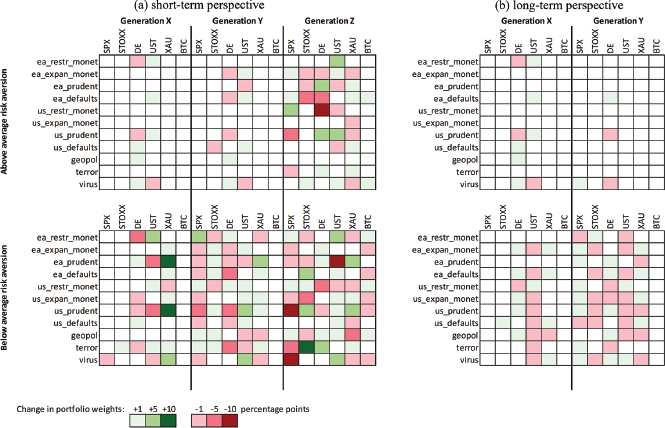
Figure 3.
Average change in the optimal portfolio structure in response to the selected events. (A) short-term perspective. (B) long-term perspective.
Note: The graph presents the average change in the optimal portfolio structure due to the occurrence of events belonging to each particular category and reports the results of the regression presented in Section 3.4. The averages of statistically significant relations only (with at least a 5% level of significance). Above-average risk aversion refers to λ = 2, while below-average risk indicates λ = 7.
Source: own work. BTC – Bitcoin; DE – DE 10Y Bunds; SPX – S&P500 stock index; STOXX – Eurostoxx 600 stock index; UST – US 10Y Treasuries; XAU – gold.
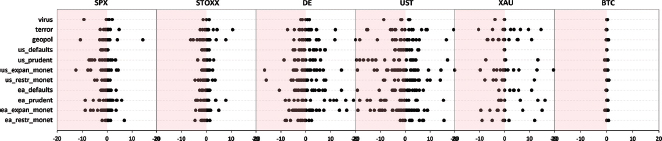
Figure 4.
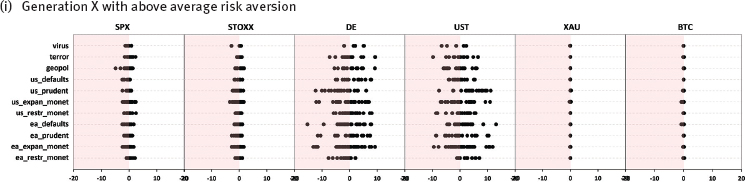
Change in the optimal portfolio structure in response to selected events – the case of the investment portfolio of generation X with below-average risk aversion.
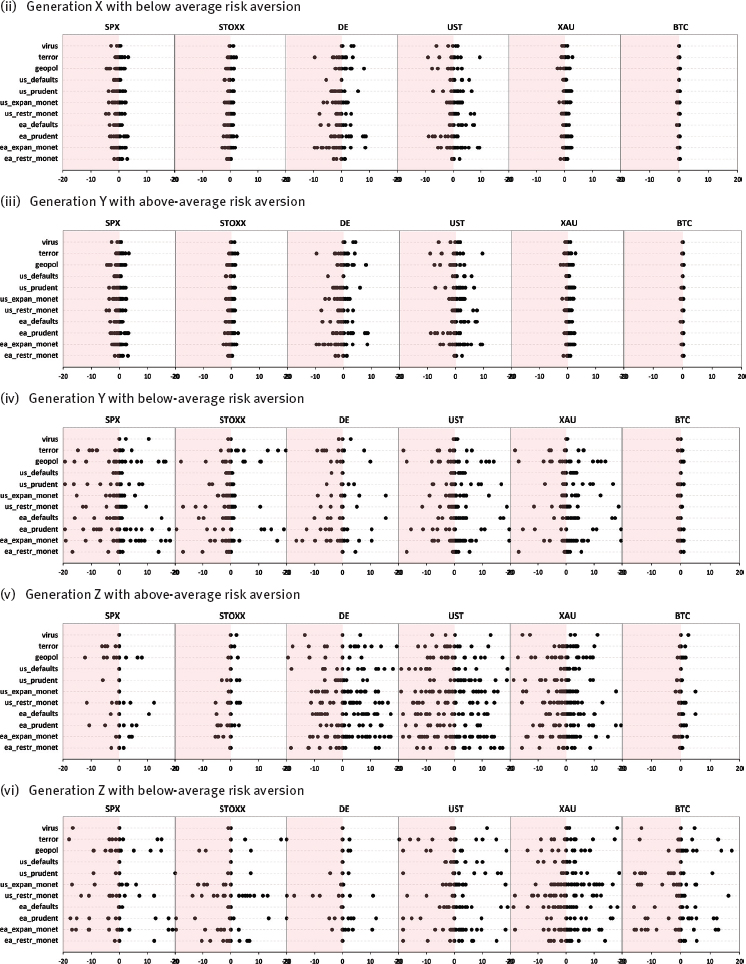
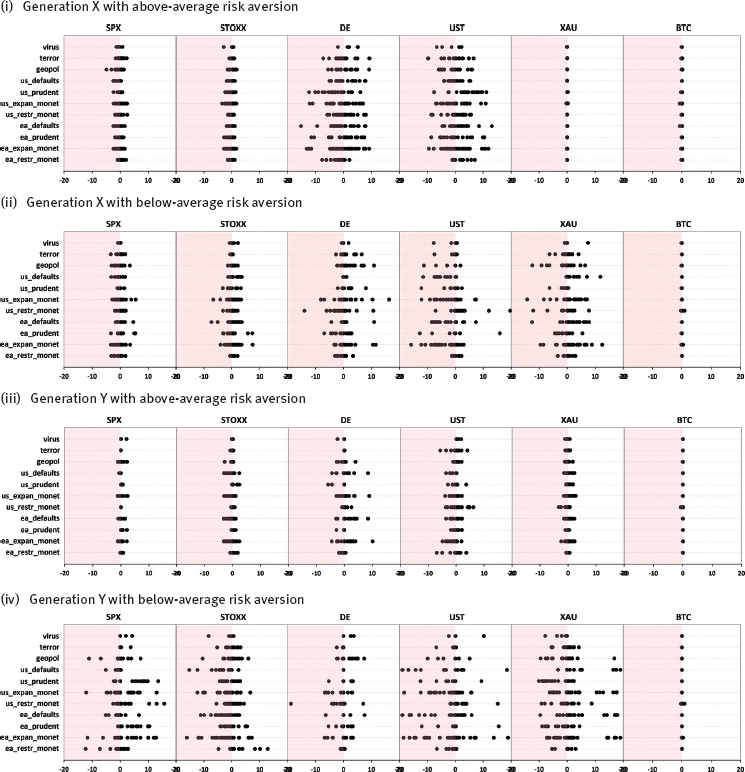
Note: The graph presents the change in the optimal portfolio structure due to the occurrence of each particular event belonging to each particular category. Every dot represents the estimated result of the regression presented in Section 3.4. for each event. The numbers on the horizontal axis indicate the strength of this effect, that is, the percentage-point change in the share of the particular asset in the optimal portfolio.
Source: own work. BTC – Bitcoin; DE – DE 10Y Bunds; SPX – S&P500 stock index; STOXX – Eurostoxx 600 stock index; UST – US 10Y Treasuries; XAU – gold.
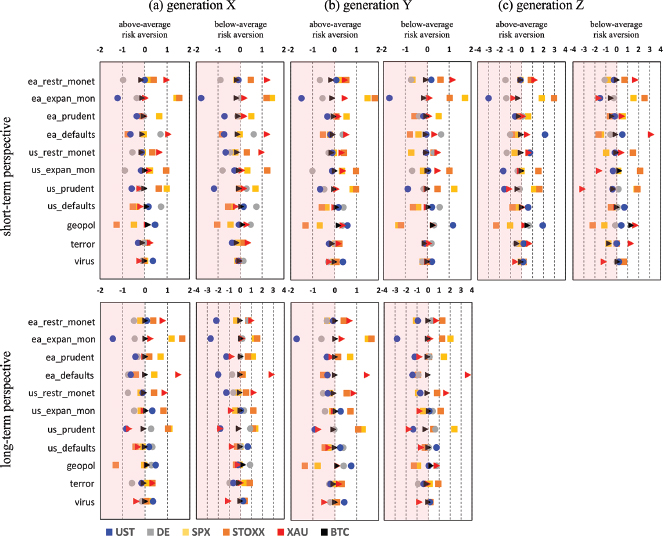
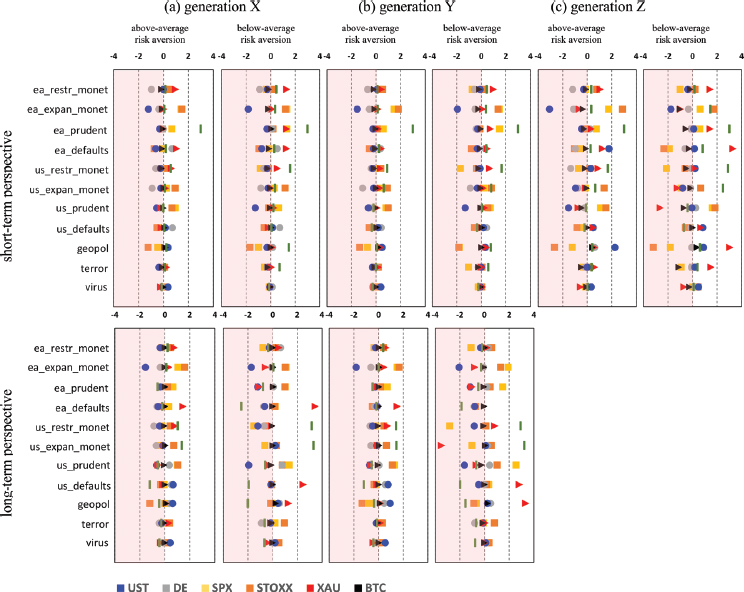
Figure 5.
Incremental annual return due to the change in exposure in response to events. The horizontal axis reports the size of the incremental returns. The incremental return refers to the additional return that the portfolio should generate over the investment horizon (i.e., in the short or long term) relative to the portfolio with the optimal structure. Each symbol refers to an incremental return which can be generated by overweighting one selected asset on the day of the event occurrence by the root of its original weighting (see the methodology section for details). For an interpretation example, consider the red triangle within the EA restrictive monetary policy in the top left-hand panel – the decision to overweight gold in response to restrictive monetary policy decision adds on average ~1 p.p. of additional annual return to the short-term portfolio of a generation X investor characterized by above-average risk aversion.
Source: own work. BTC – Bitcoin. DE – DE 10Y Bunds; SPX – S&P500 stock index; STOXX – Eurostoxx 600 stock index; UST – US 10Y Treasuries; XAU – gold.
Appendix 1.
Correlation matrix between daily returns of selected asset classes over the long term (2000-2021H1)
| Eurostoxx 600 | S&P500 | Gold | Bitcoin | Brent | DE 10Y | US 10Y | |
|---|---|---|---|---|---|---|---|
| Eurostoxx 600 | 1 | ||||||
| S&P500 | 0.581 | 1 | |||||
| Gold | -0.040 | -0.028 | 1 | ||||
| Bitcoin | 0.064 | 0.045 | 0.039 | 1 | |||
| Oil | 0.249 | 0.235 | 0.173 | 0.057 | 1 | ||
| DE 10Y | 0.394 | 0.251 | -0.129 | -0.005 | 0.127 | 1 | |
| US 10Y | 0.303 | 0.398 | -0.126 | -0.001 | 0.153 | 0.553 | 1 |
Appendix 2.
Initial structure of portfolios of generation X, Y, Z based on mini-Delphi
| Type of asset | Gen. X | Gen. Y | Gen. Z | |
|---|---|---|---|---|
| With Brent Crude Oil | Gold (%) | 14.5 | 8.5 | 2.2 |
| Bitcoin (%) | 0.8 | 5.0 | 18.5 | |
| 10Y Bunds (%) | 24.8 | 11.0 | 3.9 | |
| US Treasuries (10Y) (%) | 29.0 | 15.0 | 6.9 | |
| EuroStoxx 600 (%) | 10.5 | 20.5 | 28.0 | |
| S&P 500 (%) | 13.5 | 29.5 | 33.0 | |
| Brent (%) | 6.9 | 10.5 | 7.5 | |
| Without Brent Crude Oil | Gold (%) | 17.0 | 14.0 | 5.2 |
| Bitcoin (%) | 1.2 | 7.2 | 25.0 | |
| 10Y Bunds (%) | 24.8 | 11.0 | 3.9 | |
| US Treasuries (10Y) (%) | 29.0 | 15.0 | 6.9 | |
| EuroStoxx 600 (%) | 11.5 | 21.9 | 27.0 | |
| S&P 500 (%) | 16.5 | 30.9 | 32.0 |
Appendix 3.
Change in the optimal portfolio structure in response to selected events – short-term perspective
Appendix 4.
Change in the optimal portfolio structure in response to selected events – long-term perspective
Appendix 5.
The incremental annual return due to the change in exposure in response to events – a case of a portfolio with crude oil exposure
1 Note: UST – US 10Y Treasuries; DE – DE 10Y Bunds; SPX – S&P500 stock index; STOXX – Eurostoxx 600 stock index; XAU – gold; BTC – Bitcoin.
Each symbol refers to an incremental return over the optimal portfolio, which can be generated by overweighting one selected asset on the day of the event occurrence by the root of its original weighting (see the methodology section for details).
Source: own work.