
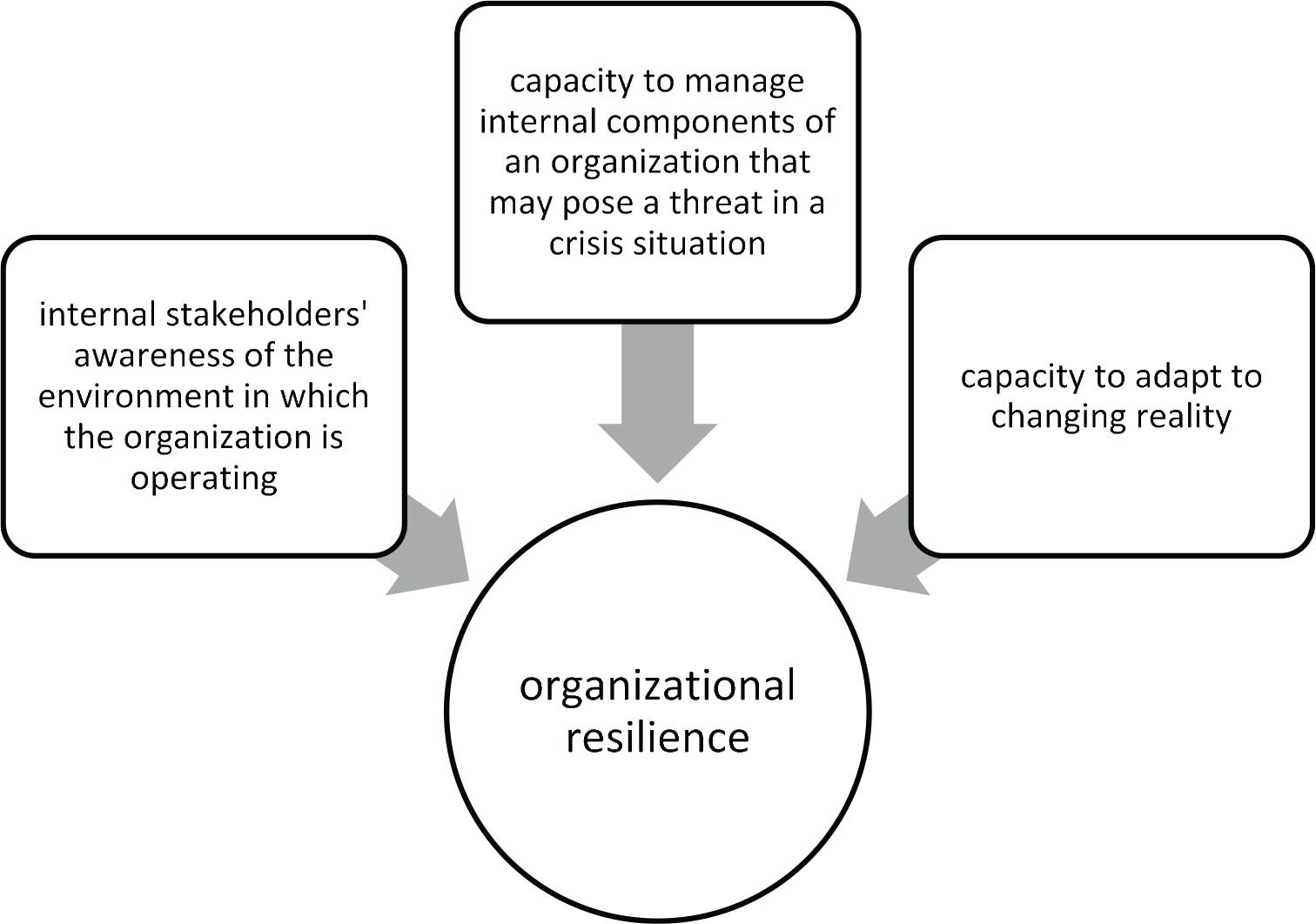
Figure 1.
Characteristic of organizational resilience.
Sources: own based on Stephenson et al. [2010].
Table 1.
Organizational resilience of startups
| Conditions | X | Me | SD |
|---|---|---|---|
| Efficient use of market information | 2.2 | 2 | 0.4 |
| Efficient acquisition of new financial resources (external financing) | 2.9 | 2 | 0.2 |
| Efficient anticipation of market trends | 2.6 | 3 | 0.7 |
| Efficient implementation of process innovations | 3.8 | 3 | 1.0 |
| Efficient acquisition of new customers | 4.1 | 4 | 0.9 |
| Efficient building of customer loyalty | 3.7 | 3 | 0.6 |
| Efficient change implementation and management | 4.8 | 4 | 0.8 |
| Efficient anticipation of market failures | 2.4 | 2 | 0.6 |
Table 2.
Stochastic relationship between organizational resilience and monthly startup revenue from October 2021 to March 2022.
| P < 0.05; Cramers’; V | Decreased (%) | Remained stable (%) | Increased (%) | |
|---|---|---|---|---|
| Efficient use of market information | P < 0.026 | 19 | 42 | 39 |
| V = 0.183 | ||||
| Efficient acquisition of new financial resources (external financing) | P < 0.023 | 9 | 78 | 13 |
| V = 0.092 | ||||
| Efficient anticipation of market trends | P < 0.035 | 12 | 72 | 16 |
| V = 0.193 | ||||
| Efficient implementation of process innovations | P < 0.000 | 7 | 35 | 58 |
| V = 0.636 | ||||
| Efficient acquisition of new customers | P < 0.040 | 26 | 29 | 45 |
| V = 0.733 | ||||
| Efficient building of customer loyalty | P < 0.033 | 25 | 49 | 26 |
| V = 0.132 | ||||
| Efficient change implementation and management | P < 0.012 | 31 | 37 | 32 |
| V = 0.472 | ||||
| Efficient anticipation of market failures | P < 0.034 | 19 | 69 | 12 |
| V = 0.092 |