Have a personal or library account? Click to login
Trends in income taxation: are taxes converging in Central and Eastern European countries? Cover

Trends in income taxation: are taxes converging in Central and Eastern European countries?

Open Access
|Dec 2023

Figures & Tables

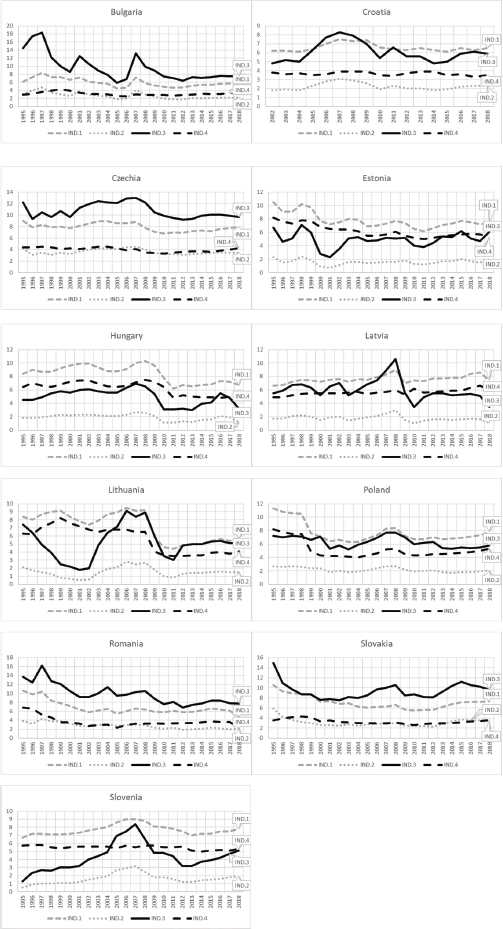
Figure 1.

Indicators showing the characteristic features of the tax systems in the countries covered by the study. IND.1: current taxes on income, wealth, etc., as a percentage of the GDP; IND.2: taxes on the income or profits of corporations, including holding gains, as a percentage of the GDP; IND.3: taxes on the income or profits of corporations, including holding gains, as a percentage of the total; IND.4: taxes on individual or household income, including holding gains, as a percentage of the GDP. GDP, gross domestic product; IND., indicator.
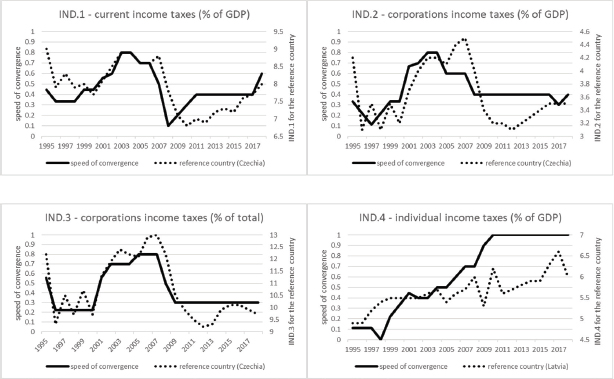

Figure 2.

Speed of convergence to the reference series in the years 1995–2018. The value “0” indicates perfect similarity between countries, and “1” indicates divergence from the reference country. GDP, gross domestic product; IND., indicator.
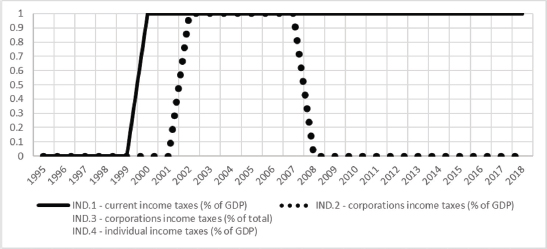
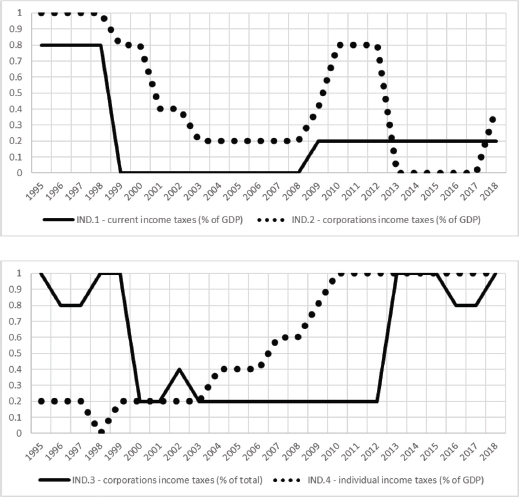
Figure 3.

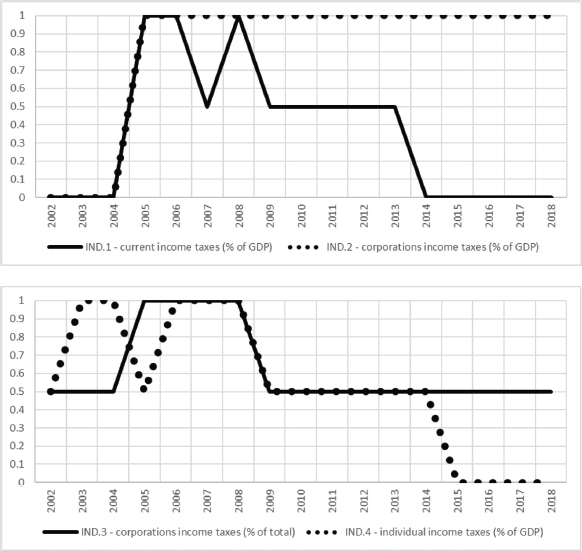
Speed of convergence to reference series in Group 1 (Bulgaria, Croatia, and Romania) in terms of the particular indicators. The value “0” indicates perfect similarity between countries, and “1” indicates divergence from the reference country. GDP, gross domestic product; IND., indicator.

Figure 4.

Speed of convergence to reference series in Group 2 (Czechia and Slovakia) in terms of the particular indicators. The value “0” indicates perfect similarity between countries, and “1” indicates divergence from the reference country. GDP, gross domestic product; IND., indicator.

Figure 5.

Speed of convergence to reference series in Group 3 (Estonia, Hungary, Latvia, Lithuania, Poland, and Slovenia) in terms of the particular indicators. The value “0” indicates perfect similarity between countries, and “1” indicates divergence from the reference country. GDP, gross domestic product; IND., indicator.

Selected characteristic features of taxation systems and applied tax incentives

Bulgaria
  • Low flat tax rate

  • Tax incentives for regional development, creating jobs, transfer of technologies, or promoting exports

  • Tax preferences in industrial zones

Croatia
  • A hybrid system (components of income and consumption taxation)

  • R&D tax relief

  • Tax preferences for the SME sector

Czechia
  • Lump sum tax-deductible expenses

  • Tax losses can be carried forward

  • R&D tax relief

  • Tax reliefs for investment projects

  • Shortened depreciation period for selected fixed assets

  • Fixed-flat-rate income tax rates

Estonia
  • Profits are not taxed until they are distributed

  • Simple tax system with limited set of tax preferences

  • From 2018, lower tax rate for companies making regular profit distribution

Lithuania
  • Many tax preferences designed to promote entrepreneurship and innovation

  • Some incentives limited in time

  • Tax preferences offered in the SEZs

Latvia
  • Profits are not taxed until they are distributed

  • Favorable tax rates for small businesses

  • Tax preferences in the SEZs and free ports (Ventspils and Riga)

Poland
  • Tax preferences designed to share development risks between entrepreneurs and the state budget (tax losses can be carried forward)

  • R&D tax relief

  • Tax preferences in SEZs

Romania
  • Tax preferences for microbusinesses

  • R&D tax relief

  • Tax preferences in SEZs

Slovakia
  • Tax-deductible expenses – real or lump-sum costs

  • R&D tax relief

  • Tax reliefs for investment projects

Slovenia
  • Special solutions applicable to funds (venture capital, investment, and pension)

  • Tax incentives

Hungary
  • Alternative minimum tax

  • Many tax reliefs and exemptions

Descriptive statistics for the selected indicators of the CEECs and EU-15 countries

StatisticsIND.1IND.2IND.3IND.4
Current income taxes (% of GDP)Corporation income taxes (% of GDP)Corporation income taxes (% of total)Individual income taxes (% of GDP)
EU-15CEEEU-15CEEEU-15CEEEU-15CEE
Min13.66.22.41.86.45.79.94.1
Mean14.27.33.02.27.66.910.34.8
Q113.96.92.62.06.86.210.14.4
Median (Q2)14.27.33.02.27.86.710.34.7
Q314.48.03.22.48.37.510.55.0
Max14.88.63.63.09.19.011.05.7

Division into groups of the most similar countries using k-means clustering method

CountryGroup 1Group 2Group 3
Bulgaria
Croatia
Czechia
Estonia
Hungary
Latvia
Lithuania
Poland
Romania
Slovakia
Slovenia
Arithmetic mean
   IND.1 – Current income taxes (% of GDP)6.427.507.71
   IND.2 – Corporation income taxes (% of GDP)2.593.351.76
   IND.3 – Corporation income taxes (% of total)8.7610.075.28
   IND.4 – Individual income taxes (% of GDP)3.453.645.71
DOI: https://doi.org/10.2478/ijme-2023-0019 | Journal eISSN: 2543-5361 | Journal ISSN: 2299-9701
Language: English
Page range: 349 - 370
Submitted on: May 3, 2023
Accepted on: Sep 5, 2023
Published on: Dec 31, 2023
Published by: Warsaw School of Economics
In partnership with: Paradigm Publishing Services
Publication frequency: 4 issues per year

© 2023 Michał Bernardelli, Paweł Felis, Marcin Jamroży, Jacek Lipiec, Elżbieta Malinowska-Misiąg, Joanna Szlęzak-Matusewicz, Grzegorz Otczyk, published by Warsaw School of Economics
This work is licensed under the Creative Commons Attribution-NonCommercial-NoDerivatives 4.0 License.