
1. Introduction
The objective of this paper is to validate the existence of a (heavily documented for developed markets and tentatively implied for less developed economies) secular upward trend in corporate cash holding. In particular, we provide evidence that the alleged trend does not actually exist either in the U.S. or in Poland (at least in the form proposed by the literature). We do this with the help of a new, up-to-date set of data for Poland and a historic dataset for the U.S. market. For the latter, we review the data provided by the literature and, based on the same inputs, reach opposite conclusions. Rather than a secular trend, we view corporate cash holding as a period-dependent and GDP-driven phenomenon. A money demand and transaction-driven explanations (i.e., the stronger economy today or in the future leads to more cash in the corporate balance sheets) seem likely for both Polish and the U.S. markets alike. Interestingly, for the latter, precautionary motive (i.e., the weaker economy last year leads to more cash accumulation today) is not unlikely either. But, as we explain below, firm motives to hold cash are not our priority.
Instead, we argue in this paper for a new approach to research corporate cash holdings. In this new approach, searching for firm-specific determinants of (optimal) cash levels is merely the first stage, which would be followed by the study of the broader macro context, shared by many companies (stage 2), as well as other liquidity (structural) shocks, originating e.g., from tax law, pandemics, or wars. The structural change in the sample composition of companies in the market may also be viewed as a stage 3 effect (see Nasdaq effect below).
Although macro context seems natural in explaining how much cash a company has/should have, it was not until quite recently that it was applied in corporate liquidity research. It was first empirically studied in 2010 by Chen and Mahajan [2010]. In contrast to this and related papers, we do not concentrate on the (micro or macro) determinants of corporate cash holdings as viewed from the perspective of a single company. Instead, we focus on the aggregate changes in cash holding across the corporate sector. It seems obvious that this time series will not be solely dependent on firm characteristics, principle-agent considerations, or factors typically described by behavioral finance. Macro context is an understandable addition. No surprisingly, the explanatory power of our simplest model is many times bigger than that for company-driven models of Chen and Mahajan [2010] and other similar models. What contributes only marginally to the position of a given firm proves to be a determining factor when averaged across the whole economy.
In contrast to Chen and Mahajan [2010] who use various macro indicators to explain corporate liquidity, we limit our interest in macro variables to GDP alone. We believe it is sufficient both to argue against the conjecture that the cash holdings lead to upward trends that persist over time and to illustrate the usefulness of the macro (stage 2) analysis. It is not our objective therefore to propose a full-structure time series model explaining the aggregate amount of cash in the corporate sector.
In the era of the pandemic and quantitative easing, very volatile capital markets, low interest rates first, and high inflation now, the interest in the research on corporate liquidity and exogenous influences seems self-evident; yet, its relevance is also important for many other, less obvious reasons. First, the availability of cash may be used to support the equity markets via, for example, buy-back programs. Second, the research on the changing trend in cash holding helps to understand the level of leverage risk present in the economy, i.e., net debt statistics may offer completely different picture than those based on debt levels alone. Third, corporate cash deposits may both help macro recovery just as well as hinder future growth if not used in most value-enhancing projects. As to cash hoarding, “many argue that this phenomenon is related to the sluggish recovery of the economy: Firms holding more cash are investing less, and this prevents the economy from taking off” [Sanchez and Yurdagül, 2013, p. 293]. Fourth, research on cash availability, channeled via e.g., the COVID-19 rescue programs, may significantly affect what is already tagged as “zombie” economy. Regardless of the definition, these companies are kept alive rather artificially thanks to the availability of cheap debt or rescue programs. Banerjee and Hoffman [2018] estimate that as much as 16% of U.S. listed firms may have “zombie” status, eight times more than in 1990. Acharya and Steffen [2020] estimate that 8% of all loans may also be infected with the “zombie” virus. No doubt, the unconventional monetary policies, protracted low interest environment, COVID-19, and the resultant generous governmental relief packages contributed to the proliferation of “zombie” firms. Last but not least, after the spell on low interest rates, the high inflation and a resulting surge in costs of capital may significantly affect the companies with either lower cash deposits or debt capacity. The war in Ukraine makes the cash question even more relevant.
To sum up, in this paper, we argue that the secular increase in corporate cash holding in Poland does not exist. Secondly, we believe that the trend in the U.S. may also be less obvious than previously thought. Thirdly, we detect a strong positive relation between the corporate cash holding and GDP growth in Poland. Similar results are found for the U.S. market. We believe this is the testimony of a transaction-driven cash accumulation motive, but even if that motivation was not warranted, the importance of GDP is evident. Fourthly, we detect some traces of negative link between the past GDP and cash holding in the U.S. This may imply a precautionary motive. Fifthly, we present some evidence of excess cash accumulation before the financial crisis of 2007–2008 both in Poland and the U.S. We also point to a complete disconnection between the GDP growth and cash in the time of COVID-19. We expect the war in Ukraine may only reinforce the discontinuation of the link between the prevailing macro growth and cash holdings. Last but not least, we believe that all these empirical findings point to the benefits of a multi-stage approach to study of corporate cash holding in which firm-specific determinants of cash balances will only be a starting point.
Our paper is organized in the following way. First, we cite the literature, both academic and professional, which documents an existence of a secular trend in corporate cash holding. Then, we briefly introduce literature on cash accumulation motives. In the method and data Section, we introduce our models and datasets. In results Section, we report our estimation results. In discussion Section, we critically appraise the cash hoarding evidence as documented in the seminal paper of Bates et al., published in the Journal of Finance in 2009. In the article entitled Why Do U.S. Firms Hold So Much More Cash than They Used To?, the authors spot a secular trend in corporate cash holding and subsequently, in line with the very title of their paper, try to search for the explanations. No doubt, the study, very comprehensive, using 13,599 unique firms, is a benchmark in corporate liquidity literature. We believe the evidence presented in the paper is far from conclusive. Based on the sample data quoted in the article, we present an alternative interpretation. In conclusions Section, we gather all our findings, re-emphasizing the objectives of the paper and listing areas in need for further inquiry.
1.1. Corporate cash hoarding – empirical evidence
In the middle of the summer 2021 [July 21st], Reuters reported “(c)ash on the balance sheets of S&P 500 companies has swelled to a record $1.9 trillion, compared to $1.5 trillion before the pandemic crisis in early 2020” [Krauskopf, 2021]. The article argues that a mounting pile of cash offers companies vast flexibility to take potentially share-supportive measures. These include increasing share buybacks (boost to earnings per share), raising dividends (attraction to income-seeking investors amid falling treasury yields), or pouring money back into their businesses (including funds for mergers and acquisitions). No doubt, cash also helps firms to respond to worries over slowing growth and the COVID-19 pandemic. The numerous pandemic relief programs are the contributors to the cash issue, too. According to the U.S. Treasury Department, American Rescue Plan and various tax credits are worth over USD 1 trillion. Although Todorov [2020] shows these funds mostly go to dividends, the scale of cash injection is quite unprecedented. Demirgüç-Kunt et al. [2020] pose a question Which Firms Benefit from Corporate QE during the COVID-19 Crisis? and subsequently show that the announcement of the Pandemic Emergency Purchase Program (PEPP) of the ECB benefited firms with an investment-grade rating most, with firms more heavily affected by the pandemic benefiting relatively little. The corporate cash hoarding did not start with the pandemic outbreak as the phenomenon had been attracting attention of both the public and academic research for many years by then. For example, in the 2018 Global Finance Cash 25 (a list of 25 largest cash holders globally), the last in the cohort held as much as USD 24.4 bn in cash, some 50% more than the 25th firm on the 2017 list [GFMAG, 2018]. Actually, the secular growth in cash hoarding has been documented since the last decades of the 20th century.
Among the first to document the upward trend in corporate cash are Bates et al. [2009] who provide the evidence of a secular increase in cash holdings from 1980 to 2006. The average cash-to-assets ratio (cash ratio [CR]) increased during this time by 0.46 p.p. per year. “Another way to see this evolution is that the average cash ratio more than doubles over our sample period, from 10.5% in 1980 to 23.2% in 2006” [p. 1985]. Even if heavily skewed to the right, it is important to note that the CR does not grow because of outliers as the median value of the CR increases from 5.5% in 1980 to 13.3% in 2006 – even more than the rise in the means. The increase is so enormous that the deposits of corporate cash in the US are larger, on average, than the corporate debt. Consequently, the net debt ratio is negative: -1%, -2.0%, and -1.5% in 2004, 2005, and 2006, respectively.
Sanchez and Yurdagül [2013] also document “a persistent and increasing pattern in cash holdings since the 1980s” [p. 294]. Using Compustat data of publicly traded companies, they document a secular increase in corporate cash till 2011 and show that “by 2011 U.S. firms were holding 4 times as much cash as they were holding in 1995 and 11 times as much as they were holding in 1979” [p. 294]. The total amount of cash held was close to a staggering level of $5 trillion in 2011. The annual growth rate amounted to 6.5% from 1979 to 1995 and accelerated to 9% thereafter, much higher than GDP. The growth for non-financial and non-utility firms was even faster: 7% and 10%, respectively. In relation to assets, the median cash holding of non-financial and non-utility US public firms increased at an annual rate of 4% from 1990 to 2000 and exceeded 11% from 2000 to 2005. A subsequent drop by 2008 induced by the global financial crisis was fully recouped by 2011. “Overall, the cash ratio increased significantly in the 2000s: The 2010 ratio was almost twice as large as in 2000” [p. 295].
Zenner et al. [2016] analyze phenomenal growth in cash after 2011, pointing to the surge of another 30% by 2014. They show that the corporate cash accumulation is by no means the US phenomenon. It cannot be therefore attributed, as frequently suggested, to the peculiarities of US tax regime and the costs of cash repatriation. Although the offshore cash accounts of US firms grew during 2011–2014 at an impressive 15% rate p.a., onshore cash holdings were also growing, even if at a more modest rate of 3% p.a. In addition, Zenner et al. [2016] show that the cash balances of non-US firms, hence not affected by the US legislation, were also on a steady rise, growing during 2004–2015 at CAGR of 4% in Germany, 6% in Canada, 8% in UK, and 9% in Japan. Similarly, Bates et al. [2009] provide strong evidence of a secular increase in a cash-to-assets ratio for companies with no foreign income. Da Cruz et al. [2019], using Compustat Global Data, compare statically 2013 and 1993 levels of average cash-to-assets ratios across the world and confirm that the increase can be found in most countries.
Bates et al. [2009] show that the increase can be spotted for both non-dividend and dividend payers, with the former dominating the process. Companies that do not pay dividends increase their CRs, on average, from 13.0% in 1980 to 27.7% in 2006. At the same time, dividend payers increased their cash holding by less than 50%, from 8.6% in 1980 to 12.0% in 2006. The particularly strong cash hoarding among non-dividend paying companies resulted in their net debt ratio dropping from 19.3% to -5.0% for the mean and even more dramatically for the median, down from 21.4% to -5.7% over the sample period.
CR increases for both profit as well as loss-making companies. Bates et al. [2009] show that the profitable companies held 75% more cash in relation to total assets in 2006 (17.6%) than in 1980 (10.1%). Far bigger growth is reported for loss makers. Their CR increased nearly three times, up from 12.2% (in line with the profitable companies at first) to 35.1% in 2006 – more than twice the cash holding of positive net income gainers. Bates et al. [2009] also document a steady rise in CR for companies which went public within the prior five years as well as those whose IPO was much earlier. Both subsamples increased the CR by some 12 percentage points, with the IPO cohort raising its CR from 21.1% to 32.6%, while the non-IPO cohort, with the rise from 9.9% to 21.8%, lagging clearly behind in nominal terms. Graham and Leary call it “Nasdaq effect” and attribute the increase in cash to a new set of entrants, usually loss-making, from IT and health sector.
Zenner et al. [2016] document the considerable skewness of the distribution with top 10 cash holders accounting for 40% of cash held and top half of cash holders responsible for 95% (see also Sanchez and Yurdagül [2013]). It does not mean that cash hoarding is a large firm phenomenon. Quite the opposite. Bates et al. [2009] argue that “the secular increase in cash ratios is not driven by the largest firms, and is markedly more pronounced in smaller firms” [p.1993]. Nevertheless, Bates et al. [2009] show that the increase in cash holding is experienced by all company sizes with the stronger growth reported for smaller firms.
Nearly all the authors note that the increase in cash is not equally spread across different sectors. Zhou [2009] provides compelling evidence of high-tech companies’ dominance in cash holding. He estimates the CR of the technology sector to increase from 11% in 1980 to nearly 40% in 2007. Zenner et al. [2016] agree that the highest growth in cash build-up over 2011–2015 was recorded in the information technology sector (15% CAGR), followed by health care (9%), consumer discretionary (9%), and consumer staples (9%). Materials, with CAGR of 1%, and utilities, with CAGR of 2%, were among the laggards in cash holding growth. One can note that foreign exposure is not a determining factor here. Among sectors growing cash the fastest, IT and health are arguably most exposed internationally, while consumer discretionary and staples are not. Similarly, among the laggards, materials boast high foreign exposure, utilities – low.
Additionally, Bates et al. [2009] prove that “(t)he firms in the highest quintile of the increase in volatility experience the most dramatic increase in cash holdings. The average cash ratio of these firms is 12.9% in 1980 and increases to 39.0% in 2006” [p. 1995]. Similarly, the firms in the second quintile increased their cash positions aggressively, nearly three times over 1980–2006, with the remaining quantiles showing rather modest changes.
Sanchez and Yurdagül [2013] show that services, with a mean CR of 23%, hold most cash, followed by manufacturing with a mean CR of 19%. They also point to a rather big heterogeneity within manufacturing with chemicals, electronics, and machinery having the flattest distributions and the highest means of 33%, 21%, and 18%, respectively.
The increasing trend in cash holding is also documented for the Polish market. Berent and Śniechowski [2019] provide empirical evidence for the upward trend in Poland over 2008–2016. Based on a rather small sample of listed firms with cash in total assets ratio growing by 0.46 p.p. – exactly the number reported by Bates et al. [2009] for the US market. Nehrebecka and Białek-Jaworska [2016] use a 1995–2012 sample of non-listed firms and show a steady increase in CRs until 2010.
1.2. Cash holding motives
The transaction motive, typically implicated in the context of classical cash models of Baumol [1952] and Miller and Orr [1966], relates the optimal stock of cash to the costly process of non-liquid assets transformation into cash. The demand-driven, transaction motive explains also why companies should keep more cash in booming economy or in expectation of booming economy [Kim et al., 1998]. Bates et al. [2018] show that the improving investment opportunities increase the value of cash held. Given economies of scale in transaction costs, the transaction motive may also explain why larger firms hold significantly less cash than smaller ones and arguably why smaller firms participate much more enthusiastically in the recent cash build-up [Mulligan, 1997; Opler et al., 1999; Ferreira and Vilela, 2004].
The agency motive, proposed by Jensen in his seminal paper in 1986, states that entrenched managers would hold more cash for their own benefits and to the detriment of the managed companies. In addition, entrenched managers are also shown to spend it more quickly [Harford, 1999; Dittmar and Mahrt-Smith, 2007; Hartford et al., 2008]. Dittmar et al. [2003] show that firms in countries with bigger agency problems tend to hold more cash. Dudley and Zhang [2016] show that a higher level of societal trust allows firms to hold more cash. Dittmar and Mahrt-Smith [2007] and Pinkowitz et al. [2006] prove that cash is worth considerably less when agency problems exist. According to Loncan [2018], foreign institutional ownership mitigates some agency conflicts in emerging economies. Corruption and cash holdings in emerging economies are studied by Thakur and Kannadhasan [2019] and Xu and Li [2018], and state ownership and its impact on cash holdings are studied by Chen et al. [2018].
The tax motive attracts arguably the biggest publicity over the last years. Foley et al. [2007] argue that the cash hoarding results from the specific tax regulation ruling in the US which effectively penalizes cash repatriation. Faulkender et al. [2017] views liquid resources kept abroad as “foreign cash trapped by U.S. repatriation tax”. Foley et al. [2007] argue that the growth in repatriation costs by one standard deviation results in 7.9 p.p. increase in cash (to assets) ratio. Consequently, the share of offshore cash held by the companies affected by these costs account for as much as 47% of firm’s total cash. This compares with only a 26% share for firms without foreign exposure. Foley et al. [2007] also show that the tax explanation is more relevant to firms with foreign business in a relatively low taxation environment and with lower financial problems domestically.
Surprising as it may seem in the world of wide range of financing and hedging tools, it is the precautionary motive which offers both most theoretical insight and the biggest variety for empirical testing. According to this motive, cash is hoarded to better cope with adverse shocks, especially when access to capital markets is costly. Kim et al. [1998] propose a model where optimal cash holdings are determined by both the variance of future cash flows and the return on future investment. Opler et al. [1999] and Riddick and Whited [2009] show that companies with poorer access to external capital and riskier cash flows hold more cash. Almeida et al. [2004] prove that cash for financially constrained firms comes from internally generated cash flows, while the greater the importance of future growth opportunities, the bigger cash holdings. Acharya et al. [2007] demonstrate that firms with high idiosyncratic risk prefer to build cash stocks rather than debt capacity. Han and Qiu [2007], using theoretical model of continuous distribution of cash flows, show that the greater the volatility of cash flow, the greater the optimal precautionary cash stock. Faulkender and Wang [2006] prove that the marginal value of cash is higher for firms more likely to face financing frictions, particularly for those with valuable investment opportunities but low levels of internal finance. Morellec et al. [2014] estimate that the scale of cash holding increases at 1.8%–2.4% after one standard deviation increase in cash flow volatility but claim, at the same time, that an increase of one standard deviation in competitive intensity of the sector the firm operates in is responsible for even higher increase in cash holding, i.e., 2.0%–3.7%. Lyandres and Palazzo [2011] argue that sector competitive intensity is particularly strong in innovative firms. Baum et al. [2008] find that U.S. non-financial firms hold more cash when macroeconomic uncertainty increases. Duchin [2010] estimates cash holding for a US non-diversified company to be twice as big as for a well-diversified company. Fernandes and Gonenc [2016], analyzing diversification effort of some 40,000 companies worldwide since 1990, provide similar evidence for international markets. Diversification matters even if there is some evidence of agency costs of diversification as studied by Rajan et al. [2000]. The importance of both external finance availability/costs and the size of diversification seem well suited to explain why cash hoarding is so prevalent in small companies. Rajan and Zingales [1995] prove that larger firms, due to its diversification, face lower bankruptcy costs. Peterson and Rajan [2002] argue that small firms face considerably higher costs of external financing. Opler et al. [1999] and Ferreira and Vilela [2004] prove that the smaller the firm, the larger its cash balance (in relation to assets).
The size of both shortage and bankruptcy costs, and hence the benefits of larger cash stocks, are particularly high for firms with better perspectives and/or more innovative projects. Almeida et al. [2004] prove that the greater the importance of future growth opportunities, the bigger the cash holdings. Better perspectives are typically proxied by P/BV and R&D spending. Opler et al. [1999] study corporate cash holdings of publicly traded U.S. firms from 1971–1994 and demonstrate a strong link between cash holdings and R&D intensity. Mikkelson and Partch [2003] note that firms with large cash holdings tend to have a higher median operating performance and are more R&D intensive. Bates et al. [2009] list four firm characteristics, which determine cash holding, one of which is R&D. Moreover, as proven by Pinkowitz and Williamson [2007] and Denis and Sibilkov [2009], the market value of the marginal dollar of cash is highest in R&D-intensive sectors such as IT, pharma, or electronic equipment. Kim and Weisbach [2008], based on 38 countries, explore the link between cash holding and R&D from the international perspective. Brown and Peterson [2010] document the pattern of R&D smoothing in which cash is drawn down when the availability of finance is low and replenished when finance is readily available.
The reaction of companies to macroeconomic and financial crises is yet another illustration of a significant role played by cash in addressing adverse shocks. Pinkowitz et al. [2013] document a significant increase in CR by 1.9 p.p. for American firms directly after the global financial crisis. The increase did not affect only offshore-oriented businesses as it used to be in pre-crisis years. Lian et al. [2011] analyze Chinese market during 1999–2009 and reach similar conclusions: cash holding increased after the crisis. Again, the increase was particularly strong for companies with limited access to external financing and/or relatively attractive investment openings. Song and Lee [2012] study six Asian countries before and after the Asian crisis. They show that after a period of stable levels of CR of 6%–7% during the 1990s, the ratio doubled to over 12% in 2006. Tendency to hoard cash after the crisis is particularly strong for financially constrained firms [Almeida et al. 2004].
Other papers exhibit more behavioral inkling. For example, Huang et al. [2015] argue that more optimistic managers tend to hold more cash to meet their optimistic investment plans. Phan et al. [2017] show managers eager to get promotion tend to embark on higher risk projects and hence hold more cash. Feng and Rao [2018] link cash holdings with CEO risk aversion. Aktas et al. [2019] study the link between CEO overconfidence and the value of corporate cash. Bhuiyan and Hooks [2019] link cash holding with “problem directors.”
1.3. Data and model
To show the importance of macro context or argue against time trends, we only estimate simple models. In fact, to argue against a secular trend in corporate cash holding, we start with the simplest time regressions. Consequently, our dataset is simple, too. It consists of balance sheet information sourced from Refinitive Eikon. We calculate the CR, i.e., the share of the balance sheet held in cash and cash equivalents, for Polish public companies listed on the Warsaw Stock Exchange during 2004–2021. We compute CRs on both an annual and quarterly basis. The number of companies range from 79 in 1Q2004 to a maximum of 380 in 1Q2020, with the 326 companies at the end of the sample period (1Q2021). For each year (quarter), we subsequently calculate an arithmetic average (MEAN-CR) and collect median values (MEDIAN-CR), too. As the distributions are heavily skewed to the right, we winsorize CRs at a 30% level. Where possible, we concentrate at annual data, with quarterly results quoted as robustness tests. The GDP data comes from Statistics Poland. Table 1 presents annual levels of CRs for Polish listed companies over 2004–2020.
Table 1.
MEAN-CR and MEDIAN-CR in Poland, 2004–2020
| Year | MEAN-CR (%) | MEDIAN-CR (%) |
|---|---|---|
| 2004 | 9.1 | 5.1 |
| 2005 | 9.9 | 6.0 |
| 2006 | 10.7 | 6.5 |
| 2007 | 11.3 | 6.3 |
| 2008 | 10.0 | 5.5 |
| 2009 | 8.1 | 5.1 |
| 2010 | 8.3 | 5.1 |
| 2011 | 7.5 | 4.2 |
| 2012 | 7.1 | 4.1 |
| 2013 | 7.3 | 3.6 |
| 2014 | 7.7 | 3.8 |
| 2015 | 8.2 | 3.9 |
| 2016 | 8.1 | 3.7 |
| 2017 | 8.6 | 4.3 |
| 2018 | 8.9 | 4.1 |
| 2019 | 9.1 | 4.0 |
| 2020 | 10.7 | 5.3 |
| Average | 8.7 | 4.7 |
We run a series of simple regression models to test if there is a trend in the calculated CR over time:
We also estimate different variants of GDP-dependent models, with and without dummy variables for pre-global financial crisis and COVID-19 periods:
GDP index comes mostly as a concurrent variable to CRs. Lagged and forward GDP variables are also used.
At some stage, only as a supportive measure, we also estimate autoregressive models, where time and GDP impact on CRs is estimated only after allowing for the previous period cash levels:
All regression models are initially estimated with the help of simple EXCEL regression functions and subsequently corroborated in the R environment. In particular, all diagnostic tests, including tests for cointegration, unreported below, are generated in the GNU package.
Separately, we extensively use the dataset provided by Bates et al. [2009] for the U.S. market over 1980–2006. Although covering a different time frame, we recognize the paper to be a point of reference in corporate empirical liquidity literature which as such deserves a closer scrutiny. Based on the data provided by Bates et al. [2009], we re-estimate all above mentioned time series models for the U.S. market and find many common features to those identical for Poland.
2. Results
We first check if a secular trend in cash accumulation, documented internationally (and tentatively spotted in Poland), is indeed present in Poland. A rough look at Table 1 suggests such a positive trend does not exist. Figure 1 presents quarterly data from 1Q2004 to 1Q2021 and does not show any trend, either.
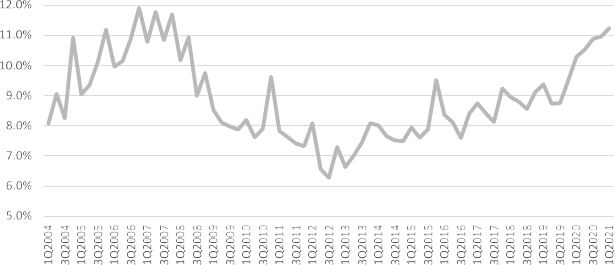
Figure 1.
CR (MEAN-CR) for Poland’s public companies over 1Q2004–1Q2021.
Source: Own calculations.
As to annual data and Table 1, the average yearly mean (8.7%) is nearly twice the average median for the period (4.7%). Cash accounts for more than 10.0% of corporate assets only in three years: COVID-ridden 2020 and pre-GFC years of 2005–2006 for MEAN-CR. With huge rescue packages and excess liquidity during the pandemic, 2020 is clearly an odd man out. High levels of cash before the crises may be a testimony of both strong economy as well as general optimism regarding the future. MEDIAN-CR, as expected, is less volatile over time and never exceeds 7%, with the largest cash accumulation again before the GFC and during the pandemic 2020.
A negative value of a simple Pearson correlation index between MEAN-CR and time (–26%) confirms no positive trend. If a trend exists, it is negative: in the regression model of MEAN-CR on time, the negative trend of -0.06 p.p. per annum, is spotted. Even if economically immaterial, it is statistically significant at a 1% level. The explanatory power of the model is very low (R2 = 7%). No positive trend in cash holding is spotted for median values, either. This is quite the opposite. A Pearson correlation index between MEDIAN-CR and time of -0.66% is not only negative but relatively high (in absolute terms). Time explains nearly half of MEDIAN-CR variability (R2 = 43%). The trend is clearly negative. Even if the economic materiality of the annual drop of 0.12 p.p. is not big, it is twice larger than for the means and statistically significant at 1% (see Table 2). Figure 2 illustrates the results graphically.
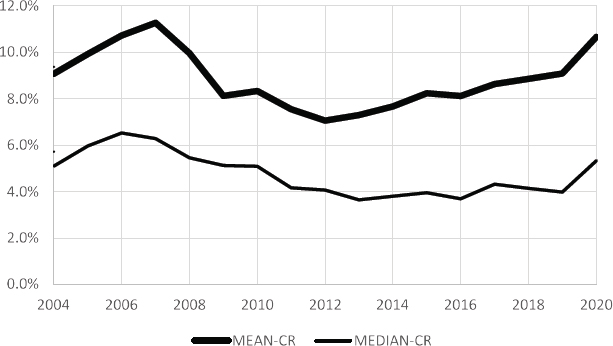
Figure 2.
MEAN-CR and MEDIAN-CR for Poland’s public companies over 2004–2020.
Source: Own calculations.
Table 2.
Time regression models
| MEAN-CR | MEDIAN-CR | |||
|---|---|---|---|---|
| DUMMY COVID | 0.0245*** (2.60) | 0.0172*** (3.50) | ||
| DUMMY PRE-GFC | 0.0224*** (3.47) | 0.0122*** (3.62) | ||
| TIME | –0.0006 (–1.03) | –0,0001 (–0.24) | –0.0012*** (–3.39) | –0.0010*** (–3.59) |
| R2 | 0.0657 | 0.6542 | 0.4338 | 0.8286 |
The result is further supported by the quarterly data over the sample period. Pearson correlation indexes remain negative: -0.17% and -0.56% for MEAN-CR and MEDIAN-CR, respectively, with the annual drop in the yearly median, small in size, being again strongly statistically significant.
We subsequently estimate the simple time series regression with pre-GFC years and COVID-ridden 2020 tagged as two separate dummy variables (DUMMY PRE-GFC, DUMMY-COVID, respectively). As expected, the strength of the explanatory power of the model explodes from 7% (without dummy variables) to 65% (with dummy variables) for MEAN-CR and from 43% to 83% for MEDIAN-CR, with both dummy variables significant at 1% (in both models). In pre-GFC years, the companies held significantly more cash than usual (2.24 p.p. for MEAN-CR and 2.22 p.p. for MEDIAN-CR). During the pandemic, the extra deposits of cash (in relation to assets) was even higher: 2.45 p.p. for MEAN-CR and 1.72 for MEDIAN-CR. Interestingly, the regression coefficients continue to be negative for the time variable, small in size, and statistically insignificant for MEAN-CR but much bigger and statistically significant at 1% for MEDIAN-CR (see Table 2).
In summary, no positive trend in corporate cash has been spotted for the Polish market. If anything, there is a negative trend, evident for MEDIAN-CR in particular, and a periodic cash accumulation in pre-GFC years as well as during the pandemic in 2020.
No trend does not imply no regularity. Figure 3 presents MEAN-CR placed next to Poland’ GDP over 2004–2020. The fit in pre-pandemic period is staggering. The Pearson correlation index between the two random variables is very high and amounts to 79% over 2004–2019. The correlation between MEDIAN-CR and GDP is also high (54%). This lends support to money demand hypothesis, whereby strong economy implies demand for cash.
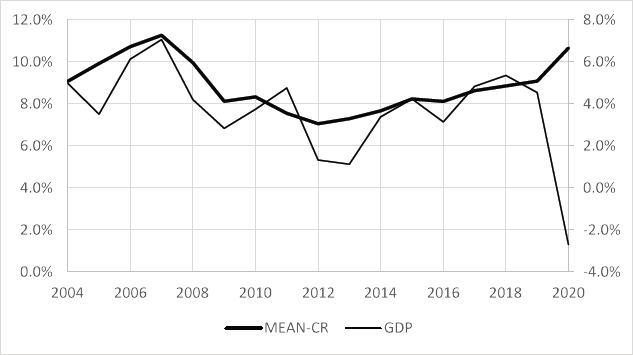
Figure 3.
MEAN-CR for Poland’s public companies and GDP over 2004. GDP (right-hand axis).
Source: Own calculations.
As Table 3 shows, GDP alone explains as much as 60% of pre-pandemic cash deposits of Polish listed firms. This increases to 65% when the pandemic 2020 year is treated separately as a dummy. One percentage point in GDP adds 0.6 p.p. to the cash-to-assets ratio, a highly statistically significant estimate. Figure 4 illustrates the result graphically using quarterly data.
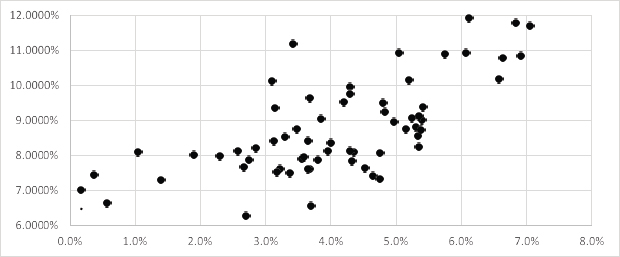
Figure 4.
MEAN-CR = f(GDP) for Poland’s public companies: 1Q 2004–4Q2019.
Source: Own calculations.
Table 3.
CR = f(GDP, TIME, DUMMIES) for Poland’s public companies 2004–2020
| MEAN-CR | (1) | (2) | (3) | (4) | (5) | (6) |
|---|---|---|---|---|---|---|
| GDP | 0.5994*** (4.50) | 0.5994*** (4.50) | 0.5498*** (4.64) | 0.5498*** (4.64) | 0.4041*** (3.74) | 0.4155*** (3.76) |
| DUMMY COVID | 0.0597*** (4.88) | 0.0640*** (5.89) | 0.0495*** (5.40) | 0.0525*** (5.26) | ||
| DUMMY PRE-GFC | 0.0159*** (3.80) | 0.0135** (2.64) | ||||
| TIME | –0.0009** (-2.31) | –0.0009** (–2.31) | –0,0003 (–0.82) | |||
| R2 | 0.5914 | 0.6465 | 0.7101 | 0.7492 | 0.8325 | 0.8414 |
| MEDIAN-CR | (1) | (2) | (3) | (4) | (5) | (6) |
| GDP | 0.3332** (2.43) | 0.3332** (2.43) | 0.2520*** (3.35) | 0.2520*** (3.35) | 0.1274 (1.17) | 0.1666** (2.38) |
| DUMMY COVID | 0.0288** (2.28) | 0.0357*** (5.18) | 0.0180* (1.96) | 0.0284*** (4.49) | ||
| DUMMY PRE-GFC | 0.0168*** (3.98) | 0.0086** (2.65) | ||||
| TIME | –0.0015*** (–5.94) | –0.0015*** (–5.94) | –0,0011*** (–4.45) | |||
| R2 | 0.2961 | 0.3145 | 0.8107 | 0.8156 | 0.6913 | 0.8836 |
Despite a heavy slump in economy in 2020, cash deposits rose significantly. The scale of the increase is truly impressive: taking the recession into account, Polish companies held as much as 6 p.p. more cash, relative to assets, than usual. Knowing the average holding in 2004–2020 amounted to 8.7%; the increase is indeed massive. When time is added as a regressor, the model explanatory power improves to above 70%, with the slope coefficients for GDP and the dummy hardly affected. The time continues to adversely affect the corporate cash holding, with statistical significance at 5% but relatively small economic impact. Adding a dummy for pre-GDP years changes little: GDP continues to add materially to cash accumulation; time slope coefficient is negative (statistically insignificant). The evidence for cash accumulation prior to 2007 is clear, and the unprecedented increase in cash holding during the pandemic is confirmed. The coefficient of determination is well above 80% at this stage. This is further confirmed by the analysis of annual medians. The negative trend in cash accumulation is evident; the temporal increases in cash accumulation are limited to pre-GFC and the pandemic years. Most importantly, except for one model, GDP is a strong determinant of corporate cash accumulation both economically and statistically (see Table 3).
We also note the importance of future GDP in explaining current CRs (not shown in the table). It is statistically significant both for both CR-MEAN and CR-MEDIAN models. For CR-MEAN, it remains to be positive regardless of whether the concurrent GDP index is included or not. We further investigate the question (do companies accumulate more cash in expectation of strong economy in the future) with an autoregressive model. Table 4 presents the results. Firstly, the simple autoregressive model explains 60% of the current CR for MEAN-CR and 65% for MEDIAN-CR, with the lagged CRs being highly statistically significant in both models.1 Adding the information on GDP raises the explanatory power to around 90% for both models, with GDPt+1 being particularly important. Time trend remains negative in both models and statistically significant at 1% for the MEDIAN-CR.
Table 4.
CRt = f(CRt-1, GDP, TIME) for Poland’s public companies 2004–2020
| MEAN-CR | MEDIAN-CR | |||||
|---|---|---|---|---|---|---|
| CR-1 | 0.8315*** (4.58) | 0.5553*** (4.28) | 0.3895** (2.38) | 0.8128*** (5.10) | 0.8318*** (7.22) | 0.3146 (1.76) |
| GDP | 0.2507** (2.29) | 0.3036** (2.80) | –0.0053 (–0.07) | 0.1228* (1.85) | ||
| GDP + 1 | 0.2620** (2.84) | 0.2371** (2.69) | 0.2416*** (3.71) | 0.1698*** (3.30) | ||
| TIME | –0.0007 (–1.52) | –0.0012*** (–3.23) | ||||
| R2 | 0.5992 | 0.8853 | 0.9087 | 0.6497 | 0.9044 | 0.9560 |
To conclude, there is no trace of positive trend in corporate cash holding in Poland. The periods of cash hoarding are limited to well-defined circumstances (before the crises and after the outbreak of the pandemic), with the deposits of cash in Polish listed companies fluctuating with (current and future) GDP instead.
3. Discussion
Our results stand in stark contrast to the evidence gathered for developed markets and the U.S. in particular. The difference can obviously be explained in various ways – a different sample period being a most obvious candidate. Below, we review in more detail the evidence provided in the seminal paper by Bates et al. [2009] and show the discrepancy between Poland and the U.S. market may be illusionary. We do it using the original dataset of Bates et al. [2009], who define their CRs in Appendix: Variable Definitions, as “cash and marketable securities to the book value of total assets” [p. 2019]. First, we start with the scrutiny of Bates et al. [2009] conclusions.
In the first paragraph, Bates et al. [2009, p. 1985] note a steady growth in cash-to-asset ratio over the sample period spanning 27 years: “We document a secular increase in the cash holdings of the typical firm from 1980 to 2006. In a regression of the average cash-to-assets ratio on a constant and time, time has a significantly positive coefficient, implying that the average cash-to-assets ratio (the cash ratio) has increased by 0.46% per year. Another way to see this evolution is that the average cash ratio more than doubles over our sample period, from 10.5% in 1980 to 23.2% in 2006.”2 The explanatory power of the model using yearly arithmetic means of CRs (MEAN-CR) was remarkably strong (89%). Moreover, the increase in MEAN-CR (0.46 p.p.) was statistically significant at 1%. The corresponding regression model of CR on time using medians (MEDIAN-CR) proved equally resilient: the coefficient of determination was 64%, with a median increase of 0.27 p.p. per annum being statistically significant at 1%. We double checked those computations and found them correct. Apart from yearly means and medians of CRs, Bates et al. [2009] provide data on aggregate CRs (AGG-CRs), i.e., “the sum of cash divided by the sum of assets for all sample firms. This ratio is 6.3% in 1980 and increases to 10.3% by 2006, reaching a peak of 10.9% in 2004” [p. 1991]. Although Bates et al. [2009] do not provide a statistical analysis of this particular variable (AGG-CR), we confirm that the annual increase in aggregate cash holding is statistically significant at 1% and the coefficient of determination, even if somewhat smaller than that for the means and medians, is quite high, too (42%). In addition, Bates et al. [2009] calculate “the average cash ratios for the firm size quintiles over our sample period” and conclude that “the average cash ratio increases across each size quintile” [p. 1992]. They support their findings with a set of regression models, one for each size cohort, and statistically significant estimates for a positive trend regardless of a company size.
Before we move to a more detailed appraisal of the paper’s conclusions, we propose a short summary of what was – given the time series data provided in the paper – obvious from the very beginning:
Firstly, the levels of MEAN-CR were considerably higher than the levels of AGG-CR for each year of the sample period – nearly 2.5 times higher, on average. That immediately implied a cash hoarding was mostly a small company problem.
Secondly, the levels of MEAN-CR were also higher than the levels of MEDIAN-CR for each year. The distributions of annual CR were therefore skewed to the right with a potential problem of outliers.
Thirdly, the increase in CR was observed for both MEAN-CR and MEDIAN-CR; hence, the cash accumulation over the sample period could not be attributed merely to (potential) outliers.
Fourthly, as the growth in CR over the sample period was higher for MEAN-CR (53.8%) than it was for AGG-CR (39.9%), the increase in cash holding observed must have been more pronounced for smaller companies. Smaller companies not only held more cash, but they increased their holdings more aggressively, too.
To conclude, cash hoarding is primarily a small company phenomenon. Whether the conclusions could be extended toward all firm sizes required more scrutiny (hence separate time regressions for each size cohort, all performed by Bates et al., [2009]).
Despite strong evidence for the existence of a positive time trend in U.S. corporate cash, we believe the conclusions may be less warranted than universally believed. First, we start with AGG-CR, computed at time t for Nt companies. As mentioned above, AGG-CR is defined as the sum of all cash held by firms in the sample to the sum of their total assets.
It is arguably the most intuitive measure of the amount of cash held within the corporate sector. This ratio increased, as explicitly stated by Bates et al. [2009], by nearly 4 p.p. from 6.3% in 1980 to 10.3% in 2006. The problem is that bulk of this increase comes just from the last 6 years. Over more than two decades of the 20th century, the increase (from 6.3% in 1980 to 7.4% in 2000) was negligible. In 1983, for example, AGG-CR was 7.6%, i.e., higher than that in 2000, and 1983 was by no means an exceptional year during 1980–2000 period. Having excluded the last 6 years, the regression model of AGG-CR on time has no explanatory power at all (R2 is less than 1%). Needless to say, the coefficient on the time trend is statistically insignificant (p-value of 0.84). To talk about a secular trend in cash holding in the 20th century (21 out of 27 years of the sample), based on AGG-CR, is simply unjustified.
The evidence for the secular trend in median values is also contestable. This trend comes again almost exclusively from the last few years and a particularly low base at the very start of 1980s. When compared with a 1983 level of 8.7%, MEDIAN-CR of 8.8% in 2000 does not look like strong growth. When we run a simple time regression model MEDIAN-CR for the 1983–2000, we – unsurprisingly – spot no cash holding increase at all: the coefficient of determination is merely 17% and p-value for the slope coefficient is well above 10%.
The regression model of MEAN-CR on time for 1983–2000 is also affected by exclusion of the extreme values at the beginning and end of the original sample period, but the conclusion about a secular positive trend is justified. The explanatory power remains high (R2 of 66% for a shortened period, and it is still higher than that for an original 1980–2006 period for both MEDIAN-CR and AGG-CR). A yearly increase in CR of 0.33 p.p. remains strongly statistically significant (p-value = 0.000042). Below, in Figure 5, we reproduce the graphs for all three annual time series for 1983–2000. It is clear that the secular trend in cash holding can only be spotted for MEAN-CR.
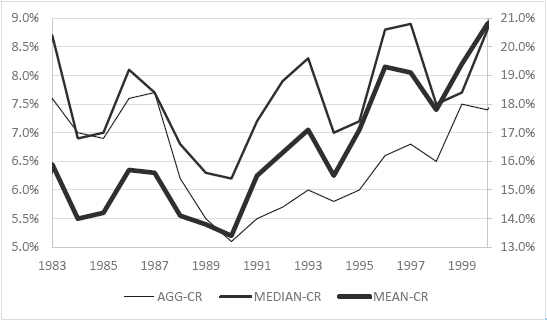
Figure 5.
CRs for U.S. companies over 1983–2000. MEAN-CR (right-hand axis).
Source: Own calculations based on data from Bates et al. [2009].
This is obviously possible to see a trend in MEAN-CR, when no trend for AGG-CR is detected. It is because the latter is an asset-weighted average of the former (for a given year).
Cash may not increase on aggregate in the corporate sector, or the asset-weighted average may not increase, and at the same time, an equally weighted MEAN-CR may grow. In particular, it happens when small companies – treated equally in MEAN-CR with large corporations – increase their CR, while big firms (marginally) decrease it. In other words, AGG-CR may go down even when MEAN-CR does not go down for all size classes securing MEAN-CR increase. However, it does not work the other way round: when MEAN-CR goes up for all size classes, it is impossible for AGG-CR not to go up. And this is precisely where Bates et al. [2009] may be misleading. They explicitly state that MEAN-CR increases for each size quintiles and, note at the same time, that AGG-CR also increases. The problem is that this does not hold for most of the sample period, as shown above. AGG-CR does not grow during 1983–2000 at all; it cannot be therefore true that MEAN-CR increases for each size quintile in that period. Bates et al. [2009] do realize that the bulk of the “the increase in the average cash ratio for the largest firms is especially strong in the later years of our sample” [p. 1992] but fail to explicitly recognize the fact that without those years the trend for large firms does not exist at all. They do not provide separately data for each size quintiles, but based on the graphs provided, it is clear the time trend does not exist for the last two quintiles (the largest companies in the sample) for most of the 20th century.
Throughout the paper, Bates et al. [2009] observe strong trends over the sample period for most variants of CR variables. They do not explicitly recognize the fact that the cash accumulation they discover comes mostly, and sometimes exclusively, from small firms. This conclusion is obvious from the first look at the input data, as mentioned above. In short, the increase in cash held by U.S. firms, as documented by Bates et al. [2009], does not apply to the whole corporate sector, all size cohorts, and the whole sample period. It is mostly driven by small firms during 1983–2000. Graham and Leary [2018] are right when they claim that the cash policies of small and large companies began to part ways since the start of the 1980s.
With the correlation of more than 94% with time, one would think there is hardly any need to search for more explanations. Unlike for Poland, the coefficient of determination for the simple linear regression of MEAN-CR and GDP is practically zero for the U.S. This is further confirmed by the model where TIME and GDP are used as two independent variables. As Table 5 shows, the slope coefficient for GDP is positive but not statistically significant. This however changes when future GDP is used. A 1% increase in GDP next year implies a quarter p.p. higher CR today. The result is statistically significant at 10% regardless of the model variant used. This is the result which resembles that for Poland: the stronger the economy (in the future), the larger the deposits of cash in corporate balance sheets. In our opinion, the shift in the focus from present GDP to future GDP, also seen for Poland, fits better the conclusions of Chen and Mahajan [2010] that “(f)irms want to hold more cash when the economy is expanding so that they have enough internal funds to finance profitable investment opportunities in the near future.” After all, cash is accumulated, according to this statement, not as a result of current value-added projects but future ones.3
Table 5.
Regression models for the U.S. companies 1980–2006
| MEAN-CR | MEDIAN-CR | |||||||
|---|---|---|---|---|---|---|---|---|
| GDP | 0.1555 (1.11) | 0.1006 (0.72) | 0.0206 (0.14) | –0.1819 (–1.25) | ||||
| GDP+1 | 0.2632* (1.76) | 0.2871* (1.99) | 0.1854 (1.34) | 0.1033 (0.93) | ||||
| GDP-1 | –0.2466* (-1.90) | –0.2612** (–2.06) | –0.2165** (–2.07) | –0.2598** (–2.52) | ||||
| Time | 0.0046*** (14.30) | 0.0045*** (14.08) | 0.0045*** (13.57) | 0.0045*** (13.99) | 0.0025** (2.65) | 0.0022** (2.49) | 0.0007* (1.69) | 0.0008* (1.92) |
| CR-1 | 0.4689** (2.35) | 0.5421*** (2.97) | 0.8931*** (6.63) | 0.8555*** (6.53) | ||||
| R2 | 0.8910 | 0.8963 | 0.8995 | 0.8971 | 0.9188 | 0.9105 | 0.8934 | 0.8775 |
With the help of data from Bates et al. [2009], we have also been able to estimate an autoregressive model for the U.S. market, with TIME and GDP variables as other regressors. With the time trend being absorbed mainly by the lagged variable, the positive link to either current GDP or future GDP has not been confirmed. Instead, the negative slope coefficient for the lagged GDP is generated: a 1 percentage point drop in past GDP, increases 0.21–0.25 p.p. CR today. As our autoregressive models serve merely as a support to our main, simple regression models, we are not determined to attach too much weight to this finding (absent in Poland). Still, a negative slope in front of last year GDP is appealing. It suggests, in addition of the money demand, transaction-driven motive and the existence of the precautionary motive for the U.S. market in line with Kim et al. [1998], Opler et al. [1999], Almeida et al. [2004], Faulkender and Wang [2006], Acharya et al. [2007], Han and Qiu [2007], Baum et al. [2008], Riddick and Whited [2009], Lyandres and Palazzo [2011], and Morellec et al. [2014].
4. Conclusions
In contrast to the results found in international markets, we fail to observe a secular upward trend in corporate cash holding in Poland. If anything, there is a (statistically significant) negative slope of small size. This contradicts the results presented in Berent and Śniechowski [2019] who, based on the smaller sample and a limited time frame (2008–2016), detect a rise in corporate cash holding. We confirm, the upward trend was indeed present throughout the 2010s but did not exist earlier. This suggests in turn a CR, rather than exhibiting secular trends, which may be a period-dependent variable. This indeed constitutes our first major conclusion: a secular upward trend worldwide in cash holding since 1980 is at best a period-dependent, time-varying phenomenon. Bates et al. [2009] may have spotted a secular trend over 1980–2006 in the U.S., but, as Graham and Leary [2018] show, it is only a small part of the larger picture inhabited by different cash cycles. An impressive growth in cash holding was detected, for example, between 1920 and 1945, when the average cash held by a U.S. firm tripled. By 1970, however, the CRs were back to the 1920 levels.
In addition, what Bates et al. [2009] consider as an unquestionable rise in cash holding since 1980 may not be true either, as the aggregate levels of corporate cash, as we show based on the original data from Bates et al. [2009], did not increase between 1980 and 2000 at all. Moreover, the increase in cash holding spotted by Bates et al. [2009] applies primarily to smaller companies. Based on the original data, we were able to show that the large companies did not participate in the growth in the last two decades of the 20th century. Furthermore, even the growth exhibited by small companies may not have originated from the changed corporate behavior but from an altered sample composition. Graham and Leary [2018] call it “Nasdaq effect” and attribute this cash increase to a new wave of entrants, mainly from IT and healthcare sectors. Based on data from Bates et al. [2009], we also show a strong growth in cash in the period before the Global Financial Crisis. Actually, without the pronounced increase in cash in the early 21st century, a secular cash growth hypothesis formulated throughout by Bates et al. [2009] is hardly true.
Studying cash holdings for Poland since 2004, a very unstable period, ridden by Global Financial Crisis, unconventional monetary policies, the COVID-19 pandemic, etc., we realized that macro context and other external shocks, frequently neglected in liquidity research, were an important factor. For example, similarly to the U.S. market, a significant pile in cash among Polish public companies was detected before the 2007–2009 crisis. We also document an almost complete disconnection between the COVID-ridden CRs and other variables. Massive relief programs on both sides of the Atlantic are clearly responsible. We have not provided any empirical evidence worldwide, but we have little doubt that this conclusion is valid almost everywhere.
The introduction of macro data is not entirely new in the study of corporate liquidity. In the past, however, it was merely used as an add-on to models focused on the study of optimal corporate cash levels and company-specific determinants of corporate liquidity. In such models, with GDP as one of regressors, not much more than 10%–11% variability was explained (viz. Chen and Mahajan [2010]). This compares to many times larger explanatory power of the simplest GDP-driven models for the Polish market.
Last but not least, we want to emphasize the need for further inquiry into what determines the overall amount of cash in the corporate sector. We believe, however, it should be followed differently than before. To date, corporate liquidity research is dominated by optimal cash models, firm-specific determinants, cash holding motives, or behavioral biases. This research is fundamental and often implies very refined tools. We claim however that the conclusions produced at this stage apply usually to relatively short periods and specific contexts and as such can miss important long-term effects. In our opinion, macro input is indispensable to understand long-term cash holding effects. The study of other external (liquidity or liquidity linked) shocks of whatever origin, as was shown by the COVID-19 pandemic or repatriation tax regulations in the U.S., is also vital. Graham and Leary [2018] believe that the growth in cash after 2000 was mainly caused by tax considerations, implying the “trapped cash” hypothesis. Da Cruz et al. [2019, p.135], in their systematic literature review claim that macroeconomic environment and tax policies are “two important (and missing) topics on the determinants and antecedents of cash holdings.” We believe that these factors are even more important when we shift the focus from micro perspective of cash holding determinants of a given firm to a macro one, where measuring and/or predicting aggregate levels of liquidity held by the corporate sector, is a priority. As we have shown in our paper, even a simple addition of a single macroeconomic variable, coupled with a separate treatment of exogenous events such as the pandemic, the GFC or regulatory framework changes and improves considerably our understanding of amount of cash held by corporations. In the unstable times ahead (economically and geopolitically), this understanding may yet prove vital.
Notes
[6] We report coefficients of determination throughout but pay little attention to them in the auto-regressive models. Still, the increase in R2 after adding GDP is worth noting.
[7] Bates et al. [2009] obviously mean 0.46 percentage points rather than 0.46% as stated in the paper.
[8] Chen and Mahajan [2010] point to future projects even if the use only current value of GDP in their model.