
1. Introduction
The rule of law implies that all citizens and institutions within a country, state, or community are accountable to the same laws. According to Bingham [2007], the principle can be broken down into a series of eight subrules, which – in general – relate to adjudicative procedures, the accessibility and application of law, protection of human rights, exercising of powers by ministers and public officers reasonably and in good faith, and compliance with international law. Maravall and Przeworski [2003] have claimed that the rule of law is a strategic choice of actors with powerful interests, rather than an exogenous constraint on politicians.
According to Haggard and Tiede [2011], there are four strands of literature wherein the rule of law has been associated with economic growth – (1) through the provision of security for a person; (2) through property rights and contract enforcement; (3) through checks on government and corruption/private capture; and (4) through equal treatment and procedural fairness. While the first of these refers to a very basic human need – the sense of safety, the other three relate to the role of institutions [Shleifer and Vishny, 1998; Asoni, 2008; Peres et al., 2018], structural safety standards [Malesky and Taussig, 2019], judicial independence [Glaeser et al., 2004], protectionism, misallocation of government spending, and private expropriation of assets by managers or controlling shareholders. Research has shown that a weaker rule of law is associated with lower investment and growth. The formal institutional environment (government legislation, policies, and programs) is an important element of international competitiveness and national economic growth. The ways in which changes in institutional conditions affect the quantity and quality of entrepreneurship in a country have also received some attention [Sobel, 2008; Stenholm et al., 2013]. The legal protection of investors in a country is also an important determinant of the development of its financial markets [La Porta et al., 1997, 1998]. Foreign investors prefer states in which they are protected and the law is enforced. As a result, those financial markets are broader and more valuable [La Porta et al., 2002]. Ben Naceur et al. [2007] prove that the link between macroeconomic instability and stock market capitalization is negative and significant.
Although the ultimate benefit of legal investor protection for financial development has been extensively documented, the effect of the rule of law on valuation has received less attention. According to Durnev et al. [2004], stock prices reflect information about changes in firms’ marginal value of investment if property rights are protected and institutions are strong and transparent. In the presence of institutional deficiencies however, it is profitable for arbitrageurs to spend resources uncovering proprietary information and then earn high rates of return using this information to trade against less-informed investors. According to the Fitch On: Central and Eastern Europe Reportv1, there has been a sharp deterioration in the rule of law in Poland since 2015, as measured by the Worldwide Governance Indicators (WGIs), and there have been significant related tensions with the European Commission. In Estonia, Latvia, and Lithuania, WGI scores have followed very different trajectories as far as rule-of-law indicators are concerned. All the Baltic state WGI scores on rule of law have been high and improving over the past decade, which makes these four countries a perfect laboratory to ask the question whether the change of rule of law within a single country affects share prices and to what extent firm market value is tied to the home country rules and reputation?
Prior research on the relation between rule of law and company market values or performance does not directly address any of these concerns, especially in the context of post-transitional economies. It is even more interesting due to the fact that the legal regulations concerning commercial codes in Poland and the Baltic States are similar. From the point of view of a comparative analysis of the legal acts themselves, the Commercial Companies Code in Poland has the largest number of articles relating to statutory bodies (216 out of 633 articles in the legislative act). In addition, the structure of the Commercial Companies Code is divided into more levels compared to those in the Baltic States, which may affect the understanding and complexity of the system and thus the rule of law in the respective country (see Table A1 in the Appendix).
This paper is organized as follows. Part 2 reviews the literature on the relationship between rule of law and firm value. In Part 3, we formulate our hypothesis. Part 4 describes our data set and indexes. Part 5 discusses our results. Part 6 concludes the paper.
2. Literature review
There are three strands of literature studying the links between corporate finance or governance and law.
The first, and most general, focuses on differences in the legal systems across countries and their economic growth, claiming the laws that protect investors differ significantly across countries because of differences in legal origins [see La Porta et al., 1998]. Malmendier [2009], in her seminal paper on the Roman experience, emphasizes two institutional circumstances that were favorable to the development of the business corporation: the state needs to be strong enough to generate demand for complex organizational tasks and weak enough to outsource them, while the legal system needs to be accommodative enough to extend existing sanctioned legal forms to solve new organizational problems. Barro [2000] suggests that raising the rule-of-law variable by one in seven ranks leads to a 0.50% increase in the growth rate over the period by encouraging investments and enhancing the productivity of investments. Demetriades and Andrianova [2004] argue that the various causal patterns in the way in which finance influences economic growth across countries reflect the differences in the quality of finance, which are, in turn, determined by the quality of financial regulation and the rule of law. Demetriades and Hook Law [2006] find that stronger institutions are more significant than financial developments in explaining output per capita in low-income countries. On the other hand, Acemoglu and Johnson [2005] investigate how central legal institutions affect the economic and financial development of a country compared to political institutions. According to them, a weak legal environment (weak protection of contractual rights) can be remedied in private agreements and via reputation, but weak political institutions (weak property protections) cannot. Conversely, Anwar and Cooray [2012] claim that the quality of institutions influences the level of financial development, which implies that the extent of benefits obtained from financial development depends on political rights and civil liberties. Similarly, Dutta and Meierrieks [2021] show that higher levels of financial development cause higher levels of entrepreneurial activity, especially when economic and political institutions are sound.
The second strand of literature finds that cross-country differences in laws and their enforcement affect corporate governance (CG) resulting in variations in ownership structure, dividend payout, availability and cost of external finance, and market valuations. La Porta et al [2002] finds evidence of higher valuations of companies in countries with better protection of minority shareholders and in firms with higher cash-flow ownership by the controlling shareholder. Klapper and Love [2004] use data on firm-level CG rankings across 14 emerging markets and claim that average firm-level governance is lower in countries with weaker legal environments, and that firm-level CG provisions matter more in countries with less-effective legal systems. Furthermore, governance is correlated with the extent of asymmetry of information and contracting imperfections that firms face. They also confirm that better CG is highly correlated with better operating performance and market valuation. According to the research conducted by Adamska and Dąbrowski [2021], the institutional context plays a significant role. Their findings indicate that in markets characterized by higher-risk institutional environments, investors demonstrated a more pronounced response to the inclusion of companies with a positive impact and exclusion of companies with a negative impact in the sustainability indexes compared to markets with lower-risk institutional environments.
Several studies have also provided support for the suggestion that investor protection at the country level correlates with larger securities markets, less-concentrated share ownership, and higher share prices (a higher value for minority shares) [e.g., Levine, 1998; La Porta et al., 2006].
And finally, the third strand of research concentrates only on firm-level CG mechanisms. Black et al. [2006] ask the very important question of whether the CG practices of firms within a single country affect these firms’ share prices: “To what extent can a firm increase its market value by upgrading its corporate governance practices, and to what extent is it tied to its home country’s rules and reputation?” They report that the overall CG index explains the market value of Korean public companies. Their CG index predicted a 0.47 increase in Tobin’s q (about a 160% increase in share price). Bai et al. [2004] investigated the relationship between governance mechanisms and the market valuation of publicly listed firms in China. They examined the effect of CG variables on market valuation after controlling for factors commonly considered in market-valuation analyses. They find that both a high concentration of noncontrolling shareholding and issue of shares to foreign investors have positive effects on market valuations, while a large holding by the largest shareholder, the chairman or vice chairman of the board of directors being the chief executive officer (CEO), and the largest shareholder being the government together have negative effects.
We combined the first and last strands of literature and raised the question of whether rule-of-law practices affect companies’ market values. In contrast to the majority of studies that have concentrated almost exclusively on the Organization for Economic Cooperation and Development (OECD) member countries and US firms, we address Poland and the Baltic States.
3. Research hypothesis
The objective of this paper is to investigate the relationship between the rule of law and firm market valuations in transition economies, which have not received much attention in literature to date. Specifically, we consider Latvia, Lithuania, Estonia, and Poland. In all of these countries, a series of political reforms began in 1989. However, in Poland, since 2015, changes in the country’s governmental order, unresolved systemic problems, and creeping authoritarianism have cast a shadow over future economic development and stability. In contrast to Poland, the Baltic States, despite the fractious nature of their politics, continued their high degree of pro-European Union (EU) policy. All the Baltic countries consistently rank highly in various indexes of institutional effectiveness and are deemed to have professional civil-service standards and a lower prevalence of corruption than in other postcommunist states. Their judicial systems are independent, and the legal mechanisms generally function well. Furthermore, empirical evidence suggests that country-specific factors become less important in asset pricing as markets become more integrated due to efficiently functioning rule of law [Hail and Leuz, 2003]. The question of how country-level governance and the rule of law strengthens investor protection and improves stock market performance has been debated intensely [Ball et al., 2000; La Porta et al., 2000; Shleifer and Wolfenzon, 2002]. Pástor and Veronesi [2013] developed a model that implies that political uncertainty commands a risk premium whose magnitude is larger under weaker economic conditions. However, the link between investor protections and the expected returns is still ambiguous, not just in the context of the measures/proxies implemented but also empirical evidence.
Empirical analyses use indicators such as the economic freedom index from the Heritage Foundation, the Anti-Director Right Index, the World Bank WGIs, and the Economic Freedom of the World (EFW) index from the Fraser Institute. According to Gwartney et al. [2015] and Attah-Boakye et al. [2021], EFW mitigates the probable dispersion of interrelated criteria, enhances a full perspective of the economic freedom of a country, and considers a global approach from various perspectives (investors, shareholders, and stakeholders). EFW regularly ranks 157 countries and, in some cases, tracks back to the 1970s.
Literature has approached the rule-of-law issue from different angles. Some works concentrate on stock market indexes, while others dwell on the cost of equity or merger and acquisition (M&A) activities or outcomes.
Hooper et al. [2009] studied stock market indexes for 50 developed and emerging markets and suggested that stable institutions are linked to higher returns on equity. They also claimed that the quality of governance (measured by governance data sourced from Kaufmann et al. [2006]) is negatively related with stock market total risk and idiosyncratic risk. These findings indicate that countries with more efficient governance systems have stock markets with higher equity returns and lower cost of capital. Consequently, we hypothesize the following:
H1: Higher-level rule of law is linked with higher returns on equity.
In contrast, Low et al. [2011], who like Hooper et al. [2009], used Morgan Stanley Capital International (MSCI) country indexes for 48 countries, reported a negative relationship between the indicators (measured by World Bank’s WGIs) representing political stability and absence of violence, government effectiveness, regulatory quality, rule of law, control of corruption indicators, and stock returns. In other words, in the presence of institutional deficiencies, equity returns increase as a result of higher transaction and agency costs in countries with a weak governance framework proxied by rule-of-law indexes. This implies that investor concerns over political risks have a significant impact on the equity markets. Their results contradict those of Hooper et al. [2009].
Hail and Leuz [2006] examined international differences in firms’ cost of equity capital across 40 countries and found that countries with extensive securities regulation and strong enforcement mechanisms exhibited lower levels of cost of capital than countries with weak legal institutions. According to Albuquerue and Wang [2008], who developed a dynamic stochastic general equilibrium model to study asset pricing and welfare implications of imperfect investor protection, weaker investor protection causes lower Tobin’s q, higher return volatility, larger risk premia, and higher interest rates.
Iona et al. [2020], using the credit market freedom (CMF) component of the EFW index computed by the Fraser Institute, studied whether CMF affected the relationship between corporate value and financial policies. They found that there is a U-shaped relationship between cash holdings and firm value only in states enjoying high levels of CMF. In these countries, they also observed a higher probability of agency problems. Finally, Iona et al. [2020] suggested that providing institutional environments with greater CMF can enhance the firm’s access to external finance, the level of corporate investment, and the economic growth, in addition to increasing conflicts of interest between managers and shareholders.
Attah-Boakye et al. [2021] also used the EFW index to study why some M&A deals had been withdrawn. Building on the institutional theory, they claimed that the likelihood of a deal’s withdrawal increased if the economic freedom and quality of legal environment of the acquiring (target) firm’s country was higher (lower). Their results showed that strong protection and information transparency made decision-makers more aware of the business risks and acquisition costs.
Bonaime et al. [2018] used a different proxy, the Baker-Bloom-Davis Index (BBD index), to uncover how uncertainty surrounding government policies affects M&A activity. They present robust evidence that policy uncertainty negatively influences M&A activity. Furthermore, they show that monetary policy, fiscal policy (taxes and government spending), and regulation (especially financial regulation) are more detrimental to M&A activity than uncertainty related to health care, entitlement programs, national security, trade policy, and sovereign debt.
Renneboog and Vansteenkiste [2019], in their overview of academic literature on the market for corporate control, indicated that country-level governance can affect the M&A process through rule of law and regulatory actions and also through political connections of the director and management. However, the influence of political connections and state ownership depends on the strength of the legal system. According to them, while the evidence based on China reveals that political connections result in worse short- and long-run deal performance, in the case of the US samples, these political connections improved short- and long-term stock and operating performances.
In general, previous literature has focused on the quality of governance in developed economies or emerging ones. Our research here is thus motivated to explain stock returns in post-transitional economies. Addressing the rise of populism in Poland, we suggest that institutional change leading to weaker institutions, lower structural safety standards, and weaker judicial independence (worse governance environment) decrease returns to shareholders by increasing both transaction costs and agency costs. In other words, investor concerns over rule of law command an equity premium across internationally competitive financial markets, resulting in higher returns on equity. It may create the option characteristic (instability creates potential opportunities for businesses to flourish). Based on this, we formulate the following research hypothesis:
H2: Lower level of rule of law is linked with higher returns on equity.
4. Research methodology
4.1. Sample
To investigate whether strength and development of the national legal system has a significant association with stock performance, we use a data set of individual public companies listed in the stock exchanges of Poland and three Baltic States over the period 2010–2020. Financial data and information related to stock prices were collected from the EquityRT and Orbis Europe databases, while country data were accessed from several sources, namely, Eurostat, World Bank, and independent nongovernmental research and educational organizations. We excluded from our sample those observations that had missing information related to any of the data. Hence, our analysis embraces an unbalanced panel sample of 228 firms and 2,124 firm-year observations. The distribution of the sample is presented in Table A2 in the Appendix.
4.2. Variables and model
We estimated the following random-effects panel regression model2 to test our hypothesis.
where firm market performance is the calendar-year/1-year stock return of firm i from country j at year t. Further, β, δ, and γ are structural parameters reflecting the impact of each variable or effect on the dependent variable, and εijt is the random error. The variables defined as Fit represent five variables for firms, and Cjt correspond to three variables for countries.To examine deterioration in legal system characteristics, we apply several rule-of-law proxies for national legal frameworks and justice system quality. First, we used the Judicial independence index, which reflects autonomy of the country’s judicial system from political influences of members of government, citizens, or firms. From an economic standpoint, an independent judiciary is the core of the rule of law, which is fundamental in a market economy to protect property rights and to ensure efficient allocation of resources and business on equal terms [Oxenstierna and Hedenskog, 2017]. As a measure of another “check” on the legal system’s quality, we used the index Impartial courts, defined as the opportunities for private businesses to settle disputes and challenge the legality of government actions and the efficiency level of the regulation process. These measures are from the database of the Fraser Institute EFW and are based on the World Economic Forum Global Competitiveness Report data. Third, we use the Rule-of-law estimate, from the WGIs. This variable reflects perceptions of the extent to which citizens have confidence in and abide by the rules of society, in particular, the quality of contract enforcement, property rights, and the courts. This estimate gives the country‘s score on an aggregate indicator in units of a standard normal distribution, i.e., ranging from approximately –2.5, corresponding to very weak, to +2.5, corresponding to very strong rules. Our last variable for the legal framework quality (Rule-of-law index) captures the extent to which “laws are transparently, independently, predictably, impartially, and equally enforced, and to what extent the actions of government officials comply with the law”. Specifically, we used the V-Dem Institute measure [Coppedge et al., 2021, p. 299] of 15 indicators, whereby each corresponds to questions answered on fully labeled ordinal scales by country experts, with the results aggregated by Bayesian factor analysis models. We expect the stock returns to be greater in firms from countries with less or decreased rule-of-law measures.
In Figure 1, we compare the values of rule-of-law proxies for Poland and the Baltic States for 2010–2020. As we can see in the first half of the sample period, all the countries’ legal characteristics are closely correlated and stable, with some of them even improving. However, the most distinct change is in Poland. Most of the rule-of-law proxies decrease rapidly after 2015 and reflect the deteriorating situation in Poland. Meanwhile, we observe a continuation of the previous tendency with slight variations in the three Baltic States.
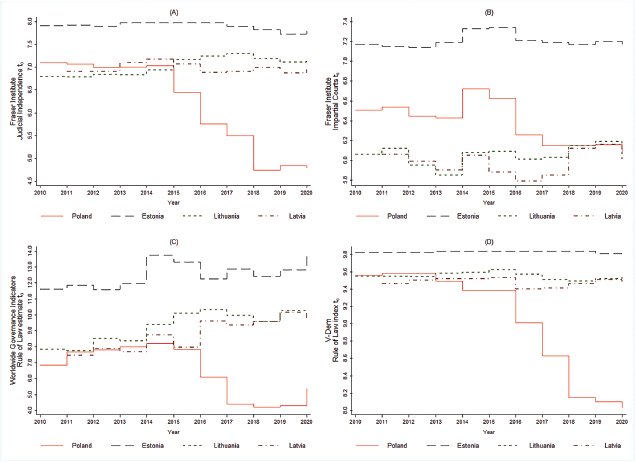
Figure 1.
Rule-of-law proxies for selected countries (Poland and the three Baltic States). (A) Fraser Institute Judicial independence; (B) Fraser Institute Impartial courts; (C) Worldwide Governance Indicators Rule-of-law estimate; and (D) V-Dem Rule-of-law Index.
Source: Own elaboration based on Fraser Institute, V-Dem, and WGI World Bank databases.
To mitigate the concern that the relation between the rule of law and stock returns can be driven by other firm- and country-level characteristics, we included several additional control variables. Regarding these control variables, we first include a vector of firm characteristics at the end of the fiscal year t (Fit), including size (natural logarithm of Market value), profitability (Return on assets), financial risk (Leverage), relative value (market price per share divided by the book value per share [P/BV] ratio), and dividend capable (earnings per share [EPS] ratio). We also use three macroeconomic control variables as proxies of the macroeconomic environment in each country (Cjt). These are real growth of gross domestic product (GDP growth), the unemployment rate (Unemployment), and the 1-year return of the market index in each country’s stock exchange (Index return). Table A3 in the Appendix provides more detailed definitions of the variables. Descriptive statistics of the variables are presented in Table A4 in the Appendix.
5. Results
Table A5 in the Appendix presents the random-effects regressions of firm market performance based on 1-year stock returns. As we can see in Column (1), some of the control variables, namely, return on assets, and unemployment rate, are insignificant; this is caused by using a robust estimator and clustering the standard errors for firms. Due to economic reasons, we decided to keep the same set of control variables in each estimation process. The statistical characteristics of the estimated regression models are quite satisfactory. For example, the Wald test shows that the obtained coefficients are statistically different from zero, and the variables included explained the stock returns.
Our results show that each of the measures of the legal framework is negatively and significantly correlated with firm market performance. In all the models, the coefficients on rule-of-law proxies are statistically significant at 0.01. As expected, the deterioration in rule of law contributes to higher returns on equity in the same year. This implies that the higher the legality standards and the less influenced the judicial standards, the lower are the stock returns. For example, we find that a one-point decrease in the Fraser Institute Judicial Independence index is related to a 10.35% increase in Model (2) and 13.58% increase in Model (3) in stock returns. In the case of the remaining explanatory variables, the average impact on firm market performance is similar, where the marginal effect depends on the methodology and measuring range used by each organization.
To build more confidence in our main findings, we used several robustness checks to determine whether our results remained unchanged. First, we tested the sensitivity of our results to each country’s unobserved heterogeneity by using country-fixed effects in Models (3), (5), (7), and (9) (Table A5 in the Appendix). The results support the finding that efficient and independent legal frameworks tend to lower stock price returns, as the coefficients for rule of law are negative in all models. We conclude from this analysis that our models do not suffer from limitations that are attributable to unobserved country-invariant characteristics.
Our second set of robustness checks consisted of running the models presented in Table A6 in the Appendix in subsamples. An important concern is whether the negative effect of amelioration in the rule of law on firm market performance is different from the historical values. We examined how this relationship varied across subsamples based on the negative (decline) and positive (increase) tendency in the legal framework characteristics. For each rule-of-law proxy, we divided the full sample into subsamples in which (i) the proxy in year t was equal to or higher than in year t – 1 (increase: legality improvement) and (ii) the proxy was decreased in year t compared to year t – 1 (decline: rule of law deteriorating). We find that the results are similar, although the strength of the relationship between the level of rule of law and return is more negative and significant in the years following the improvements in the judicial independence (Column 2) and general laws become more transparent, along with impartiality (Column 8).
As a robustness check, we divided the sample into two periods for 2015 and estimated the models using the same set of variables in each subsample period. This additional test, presented in Table A7 in the Appendix, gives further support to our first hypothesis and indicates that the negative relationship between the rule of law and firm market performance appears to be less robust after 2015. We find negative and statistically significant coefficients for the V-Dem Institute Rule of Law index (Columns 7 and 8) and the Fraser Institute proxies (Columns 1 and 4). The other parameters are not significant.
6. Conclusions
This paper investigates the link between the rule of law and equity returns in post-transitional economies over the period January 2010–December 2020 using panel data regressions. We use several rule-of-law proxies for national legal frameworks and the justice system quality as proxies of the rule-of-law principle. For Poland, Latvia, Lithuania, and Estonia, our findings indicate that country-level quality of the judicial system is an important driver of firm market performance. As expected, we find that post-transitional countries with lower measures of rule of law exhibit higher returns on equity than those with better measures. Our results support the idea that since poor governance and country instability increase agency and transaction costs, in addition to decreasing growth prospects and profitable projects available to firms, the risk premium demanded by investors increases, leading to higher equity returns. In general, our findings are consistent with those of Harvey [1995], Lombardo and Pagano [2002], Hail and Leuz [2006], and Low et al. [2011]; however, Gompers et al. [2003], Hooper et al. [2009], and Aggarwal and Goodell [2011] find an opposite relationship.
The extensive research implies that rule of law has an important impact on equity markets. Quality and structure of governance are crucial for a well-functioning financial system. In countries where enforcement of laws and regulations is impaired, improvements in the macroeconomic environment and policy will have a limited impact. The findings of this study highlight the importance of judicial reforms at a country level in states with weak political structures.
We are aware that the results of this study are also subject to limitations associated with the geography and choice of the dependent variable. First, our study is limited to the companies in the four post-transitional countries under investigation. Furthermore, it is worth noting that a substantial proportion of our observations pertain to companies originating from a single country, which could potentially have an influence on the statistical significance of our findings. Additional research should be conducted in order to include other European and developed countries in the study. A larger sample size would enhance the ability to explain and understand the relationship between the level of the rule of law and return on equity. This expanded research could potentially provide evidence to support the hypothesis that there is a positive relationship between these two variables. The second limitation relates to the firm’s market performance proxy used, which in this study is the 1-year raw stock returns. It would be interesting to adopt the excess return, as Hooper et al. [2009] and Low et al. [2011] did.
Future research could also investigate the change in the relationship between rule-of-law level and equity risk premium in emerging markets. Given the extensive literature on risk premia in equity markets, relatively little is known about expected returns and risk premia in the corporate bond market in relation to the rule of law [Gu and Kowalewski, 2016]. Further studies may investigate the relationship between institutional environment improvement and corporate bond returns. It would be interesting to look into the relationship between the rule of law and the growth of the corporate bond market in post-transitional nations.
Acknowledgments
We thank the anonymous referees for helpful comments and suggestions. This article has been presented at international conferences, including the International Society for the Advancement of Financial Economics (ISAFE-2022), December 2022, and at the 23rd Financial Management Conference (FMC), October 2022.
Notes
[1] Mutual funds, pension funds, and insurance companies often adopt investment policies that are based on credit ratings [Dong et al., 2021]. Since Fitch Ratings is one of the three largest rating agencies in the world, many empirical analyses have used data from this source [Bae et al., 2015; Huang et al., 2021; Vu et al., 2022].
Appendix
Table A1.
Comparison of legal acts relating to company statutory bodies
| Poland | Lithuania | Latvia | Estonia | |
|---|---|---|---|---|
| Name of the legal act | Act of September 15, 2000, Code of Commercial Companies (JL of 2020, Item 1526) | Act of July 13, 2000, Law on Companies, No. VIII-1835 (entry into force: 01.07.2015) | Act of June 1, 2000, Commercial Law (entry into force: 01.08.2021) | Act of September 1, 1995, Commercial Code (entry into force: 01.07.2017) |
| Structure of legal act in relation to statutory bodies | Title: Capital companies Department: Limited liability company Chapter: Company bodies Section: Management board, Supervision Department: Simple joint-stock company Chapter: Company bodies Section: Management board, Supervisory board, Board of directors Department: Joint-stock company Chapter: Company bodies Section: Management board, Supervision | Chapter: Management of company, Articles: e.g., Manager of the company | Division: Limited liability company Chapter: Administration of the company Section: Council, Board | Chapter: Management Paragraphs: e.g., the company’s management board |
| Number of articles relating to statutory bodies* | 168 (216) | 38 (49) | 42 (51) | 21 (45) |
| Participation of the parties in the regulations of statutory bodies with regard to the entire legal act | 13% | 7% | 7.5% | 9% |
| Name of the owners’ general meeting | General meeting of partners/shareholders | General meeting of shareholders | General meeting, general meeting of stockholders | General meeting of shareholders |
| Statutory bodies in a two-tier system | ||||
| Name of the body responsible for managing the company | Management of the company (in Poland – zarząd) | Management body/ Board of the company | Board of the company | Management board/Board of the company |
| Name of the statutory body responsible for supervising the company | Supervisory board (in Poland- rada nadzorcza) | Supervisory board | Management of a council | Supervisory board |
| Statutory bodies in a one-tier system | ||||
| Statutory bodies in a one-tier system | Board of directors | Manager of the company – as a manager in a one-tier system | x | x |
| Number of board members | Min. 1 person | No regulations | Min. 1 person | Min. 1 person |
| Number of members of the supervisory board | Min. 3 people | 3–15 people | 3–12 people | Min. 3 people |
| Number of members of the board of directors | Min. 1 person | No regulations | No regulations | x |
| Length of the term of office of the management board | No information (included in the agreement/ resolution of the company) | No information (included in the agreement/resolution of the company) | No information (included in the agreement/resolution of the company) | Indefinite period of time |
| Length of the term of office of the supervisory board | No regulations | Max. 4 years | Max. 5 years | No regulations |
| Length of the term of office of the board of directors | No regulations | No regulations | No regulations | No regulations |
| Number of words present: board | 396 | 32 | 36 | 564 |
| Number of words used: supervisory board | 210 | 123 | 169 | 352 |
| Number of words used: board of directors | 22 | x | x | x |
1 Source: Own elaboration based on: Act of September 15, 2000, Commercial Companies Code (Dz.U. 2020 poz. 1526); Act of July 13, 2000, Law on Companies, No. VIII-1835 (entry into force: 01.07.2015); Act of June 1, 2000, Commercial law (entry into force: 01.08.2021); Act of September 1, 1995, Commercial Code (entry into force: 01.07.2017).
Table A2.
Distribution of firm-year observations
| Year | Firms | |||||
|---|---|---|---|---|---|---|
| All | Poland | Estonia | Latvia | Lithuania | ||
| N | % | |||||
| 2010 | 149 | 7.19 | 127 | 10 | 0 | 12 |
| 2011 | 166 | 7.99 | 130 | 9 | 9 | 18 |
| 2012 | 175 | 8.33 | 139 | 10 | 9 | 17 |
| 2013 | 188 | 8.93 | 148 | 13 | 9 | 18 |
| 2014 | 202 | 9.52 | 162 | 12 | 9 | 19 |
| 2015 | 211 | 9.92 | 168 | 13 | 9 | 21 |
| 2016 | 208 | 9.72 | 172 | 13 | 9 | 14 |
| 2017 | 210 | 9.82 | 173 | 12 | 10 | 15 |
| 2018 | 210 | 9.82 | 170 | 13 | 10 | 17 |
| 2019 | 210 | 9.77 | 170 | 14 | 10 | 16 |
| 2020 | 195 | 8.98 | 165 | 14 | 9 | 7 |
| Firm-year observations | 2,124 | 100.00 | 1,724 | 133 | 93 | 174 |
Table A3.
Definitions of the variables
| Variable | Description | Source |
|---|---|---|
| Judicial independence | Presents an answer to the question to what extent is the judiciary independent from political influences of members of government, citizens, or firms? Shows higher scores for countries with greater judicial independence, on a converted scale of 1–10. | Fraser Institute |
| Impartial courts | Presents an answer to the question how efficient is the legal framework for private businesses to settle disputes and challenge the legality of government actions and/or regulations? Shows greater scores for countries where the legal framework is efficient and follows a clear, neutral process, on a scale of 1–7. | Fraser Institute |
| Rule-of-law estimate | Captures perceptions of the extent to which agents have confidence in and abide by the rules of society, in particular, the quality of contract enforcement, property rights, the police, and the courts, as well as the likelihood of crime and violence. Ranges from approximately -2.5 to +2.5, with higher scores showing “better” environments. | Worldwide Governance Indicators of the World Bank Group |
| Rule-of-law index | Presents an answer to the question to what extent is the law transparently, independently, predictably, impartially, and equally enforced, and to what extent do the actions of government officials comply with the law? Ranges from “0” to “1”, with higher scores showing higher rule-of-law quality. | V-Dem Institute |
| Market value | Natural logarithm of the market value of equity at the end of the fiscal year. | EquityRT |
| Leverage | The total liabilities to shareholders equity ratio at the end of the fiscal year. | EquityRT, Orbis |
| Return on assets | The ratio of net income to total assets at the end of the fiscal year. | EquityRT, Orbis |
| P/BV | Market value of shares divided by their book value | EquityRT |
| EPS | The ratio of net income to total shares at the end of the fiscal year. | EquityRT |
| Index return | One-year return of the main stock market index in each analyzed country, i.e., WIG Index (Poland), OMX Vilnius Index (Lithuania), OMX Riga Index (Latvia), OMX Tallinn Index (Estonia). | EquityRT |
| Unemployment | Unemployment rate refers to the share of the labor force that is without work but available for and seeking employment. | World Development Indicators World Bank Group |
| GDP growth | Real growth rate of GDP volume. The calculation of the annual growth rate of GDP volume is intended to allow comparisons of the dynamics of economic development both over time and between economies of different sizes. | Eurostat |
Table A4.
Descriptive statistics
| N | Min | Median | Mean | SD | Max | Skewness | |
|---|---|---|---|---|---|---|---|
| Firm market performance | 2,124 | -91.924 | -0.398 | 10.124 | 62.890 | 762.256 | 3.645 |
| Judicial independencet | 2,124 | 4.740 | 6.830 | 6.277 | 1.015 | 7.980 | -0.351 |
| Judicial independencet-1 | 2,124 | 4.740 | 6.990 | 6.458 | 0.930 | 7.980 | -0.665 |
| Impartial courtst | 2,124 | 5.790 | 6.260 | 6.371 | 0.313 | 7.340 | 1.022 |
| Impartial courtst- 1 | 2,124 | 5.790 | 6.400 | 6.397 | 0.303 | 7.340 | 0.899 |
| Rule-of-law estimatet | 2,124 | 4.205 | 7.662 | 7.080 | 2.235 | 13.822 | 0.684 |
| Rule-of-law estimatet-1 | 2,124 | 4.205 | 7.662 | 7.143 | 2.129 | 13.728 | 0.573 |
| Rule-of-law indext | 2,124 | 8.030 | 9.390 | 9.075 | 0.618 | 9.840 | -0.686 |
| Rule-of-law indext-1 | 2,124 | 8.100 | 9.460 | 9.197 | 0.545 | 9.840 | -1.067 |
| Market value | 2,124 | 6.205 | 10.846 | 10.971 | 1.986 | 16.498 | 0.288 |
| Leverage | 2,124 | 0.001 | 0.835 | 1.432 | 2.657 | 55.458 | 8.990 |
| Return on assets | 2,124 | -739.854 | 3.308 | -0.340 | 37.291 | 195.327 | -8.482 |
| EPS | 2,124 | -80.170 | 0.110 | 0.541 | 4.447 | 63.991 | 0.802 |
| P/BV | 2,124 | 0.004 | 1.012 | 1.855 | 4.088 | 73.751 | 9.508 |
| Index return | 2,124 | -35.457 | -0.364 | 4.567 | 22.900 | 60.679 | 0.514 |
| Unemployment | 2,124 | 3.160 | 7.500 | 7.330 | 3.076 | 17.810 | 0.453 |
| GDP growth | 2,124 | -3.800 | 3.700 | 3.127 | 2.168 | 7.300 | -1.266 |
Table A5.
Baseline regression: relationship between rule of law and stock returns
| Model No. | Dependent variable: firm market performance | ||||||||
|---|---|---|---|---|---|---|---|---|---|
| Fraser Institute | Worldwide Governance Indicators | V-Dem Institute | |||||||
| (1) | (2) | (3) | (4) | (5) | (6) | (7) | (8) | (9) | |
| Independent variables | |||||||||
| Judicial independence | -10.35*** (1.956) | -13.58*** (3.252) | |||||||
| Impartial courts | -16.57*** (4.528) | -31.61*** (9.648) | |||||||
| Rule-of-law estimate | -1.954*** (0.595) | -4.622*** (1.494) | |||||||
| Rule-of-law index | -17.49*** (3.630) | -19.17*** (5.394) | |||||||
| Market value | 2.160*** (0.589) | 2.063*** (0.589) | 2.353*** (0.601) | 2.259*** (0.579) | 2.270*** (0.600) | 1.953*** (0.590) | 2.877*** (0.647) | 2.093*** (0.582) | 2.325*** (0.601) |
| Leverage | -1.010* (0.603) | -1.094* (0.608) | -1.072* (0.603) | -1.035* (0.606) | -1.039* (0.601) | -1.062* (0.602) | -1.070* (0.647) | -1.097** (0.604)** | -1.075* (0.601) |
| Return on assets | 0.0961 (0.104) | 0.102 (0.101) | 0.0994 (0.100) | 0.0968 (0.101) | 0.0974 (0.101) | 0.101 (0.102) | 0.0824 (0.104) | 0.102 (0.101) | 0.0996 (0.100) |
| P/BV | 2.083* (1.083) | 2.123** (1.043) | 2.099** (1.050) | 2.160** (1.055) | 2.121** (1.052) | 2.098** (1.049) | 2.240** (1.122) | 2.094 (1.047) | 2.093** (1.052) |
| EPS | 0.819* (0.426) | 0.753* (0.411) | 0.753* (0.394) | 0.775* (0.415) | 0.776* (0.408) | 0.779* (0.423) | 0.782* (0.443) | 0.757* (0.408) | 0.757* (0.397) |
| Index return | 0.679*** (0.0547) | 0.678*** (0.0550) | 0.656*** (0.0537) | 0.633*** (0.0609) | 0.584*** (0.0611) | 0.658*** (0.0576) | 0.651*** (0.0545) | 0.680*** (0.0548) | 0.666*** (0.0536) |
| Unemployment | 0.502 (0.540) | 3.216*** (0.760) | 3.620*** (1.072) | 1.037** (0.514) | 1.697** (0.777) | 1.327** (0.570) | 1.040 (0.679) | 3.401*** (0.845) | 3.302*** (1.116) |
| GDP growth | -5.933*** (0.852) | -5.996*** (0.852) | -6.028*** (0.857) | -5.857*** (0.841) | -5.754*** (0.842) | -6.314** (0.905) | -5.871*** (0.887) | -5.749*** (0.832) | -5.755*** (0.841) |
| Constant | -4.619 (8.756) | 41.81*** (12.88) | 53.94*** (16.02) | 95.82*** (30.43) | 186.3*** (58.24) | 6.785 (9.778) | 17.77 (11.04) | 133.1*** (30.67) | 145.1*** (42.76) |
| Country-fixed effects | No | No | Yes | No | Yes | No | Yes | No | Yes |
| Observations | 2124 | 2124 | 2124 | 2124 | 2124 | 2124 | 2124 | 2124 | 2124 |
| Firms | 228 | 228 | 228 | 228 | 228 | 228 | 228 | 228 | 228 |
| Wald p-value | 0.000 | 0.000 | 0.000 | 0.000 | 0.000 | 0.000 | 0.000 | 0.000 | 0.000 |
| Overall | 0.168 | 0.178 | 0.182 | 0.173 | 0.175 | 0.171 | 0.176 | 0.177 | 0.179 |
| Between | 0.154 | 0.194 | 0.206 | 0.171 | 0.184 | 0.175 | 0.191 | 0.200 | 0.200 |
| Within | 0.175 | 0.184 | 0.186 | 0.179 | 0.179 | 0.177 | 0.180 | 0.182 | 0.183 |
1 Standard errors are clustered at the firm level and are reported in parentheses below their coefficient estimates. “Judicial independence” and “Impartial courts” are major components of the Fraser Institute Legal System and Security of Property Rights Index. Rule-of-law estimate is part of the World Bank Group project The Worldwide Governance Indicators (WGIs) and developed by Kaufmann et al. (2006), as a measure of the quality of domestic institutions. Rule-of-law index from V-Dem Institute aggregates a series of indicators, including the government’s compliance with court decisions, high-court and lower-court independence, transparent laws with predictable enforcement, access to justice, and judicial accountability for misconduct. Control variable definitions are provided in Table A3 in the Appendix. In Models 3, 5, 7, and 9, we also control for country-fixed effects. “Observations” and “Firms” denote the number of observations and firms, respectively.
Table A6.
Subsample regression: moderating effects of yearly change in institutional environment on the relationship between rule of law and stock returns
| Subsample | Dependent variable: Firm market performance | |||||||
|---|---|---|---|---|---|---|---|---|
| Year-on-year change | ||||||||
| Fraser Institute | Worldwide Governance Indicator | V-Dem Institute | ||||||
| Decline | Increase | Decline | Increase | Decline | Increase | Decline | Increase | |
| Model No. | (1) | (2) | (3) | (4) | (5) | (6) | (7) | (8) |
| Judicial independence | -2.604 (2.204) | -13.84*** (3.032) | ||||||
| Impartial courts | -15.83*** (4.751) | -18.40*** (7.055) | ||||||
| Rule-of-law estimate | -0.230 (0.915) | -4.040*** (0.775) | ||||||
| Rule-of-law index | -18.04*** (6.227) | -76.74*** (17.04) | ||||||
| Market value | 2.443*** (0.728) | 1.627* (0.932) | 2.250*** (0.869) | 2.204*** (0.566) | 3.166*** (0.894) | 2.434** (0.978) | 1.867** (0.773) | 2.942*** (0.855) |
| Leverage | -2.355*** (0.567) | 0.106 (0.853) | -1.920** (0.921) | -0.439 (0.645) | -0.352 (0.723) | -1.165 (0.785) | -1.013 (0.742) | -0.366 (1.089) |
| Return on assets | 0.0240 (0.113) | 0.218*** (0.0722) | 0.121 (0.151) | 0.0748 (0.0591) | 0.110 (0.0854) | 0.0583 (0.124) | 0.0725 (0.108) | 0.216*** (0.0697) |
| P/BV | 3.236*** (1.132) | 1.320 (0.936) | 2.744** (1.322) | 1.156 (0.739) | 1.003 (0.851) | 2.488* (1.327) | 2.390** (1.397) | 1.799* (1.035) |
| EPS | 0.752** (0.323) | 0.786 (0.685) | 1.088*** (0.383) | 0.318 (0.414) | -0.00541 (0.229) | 1.147*** (0.371) | 0.375 (0.389) | 0.931*** (0.320) |
| Index return | 0.512*** (O.O5O3) | 1.283*** (0.181) | 0.256*** (0.0699) | 1.282*** (0.164) | 0.582*** (0.0641) | 0.839*** (0.0875) | 0.773*** (0.0695) | 0.923*** (0.0950) |
| Unemployment | -0.255 (0.812) | 4.039*** (1.113) | 0.602 (0.759) | 1.752*** (0.669) | 3.126*** (0.822) | 0.871 (0.714) | 3.518** (1.672) | 2.164** (1.062) |
| GDP growth | -6.636*** (0.991) | -3.142** (1.485) | -4.850*** (0.930) | -1.321 (2.451) | -4.113*** (1.386) | -5.803*** (1.048) | -7.144*** (0.988) | 0.0345 (1.394) |
| Constant | 13.65 (14.66) | 55.26*** (21.35) | 98.27*** (32.59) | 87.71 (54.17) | -34.82*** (11.07) | 17.63 (14.01) | 142.4*** (49.06) | 681.3*** (166.0) |
| Country-fixed effects | No | No | No | No | No | No | No | No |
| Observations | 1263 | 861 | 1137 | 987 | 853 | 1271 | 1255 | 869 |
| Firms | 227 | 226 | 224 | 227 | 221 | 228 | 225 | 219 |
| Wald p-value | 0.000 | 0.000 | 0.000 | 0.000 | 0.000 | 0.000 | 0.000 | 0.000 |
| Overall | 0.206 | 0.201 | 0.0997 | 0.291 | 0.170 | 0.182 | 0.161 | 0.249 |
| Between | 0.165 | 0.138 | 0.200 | 0.237 | 0.173 | 0.122 | 0.102 | 0.0544 |
| Within | 0.230 | 0.217 | 0.0995 | 0.290 | 0.171 | 0.207 | 0.181 | 0.293 |
1 Standard errors are clustered at the firm level and are reported in parentheses below their coefficient estimates. “Judicial independence” and “Impartial courts” are major components of the Fraser Institute Legal System and Security of Property Rights Index. Rule-of-law estimate is part of the World Bank Group project The Worldwide Governance Indicators (WGIs) and developed by Kaufmann et al. (2006), as a measure of the quality of domestic institutions. Rule-of-law index from V-Dem Institute aggregates a series of indicators, including the government’s compliance with court decisions, high-court and lower-court independence, transparent laws with predictable enforcement, access to justice, and judicial accountability for misconduct. Control variables’ definitions are provided in Table A3 in the Appendix. “Observations” and “Firms” denote the number of observations and firms, respectively.
Table A7.
Subsample regression: moderating effects of period on the relationship between rule of law and stock returns
| Dependent variable: firm market performance | ||||||||
|---|---|---|---|---|---|---|---|---|
| Subsample | Fraser Institute | Worldwide Governance Indicator | V-Dem Institute | |||||
| Before 2015 | After 2015 | Before 2015 | After 2015 | Before 2015 | After 2015 | Before 2015 | After 2015 | |
| Model No. | (1) | (2) | (3) | (4) | (5) | (6) | (7) | (8) |
| Judicial independence | -29.09*** (5.583) | -2.899 (2.551) | ||||||
| Impartial courts | -7.791 (10.30) | -12.51** (5.455) | ||||||
| Rule-of-law estimate | -1.455 (lo477) | -0.413 (0.799) | ||||||
| Rule-of-law index | -70.12*** (13.60) | -8.718* (5.180) | ||||||
| Market value | 3.764*** (0.926) | 1.244 (0.869) | 3.603*** (0.870) | 1.294 (0.864) | 3.503*** (0.889) | 1.236 (0.868) | 3.710*** (0.907) | 1.278* (0.867) |
| Leverage | -1.177 (0.793) | -0.780 (0.720) | -1.102 (0.741) | -0.765 (0.723) | -1.132 (0.743) | -0.782 (0.718) | -1.186 (0.753) | -0.782 (0.721) |
| Return on assets | 0.229*** (0.0860) | 0.0255 (0.108) | 0.233*** (0.0836) | 0.0252 (0.108) | 0.233*** (0.0831) | 0.0252 (0.109) | 0.235*** (0.0822) | 0.0256 (0.108) |
| P/BV | 1.633 (1.195) | 3.087*** (1.032) | 1.507 (1.149) | 3.136*** (1.019) | 1.499 (1.143) | 3.072*** (1.039) | 1.521 (1.162) | 3.101*** (1.029) |
| EPS | 0.604* (0.363) | 0.490 (0.389) | 0.654* (0.353) | 0.480 (0.385) | 0.652* (0.353) | 0.507 (0.393) | 0.583* (0.349) | 0.479 (0.386) |
| Index return | 0.712*** (0.0993) | 0.726*** (0.0766) | 0.685*** (0.101) | 0.708*** (0.0755) | 0.675*** (0.103) | 0.714*** (0.0778) | 0.815*** (0.0976) | 0.724*** (0.0763) |
| Unemployment | 4.646*** (1.219) | -0.537 (2.081) | 3.353** (1.627) | -1.514 (1.384) | 3.786*** (1.266) | -1.492 (1.811) | 4.393*** (1.227) | 0.985 (2.427) |
| GDP growth | -4.273** (lo757) | -6.529*** (0.970) | -3.290* (1.703) | -6.398*** (0.946) | -3.680** (1.820) | -6.584*** (0.998) | -2.570 (1.688) | -6.458*** (0.959) |
| Constant | 134.9*** (44.13) | 27.19* (15.82) | -6.177 (80.75) | 92.57** (37.80) | -46.96* (26.43) | 18.51 (14.57) | 596.8*** (131.1) | 78.40** (38.95) |
| Country-fixed effects | No | No | No | No | No | No | No | No |
| Observations | 1091 | 1033 | 1091 | 1033 | 1091 | 1033 | 1091 | 1033 |
| Firms | 216 | 220 | 216 | 220 | 216 | 220 | 216 | 220 |
| Wald p-value | 0.000 | 0.000 | 0.000 | 0.000 | 0.000 | 0.000 | 0.000 | 0.000 |
| Overall | 0.221 | 0.164 | 0.206 | 0.166 | 0.206 | 0.164 | 0.216 | 0.165 |
| Between | 0.0985 | 0.0722 | 0.100 | 0.0771 | 0.102 | 0.0708 | 0.105 | 0.0747 |
| Within | 0.254 | 0.191 | 0.225 | 0.193 | 0.225 | 0.191 | 0.241 | 0.192 |
1 Standard errors are clustered at the firm level and are reported in parentheses below their coefficient estimates. “Judicial independence” and “Impartial courts” are major components of the Fraser Institute Legal System and Security of Property Rights Index. Rule-of-law estimate is part of the World Bank Group project The Worldwide Governance Indicators (WGIs) and developed by Kaufmann et al. (2006), as a measure of the quality of domestic institutions. Rule-of-law index from V-Dem Institute aggregates a series of indicators, including the government’s compliance with court decisions, high-court and lower-court independence, transparent laws with predictable enforcement, access to justice, and judicial accountability for misconduct. Control variable definitions are provided in Table A3 in the Appendix. ”Observations” and ”Firms” denote the number of observations and firms, respectively.