
Table 1
Examples of articles on the impact of customer capital on company's MV
| Year of publication | Author/Authors | Findings/results | |
|---|---|---|---|
| Regarding all intangible assets | Regarding customer (relational, relationship) capital | ||
| 2005 | M.C. Chen, S.J. Cheng, and Y. Hwang | The firms’ intellectual capital has a positive impact on MV and financial performance, and may be an indicator for future financial performance | The object–advertising expenditure. The authors suggested that companies with greater advertising expenditure tend to have higher market-to-book value ratios, but according to the results of correlation analysis it was found that the coefficient on advertising expenditure is not significant |
| 2005 | C.-Y. Tseng and Y.-J.J. Goo | The results generally support the hypothesis regarding the relationship between intellectual capital and corporate value | The object–relationship capital. The findings of this study suggest that relationship capital directly influence corporate value |
| 2013 | M.B. Taghieh, S. Taghieh, and Z. Poorzamani | It can be concluded that customer capital, which is considered as bridge or catalyst in intellectual capital activities, is the dominant and determining factor to change intellectual capital to the MV, accordingly, the company's business performance | The object–relational capital. Based on the results of testing hypotheses, relational capital has significant and positive effect on firm value |
| 2015 | B. Bchini | Based on the survey data in Tunisia, the authors find that the link between intellectual capital and value creation is linear and positive in manufacturing companies | The object–relational capital. The results of these regressions are presented that the relationship between relational capital and value creation in the Tunisian manufacturing companies is statistically significant |
| 2017 | F. Sardo and Z. Serrasqueiro | Concerning firms’ MV, the current study shows that human capital and structural capital have higher contribution to firm's MV. Therefore, human capital can be seen as the main driver of firms’ future growth and innovativeness | The object–relational (or customer) capital. As a result of the regression analysis, it was found that the hypothesis that relational capital has a positive effect on firms’ MV was rejected |
| 2018 | I. Yilmaz and G. Acar | Amongst the components of multiple factors model, the most influential explanatory variable was capital employed, then comes human capital, and relational capital. Structural capital has the lowest effect on explaining both company's value and performance | The object–relational capital. The relational capital has positive and significant effect on M/B ratio |
[i] M/B, market to book; MV, market value.
Table 2
The variants of regression models of the impact of customer capital on company's MV
| Model 1 | Model 2 | Model 3 | |||
|---|---|---|---|---|---|
| Dependent variable | |||||
| MV | |||||
| Independent variable | Independent variables | Independent variables | |||
| IAcust | Intangible assets that characterize customer capital | IAcust | Intangible assets that characterize customer capital | IAcust | Intangible assets that characterize customer capital |
| IAother | Other intangible assets | IAother | Other intangible assets | ||
| GW | Goodwill | GW | Goodwill | ||
| RD | Research and development costs | RD | Research and development costs | ||
| TA | Total assets | ||||
| Int | Research and development intensity | ||||
| FinLev | Financial leverage | ||||
[i] MV, market value.
Table 3
Summary statistics, using the observations 1–100 (Model 2)
| Variable | Mean | Median | Standard deviation | Min | Max |
|---|---|---|---|---|---|
| MV | 1,40,107 | 92,998 | 1.65e + 0.05 | 26,262 | 9,56,625 |
| IAcust | 3,481 | 432 | 7,537 | 0 | 45,358 |
| IAother | 8,461 | 1,367 | 20,395 | 0 | 1,38,005 |
| GW | 17,092 | 8,801 | 21,745 | 0 | 1,46,370 |
| RD | 2,480 | 915 | 3,858 | 0 | 21,419 |
[i] GW, goodwill; IAcust, intangible assets that characterize customer capital; MV, market value; RD, research and development.
Table 4
Correlation coefficients for independent variables of Model 2 using the observations 1–100
| IAcust | IAother | GW | RD | Variables |
|---|---|---|---|---|
| 1.0000 | 0.3239 | 0.6493 | 0.0127 | IAcust |
| 1.0000 | 0.6346 | −0.0696 | IAother | |
| 1.0000 | 0.0985 | GW | ||
| 1.0000 | RD |
[i] GW, goodwill; IAcust, intangible assets that characterize customer capital; RD, research and development.
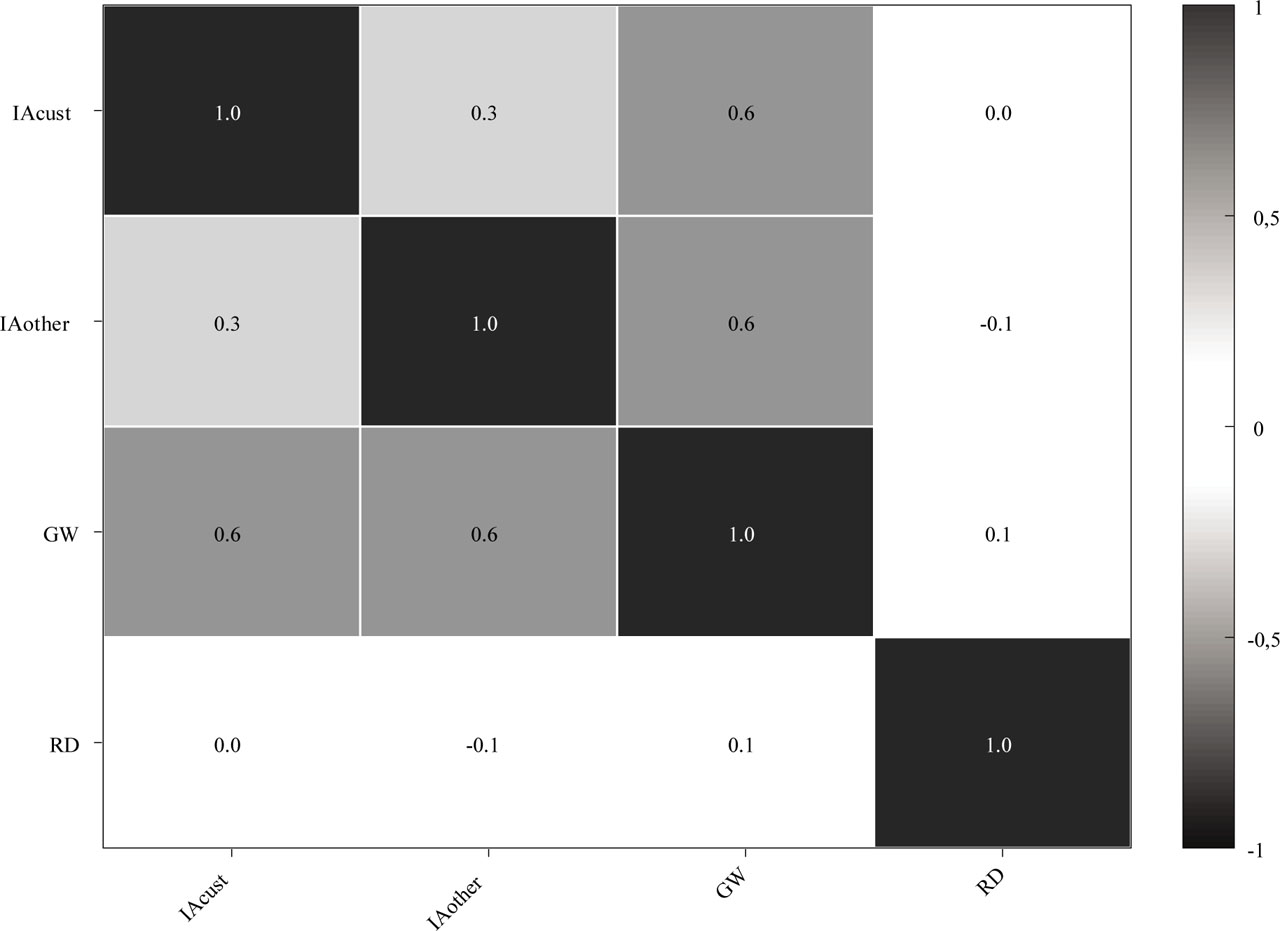
Figure 1
Correlation matrix of Model 2. GW, goodwill; IAcust, intangible assets that characterize customer capital.
Table 5
Coefficients of determination
| R2 | IAcust | 0.44 |
| IAother | 0.44 | |
| GW | 0.64 | |
| RD | 0.05 |
[i] GW, goodwill; IAcust, intangible assets that characterize customer capital; RD, research and development.
Table 6
Summary statistics, using the observations 1–100 (Model 3)
| Variable | Mean | Median | Standard deviation | Min | Max |
|---|---|---|---|---|---|
| MV | 1,40,107 | 92,998 | 1.65e+0.05 | 26,262 | 9,56,625 |
| IAcust | 3,481 | 432 | 7,537 | 0 | 45,358 |
| IAother | 8,461 | 1,367 | 20,395 | 0 | 1,38,005 |
| GW | 17,092 | 8,801 | 21,745 | 0 | 1,46,370 |
| RD | 2,480 | 915 | 3,858 | 0 | 21,419 |
| TA (log) | 10.95 | 10.93 | 0.96 | 8.55 | 13.18 |
| Int | 1.92 | 2.00 | 0.88 | 1.00 | 3.00 |
| FinLev | 14.53 | 1.69 | 85.12 | −8.03 | 805.6 |
[i] FinLev, financial leverage; GW, goodwill; IAcust, intangible assets that characterize customer capital; MV, market value; RD, research and development; TA, total assets.
Table 7
Correlation coefficients for independent variables of Model 3, using the observations 1–100
| IAcust | IAother | GW | RD | TA | Int | FinLev | Variables |
|---|---|---|---|---|---|---|---|
| 1.0000 | 0.3239 | 0.6493 | 0.0127 | 0.3903 | −0.0998 | −0.0621 | IAcust |
| 1.0000 | 0.6346 | −0.0696 | 0.4128 | −0.0884 | −0.0571 | IAother | |
| 1.0000 | 0.0985 | 0.5850 | 0.0021 | −0.0962 | GW | ||
| 1.0000 | 0.3290 | 0.4661 | 0.0176 | RD | |||
| 1.0000 | −0.0794 | −0.1267 | TA | ||||
| 1.0000 | −0.0585 | Int | |||||
| 1.0000 | FinLev |
[i] FinLev, financial leverage; GW, goodwill; IAcust, intangible assets that characterize customer capital; Int, intensity of research and development; RD, research and development; TA, total assets.
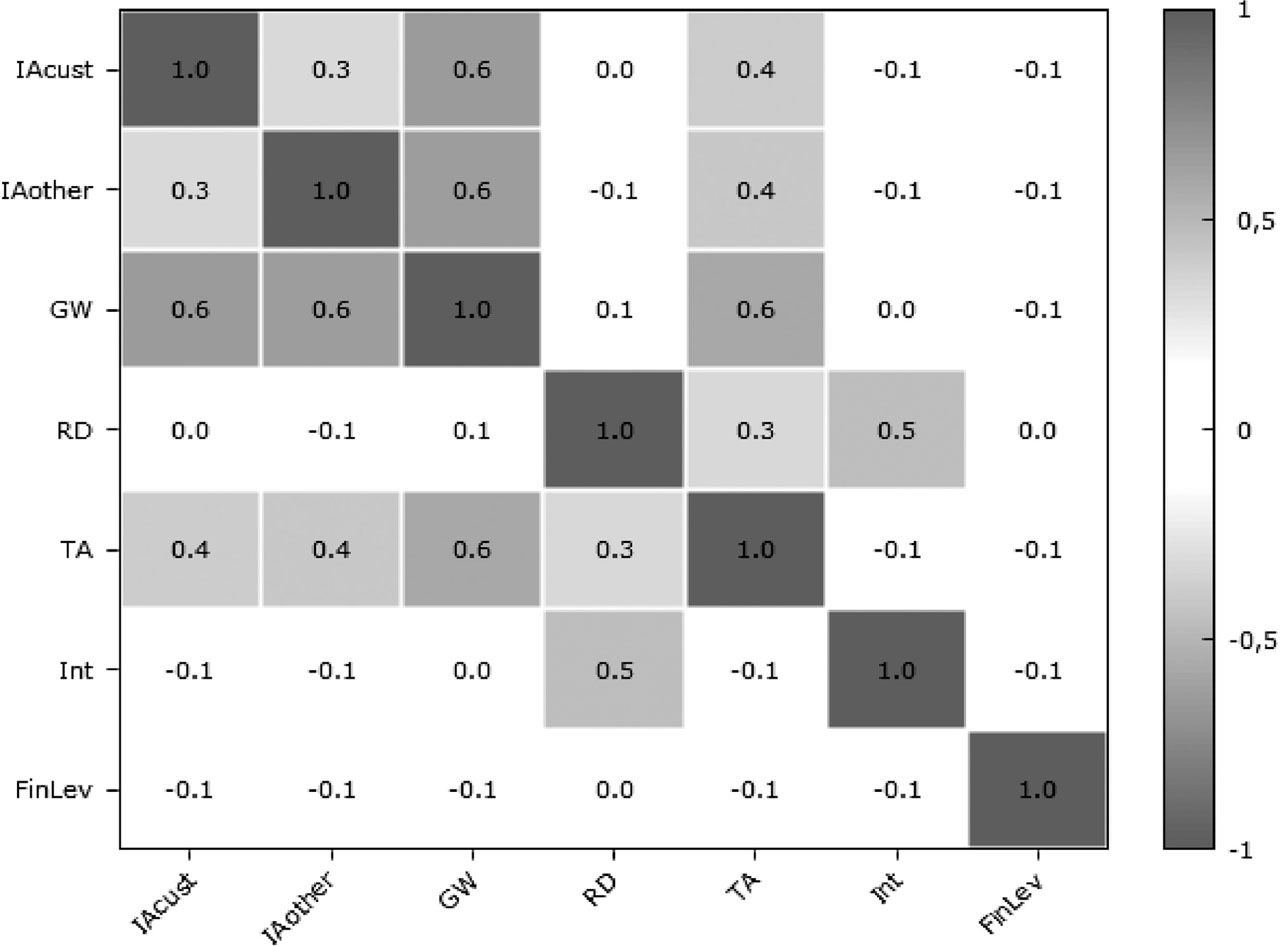
Figure 2
Correlation matrix of Model 3. FinLev, financial leverage; GW, goodwill; IAcust, intangible assets that characterize customer capital; Int, intensity of research & development.
Table 8
Coefficients of determination
| R2 | IAcust | 0.45 |
| IAother | 0.45 | |
| GW | 0.68 | |
| RD | 0.40 | |
| TA | 0.49 | |
| Int | 0.31 | |
| FinLev | 0.03 |
[i] FinLev, financial leverage; GW, goodwill; IAcust, intangible assets that characterize customer capital; Int, intensity of research and development; RD, research and development; TA, total assets.
100 U.S. stock market leaders (the list was relevant as of January 10, 2020)
| No | Company | No | Company |
|---|---|---|---|
| 1 | 3M Co. | 51 | Illinois Tool Works Inc. |
| 2 | Abbott Laboratories | 52 | Intel Corp. |
| 3 | AbbVie Inc. | 53 | International Business Machines Corp. |
| 4 | Accenture PLC | 54 | Intuit Inc. |
| 5 | Adobe Inc. | 55 | Intuitive Surgical Inc. |
| 6 | Allergan PLC | 56 | Johnson & Johnson |
| 7 | Alphabet Inc. | 57 | Kimberly-Clark Corp. |
| 8 | Altria Group Inc. | 58 | Kinder Morgan Inc. |
| 9 | Amazon.com Inc. | 59 | Kraft Heinz Co. |
| 10 | Amgen Inc. | 60 | Linde plc |
| 11 | Apple Inc. | 61 | Lockheed Martin Corp. |
| 12 | Applied Materials Inc. | 62 | Lowe's Cos. Inc. |
| 13 | AT&T Inc. | 63 | Marriott International Inc. |
| 14 | Automatic Data Processing Inc. | 64 | McDonald's Corp. |
| 15 | Becton, Dickinson & Co. | 65 | Medtronic PLC |
| 16 | Biogen Inc. | 66 | Merck & Co. Inc. |
| 17 | Boeing Co. | 67 | Microsoft Corp. |
| 18 | Booking Holdings Inc. | 68 | Mondelēz International Inc. |
| 19 | Boston Scientific Corp. | 69 | Netflix Inc. |
| 20 | Bristol-Myers Squibb Co. | 70 | Nike Inc. |
| 21 | Broadcom Inc. | 71 | Northrop Grumman Corp. |
| 22 | Caterpillar Inc. | 72 | NVIDIA Corp. |
| 23 | Charter Communications Inc. | 73 | Occidental Petroleum Corp. |
| 24 | Chevron Corp. | 74 | Oracle Corp. |
| 25 | Cisco Systems Inc. | 75 | PepsiCo Inc. |
| 26 | Coca-Cola Co. | 76 | Pfizer Inc. |
| 27 | Colgate-Palmolive Co. | 77 | Philip Morris International Inc. |
| 28 | Comcast Corp. | 78 | Phillips 66 |
| 29 | ConocoPhillips | 79 | Procter & Gamble Co. |
| 30 | Costco Wholesale Corp. | 80 | Qualcomm Inc. |
| 31 | CSX Corp. | 81 | Raytheon Co. |
| 32 | CVS Health Corp. | 82 | Regeneron Pharmaceuticals Inc. |
| 33 | Danaher Corp. | 83 | salesforce.com Inc. |
| 34 | Delta Air Lines Inc. | 84 | Schlumberger Ltd. |
| 35 | DuPont de Nemours Inc. | 85 | Starbucks Corp. |
| 36 | Eli Lilly & Co. | 86 | Stryker Corp. |
| 37 | Emerson Electric Co. | 87 | Target Corp. |
| 38 | EOG Resources Inc. | 88 | Texas Instruments Inc. |
| 39 | Estée Lauder Cos. Inc. | 89 | Thermo Fisher Scientific Inc. |
| 40 | Exxon Mobil Corp. | 90 | TJX Cos. Inc. |
| 41 | Facebook Inc. | 91 | T-Mobile US Inc. |
| 42 | FedEx Corp. | 92 | Union Pacific Corp. |
| 43 | Ford Motor Co. | 93 | United Parcel Service Inc. |
| 44 | General Dynamics Corp. | 94 | United Technologies Corp. |
| 45 | General Electric Co. | 95 | UnitedHealth Group Inc. |
| 46 | General Mills Inc. | 96 | Verizon Communications Inc. |
| 47 | General Motors Co. | 97 | Walgreens Boots Alliance Inc. |
| 48 | Gilead Sciences Inc. | 98 | Walmart Inc. |
| 49 | Home Depot Inc. | 99 | Walt Disney Co. |
| 50 | Honeywell International Inc. | 100 | Zoetis Inc. |