
Table 1
Territory and population in the Nordic countries, 2018
| Denmark | Finland | Iceland | Norway | Sweden | |
|---|---|---|---|---|---|
| Area (in km2) | 43,094 | 338,145 | 103,000 | 323,802 | 450,295 |
| Population (in million people) | 5.810 | 5.537 | 0.344 | 5.372 | 10.041 |
Table 2
Territory and population in Sweden, US, and Poland, 2018
| Country | Area (in km2) | Population (in million people) |
|---|---|---|
| Sweden | 450,295 | 10.041 |
| US | 9,833,517 | 329.256 |
| Poland | 312,685 | 38.421 |
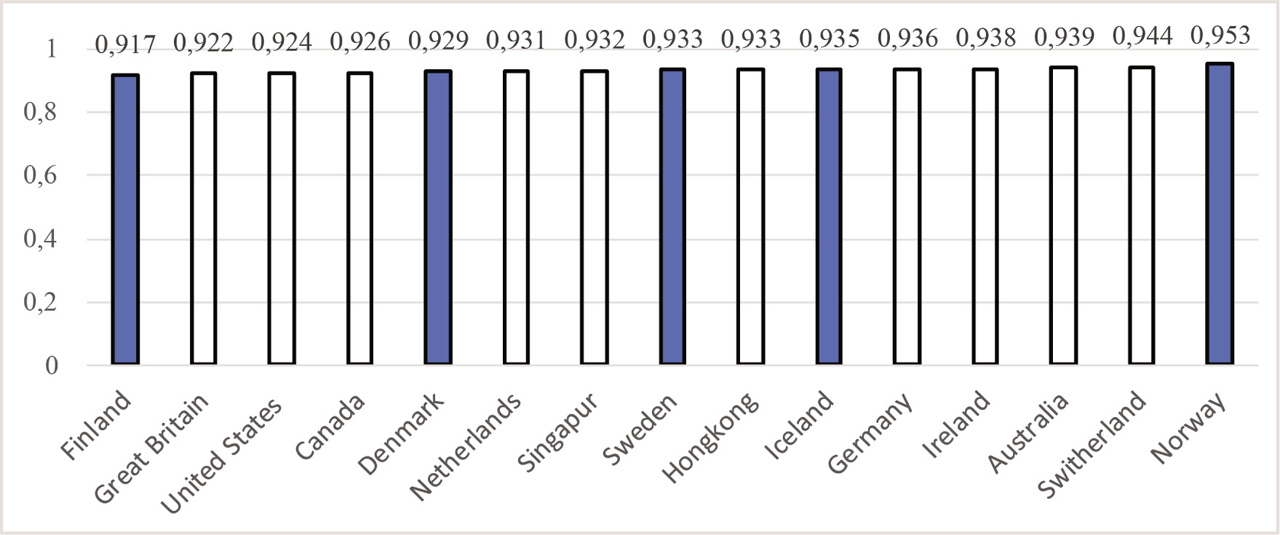
Figure 1
Countries with the highest HDI, 2017.
Source: Human Development Indices and Indicators: 2018 Statistical Update 2018, p. 22. HDI, Human Development Index.
Table 3
HDI in Sweden and other Nordic countries, 2017
| Sweden | Norway | Iceland | Denmark | Finland |
|---|---|---|---|---|
| 0.933 | 0.953 | 0.935 | 0.929 | 0.917 |
[i] Source: Human Development Indices and Indicators: 2018 Statistical Update 2018, p. 22.
[ii] HDI, Human Development Index.
Table 4
HDI in Sweden, the US, and Poland, 2017
| Sweden | US | Poland |
|---|---|---|
| 0.933 | 0.924 | 0.865 |
[i] Source: Human Development Indices and Indicators: 2018 Statistical Update 2018, p. 22.
[ii] HDI, Human Development Index.
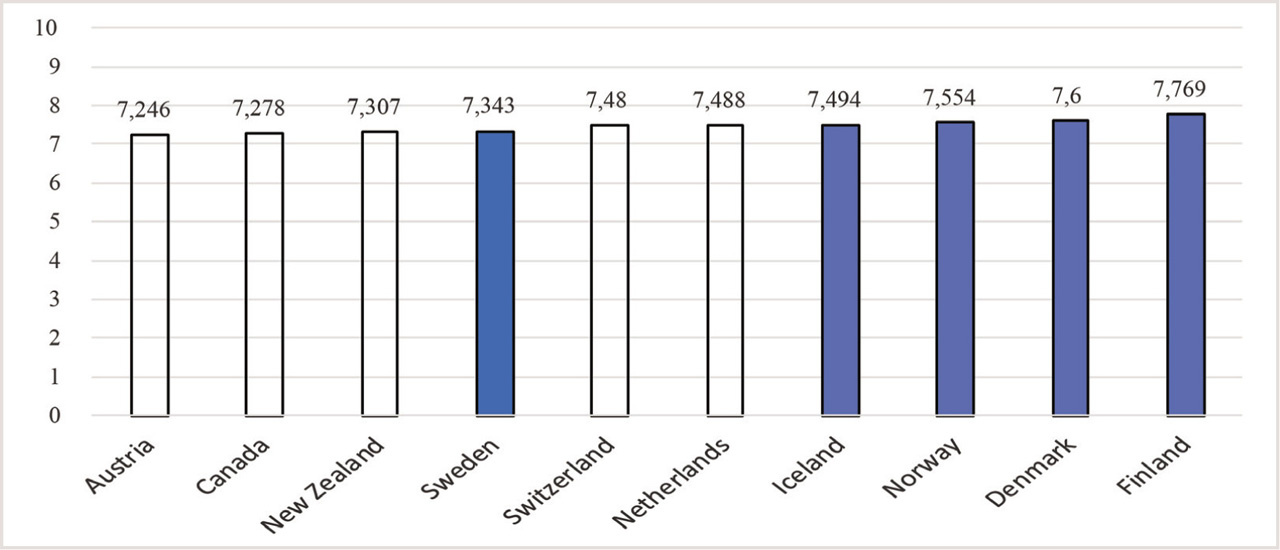
Figure 2
Countries with the highest level of life satisfaction of their inhabitants, 2016–2018a.
aScale 0–10.
Source: Helliwell, Layard, Sachs 2019.
Table 5
Life satisfaction in Sweden and other Nordic countries, 2016–2018a
| Sweden | Finland | Denmark | Norway | Iceland |
|---|---|---|---|---|
| 7.343 | 7.769 | 7.600 | 7.554 | 7.494 |
Source: Helliwell, Layard, Sachs 2019.
Table 6
Satisfaction with life in Sweden, the US, and Poland, 2016–2018a
| Sweden | US | Poland |
|---|---|---|
| 7.343 | 6.892 | 6.182 |
Source: Helliwell, Layard, Sachs 2019.
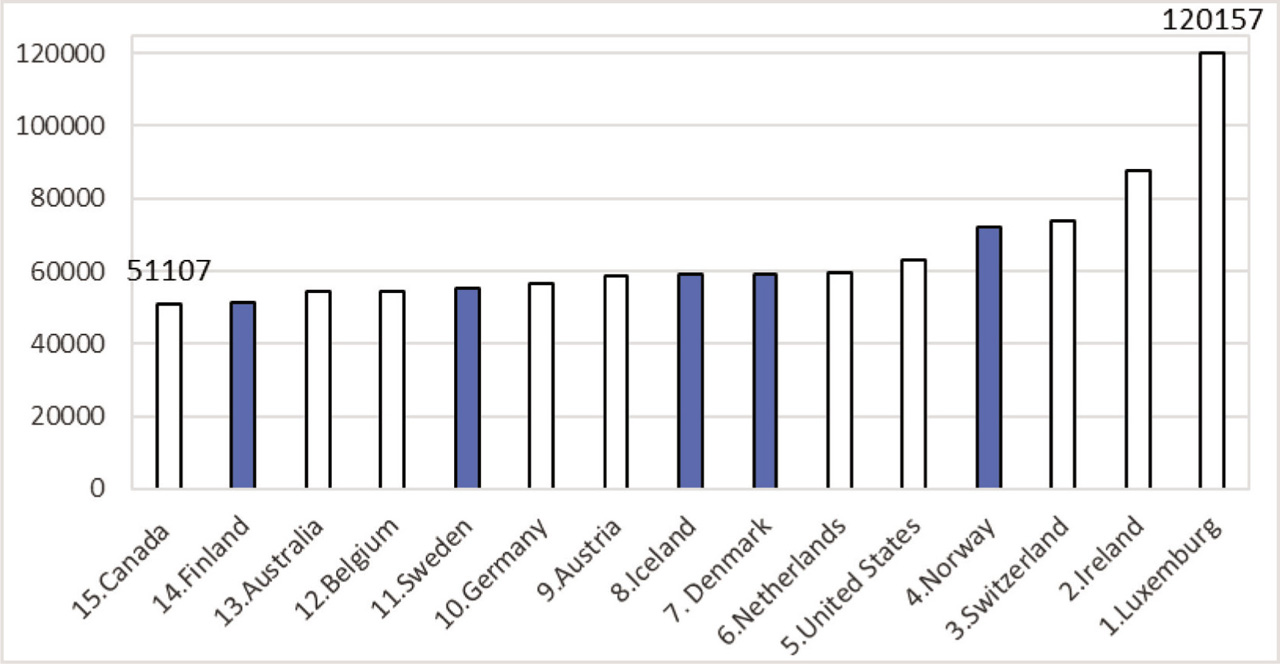
Figure 3
OECD member countries with the highest per capita GDP, 2018a.
aIn US dollars, current PPPs. GDP, gross domestic product; PPP, purchasing power parity.
Source: OECD [2021], GDP: GDP per head, US$, current prices, current PPPs; https://stats.oecd.org/index.aspx?queryid=60702 (accessed January 9, 2021).
Table 7
GDP per capita in Sweden and other Nordic countries, 2018a
| Sweden | Norway | Denmark | Iceland | Finland |
|---|---|---|---|---|
| 55,243 | 71,909 | 59,272 | 58,953 | 51,296 |
Source: OECD [2021], GDP: GDP per head, US$, current prices, current PPPs; https://stats.oecd.org/index.aspx?queryid=60702 (accessed January 9, 2021).
GDP, gross domestic product; PPP, purchasing power parity.
Table 8
GDP per capita in Sweden, the US, and Poland, 2018a
| Sweden | US | Poland |
|---|---|---|
| 55,243 | 62,949 | 32,611 |
Source: OECD [2021], GDP: GDP per head, US$, current prices, current PPPs; https://stats.oecd.org/index.aspx?queryid=60702 (accessed January 9, 2021).
GDP, gross domestic product; PPP, purchasing power parity.
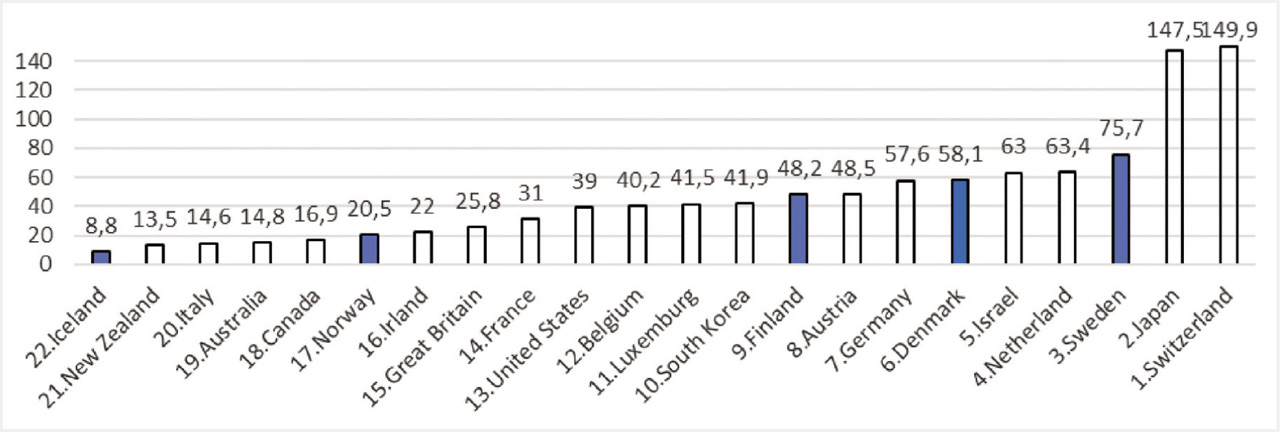
Figure 4
Number of triadic patent families per million inhabitants, 2018.
Source: OECD [2021], Triadic patent families (indicator). doi: 10.1787/6a8d10f4-en (accessed June 2, 2021); OECD [2021], Population (indicator). doi: 10.1787/d434f82b-en (accessed June 2, 2021). Own calculations.
Table 9
Innovativeness in the Nordic countries (triadic patent families, 2018)a
| Sweden | Denmark | Finland | Norway | Iceland |
|---|---|---|---|---|
| 75.7 | 58.1 | 48.2 | 20.5 | 8.8 |
Source: OECD [2021], Triadic patent families (indicator). doi: 10.1787/6a8d10f4-en (accessed June 2, 2021); OECD [2021], Population (indicator). doi: 10.1787/d434f82b-en (accessed June 2, 2021). Own calculations.
Table 10
Innovativeness in Sweden, the US, and Poland (triadic patent families, 2018)a
| Sweden | US | Poland |
|---|---|---|
| 75.7 | 39 | 2.5 |
Source: OECD [2021], Triadic patent families (indicator). doi: 10.1787/6a8d10f4-en (accessed June 2, 2021); OECD [2021], Population (indicator). doi: 10.1787/d434f82b-en (accessed June 2, 2021). Own calculations.
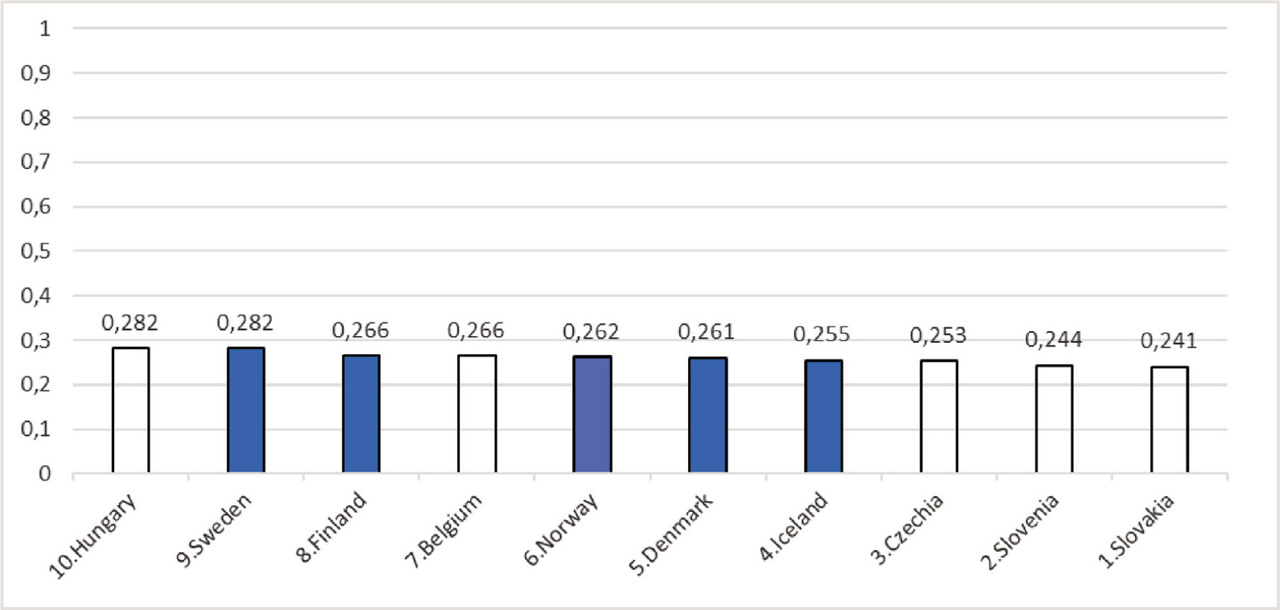
Figure 5
OECD member countries with the lowest Gini coefficient, year 2017a.
aScale 0 – 1.0; net income (after taxes and transfers).
b2016 data.
c2015 data.
Source: OECD [2019], Income inequality (indicator). doi: 10.1787/459aa7f1-en (accessed November 9, 2019).
Table 11
Gini coefficient for disposable income in Sweden and other Nordic countries, 2017a
Source: OECD [2019], Income inequality (indicator). doi: 10.1787/459aa7f1-en (accessed November 9, 2019).
Table 12
Gini coefficient for disposable income in Sweden, the US, and Poland, 2017a
| Sweden | US | Polandb |
|---|---|---|
| 28.2 | 39.0 | 28.4 |
Source: OECD [2019], Income inequality (indicator). doi: 10.1787/459aa7f1-en (accessed November 9, 2019).
Table 13
Average HUR in Sweden and other Nordic countries, 2007–2017 (in % of the labor force)
| Sweden | Finland | Denmark | Iceland | Norway |
|---|---|---|---|---|
| 7.44 | 8.09 | 6.33 | 4.85 | 3.62 |
[i] Source: OECD [2019], HUR (indicator). doi: 10.1787/52570002-en (accessed November 9, 2019); own calculations.
[ii] HUR, harmonized unemployment rate.
Table 14
Average HUR in Sweden, the US, and Poland in 2010–2018 (in % of the labor force)
| Sweden | US | Poland |
|---|---|---|
| 7.44 | 6.76 | 8.38 |
[i] Source: OECD [2019], HUR (indicator). doi: 10.1787/52570002-en (accessed November 9, 2019); own calculations.
[ii] HUR, harmonized unemployment rate.
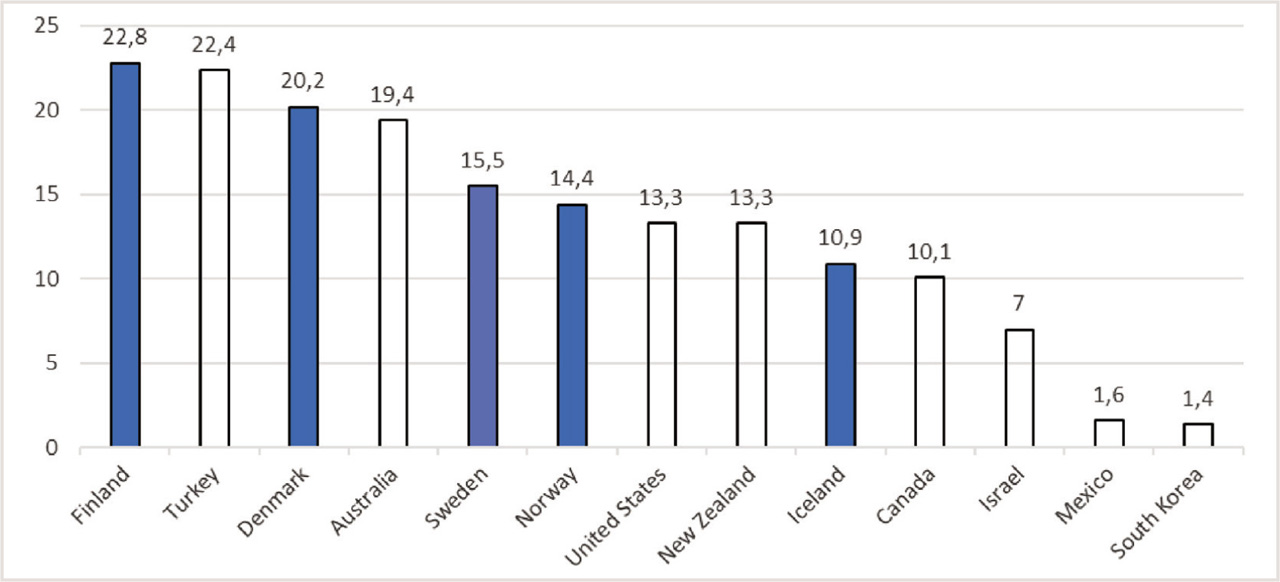
Figure 6
Share of long-term unemployment in total unemployment in selected OECD countries, 2018 (%).
Source: OECD [2019], Long-term unemployment rate (indicator). doi: 10.1787/76471ad5-en (accessed November 9, 2019).
Table 15
Share of long-term unemploymenta in total unemployment in Sweden and other Nordic countries, 2018 (%)
| Sweden | Iceland | Norway | Denmark | Finland |
|---|---|---|---|---|
| 15.5 | 10.9 | 14.4 | 20.2 | 22.8 |
Source: OECD [2019], Long-term unemployment rate (indicator). doi: 10.1787/76471ad5-en (accessed November 9, 2019).
Table 16
Share of long-term unemploymenta in total unemployment in Sweden, the US, and Poland, 2018 (%)
| Sweden | US | Poland |
|---|---|---|
| 15.5 | 13.3 | 26.9 |
Source: OECD [2019], Long-term unemployment rate (indicator). doi: 10.1787/76471ad5-en (accessed November 9, 2019).
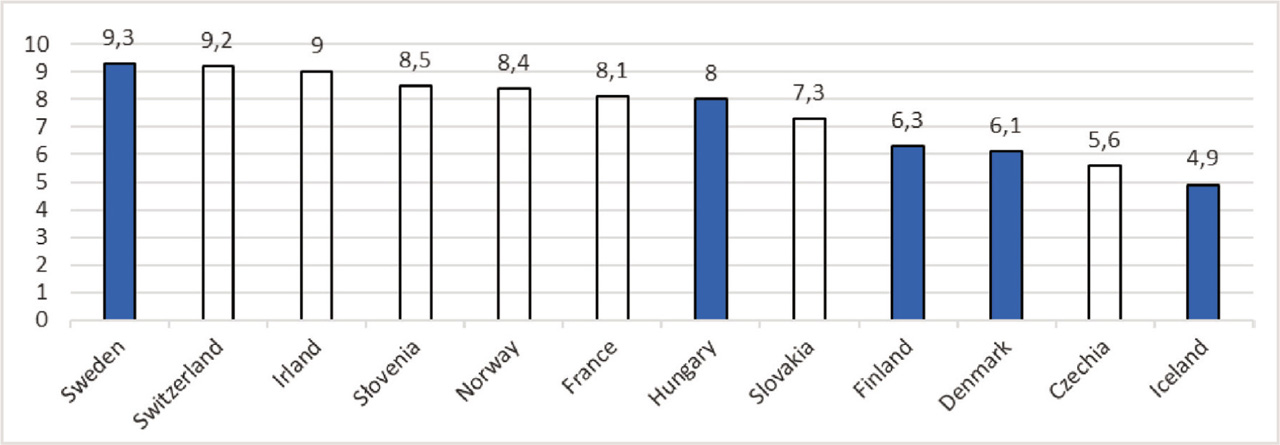
Figure 7
OECD countries with the lowest poverty rate (in %), end of 2017a.
aThe poverty rate is the percentage of inhabitants whose income is less than half the median income of all households.
Source: OECD [2021], Poverty rate (indicator). doi: 10.1787/0fe1315d-en (accessed February 17, 2021).
Table 17
Poverty rate in the Nordic countries (in %), 2017
Source: OECD [2021], Poverty rate (indicator). doi: 10.1787/0fe1315d-en (accessed February 17, 2021).
Table 18
Poverty rate in Sweden, US, and Poland (%), 2017
| Sweden | US | Poland |
|---|---|---|
| 9.3 | 17.8 | 9,6 |
[i] Source: OECD [2021], Poverty rate (indicator). doi: 10.1787/0fe1315d-en (accessed February 17, 2021).
Table 19
Intergenerational mobility of earnings in Sweden and other Nordic countriesa
| Sweden | Denmark | Norway | Finland | Iceland |
|---|---|---|---|---|
| 0.27 | 0.15 | 0.17 | 0.18 | n.d.a. |
a The table shows the elasticities of sons’ earnings compared to those of fathers. For example, a coefficient level of 0.3 means that a 100% change in fathers’ earnings is accompanied by a 30% change in sons’ earnings. A smaller coefficient of elasticity thus means greater intergenerational mobility of earnings.
Source: Corak [2013a] (after: Corak [2016]).
Table 20
Intergenerational mobility of earnings in Sweden and the US
| Sweden | US | Poland |
|---|---|---|
| 0.27 | 0.470 | n.d.a. |
[i] Source: Corak [2013a] (after: Corak [2016]).