
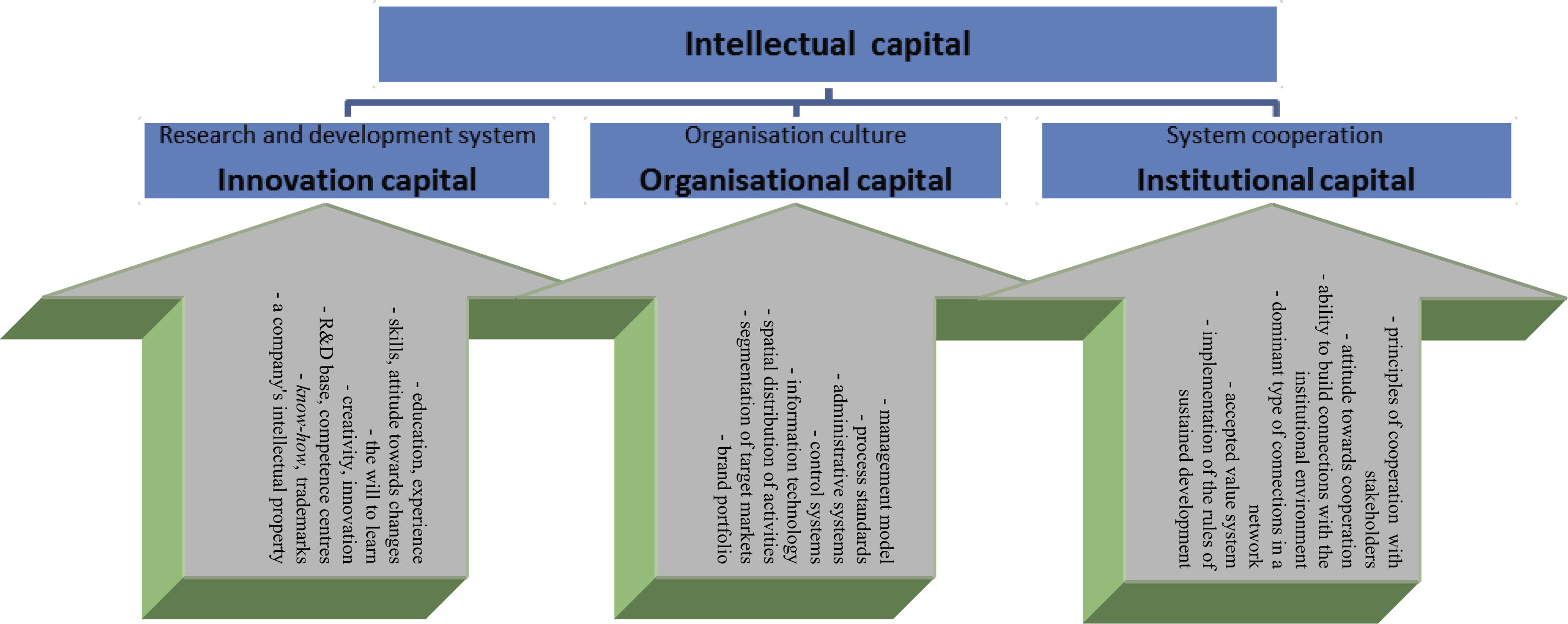
Figure 1
The systemic model of intellectual capital.
Source: Own elaboration.
Table 1
The significance of the key factors of IC (included in the given corporations’ development strategies)
| TNCs by sectors | Sector | Automotive | Electronics | Petroleum | Pharmaceutical | Media & Telecommunications | Consumer goods&services | Industry goods&services | Public goods&services | Multi-branch | 9 industry sectors |
|---|---|---|---|---|---|---|---|---|---|---|---|
| The most powerful transnational corporations (leaders of sectors) | Toyota Motor Volkswagen Group; Honda Motor | General Electric; Siemens; Samsung Electronics | Royal Dutch Shell; British Petroleum; Exxon Mobil | Sanofi; Roche Group; Pfizer | Vodafone Group; Telefónica; France Telecom | Procter&Gamble; Nestle; Kraft | Arcelor Mittal; Rio Tinto; Lafarge | Electricite de France; E.On; GDF | Vivendi Universal; Hutchison Whampoa; Marubeni Corporation | Value of the average Leaders of different sectors (27 Top-TNCs | |
| Layers of intellectual capital (IC) | INNC | Cumulative rating for three industry leaders | |||||||||
| R&D systems | 3 | 3 | 2 | 3 | 3 | 2 | 2 | 1 | 1 | 2.22 | |
| Models of created value | 3 | 3 | 2 | 3 | 2 | 3 | 2 | 1 | 2 | 2.33 | |
| Management innovations | 2 | 2 | 1 | 3 | 3 | 3 | 2 | 2 | 1 | 2.11 | |
| ORGC | Cumulative rating for three industry leaders | ||||||||||
| Brand strategy | 3 | 2 | 2 | 2 | 3 | 3 | 1 | 0 | 0 | 1.78 | |
| Business network | 3 | 2 | 3 | 1 | 3 | 2 | 1 | 3 | 1 | 2.11 | |
| Typ es of connections | 3 | 3 | 3 | 2 | 3 | 3 | 2 | 3 | 2 | 2.67 | |
| INSC | Cumulative rating for three industry leaders | ||||||||||
| Institutional relations | 2 | 2 | 2 | 2 | 3 | 2 | 2 | 3 | 1 | 2.11 | |
| Coopetition | 3 | 3 | 2 | 2 | 1 | 3 | 2 | 1 | 0 | 1.89 | |
| Stakeholders | 3 | 2 | 1 | 3 | 3 | 3 | 1 | 3 | 1 | 2.22 | |
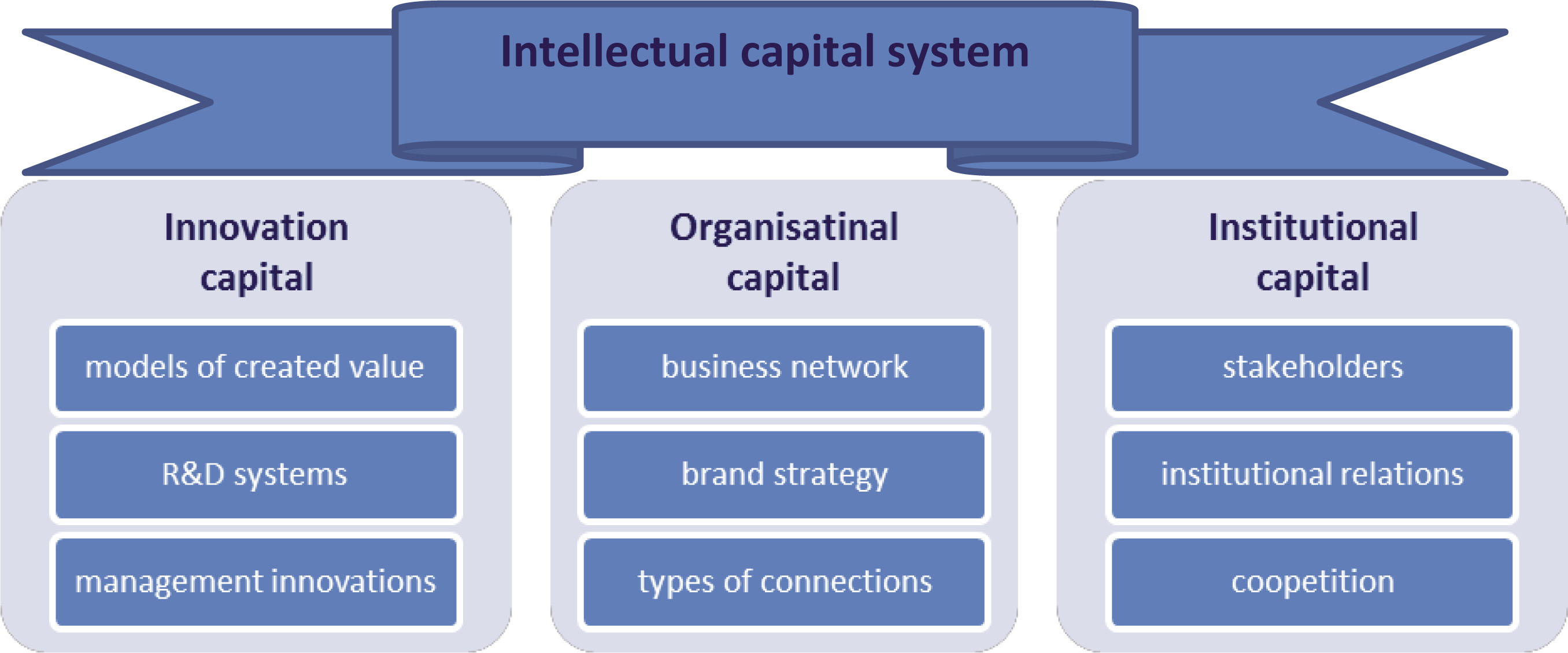
Figure 2
The conceptual model of the pillars of each of the layers of intellectual capital.
Source: Own elaboration.