Have a personal or library account? Click to login
Sharing economy and the city Cover

Figures & Tables

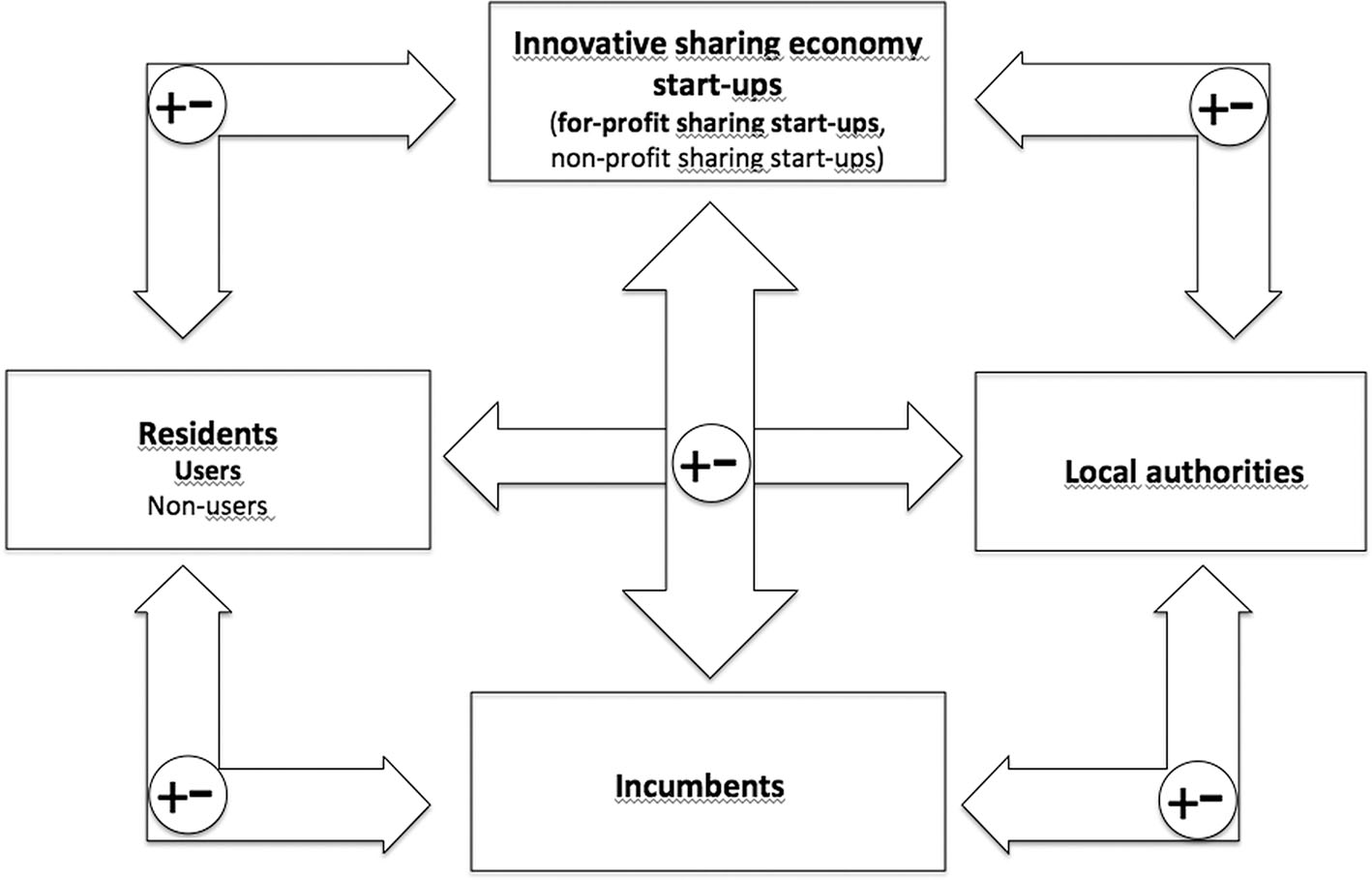
Figure 1

Impact of innovative sharing economy start-ups on the city: interplay of interests of various stakeholders in the city.Source: Own elaboration.

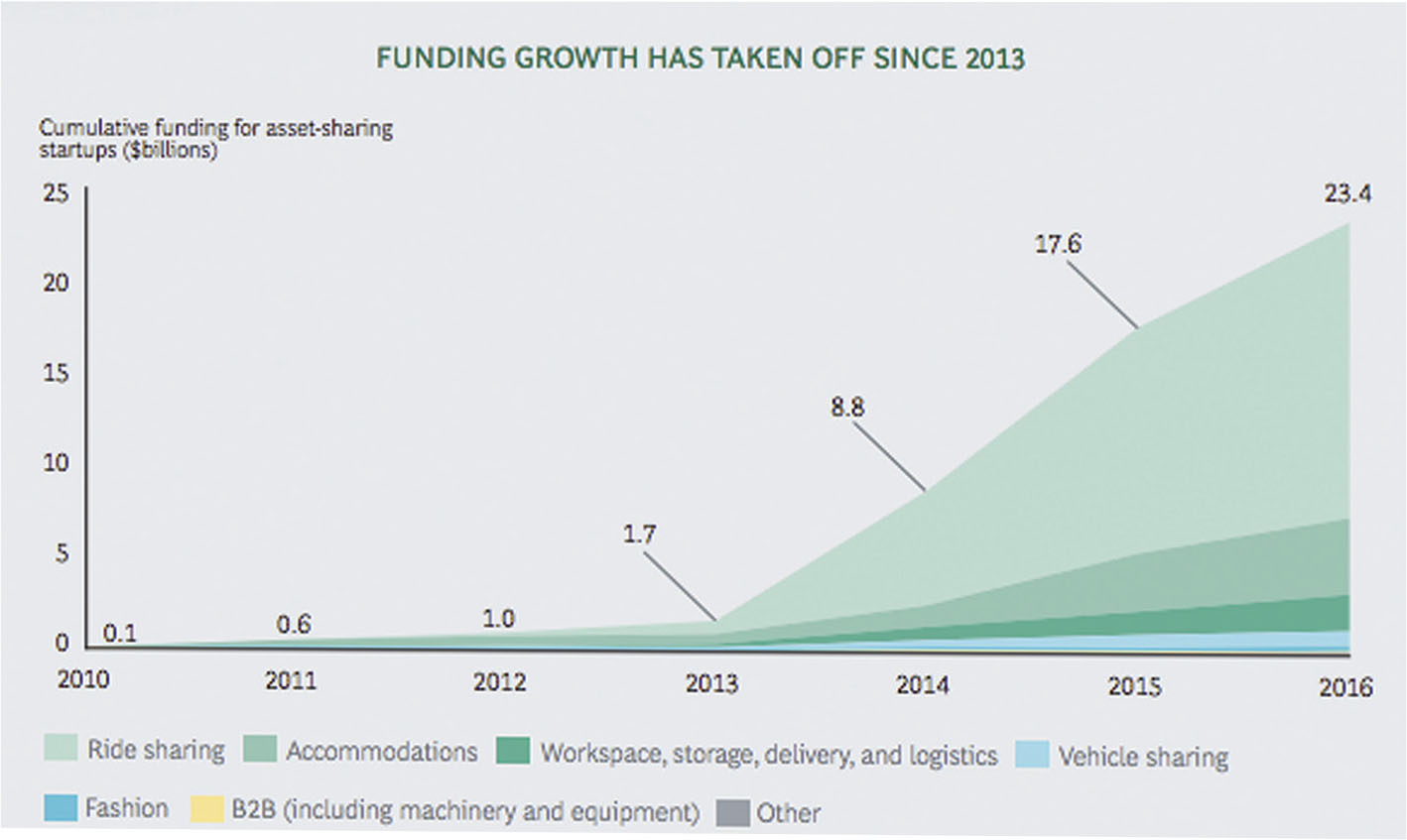
Figure 2

Cumulative funding for asset-sharing start-ups from 2010 to 2016.Source: Wallenstein and Shelat, BCG analysis [2017], p. 5.

City as an arena of contrasting interests, represented by different stakeholders

City’s stakeholdersApproach + for − againstCharacteristics of approach
Sharing economy companies+
  • Connect citizens: drivers–riders and landlords–guests to generate revenues (gain loyalty)

  • Successfully attack the market position of incumbent companies

  • Have low entry barriers

  • Gain profits from platforms: revenues from users and advertisers, selling databases, etc.

  • Create new jobs for contractors/employees, including people who were not previously employed

  • Generate additional demand

  • Contribute to new socialization by creation of a community

  • Lower transaction costs

----------------------
  • Face fierce competition in sharing economy sector

  • Face increasing resistance of incumbents and rising (governmental, municipal) restrictions on sharing services

Incumbents+
  • Face competitiveness, which leads to higher standard of services

----------------------------
  • Are under disruptive impact of sharing companies with reference to revenue and profits

  • Question legality, price policy, and tax policy of ridesharing and lodging, because of their status as unlicensed (Uber, Blablacar) and lower-priced competitors (Uber, Blablacar, and Airbnb) using peer-to-peer low-cost service practices with low capital entry with reference to possession (Blablacar carpooling, Airbnb)

  • Suffer decline in standard of living due to lower wages

RESIDENTS
  • Save money by getting cheap access to goods and services offered by sharing companies

Users (consumers)+
  • Save money by getting cheaper access to traditional services being under competitive pressure

  • Benefiting from improved standard of living

-------------------------
  • Become less dependent on ownership

  • Are exposed to risk (quality of goods and services)

--------------------------------------
Contractors (peers)
  • Earn money paid for peer-to-peer jobs

+
  • Earn money paid for assets owned by them

  • Have more flexibility

  • Appreciate participation in communities created by users of platforms

  • Benefiting from improved standard of living

-----------------------
  • Are exposed to risk of lack of payments, poor working conditions, etc.

---------------------------------
Nonusers+
  • Use tourist-driven demand to earn money

----------------------------
  • Complain about tourists behavior in neighborhood areas

---------------------------------
All residents+
  • Favor better quality of life (environmental aspects)

-----------------------
  • Have unequal access to sharing services operating for different segments of population (ridesharing)

Local authorities+
  • Sharing businesses contribute to jobs and local economic growth induced by increasing demand (total and sectorial, e.g., tourism)

  • Help to solve transportation problems (urban planners are provided with data, which helps design cities in a way that would reduce congestion and reduce car usage)

  • Offer alternative possibilities of services, such as commuting and apartment renting

  • Favor social inclusion (particularly for disadvantaged groups of citizens and strangers)

  • Shape sociocultural features desirable for entrepreneurial attitudes, such as openness and innovativeness

  • Contribute to the creation of sharing communities

  • Help to develop new functions in cites (cultural, tourist activities)

  • Ease environmental problems due to better use of underused assets: e.g., cars, apartments; and help to create more environmentally friendly urban environment for all citizens

  • Help to enhance quality of life in the city

  • Change possibilities of city and intercity transportation (additional alternatives, more frequent traveling, lower cost of travel)

  • Totally change future of urban transportation (self-driving cars, vertical-take-off-and-landing planes)

-------------------------
  • Concern about tax losses associated with growing “black” economy are aroused

  • Problems in local labor market are induced (e.g., massive protests of incumbent companies threatened by the risk of decreasing revenues and even bankruptcy)

  • Position of traditional urban transportation (taxis, buses, trams, and trains) is threatened

  • Stability of local real estate markets is threatened due to increases in real estate prices

  • Problems of overtourism might arouse and be increased

Timeframe and expansion of the three studied companies

Uber
  • spread of activity from US to all regions of the world

    • 2011 San Francisco

    • 2018 >400 cities worldwide in >60 countries

BlaBlaCar
  • spread of activity between cities from France across Europe to 19 countries, as well as to Asia (India) and Latin America (Brazil, Mexico)

  • diversification of activities aimed at cities, with mytaxi match being an application only for urban dwellers

    • 2017 Warsaw

    • 2018 70 cities in 12 countries in Europe

    • e.g., Hamburg, Vienna, Zurich, Barcelona, Madrid

  • spread of activity (diversification of carpooling) between cities to daily commute through BlaBlalines: pilot launch in France

    • 2018 Reims-Châlons-en-Champagne and Toulouse-Montauban

Airbnb
  • spread of activity from US to all regions of the world

    • 2008 San Francisco

    • 2018 >190 countries in 81,000 cities

Different scales and applications of the sharing paradigm in modern communities

ThingsServicesActivities
IndividualSwapping, bartering, giftingRidesharing, couchsharingSkill sharing
CollectiveCar clubs, tool banks, fab-labsChildcare, time banks, crowdfundingSports, clubs, open-source software
PublicLibraries, freecyclingHealth services, public transportPolitics, public space

European comparison of the number of Airbnb listings per user

City1 listing2 Listings3 Listings4 Listings5 or more listings
Paris90,97%6,73%1,16%0,36%0,77%
Nantes89,03%8,61%1,60%0,35%0,42%
Cologne88,55%8,33%1,46%0,66%0,99%
Amsterdam88,53%7,92%1,85%0,69%1,01%
Strasbourg88,53%9,01%1,27%0,47%0,72%
Toulouse87,55%9,30%1,53%0,37%1,15%
Munich87,30%9,47%1,81%0,79%0,63%
Berlin86,18%9,73%2,19%0,72%1,07%
Frankfurt86,18%10,34%1,88%0,86%0,74%
Glasgow83,50%11,97%2,45%1,09%1,00%
London80,89%12,03%3,12%1,27%2,69%
Manchester78,61%13,18%3,72%1,62%2,87%
Edinburg77,88%14,03%4,11%1,66%2,31%
Prague70,63%13,94%5,28%2,75%7,40%
Barcelona69,37%16,57%6,11%2,65%5,30%
DOI: https://doi.org/10.2478/ijme-2019-0026 | Journal eISSN: 2543-5361 | Journal ISSN: 2299-9701
Language: English
Page range: 346 - 368
Submitted on: Jul 28, 2018
Accepted on: Dec 20, 2019
Published on: Dec 31, 2019
Published by: Warsaw School of Economics
In partnership with: Paradigm Publishing Services
Publication frequency: 4 issues per year

© 2019 Anna Rutkowska-Gurak, Agata Adamska, published by Warsaw School of Economics
This work is licensed under the Creative Commons Attribution-NonCommercial-NoDerivatives 4.0 License.