
Table 1
Human capital, social capital, and performance survey items
| Constructs | Variables (codes) | References |
|---|---|---|
| Human capital Knowledge | Education (ZSRL1) | [Schultz, 1961], [Blundell et al., 1999], |
| Training times (ZSRL2) | [Arvanitis and Loukis, 2009], [Lazear, | |
| Agricultural skills (ZSRL3) | 2009], [McCallum and O’Connell, 2009] | |
| Computer skills (ZSRL4) | ||
| Internet communication skill (ZSRL5) | ||
| Ability | Working experiences before the farmer cooperative work (NLRL1) | [Xu and Zhang, 2014] |
| Working years in cooperative (NLRL2) | ||
| Motivation | Shareholding ratio (JLRL1) Honor and reward gained (JLRL2) | [Xu and Zhang, 2016] |
| Social capital | ||
| Internal relations | Trust between directors and supervisory board members (NBSH1) | [Putnam, 1993], [Lv and Gong, 2012], [Ju, 2014] |
| Trust from cooperative members (NBSH2) | ||
| Networking with cooperative members (NBSH3) | ||
| Commercial relations | Trust from financial institutions (SYSH1) Networking with financial institution members (SYSH2) Networking with other cooperatives or cooperative managers (SYSH3) Networking with agricultural product wholesalers or buyers (SYSH4) | [Uzzi, 1999], [Yao et al., 2016], [Adler and Kwon, 2002] |
| Political relations | Networking with government departments (ZZSH1) Trust from village cadres (ZZSH2) | [Faccio, 2006], [Wu et al., 2008] |
| Trust from government leaders (ZZSH3) | ||
| Innovative relations | Networking with technical services/research institutes (CXSH1) Networking with social media or reporters (CXSH2) | [Siomkos and Kurzbard, 1994], [Tsai and Ghoshal, 1998] |
| Performance | ||
| Financial | Operating income can make ends meet (CWJX1) Annual distributable surplus (CWJX2) Cooperative profit (CWJX3) | [Kaplan and Norton, 1995], [Chibanda et al., 2009] |
| Customer-focused | Market share (GKJX1) Increased cooperative farmer number (GKJX2) Satisfaction of cooperative members (GKJX3) | |
| Internal process | Proportion of production sale (NBJX1) Proportion of production purchased and distributed (NBJX2) Technical guidance for cooperative members (NBJX3) Council meeting times (NBJX4) | |
| Learning and growth | Training times for members (CZJX1) Members can actively offer advices (CZJX2) Brand development (CZJX3) Number of certificated brands (CZJX4) | [Carlucci et al., 2004], [Liang et al., 2015] |
Table 2
Summary of test results for the proposed hypotheses
| No. | Hypothesis | Result |
|---|---|---|
| H1a | Positive correlation between knowledge human capital and financial performance | × |
| H1b | Positive correlation between knowledge human capital and customer-focused performance | × |
| H1c | Positive correlation between knowledge human capital and internal process performance | × |
| H1d | Positive correlation between knowledge human capital and learning and growth performance | √ |
| H2a | Positive correlation between ability human capital and financial performance | √ |
| H2b | Positive correlation between ability human capital and customer-focused performance | × |
| H2c | Positive correlation between ability human capital and internal process performance | √ |
| H2d | Positive correlation between ability human capital and learning and growth performance | √ |
| H3a | Positive correlation between motivation human capital and financial performance | √ |
| H3b | Positive correlation between motivation human capital and customer-focused performance | × |
| H3c | Positive correlation between motivation human capital and internal process performance | √ |
| H3d | Positive correlation between motivation human capital and learning and growth performance | √ |
| H4a | Positive correlation between internal social capital and financial performance | √ |
| H4b | Positive correlation between internal social capital and customer-focused performance | √ |
| H4c | Positive correlation between internal social capital and internal process performance | √ |
| H4d | Positive correlation between internal social capital and learning and growth performance | √ |
| H5a | Positive correlation between commercial social capital and financial performance | √ |
| H5b | Positive correlation between commercial social capital and customer-focused performance | √ |
| H5c | Positive correlation between commercial social capital and internal process performance | √ |
| H5d | Positive correlation between commercial social capital and learning and growth performance | √ |
| H6a | Positive correlation between political social capital and financial performance | √ |
| H6b | Positive correlation between political social capital and customer-focused performance | √ |
| H6c | Positive correlation between political social capital and internal process performance | √ |
| H6d | Positive correlation between political social capital and learning and growth performance | √ |
| H7a | Positive correlation between innovative social capital and financial performance | √ |
| H7b | Positive correlation between innovative social capital and customer-focused performance | √ |
| H7c | Positive correlation between innovative social capital and internal process performance | √ |
| H7d | Positive correlation between innovative social capital and learning and growth performance | √ |
| H8a | Positive correlation between resource acquisition ability and financial performance | √ |
| H8b | Positive correlation between resource acquisition ability and customer-focused performance | √ |
| H8c | Positive correlation between resource acquisition ability and internal process performance | √ |
| H8d | Positive correlation between resource acquisition ability and learning and growth performance | √ |
| H9a | Positive correlation between management ability and financial performance | √ |
| H9b | Positive correlation between management ability and customer-focused performance | √ |
| H9c | Positive correlation between management ability and internal process performance | √ |
| H9d | Positive correlation between management ability and learning and growth performance | √ |
[i] Note:“√” in the results column indicates that the hypothesis is supported by data.
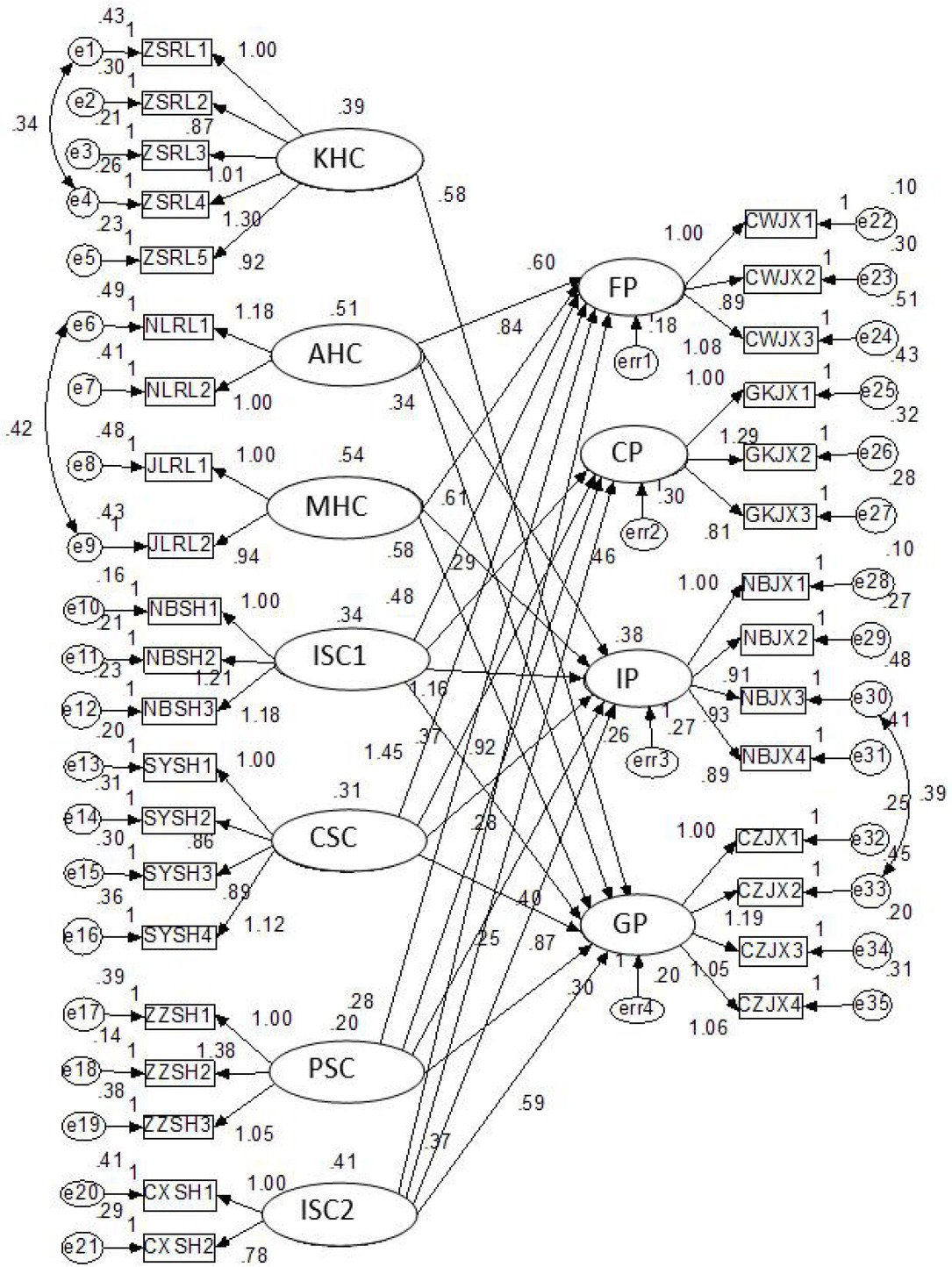
Figure 1
Corrected model path coefficient diagram for the relationship between human capital, social capital, and performance. KHC: knowledge human capital; AHC: ability human capital; MHC: motivation human capital; ISC1: internal social capital; CSC: commercial social capital; PSC: political social capital; ISC2: innovative social capital; FP: financial performance; CP: customer-focused performance; IP: internal process performance; GP: learning and growth performance.
Table 3
Summary of the test results for mediating effect
| Mediator | Dimension | Financial performance | Customer-focused performance | Internal process performance | Learning and growth performance |
|---|---|---|---|---|---|
| Resource acquisition | Knowledge human capital | N | N | N | N |
| ability | Ability human capital | Y | N | Y | Y |
| Motivation human capital | Y | N | Y | Y | |
| Internal social capital | Y | Y | Y | Y | |
| Commercial social capital | Y | Y | Y | Y | |
| Political social capital | Y | Y | Y | Y | |
| Innovative social capital | Y | Y | Y | Y | |
| Management ability | Knowledge human capital | N | N | N | N |
| Ability human capital | Y | N | Y | Y | |
| Motivation human capital | Y | N | Y | Y | |
| Internal social capital | Y | Y | Y | Y | |
| Commercial social capital | Y | Y | Y | Y | |
| Political social capital | Y | Y | Y | Y | |
| Innovative social capital | Y | Y | Y | Y |
[i] Note: “Y” indicates mediator role supported by our data.
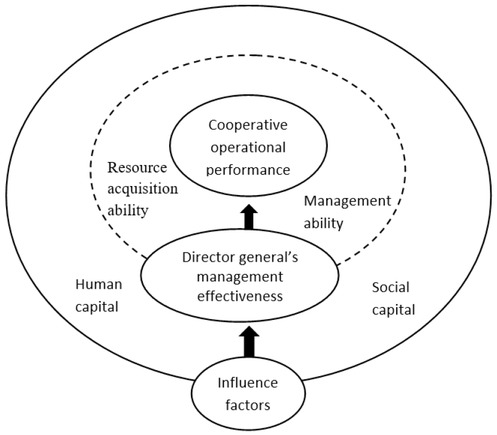
Figure 2
Human capital, Social capital, Efficacy, and Performance (HSCEP) theoretical model.
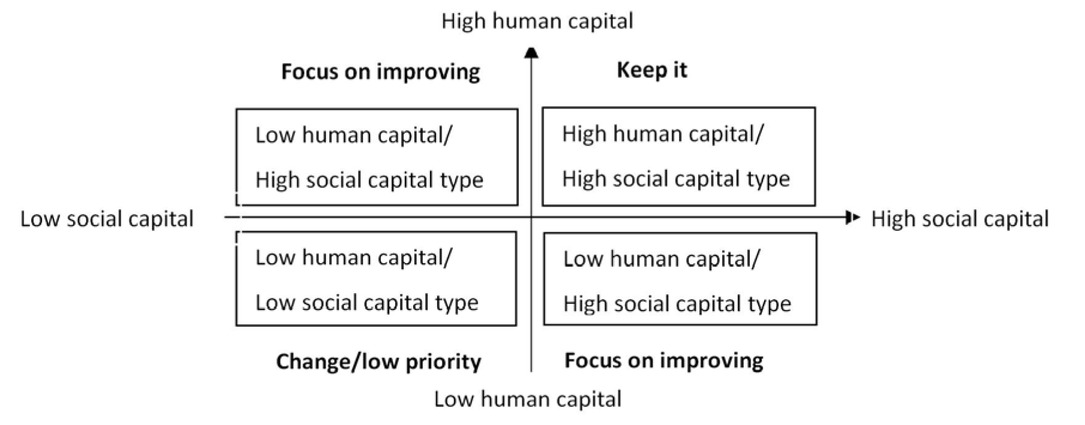
Figure 3
Two-dimensional model formed from director-general’s human capital and social capital.
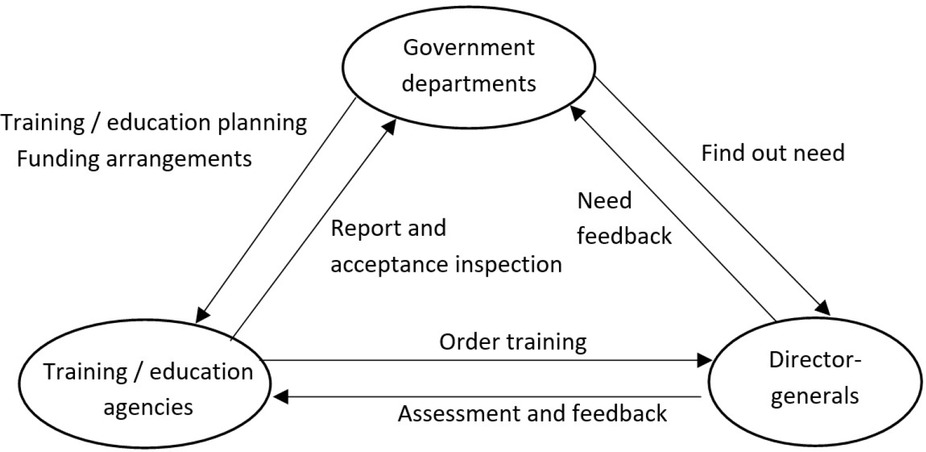
Figure 4
Triangle model for professional training procedure for cooperatives’ director-generals.
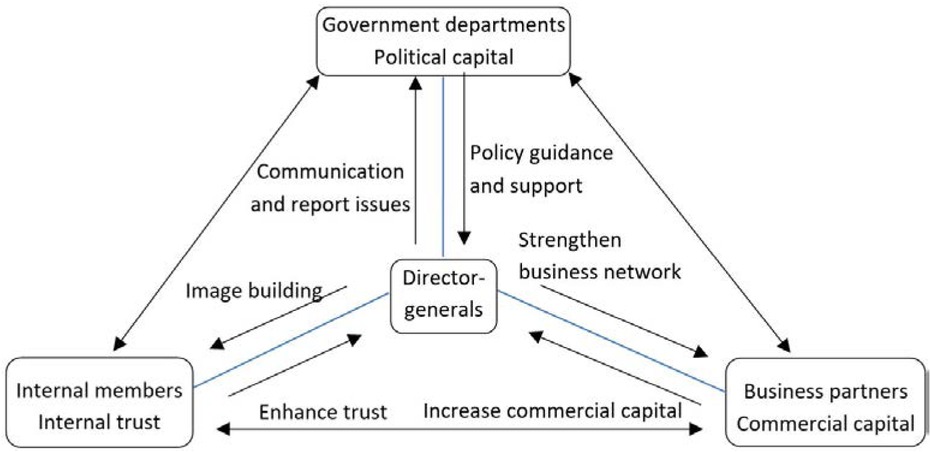
Figure 5
The social capital enhancement pathway for director-generals based on the internal trust, Government policy support, and Business network (IGB) model.