Have a personal or library account? Click to login
Application of machine learning frameworks in the controllability study of infinite-delay neutral integro-differential equations Cover

Application of machine learning frameworks in the controllability study of infinite-delay neutral integro-differential equations

Open Access
|Jun 2026

Full Article

1
Introduction

In the functional differential equations (FDEs) literature, special efforts have been made in understanding second-order integro-differential equations (IDEs) with infinite delays and random effects. This part of the analysis is important for modeling complex systems where historical dependencies and stochasticity are both important. Second-order neutral functional IDEs describe dynamical systems in which the evolution depends on both the present state and the history of the state and its derivative. The neutral and integral terms account for memory effects, while the infinite delay implies dependence on the entire past history, leading to an infinite-dimensional phase space. These features make the analysis of existence and controllability highly challenging and require specialized functional-analytic and stochastic methods. In literature, many works have concerned the existence and controllability of FDEs approach semigroup technique and fixed point. Ahmed in [1] was the first to study semigroup properties in connection with control systems. Balachandran in [2] explored controllability in nonlinear delayed systems with applications. Dhakne and Kucche in [3] examined second-order Volterra-Fredholm IDEs and proved existence results by means of the integral inequality techniques. Engl in [4] introduced a general stochastic fixed point theorem for continuous random operators defined on stochastic domains, which serves as a basis of analysis of random differential equations. The controllability of impulsive fractional evolution equations with the resolvent operators has been considered in Gou and Li in [5]. Gunasekar et al. in [6] investigated the existence and controllability of the neutral fractional Volterra-Fredholm IDEs through fixed point theory in terms of solution criteria. Hale and Kato in [7] explored phase spaces for retarded equations with infinite delay. Lupulescu and Lungan in [8] established the random integral equations on time scales. Madhumitha et al. in [9] investigated second-order FDEs with infinite delay in a random setting. Pachpatte in [10] investigated results on integral and finite difference inequalities relevant to these systems, while Pavlackova and Taddei in [11] examined mild solutions of impulsive differential inclusions. Raghavendran et al. in [12] employed artificial neural networks to study the controllability of impulsive fractional Volterra-Fredholm IDEs. Shen et al. in [13] investigated the control and stability of fractional stochastic functional systems driven by Rosenblatt process via fractional calculus theory to obtain main results. Yang et al. in [14] provided the periodic solutions in delayed functional differential systems. Gunasekar et al. in [15] investigated the existence and controllability of second order neutral functional IDEs with infinite delay and random perturbations in non-linear dynamical systems. Recent progress improved the controllability theory for second order semilinear differential equations in Banach spaces, by new ideas and operator methods that complement the classic analysis [16]. Recently, other works have continued these ideas to second order impulsive functional differential systems and by means of semigroup methods and the control of impulsive effects [17]. However, there are few results which can investigate the second order differential equations with neutral terms coupled with infinite delays, integral operators and random effects at one blow to date, such a gap seems to have not been filled yet in the context of the stochastic calculus. Kalidass et al. in [18] studied the stability of fractional-order quasi-linear impulsive integro-differential systems with multiple delays and established sufficient conditions ensuring stability of the system. In [19], authors analyzed the global dynamics and sensitivity of a diabetic population model with two time delays, highlighting the influence of parameters on disease progression. Babaoglu et al. in [20] developed a time-delay based model combined with Machine Learning (ML) techniques to investigate hydrogel gelation and improve predictive performance. Akber et al. in [21] proposed a time-delay logistic model to examine population projection, demonstrating the effect of delay on growth dynamics. In [22], authors proposed a hybrid neural network approach to study the controllability of Caputo fractional neutral integro-differential systems with applications in cryptocurrency forecasting. Their model combines fractional calculus and ML to effectively capture memory effects and nonlinear dynamics, improving prediction performance in complex financial systems. Ikram et al. in [23] investigated a stochastic epidemic model with time delay and derived conditions for extinction and stationary distribution, emphasizing the role of randomness in the system.

This collection of references highlights the wide-ranging of research focused on neutral functional differential and integral equations, showcasing a comprehensive approaches and methodologies. It focuses both the foundational theories that put down the groundwork for the field and the more current advancements that continue to shape its evolution. These works exhibit important progress in focussing complex mathematical challenges, providing insights into novel techniques and applications. The references include a various array of problem types, from classical models to more modern, intricate systems. On the whole, they establish the ongoing and dynamic nature of research in this significant area of mathematics.

(1)ddt[x(t,ρ)+y(t,xt(.,ρ),ρ)]=Ax(t,ρ)+ϕ(t,xt(.,ρ),x(ε,ρ),0tχ(ε,xε(.,ρ))dε,  0φδ(ε,xε(.,ρ))dε,ρ)+Bη(t,ρ);tI=[0,φ]x(t,ρ)=a1(t,ρ)x(0,ρ)=a2(ρ). $$\matrix{ {{d \over {dt}}\left[ {x'\left( {t,\rho } \right) + y\left( {t,{x_t}\left( {.,\rho } \right),\rho } \right)} \right]} \hfill & = \hfill & {Ax\left( {t,\rho } \right) + \phi (t,{x_t}\left( {.,\rho } \right),x'\left( {\varepsilon ,\rho } \right),\mathop \smallint \limits_0^t \chi \left( {\varepsilon ,{x_\varepsilon }\left( {.,\rho } \right)} \right)d\varepsilon ,} \hfill \cr \; \hfill & \; \hfill & {\mathop \smallint \limits_0^\varphi \delta \left( {\varepsilon ,{x_\varepsilon }\left( {.,\rho } \right)} \right)d\varepsilon ,\rho ) + B\eta \left( {t,\rho } \right);t \in I = \left[ {0,\varphi } \right]} \hfill \cr {x\left( {t,\rho } \right)} \hfill & = \hfill & {{a_1}\left( {t,\rho } \right)} \hfill \cr {x'\left( {0,\rho } \right)} \hfill & = \hfill & {{a_2}\left( \rho \right).} \hfill \cr } $$

Let (Ω,F,P)(\Omega, \mathbb{F}, \mathbb{P}) be a complete probability space, where Ω denotes the sample space, F\mathbb{F} is a σ-algebra of subsets of Ω\Omega, and P\mathbb{P} is a probability measure. Let ρΩ\rho \in \Omega and A is the infinetesimal generator of a strongly continuous cosine family {T1(t):tI}\{T_1(t):t \in I\} of a bounded linear operator in a Banach Space K\mathbb{K} with the norm \|.andϕ\| and \phi : I×P×K×K×K×KK,χ:I×PK,δ:I×PKI \times P \times \mathbb{K} \times \mathbb{K} \times \mathbb{K} \times \mathbb{K} \rightarrow \mathbb{K}, \chi : I \times P \rightarrow \mathbb{K}, \delta: I \times P \rightarrow \mathbb{K}, and y:I×P×KKy: I \times P \times \mathbb{K} \rightarrow \mathbb{K} are continuous functions. The control function η(.,ρ)\eta(.,\rho) is set by L2(I,U), a Banach space of admissible control functions, wherever U is a Banach space and B:UKB : U \rightarrow \mathbb{K} is a bounded linear operator.

Motivated by the above observations, the present study aims to fill this gap by addressing the controllability of second-order neutral functional integro-differential systems with infinite delay in a stochastic domain. Unlike most existing controllability results, which rely on deterministic assumptions and classical semigroup-based fixed point techniques, the present analysis employs a random fixed point theorem for set-valued operators to establish the existence of mild random solutions and derive controllability criteria. An important conceptual contribution is the observation that stochastic perturbations can relax certain controllability restrictions that typically arise in deterministic systems with infinite delay, thereby enabling controllability results that are otherwise difficult to obtain. Furthermore, the proposed framework goes beyond theoretical analysis by demonstrating how controllable stochastic trajectories can be utilized in machine-learning-based approximation and forecasting models, highlighting the practical relevance of the developed theory for data-driven applications.

The research and analysis of second-order neutral functional integro-differential systems with infinite delay considered through the lens of their numerous fields such as the dynamics of engineering, biology, and finance, where history as well as the present state heavily dictate the behavior of the system. Such systems possess great complexity because of the combination of neutral terms, unbounded delays, and nonlinear integral operators, which severely limit the scope of classical numerical or analytical methods and make the analysis of controllability very difficult. Usually, such problems are not solvable in a reasonable time or at all because the infinite-dimensional memory structure has to be handled and computationally efficient solutions for practical applications are required.

The paper is organized as follows. Section 2 presents the preliminaries, including the necessary notations, definitions, and fundamental results required for the analysis. Section 3 establishes the existence of mild random solutions and derives the controllability criteria for the considered second-order neutral functional integrodifferential system with infinite delay. Section 4 focuses on applications to ML approximation and data-driven modelling, illustrating how mild solution trajectories are constructed and utilized for data-driven approximation of the system dynamics. This section also includes performance evaluation through trajectory comparison and a synthesis of analytical and ML perspectives. Section 5 presents the results and discussion. Finally, Section 6 concludes the paper by summarizing the main findings and highlighting the implications of the proposed approach.

2
Preliminaries

Let (P,P)(P,\|\cdot\|_P) is a seminormed linear space of functions that map (,0](-\infty,0] into K\mathbb{K} :(A) The following estimates hold for every tIt \in I provided that x:(,φ]K,φ>0x:(-\infty,\varphi] \rightarrow \mathbb{K}, \varphi>0, is continuous on II and x0Px_0 \in P :

  • xtPx_t \in P;

  • There exists a +ve+_{ve} constant CC such that x(t)CxtP\|x(t)\| \le C\|x_t\|_P.

Functions C,λ,λ:++C,\lambda,\lambda':\Re^+ \rightarrow \Re^+, independent of xx, are such that K\mathbb{K} is continuous and bounded, and λ,λ\lambda,\lambda' are locally bounded, such that

xtP(C(t)sup{x(m):0mt}+λ(t)x0P+λ(t)x0P\|x_t\|_P \le (C(t)\sup\{\|x(m)\|:0\le m\le t\} + \lambda(t)\|x_0\|_P + \lambda'(t)\|x'_0\|_P)

(B) xtx_t is a PP-valued continuous function on II for the functions xx in (A).(C) PP is a complete space.

Definition 1

A map y:I×P×ΩK$\mathop t\limits^{ \to y\left( {t,x,\rho } \right)} $ is called Caratheodory if it satisfies the following conditions [9]:

  • ty(t,x,ρ)t \rightarrow y(t,x,\rho) is measurable for each xPx \in P and for all ρΩ\rho \in \Omega.

  • xy(t,x,ρ)x \rightarrow y(t,x,\rho) is continuous for almost each tIt \in I and all ρΩ\rho \in \Omega.

  • ρy(t,x,ρ)\rho \rightarrow y(t,x,\rho) is measurable for each xPx \in P and for all tIt \in I.

Consider the operator A under the following conditions:

A serves as the infinitesimal generator of the strongly continuous cosine family T1(t)T_1(t), where tt \in \Re, and is defined as:

Ax=[d2dt2T1(t)x]t=0 for xD(A).$$Ax = {\left[ {{{{d^2}} \over {d{t^2}}}{T_1}\left( t \right)x} \right]_{t = 0}}{\rm{for}}x \in D\left( A \right).$$

where the domain D(A)D(A) is given by:

D(A)={xK:T1(t)x is twice continuously differentiable in t}.D(A) = \{x \in \mathbb{K} : T_1(t)x \text{ is twice continuously differentiable in } t\}.

Furthermore, define the set F as:

F={xK:T1(t)x is once continuously differentiable in t}.F = \{x \in \mathbb{K} : T_1(t)x \text{ is once continuously differentiable in } t\}.

(G1)(G_1) The adjoint operator AA^* is densely defined, consisting of bounded linear operators from K\mathbb{K} to itself. This implies that D(A)=K\overline{D(A^*)} = \mathbb{K}^*.

Lemma 1

Let z(t),u(t),v(t),w(t)P([α,β],+),k0z(t),u(t),v(t),w(t) \in P([\alpha,\beta],\Re_+), k \ge 0 be a real constant [10] and

z(t,ρ)k+αtu(ε)[z(ε)+αεv(λ)z(λ)dλ+αβw(λ)z(λ)dλ]dε, for t[α,β]Ifr=αβw(λ)e(αλ[u(h)+v(h)]dh)dλ<1, $$\matrix{ {z\left( {t,\rho } \right) \le k + \mathop \smallint \limits_\alpha ^t u\left( \varepsilon \right)\left[ {z\left( \varepsilon \right) + \mathop \smallint \limits_\alpha ^\varepsilon v\left( \lambda \right)z\left( \lambda \right)d\lambda + \mathop \smallint \limits_\alpha ^\beta w\left( \lambda \right)z\left( \lambda \right)d\lambda } \right]d\varepsilon ,{\rm{for}}t \in \left[ {\alpha ,\beta } \right]} \hfill \cr {{\rm{If}}\,{r^ * } = \mathop \smallint \limits_\alpha ^\beta w\left( \lambda \right){e^{\left( {\mathop \smallint \limits_\alpha ^\lambda \left[ {u\left( h \right) + v\left( h \right)} \right]dh} \right)d\lambda }} < 1,} \hfill \cr } $$

then

Z(t)k1re(αt[u(ε)+v(ε)]dε) for t[α,β].$$Z\left( t \right) \le {k \over {1 - {r^ * }}}{e^{\left( {\mathop \smallint \limits_\alpha ^t \left[ {u\left( \varepsilon \right) + v\left( \varepsilon \right)} \right]d\varepsilon } \right)}}{\rm{for}}t \in \left[ {\alpha ,\beta } \right].$$

3
Controllability results
Definition 2

The problem (1) is controllable on the interval (,φ](-\infty,\varphi], if for every final state x1(ρ),x^1(\rho),\exists a control η(t,ρ)\eta(t,\rho) in L2(I,U)L^2(I,U), such that the solution x(t,ρ)x(t,\rho) of equation (1) verifies x(φ,ρ)=x1(ρ)x(\varphi,\rho) = x^1(\rho) [15].

Definition 3

If x0=a1x_0 = a_1 and x:(,φ]×ΩKx:(-\infty,\varphi] \times \Omega \rightarrow \mathbb{K} is a continuous function, and P=[(,0],K]P = [(-\infty,0],\mathbb{K}] satisfies the integral equation, then xx is referred to as a mild solution to equation (1).

x(t,ρ)=T1(t)a1(0,ρ)+T2(t)[a2(ρ)+y(0,a1(0,ρ),ρ)]0tT1(tε)y(ε,xε(.,ρ),ρ)dε+(0tT2(tε)ϕ(ε,xε(.,ρ),x(ε,ρ),0εχ(h,xh(.,ρ))dh0φδ(h,xh(.,ρ))dh,ρ)dε)+0tT2(tε)Bη(t,ρ). $$\matrix{ {x\left( {t,\rho } \right) = } \hfill & {{T_1}\left( t \right){a_1}\left( {0,\rho } \right) + {T_2}\left( t \right)\left[ {{a_2}\left( \rho \right) + y\left( {0,{a_1}\left( {0,\rho } \right),\rho } \right)} \right] - \mathop \smallint \limits_0^t {T_1}\left( {t - \varepsilon } \right)y\left( {\varepsilon ,{x_\varepsilon }\left( {.,\rho } \right),\rho } \right)d\varepsilon + } \hfill \cr {} \hfill & {(\mathop \smallint \limits_0^t {T_2}\left( {t - \varepsilon } \right)\phi (\varepsilon ,{x_\varepsilon }\left( {.,\rho } \right),x'\left( {\varepsilon ,\rho } \right),\mathop \smallint \limits_0^\varepsilon \chi \left( {h,{x_h}\left( {.,\rho } \right)} \right)dh} \hfill \cr {} \hfill & {\mathop \smallint \limits_0^\varphi \delta \left( {h,{x_h}\left( {.,\rho } \right)} \right)dh,\rho )d\varepsilon ) + \mathop \smallint \limits_0^t {T_2}\left( {t - \varepsilon } \right)B\eta \left( {t,\rho } \right).} \hfill \cr } $$

Remark 1. Definition 3 formulates the concept of a mild solution in terms of an equivalent integral equation with the operator families T1()T_1(\cdot) and T2()T_2(\cdot). This method does not necessitate classical differentiability and can therefore be applied to problems with delay and to equations with integral operators. The definition not only captures the traditional concept of mild solutions but also includes problem instances where the solutions depend on the past and where non-linearities occur in the integral terms, this being the case where the operator-theoretic framework is used. It will be the case that this definition is the main one used throughout the analysis that is to follow.

These are the additional hypotheses which will be discussed in the following section are listed below.

Let λ=sup{T1(t)P(K):t>0}\lambda = \sup\{\|T_1(t)\|_{P(\mathbb{K})} : t > 0\} and λ=sup{T2(t)P(K):t>0}\lambda' = \sup\{\|T_2(t)\|_{P(\mathbb{K})} : t > 0\}(G2)(G_2) There exist a continuous function k,l,m,n:I+k,l,m,n: I \rightarrow \Re_+such that

ϕ(t,,x,y,z,ρ)k(t,ρ)((P+x+y+z),ρ)χ(t,,ρ)l(t)(P)δ(t,,ρ)m(t(P)y(t,,ρ)n(t,ρ)(P,ρ).\begin{aligned} \|\phi(t,\aleph,x,y,z,\rho)\| &\le k(t,\rho)((\|\aleph\|_P + \|x\| + \|y\| + \|z\|),\rho) \\ \|\chi(t,\aleph,\rho)\| &\le l(t)(\|\boldsymbol{\aleph}\|_P) \\ \|\delta(t,\boldsymbol{\aleph},\rho)\| &\le m(t(\|\boldsymbol{\aleph}\|_P) \\ \|y(t,\boldsymbol{\aleph},\rho)\| &\le n(t,\rho)(\|\boldsymbol{\aleph}\|_P,\rho) \end{aligned} $$

for all t,εIt,\varepsilon \in I and ,x,y,zK\aleph,x,y,z \in \mathbb{K}( G3G_3 ) For all t,εIt,\varepsilon \in I, the function ϕ(t,.,.,.,):.P×K×K×K×KK\phi(t,.,.,.,):.P\times\mathbb{K}\times\mathbb{K}\times\mathbb{K}\times\mathbb{K} \rightarrow \mathbb{K} is continuous and for all (,x,y,z,ρ)P×K×K×K×K(\aleph,x,y,z,\rho) \in P\times\mathbb{K}\times\mathbb{K}\times\mathbb{K}\times\mathbb{K} the function ϕ(.,,x,y,z,ρ):IK\phi(.,\aleph,x,y,z,\rho): I \rightarrow \mathbb{K} is strongly measurable.

(G4G_4 ) For all t,εIt,\boldsymbol{\varepsilon} \in I, the function y(t,.,):.P×KKy(t,.,):.P\times\mathbb{K} \rightarrow \mathbb{K} is continuous and for all P\boldsymbol{\aleph} \in P the function y(.,,ρ)y(.,\boldsymbol{\aleph},\boldsymbol{\rho}) : IKI \rightarrow \mathbb{K} is strongly measurable.( G5G_5 ) For all t,εIt,\varepsilon \in I the function χ(t,),.δ(t,):.PK\chi(t,),.\delta(t,):.P \rightarrow \mathbb{K} is continuous and for all P,xK\aleph \in P, x \in \mathbb{K} the functions χ(.,),δ(.,):IK\chi(.,\aleph),\delta(.,\aleph): I \rightarrow \mathbb{K} are strongly measurable.

(G6)(G_6) For all +ve+_{ve} integer cc, there exist αc,βcL1(I,+)ϕ(t,,x,y,z,ρ)αc(t,ρ),y(t,,ρ)βc(t,ρ)\alpha_c,\beta_c \in L^1(I,\Re_+) \ni \|\phi(t,\aleph,x,y,z,\rho)\| \le \alpha_c(t,\rho), \|y(t,\boldsymbol{\aleph},\rho)\| \le \beta_c(t,\rho) for x,yx,y satisfying c,xc,yc,zc\|\boldsymbol{\aleph}\| \le c, \|x\| \le c, \|y\| \le c, \|z\| \le c and for almost everywhere t,εIt,\boldsymbol{\varepsilon} \in I.(G7)T1(t),t>0(G_7) T_1(t), t>0 is compact.

(G)8(G)_8 ) The linear operator H:L2(I,U)KH:L^2(I,U) \rightarrow \mathbb{K} given by Hη=0φT2(φε)Bη(ε,ρ)dεH\eta = \int_{0}^{\varphi}T_2(\varphi-\varepsilon)B\eta(\varepsilon,\rho)d\varepsilon has a pseudo-inverse operator H1H^{-1} in L2(I,U)/L^2(I,U)/ ker HH and a+ve\exists \mathrm{a} +_{ve} constant GBH1GG \ni \|BH^{-1}\| \le G

(G9)(G_9) There exists a random function Q:K+Q:\mathbb{K} \rightarrow \Re_+where

λ[1+φλG]a1P+λ[1+φλG]a2+C1a1+C2P+λGφx1(ρ)+0tλβc0(ε,ρ)dε+λ0tαc0(ε,ρ)dε+φλ2G0φαc0(h,ρ)dh+Gφλλ0φβc0(h,ρ)dhQ(ρ).$$\matrix{ {} \hfill & {\lambda \left[ {1 + \varphi \lambda 'G} \right]{a_1}{_P} + \lambda '\left[ {1 + \varphi \lambda 'G} \right]{a_2} + {C_1}{a_1} + {C_2}{_P} + \lambda 'G\varphi {x^1}\left( \rho \right) + \mathop \smallint \limits_0^t \lambda {\beta _{{c_0}}}\left( {\varepsilon ,\rho } \right)d\varepsilon + } \hfill \cr {} \hfill & {\lambda '\mathop \smallint \limits_0^t {\alpha _{{c_0}}}\left( {\varepsilon ,\rho } \right)d\varepsilon + \varphi {\lambda ^{\prime 2}}G\mathop \smallint \limits_0^\varphi {\alpha _{{c_0}}}\left( {h,\rho } \right)dh + G\varphi \lambda \lambda '\mathop \smallint \limits_0^\varphi {\beta _{{c_0}}}\left( {h,\rho } \right)dh \le Q\left( \rho \right).} \hfill \cr } $$

The above hypotheses are essential for proving the existence of mild random solutions and for deriving controllability conditions.

Theorem 2

If (G1)(G_1) - (G9)(G_9) are satisfied, then the problem (1) is controllable on II.

Proof: Let us define the control:

η(t,ρ)=H1(x1(ρ)T1(φ)a1(0,ρ)T2(φ)[a2(ρ)+y(0,a1(0,ρ),ρ)]+0φT1(φε)y(ε,xε(.,ρ),ρ)dε0φT1(φε)ϕ(ε,xε(.,ρ),x(ε,ρ)0εχ(h,xh(.,ρ))dh,0φδ(h,xh(.,ρ))dh,ρ)dε). $$\matrix{ {\eta \left( {t,\rho } \right) = } \hfill & {{H^{ - 1}}({x^1}\left( \rho \right) - {T_1}\left( \varphi \right){a_1}\left( {0,\rho } \right) - {T_2}\left( \varphi \right)\left[ {{a_2}\left( \rho \right) + y\left( {0,{a_1}\left( {0,\rho } \right),\rho } \right)} \right] + } \hfill \cr {} \hfill & {\mathop \smallint \limits_0^\varphi {T_1}\left( {\varphi - \varepsilon } \right)y\left( {\varepsilon ,{x_\varepsilon }\left( {.,\rho } \right),\rho } \right)d\varepsilon - \mathop \smallint \limits_0^\varphi {T_1}\left( {\varphi - \varepsilon } \right)\phi (\varepsilon ,{x_\varepsilon }\left( {.,\rho } \right),x'\left( {\varepsilon ,\rho } \right)} \hfill \cr {} \hfill & {\mathop \smallint \limits_0^\varepsilon \chi \left( {h,{x_h}\left( {.,\rho } \right)} \right)dh,\mathop \smallint \limits_0^\varphi \delta \left( {h,{x_h}\left( {.,\rho } \right)} \right)dh,\rho )d\varepsilon ).} \hfill \cr } $$

We define the operator N:ΩPP\mathcal{N}:\Omega*P \rightarrow P by (N(ρ)x)(t)=a1(t,ρ)(\mathcal{N}(\rho)x)(t) = a_1(t,\rho), if t(,0]t \in (-\infty,0],

(N(ρ)x)(t)=T1(t)a1(0,ρ)+T2(t)[a2(ρ)+y(0,a1(0,ρ),ρ)]0tT1(tε)y(ε,xε(.,ρ),ρ)dε+0tT2(tε)ϕ(ε,xε(.,ρ),x(ε,ρ)0εχ(h,xh(.,ρ))dh,0φδ(h,xh(.,ρ))dh,ρ)dε+0tT2(tε)BH1(x1(ρ)T1(φ)a1(0,ρ)T2(φ)[a2(ρ)+y(0,a1(0,ρ),ρ)]+0φT1(φh)y(h,xh(.,ρ),ρ)dh0φT2(φh)ϕ(h,xh(.,ρ),x(h,ρ)0hχ(α,xα(.,ρ))dα,0φδ(α,xα(.,ρ))dα)dh,ρ)dε.\begin{aligned} (\mathcal{N}(\rho)x)(t) &= T_1(t)a_1(0,\rho) + T_2(t)[a_2(\rho) + y(0,a_1(0,\rho),\rho)] - \\ &\quad \int_{0}^{t}T_1(t-\varepsilon)y(\varepsilon,x_{\varepsilon}(.,\rho),\rho)d\varepsilon + \int_{0}^{t}T_2(t-\varepsilon)\phi(\varepsilon,x_{\varepsilon}(.,\rho),x'(\varepsilon,\rho)\\ &\quad \left.\int_{0}^{\varepsilon}\chi(h,x_h(.,\rho))dh,\int_{0}^{\varphi}\delta(h,x_h(.,\rho))dh,\rho\right)d\varepsilon + \int_{0}^{t}T_2(t-\varepsilon)\\ & BH^{-1}\left(x^1(\rho) - T_1(\varphi)a_1(0,\rho) - T_2(\varphi)[a_2(\rho) + y(0,a_1(0,\rho),\rho)] + \right.\\ &\quad \int_{0}^{\varphi}T_1(\varphi-h)y(h,x_h(.,\rho),\rho)dh - \int_{0}^{\varphi}T_2(\varphi-h)\phi(h,x_h(.,\rho),x'(h,\rho)\\ &\quad \left.\left.\int_{0}^{h}\chi(\alpha,x_{\alpha}(.,\rho))d\alpha,\int_{0}^{\varphi}\delta(\alpha,x_{\alpha}(.,\rho))d\alpha\right)dh,\rho\right)d\varepsilon \end{aligned} $$

Step 1: We will now demonstrate that the operator N(ρ)( \mathcal{N}(\varrho) \) is uniformly bounded.

(N(ρ)x)(t)T1(t)a1P+T2(t)a2+C1a1+C2P+0tT1(tε)y(ε,xε(.,ρ),ρ)dε+0tT2(tε)ϕ(ε,xε(.,ρ),x(ε,ρ),0εχ(h,xh(.,ρ))dh,0φδ(h,xh(.,ρ))dh,ρ)dε+0tT2(tε)BH1[x1(ρ)+T1(φ)a2+C1a1+C2P+0φT1(φε)y(ε,xε(.,ρ),ρ)dε+T2(φ)a2P+0φT2(φh)ϕ(h,xh(.,ρ),x(h,ρ),0hχ(α,xα(.,ρ))dα0φδ(α,xα(.,ρ))dα,ρ)dh]dε\begin{aligned} \|(\mathcal{N}(\varrho)x)(\textit{t})\| \leq& \|T_1(\textit{t})\| \|\textit{a}_1\|_\textit{P} +\|T_2(\textit{t})\|\|\textit{a}_2+C_1 \textit{a}_1 +C_2\|_\textit{P} +\\& \int_{0}^{\textit{t}}\|T_1(\textit{t}-\varepsilon)\| \|y(\varepsilon,x_\varepsilon(.,\varrho),\varrho)\|d\varepsilon + \int_{0}^{\textit{t}}\|T_2(\textit{t}-\varepsilon)\|\\& \|\phi(\varepsilon,x_\varepsilon(.,\varrho),x'(\varepsilon,\varrho), \int_{0}^{\varepsilon} \chi(h,x_h(.,\varrho))dh,\int_{0}^{\varphi} \delta(h,x_h(.,\varrho))dh,\varrho)d\varepsilon\|\\& + \int_{0}^{\textit{t}}\|T_2(\textit{t}-\varepsilon)\| B \textit{H}^{-1}[\| x^1(\varrho)\| + \|T_1(\varphi)\| \|\textit{a}_2+C_1 \textit{a}_1 +C_2\|_\textit{P} +\\&\int_{0}^{\varphi}\|T_1(\varphi-\varepsilon)\| \|y(\varepsilon,x_\varepsilon(.,\varrho),\varrho)\|d\varepsilon + \|T_2(\varphi)\| \|\textit{a}_2\|_\textit{P} +\\& \int_{0}^{\varphi}\|T_2(\varphi-h) \phi(h,x_h(.,\varrho),x'(h,\varrho), \int_{0}^{h} \chi(\alpha, x_\alpha(.,\varrho))d\alpha,\\& \int_{0}^{\varphi} \delta(\alpha,x_\alpha(.,\varrho))d\alpha,\varrho)dh] \|d\varepsilon\\ \end{aligned} λa1P+λa2+C1a1+C2P+0tλn(ε,ρ)(xε(.,ρ)P,ρ)dε+0tλk(ε,ρ)[xε(.,ρ)+x(h,ρ)+0εl(h)[xh(.,ρ)]dh+0φm(h)[xh(.,ρ)]dh,ρ]dε+λG0t(x1(ρ)+λa1P+λ[a2+C1a1+C2P]+0tλn(h,ρ)(xh(.,ρ))P,ρ)dh+0φλk(h,ρ)[xh(.,ρ)+x(α,ρ)+0hl(α)([xα(.,ρ)]dα,0φm(α)[xα(.,ρ)]dα,ρ)]dhλ[1+φλG]a1P+λ[1+φλG]a2+C1a1+C2P+λGφx1(ρ)+0tλβc0(ε,ρ)dε+λ0tαc0(ε,ρ)dε+φλ2G0φαc0(h,ρ)dh+Gφλλ0φβc0(h,ρ)dhQ(ρ)\begin{aligned} \leq& \lambda \|\textit{a}_1\|_\textit{P} + \lambda' \|\textit{a}_2+C_1 \textit{a}_1 +C_2\|_\textit{P} + \int_{0}^{\textit{t}}\lambda n(\varepsilon,\varrho)(\|x_\varepsilon(.,\varrho)\|_\textit{P},\varrho)d\varepsilon+ \\&\int_{0}^{\textit{t}}\lambda'k(\varepsilon,\varrho)[\|x_\varepsilon(.,\varrho)\|+\|x'(h,\varrho)\|+ \int_{0}^{\varepsilon} l(h)[\|x_h(.,\varrho)\|]dh+\\&\int_{0}^{\varphi} m(h)[\|x_h(.,\varrho)\|]dh,\varrho]d\varepsilon +\lambda' \textit{G} \int_{0}^{\textit{t}}(\| x^1(\varrho)\| + \lambda \|\textit{a}_1\|_\textit{P} + \lambda' [\|\textit{a}_2+C_1 \textit{a}_1 +C_2\|_\textit{P}] + \\&\int_{0}^{\textit{t}}\lambda n(h,\varrho)(\|x_h(.,\varrho))\|_\textit{P},\varrho)dh + \int_{0}^{\varphi} \lambda'k(h,\varrho)[\|x_h(.,\varrho)\|+\|x'(\alpha,\varrho)\|+ \\& \int_{0}^{h} l(\alpha)([ \|x_\alpha(.,\varrho)\|]d\alpha,\int_{0}^{\varphi} m(\alpha)[\|x_\alpha(.,\varrho)\|]d\alpha,\varrho)] dh\\ \leq& \lambda \|\textit{a}_1\|_\textit{P} + \lambda' \|\textit{a}_2+C_1 \textit{a}_1 +C_2\|_\textit{P} + \int_{0}^{\textit{t}}\lambda n(\varepsilon,\varrho)(\|x_\varepsilon(.,\varrho)\|_\textit{P},\varrho)d\varepsilon + \\&\int_{0}^{\textit{t}}\lambda'k(\varepsilon,\varrho)[\|x_\varepsilon(.,\varrho)\|+\|x'(h,\varrho)\|+ \int_{0}^{\varepsilon} l(h)[\|x_h(.,\varrho)\|]dh+\\&\int_{0}^{\varphi} m(h)[\|x_h(.,\varrho)\|]dh,\varrho]d\varepsilon +\lambda' \textit{G} \varphi \| x^1(\varrho)\| + \lambda' \textit{G} \varphi\lambda \|\textit{a}_1\|_\textit{P} + \lambda'^2 \textit{G} \varphi \|\textit{a}_2+C_1 \textit{a}_1 +C_2\|_\textit{P} +\\&G\varphi\lambda \lambda'\int_{0}^{\varphi} n(h,\varrho)(\|x_h(.,\varrho)\|_\textit{P},\varrho)dh+ \int_{0}^{\varphi} \lambda'^2 \textit{G} \varphi k(h,\varrho)[\|x_h(.,\varrho)\|+\|x'(\alpha,\varrho)\|+\\& \int_{0}^{h} l(\alpha)([ \|x_\alpha(.,\varrho)\|]d\alpha,\int_{0}^{\varphi} m(\alpha)[\|x_\alpha(.,\varrho)\|]d\alpha,\varrho) dh] \\ \leq& \lambda[1+\varphi\lambda'\textit{G}]\|\textit{a}_1\|_\textit{P} + \lambda'[1+\varphi\lambda'\textit{G}]\|\textit{a}_2+C_1 \textit{a}_1 +C_2\|_\textit{P} + \lambda'G\varphi\|x^1(\varrho)\|+\int_{0}^{\textit{t}}\lambda \beta_{c_0}(\varepsilon,\varrho)d\varepsilon+\\&\lambda' \int_{0}^{\textit{t}} \alpha_{c_0}(\varepsilon,\varrho)d\varepsilon + \varphi\lambda'^2G \int_{0}^{\varphi}\alpha_{c_0}(h,\varrho)dh+ G\varphi\lambda \lambda' \int_{0}^{\varphi}\beta_{c_0}(h,\varrho)dh\\\leq& Q(\varrho) \end{aligned}

where

βc0(h,ρ)=n(h,ρ)(xh(.,ρ))P,ρ)dhβc0(ε,ρ)=n(ε,ρ)(xε(.,ρ)P,ρ)αc0(ε,ρ)=k(ε,ρ)[xε(.,ρ)+x(h,ρ)+0εl(h)[xh(.,ρ)]dh+0φm(h)[xh(.,ρ)],ρ]dhαc0(h,ρ)=k(h,ρ)[xh(.,ρ)+x(α,ρ)+0hl(α)[xα(.,ρ)]dα0φm(α)[xα(.,ρ)],ρ]dα.\begin{aligned} \alpha_{c_0}(\varepsilon,\varrho) =& k(\varepsilon,\varrho)[\|x_\varepsilon(.,\varrho)\|+\|x'(h,\varrho)\|+ \int_{0}^{\varepsilon} l(h)[\|x_h(.,\varrho)\|]dh\\&+\int_{0}^{\varphi} m(h)[\|x_h(.,\varrho)\|],\varrho]dh\\ \alpha_{c_0}(h,\varrho) = &k(h,\varrho)[\|x_h(.,\varrho)\|+\|x'(\alpha,\varrho)\|+ \int_{0}^{h} l(\alpha)[ \|x_\alpha(.,\varrho)\|]d\alpha,\\& \int_{0}^{\varphi} m(\alpha)[\|x_\alpha(.,\varrho)\|],\varrho] d\alpha. \end{aligned} $$

This implies that N(ρ)\( \mathcal{N}(\varrho) \) is a random operator with a stochastic domain. Therefore, the operator N\( \mathcal{N} \) is uniformly bounded.

Step 2: We now proceed to prove that the operator N(ρ)\( \mathcal{N}(\varrho) \) is completely continuous.

Let xn\( x_n \) be a sequence that is continuous, meaning xnx\( x_n \to x \) in P\( \textit{P} \). Taking the norm on both sides, we obtain:

(N(ρ)xn)(t)(N(ρ)x)(t)0tλy(ε,xns(.,ρ),ρ)y(ε,xε(.,ρ),ρ)dε+0tλϕ(ε,xεn(.,ρ),xn(h,ρ),0εχ(h,xhn(.,ρ))dh0φδ(h,xhn(.,ρ))dh,ρ)dεϕ(ε,xε(.,ρ),x(ε,ρ),0εχ(h,xh(.,ρ))dh,0φδ(h,xh(.,ρ))dh,ρ)dε+0φλλGφy(h,xhn(.,ρ),ρ)dhy(h,xh(.,ρ),ρ)dh+λ2Gφ0φϕ(h,xhn(.,ρ),xn(h,ρ),0hχ(α,xαn(.,ρ))dα0φδ(α,xαn(.,ρ))dα,ρ)dhϕ(h,xh(.,ρ),x(h,ρ),0hχ(α,xα(.,ρ))dα0φδ(α,xα(.,ρ))dα,ρ)dh0tλy(ε,xns(.,ρ),ρ)y(ε,xε(.,ρ),ρ)dε+0tλϕ(ε,xεn(.,ρ),xn(h,ρ),0εχ(h,xhn(.,ρ))dh0φδ(h,xhn(.,ρ))dh,ρ)dεϕ(ε,xε(.,ρ),x(ε,ρ),0εχ(h,xh(.,ρ))dh,0φδ(h,xh(.,ρ))dh,ρ)dε+0tλλGφy(h,xhn(.,ρ),ρ)y(h,xh(.,ρ),ρ)dε+λ2Gφ0tϕ(h,xhn(.,ρ),xn(h,ρ),0hχ(α,xαn(.,ρ))dα,0φδ(α,xαn(.,ρ))dα,ρ)dεϕ(h,xh(.,ρ),x(h,ρ),0hχ(α,xα(.,ρ))dα,0φδ(α,xα(.,ρ))dα,ρ)dελ(1+φλG)0ty(h,xhn(.,ρ),ρ)dhy(h,xh(.,ρ),ρ)dh+λ(1+φλG)0φϕ(h,xhn(.,ρ),xn(h,ρ),0hχ(α,xαn(.,ρ))dα,0φδ(α,xαn(.,ρ))dα,ρ)dh.\begin{aligned} \|(\mathcal{N}(\varrho)x^n)(\textit{t}) - (\mathcal{N}(\varrho)x)(\textit{t})\| \leq & \int_{0}^{\textit{t}}\lambda \|y(\varepsilon,x^ns(.,\varrho),\varrho) - y(\varepsilon,x_\varepsilon(.,\varrho),\varrho)\|d\varepsilon +\\& \int_{0}^{\textit{t}} \lambda'\|\phi(\varepsilon,x_\varepsilon ^n(.,\varrho),x'^n(h,\varrho), \int_{0}^{\varepsilon} \chi(h,x_h ^n(.,\varrho))dh,\\&\int_{0}^{\varphi} \delta(h,x_h ^n(.,\varrho))dh,\varrho)d\varepsilon - \phi(\varepsilon,x_\varepsilon(.,\varrho),x'(\varepsilon,\varrho), \\&\int_{0}^{\varepsilon} \chi(h,x_h(.,\varrho))dh,\int_{0}^{\varphi} \delta(h,x_h(.,\varrho))dh,\varrho)d\varepsilon\| \\& +\int_{0}^{\varphi}\lambda \lambda' G\varphi \|y(h,x^n_h(.,\varrho),\varrho)dh - y(h,x_h(.,\varrho),\varrho)\|dh+\\ & \lambda'^2G\varphi\int_{0}^{\varphi}\|\phi(h,x_h ^n(.,\varrho), x'^n(h,\varrho), \int_{0}^{h} \chi(\alpha, x_\alpha ^n(.,\varrho))d\alpha,\\& \int_{0}^{\varphi} \delta(\alpha,x_\alpha ^n(.,\varrho))d\alpha,\varrho)dh\\& - \phi(h,x_h (.,\varrho),x'(h,\varrho), \int_{0}^{h} \chi(\alpha, x_\alpha(.,\varrho))d\alpha,\\& \int_{0}^{\varphi} \delta(\alpha,x_\alpha(.,\varrho))d\alpha,\varrho)dh\|\\ \leq &\int_{0}^{\textit{t}}\lambda \|y(\varepsilon,x^ns(.,\varrho),\varrho) - y(\varepsilon,x_\varepsilon(.,\varrho),\varrho)\|d\varepsilon +\\& {\int_{0}^{\textit{t}} \lambda'\|\phi(\varepsilon,x_\varepsilon ^n(.,\varrho),x'^n(h,\varrho), \int_{0}^{\varepsilon} \chi(h,x_h ^n(.,\varrho))dh,}\\&{\int_{0}^{\varphi} \delta(h,x_h ^n(.,\varrho))dh,\varrho)d\varepsilon - \phi(\varepsilon,x_\varepsilon(.,\varrho),x'(\varepsilon,\varrho),} \\&{\int_{0}^{\varepsilon} \chi(h,x_h(.,\varrho))dh,\int_{0}^{\varphi} \delta(h,x_h(.,\varrho))dh,\varrho)d\varepsilon\| + }\\& {\int_{0}^{t}\lambda \lambda' G\varphi \|y(h,x^n_h(.,\varrho),\varrho) - y(h,x_h(.,\varrho),\varrho)\|d\varepsilon+}\\& {\lambda'^2G\varphi \int_{0}^{t}\|\phi(h,x_h ^n(.,\varrho), x'^n(h,\varrho), \int_{0}^{h} \chi(\alpha, x_\alpha ^n(.,\varrho))d\alpha,}\\& {\int_{0}^{\varphi} \delta(\alpha,x_\alpha ^n(.,\varrho))d\alpha,\varrho)d\varepsilon} -\\& { \phi(h,x_h (.,\varrho),x'(h,\varrho), \int_{0}^{h} \chi(\alpha, x_\alpha(.,\varrho))d\alpha,}\\& {\int_{0}^{\varphi} \delta(\alpha,x_\alpha(.,\varrho))d\alpha,\varrho)d\varepsilon\|}\\ \leq&\lambda(1+\varphi\lambda'\textit{G})\int_{0}^{t}\|y(h,x^n_h(.,\varrho),\varrho)dh - y(h,x_h(.,\varrho),\varrho)\|dh+ \\&\lambda'(1+\varphi\lambda'\textit{G}) \int_{0}^{\varphi}\|\phi(h,x_h ^n(.,\varrho),x'^n(h,\varrho),\\& \int_{0}^{h} \chi(\alpha, x_\alpha ^n(.,\varrho))d\alpha, \int_{0}^{\varphi} \delta(\alpha,x_\alpha ^n(.,\varrho))d\alpha,\varrho)dh \\ \end{aligned} $$

Since ϕ(t,,x,y,z,ρ)\( \phi(\textit{t}, \cdot, x, y, z, \varrho) \) is continuous, it follows thatϕ(.,Σn,xn,yn,zn,ρ)ϕ(.,,x,y,z,ρ)0||\phi(.,\aleph^n,x^n,y^n,z^n,\varrho) - \phi(.,\aleph,x,y,z,\varrho)|| \rightarrow 0 as nn \rightarrow \infty Therefore, N\( \mathcal{N} \) is continuous.

Step 3: To prove that N(ρ)\mathcal{N}(\varrho) maps bounded sets into equicontinuous sets. Let t1,t2[0,φ]t_1,t_2 \in [0,\varphi]. Then, taking the norm on both sides Let t1,t2[0,φ]\textit{t}_1,\textit{t}_2 \in [0,\varphi] then

(N(ρ)x)(t1)(N(ρ)x)(t2)T1(t1)T1(t2)a1P+T2(t1)T2(t2)a2+C1a1+C2P+0t1T1(t1ε)T1(t2ε)y(ε,xε(.,ρ),ρ)dε+0t1T2(t1ε)T2(t2ε)ϕ(ε,xε(.,ρ),x(ε,ρ)0εχ(h,xh(.,ρ))dh,0φδ(h,xh(.,ρ))dh,ρ)dε+t1t2T1(t2ε)y(ε,xε(.,ρ),ρ)dε+t1t2T2(t2ε)ϕ(ε,xε(.,ρ),x(ε,ρ),χ(h,xh(.,ρ))dh,0φδ(h,xh(.,ρ))dh,ρ)dε+0t1T2(t1ε)T2(t2ε)BH1[x1(ρ)+T1(φ)a1P+T2(φ)a2+C1a1+C2P+0φT1(φh)y(h,xh(.,ρ),ρ)dh+0φT2(φh)ϕ(h,xh(.,ρ),x(h,ρ),0hχ(α,xα(.,ρ))dα0φδ(α,xα(.,ρ))dα,ρ)dhdε+t1t2T2(t2ε)G[x1(ρ)+T1(φ)a1P+T2(φ)a2+C1a1+C2P+0φT1(φh)y(h,xh(.,ρ),ρ)dh+0φT2(φh)ϕ(h,xh(.,ρ),x(h,ρ),0hχ(α,xα(.,ρ))dα0φδ(α,xα(.,ρ))dα,ρ)dhdεT1(t1)T1(t2)a1P+T2(t1)T2(t2)a2+C1a1+C2P+0t1T1(t1ε)T1(t2ε)βc0(ε,ρ)dε+0t1T2(t1ε)T2(t2ε)αc0(ε,ρ)dε+t1t2λβc0(ε,ρ)dε+t1t2λαc0(ε,ρ)dε+0t1T2(t1ε)T2(t2ε)G[x1(ρ)+T1(φ)a1P+T2(φ)a2+C1a1+C2P+t1t2λβc0(h,ρ)dh+0φλαc0(h,ρ)dh]dε+t1t2λG[x1(ρ)+T1(φ)a1P+T2(φ)a2+C1a1+C2P+t1t2λβc0(h,ρ)dh+0φλαc0(h,ρ)dh]dε.\begin{aligned} \|(\mathcal{N}(\varrho)x)(\textit{t}_1) - &(\mathcal{N}(\varrho)x)(\textit{t}_2)\| \leq \|T_1(\textit{t}_1)- T_1(\textit{t}_2)\| \|\textit{a}_1\|_\textit{P} +\|T_2(\textit{t}_1)-T_2(\textit{t}_2)\| \|\textit{a}_2+C_1 \textit{a}_1 +C_2\|_\textit{P} \\&+ \int_{0}^{\textit{t}_1}\|T_1(\textit{t}_1-\varepsilon)-T_1(\textit{t}_2-\varepsilon)\| \|y(\varepsilon,x_\varepsilon(.,\varrho),\varrho)d\varepsilon\| \\&+ \int_{0}^{\textit{t}_1}\|T_2(\textit{t}_1-\varepsilon)-T_2(\textit{t}_2-\varepsilon)\| \|\phi(\varepsilon,x_\varepsilon(.,\varrho),x'(\varepsilon,\varrho),\\& \quad\int_{0}^{\varepsilon} \chi(h,x_h(.,\varrho))dh,\int_{0}^{\varphi} \delta(h,x_h(.,\varrho))dh,\varrho)d\varepsilon\| \\&+\int_{\textit{t}_1}^{\textit{t}_2}\|T_1(\textit{t}_2-\varepsilon)\|\|y(\varepsilon,x_\varepsilon(.,\varrho),\varrho)d\varepsilon\|\\&+ \int_{\textit{t}_1}^{\textit{t}_2}\|T_2(\textit{t}_2-\varepsilon)\| \|\phi(\varepsilon,x_\varepsilon(.,\varrho),x'(\varepsilon,\varrho), \chi(h,x_h(.,\varrho))dh,\int_{0}^{\varphi} \delta(h,x_h(.,\varrho))dh,\varrho)d\varepsilon\|\\&+ \int_{0}^{\textit{t}_1}\|T_2(\textit{t}_1-\varepsilon)-T_2(\textit{t}_2-\varepsilon)\| B \textit{H}^{-1}[ \|x^1(\varrho)\| + \|T_1(\varphi)\| \|\textit{a}_1\|_\textit{P} \\& + \|T_2(\varphi)\| \|\textit{a}_2+C_1 \textit{a}_1 +C_2\|_\textit{P} + \int_{0}^{\varphi}T_1(\varphi-h) y(h,x_h(.,\varrho),\varrho)dh \\&+ \int_{0}^{\varphi}T_2(\varphi-h) \|\phi(h,x_h(.,\varrho),x'(h,\varrho), \int_{0}^{h} \chi(\alpha, x_\alpha(.,\varrho))d\alpha, \\& \quad\int_{0}^{\varphi} \delta(\alpha,x_\alpha(.,\varrho))d\alpha,\varrho)dh\| ]d\varepsilon + \int_{\textit{t}_1}^{\textit{t}_2}\|T_2(\textit{t}_2-\varepsilon)\| \\& \quad\textit{G}[\| x^1(\varrho)\| + \|T_1(\varphi)\| \|\textit{a}_1\|_\textit{P} + \|T_2(\varphi)\| \|\textit{a}_2+C_1 \textit{a}_1 +C_2\|_\textit{P} \\&+ \int_{0}^{\varphi}T_1(\varphi-h) y(h,x_h(.,\varrho),\varrho)dh + \int_{0}^{\varphi}\|T_2(\varphi-h) \phi(h,x_h(.,\varrho),x'(h,\varrho),\\& \quad \int_{0}^{h} \chi(\alpha, x_\alpha(.,\varrho))d\alpha, \int_{0}^{\varphi} \delta(\alpha,x_\alpha(.,\varrho))d\alpha,\varrho)dh] \|d\varepsilon\\ \leq& \|T_1(\textit{t}_1)- T_1(\textit{t}_2)\| \|\textit{a}_1\|_\textit{P} +\|T_2(\textit{t}_1)- T_2(\textit{t}_2)\| \|\textit{a}_2+C_1 \textit{a}_1 +C_2\|_\textit{P} \\&+\int_{0}^{\textit{t}_1}\|T_1(\textit{t}_1-\varepsilon)-T_1(\textit{t}_2-\varepsilon)\| \beta_{c_0}(\varepsilon,\varrho)d\varepsilon + \int_{0}^{\textit{t}_1}\|T_2(\textit{t}_1-\varepsilon)\\&- T_2(\textit{t}_2-\varepsilon)\|\alpha_{c_0}(\varepsilon,\varrho)d\varepsilon+\int_{\textit{t}_1}^{\textit{t}_2}\lambda \beta_{c_0}(\varepsilon,\varrho)d\varepsilon+ \int_{\textit{t}_1}^{\textit{t}_2}\lambda' \alpha_{c_0}(\varepsilon,\varrho)d\varepsilon\\&+\int_{0}^{\textit{t}_1}\|T_2(\textit{t}_1-\varepsilon)-T_2(\textit{t}_2-\varepsilon)\| \textit{G} [ \|x^1(\varrho)\| + \|T_1(\varphi)\| \|\textit{a}_1\|_\textit{P} \\&+ \|T_2(\varphi)\| \|\textit{a}_2+C_1 \textit{a}_1 +C_2\|_\textit{P}+\int_{\textit{t}_1}^{\textit{t}_2}\lambda \beta_{c_0}(h,\varrho)dh\\ \end{aligned} $$

Since T1(t)\( T_1(\textit{t}) \) and T2(t)\( T_2(\textit{t}) \) are compact operators for t>0\( \textit{t} > 0 \) and strongly continuous, the right-hand side of the above inequality tends to 0 as t2t10\( \textit{t}_2 - \textit{t}_1 \to 0 \). This allows us to conclude that the continuity holds in the uniform operator topology. Let t[0,φ]\( \textit{t} \in [0,\varphi] \), and since T2(t)\( T_2(\textit{t}) \) is compact, by our assumption, the set

0tT1(tε)y(ε,xε(.,ρ),ρ)dε+0tT2(tε)ϕ(ε,xε(.,ρ),x(ε,ρ),0εχ(h,xh(.,ρ))dh0φδ(h,xh(.,ρ))dh,ρ)dε+0tT2(tε)Bη(t,ρ),$$\matrix{ {} \hfill & {{T_1}\left( t \right){a_1}\left( {0,\rho } \right) + {T_2}\left( t \right)\left[ {{a_2}\left( \rho \right) + y\left( {0,{a_1}\left( {0,\rho } \right),\rho } \right)} \right] - } \hfill \cr {} \hfill & {\mathop \smallint \limits_0^t {T_1}\left( {t - \varepsilon } \right)y\left( {\varepsilon ,{x_\varepsilon }\left( {.,\rho } \right),\rho } \right)d\varepsilon + \mathop \smallint \limits_0^t {T_2}\left( {t - \varepsilon } \right)\phi (\varepsilon ,{x_\varepsilon }\left( {.,\rho } \right),x'\left( {\varepsilon ,\rho } \right)} \hfill \cr {} \hfill & {\mathop \smallint \limits_0^\varepsilon \chi \left( {h,{x_h}\left( {.,\rho } \right)} \right)dh,\mathop \smallint \limits_0^\varphi \delta \left( {h,{x_h}\left( {.,\rho } \right)} \right)dh,\rho )d\varepsilon + \mathop \smallint \limits_0^t {T_2}\left( {t - \varepsilon } \right)B\eta \left( {t,\rho } \right),} \hfill \cr } $$

is pre-compact in K, and the set

T1(t)a1(0,ρ)+T2(t)[a2(ρ)+y(0,a1(0,ρ),ρ)]0tT1(tε)y(ε,xε(.,ρ),ρ)dε+0tT2(tε)ϕ(ε,xε(.,ρ),x(ε,ρ)0εχ(h,xh(.,ρ))dh,0φδ(h,xh(.,ρ))dh,ρ)dε+0tT2(tε)Bη(t,ρ),$$\matrix{ {} \hfill & {{T_1}\left( t \right){a_1}\left( {0,\rho } \right) + {T_2}\left( t \right)\left[ {{a_2}\left( \rho \right) + y\left( {0,{a_1}\left( {0,\rho } \right),\rho } \right)} \right] - } \hfill \cr {} \hfill & {\mathop \smallint \limits_0^t {T_1}\left( {t - \varepsilon } \right)y\left( {\varepsilon ,{x_\varepsilon }\left( {.,\rho } \right),\rho } \right)d\varepsilon + \mathop \smallint \limits_0^t {T_2}\left( {t - \varepsilon } \right)\phi (\varepsilon ,{x_\varepsilon }\left( {.,\rho } \right),x'\left( {\varepsilon ,\rho } \right)} \hfill \cr {} \hfill & {\mathop \smallint \limits_0^\varepsilon \chi \left( {h,{x_h}\left( {.,\rho } \right)} \right)dh,\mathop \smallint \limits_0^\varphi \delta \left( {h,{x_h}\left( {.,\rho } \right)} \right)dh,\rho )d\varepsilon + \mathop \smallint \limits_0^t {T_2}\left( {t - \varepsilon } \right)B\eta \left( {t,\rho } \right),} \hfill \cr } $$

The set is precompact in K\( \mathbb{K} \). Therefore, N(ρ):PP\( \mathcal{N}(\varrho): \textit{P} \to \textit{P} \) is both continuous and compact. By Schauder's theorem, this implies that N(ρ)\( \mathcal{N}(\varrho) \) has a fixed point x(ρ)\( x(\varrho) \) in P\( \textit{P} \). Hence the proof.

4
Applications to ML approximation and data-driven modelling

The neutral functional integro-differential system with infinite delay studied in this paper shows intricate behavior due to the inheritance terms, neutral feedback, and the presence of non-linear integral operators. Such systems are usually a challenge for conventional numerical methods as the past trajectory's whole influence cannot be truncated without considerable accuracy loss. However, the unique mild solution, which has been rigorously proved in the previous sections, allows one to treat the system as a well-posed dynamical model. This, in turn, facilitates the effective generation of numerical datasets that are compatible with contemporary ML techniques, specifically Artificial Neural Networks (ANNs), for surrogate modelling, system identification, and accelerated simulation purposes. The main aim of the current section is to show that the analytic mild solution is the basis for data-driven modelling. We will explain how the numerical samples are built, their role in the training of the neural networks, and how the thus obtained models mirror the operation of the infinite delay system. The quality of this methodology will be underlined by representative figures derived from numerical experiments.

4.1
Mild solution-based data construction

Earlier, the mild solution obtained relates the state x(t)x(\textit{t}) to the strongly continuous cosine and sine families {T1(t)}{T_1(\textit{t})\} and {T2(t)}\{T_2(\textit{t})\}, along with the nonlinear functions ϕ,χ,δ$\phi$, $\chi$, $\delta$, and the control term yy. The mild solution is a mathematical representation of the neutral and memory effects that come into play, hence it is a mathematically right method for the generation of sample trajectories. For the purpose of the numerical data the interval [0,φ][0,\varphi] is divided into N$N$ equal parts, represented by the points t0,t1,,tN\textit{t}_0,\textit{t}_1,\cdots,\textit{t}_N. The mild solution at each time step is estimated by means of quadrature and the cosine and sine family approximations. One thus obtains a series of samples:

{tk,x(tk),x(tk),y(tk),0tkχ(ε,xε)dε,0φδ(ε,xε)dε}\left\{ \textit{t}_k,\, x(\textit{t}_k),\, x'(\textit{t}_k),\, y(\textit{t}_k),\, \int_{0}^{\textit{t}_k}\chi(\varepsilon,x_{\varepsilon})\,d\varepsilon,\, \int_{0}^{\varphi}\delta(\varepsilon,x_{\varepsilon})\,d\varepsilon \right\}

which together convey the system's delayed and hereditary character. In Figure 1, we see the data construction process. The structured datasets created by numerical discretization from analytic mild solution are the training inputs for ML algorithms. This data is generated through a well-posed mathematical model, thus it does not carry the inconsistencies usually found when learning from raw physical measurements directly. This set of data, grounded theoretically, is the backbone of the model training process. The ML algorithms rely entirely on the presented samples, and hence a dataset that is mathematically consistent guarantees that the developed neural models are in accordance with the physical rules governing the matter and will not grasp the artificial or unstable dynamics.
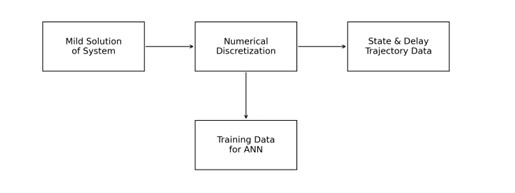
Fig. 1

Workflow for constructing a ML dataset directly from the mild solution of the model.

4.2
Data-driven approximation of system dynamics

After the dataset is ready, an ANNs will be trained next to the evolution operator to approximate it in accordance with the system. In more detail, the mapping:

(t,xt,x(t),u(t))x(t+Δ),(t, x_t, x'(t), u(t)) \mapsto x(t+\Delta)

where xtx_t is the finite-dimensional numerical representation of the infinite delay segment. The system's dependence on the whole past history is still there, but the discretized representation of xtx_t lets the ANNs learn an effective surrogate for the memory effects. The neural network model consists of two hidden layers where Rectified linear unit is applied as an activation function, plus one output layer that is linear. This type of architecture is complicated enough to handle the capturing of the nonlinear and hereditary dynamics, which are stored in the mild solution. The Mean Squared Error loss function along with the Adam optimizer is used during the training process, which makes even the long-range dependencies caused by the delayed behavior stable. The process of training leads to the development of a rapid and data-driven surrogate model that is capable of estimating the dynamics of the system while consuming much less power in terms of computation than direct evaluation of the analytic mild solution. This attribute is of a great advantage in real-time applications, control synthesis, or large-scale simulations where the repeated evaluation of integral operators would become impractical otherwise.

4.3
Performance evaluation via trajectory comparison

The comparison between the ANNs predicted trajectories and the true trajectories derived from the mild solution directly is the method used to assess the trained ANNs efficiency. Figure 2 shows an illustrative example of such comparison. The ANNs prediction closely approximates the true trajectory, thereby revealing both the gradual change of state and the oscillatory nature brought about by the infinite delay. The close match between the two trajectories is sufficient proof that the ANNs has been able to learn a very good approximation of the evolution operator of the system. The most significant point is that this includes the memory terms that are the result of the delay-dependent parts, thereby showcasing the power of ML in the area of providing reliable surrogate models for complex infinite-dimensional dynamical systems.
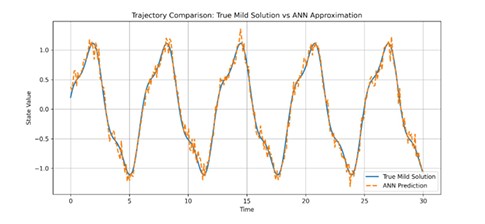
Fig. 2

Comparing the numerically computed mild solution and the neural network approximation.

4.4
Synthesis of analytical and ML perspectives

The combination of analytic methods and ML creates a highly effective hybrid modelling framework. The mild solution's existence and uniqueness guarantee that the neural network's training data corresponds to physically meaningful dynamics. The neural network, in turn, acts as a powerful surrogate model that estimates the solution of a very complicated system without the need for repeated integral and delay operators evaluation. In here, Figures 1 and 2 jointly portray this cooperation. The workflow figure depicts how analytic results are immediately used in the data construction, while the trajectory comparison makes clear the accuracy of the learned approximation. These results combined indicate that data-driven models can indeed be built up on strong mathematical foundations, thus, making it possible to simulate, control, and analyze quite complex systems with infinite delays at a significantly lower computational cost. This hybrid methodology not only remains open to further research, such as parameter estimation, control synthesis with the aid of learned models, and the direct embedding of the infinite-delay structure into neural architectures, but also expands its applicability to the stochastic versions of the system, where random perturbations are in interaction with delay and integral operators. Hence, the proposed framework does not only support the theoretical claims but also shows an application of their contemporary data-driven modelling utility.

5
Results and discussion

The results of this study establish that second-order neutral impulsive functional IDEs with infinite delay are controllable even in the presence of stochastic perturbations. By employing a random fixed-point theorem under appropriate assumptions, the existence of mild random solutions is ensured and sufficient conditions for controllability are derived. These findings indicate that randomness, impulsive effects, and infinite memory can be incorporated into the system model without compromising controllability, provided that a suitable functional-analytic framework is adopted. The theoretical outcomes extend existing controllability results by simultaneously addressing infinite delay and impulsive behavior within a stochastic setting. The infinite-delay structure captures the influence of the entire past history of the state, which plays a significant role in the evolution of the system dynamics. The derived controllability conditions confirm that the control operator remains effective despite accumulated memory effects and random disturbances, demonstrating the applicability of the proposed approach to complex systems governed by long-term memory. In addition to the analytical results, numerical simulations of mild solution trajectories are utilized to support the theoretical analysis and to facilitate data-driven approximation. The generated trajectories are consistent with the controllability results and serve as training data for ML models used to approximate the system dynamics. The close agreement between the analytical solutions and the ML predictions illustrates the potential of combining controllability theory with data-driven modelling, offering a practical computational perspective for studying stochastic systems with infinite delay.

6
Conclusion

The main goal of this study was to check the controllability of second-order neutral impulsive FDEs with infinite delay, a class of equations known for their difficulties in analyzing and being complex in structure. The use of a random fixed-point theorem in conjunction with stochastic set-valued operators made it possible to prove the existence of random solutions that are only mildly affected by the random nature of the system. These results demonstrate that the combined presence of randomness, impulsive effects, and infinite memory does not prevent controllability, provided that an appropriate analytical structure is adopted. Beyond the theoretical analysis, this study also explored the practical implications of the developed framework. In particular, the controllability results enable the generation of reliable solution trajectories that can be used as high-quality data for machine-learning-based approximation and forecasting. The numerical example involving a feed-forward artificial neural network illustrates how abstract controllability theory can be transformed into a computational tool for predicting complex time-dependent phenomena, such as systems with strong uncertainty and memory effects. Overall, the research contributes significantly to the theoretical comprehension of second-order neutral IDEs and at the same time connects the functional differential equation theory with contemporary data-driven techniques. The combination of the controllability theory with numerical simulation and ML not only illustrates the wide applicability of hybrid methods but also the great potential of the latter. The results open new directions for future research on hybrid models that combine stochastic dynamics, control mechanisms, infinite memory, and intelligent data-driven techniques for applications in engineering, finance, biology, and other applied sciences. In summary, this paper contributes to the controllability analysis of second-order neutral impulsive functional IDEs with infinite delay under stochastic perturbations by developing an appropriate controllability framework and establishing the existence of mild solutions through a random fixed-point technique. The results demonstrate that controllability can be achieved even in the presence of randomness, impulsive effects, and infinite memory. In addition, a mild solution-based data construction approach is introduced to facilitate ML approximation of infinite-delay system dynamics, thereby linking rigorous analytical results with data-driven modelling. This unified analytical and computational perspective enhances the understanding of complex systems governed by stochastic dynamics and memory effects.

Language: English
Submitted on: Dec 10, 2025
Accepted on: Apr 19, 2026
Published on: Jun 2, 2026
Published by: Harran University
In partnership with: Paradigm Publishing Services
Publication frequency: 2 issues per year

© 2026 Srinivasan Madhumitha, Prabakaran Raghavendran, Yamini Parthiban, published by Harran University
This work is licensed under the Creative Commons Attribution 4.0 License.

AHEAD OF PRINT