
1. Introduction
With an estimated 19.8 million deaths annually and nearly one-third of all deaths worldwide, Cardiovascular Disease (CVD), which includes Coronary Heart Disease (CHD) and Myocardial Infarction (MI, “heart attack"), is the leading cause of death worldwide. Heart attacks and strokes account for more than 85% of these deaths [1, 2]. MI occurs when a coronary artery becomes acutely blocked, usually as a result of atherosclerotic plaque rupture and subsequent thrombosis, which causes myocardial ischemia and necrosis [3]. Coronary artery disease, where atherosclerosis accumulates over decades as a result of several interrelated risk factors, dominates the pathophysiology of a heart attack [4, 5]. Tobacco use, an unhealthy diet high in salt and saturated fats, physical inactivity, excessive alcohol consumption, and exposure to air pollution are examples of classic modifiable behavioral risk factors that accelerate atherogenesis and cause acute events [6]. The risk of MI is further increased by biological risk factors, including diabetes mellitus, dyslipidemia, and hypertension, which is linked to almost half of heart attacks, strokes, and heart failure cases globally [7, 8].
Nine major modifiable risk factors such as smoking, abnormal lipids, hypertension, diabetes, abdominal obesity, psychosocial factors, low fruit/vegetable consumption, physical inactivity, and alcohol were identified by the inter-heart study as accounting for more than 90% of the population-attributable risk for MI worldwide [9, 10]. According to a comprehensive review, the prevalence of MI is 3.8% in those under 60 and 9.5% in those over 60, with significant geographical variation owing to healthcare and lifestyle differences [11]. Epidemiological studies show a high incidence of MI worldwide. Gaps in clinical practice are highlighted by the fact that many people with MI do not get guideline-recommended preventive treatments and have no recorded risk factors before to their first event due to fragmented access to preventive care [12]. Obesity, smoking, hypertension, and diabetes are among the most common risk factors among MI patients, and these risk factors are rising in many areas as a result of urbanization and dietary and physical activity changes [13, 14]. In recent decades, obesity has overtaken smoking as the most prevalent risk factor in some cohorts [15]. Age, male sex, family history, and genetic predisposition are examples of non-modifiable hazards that also play a major role; women’s risk increases after menopause, whereas men tend to get MI earlier in life [16]. From the standpoint of clinical symptoms, MI frequently manifests as chest pain or discomfort, dyspnea, diaphoresis, nausea, and syncope. However, atypical presentations are frequent, particularly in women, the elderly, and patients with diabetes, which can cause a delay in diagnosis and treatment [17, 18].
The cornerstone for reducing myocardial damage in acute MI and increasing survival is still early reperfusion treatment, either by thrombolysis or Percutaneous Coronary Intervention (PCI), especially when given soon after symptom onset [19, 20]. Antiplatelet agents (aspirin, P2Y12 inhibitors), beta-blockers, ACE inhibitors or ARBs, statins, and in certain cases aldosterone antagonists are examples of adjunctive evidence-based medical therapies that, when started early and maintained over time, reduce mortality and adverse remodeling [21,22]. Additionally, recent research indicates that combination lipid-lowering treatments, such as statins and ezetimibe, can help MI survivors experience fewer recurrent occurrences [23–25]. For both primary and secondary prevention, controlling CHD risk factors is crucial. The incidence of MI and associated mortality is greatly decreased by controlling hypertension with medication and lifestyle changes [26, 27]. While dietary modifications and physical activity improve blood pressure, glycemic management, and lipid profiles, quitting tobacco lowers cardiovascular risk within years after stopping [28]. It has been demonstrated that managing diabetes with glycemic control and medications such SGLT2 inhibitors and GLP-1 receptor agonists can improve cardiovascular health in addition to decreasing blood sugar levels [29, 30]. In some high-risk people, lipid reduction with high-intensity statins and other medications such PCSK9 inhibitors further reduces plaque instability and atherosclerotic development [31]. Cardiac rehabilitation with organized exercise, psychological support, and education enhances functional status and decreases recurrent episodes in addition to medication [32, 33]. In order to determine the level of treatments, preventive recommendations place a strong emphasis on risk stratification using instruments like the SCORE or Framingham risk scores [34]. Global disparities still exist despite advancements in treatment and prevention: premature death (less than 70 years old) accounts for a sizable share of all CVD mortality, and more than three-quarters of CVD fatalities occur in low- and middle-income countries with restricted access to healthcare [35, 36]. The WHO’s “25 by 25" goal is to reduce premature mortality from noncommunicable diseases (NCDs) by 25% by 2025 by reducing risk factors and improving care, which includes making necessary medications and technology widely available. Without the large scale application of wide ranging measures to prevent disease, the total number of heart disease and MI cases is going to increase due to demographic changes like population aging and urbanization, etc. [37]. One of the major changes in the area of cardiovascular risk evaluation and treatment is the movement towards next generation predictors including socioeconomic, environmental, and genetic factors, as well as AI based early identification tools [38–40]. Mathematical models have a long history of being used to identify knowledge gaps, disease pathways, disease progression, and treatment resistance issues.
Mathematical modeling is the key instrument for work with problem issues from various fields such as science, engineering, medicine, and economics [41–43]. It allows to see the key factors and relations by changing the complicated events into mathematical equations. One of its significant features is the predictive ability that gives the opportunity to create the future scenarios and therefore help to make the right decision in such areas as environmental science and epidemiology. In the case when direct trial is impossible, models also facilitate experimentation by giving parameter estimates and sensitivity analysis through which the insights can be found. Ultimately, single or system mathematical models lead to the implementation of evidence, based solutions to difficult problems [44, 45], deepen scientific knowledge, and have an impact on the policy. Researchers are putting forth an array of strategies for approximating numerical solutions (see, [46], [47]) to nonlinear differential equations, and neural network techniques are being used more frequently in a variety of fields. Achieving a balance between accuracy and processing economy is an ongoing challenge in scientific computing. Neural networks have transformed approximation techniques, displaying enormous potential for tackling complicated problems. Variable-coefficient nonlinear equations have recently received a lot of attention because of their applications in mathematical physics. Several neural-symbolic approaches have recently been presented for quickly computing exact solutions [48–51].
Fuzzy set theory is a core element of the mathematical model of the problem that is characterized by uncertain and vague features. In contrast to classical set theory with its clear, cut boundaries, fuzzy sets allow partial membership values that reflect human reasoning and complex systems much better [52, 53]. The ability to choose is very important for the real world phenomena such as medical diagnoses, economic behavior, environmental risk, and social dynamics which are often only implicitly numerical because of the nature of the problems, that have to be solved [54, 55]. The use of fuzzy sets opens the door to the inclusion of linguistic variables, expert knowledge, and uncertain data in the mathematical models which is helping the favour of the most realistic field of research such as control systems [56, 57] where the fuzzy logic controllers solve the problem of nonlinear systems efficiently. In medicine, fuzzy models provide help to the physicians in the event of ambiguous symptoms and incomplete data [58, 59], and environmental models solve the problems of uncertain measurements and climate variability [60, 61]. Besides that, fuzzy sets have been widely implemented in economics and social systems [62, 63], which are dominated by subjective human judgement. The use of fuzzy models together with differential equations and hybrid systems is a powerful instrument to study the dynamical processes under uncertainty, thus enhancing the understanding and usage of mathematical models in solving the problems of the complex world, where exactness is seldom achievable.
1.1. Fractional calculus and fuzzy fractional-order mathematical models
Fractional calculus, by focusing on derivatives and integrals of non-integer order, goes beyond classical calculus and enhances its capability to model natural phenomena. Its use has become significant over the last few decades due to its capability to depict memory and heredity features of complex systems, although its mathematical basis can be traced back to figures like Leibniz, Liouville, and Riemann [64]. Those systems, for example, fluid flow in porous media [65, 66], anomalous diffusion [67, 68], and viscoelastic materials [69, 70], are characterized by long, range temporal dependency which is very challenging for integer, order differential equations to represent adequately. Thanks to fractional, order models, it is possible to have more realistic and versatile descriptions of complex systems by the inclusion of history, dependent behavior via nonlocal operators [71, 72]. Control engineering [73], epidemiology [74, 75], economics [76, 77], signal processing [78, 79], and neurology [80, 81] are just a few of the practical domains where fractional calculus thrives. Continuous model dynamics tuning is made possible by fractional-order systems, which improves data fitting, stability analysis, and uncertainty resilience. When experimental data show power-law behavior or slow decay events that conventional models are unable to effectively account for, this flexibility is extremely helpful [82, 83]. The synergy between fuzzy sets or fuzzy logic and fractional calculus further improves mathematical modeling, particularly in uncertain contexts. Recent studies on fractional-order derivatives have improved disease modeling by incorporating non-local features that enhance simulations, particularly for infectious diseases. Triangular fuzzy numbers are utilized to account for uncertainties related to patient-specific psychological factors such as obesity and depression, increasing model realism and predictive accuracy. While fractional derivatives show memory and long-term interactions, fuzzy sets allow for imprecision in parameters and system states due to insufficient or unclear information. This integration leads to fuzzy fractional differential equations and fuzzy fractional control systems, which are especially helpful in biological, medical, and economical contexts where memory effects and uncertainty are prevalent [84–87].
Venkatesh et al. [88] proposed a Caputo fractional-order compartmental model to examine Monkeypox impaired transmission in vaccinated populations. Findings suggest that memory effects impact the infection’s temporal evolution, often delaying peaks and altering long-term dynamics. Subramanian and colleagues [89] introduced a fuzzy fractional SIR epidemic model to analyze childhood diseases. This extension of the classic SIR structure utilizes Caputo fractional derivatives and fuzzy parameters to reflect historical influences and imprecision in data.
The Fuzzy Laplace transform is used to obtain the approximate solutions. The findings suggest that fuzzy fractional methods improve epidemic modeling by integrating uncertainty and long-term memory effects. Fatima and colleagues [90] go over a fuzzy-fractional SEIR epidemic model for Marburg Virus Disease. They utilized WHO outbreak data and the model captures disease progression by treating key transmission parameters as triangular fuzzy numbers to address the limitations of epidemiological information. It employs fractional derivatives in the Caputo sense, offering a history-dependent transmission description.
They used an extended Residual Power Series method combined with fuzzy-Caputo Laplace transforms for analyzing the model, and hence producing approximate fuzzy solutions that account for both fuzzy parameters and fractional memory effects. Qayyum and colleagues in [91] examined a host vector dengue model by utilizing Caputo fractional derivatives to account for memory effects in disease transmission and employ triangular fuzzy numbers to represent uncertainty in epidemiological parameters. This method captures the variability of biological processes and the non-local dynamics of infectious diseases. This offers a broader range of potential epidemic outcomes than traditional models. Ali in [92] proposed a fuzzy fractional stochastic epidemic model in a view to sugarcane smut disease transmission. The model incorporates fractional derivatives for memory effects and stochastic perturbations through fractional Brownian motion to represent randomness and dependencies of disease dynamics. This novel method merges fuzzy set theory, fractional calculus, and stochastic differential equations, providing a more accurate representation of disease progression than classical models. Another study, given in [93], presents a fuzzy-fractional model of cancer tumor dynamics, employing Caputo fractional derivatives to incorporate memory effects and utilizes triangular fuzzy numbers to manage uncertainties.
This methodology generates upper and lower bound trajectories for cancer dynamics, enhancing the understanding of treatment responses. The authors introduce a modified He-Laplace-Carson (HLC) algorithm, combining various techniques to solve the fuzzy-fractional system and analyze parameter variations affecting cancer dynamics. The authors in [94] proposed a model that uses Caputo fractional derivatives to model memory effects and incorporates fuzzy parameters to address uncertainties in contact, infection, and recovery rates. It adopts a SIS structure for both populations, allowing for repeated infections.
The analytical insights are derived through a fuzzy Laplace transform, and a numerical scheme based on fractional Adams-Bashforth methods approximates solutions with interval-valued uncertainty. Graphical representations demonstrate the influence of fuzziness and fractional order on epidemic projections, emphasizing the network’s impact on transmission dynamics. The study via [95] utilizes fuzzy set theory and piecewise fractional derivatives to address uncertainty and capture diverse epidemic dynamics. The analysis confirms the model’s stability and equilibrium characteristics, while a hybrid numerical method effectively solves the system. Simulations validate the model’s capability to represent dynamic transitions and produce interval forecasts, offering improved insights for public health compared to traditional approaches.
This approach also addresses the complexity of heart attacks and cardiovascular diseases, as an application. Traditional integer-order models often fail to account for physiological memory effects, delayed responses, and patient variability. The current research links mathematical theory with cardiovascular processes by integrating fuzzy logic and fractional-order dynamics. It intends to enhance the understanding, prediction, and treatment of cardiac disorders through more reliable and clinically applicable models. Challenges such as measurement errors and subjective assessments further complicate heart disease data. The use of fractional calculus, specifically the Caputo derivative, introduces memory and nonlocal effects essential for modeling chronic diseases, while fuzzy set theory systematically handles ambiguity in clinical data.
2. Preliminaries
This subsection presents standard definitions commonly used in fuzzy fractional-order mathematical models. The exposition combines fuzzy set theory with fractional calculus and is suitable as a preliminary section in applied mathematics, epidemiology, engineering, and biological modeling papers.
Definition 1.
(Fuzzy Set [52, 96]): Assume that X is a non-empty universal set. A "fuzzy set" Ã in X is defined by
where μà (x) represents the degree of membership of x ∈ X in Ã.Definition 2.
(Fuzzy RL integral [97]): For a fuzzy-valued function, , the fuzzy RL integral defined by α-cuts is given by
Definition 3.
(Fuzzy Caputo fractional derivative [97]): The fuzzy Caputo fractional derivative of is defined by
Definition 4.
(Fuzzy fractional differential equation [98, 99]): A fuzzy fractional differential equation can be expressed as
where is a fuzzy-valued state variable and 0 < α ≤ 1.Definition 5.
(Fuzzy fractional order model [99]): A fuzzy fractional-order model is a dynamical system governed by fractional derivatives of order α ∈ (0, 1] with fuzzy parameters or fuzzy initial conditions, expressed as
where denotes fuzzy parameters.3. A fuzzy fractional-order model for heart disease research
By using mathematical models to characterize these illnesses, we can predict the extent and severity of infections. Here, we develop a fuzzy fractional order model for heart disease research [100]. The total population is divided into six sub-populations: susceptible individuals, heart-attack cases, chronic heart-disease cases, infected individuals, individuals under treatment, and individuals who have recovered from heart disease. The total population A(t) is partitioned into six compartments according to the health status of individuals: susceptible S(t), heart attack cases HA(t), chronic heart-disease cases HC(t), infected individuals I(t), individuals receiving treatment T(t), and recovered individuals R(t). All parameter descriptions used in the proposed model are presented in Table 1. The following assumptions are made in formulating the model:
The birth and natural death rates in the population are distinct and influence the prevalence of heart disease.
After obtaining the right care, people with heart disease may recover, but their recovery might not last.
Even after an initial recovery, people may continue to have heart-related health problems.
Table 1
Parameters’ descriptions.
| Parameter | Description |
|---|---|
| P | Rate at which individuals enter the population |
| Natural death rate in each compartment | |
| Transition rate from chronic cases to heart-attack cases | |
| Contact rate of S(t) with HC(t) | |
| Contact rate of S(t) with I(t) | |
| Rate at which recovered individuals become susceptible again | |
| HA(t)’s treatment rate | |
| HC(t)’s treatment rate | |
| I(t)’s treatment rate | |
| Disease-induced death rate for infected individuals | |
| Transition rate from chronic cases to infected cases | |
| Rate at which treated individuals move to the recovered class | |
| Disease-induced death rate for heart-attack individuals |
The fuzzy fractional-order model (FFOM) is presented as a nonlinear system using first-order Caputo derivatives of order γ, 0 < γ ≤ 1.
with S(0) ≥ 0, HA(0) ≥ 0, HC(0) ≥ 0, I(0) ≥ 0, T (0) ≥ 0, R(0) ≥ 0, where fuzzy-valued rates under uncertainty are indicated by . The study demonstrates, step-by-step, how the suggested paradigm enhances predictive analytics in personalized cardiology by creating dynamic risk indices for patients using clinical ambiguity and patient history via fuzzy fractional-order modeling approaches. In order to enable novel applications in personalized medicine and optimize algorithms for real-time needs, it highlights potential research avenues, such as the integration of FFOM with machine learning methods.The flow chart of system (10) is given in Figure 1.
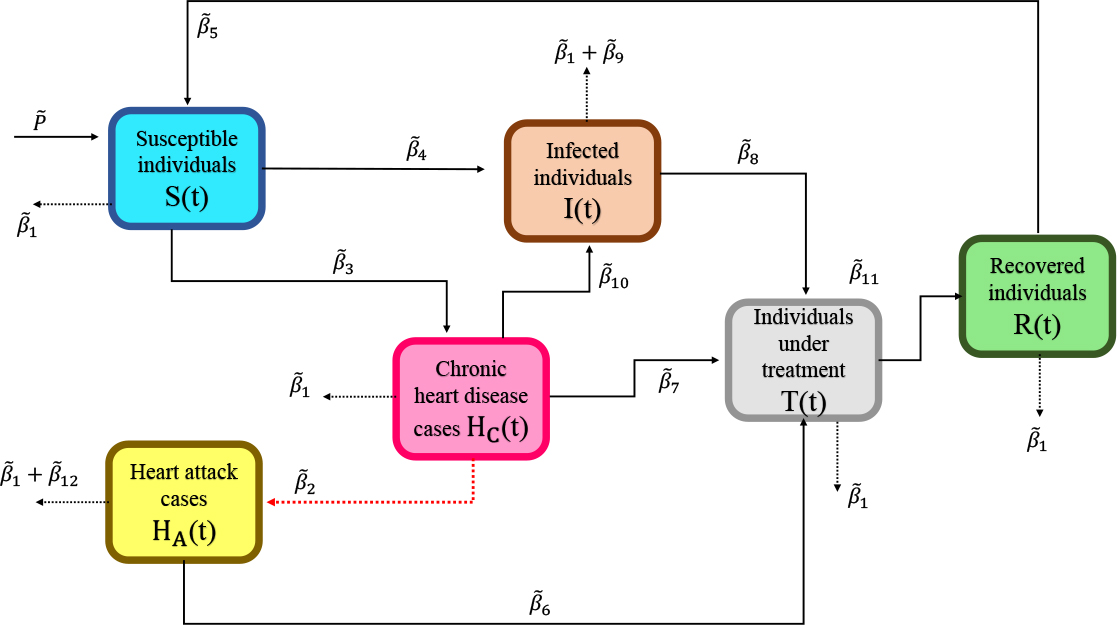
Fig. 1
Schematic diagram.
3.1. Biological feasibility
Theorem 1.
The solution to the initial value problem (10) remains inside the positive domain of [101].
Proof.
There is a single ideal solution to (10) in (0, ∞). The domain must be positively invariant in order to get the following findings.
Because the vector field always flows in the same direction within every hyperplane of non-negative space, the domain is essentially positively invariant. Only when the beginning conditions are in can the solution be found inside the hyperplane.
This implies that
As a result, we can conclude that the system (10) solutions are uniformly confined within the invariant region △.
3.2. Equilibrium point analysis
To determine the steady-state behavior of system (10), we obtain the equilibrium points by setting all fractional derivatives to zero, that is,
This leads to a nonlinear algebraic system whose solutions represent the equilibrium states of the model.
3.2.1. Disease-free equilibrium (DFE)
At the disease-free equilibrium, all disease-related compartments vanish:
Substituting these into the first equation of system (10) yields:
which impliesHence, the disease-free equilibrium point is
3.2.2. Endemic equilibrium (EE)
The endemic equilibrium corresponds to a steady state where all compartments remain positive. Denoting this state by
we solve the system obtained from setting all derivatives to zero. From heart-attack population which givesFrom chronic population
Assuming , we obtain
From Infected population
which givesFrom treated population
leading toFrom recovered population
so thatSubstituting R*, I*, and T * into susceptible population
yields a nonlinear algebraic equation for from which all remaining equilibrium components can be determined. The endemic equilibrium satisfiesThe remaining value is found by solving the susceptible equation, ensuring the positivity and feasibility of all compartments. The basic reproduction number R0 is computed in Eq. (31).
3.3. Stability analysis of equilibria
To study the local stability of the equilibrium points of system (10), we compute the Jacobian matrix J of the right-hand side. For the ordering of state variables (S, HA, HC, I, T, R) the Jacobian is
3.3.1. Local stability of the disease-free equilibrium
At the DFE E0 = (S0,0,0,0,0,0) with , the Jacobian reduces to
This matrix has a block structure. Several eigenvalues are immediately identifiable:
which are all strictly negative. The remaining eigenvalues are associated with the (HC,I)-submatrixThe spectral radius of the next-generation matrix reduces to
Theorem 3
(Local stability of DFE [103]). The fractional-order system of order γ ∈ (0,1), E0 is locally asymptotically stable if every eigenvalue λ of J (E0) satisfies the Matignon condition
In particular, since the real eigenvalues above are negative, a sufficient condition for fractional-order stability is R0 < 1 together with γ ∈ (0, 1).
3.3.2. Local stability of the endemic equilibrium
Let denote a biologically feasible endemic equilibrium. The Jacobian J (E*) is obtained by substituting these values into J(S, HA, HC, I, T, R).
Theorem 4
(Local stability of EE [103]). The fractional-order system of order y ∈ (0, 1), E* is locally asymptotically stable if every eigenvalue f of J(E*) satisfies
Both theorems (Local stability of DFE and EE) use the Matignon stability criterion, but they have different equilibrium points, Jacobian structures, eigenvalue natures, and epidemiological interpretations. The local stability theorem for disease-free equilibrium is based on the basic reproduction number and uses a simplified Jacobian structure. On the other hand, the endemic equilibrium theorem requires detailed eigenvalue analysis due to nonlinear interactions and is greatly influenced by fractional order.
3.4. Existence and uniqueness of solutions
The Lipschitz and growth conditions are essential for demonstrating the existence and uniqueness of solutions to differential equations, particularly in fractional order systems. The growth condition restricts function increase, while the Lipschitz condition prevents rapid changes. These conditions extend the Picard-Lindelöf theorem to the fractional domain and are typically validated using the Banach fixed-point theorem. To establish existence and uniqueness in fractional calculus, the accompanying theorem must be proven, focusing on the relevant system of equations.
Theorem 5.
Let [0, T] be a domain in ℝ × ℝ6 and Ψ* : [0, T] → ℝ6. There exist some positive constants, λi > 0, such that
For remaining compartments, we have where
whereFor, second condition, we have
under the condition . Similarly, under the condition . under the condition . under the condition . under the condition . under the condition .Therefore, we can say that the system (10) has a unique solution if
4. Numerical scheme
This section provides a generic method for using the fuzzy Laplace transform to derive the semi-analytic solution of the fuzzy fractional model (10). Generalizing the system we get:
with fuzzy initial conditions where X(t) = (X1 (t),X2(t), … ,XN(t))T, and Gi represent nonlinear fuzzy-valued functions. Now, using the fuzzy Laplace transform of the Caputo fractional derivative,We get
The infinite series solution of each state variable is assumed in the form
where, the components to be found recursively are Xi,n (t). Also, the nonlinear terms Gi are decomposed into Adomian polynomials as follows: whereSubstituting the series representations and taking the inverse Laplace transform of each equation, we obtain the recursive series representations:
Thus, we find
where M is used to provide satisfactory convergence of the series. Next, β–cuts are used to express fuzzy beginning conditions and parameters in order to deal with uncertainty. The fuzzy solution for β ∈ [0,1] is written as where the fuzzy solution’s lower and higher limits are represented by and , respectively. The whole fuzzy solution is obtained by applying the recursive strategy independently to each bound.The flow chart of scheme is given in Figure 2.
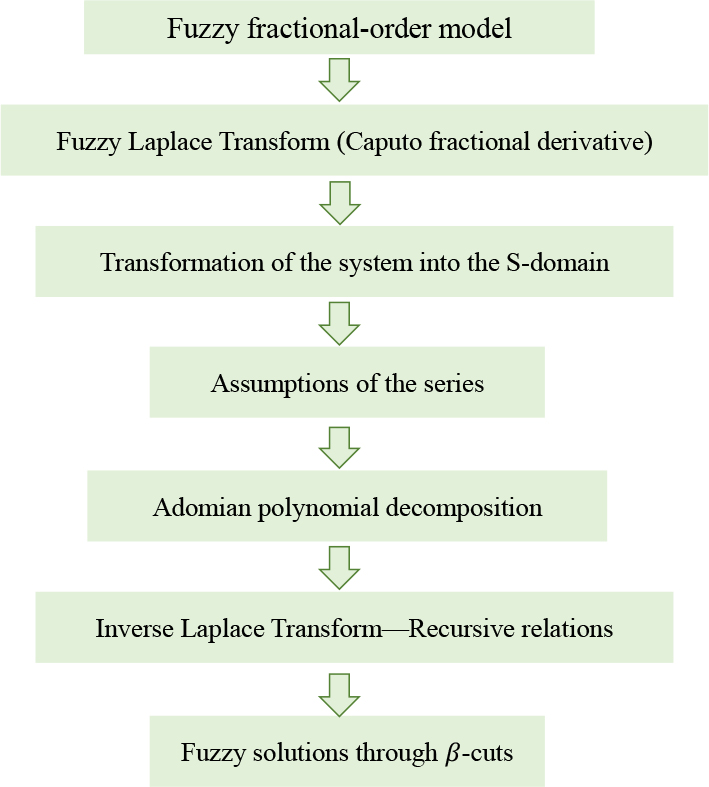
Fig. 2
Flow chart of numerical scheme.
5. Results and discussion
The model was simulated using the parameter values listed in Table 2 and the fuzzy triangular initial conditions.
Table 2
Initial conditions and parameters’ values [100].
| Variable | Initial condition | Parameter | Value | Parameter | Value |
|---|---|---|---|---|---|
| S (0) | 500 | 0.2 | 0.01 | ||
| Ha (0) | 35 | 0.486 | 0.09 | ||
| Hc (0) | 20 | 0.1679 | 0.019 | ||
| I (0) | 41 | 0.0003 | 0.1981 | ||
| T (0) | 15 | 0.003 | 0.001 | ||
| P (0) | 15 | 0.001 | 0.09 | ||
| P | 5 |
The series solution was truncated after the third term to approximate the system’s behavior over time. Figures 3, 4, 5, 6, and 7 present the trajectories of all six compartments for fractional orders γ = 1.00, 0.95, 0.90, 0.85, and 0.80. The fractional order γ significantly affects both the transient and long-term dynamics of the system. As γ decreases from the classical case γ = 1 to γ = 0.80, the susceptible population S decreases more gradually, reflecting the memory effect inherent in fractional derivatives; moreover, the steady-state value of S increases slightly for smaller γ, indicating slower depletion of susceptibles. Heart-attack cases (HA) display higher and more prolonged peaks for lower γ, such as the increase from approximately 31.09 at t = 10 for γ = 1 to 79.66 for γ = 0.80, suggesting that fractional-order dynamics capture delayed physiological responses or intervention effects. Chronic cases (HC) follow a similar trend, exhibiting higher peaks and slower decline as γ decreases, consistent with the lingering nature of chronic disease progression. The infected compartment shows delayed peaking and slower convergence for smaller γ values; moreover, the treated and recovered populations remain notably smaller, implying reduced treatment pace or recovery efficiency under strong memory effects. The numerical results are illustrated in Tables 3, 4, 5, 6, and 7.
Fuzzy uncertainty analysis is presented in Figures 8, 9, 10, 11, 12, and 13, where fuzzy envelopes represent the range of possible trajectories generated by triangular fuzzy initial values. These envelopes widen during the early transient period, reflecting high sensitivity to uncertainty, and gradually narrow as the system approaches steady state. For all γ, the chronic compartment HC converges to zero in both crisp and fuzzy forms, as summarized in Table 8, indicating eventual elimination of chronic cases under the chosen parameters. Table 8 also highlights the steady-state behavior at t = 50, showing that the susceptible population remains the dominant compartment (of order 109–1010 under the model scaling), whereas HA and I stabilize at much smaller but non-zero magnitudes, suggesting endemic persistence. The treated and recovered classes have been kept small to a certain extent, which shows that either the coverage of the treatment is limited or there is a high probability of relapse. All compartment sizes, except for HC, shrink as γ is lowered, indicating that fractional damping reduces the total disease load.
The fuzzy 3D surface plots in Figures 14, 15, 16, 17, 18, and 19 depict the combined effect of time and membership level β on each compartment, thereby reflecting the smooth transitions within the fuzzy bounds and pointing out system behavior sensitivity to the initial uncertainty. In general, the simulations provide evidence that fractional, order models constitute a versatile framework for the incorporation of memory effects and anomalous diffusion which is usually the case in chronic diseases such as heart conditions. The system dynamics depending on γ to a great extent shows that the fractional order can be adjusted to depict individual differences in recovery or a delay in treatment response. The outcomes from the perspective of public health are that the results emphasize the intervention’s taking place at the earliest time as being very important because a lower (stronger memory) results in higher and more prolonged disease prevalence. Furthermore, the fuzzy analysis underscores the necessity for policy decisions that explicitly accommodate uncertainties in initial states and parameter estimates.
Although the present model incorporates both fuzzy uncertainty and fractional dynamics, it assumes constant parameters and omits spatial heterogeneity and age structure. Future work may extend the framework to include time-dependent parameters such as seasonal variation or improved treatment rates, stochastic or impulsive controls such as vaccination or rapid interventions, and spatial or network-based diffusion to capture geographic spread. Validation with real clinical or epidemiological data would also help in estimating γ and refining model parameters for more accurate prediction.
Table 3
Simulation results for the model compartments over time at γ = 1.
| Time | S | HA | HC | I | T | R |
|---|---|---|---|---|---|---|
| 0 | 500.0000 | 35.0000 | 20.0000 | 41.0000 | 15.0000 | 15.0000 |
| 10 | 5.5083 | 31.0891 | 4.0791 | 12.4312 | 17.2906 | 2.0702 |
| 15 | 5.3049 | 12.8700 | 4.4243 | 4.8926 | 8.5515 | 0.7879 |
| 20 | 5.3277 | 8.6353 | 4.3934 | 3.2770 | 4.3704 | 0.3041 |
| 25 | 5.3249 | 7.6447 | 4.3965 | 2.9288 | 2.6253 | 0.1204 |
| 30 | 5.3252 | 7.4128 | 4.3961 | 2.8537 | 1.9401 | 0.0505 |
| 35 | 5.3252 | 7.3585 | 4.3961 | 2.8374 | 1.6790 | 0.0239 |
| 40 | 5.3252 | 7.3457 | 4.3960 | 2.8339 | 1.5812 | 0.0137 |
| 45 | 5.3252 | 7.3427 | 4.3960 | 2.8331 | 1.5449 | 0.0099 |
| 50 | 5.3252 | 7.3420 | 4.3960 | 2.8330 | 1.5315 | 0.0084 |
Table 4
Simulation results of the model compartments over time γ = 0.95.
| Time | S | HA | HC | I | T | R |
|---|---|---|---|---|---|---|
| 0 | 500.0000 | 35.0000 | 20.0000 | 41.0000 | 15.0000 | 15.0000 |
| 10 | 4.5025 | 44.2874 | 8.9331 | 18.6090 | 19.1061 | 2.7453 |
| 15 | 4.9252 | 22.5143 | 7.1270 | 9.2256 | 11.3788 | 1.3878 |
| 20 | 5.0725 | 15.1313 | 6.3753 | 6.1570 | 7.0169 | 0.7761 |
| 25 | 5.1470 | 12.2051 | 5.9528 | 4.9537 | 4.7488 | 0.4813 |
| 30 | 5.1906 | 10.8292 | 5.6811 | 4.3821 | 3.5689 | 0.3289 |
| 35 | 5.2188 | 10.0704 | 5.4914 | 4.0606 | 2.9322 | 0.2443 |
| 40 | 5.2381 | 9.5947 | 5.3513 | 3.8550 | 2.5688 | 0.1935 |
| 45 | 5.2521 | 9.2674 | 5.2436 | 3.7112 | 2.3472 | 0.1608 |
| 50 | 5.2626 | 9.0269 | 5.1581 | 3.6045 | 2.2029 | 0.1383 |
Table 5
Simulation results of the model compartments over time at γ = 0.90.
| Time | S | HA | HC | I | T | R |
|---|---|---|---|---|---|---|
| 0 | 500.0000 | 35.0000 | 20.0000 | 41.0000 | 15.0000 | 15.0000 |
| 10 | 4.2601 | 56.7490 | 14.7438 | 24.5743 | 20.5965 | 3.4152 |
| 15 | 4.7013 | 33.0526 | 10.8143 | 14.0625 | 13.9289 | 2.0238 |
| 20 | 4.8947 | 23.1164 | 9.1128 | 9.7642 | 9.6698 | 1.3170 |
| 25 | 5.0016 | 18.3131 | 8.1476 | 7.7023 | 7.1129 | 0.9273 |
| 30 | 5.0687 | 15.6690 | 7.5216 | 6.5637 | 5.5649 | 0.6969 |
| 35 | 5.1143 | 14.0470 | 7.0812 | 5.8597 | 4.5964 | 0.5516 |
| 40 | 5.1471 | 12.9635 | 6.7537 | 5.3851 | 3.9646 | 0.4546 |
| 45 | 5.1717 | 12.1910 | 6.5003 | 5.0438 | 3.5339 | 0.3865 |
| 50 | 5.1907 | 11.6123 | 6.2981 | 4.7864 | 3.2277 | 0.3366 |
Table 6
Simulation results of the model at different time points at γ = 0.85.
| Time | S | HA | HC | I | T | R |
|---|---|---|---|---|---|---|
| 0 | 500.0000 | 35.0000 | 20.0000 | 41.0000 | 15.0000 | 15.0000 |
| 10 | 4.2201 | 68.5668 | 21.6898 | 30.3474 | 21.8069 | 4.0770 |
| 15 | 4.5978 | 44.1806 | 15.5613 | 19.2695 | 16.1936 | 2.6871 |
| 20 | 4.7872 | 32.3705 | 12.7564 | 14.0184 | 12.2355 | 1.9164 |
| 25 | 4.8998 | 25.9176 | 11.1314 | 11.1731 | 9.5961 | 1.4518 |
| 30 | 4.9743 | 22.0151 | 10.0638 | 9.4543 | 7.8252 | 1.1527 |
| 35 | 5.0270 | 19.4550 | 9.3054 | 8.3239 | 6.6074 | 0.9494 |
| 40 | 5.0663 | 17.6646 | 8.7370 | 7.5302 | 5.7442 | 0.8050 |
| 45 | 5.0967 | 16.3479 | 8.2941 | 6.9439 | 5.1132 | 0.6982 |
| 50 | 5.1208 | 15.3405 | 7.9387 | 6.4935 | 4.6384 | 0.6166 |
Table 7
Simulation results of the model at different time points at γ = 0.80.
| Time | S | HA | HC | I | T | R |
|---|---|---|---|---|---|---|
| 0 | 500.0000 | 35.0000 | 20.0000 | 41.0000 | 15.0000 | 15.0000 |
| 10 | 4.2840 | 79.6565 | 29.7862 | 35.8800 | 22.7665 | 4.7281 |
| 15 | 4.5781 | 55.6059 | 21.4699 | 24.7168 | 18.1625 | 3.3692 |
| 20 | 4.7406 | 42.6288 | 17.4538 | 18.8152 | 14.6362 | 2.5637 |
| 25 | 4.8432 | 34.8770 | 15.0662 | 15.3228 | 12.0838 | 2.0453 |
| 30 | 4.9140 | 29.8506 | 13.4723 | 13.0666 | 10.2338 | 1.6909 |
| 35 | 4.9659 | 26.3744 | 12.3266 | 11.5074 | 8.8693 | 1.4370 |
| 40 | 5.0056 | 23.8453 | 11.4602 | 10.3720 | 7.8408 | 1.2480 |
| 45 | 5.0371 | 21.9297 | 10.7800 | 9.5105 | 7.0481 | 1.1028 |
| 50 | 5.0626 | 20.4309 | 10.2306 | 8.8352 | 6.4242 | 0.9884 |
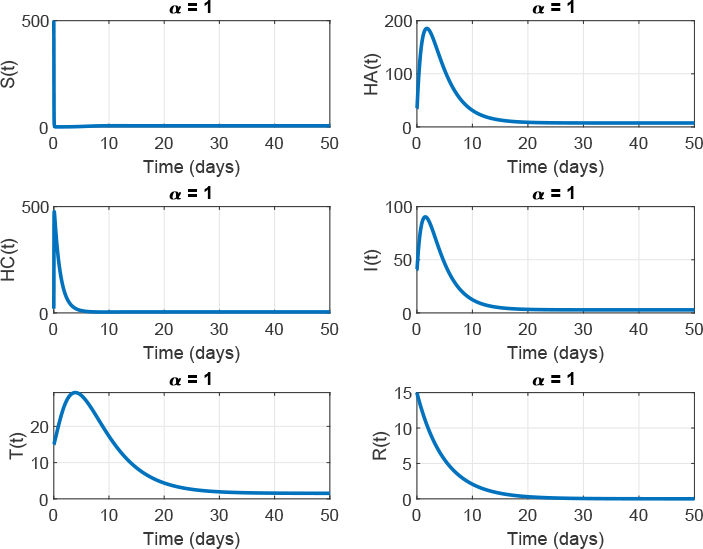
Fig. 3
Simulation of the Model Compartments at fractional order γ = 1.00.
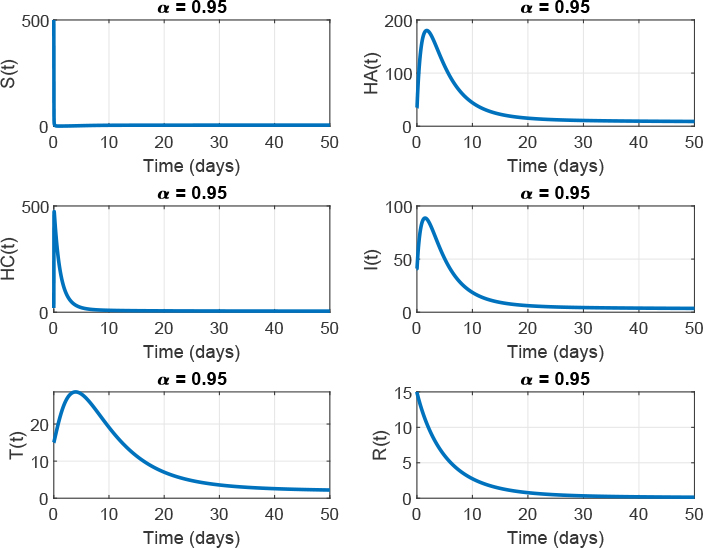
Fig. 4
Simulation of the Model Compartments at fractional order γ = 0.95.
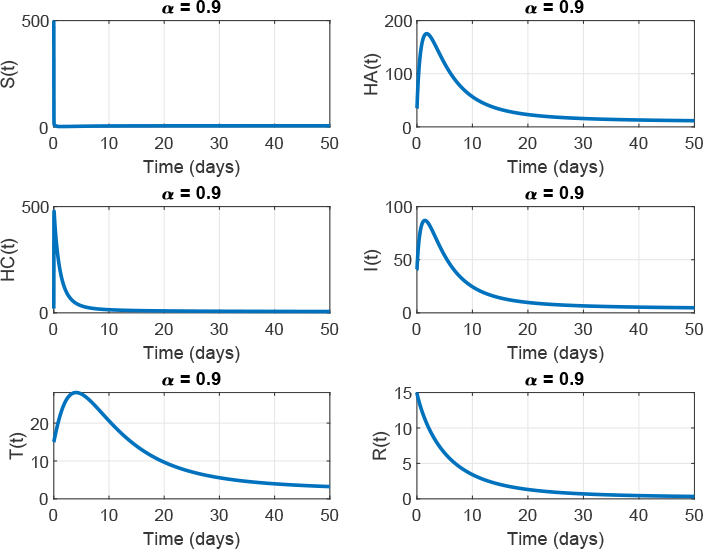
Fig. 5
Simulation of the Model Compartments at fractional order γ = 0.90.
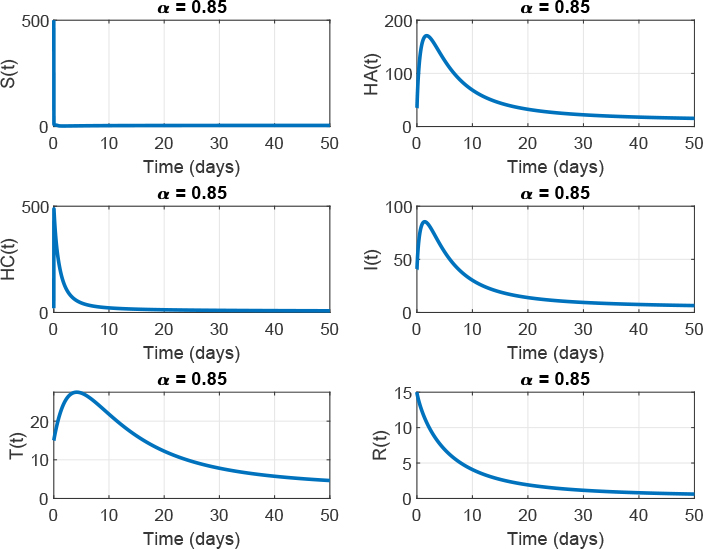
Fig. 6
Simulation of the Model Compartments at fractional order γ = 0.85.
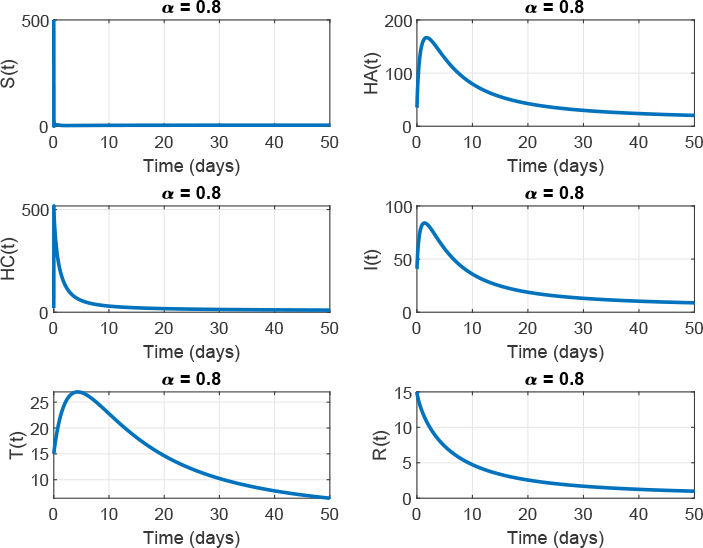
Fig. 7
Simulation of the Model Compartments at fractional order γ = 0.80.
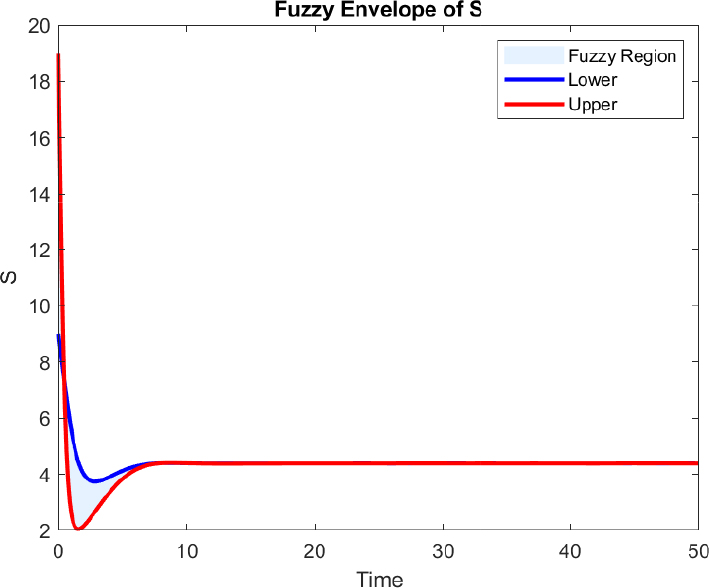
Fig. 8
Fuzzy envelope of S(t).
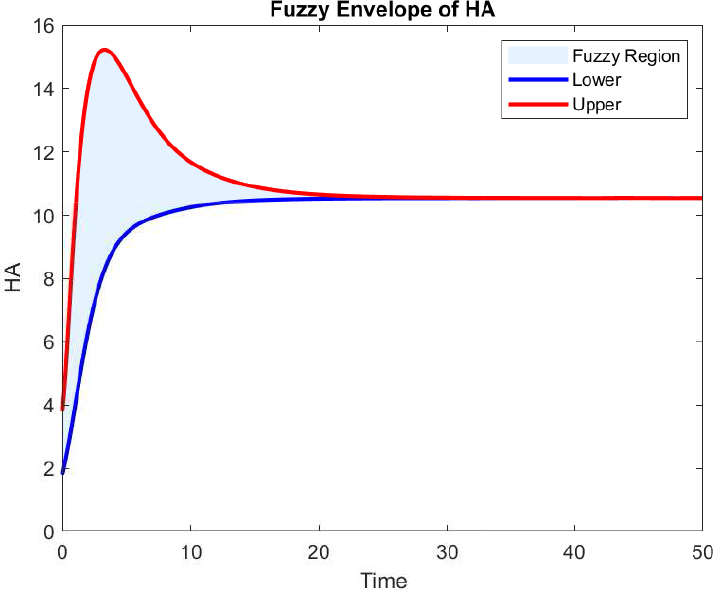
Fig. 9
Fuzzy envelope of HA (t).
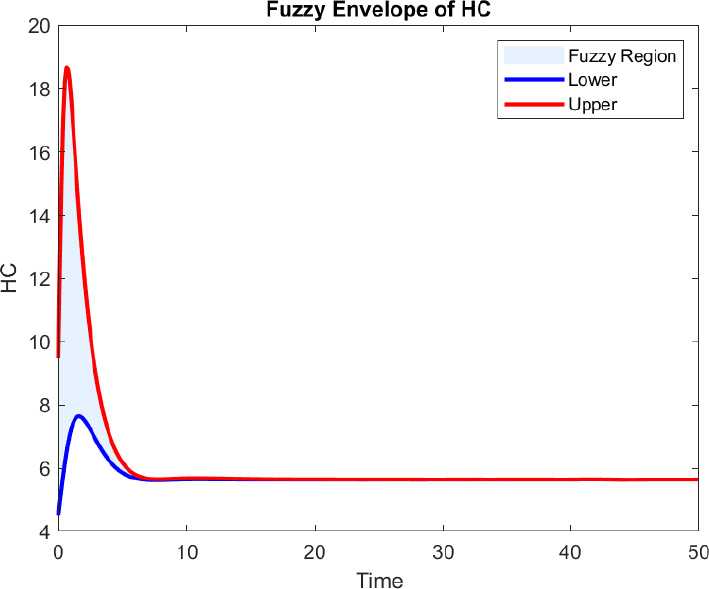
Fig. 10
Fuzzy envelope of HC(t).
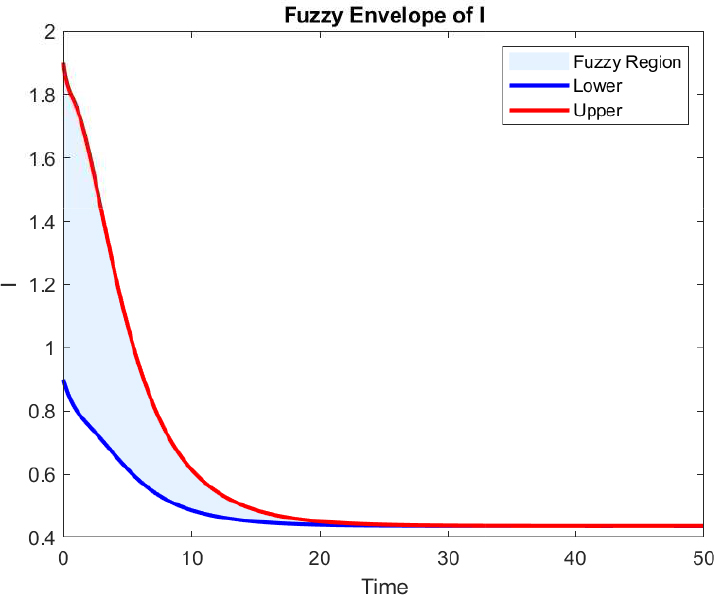
Fig. 11
Fuzzy envelope of I(t).
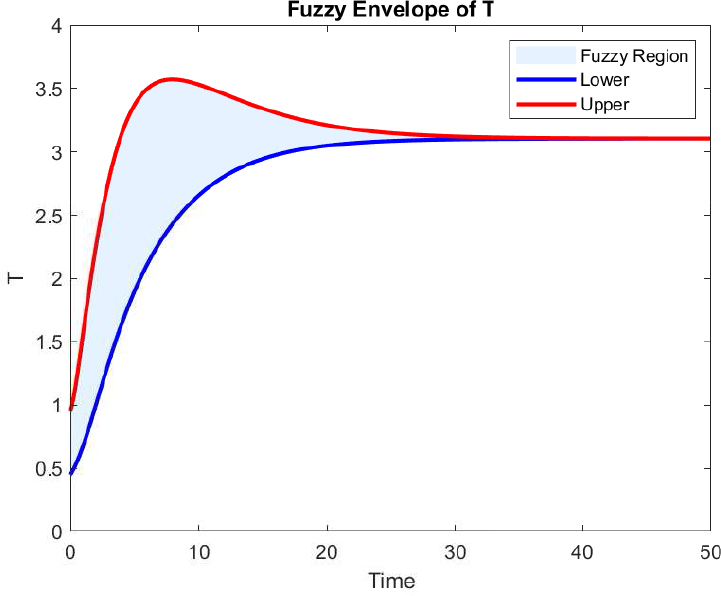
Fig. 12
Fuzzy envelope of T(t).
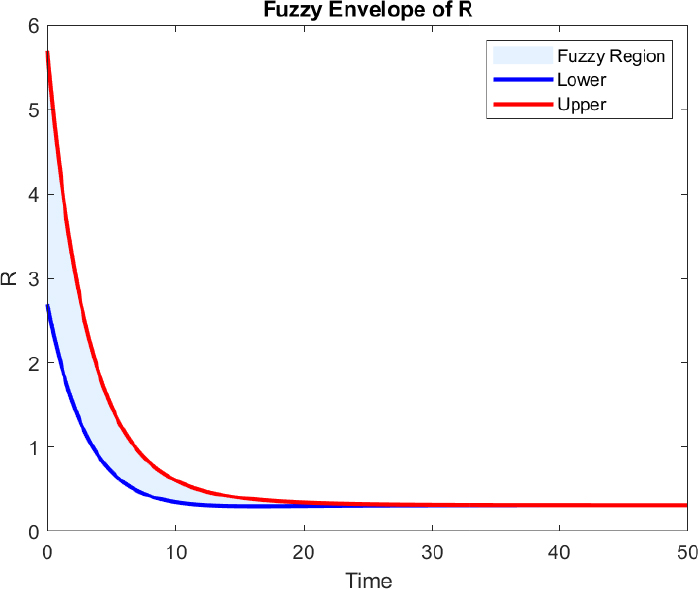
Fig. 13
Fuzzy envelope of R(t).
Table 8
Crisp and fuzzy bounds of all compartments for different fractional orders.
| Fractional Order | Compartment | Crisp | Fuzzy Min | Fuzzy Max |
|---|---|---|---|---|
| 1 | S | 3.9185 × 10¹⁰ | 1.6155 × 10¹⁰ | 8.0882 × 10¹⁰ |
| 1 | HA | 3.2297 × 10⁶ | 2.0615 × 10⁶ | 4.6590 × 10⁶ |
| 1 | HC | 0 | 0 | 0 |
| 1 | I | 1.3390 × 10⁶ | 8.8027 × 10⁵ | 1.8464 × 10⁶ |
| 1 | T | 65006 | 40905 | 94657 |
| 1 | R | 1812.4 | 1449.9 | 2174.9 |
| 0.95 | S | 2.4488 × 10¹⁰ | 1.0091 × 10¹⁰ | 5.0562 × 10¹⁰ |
| 0.95 | HA | 2.3017 × 10⁶ | 1.4691 × 10⁶ | 3.3202 × 10⁶ |
| 0.95 | HC | 0 | 0 | 0 |
| 0.95 | I | 9.4477 × 10⁵ | 6.2001 × 10⁵ | 1.3074 × 10⁶ |
| 0.95 | T | 46352 | 29171 | 67488 |
| 0.95 | R | 1226.2 | 980.94 | 1471.4 |
| 0.9 | S | 1.5186 × 10¹⁰ | 6.2546 × 10⁹ | 3.1366 × 10¹⁰ |
| 0.9 | HA | 1.6308 × 10⁶ | 1.0410 × 10⁶ | 2.3526 × 10⁶ |
| 0.9 | HC | 0 | 0 | 0 |
| 0.9 | I | 6.6342 × 10⁵ | 4.3469 × 10⁵ | 9.2108 × 10⁵ |
| 0.9 | T | 32865 | 20687 | 47845 |
| 0.9 | R | 815.41 | 652.33 | 978.49 |
| 0.85 | S | 9.3413 × 10⁹ | 3.8451 × 10⁹ | 1.9302 × 10¹⁰ |
| 0.85 | HA | 1.1486 × 10⁶ | 7.3316× 10⁵ | 1.6569 × 10⁶ |
| 0.85 | HC | 0 | 0 | 0 |
| 0.85 | I | 4.6350 × 10⁵ | 3.0326 × 10⁵ | 6.4540 × 10⁵ |
| 0.85 | T | 23166 | 14585 | 33720 |
| 0.85 | R | 531 | 424.8 | 637.2 |
| 0.8 | S | 5.6979 × 10⁹ | 2.3438 × 10⁹ | 1.1779 × 10¹⁰ |
| 0.8 | HA | 8.0394 × 10⁵ | 5.1316× 10⁵ | 1.1597 × 10⁶ |
| 0.8 | HC | 0 | 0 | 0 |
| 0.8 | I | 3.2208 × 10⁵ | 2.1045 × 10⁵ | 4.4967 × 10⁵ |
| 0.8 | T | 16230 | 10221 | 23621 |
| 0.8 | R | 336.82 | 269.46 | 404.19 |
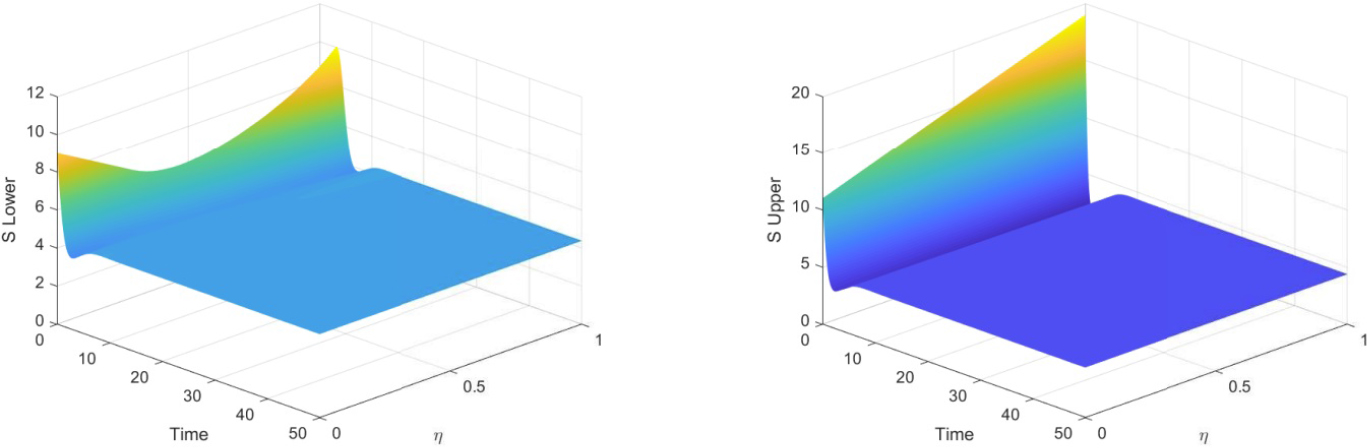
Fig. 14
Fuzzy Surface S(t).
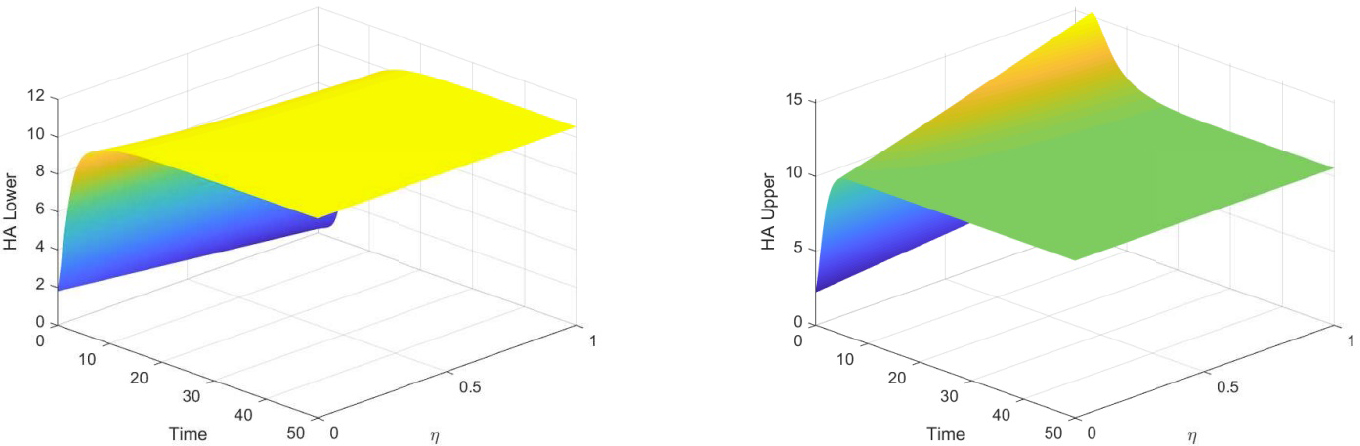
Fig. 15
Fuzzy Surface HA(t).
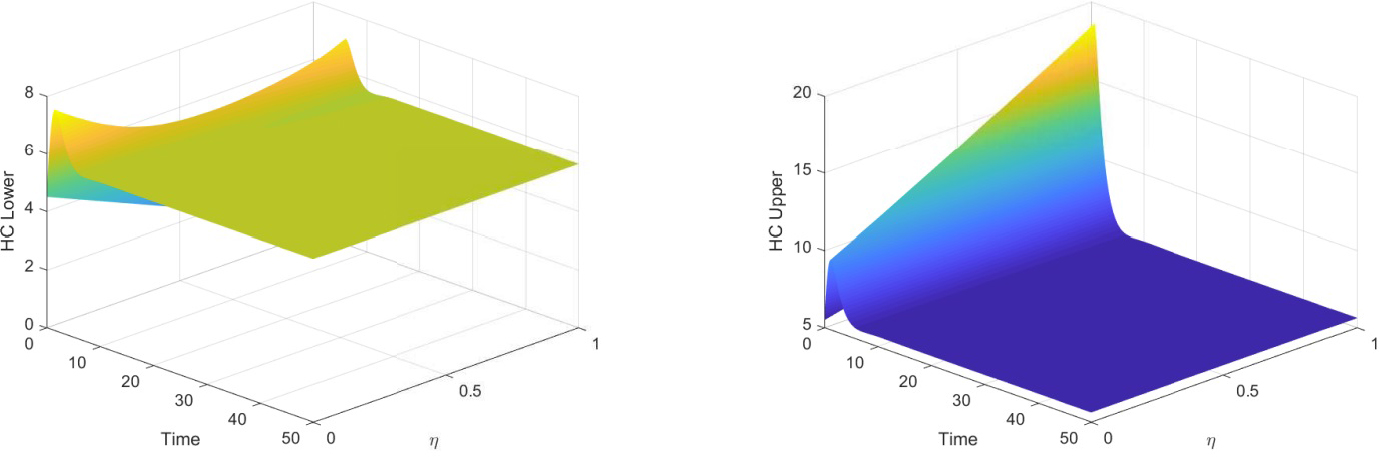
Fig. 16
Fuzzy Surface I(t).
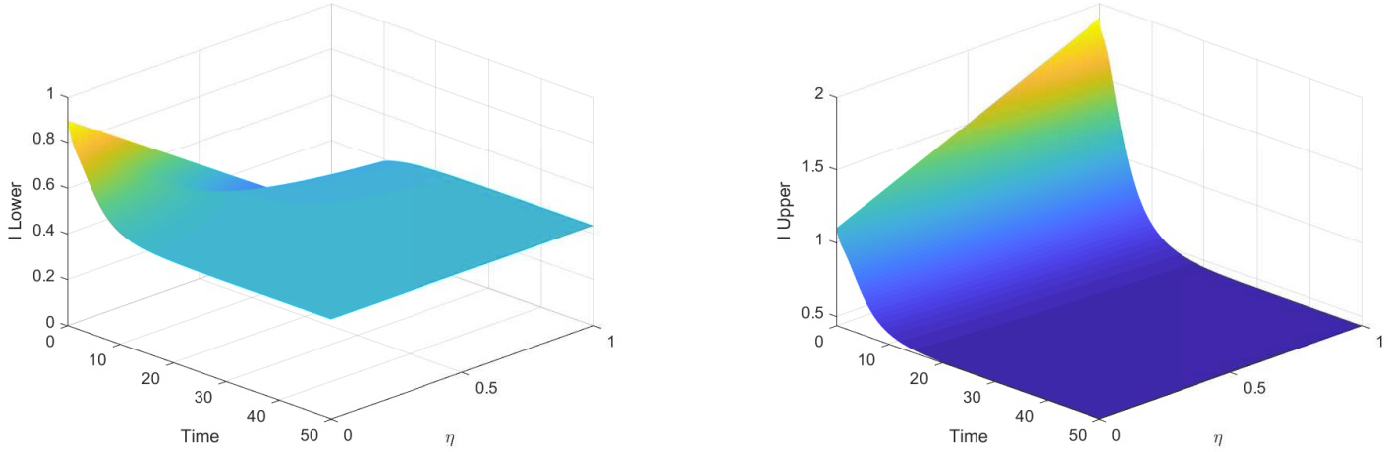
Fig. 17
Fuzzy Surface I(t).
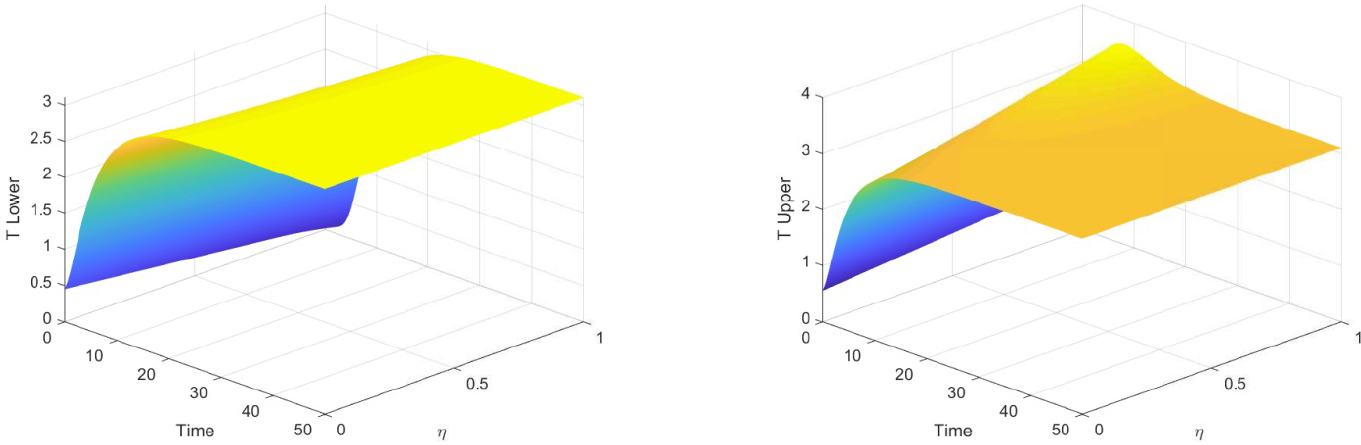
Fig. 18
Fuzzy Surface T(t).
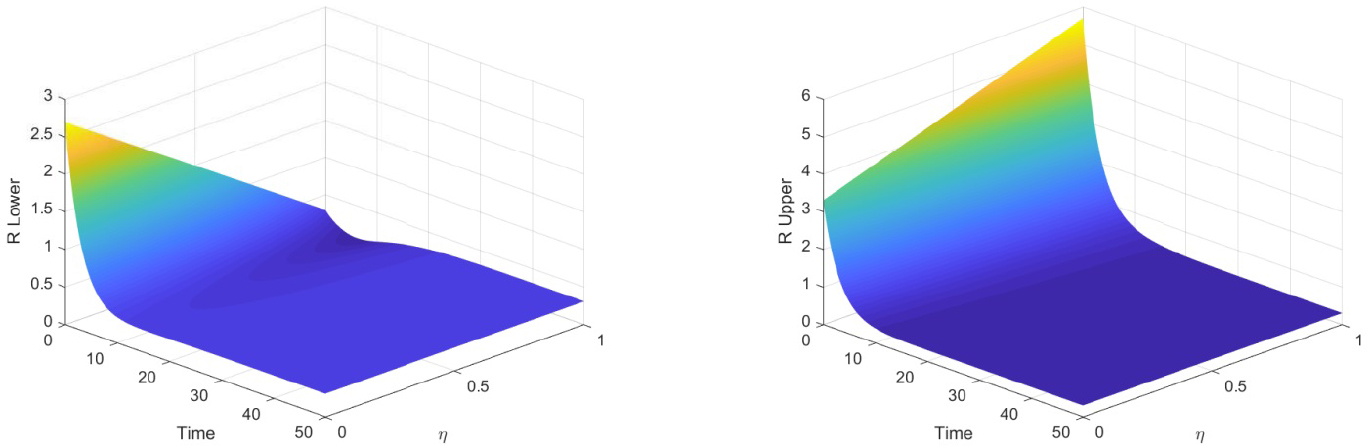
Fig. 19
Fuzzy Surface R(t).
6. Conclusion
A novel fuzzy fractional-order model using the Caputo fractional derivative has been developed to address cardiovascular diseases, factoring in memory and hereditary effects. By combining fractional calculus with fuzzy set theory, the model represents the cardiovascular processes that depend on the memory and also takes into account the uncertainties in biomedical data. This paper deals with the importance of public health and the positivity of solutions, and it also confirms their existence and uniqueness by the fixed-point theorem. Besides, it examines the equilibrium points and stability for curing cardiovascular problems and gives an overview of a way that uses the fuzzy Laplace transform for semi-analytic solutions, showing that fuzzy parameters and fractional order have a great impact on disease dynamics and are more flexible than traditional models. The simulations show how important fractional order and fuzziness are in disease dynamics and that minor changes in memory effects or uncertainty can have a substantial impact on the behavior of the system. This research conveys that modeling of the cardiovascular system in an overly simplified manner, without taking into account memory and uncertainty, is quite simple. The fuzzy fractional-order Caputo model improves knowledge of heart disease causes and helps to evaluate intervention techniques, opening the path for patient-specific cardiovascular models. Proposed research topics include combining clinical and epidemiological data to improve fuzzy membership functions, investigating comorbidities such as diabetes and obesity, and including temporal delays in responses. Future directions include investigating various fractional derivatives, constructing fuzzy fractional optimum control techniques, conducting sensitivity and uncertainty studies to identify risk factors, and putting the model into machine learning for hybrid frameworks.
7. Declarations
7.4 Acknowledgement:
The authors extend their appreciation to Prince Sattam bin Abdulaziz University for funding this research work through the project number (PSAU/2025/01/36956)
Notes
[1] Conflicts of interest 7.1 Conflicts of interest
Not applicable.
[2] Contributed by 7.3 Author’s contribution
K.S.N.-Conceptualization, Design, Formal Analysis, Methodology, Writing Original Draft. M.F.- Software, Writing, Original Draft, Resources, Visualization. All authors reviewed the results and approved the final version of the manuscript.
[3] 7.5 Data availability statement
All data that support the findings of this study are included within the article.
[4] 7.6 Using of AI tools
The authors declare that they have not used Artificial Intelligence (AI) tools in the creation of this article.