
1. Introduction
Various constraints encountered in many real-world phenomena can only be modeled by using nonlinear partial differential (NPD) equations. Some phenomena arising in ocean sciences include modeling short-distance seismic activities such as earthquakes and acoustic waves in nuclear physics. Other equations are used to model phenomena in physical science [1], finance [2], and optical science [3]. As a result, obtaining analytical solutions to nonlinear conformable partial differential (NCPD) equations allows for a more thorough examination of the phenomena governed by these equations.
Researchers have extensively studied the NPD equations to obtain exact and explicit soliton solutions using various approaches. Among the notable approaches there are as the following ones: the reductive perturbation technique [4], the tanh(η) expansion method [5], the expansion approach [6], the new extended auxiliary equation method [7], the improved Exp-function method [8], the double auxiliary equations approach [9, 10], the new generalized of e(−Φ(ξ))-expansion approach [11], the cotha (ξ) expansion approach [12], the generalized double auxiliary equation method [13,14,15], the F–expansion approach [16], the improved Jacobi elliptic function [17], the Cham method [18], the improved Cham method [19], the conformal fractional - expansion approach [20], the Exp-function approach [21], the auxiliary equation approach [22], the extended auxiliary equation approach [23], the fractional sub-equation approach [24], the fractional Riccati equation rational expansion approach [25], the improved shooting method [26], and others [27,28,29,30].
This paper investigates the exact solutions to three different space-time nonlinear models with conformable equations such as the Whitham-Broer-Kaup [31] given as
the Burgers equations [32] defined by and finally, the modified Korteweg-de Vries equations [33] read as where α ∈ (0, 1]; δ, p, and q are real constants.The paper is divided into four sections. Section 2 provides an overview of Katugampola's conformal derivative and explains the proposed modified conformal expansion method (MCEM). Section 3 demonstrates the efficiency of our method on the three above mentioned equations and provides some physical interpretations of the results. Section 4 offers a conclusive overview of the work.
2. The proposed MCEM
The preliminaries and definitions of the proposed approach are given as follows.
2.1. The Katugampola's conformal derivative
Among the various derivative definitions, we use Katugampola's derivative [34] that fulfills the linearity property and the quotient, the power, the Leibniz, and the chain rules. For a given real function g(t) where t > 0, we can define the derivative of a given order α ∈ (0, 1) by:
If the limt→0+ Dα (g)(t) exists and the function g is α–differentiable in (0, a), a > 0, the following value can be defined:
Let us consider two functions h, g that are α–differentiable, where α ∈ (0, 1]. Using the above definition, the following results can be stated [34]:
.
.
.
.
.
.
2.2. Describing of MCEM
Consider the NCPD equation in Eq.(5), where t and x are independent.
where u is an unknown function, is the Katugampola's derivative of u of order α in respect to x (resp. t), and F is a polynomial in u.The proposed modified conformal expansion method to solve Eq.(5) is defined in five steps:
Step 1. Use the transformation given in Eq.(6) to transform the CPD equation into NCD equation.
where k1, k2 ∈ ℝ will be determined later. Hence, Eq.(5) becomes a nonlinear ordinary differential equation with the new variable ξ. where stands for differentiation with respect to ξ in the sense of Katugampola.Step 2. Balance the term having the high-level derivative with nonlinear terms of equation (7) to find the value of m ∈ ℕ − {0} using the relation (8).
Step 3. Suppose that solutions of equation (7) have the form given in Eq.(9):
where, li ∈ ℝ, ∀(i = −m, …, m) and satisfies Eq.(10). Hence, Eq.(10) has several solutions defined as follows:Step 4. Find the system of equations for C1,C2, μ, λ, k1, k2, and li (i = −m, …, m) as follows: replace Eq.(9) in equation (7), use equation (10), and finally set coefficients of to zero.
Step 5. Resolve the obtained system, then replace the solutions of Eq.(10), all coefficients C1,C2, μ, λ, k1, k2, and li (i = −m, …, m) into Eq.(9), to get the solutions of the original Eq.(5).
3. Applications
The ability of the method to generate exact solutions is assessed using three different nonlinear fractional partial differential equations. Subsection 3.1 shows the performance of the method on the Whitham-Broer-Kaup equation. Subsection 3.2 presents the application of MCEM on the coupled Burgers equations. Finally, subsection 3.3 provides the efficiency of the method on the coupled modified Korteweg-de Vries (mKdv) equations.
3.1. The Whitham-Broer-Kaup equation
The governing equations in the conformal derivative are given by Eq.(12), in which β, γ are constants, u and v are functions of (x,t), and α ∈ (0, 1].
By employing the traveling wave transformation given in Eq.(13):
where k1, k2 ∈ ℝ, Eq.(12) becomes a nonlinear ordinary differential equation given in Eq.(14):By balancing the order of and in the first (resp. second) equation of Eq.(14), we find n = 1 and m = 2. Hence, the solutions of Eq.(14) are given by Eq.(15), such that αi ∈ ℝ (i = 0, 1, 2) and β j ∈ ℝ (j = 0, 1, 2, 3, 4) will be obtained later.
The left side of Eq.(14) is transformed to polynomials in , (j = 0, ±1, ±2, …) by using Eq.(15). As a result, we get a system of equations for k1, k2, αi(i = 0, 1, 2), and βj(j = 0, 1, 2, 3, 4), by grouping the coefficients of these polynomials and setting them to zero. Maple software is used to generate three cases:
Case 1:
henceCase 2:
thenCase 3:
thereforeUsing the solutions given by Eq.(11), the Whitham-Broer-Kaup equation has the following new exact solutions:
Case (3.1). (λ2 − 4μ) > 0,
Case (3.2). (λ2 − 4μ) < 0,
Case (3.3). (λ2 − 4μ) = 0,
The remaining solutions for Case 1 and Case 2 can be obtained analogously.Figures (1,2,3) are the profiles of some solutions that are obtained as u3.1 (ξ), v3.1 (ξ), u3.2 (ξ), v3.2 (ξ), u3.3 (ξ), and v3.3 (ξ). These profiles were plotted using Maple 2022, providing a clearer understanding of the characteristics of each solution. The results show fascinating shapes of singular, periodic, and bright bell-shaped solitons for different parameters.
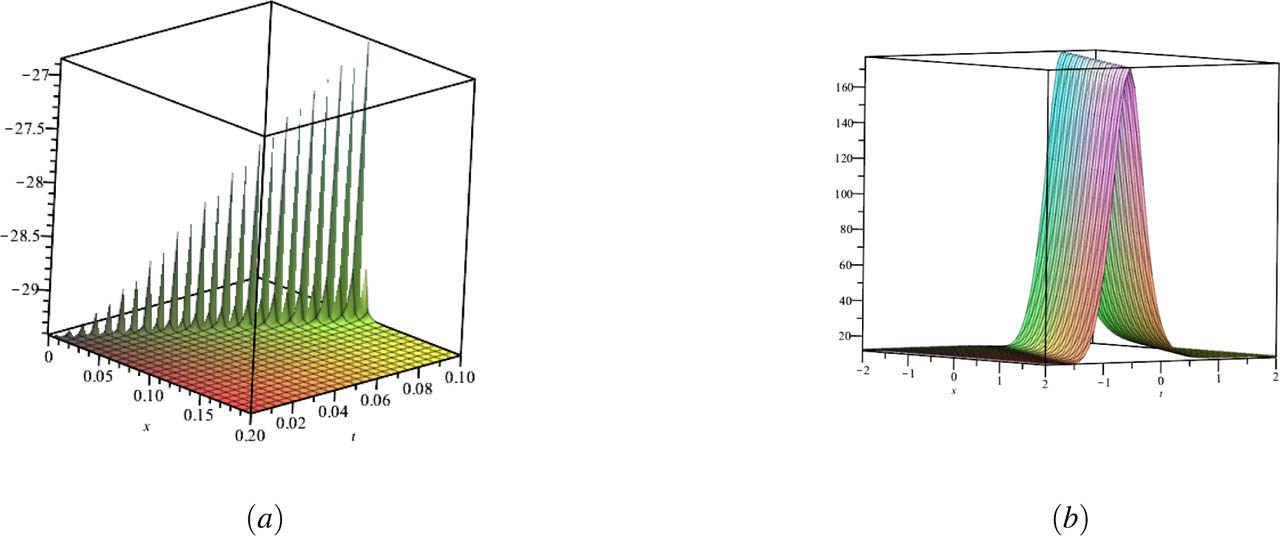
Fig. 1
(a) The 3D plot of u3.1 (ξ) when λ = 5, μ = 0.01, C1 = −5, C2 = −11, β = 6, γ = 1, k1 = 1; k2 = −1 and , showcasing it as a multi-soliton solution, (b) The 3D plot of v3.1 (ξ)) when λ = 3, , C1 = 2, C2 = 3, β = 11, γ = −3, k1 = 1; k2 = 2, and α = 1, showcasing it as a bright soliton solution.
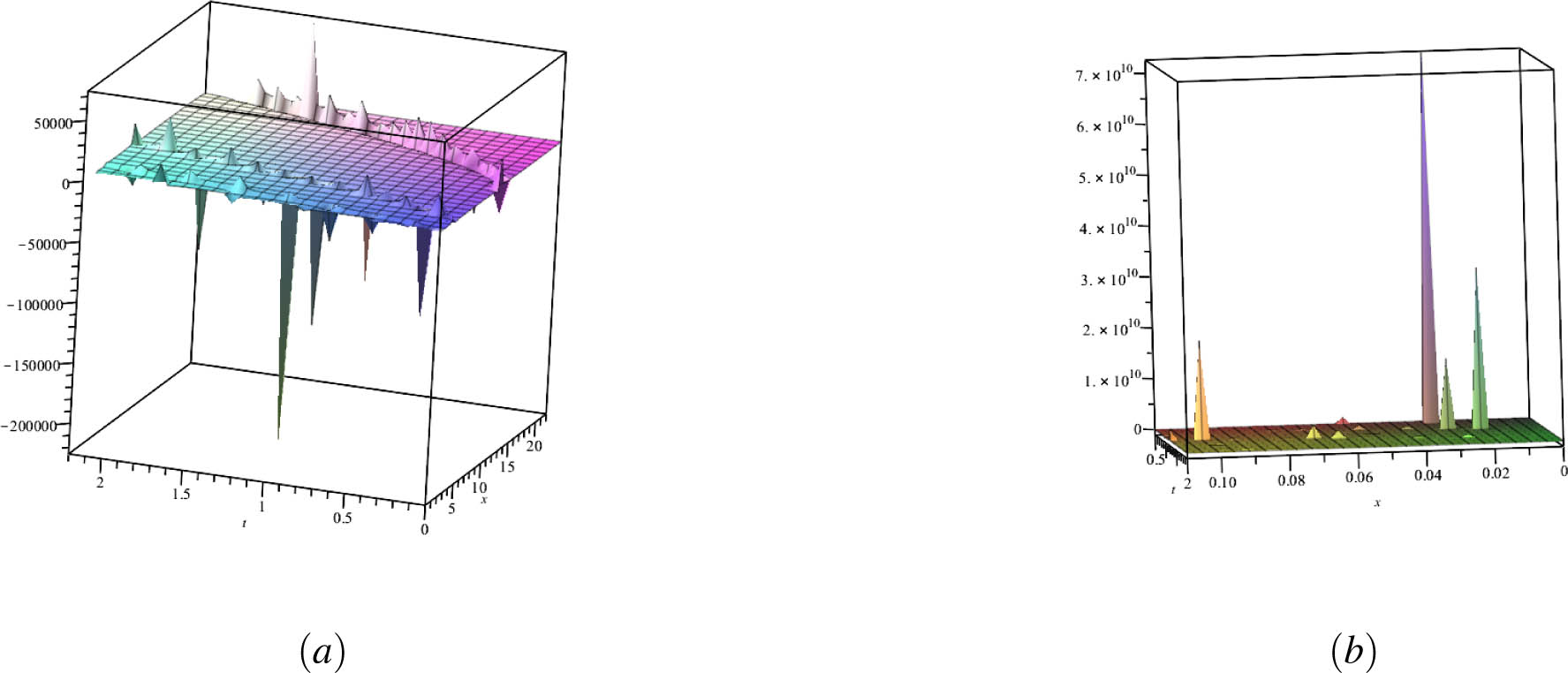
Fig. 2
(a) The 3D plot of u3.2 (ξ) when λ = 0.1, μ = 1, C1 = −5, C2 = −11, β = 63, γ = 1, k1 = 1; k2 = −1 and , showcasing it as a kink wave solution, (b) The 3D plot of v3.2 (ξ) when λ = 0.3, μ = 111, C1 = 3, C2 = 2, β = −2, γ = −1, k1 = 1, k2 = 1, and , showcasing it as a multi-soliton solution.
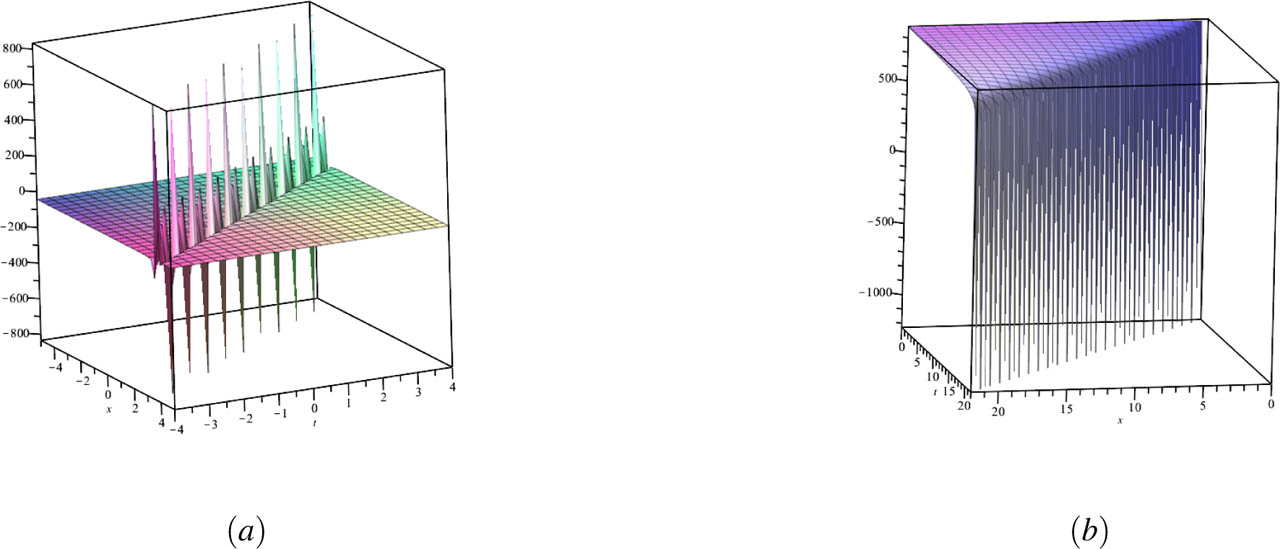
Fig. 3
(a) The 3D plot of u3.3 (ξ) when λ = 4, μ = 4, C1 = −3, C2 = −5, β = 3, γ = 3, k1 = 3, k2 = 3 and α = 1, showcasing it as a solitary wave. (b) The 3D plot of v3.3 (ξ) when λ = 2, μ = 1, C1 = 1.1, C2 = 2, β = 15, γ = −1, k1 = 2, k2 = −2 and , showcasing it as a single wave behavior.
3.2. The coupled Burgers equations
The governing equations in the conformal derivative of the coupled Burgers equations are given by Eq.(19), where 0 < α ≤ 1, p and q are two constants, h = h(x,t) and g = g(x,t) are functions of x and t independent variables.
Using the following transformation: where k1 and k2 are two constants, Eq.(19) becomes equivalent to Eq.(21). If we balance both nonlinear terms and order of derivatives with high levels in both equations of Eq.(21), we find n = 1 and m = 1. Hence, the solutions of Eq.(21) are given by Eq.(22), where αi ∈ ℝ (i = 0, 1, 2) and βj ∈ ℝ (j = 0, 1, 2) will be obtained later.Substituting Eq.(22) into Eq.(21), the left side is transformed into polynomials in where j = 0, ±1, ±2, …. As a result, we get a system of equations for k1, k2, αi(i = 0, 1, 2) and βj(j = 0, 1, 2) by setting the coefficients of these polynomials to zero. The Maple software is used to generate two cases:
Case 1:
henceCase 2:
thenUsing Case 2 and Eq.(17), the coupled Burgers equations have the following new exact solutions:
Case (2.1). (λ2 − 4μ) < 0,
Case (2.2). (λ2 − 4μ) = 0,
Case (2.3). (λ2 − 4μ) = 0,
Similarly, the remaining solutions for Case 1 can be obtained analogously.Figures (4,5,6) are shown below: h2.1 (ξ), h2.2 (ξ), h2.3 (ξ), g2.1 (ξ), g2.2 (ξ) and g2.3 (ξ). This information was plotted using Maple 2022, which helped us see each solution's characteristics more clearly.
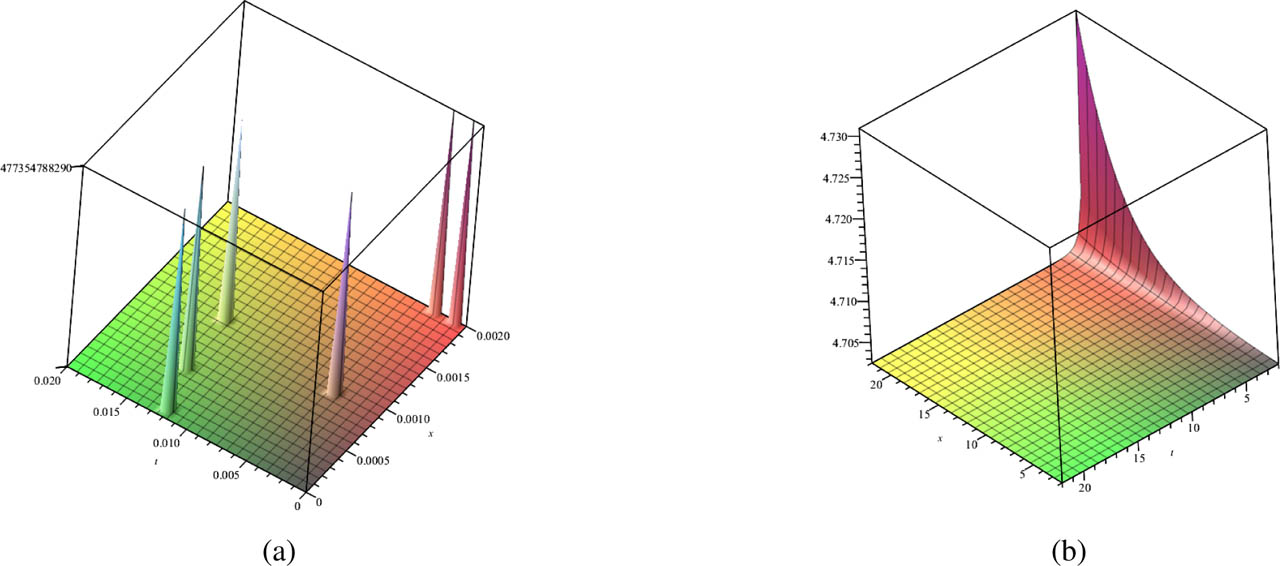
Fig. 4
(a) The 3D plot of h2.1 (ξ) when λ = 4, , β0 = 2, α2 = 2, C1 = −1, C2 = 1, p = 8, q = 2 and , showcasing it as multi-soliton solution, (b) The 3D plot of g2.1 (ξ)) when λ = 2, μ = 0.1, β0 = 1, α2 = 1, C1 = 4, C2 = 2, p = 6, q = 0.05 and , showcasing it as a soliton solution.
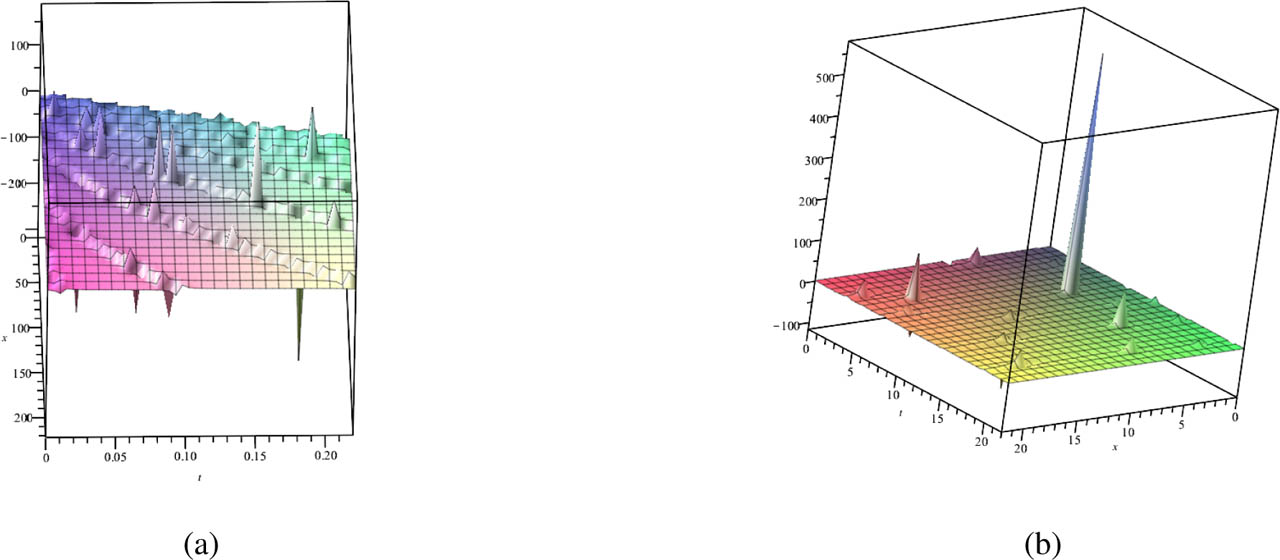
Fig. 5
(a) The 3D plot of h2.2 (ξ) when λ = 2, μ = 8, , β0 = 1, α2 = 2, C1 = −5, C2 = −11, p = 6 and q = 3, showcasing it as multi-soliton solution, (b) The 3D plot of g2.2 (ξ) when λ = 1, μ = 4, β0 = 2, α2 = 1, C1 = −11, C2 = 2, p = −4, q = 3 and , showcasing it as multi-soliton solution.
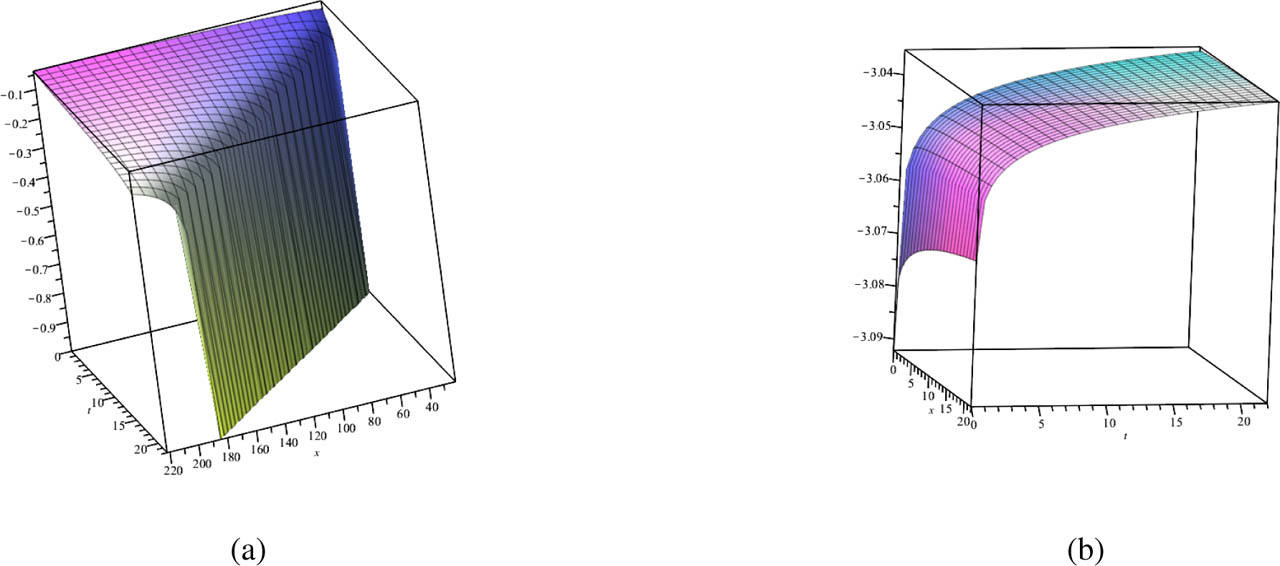
Fig. 6
(a) The 3D plot of of h3.3 (ξ) when λ = 2, μ = 1, , β0 = 1, α2 = 1, C1 = 1, C2 = 1, p = 6 and q = 5, showcasing it as Singular Kink wave solution, (b) The 3D plot of g3.3 (ξ) when λ = 2, μ = 1, β0 = 1, α2 = 1, C1 = 111, C2 = 5, p = 2, q = 5 and , showcasing it as singular anti Kink wave solution of
3.3. The coupled mKdV equation
The governing equations in the conformal derivative of the coupled mKdV equation are given by Eq.(25),
where 0 < α ≤ 1, δ is a constant, ψ = ψ(x,t) and ϕ = ϕ(x,t) are functions of x and t independent variables. We consider the following traveling wave transformation where k1, k2 are two constants:We find the following nonlinear conformal derivative ordinary differential equations by replacing Eq.(26) in Eq.(25):
We balance both nonlinear terms and order of derivatives with high levels in both equations of Eq.(27) to get n = 1 and m = 1. Thus, the solutions of Eq.(27) are given by Eq.(28), where αi ∈ ℝ (i = 0, 1, 2) and βj ∈ ℝ (j = 0, 1, 2) will be obtained later.
By replacing Eq.(28) in Eq.(27), the left side of Eq.(27) is transformed into polynomials in where j = 0, ±1, ±2, …. As a result, we get a system of equations for k1, k2, αi, i ∈ {0, 1, 2} and βj, (j ∈ {0, 1, 2, 3, 4}) by setting the coefficients of these polynomials to zero. The Maple software is used to generate two cases:
Case 1:
thenCase 2:
henceUsing Case 1 and Eq.(17), the coupled mKdV equation has the following new exact solutions:
Case (1.1). (λ2 − 4μ) > 0,
Case (1.2). (λ2 − 4μ) < 0,
Case (1.3). (λ2 − 4μ) = 0,
The remaining solutions for Case 2 can be obtained analogously.
We present the Figures (7,8,9) of some solutions obtained as ψ3.1 (ξ), ϕ3.1 (ξ), ψ3.2 (ξ), ϕ3.2 (ξ), ψ3.3 (ξ), and ϕ3.3 (ξ). These profiles were graphed using Maple 2022, aiding in a more transparent comprehension of their characteristics.
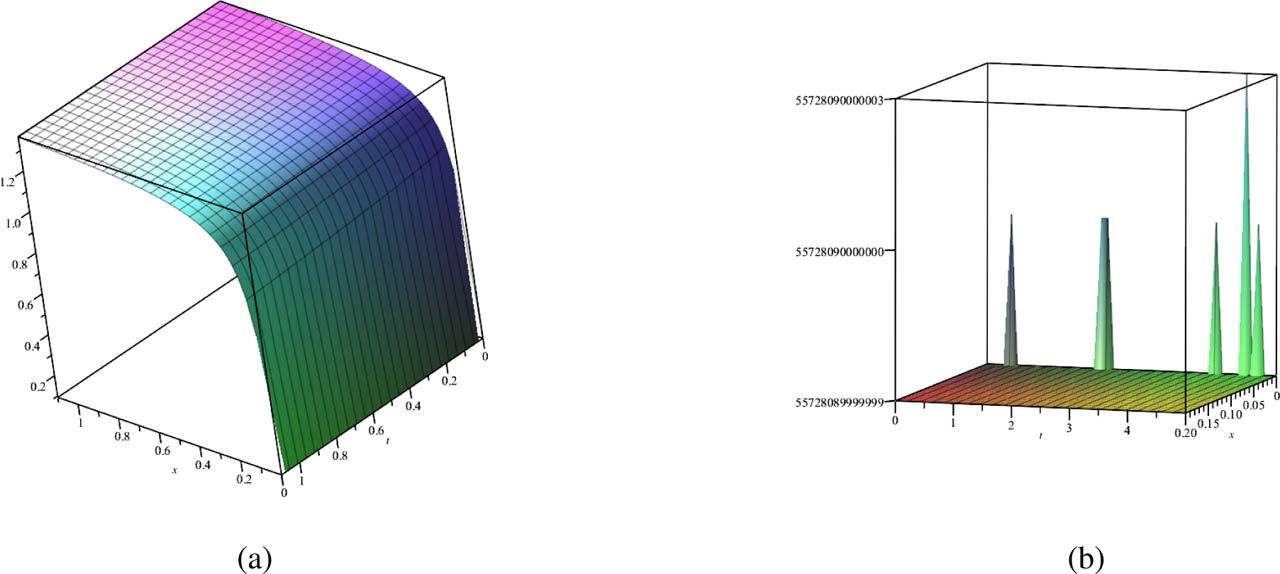
Fig. 7
(a) The 3D plot of ψ1.1 (ξ) when λ = 2, μ = 0.2, C1 = −5, C2 = 11, β = 1, k1 = 1 and , showcasing it as Singular Kink wave solution, (b) The 3D plot of ϕ1.1 (ξ)) when λ = 2, μ = 0.2, C1 = −1, C2 = 1, β = 1, k1 = 1, δ = 2, and , showcasing it as multi-soliton solution.
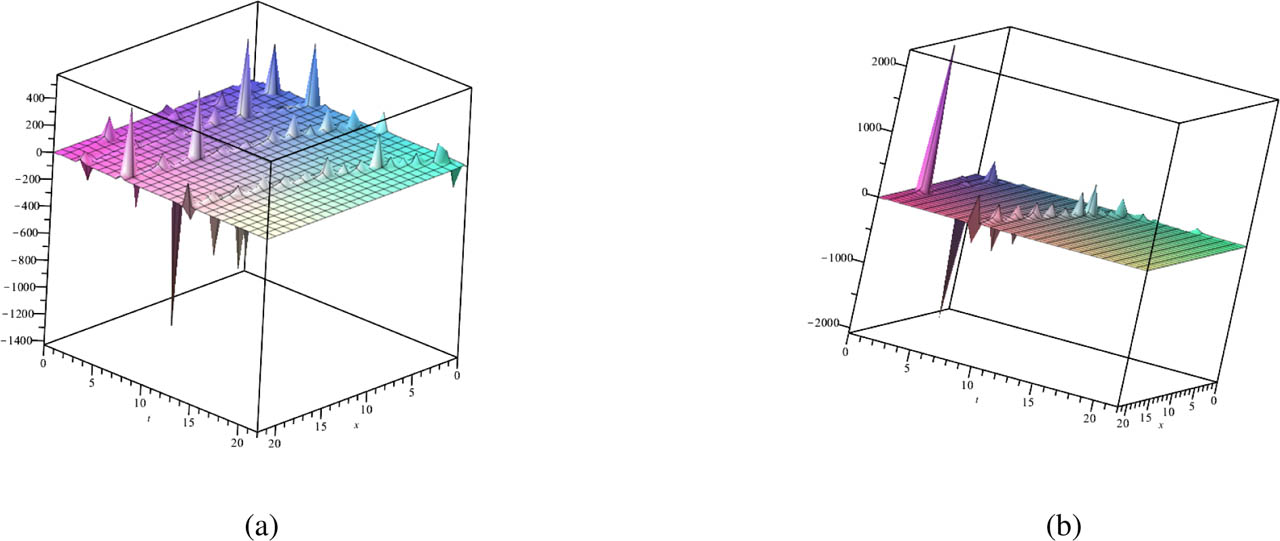
Fig. 8
(a) The 3D plot of ψ1.2 (ξ) when λ = 2, μ = 0.2, C1 = −5, C2 = 11, β = 1, k1 = 1 and , showcasing it as muli-soliton solution, (b) The 3D plot of ϕ1.2 (ξ) when λ = 1, μ = 4, C1 = −11, C2 = 2, β = 1, k1 = 1, δ = −4, and , showcasing it as multi-soliton solution.
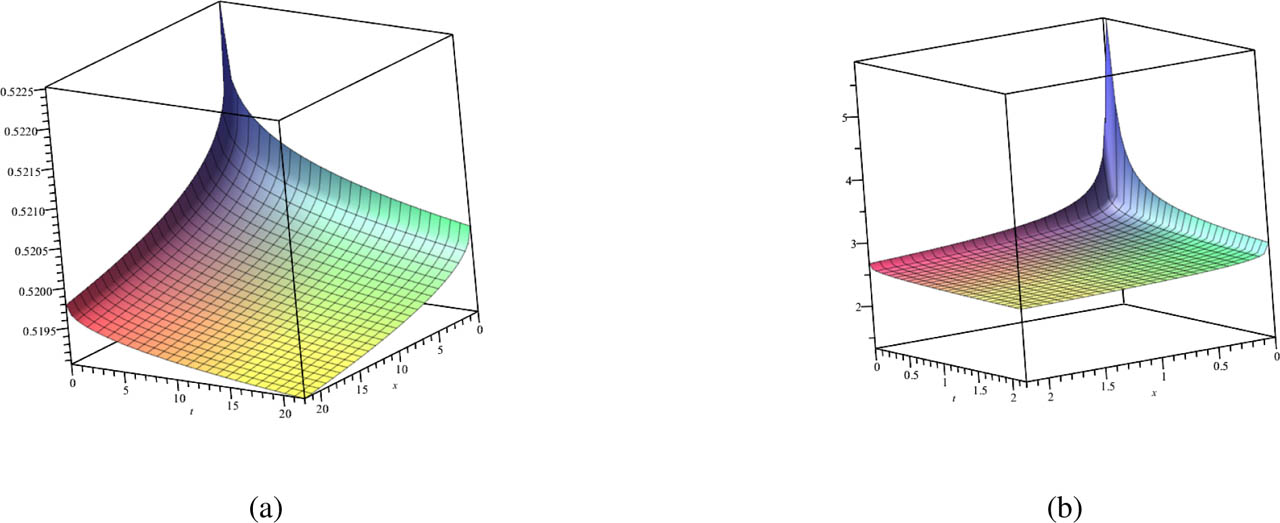
Fig. 9
(a) The 3D plot of ψ1.3 (ξ)) when λ = 2, μ = 0.2, C1 = −5, C2 = 11, β = 1, k1 = 1 and , showcasing it as soliton solution, (b)The 3D plot of ϕ1.3 (ξ)) when λ = 2, μ = 1, C1 = 2, C2 = −2, β = −2, k1 = 2, δ = 2, and , showcasing it as soliton solution.
4. Conclusion
In this research paper, we presented the general properties of MCEM for solving various NPD equations. This method is based on transforming the nonlinear equations into ordinary differential equations by utilizing Katugampola's derivative and the complex transform. The proposed method is effectively used to find exact solutions for three distinct space-time conformal derivative nonlinear equations: the Whitham-Broer-Kaup equations, the Burgers equations, and the modified Korteweg-de Vries equations. The exact solutions included singular kink wave solution, singular anti kink wave solution, multiple-soliton solution, and singular soliton were extracted. Under the suitable values of parameters in solutions, various wave simulations of results of this paper were simulated.
5. Declarations
5.1. Conflict of interest:
The authors hereby declare that there is no conflict of interests regarding the publication of this paper.
5.2. Funding:
No funding was received to assist with the preparation of this manuscript.
5.3. Author's contribution:
L.A.A.-Writing Original Draft, Supervision, Editing. A.A.M.-Writing Original Draft, Software, Methodology. B.G.-Writing Original Draft, Software, Methodology. Y.M.-Supervisor, Editing, Validation. M.N.R.-Methodology. All authors read and approved the final submitted version of this manuscript.
5.4. Acknowledgement:
The authors deeply appreciate the anonymous reviewers for their helpful and constructive suggestions, which can help further improve this paper.
5.5. Data availability statement:
All data that support the findings of this study are included within the article.
5.6. Using of AI tools:
The authors declare that they have not used Artificial Intelligence (AI) tools in the creation of this article.