
1. Introduction
Researchers used Hele-Shaw experimental models to verify the derived transient drainage equations from theory. A detailed analysis of using the Hele-Shaw model to study the water table response to tile drains was presented by Shery [1]. His work presented an experimental determination of the effect of the ratio of the saturated aquifer depth to the horizontal distance between the drains on the rate of water table drawdown between parallel tile drains. In his work, the ratio of drawdown to depth was kept constant at a small value throughout the experiment. Differences between theoretical and experimental values were almost entirely due to variations in the spacing between drains. The resulting drawdown profiles were recorded, tabulated, and compared with theoretical values. Several researchers have used Glass bead-glycerol models to study transient drainage problems. Grover and Kirkham [2] and Vaigneur and Johnson [3] reported good agreement between obtained results with a glass beads and glycerol model and those of the theoretical solution of the Transient Drainage equation (TDE). Similarly, Rochester and Kriz [4] used a Hele-Shaw model to evaluate the influence of the depth of an impermeable layer on transient subsurface drainage into equally spaced open drains. The model results indicated that a horizontal impermeable layer affects drainage significantly only if the layer is closer to the ditch bottom than one-twelfth of the ditch spacing. He also noticed that the initial above the ditch bottom did not affect the criteria. He noticed that the midpoint recession of the free surface is exponential only if the flow was not affected by the depth of the impermeable layer. The results of their experiments with a Hele-Shaw model showed an excellent agreement between model and theory. Sharma et al. [5] presented an analytical solution to the problem of transient drainage of a two-layered soil regime without replenishment by applying the theory of Girinsky’s potential. Sharma et al. [5] evaluated the effect of various parameters on drainage and developed relationships that helped design drainage systems of layered soils. The proposed analytical solutions have been experimentally investigated by Sharma et al. [5] on a vertical Hele-Shaw model in which the two-layered soil conditions were simulated. The comparison of the results of proposed analytical solutions with the experimentally observed ones in the Hele-Shaw model showed that the experimentally observed and predicted midpoint water tables were found to be in good agreement for the entire duration of the experiment. The proposed theoretical model may be utilized for the transient design of a drainage system in a two-layered soil. Tang and Skaggs [6] used finite difference methods and solved Richard’s equation of a two-dimensional saturated-unsaturated water movement for the case of drainage and subirrigation boundary conditions. In a large laboratory soil tank, Tang and Skaggs [6] compared their solutions with those obtained experimentally. The soil water characteristic and hydraulic conductivity function were measured by conventional methods and used as inputs in the numerical solution to the Richards equation. Although the predicted water table drawdown was somewhat slower than was observed, the agreement between the numerical solutions and experimental observations was generally good. Hanks and Bowers [7] used an electric simulator to approximate the transient state one-dimensional solution of several cases of moisture, temperature, and air pressure problems in soil. The simulator consists of a resistance-capacitance network with accessory units for setting initial conditions and recording or indicating the simulated variable with time and depth. They scaled the physical parameters of the time and distance to convenient magnitudes. Provision for changing the simulated diffusivity with distance and time allowed for the approximate solution of several types of moisture problems. The researcher included an example describing absorption, redistribution after absorption, and evaporation from Yolo light clay. Comparison of mathematical and simulated solutions of absorption and temperature distribution in soil with constant diffusivity and temperature varying sinusoidally at the surface showed excellent concordance. Hanks and Bowers [7] estimated the fluctuation of soil temperatures with time between two measured depths, and the solution agreed reasonably well with actual field measurements. The discovery that the differential equation describing the groundwater flow is identical in forms and principle with electricity and heat flow equations has more than academic significance, Domenico [8]. For an analogous set of initial and boundary conditions, a solution to one of these equations is a solution to all of them. For a hydrologic solution, it only remains to identify the hydrologic counterparts of the pertinent physical parameters and boundary conditions. Textbooks on electricity and heat flow can contribute a lot to theories of groundwater flow. Experiments demonstrating a one-to-one correspondence in equations describing hydrologic, thermal, and electrical (such as the Laplace equation, diffusion equation, and wave equation) are good physical models. When it is possible to find an analogy between one phenomenon and another that is easier to observe, information about one phenomenon leads to information about the other, Domenico [8]. In the application of transient flow to drains, it is necessary to make a comparison of theory with model data. One of the applications of heat flow in drainage theories is the one originated by Glover Schilfgaarde [9]. Glover derived an equation from the heat flow equation that relates the spacing of tile drains to the rate of drop of the water table at a given height above the drains. It is necessary to note that the solution of Glover’s differential equation depends on the analytical solution of the one-dimensional heat equation. Introducing technology into the education process offers effective opportunities, particularly in the fields of STEM (Science, Technology, Engineering, and Mathematics). In this context, the Arduino platform is used as a low-cost, easy-to-use microcontroller in physics teaching. Atkin [10] showed how distinct but related models can bring out the essential physics of heat flow in one dimension. The first model is a stepwise procedure using SMATH studio, while the second is an electric RC ladder connected to an Arduino microcontroller. A comparison of both approaches showed the power of analogs in learning physics. The notebook of the heat transfer and model verification tests by Wolfram Language and System [11] contains tests that verify the heat transfer PDE using finite elements. The tests in both 1D and 2D models are grouped into (time-dependent and time-independent) tests. The modeling process of the PDE of the heat equation is solved by the computer software NDSolve in terms of interpolating functions. Schiren [12] used the Petrov–Galerkin finite element method to model the 1D heat equation with and without convection. The results of the model are compared with the MATLAB solutions of the analytic Fourier series solutions. The main result of the work indicated the suitability of using the finite element method for the analysis of the heat equation. Zhu et al. [13] conducted a laboratory experimental study of the 1D heat equation using copper and aluminum bars with holes for inserting thermocouples. The heating element used in the experiment was a soldering wire encapsulated 30 W cylindrical heater. The derived mathematical models of the heat equation with and without heat losses were solved by the software MATLAB.
Therefore, the main objective of this research is to use an Arduino microcontroller to derive experimentally-by using an RC analog circuit connected to an Arduino microcontroller linked with the software LabVIEW- a solution to Kirchhoff’s partial differential equation describing the unsteady electrical flow through the RC circuit. The RC analog electrically simulates a non-dimensional virtual aquifer for which an experimental Fourier sine series solution in terms of the analog components is derived and used for comparison with the theoretical Fourier sine series solution of the transient partial differential equation of land drainage. The derived Fourier sine series solution of the partial differential equation governing the unsteady electrical flow through the RC analog is written in a non-dimensional form to enable its general application to the case study of this research.
2. Differential equation for the water table drawdown in TLD
One application of the one-dimensional heat flow equation, as reported by Schilfgaarde [9], originated by Glover. Glover as reported by Schilfgaarde [9], has derived an equation from the heat flow equation relating the spacing of tile drains (L) to the rate of drawdown of the water table above the tile drains. Based on the Dupuit assumptions, the equation of continuity of a system of equally spaced parallel tile drains in a homogeneous soil overlying an impervious boundary is written as:
Eq.(1) is referred to as the heat flow equation since it is identical to the differential equation that applies to many heat flow problems. A solution of Eq.(1) for an initially flat-water table can be found by conventional methods in terms of the Fourier sine series, Schilfgaarde [9].Where h = total hydraulic head at time t, h0= initial hydraulic head at time t = 0 above drain interface plane, x = direction of flow, T = transmissivity, S = storage coefficient, and L = drain spacing. Glover presented a graphical plot of equation (2) that shows successive elliptical water table shapes as a function of (t, x/L) between the drains.
3. Analog simulations
The partial differential equation describing the transient drainage of this research study is similar in form and principle to the electrical equation (3) derived by utilizing Kirchhoff’s current law around a resistance-capacitance network Domenico [8] and Agarwal [14].
Where V = nodal voltage, R = resistance value, C = capacitor value, x = direction of flow, and te = analog time. The resistors are the energy dissipaters, similar in function to transmissivity (T), and the capacitors are potential energy reservoirs analogous to the storage coefficient (S), Domenico [8] and Agarwal [14]. Each resistor in an RC network is equivalent to the reciprocal of the aquifer transmissivity, and each capacitor of an RC network is analogous to the fluid-storing capabilities of the aquifer. The resistance to fluid flow is inversely proportional to the aquifer thickness (b), and the storage capacity is directly proportional to the aquifer thickness. It is convenient to express equation (3) in terms of the non-dimensional variables of Figure 1.
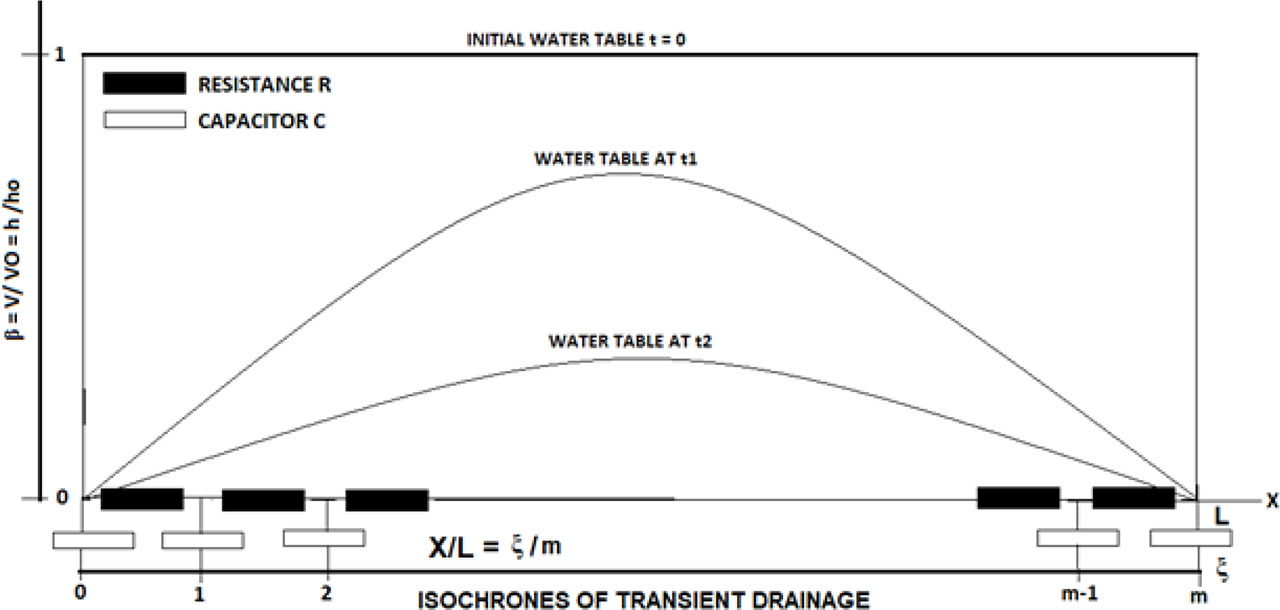
Fig. 1
Non-dimensional axes definitions of the transient drainage case.
According to the non-dimensional definitions of Figure 1, equation (3) can be written as:
Where τ = RC. By separation of variables, the general solution of equation (4) can be written in the form of the following product:
The boundary and initial conditions to be fitted to equation (4) are (see Figure 1):
Substituting the general solution in the first B.C. gives . So, B = 0, and substituting it in the second B.C. gives 0 = (An sin(λm).
Either: An = 0 or λnm = nπ, n = 0, 1, 2, · · · ∞.
From the second choice and the general solution can be written as:
It should be remembered that the sum of any number of solutions of a linear differential equation is also a solution. Therefore, equation (6) may be written as It follows that, . Performing the integration between the specified limits gives Substituting the result into Eq.(7), the final solution Eq.(8) is obtained.Where (V0) is the Arduino-Atmega (5) volts power source, and (V) is the nodal voltage reading at any (xi, te). Figure 2 shows a resistance-capacitance network design to simulate the partial differential equation (1) of a virtual transient drainage flow system. The network resistors and capacitors chosen for the simulation of the hydrologic case studies are (220000) Ohm and (10E-6) Microfarad, respectively, and the network is composed of (m= 10) segments, each equal (L/m) unit length. Capacitors equal to half the values i.e. (5E-6) Microfarads are used at the boundaries, Rushton and Redshaw [15]. Based on the selected (R) and (C) values of the hydrologic flow system, the hydrological properties of the simulated cases are:
To establish a one-to-one correspondence between the electric and hydrologic systems, it is necessary to introduce scale factors or factors of proportionality.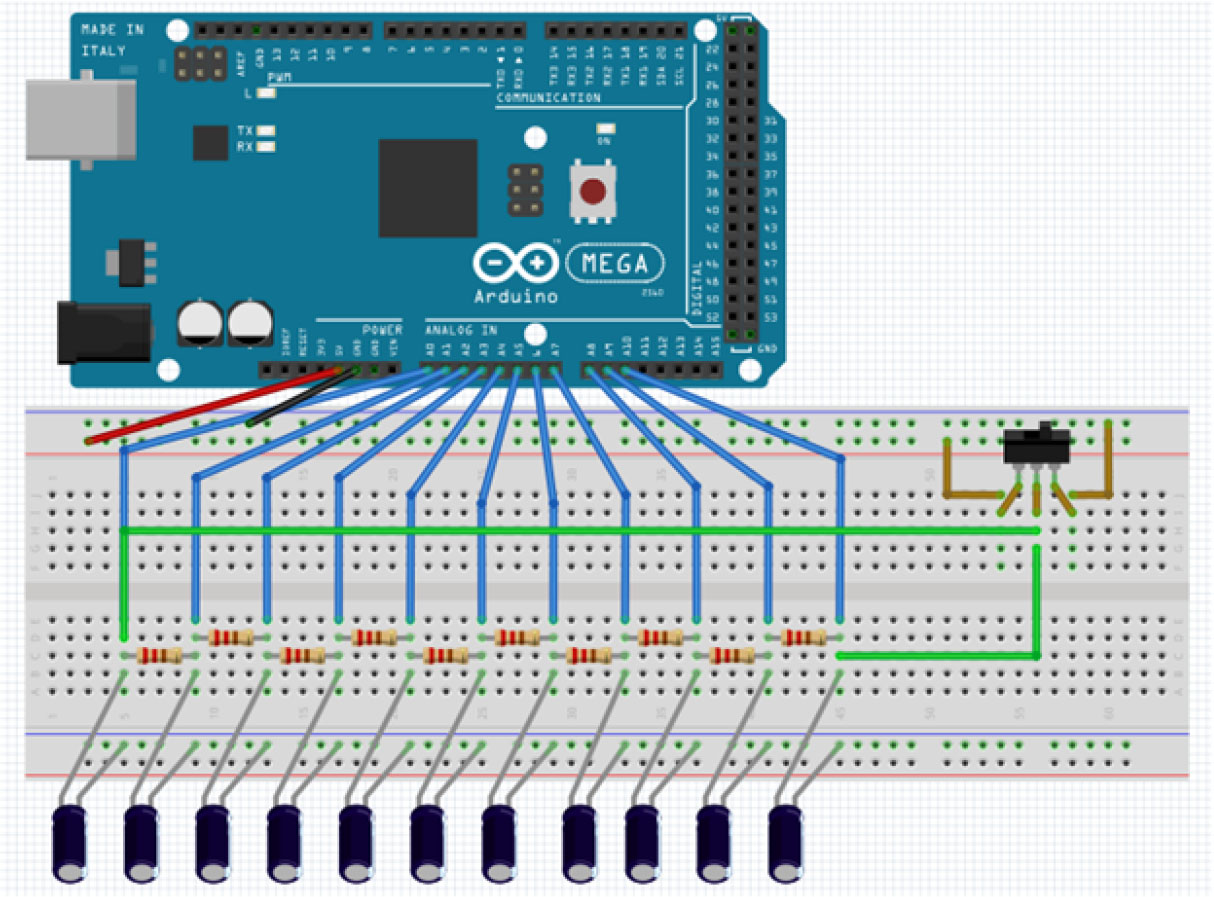
Fig. 2
Electrical analog of a virtual 1D transient drainage system.
The following one-one relationship is defined, Rushton and Redshaw [15]:
Substitution of equations (13) and (14) into equation (12) gives, where te is the analog time in seconds, t is the physical time in days, and τ is the time constant of the analog. The “ANALOG SIMULATION” of the LabVIEW TAB-control of the graphic display of Figure 3, shows the graphical output of the nodal voltage readings of the RC analog at an analog time te = 16 seconds. The Figure clearly shows the elliptical distribution of the variable (V) of equation (8) along the non-dimensional horizontal axis ξ/m = x/L of the constructed analog.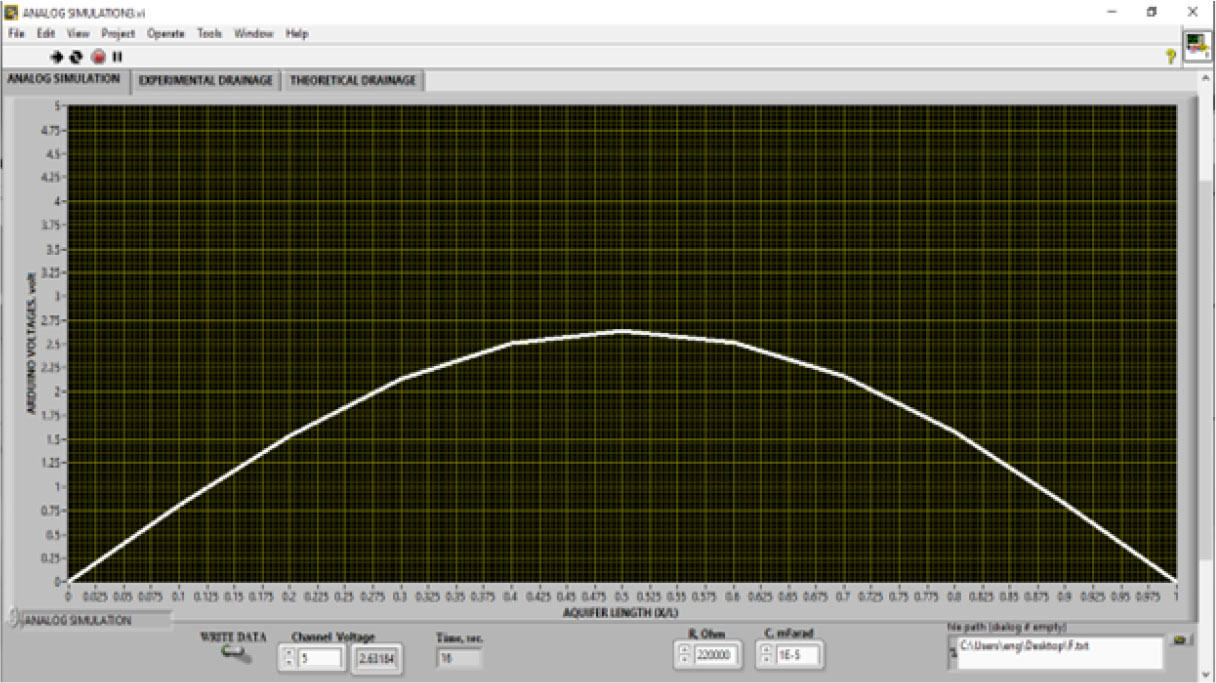
Fig. 3
The elliptical graphical output of the capacitors of the RC analogue at a given time (te).
4. Results and discussions
4.1. Application 4.1
The hydrological properties of a drainage project are: K = 4.01m/d, D = 4.572m, L = 152.4m, and S = 0.15. Use the LabVIEW program and the RC network to:
1-Calculate at x = L/2, the (h/h0) and (β) values using equations (2) and (8) for an analog time (te = 30sec.).
2-For the analog time of step (1), plot and compare the measured results against those of equation (8).
Solution
1- Check the following calculations:
From equation (2), From Eq.(8),2- Figure 4 shows an excellent agreement between the measured values of (V/V0) and those calculated by the Fourier sine series of Eq.(8). At(x/L) = (ξ/m) = 0.5, the indicated maximum difference between the measured and calculated values of (V/V0) is (0.01024), and its M.S.E. = 0.001147. The left screen of Figure 4 shows the graphical variation of the voltage readings (V) of the nodal points of the RC analog with time (te).
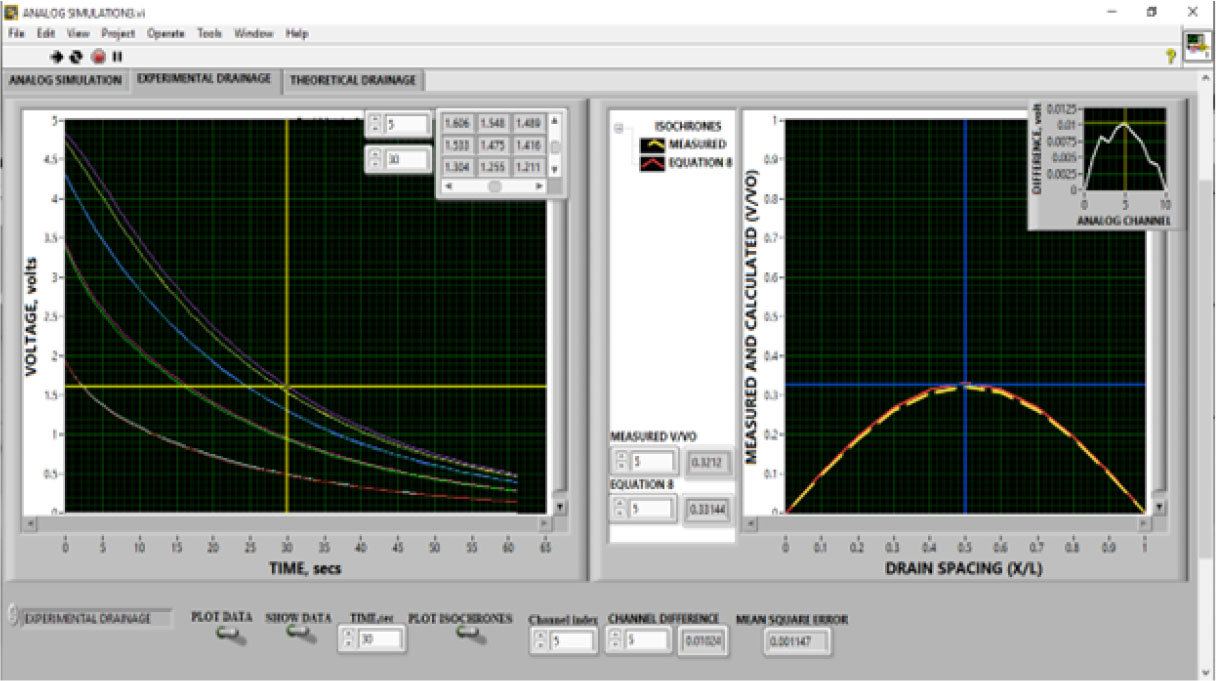
Fig. 4
Measured and calculated values of V/Vo of the transient land drainage case (right) and the voltage drop with time (te) across the network capacitors (left).
4.2. Application 4.2
1- Use the program LabVIEW to graphically plot the results of equations (2) and (8) for any given analog time (te).
2- Discuss the graphical results of step 1.
Solution
1- Refer to Figure 5.
2- The curves of equations (2) and (8) of Figure 5 showed complete similarity in form and magnitudes.
The left LabVIEW graphic display of Figure 4 shows the nodal electrical discharges of the capacitors composing the virtual transient drainage case. Regardless of whether the researcher is dealing with the flow of groundwater, electricity, or heat, the differential equation describing each is similar in form and principle; only the physical parameters of the equations are called different things. Generally, this research indicated an excellent agreement in trend and accuracy between the analytic solution of the partial differential equation (8) of the transient electrical flow of the RC network and the theoretical analytic solution of the partial differential equation (2) of the transient drainage case. However, the LabVIEW graphical plots of the differences between both solutions varied according to the case simulated by the RC network and its analog time (te). The differences are due to the increasing leakage currents of the model capacitors with time, the electric tolerances of the capacitors and resistors composing the RC network, and the theoretical solution of the 1D heat equation, which does not consider the heat losses that would give results much closer to those of the analog, Zhu et al. [13]. The LabVIEW graphic plot of Figure 5 shows that equations (2) and (8) are physically and mathematically similar in form and identical in their results. That is true since the exponential functions of both equations depend on the same soil’s physical properties.
5. Conclusions
This research revealed what follows:
1- The constructed electrical analog demonstrates a pedagogical use for the versatile Arduino microcontroller. The power of analogs should form an integrated part of learning groundwater physics.
2- Differential equations describing groundwater flow are identical in form and principle to those dealing with electricity and heat flow. For a given analogous set of boundary conditions, a solution to one of these equations is a solution to all of them.
3- Experimental results of the RC network are accurate and in excellent agreement with the analytical solution of the partial differential equation describing Kirchhoff’s law of the transient electrical flow through the RC network. The isochrones of equations (2) and (8) are physically and mathematically similar.
4- The discrepancy between the theoretical and experimental results is related to
(a) Tolerance errors of the resistors and capacitors.
(b) Increasing leakage currents of the model capacitors with time.
(c) The theoretical solution of the 1D heat equation does not consider the heat losses that would give theoretical results much closer to those of the analog.
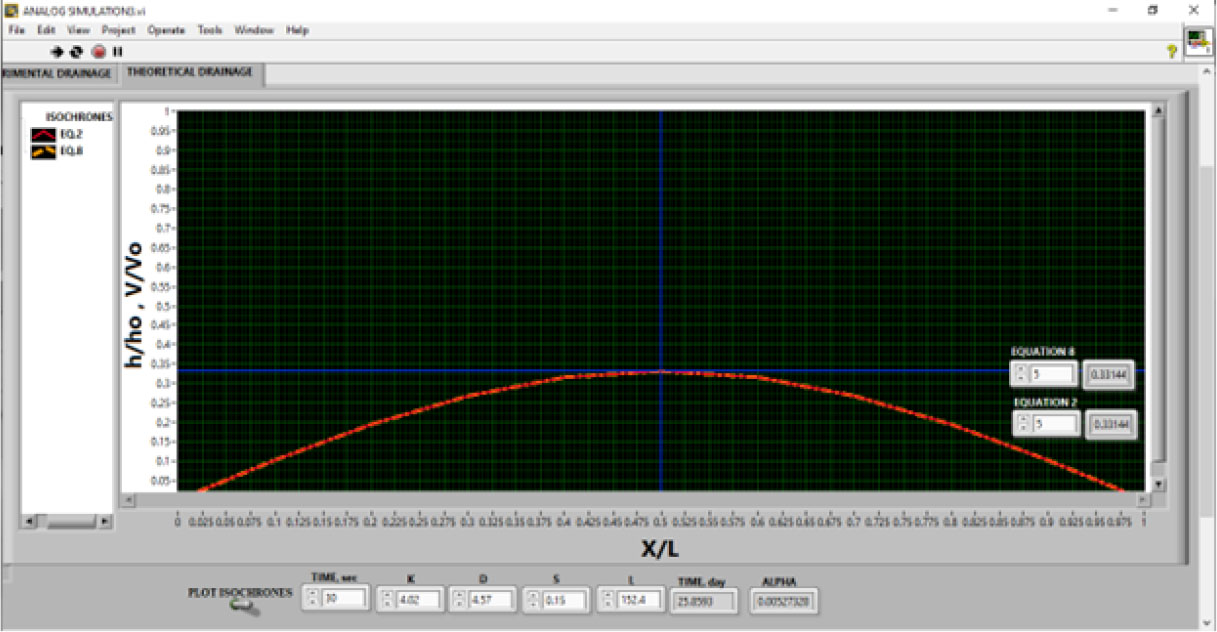
Fig. 5
Isochrones of equations (2) and (8) of the transient drainage case.
According to the author’s knowledge, no one has used Arduino microcontrollers to verify the TDE physically and mathematically.
6. Declarations
6.1. Conflict of interest:
The corresponding author states that there is no conflict of interest.
6.2. Funding:
There is no funding regarding the publication of this research study.
6.3. Author’s contribution:
F.A.M.A.-Conceptualization, Methodology, Software, Writing-Review Editing, Formal Analysis, Validation, Writing-Original Draft. The author read and approved the final submitted version of this manuscript.
6.4. Acknowledgement:
The author deeply appreciates the anonymous reviewers for their fruitful and constructive suggestions which helped in further improvements of this paper.
6.5. Data availability statement:
All data that supports the findings of this research can be created by the use of the constructed analog of this paper.
6.6. Using of AI tools:
The authors declare that they have not used Artificial Intelligence (AI) tools in the creation of this article.