
1. Introduction
It must be remembered that exact solutions to non-linear partial differential equations (PDEs) play a critical role in drawing attention to a wide range of peculiar and intricate characteristics that arise in a variety of applied scientific domains. Symbolic algorithmic programs such as Maple, MATLAB, and Mathematica significantly facilitate the process for mathematicians, physicists, and engineers to explore a wide range of new solutions for non-linear PDEs. These programs offer various analytic and numerical methods, making the framework more accessible and streamlined. Analytic and semi-analytic techniques for resolving linear and nonlinear operational models have been strengthened through diverse methodologies throughout previous works. The fundamental basis for introducing the material is the extended literature on addressing mathematical queries using semi-analytic or analytic methods. Investigators from all around the world are trying to apply these procedures, just as mathematical models with applications in chemistry, biology, physics, and engineering, have recently been solved using these methods. Another argument is that readers may feel certain that these techniques produce appropriate, correct affirmations of the models by complementing the model with computations. Numerous modified and extended versions of the semi-analytic methods have been applied for the illustration of the modified version of tanh− function and the extended rational sinh-cosh function methods [1], the modified performance method of the exponential functions [2], Bernoulli and its improved version methods [3, 4], the Laplace transformation method has been applied to the features of the Caputo-fractional derivatives [5], the improved version of Bernoulli combined with the methods related to the hyperbolic trigonometric functions [6,7,8], the new extended direct algebraic method employed [9], the sine-Gordon expansion method and its rational version have been applied [10], the development version of the ultra-spherical wavelet method utilized [11], a Lie symmetry analysis employed [12], the Hirota’s bilinear method is considered [13], describing an auxiliary equation approach [14].
The nonlinear fourth-order (2+1)-dimensional generalized Hietarinta-type equation that we investigated has the following arrangement:
where α1,α2,γi for i = 1,2,···, 5 are parameters to be determined later, and α2 represents the nonlinear coefficient for a generalized Hietarinta-type equation. The studied model represents the dispersion waveform.Numerous academicians have conducted investigations into the various interpretations of (1) employing more methodological approaches, which include the bilinear method [15], the Hirota bilinear method and Bell polynomials [16,17]. If you are seeking a unique form of solution that is logically localized in every possible direction, semi-analytic solutions and their interactions are an amazing place to start [18,19,20,21]. The utilized method is trustworthy, dependable, and more practical for solving different mathematical models. To provide evidence of the prior declaration, one can inspect how many researchers applied this method and other different performances, herein are some sources [22,23,24,25,26]. The lump solutions to the studied model by utilizing the symbolic computation method have been presented in [27].
Sub-sequential sentences are specialized for the extraction of how these methods apply to different mathematical models, the generalized Kudryashov, generalized Riccati equation mapping, the unified method, the generalized exponential rational function method, and the modified extended tanh− expansion method [28,29,30,31], two new modifications for the trigonometric and hyperbolic trigonometric function methods [32], in these dissertations, some important applications of semi-analytic methods have been represented [33,34], and the references contained therein.
The rest of the paper is organized as follows: Literature is reviewed related to the fourth-order non-linear (2+1)-dimensional generalized Hietarinta-type equation in Section 1. After that, in Section 2, the configuration of the mentioned procedure is given, briefly. In Section 3, the suggested approach is applied to the disseminated model, and its acquired solutions are demonstrated graphically. Section 4 focusses on the result and discussion; here we present the physical behaviors of the figures. Moreover, numerical simulations of the outcomes and figures are demonstrated. Finally, in Section 5, finalizing and ending views are reported.
2. Structure of the modified extended tanh− function method
The studied method is abbreviated into the following five steps:
Step 1. The following nonlinear partial differential equation is considered.
where Λ = Λ(x,y,t). By operating The parameters ν1, ν2 and ν3 are arbitrary and non-zero parameters. They represent the straight-line velocity, magnitude of motion, and thickness of wave propagation speed, respectively. Substituting equation (3) into equation (2) yields the follows whereStep 2. Consider equation (4) for the subsequent potential solution:
The constants a0,ai,bi,i = 1,···, m must be subsequently demonstrated in a way that guarantees either am or bm is not equal to zero, and ℋ (𝒯) is a function that satisfies the specified Riccati ODE:
the set-solutions of (6) are established as follows: Case 1: Suppose that b is negative, then:Case 2: Suppose that b is positive, then:
Case 3: Suppose that b = 0, then:
Step 3. The value of the positive integer m in equation (4) should be determined using the balance of powers principle, which involves considering the relationship between the highest-order derivatives and the greatest power of the non-linear terms.
Step 4. By substituting equations (5) and (6) into equation (4) and grouping terms with the identical power of ℋi where i = 0,±1,±2,···, we acquire a set of algebraic equations. These equations can be solved using software programs to determine the principles of the parameters.
Step 5. A combination of equations (7)–(9) and considering constrained values of parameters may give the exact solution to equation (2).
3. Application
By putting wave transformation (3) to equation (1) and simplifying mathematically, the following result is obtained:
and substituting (11) into (10), directly one obtains: by running integration to (12) one time, we assume ℱ (·) at the initial effectiveness is nullified, and then one concludes the outcome with: by replacing 𝒰′ = ℱ in (13), the process ends up by: The resulting ODE that exists in (14) is an authorized equation for functioning the balance principle.To solve the model in equation (1) using the modified extended tanh− function technique, begin by using the balancing principle in equation (14) to compare ℱ″ and ℱ2. This yields the result m = 2, and equation (5) may then be rewritten as:
where a0,a1,a2,b1,b2 are all parameters to be picked up afterward, whereas a2 ≠ 0 or b2 ≠ 0, and ℋ is a function that fulfills the subsequent ODE: To get the first and second derivatives, respectively, refer to equation (15). By taking into account equation (16), one may immediately obtain the following: and By substituting equations (15)–(18) into equation (13) and simplifying, we gather all the coefficients of ℋi, where i ranges from 0 to 8. We then equate the coefficients of the same power of ℋi to zero. Generating a set of algebraic equations for the parameters as follows:The system (19) is solved by programs running on computers, and the subsequent illustrations are generated:
Case 1. The following are the parameters that were gathered while solving (19):
The computed parameters in (20) and for the varied characteristics of b the subsequent sub-cases of the outcomes are picked up.
Case 1.1. After solving the Riccati ODE (16) for b < 0 by performing , the solutions of (1) are identified as.
whereCase 1.2. If b > 0, and designated as an outcome of the Riccati ODE (16), the consequent solutions of (1) turn into:
and hereinThe profiles of the solutions in (23) and (24) have been appointed in the following where: , , , , , and x, t ∈ [−10, 10].
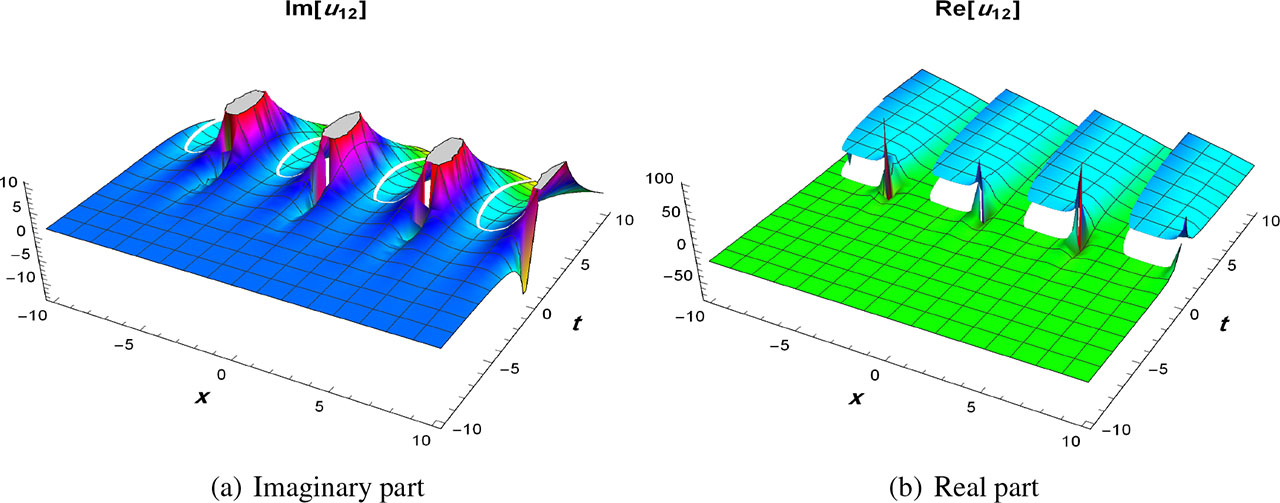
Fig. 1
Three-dimensional figures of (23).
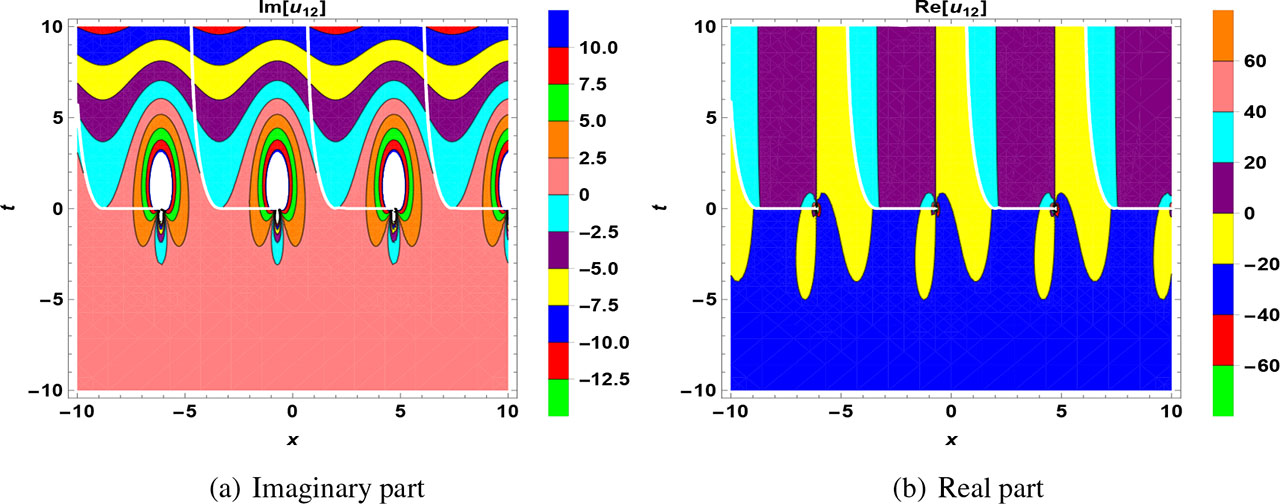
Fig. 2
Two-dimensional contour surface plots for (23).
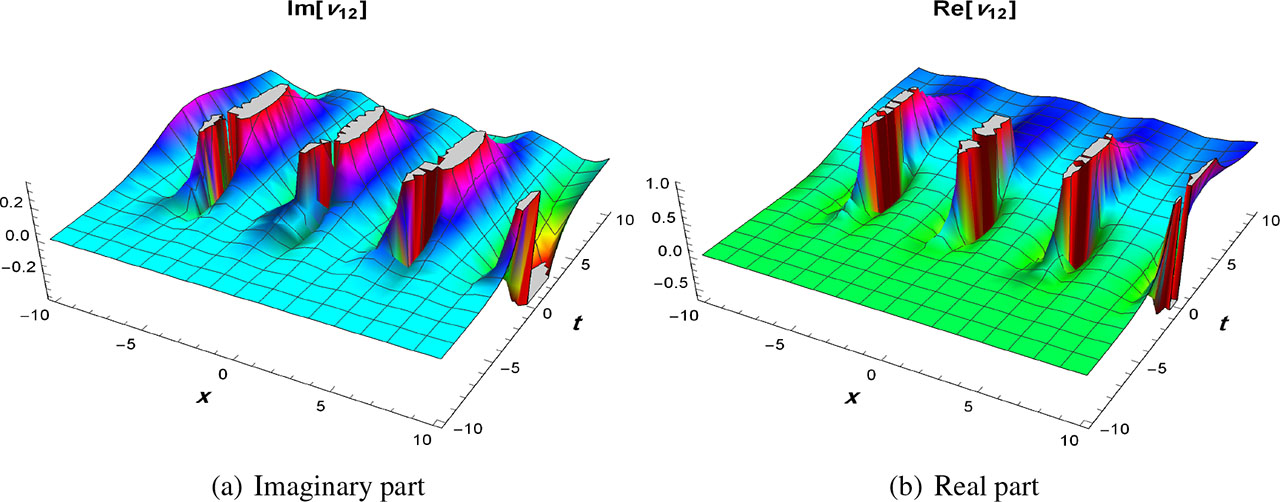
Fig. 3
Three-dimensional figures of (24).
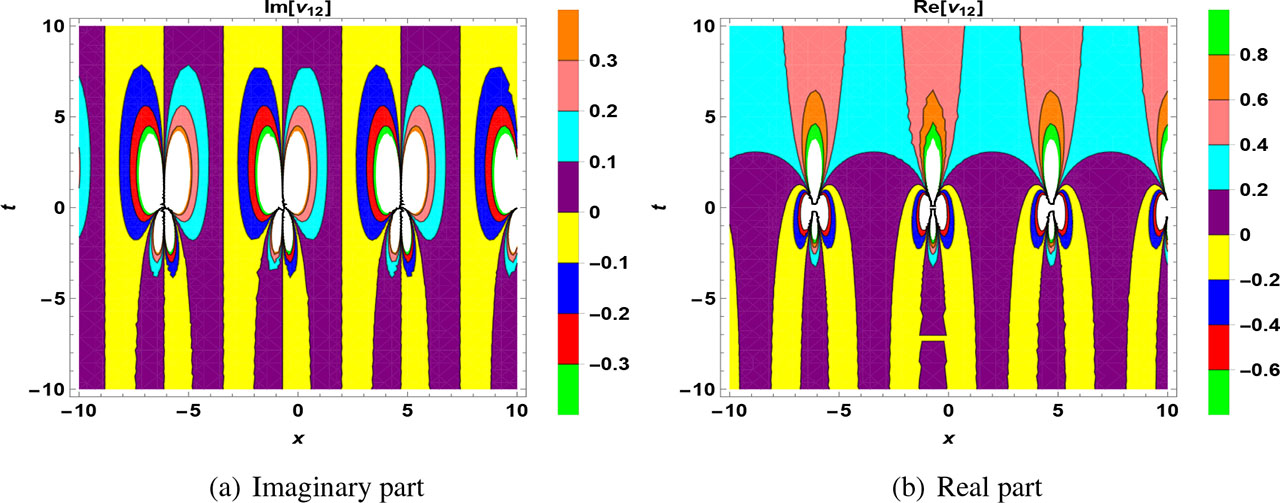
Fig. 4
Two-dimensional contour surface plots for (24).
In the following three-dimension revolution figures, select ,x ∈ [−10, 10].
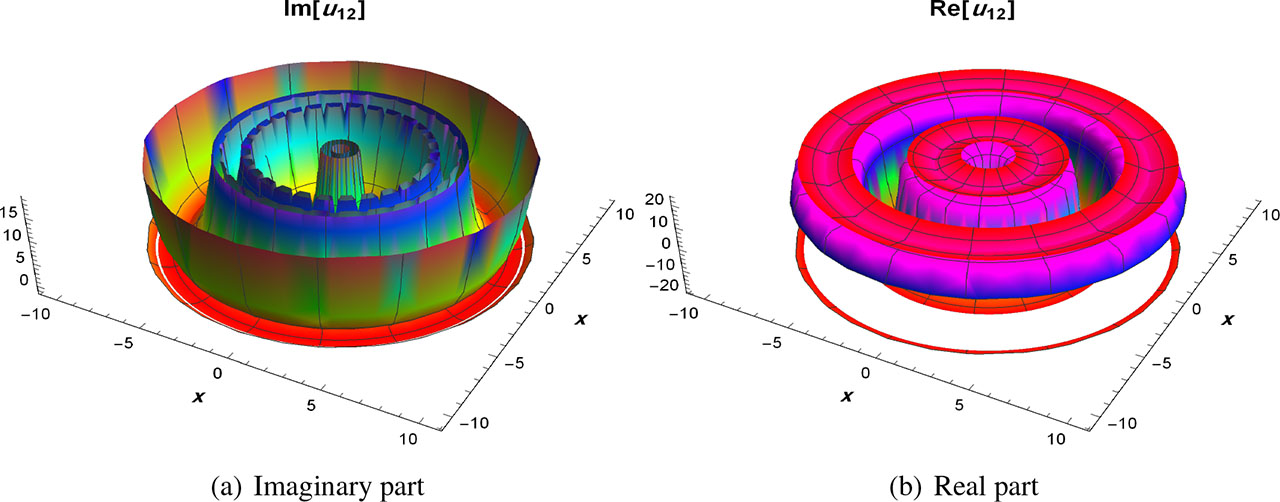
Fig. 5
3D revolving plots of (23).
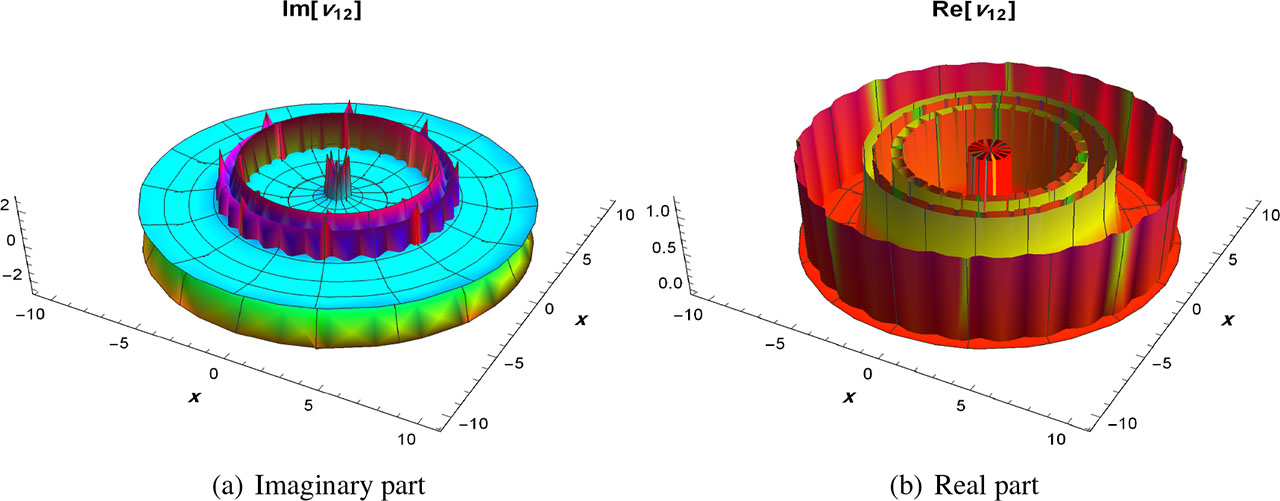
Fig. 6
3D revolving plots of (24).
Where time-evolution values are given in the legend below and −20 ≤ x ≤ 20 we have the following two dimensional time evolution graphs for (23) and (24):
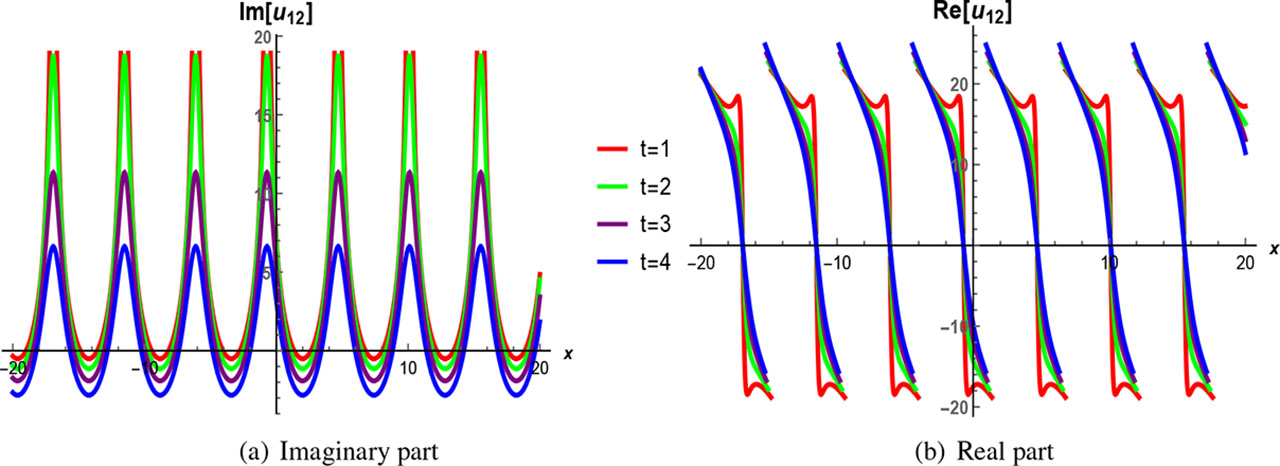
Fig. 7
2D time-evolution graphs of (23).
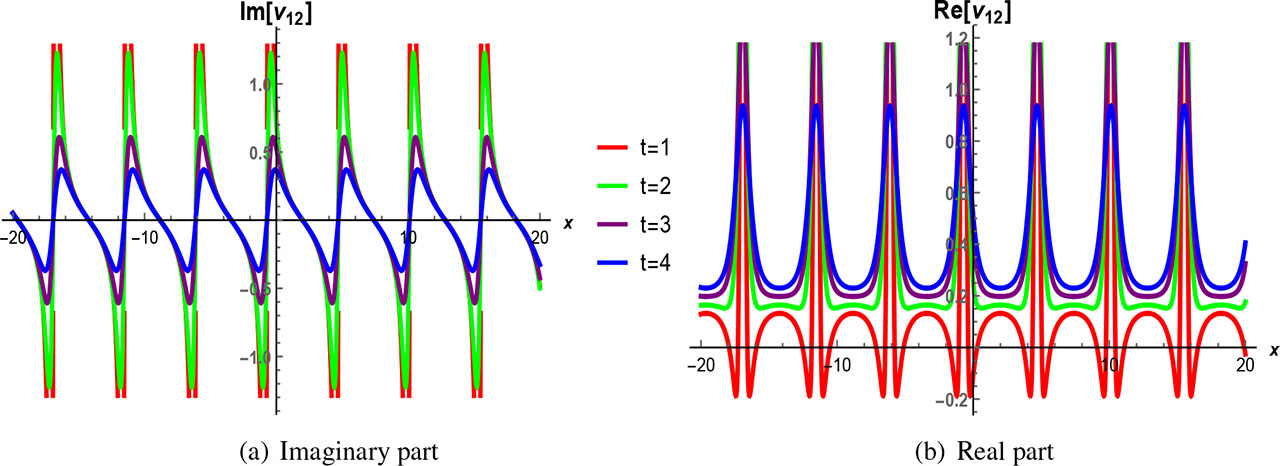
Fig. 8
2D time-evolution graphs of (24).
Remark 1
A null possibility exists for b = 0. One could say that the investigated model has a trivial solution in this particular case.
Remark 2
In this instance, the relevance of choosing parameter values is clear; they define the resulting solutions’ characteristics and physical elements.
Case 2. The subsequent parameters are acquired from solving (19):
The obtained parameters in (25) and the sign of the constant b have a central function in generating the following sub-cases of the solutions for the investigated model.Case 2.1. If b < 0 and using as a solution of the Riccati ODE (16), one attains the following solutions to (1):
andCase 2.2. The solution of (1) has been retrieved if b > 0 using as a solution of the Riccati ODE (16).
and herein 𝒯 = ν x +ν2y −ν3t.Remark 3
A null possibility occurs for b = 0. One may claim that the researched model has a trivial solution in this specific circumstance.
Case 3. The succeeding parameters can be determined by resolving the system (19).
Components in (30) are produce the subsequent sub-cases of solutions of (1) by taking into consideration the sign of b.
Case 3.1. If b < 0 operating as a solution of the Riccati ordinary differential equation (16), then one obtains the following solutions to (1).
and where
Case 3.2. If b > 0 operating as a solution of (16), then the obtained solutions of (1) take the formulations below:
andIn (33) and (34) it should be declared that
when , , , , , and −10 ≤ x ≤ 10, −10 ≤ t ≤ 10 the existed solutions in (33) and (34) have the following figures: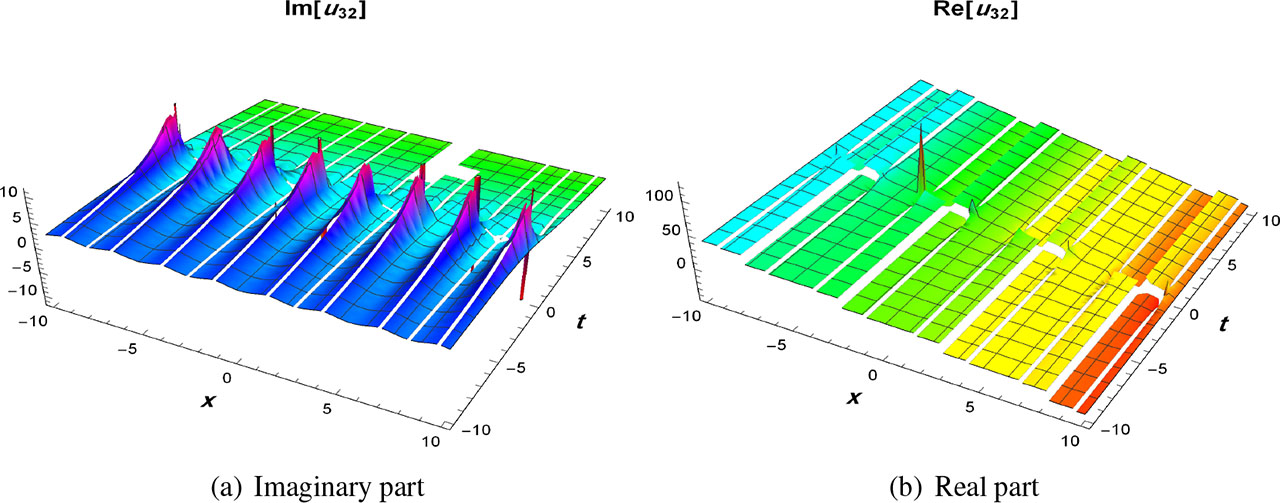
Fig. 9
Three-dimensional figures of (33).
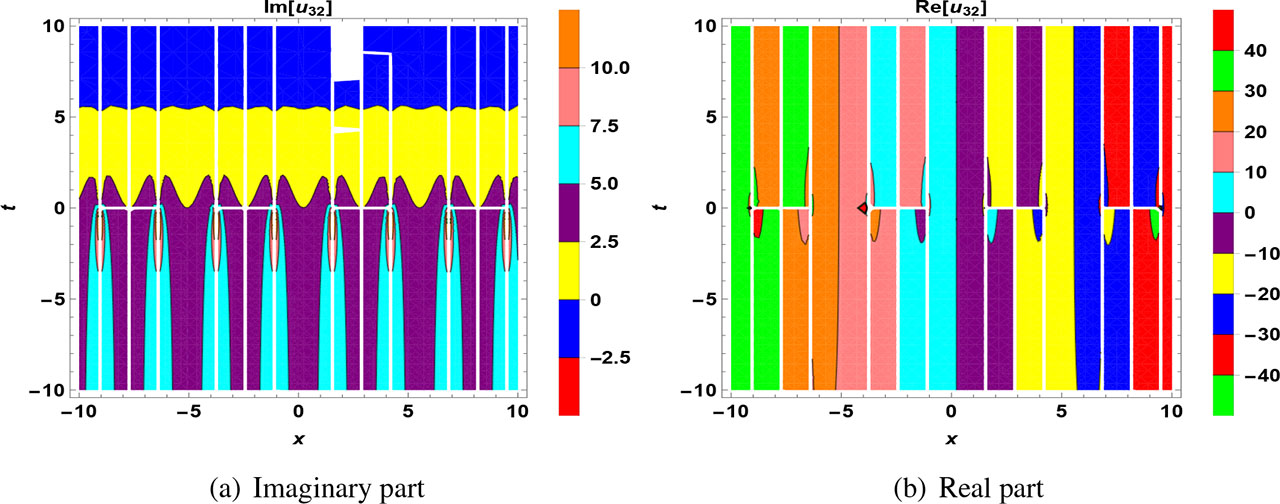
Fig. 10
Two-dimensional contour surface plots for (33).
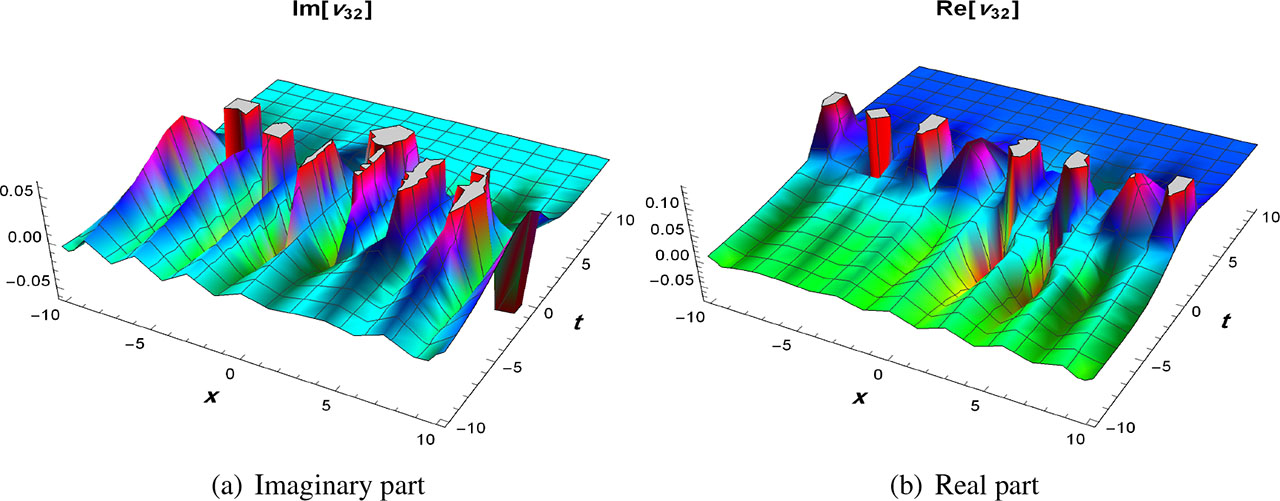
Fig. 11
Three-dimensional figures of (34).
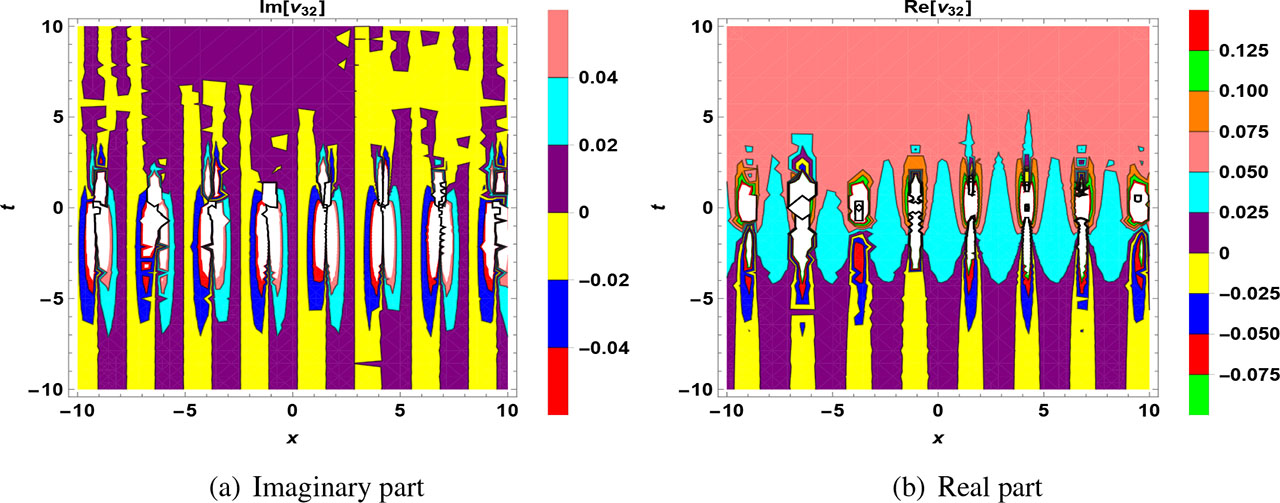
Fig. 12
Two-dimensional contour surface plots for (34).
Where , and −10 ≤ x ≤ 10 we have the following three-dimensional revolving figures:
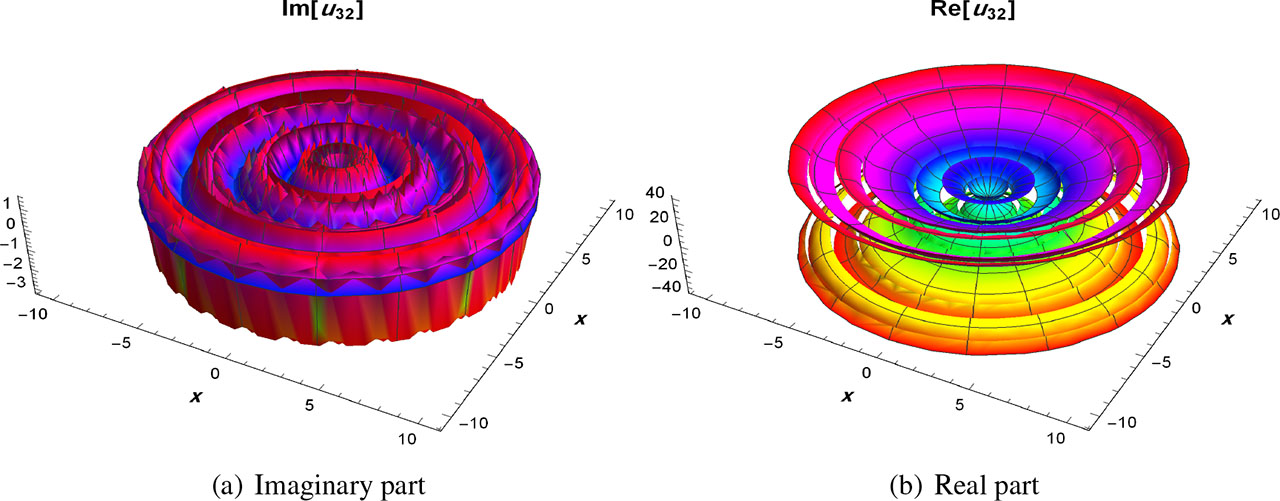
Fig. 13
3D revolving plot of (33).
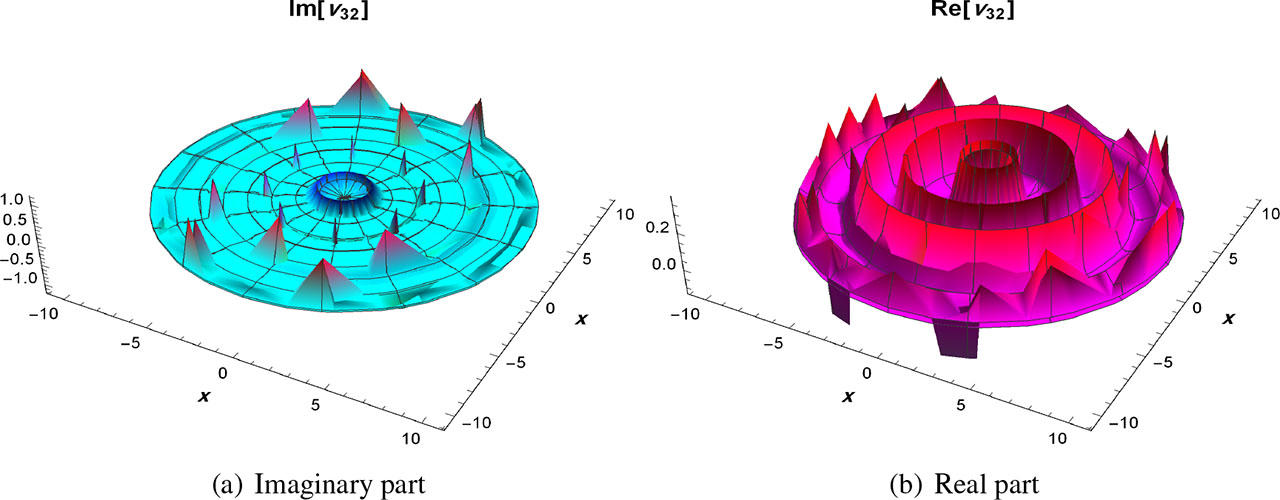
Fig. 14
3D revolving plot of (34).
When time values are provided in the legend below along with −10 ≤ x ≤ 10 we obtain the following two-dimensional visualizations that illustrate time-evolution impacts on the solution’s behaviors.
Remark 4
A zero-valued value for b cannot be achieved as it leaves part of the coefficients undefined, and hence, in this circumstance, one may say (1) has only a trivial solution.
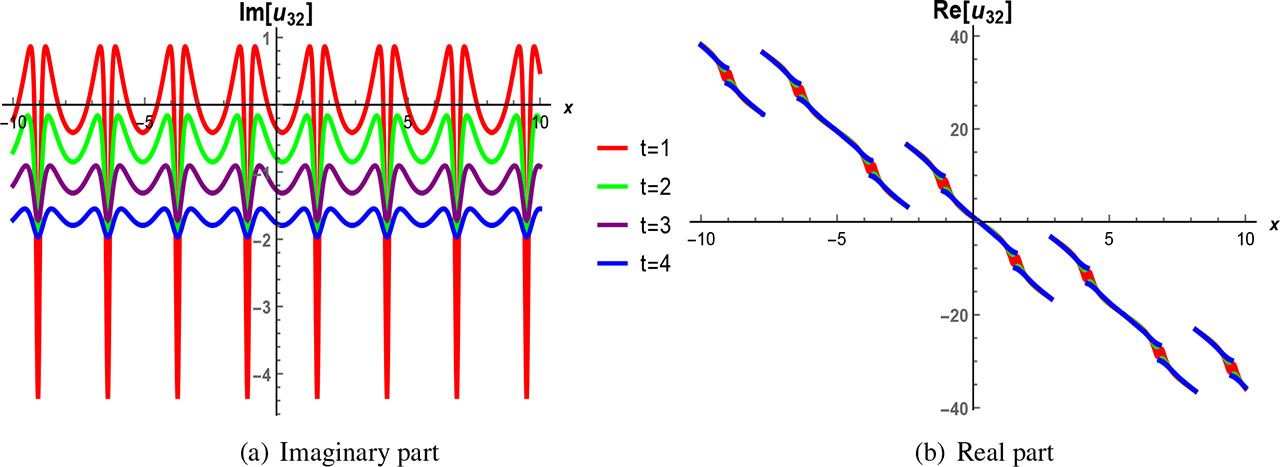
Fig. 15
2D time-evolution graphs of (33).
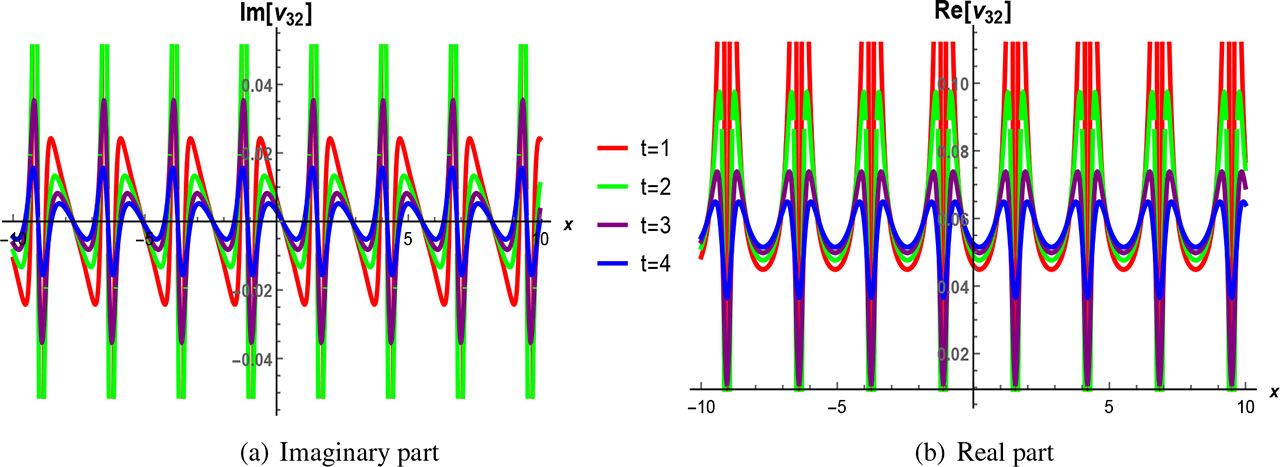
Fig. 16
2D time-evolution graphs of (34).
4. Result and discussion
The newly discovered explicit wave configurations in the generalized Hietarinta-type dynamic wave equation have been addressed. Various types of solutions such as lump-periodic, rouge waves, breather-type, and two-wave solutions have been reconstructed by using the modified extended tanh− function method. Proficient individuals may extend the obtained results to the other fields of physics or mathematics. Through the utilization of algorithms for computation, we have validated our results by reintroducing them into the specified equation. Our study is more familiar compared to the previous investigations. To declare this, some particular recent studies have been mentioned, for instance: In [27], the lump solutions have been found for this model. In [17], several kinds of wave structures have been generated through the application of Hirota’s bilinear method and diverse test function viewpoints. The waveform and the figures are mostly affected by choosing appropriate numerical values for free parameters that remain in the solutions. For equations (23) and (24), the free parameters have been selected by: , , , , . While the intervals also have a great impact on the appearance of the solutions, here we choose −10 ≤ x ≤ 10, −10 ≤ t ≤ 10, these effects are observed in Figures ( 1, 2, 3, 4), in the same interval, by selecting , Figures (5, 6) are presented. The intervals have been maintained by −20 ≤ x ≤ 20, −20 ≤ t ≤ 20, while time has been indicated in the legend to show the influence of time development on the wave patterns for Figures (7, 8). For equations (33) and (34), the complimentary coefficients have been determined by: , , , , . While the intervals also have a great impact on the appearance of the solutions, here we choose −10 ≤ x ≤ 10, −10 ≤ t ≤ 10, these significances are reflected in Figures (9, 10, 11, 12). In the same interval, by setting , Figures (13, 14) are introduced. The horizontal and vertical intervals have been maintained as previously, while time has been indicated in the legend to demonstrate the effect of time evolution on the wave designs for Figures (15, 16).
5. Conclusion
This work aimed to examine the exact solutions of the nonlinear fourth-order generalized Hietarinta-type problem in a (2+1)-dimensional space. This has been achieved by using the modified extended tanh− function approach. This is the first application of the approach to this model. The results of this study are novel and noteworthy concerning previous research since they present various approaches non-examined, analytically. These solutions represent in a various forms such as hybrid rational, logarithmic, hyperbolic, and trigonometric functions. Besides, two- and three-dimensional graphical representations of the solutions and two-dimensional visuals exhibiting the impacts of temporal development have been introduced. Also, two dimensional contour plots and revolving plots in three dimensions have been authenticated to better comprehend the dynamical properties of the discovered solutions. Furthermore, all obtained solutions have been confirmed by representational computational software programs by re-entering them into the main model considered. The usefulness and dependability of the technique used in analyzing the produced solutions to the aforementioned equation have been proven by the study results, which will be applied to further mathematical models. The findings reveal that the free parameters of the collected solutions strongly impact the waveform and its dynamics, possibly acting as a representation of multiple difficult and unknown features that develop across diverse scientific fields.
6. Declarations
6.1. Competing interests
The author affirms that there is no conflict of interest related to the publishing of this work.
6.2. Funding
Not applicable.
6.3. Author’s contributions
A.A.M.-Conception and Design, Material Preparation, Data Collection, Methodology, Analysis, Writing and Original Draft. All authors read and approved the final version of the manuscript.
6.4. Acknowledgement
We are grateful to Editor-in-Chief Prof. Dr. Haci Mehmet Baskonus for his guidance and insights throughout this period. We appreciate the role of reviewers in providing helpful input that enhanced the quality of our paper.
6.5. Data availability statement
The data sources collected during and/or analyzed during the present investigation are accessible from the corresponding author upon reasonable request.
6.6. Using of AI tools
The author affirms that Artificial Intelligence (AI) techniques were not used in creating this content.