
1. Introduction
Recently, the models arising in the field of biological rheology related to blood, vessels and heart, which constitutes human blood circulation, have been rapidly developed [1]. Blood circulation is a complex system that affects the entire body. In order to better understand the physiological and pathological behavior of the cardiovascular system, it is important to study the dynamics of blood flow in the arteries and the mechanical factors of blood flow [2]. Therefore, many studies have concentrated on the hemodynamic models, which examine the properties of arterial blood flow movement. The characteristics of two structural models are studied here such as blood and blood vessels/arteries [2, 3]. Blood is a special suspension of various blood cells and plasma, and its rheological properties are non-Newtonian fluid, but it is considered an incompressible inviscid fluid [4, 5]. Blood flow submits the principles of universal conservation of mass, momentum and energy [2, 6]. The forces that direct the blood flow are gravity and pressure gradient force, while the hindering forces are shear forces resulting from viscosity and turbulence [5, 7]. The wall thickness to vessel radius (diameter) ratio due to arteries, are considered flat incompressible, thick viscoelastic [5, 8, 9] or elastic tubes [10], as well as thin elastic [5, 11,12,13] or viscoelastic tubes [5, 14, 15]. Therefore, these features obviously show nonlinearity. Usually, for simplicity, arteries are modelled as circular cylindrical elongated tubes with a constant cross-section [1,5]. Under these assumptions, many models were proposed by well-known equations in the literature [3, 16,17,18,19]. Firstly, the Korteweg-de Vries (KdV) equation was determined by combining nonlinear science with hemodynamics for simplest assumptions [4, 20]. Later, considering more complex situations, the variable/constant coefficient forced KdV equation was developed [5,21,22,23]. Boussinesq-type equations were derived from the flow equations in elastic tubes and were used to analyze the effects of a local increase of radius followed by local variation of the thickness or rigidity of an elastic tube on the behavior of solitary waves [1, 4, 24]. The nonlinear Schrödinger equation was proposed in the view of Navier-Stokes equations and continuous equation [1, 4, 25].
In this work, the models which have recently been submitted to literature will be considered, and the exact solutions are obtained in the soliton form and wave form. Most of the research in the specific literature are related to the model development, numerical and semi-analytical solutions. Therefore, we will try to fill the gap in this area by obtaining analytical solutions. To reach the expected results, the Bernoulli method which is one of the ansatz-based methods will be used. The results will play an important role in supporting the improvement of models and present some important information of the theoretical basis and diagnosis of some blood diseases.
The rest of this paper is organized as follows: In Section 2, we provide the basic information of the method needed throughout the paper. In Section 3, we apply the ansatz method to the blood flow-motion of the arterial wall model and the blood flow in the blood vessels to obtain some new travelling wave solutions. Several simulations such as 3D and 2D graphs are also extracted. In Section 4, we give conclusions and remarks about the novelties of the paper.
2. Method summary
Ansatz methods first come to mind when searching for analytical solutions. Various types of ansatz methods are seen in literature [26,27,28,29,30,31,32]. Generally, the first step is reduction. So, the classical wave transformation u(x,t) = U (ξ), ξ = x−ct, c ≠ 0 is considered. Then, the model is reduced to the nonlinear ordinary differential equation (NODE). Then, the assumption of test function of the solution is taken as following
where gi (i = 0, 1, 2, 3, … , N) are parameters that the method's aim is to determine them. N is defined by using balance principle [32]. Generally, z (ξ) is sometimes determined as a function and sometimes as a solution to an ordinary differential equation. In this work, z (ξ) is the solution of the Bernoulli differential equation (BDE) given as below where P and Q parameters, and its solution is and C1 is an integration constant. At the last step, the assumption of the solution and if needed the BDE are substitute into NODE and by solving the system of equations obtained with coefficients of the powers of z (ξ), the mentioned parameters are obtained. Substituting all parameters and the solution of BDE into the solution assumption, the exact solution is extracted.3. Applications
In this part of the paper, we apply the ansatz method to obtain some new travelling wave solutions of governing models.
3.1. The blood flow and motion of arterial wall model
Considering that blood is a viscous fluid and the flow through a circular cylindrical tube of radius a. In the view of Navier-Stokes equation or equivalently the second law of Newton for fluid flow, the model is proposed [2];
where and are determined. v0 is the phase velocity of nonlinear waves and depends on wall incompressibility (η), Young modulus (E) and density of blood (ρ), whereas s depends on wall incompressibility (η), density of the artery wall (ρw), equilibrium for artery of radius (R0) and density of blood (ρ). β = α − 2 and α is the coefficient of nonlinear elasticity. As seen all parameters vary from individual to individual. Equation (1) is proposed for the nonlinear coefficient of elasticity of the artery wall and for dispersion connected to the inertial effects of the wall. Equation (1) is generally reduced to KdV equation via the reductive perturbation method and rescaling of coordinates [2, 33, 34] and the solutions obtained via known numerical or analytical methods [2]. Now, the classical wave transformation given by where v ≠ 0 is used to reduce equation (1) to NODE and it is converted as being U = U (ξ), and . Firstly, equation (2) is integrated twice respect to ξ and integration constants are assumed zero. For simplicity, one reads the equation (2) as belowFor equation (3), the test function of the exact solution is assumed as following
where g0, g1, g2 are parameters with real number and z (ξ) is a solution of BDE z′ (ξ) = Pz (ξ) + Qz2 (ξ), P and Q are considered as real constants. Therefore, substituting equation (4) into equation (3), a nonlinear algebraic equation system is obtained. The solution of the nonlinear algebraic system produces the following coefficientsAs the strain condition, one reads α2(β + 1) −v2 ≠ 0. For the z(ξ) function, it may be written as follows
When all these parameters are substituted into equation (4), the exact solution as the travelling wave is obtained. The 3D-plot of the exact solution for Q = 1, s = 2, v = 0.5, β = 3.55, α = 0.1, C1 = 0.1 is plotted in Figure 1. Additionally, for the same parameter's values, 2D-plot is simulated at t = 0, t = 0.2, t = 0.4, t = 0.6, t = 0.8, respectively, in Figure 2.
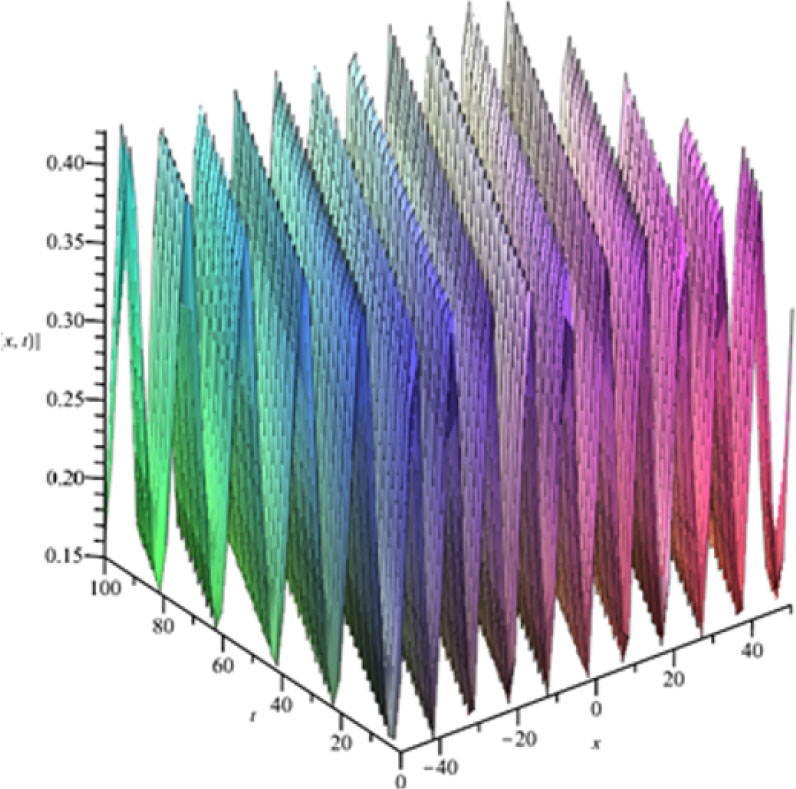
Fig. 1
3D simulation of the exact solution of the equation (1) for Q = 1, s = 2, v = 0.5, β = 3.55, α = 0.1, C1 = 0.1.
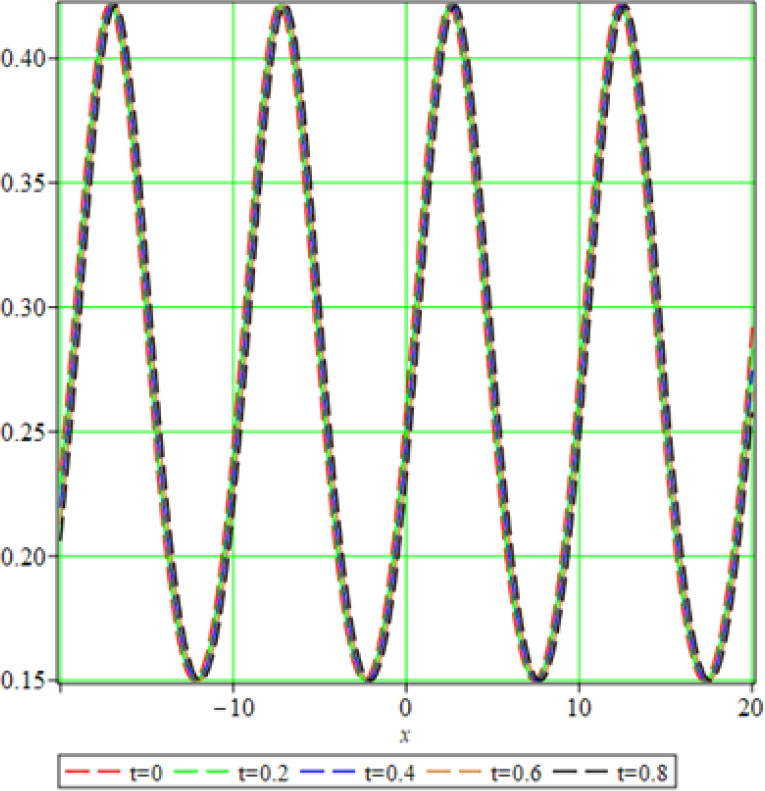
Fig. 2
2D simulation of the exact solution of the equation (1) for Q = 1, s = 2, v = 0.5, β = 3.55, α = 0.1, C1 = 0.1.
3.2. The blood flow in the blood vessels
Blood flow with weak viscosity is known as Poiseuille flow [4]. According to the Navier-Stokes equation or equivalently Newton's second law for fluid flow, and considering the vessel wall viscosity, the model is proposed as for modeling flow in arteries [4]
where α, β, σi(i = 1, 2, 3) are parameters that depend on blood and vessel values that vary from individual to individual and also, ɛ is a small parameter measuring the weakness of nonlinearity and dispersion. To solve equation (5), it is necessary to reduce to the NODE system corresponding to the real and imaginary parts via u (x,t) = V (ξ) eiφ(x,t), ξ = x− λt and φ (x, t) = κx−ct. The NODE system is obtained as belowFor the system of equations (6) and (7), the test function of the solution formula is assumed as
where g0, g1 are parameters and z (ξ) is a solution of z′ (ξ) = Pz (ξ) + Qz2 (ξ), P and Q are considered as constant coefficients with non-zero. Therefore, substituting equation (8) into the system of equations (6) and (7), a nonlinear algebraic equation system is obtained. Solving this system, we find these parameters given as andBy using these parameters, we obtain the travelling wave solution of equation (5) as below
being ξ = x −λt and φ (x,t) = κx − ct. The 3D-plot of the exact solution equation (9) for σ2 = 0.5, σ1 = 0.5, ɛ = 0.05, κ = 1, c = 2, λ = 2, β = 1/3, g1 = 2 is given by Figure 3, additionally for the same parameter values 2D-plot is plotted at t = 0, t = 0.2, t = 0.4, t = 0.6, t = 0.8, respectively, in Figure 4.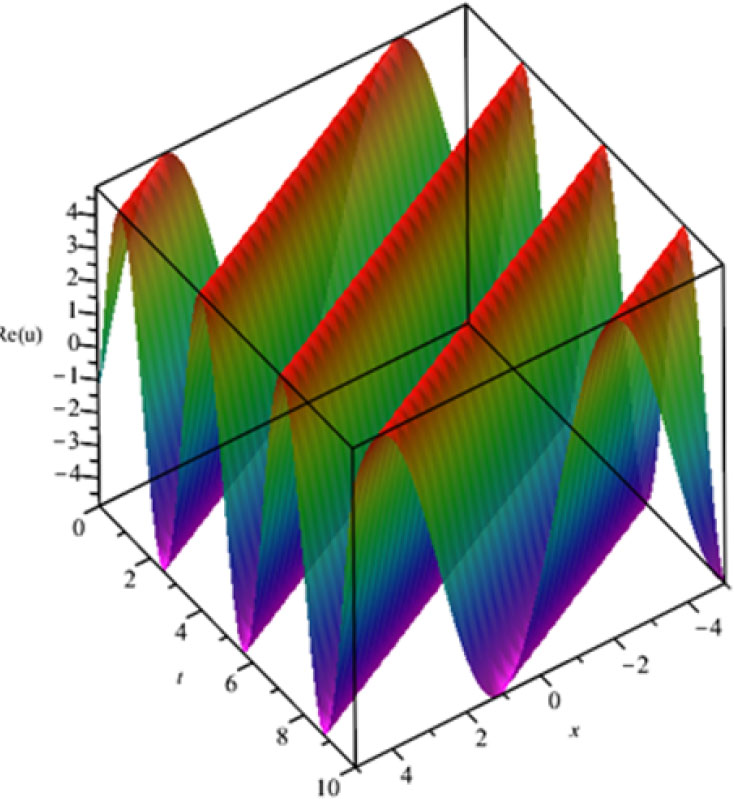
Fig. 3
3D simulation of the exact solution of the equation (9) for Q = 1, s = 2, v = 0.5, β = 3.55, α = 0.1, C1 = 0.1.
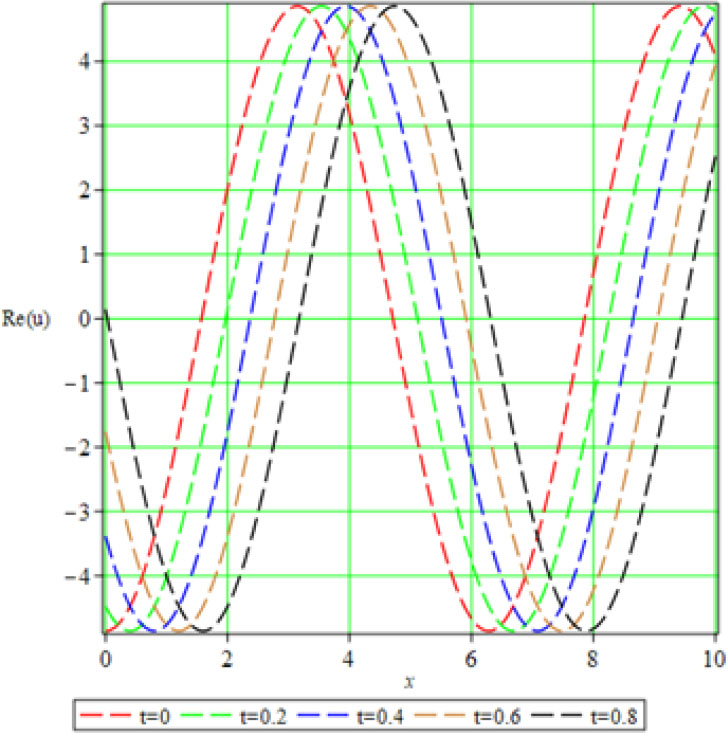
Fig. 4
2D simulation of the exact solution of the equation (9) for Q = 1, s = 2, v = 0.5, β = 3.55, α = 0.1, C1 = 0.1.
4. Conclusions
In this paper, we have successfully applied the ansatz method, firstly, to the blood flow-motion of arterial wall model, and secondly, to the blood flow in the blood vessels. We obtained some new travelling wave solutions of the hemodynamic models studied in this paper. The solutions obtained in this paper were reported analytically. 3D- and 2D- plots were plotted to observe deep properties of the models. The results were proposed in the explicit form and the parameters were considered arbitrarily for healthy humans, so these parameter values depend on individual health. If a human has a health problem, we can say that the wave structure will change due to the individual parameters. Therefore, the results will support the theoretical basis and in diagnosis for some blood diseases. Additionally, the results play an important role to improve the models. In literature, most of the researches are about the improvement of models whereas some depend on the numerical and semi-analytical solutions. For future works, it may be interesting to apply other well-organized methods, such as Bifurcation analysis [30], Jacobi elliptic function method [29], Kudryashov method [27], etc. to derive some new wave solutions of the governing models.
5. Declarations
5.1. Conflict of interest
The authors have no competing interests to declare that are relevant to the content of this article.
5.2. Funding
No funding was received to assist with the preparation of this manuscript.
5.3. Author's contribution
Z.P.İ.-Conceptualization, Methodology, Software, Writing-Review Editing, Formal Analysis, Validation, Writing-Original Draft. The authors read and approved the final submitted version of this manuscript.
5.4. Acknowledgement
The authors deeply appreciate the anonymous reviewers for their helpful and constructive suggestions, which can help further improve this paper.
5.5. Data availability statement
All data that support the findings of this study are included within the article.
5.6. Using of AI tools
The authors declare that they have not used Artificial Intelligence (AI) tools in the creation of this article.