
1. Introduction
Fuzzy number and fuzzy arithmetic were introduced by Zadeh in 1965 [1]. Fuzzy differential equations are an important topic in many fields. Thus, many researchers have studied fuzzy differential equation using different approach methods [2, 3, 4, 5, 6, 7, 8, 9, 10, 11]. The first approach is the Hukuhara derivative [12, 13]. This approach has a drawback: the solution becomes fuzzier as time goes. Thus, the fuzzy solution behaves quite differently from the crisp solution. So, the generalized Hukuhara derivative was studied [7, 8, 11, 14, 15, 16]. The generalized Hukuhara derivative allows to resolve the above-mentioned shortcoming. The second approach is the extension principle [17]. The third approach is the differential inclusion one [18]. The Fuzzy Laplace transform (FLM) method is useful to solve fuzzy differential equations. In many articles, the solution of fuzzy differential equation has been studied by using FLM approach [19, 20, 21, 22, 23, 24].
The rest of this paper is organized as follows: preliminaries and basic definitions used in this paper are given in Section 2. In Section 3, some applications and main results are reported. In Section 4, the conclusions of this paper are introduced.
2. Preliminaries
In this part, we present some important definitions and theorems which will be used in this paper.
Definition 1
[25] A fuzzy number is a mapping u:ℝ → [0, 1] satisfying the properties is compact, u is normal, u is convex fuzzy set, u is upper semi-continuous on ℝ. Let's denote the set of all fuzzy numbers with ℝF.
Definition 2
[11] Let be u ∈ ℝF. The α-level set of u is [u]α = [uα, ūα] = {x ∈ ℝ | u (x) ≥ α}, 0 < α ≤ 1.
Definition 3
[11] The parametric form [uα, ūα] of u fuzzy number satisfies the following requirements:
The lower part uα is bounded non-decreasing left-continuous on (0, 1], right-continuous for α = 0.
The upper part ūα is bounded non-increasing left-continuous on (0, 1], right-continuous for α = 0.
uα ≤ ūα, 0 ≤ α ≤ 1.
Definition 4
[25] If A is asymmietric triangular fuzzy number with support [a, ā], the α–level set of A is .
Definition 5
[26] Let u, v ∈ ℝF. The generalized Hukuhara difference (gH-difference) between u and v is the set w ∈ ℝF which u⊖gv = w if and only if u = v + w or v = u + (−1) w.
Definition 6
[11] Let f : [a, b] → ℝF and t0 [a, b]. We say that f is (1)-differentiable at t0, if there is an element f′ (t0) ∈ ℝF such that for all h > 0 sufficiently small (near to 0), exist f (t0 + h) ⊖ f (t0), f (t0) ⊖ f (t0 − h) and the limits
and f is (2)-differentiable if for all h > 0 sufficiently small (near to 0), exist f (t0) ⊖ f (t0 + h), f (t0 − h) ⊖ f (t0) and the limitsTheorem 1
[27] Let f : [a, b] → ℝF be fuzzy function, where , for each α ∈ [0, 1].
(i) If f is (1)-differentiable then fα and are differentiable functions and ,
(ii) If f is (2)-differentiable then fα and are differentiable functions and .
Theorem 2
[19] Let f′ (t) be an integrable fuzzy function and f (t) is primitive of f′ (t) on (0, ∞].
1. If f is (1)-differentiable, L (f′ (t)) = sL ( f (t)) ⊖ f (0).
2. If f is (2)-differentiable, L (f′ (t)) = (− f (0)) ⊖ (−sL (f (t))).
Theorem 3
[28] Let f″ (t) be an integrable fuzzy function and f (t), f′ (t) are primitive of f′ (t), f″ (t) on (0, ∞].
1. If f and f′ are (1)-differentiable, L (f″ (t)) = s2L (f (t)) ⊖ s f (0) ⊖ f′ (0).
2. If f and f′ are (2)-differentiable, L (f″ (t)) = s2L(f (t)) ⊖ s f (0) − f′ (0).
3. If f is (1)-differentiable and f′ is (2)-differentiable, L (f″ (t)) = ⊖ (−s2) L(f (t)) − s f (0) − f′ (0).
4. If f is (2)-differentiable and f′ is (1)-differentiable, L (f″ (t)) = ⊖ (−s2) L(f (t)) − s f (0) ⊖ f′ (0).
3. Applications
We investigate the solutions of the problem given as
by the fuzzy Laplace transform and the generalized Hukuhara differentiability, where , , , are symmetric triangular fuzzy numbers, u (t) is positive fuzzy function, the fuzzy Laplace transform of fuzzy function u (t) is L(u (t)) = U(s) and (i, j)-solution means that u is (i)-differentiable, u′ is (j)-differentiable, i, j = 1, 2.1. (1,1)-solution: Let u, u′ be (1)-differentiable. Then, the equation
is obtained by using FLT. From this, we have the equationsUsing the initial conditions, we obtain
Taking the inverse Laplace transform of these equations, (1, 1)-solution is obtained as
2. (1,2)-solution: Let u be (1)-differentiable and u′ be (2)-differentiable. Then, since
we have the equationsUsing the initial conditions and making the necessary operations, we obtain the equations
Then, (1, 2)-solution is obtained as
3. (2,1)-solution: Let u be (2)-differentiable and u′ be (1)-differentiable. From the equation
we have the equationsFrom this, making the necessary operations, (2, 1)-solution is obtained as
4. (2,2)-solution: Let u and u′ be (2)-differentiable. Since
(2, 2)-solution is obtained asThese solutions must be valid fuzzy functions.
Example 3.1
Consider the solutions of the fuzzy problem
where [1]α = [α, 2 − α], [2]α = [1 + α, 3 − α].(1, 1)-solution is
(1, 2)-solution is
(2, 1)-solution is
and (2, 2)-solution isFrom Definition 3, according to Figure (1a) and Figure (2b), (1, 1) and (2, 2) solutions are valid fuzzy functions. But, according to Figure (1b) and Figure (2a), (1, 2) and (2, 1) solutions are not valid fuzzy functions.
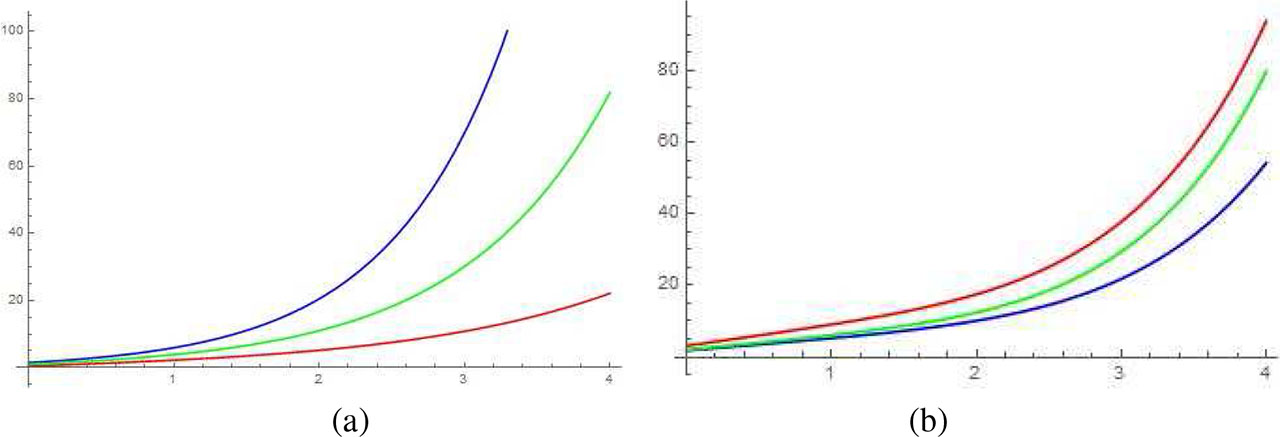
Fig. 1
a) Graphic of (1,1)-solution for α = 0.5. b) Graphic of (1,2)-solution for α = 0.5.
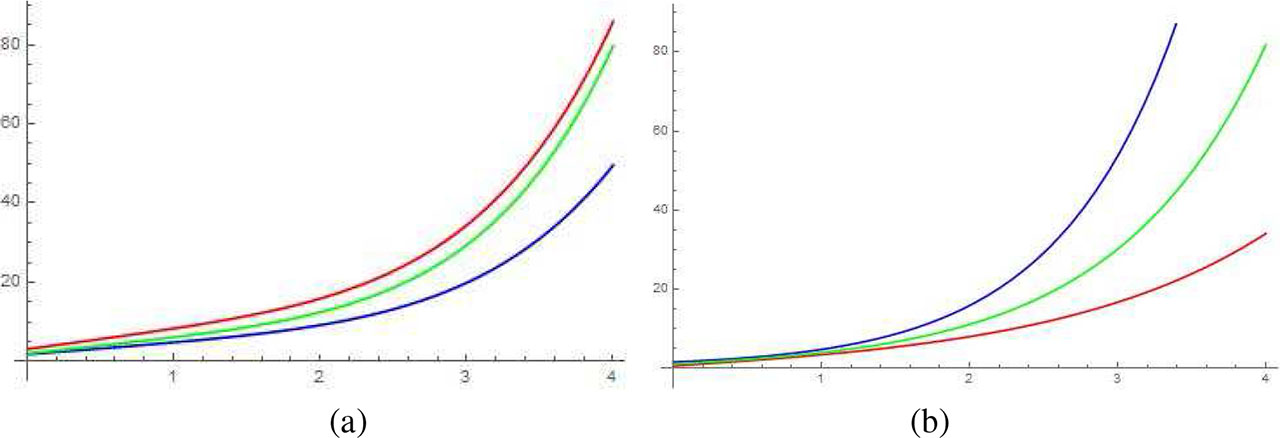
Fig. 2
a) Graphic of (2,1)-solution for α = 0.5. b) Graphic of (2,2)-solution for α = 0.5.
In these figures, blue is used to symbolize , red is for → yα (t) and green is used to explain .
4. Conclusion
In this work, we studied a fuzzy initial problem with fuzzy coefficient. We used the generalized differentiability and the fuzzy Laplace transform. We solved an application on the problem and drew the figures of the solutions. Finally, it is shown that the solutions are valid fuzzy functions or not.
5. Declarations
5.1. Conflict of interest
The authors hereby declare that there is no conflict of interests regarding the publication of this paper.
5.2. Funding
Not applicable.
5.3. Author's contribution
H.G.Ç.-Methodology, Writing-Original Draft, Validation, Conceptualization, Formal Analysis, Investigation, Writing-Review and Editing. All authors read and approved the final submitted version of this manuscript.
5.4. Acknowledgement
The authors deeply appreciate the anonymous reviewers for their helpful and constructive suggestions, which can further help improve this paper.
5.5. Data availability statement
All data that support the findings of this study are included within the article.
5.6. Using of AI tools
The authors declare that they have not used Artificial Intelligence (AI) tools in the creation of this article.