
1. Introduction
Optical soliton disturbance is one of the most discernible bounds of exploration in telecommunication industry [1,2,3,4,5,6]. The realm of studying soliton transmission in optical fibers has flourished in the last few decades due to its rich prominence of occurrences explaining these events [7,8,9,10,11]. A soliton refers to a self-localized out-come of a non-linear evolutionary equation narrating the progression of a non-linear dynamical process with an unbounded number of degrees of freedom [12,13,14,15,16,17]. Solitary wave and soliton solutions can be distinguished by their unique interaction dynamics. Solitons possess the remarkable attribute of retaining their shape unchanged during interactions, leading to a mere phase shift as the outcome. On the other hand, the presence of solitary wave results indicates a precise equilibrium between dispersion and non-linearity, often necessitating specific conditions that cannot be universally established [18,19,20]. If optical losses are not present, the fundamental equation governing the transmission of optical pulses is in mono-mode fiber. It is described by the renowned non-linear Schrödinger’s (NLS) equation [21,22,23]. Apart from its significance in non-linear optical phenomena, the non-linear Schrödinger’s equation also emerges in diverse domains such as Bose-Einstein condensates, non-linear quantum field theory, and water waves biomolecular kinetics. For the NLS equation, the inquisition of exact soliton solution and its augmentation is one of the most emergent tasks in non-linear science. These applications offer a wide range of uses in the development of fiber optic amplifiers, communication links based on solitary waves, and more. In recent years, a multitude of adaptations to the NLS equation have emerged, catering to distinct physical scenarios and specific requirements. Examples comprise the cubic-quintic NLS equation, the Fokas-Lenells (FL) system, the cubic-quintic-septic NLS equation, and so on. By employing the bi-Hamiltonian method, the FL model, which represents an integrable extension of the NLS equation, was firstly obtained [24].
The FL equation holds significant importance in explaining optical rogue waves and the behavior of pulse transmission in optical fibers [25]. Moreover, it is of great significance in analyzing the behavior of electromagnetic vibrations in birefringent media, especially when subjected to differential group delay caused by manufacturing flaws and other imperfections in fibers.
The FL equation has been widely recognized since its introduction. It has been investigated by many academics. The soliton outcomes for the FL system have been acquired via the generalized exponential function technique [26], the unified method [27], the mapping scheme [28], the extended trial function procedure [29], the trial equation strategy [30], and the complex envelope function hypothesis [31]. The bright and dark soliton solutions of the FL structure are also obtained utilizing a direct scheme by Matsuno [32, 33]. Optical soliton outcomes to the FL equation have recently been achieved using the φ6-model expansion approach [34]. A specific analytical depiction of the rogue fluctuations of the FL equation has been presented recently [35]. Optical soliton solutions of the mentioned model are obtained by the modified Kudryashov’s, the exp(ϕ (ξ)) function, and the sine-Gordon expansion techniques [36].
Many researchers are dedicated to advancing the field of nonlinear models, exploring diverse perspectives in differential forms. Ma and Lee applied the transformed rational function procedure technique to extract exact solutions to the (3+1) dimensional Jimbo-Miwa model [37]. Ma and Fuchssteiner have used the Cole-Hopf transformation to observe the solutions of Kolmogorov-Petrovskii-Piskunov equation [38]. The (1/G′)-expansion technique was first presented by Yokus [39]. In this method, he used the second-order Riccati equation G″ + λ G′ + γ = 0, with arbitrary constants λ and γ. Then, many researchers utilized this technique to explore different nonlinear evolution equations (NLEEs) in order to derive solutions representing traveling waves. Relevant references for these studies can be found in [40]. The direct algebraic technique was initially introduced by Zhang in 2009 [41]. In this approach, he employed the first-order Riccati equation S′(ξ) = S2(ξ) + p, where p is an arbitrary constant. Subsequently, many researchers utilized this method to investigate various NLEEs and obtain solutions depicting traveling waves. The pertinent references for these studies are cited in [42, 43].
The construction of this work is outlined as follows: In Section 2, we present the model studied. In Section 3, we provide the ODE conversion of the FL model. Moving to Section 4, we explain the application of the direct algebraic method [41,42,43] and its solution procedure. Section 5 delves into the modified rational sine-cosine technique [44] and its practical implementation. The utilization of the (1/G′) expansion scheme [45] is elaborated in Section 6, accompanied by its application. Section 7 is dedicated to offering a clear understanding of the graphs through physical explanations. The comparison of outcomes and the novelty they bring forth are discussed in Section 8. Finally, Section 9 encompasses our concluding remarks on the study.
2. Governing model
The FL model in its dimensionless form is introduced by [25,26,27,28,29,30,31,32,33,34,35,36]:
In the above equation ψ(x, t) corresponds to the complex wave amplitude. The value of P1 is group velocity dispersion, the factor of P2 denotes spatio-temporal dispersion. The coefficient of q depicts the nonlinear component. Here, k corresponds to the inter-model dispersion when c is linear dispersion, and b comes from the self-steepening effect. Finally, n is the full non-linearity exponent.3. The ODE form of the model
To solve the equation (1), the solution structure can be considered as [46]
where ξ = x − mt for soliton velocity m with the soliton magnitude element Q and the phase component θ can be written as θ = −rx + lt + ɛ in which wave number l, frequency r, and phase value ɛ.Substituting the value of equation (2) into equation (1) and parting the imaginary and real components.
The real part is
and the imaginary part is or Putting [(2n + 1)b + 2cn]Q2n = 0, σ = 0, then we have as follows Now from equation (3), we have4. Direct algebraic scheme for the FL model
Let the trial solution of the FL model be,
where λk (k = 0, 1, 2, ⋯ , N) are real quantities and S(ξ) gratifies the next Riccati equation as, Solutions of equation (8) are introduced in [41,42,43] and can be written asfor p < 0,
for p > 0,
for p = 0,
By balancing between Q3 and Q″ in equation (6), one can easily obtain as N = 1. For N = 1, equation (7) becomes
Now combining equation (12) and equation (8) and putting into equation (6), we get the solution set as, where q, r, p, P1, P2 and λ1 are arbitrary constants.Applying equations (8),(9),(10),(11),(12),(13) into equation (2), we get five types of exact solutions as follows,
where .It is well known that the mentioned technique is a particular case of the transformed rational function procedure [37], and the adopted auxiliary equation (8) is a Riccati equation. The general solution for this equation was introduced in [38].
5. Modified rational sine-cosine technique for the FL model
The modified rational sine-cosine scheme presupposes that the resolution of equation (6) adopts the format [44],
To find out the parameter’s value L, M and N, we insert equation (14) into equation (6) and gather the co-efficient of the fundamental functions, sin(ξ), cos(ξ), sin(ξ) cos(ξ), sin2 (ξ), sin3 (ξ), and sin2 (ξ) cos(ξ).Next, we equate each obtained co-efficient to zero as the original equation is homogeneous. The process of solving these equations results in a set of solutions that form a family as
where k, r, P1, P2 and N are arbitrary constants.The exact solution gives the result,
where .6. (1/G′) scheme for the FL model
Let’s apply the fundamental assumption of equation (1) with the auxiliary form,
where βk (k = 0, 1, 2, ⋯ , N) are real quantities and G(ξ) gratifies the next Riccati equation as, whilst γ and λ are scalars. Solutions of equation (17) are introduced in [45] and can be written as where B is a real constant. We can notice that for integer K = 1, there is a balance between Q3 and Q″ in equation (16). Then, the initial hypothesis in equation (16) is written as: Putting equation (16) and equation (17) into equation (6) and assigning each coefficient of 1, , , and to 0 gives the results, where q, r, P1, P2, λ, γ, and β1 are arbitrary constants.Applying equation (18), (19), (20) into equation (2), we get the exact result of the suggested model,
where and .It is well known that the mentioned technique is a particular case of the transformed rational function procedure [37], and the adopted auxiliary equation (17) implies that satisfies another Riccati equation. Therefore, all solutions presented here can be obtained from a general class of solutions to the general Riccati equation introduced in [38].
7. Figure analysis
In the context of our analysis, we have explored the solution of ψ1. The specific case of ψ1 depicted in Fig.1(a–f). From the demonstration, we have noted distinctive characteristics associated with different components of ψ1. Re(ψ1) and Im(Ψ1) reveal double periodic waves, while |ψ1| gives a dark soliton solution. Solutions ψ2 and ψ5 display an identical wave pattern, which is depicted in Fig.2(a–f). ψ5 is demonstrated in this instance. From the demonstration, distinctive characteristics associated with different components of ψ5 have been noted. Re(ψ5) and Im(ψ5) reveal a singular bright-dark breather wave, whereas |ψ5| gives a bright breather wave solution. The identical pattern is observed for solutions ψ3, ψ4, and ψ6, which is illustrated in Fig.3(a–f) specifically for solution ψ6. From the demonstration, distinctive characteristics associated with different components of ψ6 have been noted. Re(ψ6) and Im(ψ6) reveal a singular multiple bright-dark breather waves, whereas |ψ6| represents multiple bright breather waves solution. The specific case of ψ7 depicted in Fig.4(a–f) is being discussed. From the demonstration, distinctive characteristics associated with different components of ψ7 have been noted. Re(ψ7) and Im(ψ7) reveal a periodic breather wave, whereas |ψ7| gives a bright breather waves solution.
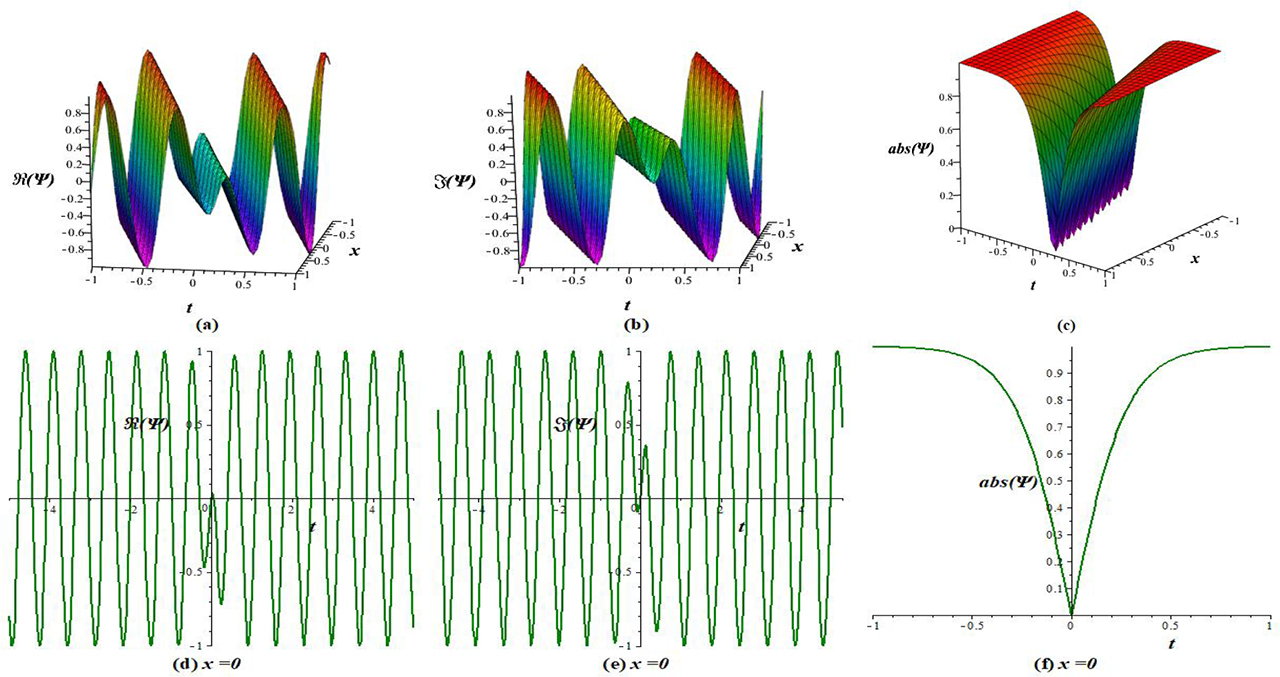
Fig. 1
Behaviour of ψ1 for , r = 3, p = −1, p1 = 7, p2 = 2, λ0 = 0, λ1 = ɛ = 1: (a,b,c) cubical wave pattern, and (d,e,f) planner wave pattern.
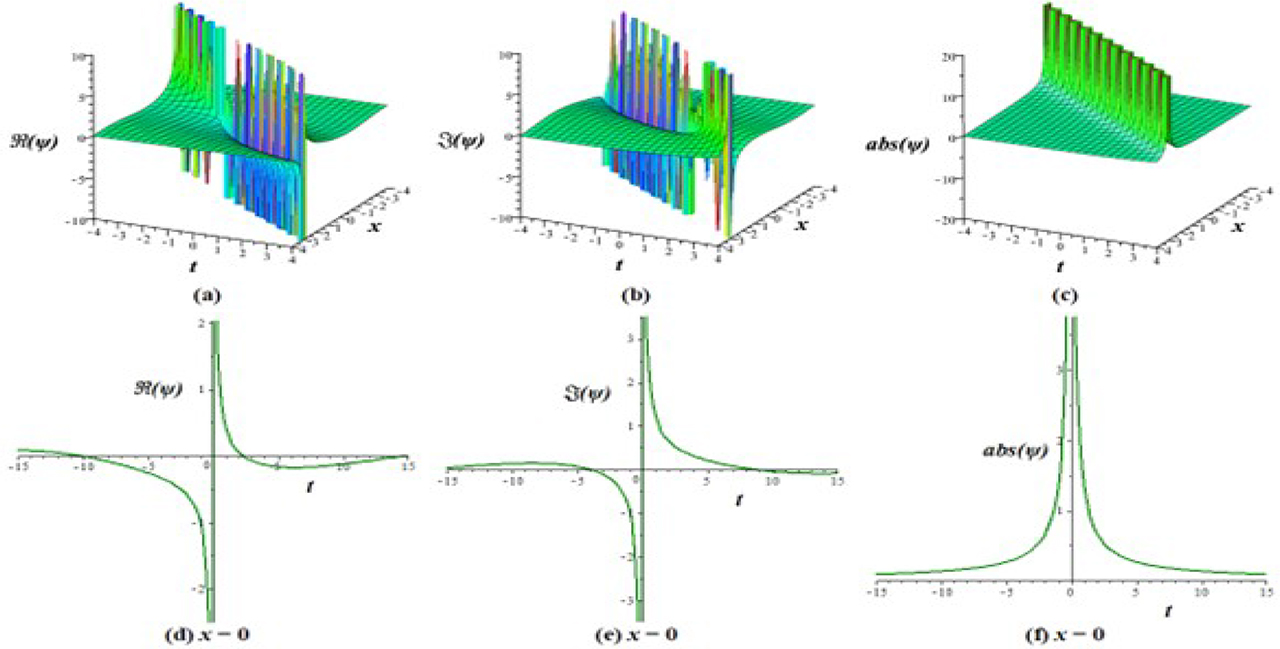
Fig. 2
Plot of solution ψ5 for p = λ0 = 0, λ1 = p1 = r = q = ɛ = 1, p2 = 2: (a,b,c) cubical wave pattern, and (d,e,f) planner wave pattern.
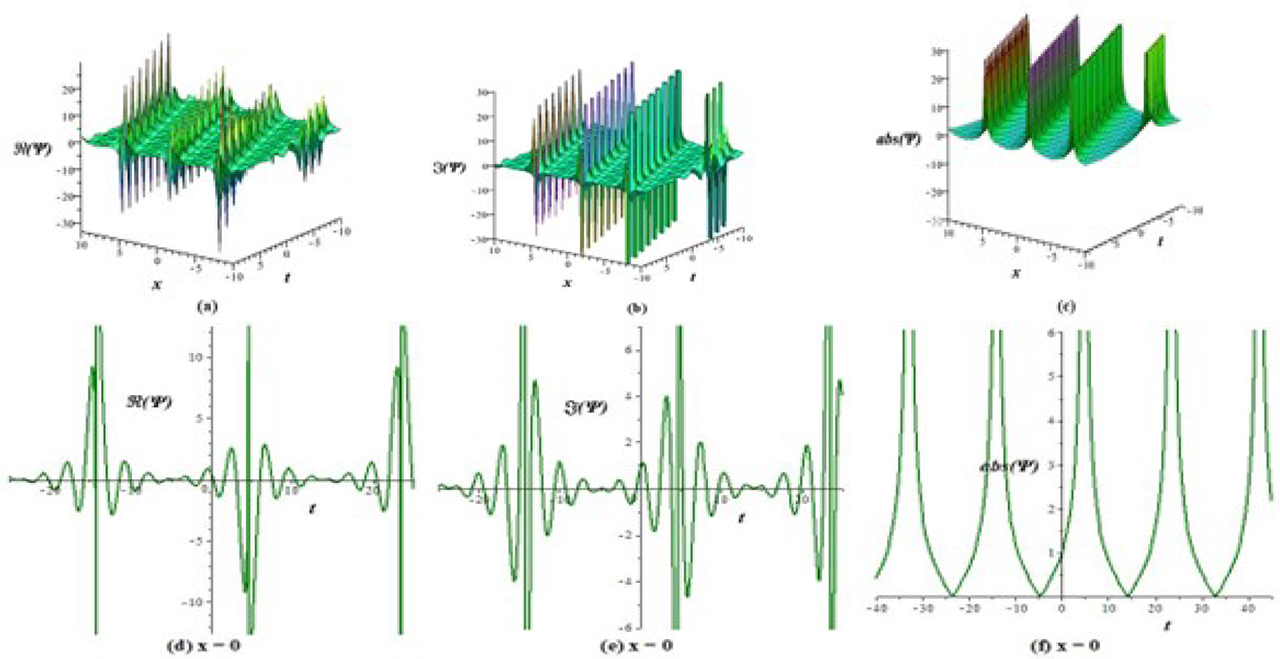
Fig. 3
Graphical representation of ψ6 for M = 0, L = N = r = p1 = ɛ = 1, p2 = k = 2: (a,b,c) cubic wave form, and (d,e,f) 2D wave pattern.
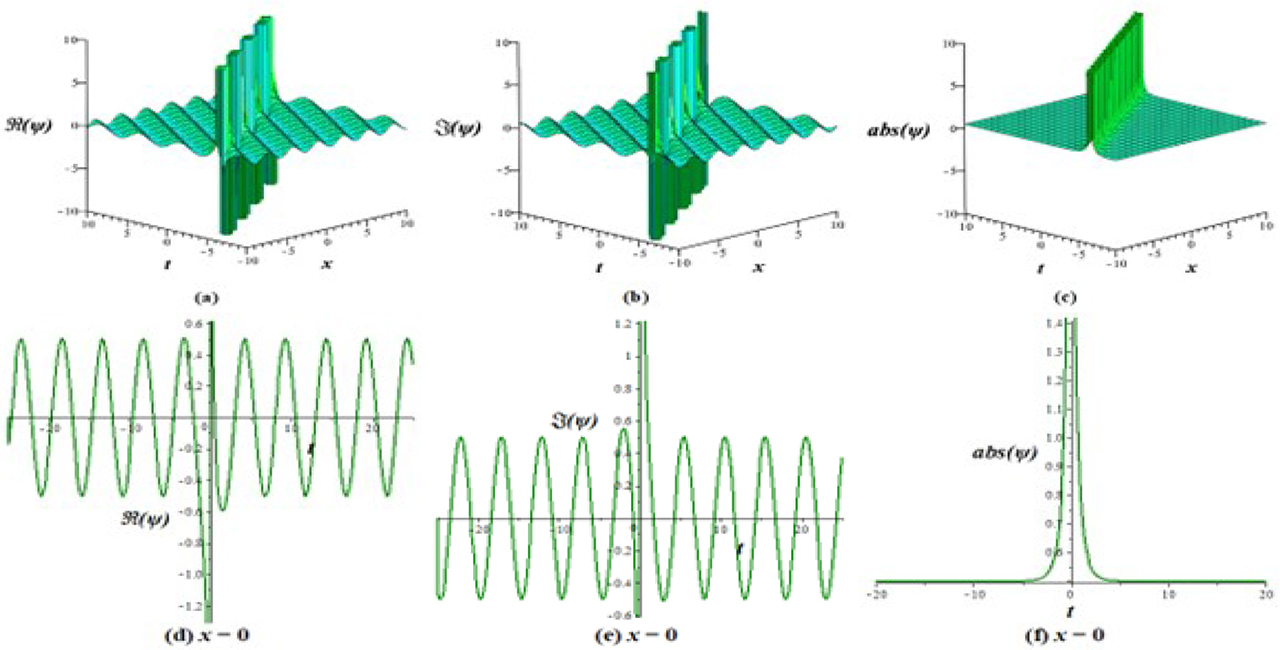
Fig. 4
Outlook of solution ψ7 for q = B = λ = p1 = p2 = β1 = γ = ɛ = 1, r = 2: (a,b,c) cubical wave pattern, and (d,e,f) planner wave pattern.
8. Comparative analysis and novelty of results
This section outlines the uniqueness of the findings and the paper’s significant contribution to the field. Our research direction was established through a comparative assessment of our outcomes with those of recently published investigations [29,30,31,32,33,34,35,36]. A diverse array of analytical methodologies has been employed in the pursuit of soliton solutions to FL equation. The extended trial function technique has been applied to discover soliton solutions characterized as bright, dark, and singular for the FL equation [29]. A group of chirped solutions including bright, dark, and kink solutions is also obtained [30]. By using the complex envelop function ansatz, a class of exact solitary wave solution is found [31]. Matsuno employed a direct approach to successfully derive both bright and dark soliton solutions for the FL equation [32,33]. Optical soliton outcomes in the context of the FL model have been obtained by implementing the φ6-model expansion approach [34]. Recent developments include the presentation of a specific analytical depiction of rogue oscillations within the FL equation [35]. The methodologies involving the Modified Kudryashov’s, the exp(ϕ (ξ)) function, and the sine-Gordon expansion have been harnessed to procure new soliton solutions for the FL equation [36]. We observe that they found bright, dark soliton solutions, kink, and breather waves. However, our study expands the scope, revealing additional phenomena such as dark and bright periodic waves, dark soliton solutions, single and multiple bright breather waves, and single and multiple bright-dark breather waves with singular solutions. Importantly, several of our findings present distinct variations from those previously documented [29,30,31,32,33,34,35,36].
9. Conclusion
This study has presented the direct algebraic, the modified rational sine-cosine, and the (1/G′)-expansion schemes to integrate the FL model to retrieve optical solitons that can be used in birefringent fibers. These procedures allow us to simplify the proposed framework into an algebraic methodology that can be effectively solved using various computational packages. Through these techniques, we have been able to derive double periodic waves, bright soliton, dark soliton, single and multiple bright breather waves, and periodic breather waves of this model through symbolic computation. This underscores the reliability and utility of our suggested approaches, which can be readily applied to various complicated systems that arise in nonlinear science. These solutions are set to have a crucial impact on the progression of subsequent studies involving the model.
10. Declarations
10.1. Conflict of interest
The authors declare that there is no conflict of interest regarding the publication of this paper.
10.2. Author’s contributions
M.I.J.-Writing-Original Draft, Software. M.S.U.-Methodology, Conceptualization and Supervision. H.O.R.-Validation and Writing-Review and Editing. Z.R.-Investigation, Formal Analysis. R.A.-Writing-Review and Editing, Validation. All authors read and approved the final manuscript.
10.3. Funding
There is no funding regarding the publication of this paper.
10.4. Acknowledgement
Thank you so much to Editor-in-Chief Prof. Dr. Haci Mehmet Baskonus for his guidelines and opinions throughout this process.
10.5. Data availability statement
All data that support the findings of this study are included within the article.
10.6. Using of AI tools
The authors declare that they have not used Artificial Intelligence (AI) tools in the creation of this article.