
1. Introduction
This article builds upon previous work identifying the correlation of streaming and the decline of Australian and non-Anglo artist representation in the Australian charts (Kelly, 2024). Tschmuck (2006) identified three technology driven eras in the music industries: sheet music publishing up until the 1920s; broadcasting through to the early 1950s; and the era of the phonographic industry to the early 2000s. Arguably, the recorded music industry is now in its fourth technological era—the era of platformisation.
The adoption of streaming technology fundamentally altered the economics of the recorded music industry (Jensen, 2024). Streaming became the pre-eminent Australian music distribution format in 2017 with a 55.4% market share, rising to 89% in 2024. Spotify is the principal actor in the Australian streaming sector with an estimated market share of 66% (Kelly, 2024). The impact of streaming on the recorded music economy has had a net positive effect, returning the recorded music sector to growth and reversing the revenue decline of 2000–2014. However, not all growth is equal. This article, focused on the Australian market, utilises official trade industry association Australian Recording Industry Association (ARIA) statistics for annual financial and chart information. The data provide the basis to quantitatively analyse the extent to which the streaming economy of the recorded music industry has impacted new music in Australia.
2. Data and Method
An in-depth analysis of the data and method used in this article is detailed in my previous article, Down, and Under Pressure: The Decline of Local and Non-Anglo Best-Selling Recording Artists in Australia 2000–2024 (Kelly, 2024). Moreover, the charts, as barometers of popularity and by extension revenue, reflect the public consumption of new release and catalogue recordings at scale and, in turn, provide some visibility into recorded music revenues and resourcing. To this end, I analysed the ARIA annual top 100 single/album charts 2000–2024 and annual recorded music revenues 2000–2024 to distinguish between new release and catalogue recordings in the period.
The recorded music industry differentiates between new release (or ‘frontline’) recordings and catalogue recordings. New releases are recordings that are less than 18 months old, while catalogue encompasses all titles older than 18 months old (Luminate, 2023). The distinction is more than semantic. Record labels, and particularly major labels, organise financial and staffing resources, especially in marketing, promotions and talent acquisition, according to the value of revenue flowing to either their new release or catalogue departments.2 Whilst there is increasing debate about the value of such distinctions in the modern music economy, in 2022 BMG became the first global label to abandon the distinction between frontline and catalogue (Paine, 2023); for the most part it continues to inform the make-up of departments, budgets and resource allocation at record labels.
For this research, the application of a strict 18-month rule for new release was deemed over-complicated, partly due to the practice of staggered international release dates in the first decade of the century and partly due, in practice, to the internal company switch from new release to catalogue occurring at the beginning of a calendar year.3 Therefore, this analysis determined a new release recording as anything released in the year of or the preceding year of the chart. For example, in the 2020 annual charts a new release constituted all releases from 1 January 2019 to 31 December 2020. Any title released prior to 2019 was deemed catalogue. The album charts often contain compilation albums, newly formatted releases of previously released recordings. Compilation albums are predominantly made up of Greatest Hits, Best of and similar collections of catalogue recordings bundled together in a new format. These recordings are grouped separately to new release and catalogue recordings. It is worth noting that multi-artist hits albums, such as the successful So Fresh and Now That’s What I Call Music series of albums, were not eligible for the album charts in Australia, and accordingly have not been included in the data.
The qualitative component to this research was provided by 15 in-depth, semi-structured interviews conducted during 2024 and 2025, exploring the impact of global consolidation in recorded music on decision making for artists and creative managers. The participants were recruited on the basis of being practising, professional artists or creative managers in the Australian recorded music industry.
3. Findings
Prior to streaming, music ownership was determined by consumer purchase decisions. Whether the format be vinyl, cassette tape, compact disc or download, the consumer purchased, via a one-time payment, the recording to own in perpetuity. Due, in part, to limited store space, the recorded music industry in the purchase age was predominantly a new music business with the latest offerings given prominence in high-street retail displays. Streaming technology altered the consumer relationship and the revenue flow of music. In the streaming economy revenue is determined by how many times the consumer plays a song, whether by direct choice or via platform curation, in what has been described as a consumption economy (Luminate, 2025; Pelly, 2025).4 Revenue flows from what is played rather than purchased. The dramatic switch from physical to streaming in Australian recorded music revenues is visually represented in Figure 1.
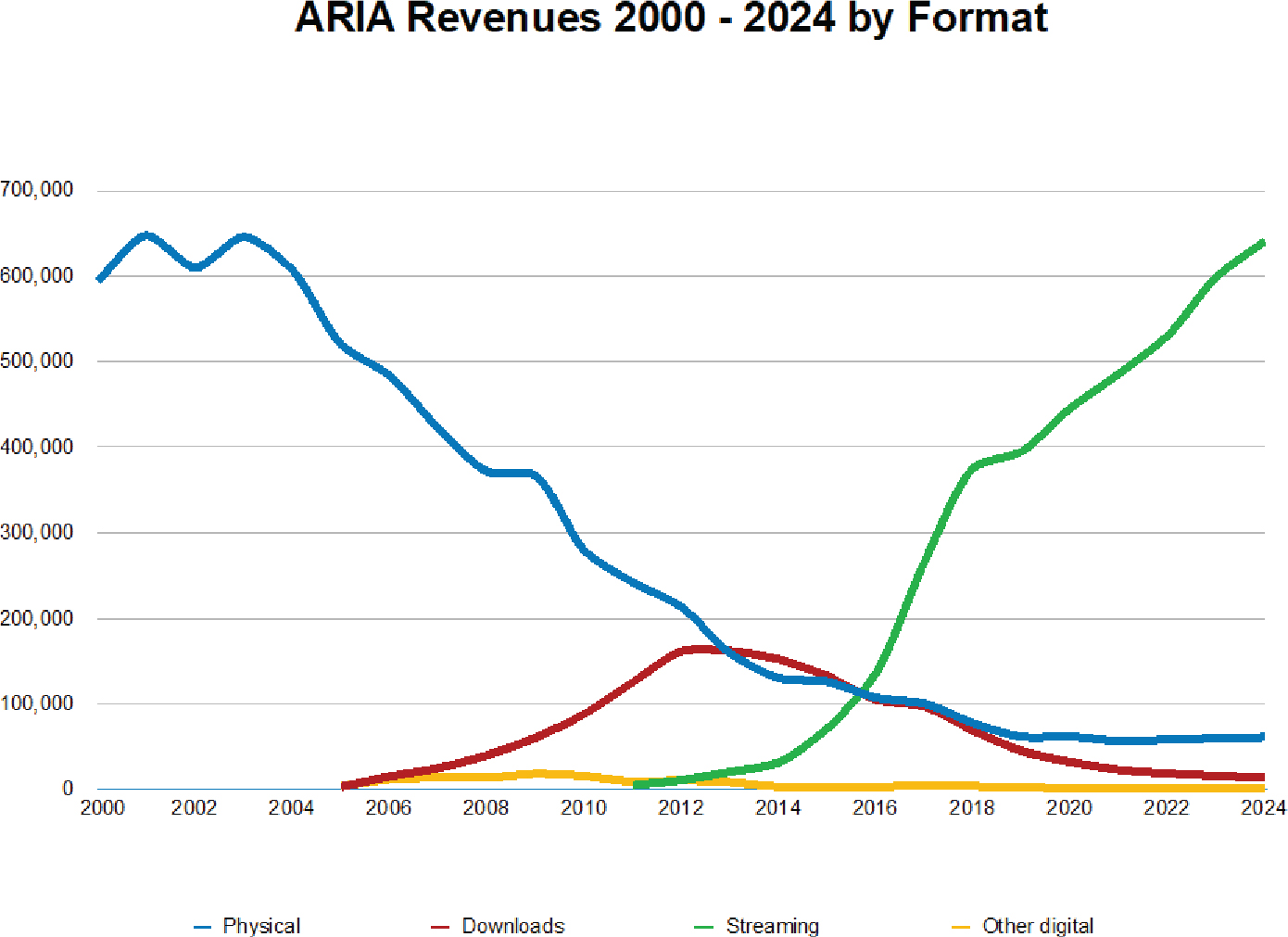
Figure 1.
ARIA annual revenue 2000–2024 by individual format type.
The public adoption of streaming services and the emergence of catalogue recordings in the ARIA charts is evidenced in the analysis of the best-selling singles and albums during the period.
Figure 2, 5 reveals that the annual single charts were almost exclusively the preserve of new release recordings from 2000 to 2018, accounting for a 99% chart share. Since 2018, exponential growth has seen catalogue share increase from 5% in 2019, to 15% in 2020, 25% in 2021, and 41% in 2023 with a slight decline to 34% in 2024.6 The growth of catalogue chart share has been partially fuelled by what might be termed as recent catalogue. In 2022, for example, hits from 2019 and 2020, the 2 years prior to new release status, accounted for 12 of the 39 catalogue entries.7 However, the bulk of catalogue share, 27 of the 39 entries, were deep catalogue, that is, releases over 4 years old.8 Similarly in 2024, 12 of the 34 catalogue entries were from 2021 to 2022, with 22 deep catalogue entries.9
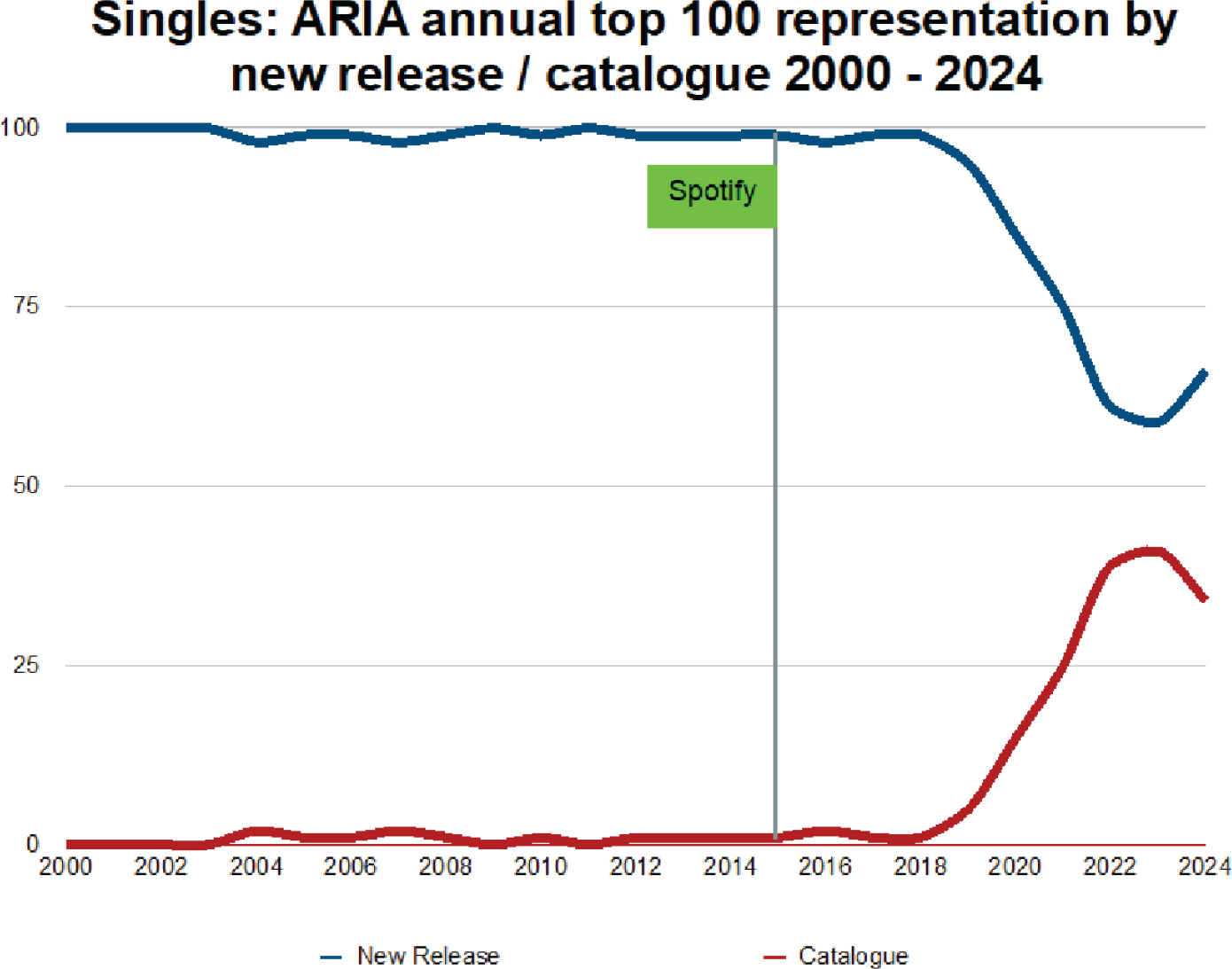
Figure 2.
ARIA annual top 100 single representation by new release / catalogue 2000–2024.
The album data in Figure 3 reveals more pronounced change. Catalogue albums averaged an approximate 9% share between 2000 and 2011. That rate doubled to 18% between 2012 and 2017, the formative years of streaming adoption. Since 2018, catalogue share of the annual top 100 albums has grown from 24% to 70% in 2023, declining slightly to 67% in 2024. As with singles, whilst 18 of the 64 catalogue albums in 2022 can be classified as recent,10 the majority, 46 of the 64, are ‘deep catalogue’ pre-dating 2019.11 Similarly, in 2024, 41 of the 67 catalogue entries are deep catalogue.12 The compilation album market declined from an average of just over 10% in 2000–2011, to 2.75% in 2017–2024. In this zero-sum game, the rapid gains of catalogue recordings are matched by the equal decline of new release titles. Between 2000 and 2016, new release albums accounted for just over 75% of the top 100. In 2023, new release share was 26%13 with 28% in 2024.14 The data indicate that catalogue, in both best-selling single and album charts, has rapidly increased the chart share at the expense of new releases. In a fragmented music economy (Chayka, 2025; Hesmondhalgh, 2022; Music Ally, 2024), it is worth asking if the top 100 charts reflect the wider economy of recorded music revenues. For this, we turn to annual recorded music revenue data for the Australian market as a whole.
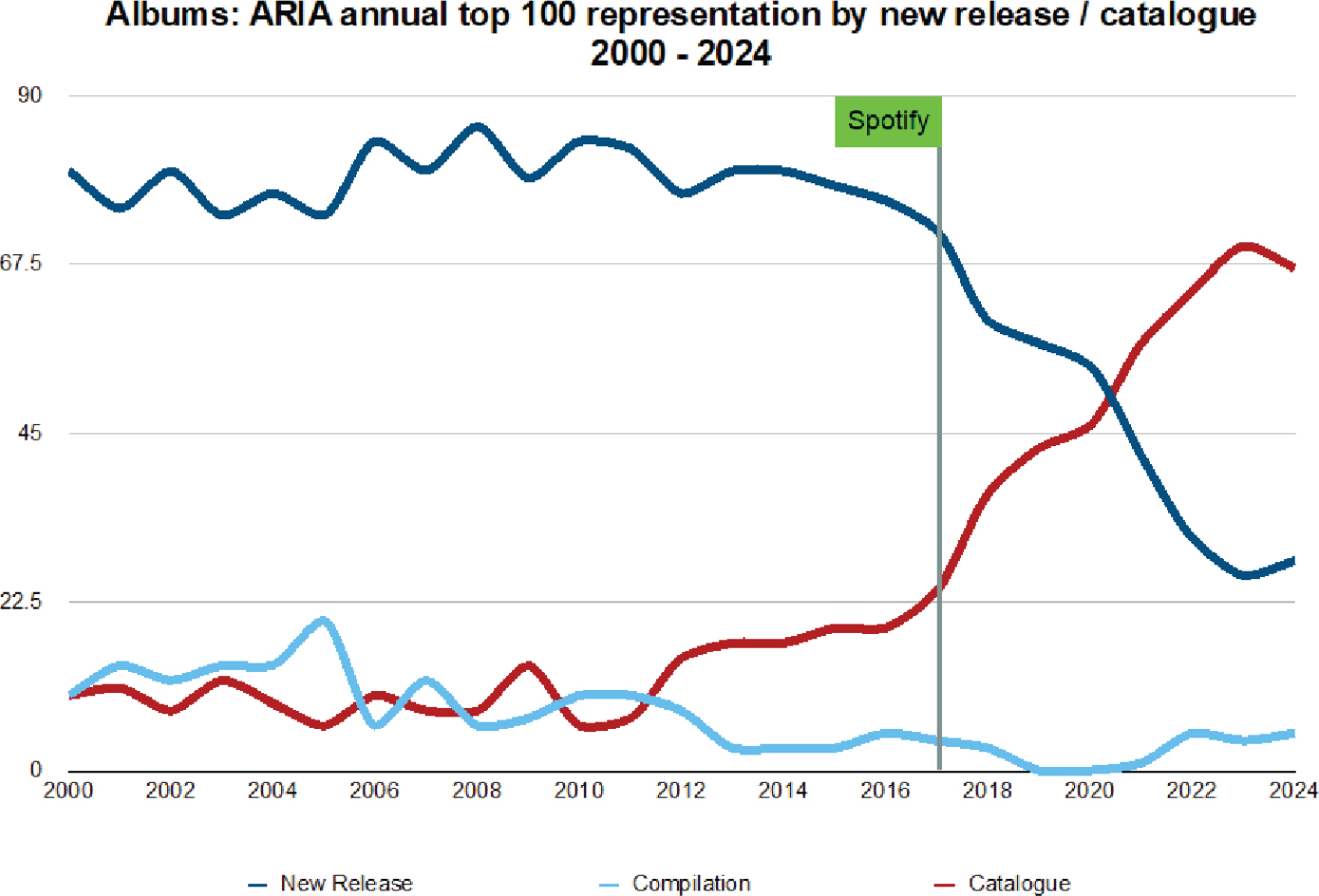
Figure 3.
ARIA annual top 100 album representation by new release / catalogue 2000–2024.
The ARIA revenue data is grouped into the release formats of physical (compact discs [CD], vinyl, cassette tapes), downloads (predominantly iTunes) and streaming revenues. These categories were coded to replicate International Federation of the Phonographic Industry (IFPI) measurements providing comparisons between the Australian recorded music market and the global recorded music economy. The physical (CD driven) market produced record global revenues in 1999 (Lozic, 2020), with a high in Australian revenues following suit in 2001. The decline of the CD revenue model accelerated from 2005, and the introduction of paid downloads via the iTunes store failed to arrest the overall deterioration of recorded music revenues. The correlation of recorded music revenue growth and streaming is shown in Figure 4.
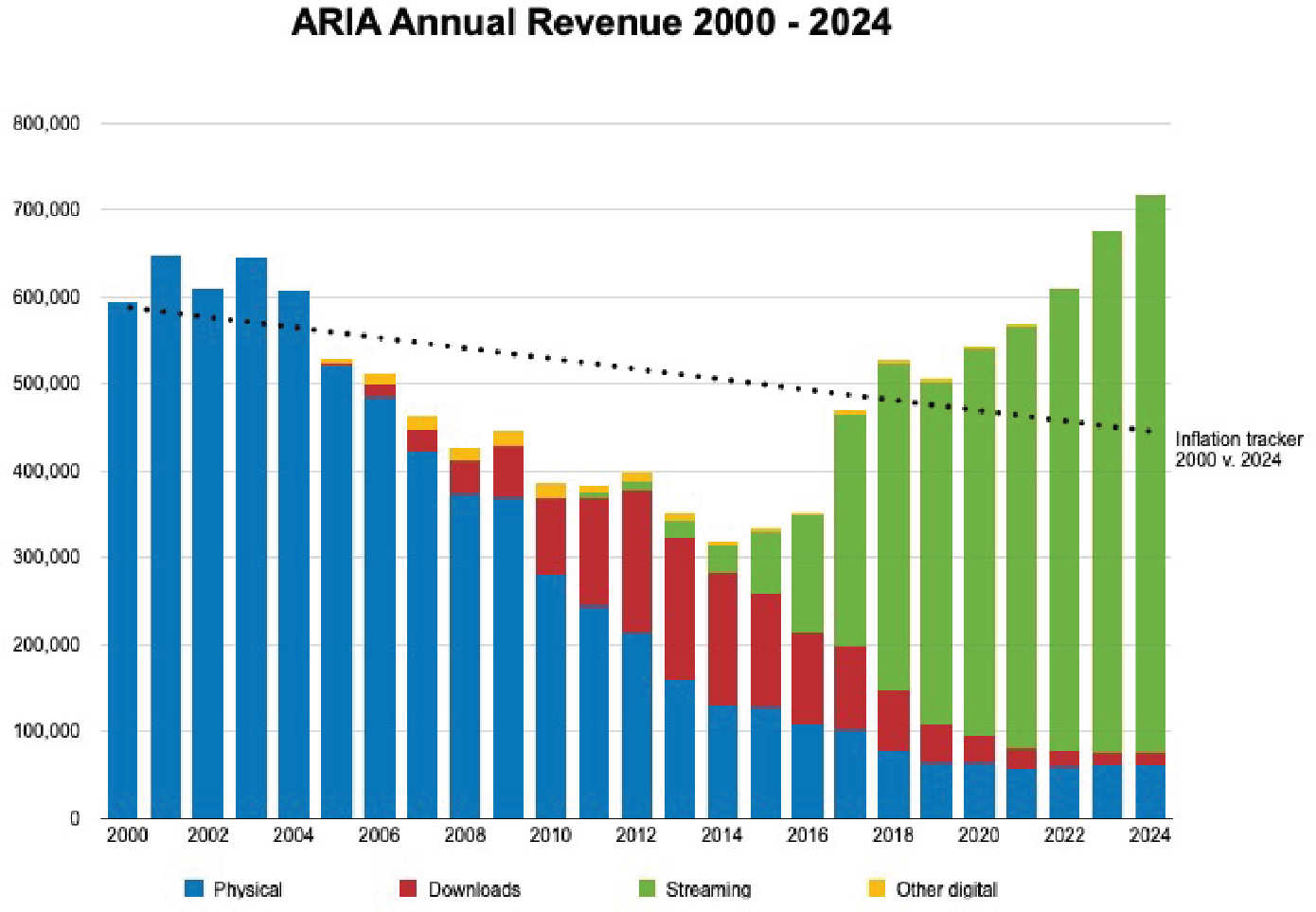
Figure 4.
ARIA annual revenue 2000–2024.
Whilst revenues in 2023–2024 exceed the levels of the early 2000s, on an inflation adjusted basis, indicated by the inflation line,15 Australian revenues in 2024 were down to 37.8% from 2000. Nonetheless, streaming has been fundamental to positive recorded music revenue growth in Australia, and globally, since 2014.
There is varied data pertaining to the revenue split between new release and catalogue income streams. Brooks (2022) estimated a 65%/35% new release to catalogue ratio in 2004.16 In more recent years, analysis indicates a catalogue share of market between 70% and 73%, and growing (Gioia, 2022; Ingham, 2022; Luminate, 2023). The old, new release-driven model has flipped to a catalogue economy with older music now being the mainstay of recorded music in general, and the major labels in particular. As one major label insider, requesting anonymity, commented, “We know how to distribute music; we know how to bank catalogue” (P.C., November 2024). The implication of Brooks (2022) 65% new release/35% catalogue revenue split for the pre-streaming economy of 2000 and 2014, and an estimated 70% catalogue share in 2023, is strong evidence that, in Australia, whilst streaming ‘saved’ recorded music, it did so to the detriment of new music.
Figure 5 estimates Australian new release revenue in 2000, 2014 and 2024. In raw numbers, 2000 new release recordings generated approximately A$386,082,000 (65% of the total) in revenues. In 2024, new release accounted for approximately A$215,141,000 (30% of total), representing a decrease in revenues of A$170,940,000 or 44.3% from 2000. Inflation adjusted, indicated by the dotted red line, the value of new release recordings declined by 71.3% between 2000 and 2024. The value of new release recordings in 2014, the low point for music revenues this century, was approximately A$206,563,000.17 The value of new release music, since 2014, has increased by just 4% in a market that has doubled its value during that period.
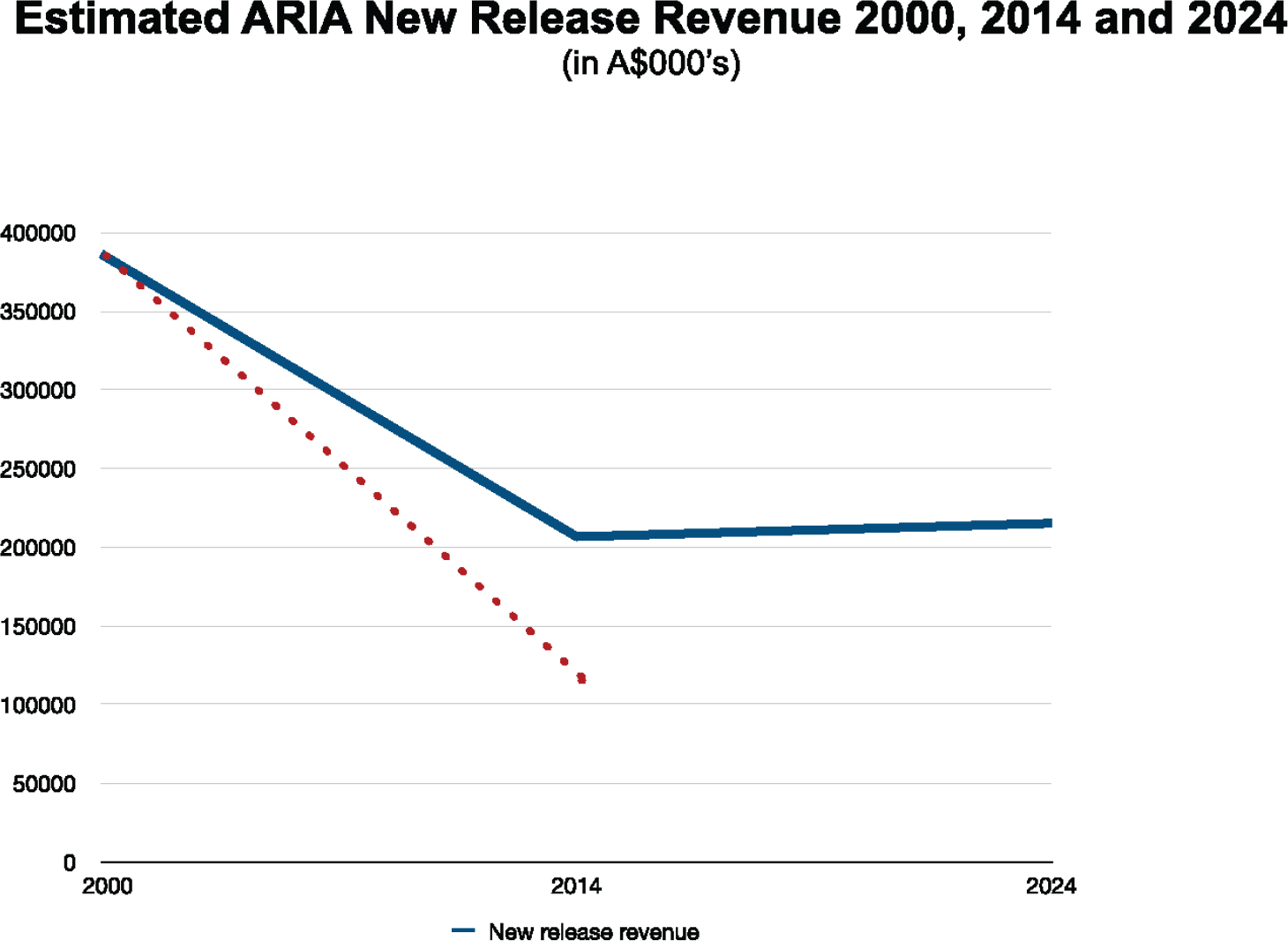
Figure 5.
Estimated ARIA new release revenue in 2000, 2014 and 2024.
The revenue shift from new release to catalogue has prompted debate that consumers are now listening to more catalogue music than they did previously (Hesmondhalgh, 2023). In one sense, this is conjecture. Whilst streaming data reveals what consumers listen to, when and for how long, in the pre-streaming age the industry only knew what people purchased, not what they played. However, several commentators have observed that streaming platforms encourage listening to older music through availability and algorithmic design (Chayka, 2025; Pelly, 2025; Singer, 2024a).
Impacts of the streaming model and the reduction of revenue for new release recordings include the subsequent shifting of resources by labels from new release to catalogue-driven investment (Cirissano, 2022). In recent years, high-profile catalogue acquisition has included Sony Music’s US$1billion + procurements of the Queen (Grow, 2024), Bob Dylan (Snapes, 2022) and Pink Floyd (Aswad, 2024a) catalogues and major label acquisition of independent label market share exemplified by Universal Music’s purchase of PIAS Recordings18 and Downtown Music (Stasssen, 2024) at the expense of investment in new music. Additionally, lower barriers of entry to industry provided by Internet access and streaming platforms has produced an explosion of new release music, and therefore increased competition, with an estimated 120,000 songs uploaded to Spotify daily (Luminate, 2023) exacerbating the pressure for new release recordings to compete in a concentrated field. Commentators argue that the intensity of competition for reduced revenues from and between artists releasing new music has potentially led to growing pressure to self-promote within institutionalized industry frameworks (Haynes & Marshall, 2018, p.1974; Klein et al., 2017, p.231). From an Australian perspective, the challenges for new music have created concern about pathways to success for emerging artists in the industry generally and the commitment of labels to develop artists specifically.
4. Discussion
Global and Australian revenue graphs correlate the rise of recording music revenues from 2014 with the public adoption of streaming services. The paradigm-shift from ownership to access models of music consumption moved the economy of music to one driven by consumer listening habits rather than purchase decisions, revealing a public preference, encouraged by platform design, for catalogue from a listening perspective. As such, the flow of revenues has moved from new music to older music. The rise of catalogue in the charts reflects these changes and fundamental shifts in industry have resulted. The competition for market share between labels has changed from expertise in introducing novel products to the market to scale generated by catalogue, something Universal Music Group CEO Lucian Grange foresaw when acquiring EMI in 2012.19 Revenues derived from catalogue scale have reduced the necessity of major record labels to develop new talent. Recent consolidation of frontline (new release) labels at Universal UK, merging Island Records and EMI, and Universal US, merging all frontline imprints into Republic and Interscope label groups, is testament to the declining focus on new release recordings (Aswad, 2024b).
Research interviews with artists and creative managers in Australia I conducted point to a local industry that has largely outsourced artist development to the artist, or, by default, their manager, and is generally unable to address wider market dynamics. One A&R person, requesting anonymity, stated, “No one’s broken anything”20 (P.C, November 2024), before going on to say the pressure to ‘break’ artists has lessened as competitors are not setting a competitive bar of achievement. Interview participants, all requesting anonymity, felt that the major record labels had for the most part exited their responsibilities for artist development. Comments include:
“Artist development with major labels is a thing of the past.”
Artist Manager (P.C., July 2024).
“Artist development is now in the hands of the artist.”
Label Executive (P.C., August 2024).
“The majors have forgotten how to break stuff.”
Marketing Executive (P.C., May 2024).
“I’m talking majors here; they miss the whole artist development thing.”
Artist (P.C., March 2025).
One industry identity, also requesting anonymity, felt that such comments were unfair on Australian labels and that artist development was still critical to their operations: “The sense I get from the major labels locally is they’re just as much in the Australian music game as they’ve ever been…if they’re not trying then it’s going to be taken off them.” (P.C., October 2024). However, another figure in the Australian music industries pointed out that the consolidation of recorded music around US-led companies, governance and design has restricted the ability of Australian labels to influence their own market: “Labels are largely powerless to influence music discovery, particularly at an Australian level.” And that emerging artists need to recognise this situation, “If you think they (major labels) can get you to first base, clearly you’re looking for love in all the wrong places.” (P.C., August 2024).
The economic impact on new artists and new releases has been significant. The advent of streaming for new music, in Australia, failed to reverse the revenue declines of 2000–2014. In 2024, new music revenues were found to have declined to an estimated 55.7% in actual value and 71.3% in inflation adjusted value compared with revenues in 2000. Actual new recorded music revenues are only marginally, 4%, higher than in the 2014 low-point of recorded music revenues in the market. In the past 10 years, new music revenues are essentially flat in a market that has grown 125%. As noted earlier, the deteriorating presence of new music is given visibility in the annual ARIA top 100 single and album charts. In the single charts, an average of 99% new music share in 2000–2018 decreased by 37%–62% in the period 2022–2024. In the annual album charts, an average 78% share in 2000–2018 declined by 50% to 28% between 2022 and 2024. Moreover, there are broader implications, with much of the discourse around new music discovery focusing on what has been termed the ‘flattening’ of culture with algorithmic design leaning to centrist curation, a culture of nostalgia and passive consumption (Chayka, 2025; Han, 2022; Pelly, 2025; Singer, 2024b).
The stress of the new release economy combined with a reduced presence of Australian artists in the ARIA chart has led to ongoing industry appeals for government support via cultural policy initiatives, exemplified in a Rolling Stone interview with ARIA CEO Annabelle Herd (Griffiths, 2025). In addition to cultural policy initiatives, there is also a role for the recorded music industry to play in addressing the environment it played a role in creating.
In the purchase-led music economy, new release retailed at full-price, with a full-price royalty accounted back to the artist, whilst the bulk of catalogue was released at mid-price with a mid-price royalty returned to the artist account. In essence, new music was given a greater value than old music. The current ‘pro-rata’ streaming remuneration model, which has remained in place since the introduction of streaming technology, places equal value to a song regardless of circumstance (Jensen, 2024), whether it is actively or passively streamed, whether it is a new release or a catalogue release, thereby reducing the economic incentive for industry to prioritise the processes of signing, marketing and selling new music. If the recorded music industry is concerned about the introduction of the next wave of talent for future revenues, it may need to incentivise itself by rebalancing the economic playing field of music remuneration. Resistance to change in what, for the key rights holders, is a growing recorded music economy, will be entrenched due to business focus on short- and medium-term financial results. In the longer term, the infusion of new talent into the recorded music industry seems essential to continued growth. McIntyre (2008), in applying Csikszentmihalyi’s Systems Model of Creativity (2014), argued that industry can be open or closed to new products, with Scott (in Leyshon, 2001) making the point that the introduction of new products is the lifeblood of industry. A view echoed by Tim Levinson, artist (known as Urthboy), manager and independent label owner (Elefant Traks), who described artist development as: “That’s where the health is, that’s where the heartbeat (of industry) is” (Levinson, T, P.C., August, 2024).
Streaming remuneration model discourse has, for the most part, focused on the User Centric Model (UCM), whereby each user’s subscription is distributed in relation to their listening habits. However, modelling by Moreau et al. (2024) has shown that the UCM will further benefit catalogue over new music. Jensen (2024) highlights two models focused on active rather than passive listening that could benefit the new music economy. The Active Engagement Model attaches premium value to songs specifically chosen by the user, with a lesser rate allocated to passive engagement streams. In a similar fashion, the Excluding User’s First Stream Model postulates that the first stream is a sample of the product and should not be remunerated, thereby eliminating one-time passive streams whilst incentivising industry to ensure users return for further engagement with the song. The European independent music companies’ association IMPALA proposes an Artist Growth Model (IMPALA, 2024), which reduces royalty payments on a sliding scale as streams move up the play count dial, thereby bolstering the lower end of the streaming economy to instigate discovery. An additional consideration is a New Release/Catalogue model with a higher royalty tier for new release and lower-tier remuneration for catalogue, driving the new release value proposition for investors and labels.
5. Conclusion
In Australia the new music economy has experienced a significant revenue decline. Catalogue recordings are now the dominant driver of music industry revenues. The decline of new release revenue and chart presence has led to a reduction in resources and pathways for novel products to enter and energise the recorded music market. The changed landscape has significant implications for new artists, industry and culture. For new artists, the lack of a pathway to generate sufficient revenue may lead to the questioning of whether to engage in the sector. For independent labels, dependent on new release revenue, the ability to compete in a catalogue market is limited. The role of the major Australian labels, who continue to profit via catalogue and US-led superstar artists, in developing Australian talent both in Australia and overseas is also in question. A rebalancing of the value of new music in relation to catalogue recordings could incentivise industry to address resource allocation and artist development to drive company profits and ensure long-term dynamism in the sector. Culturally, in Australia, the decline of new music impacts new Australian music first and foremost, and carries with it the threat of the continued erosion of a dynamic Australian culture in the music industries.
About the Author
Tim Kelly is Program Director for the Bachelor of Music Business at the Australian Institute of Music and a PhD candidate at the University of Technology, Sydney. The working title of his thesis is–Diversity, Conformity, and Creativity: The 21st Century Recorded Music Industry. A former record label executive, he has held senior positions at One Little Indian Records, Rough Trade Records, Pinnacle Entertainment, Sony Music Australia, Universal Music Australia, Sony Music Australasia and Inertia Music. He was an ARIA Chart Committee member 2005–2014 and 2015–2017.
Acknowledgment
The author acknowledges the assistance of Phil Hayward, Robert Sazdov, Brent Keogh and Jeff Crabtree.
Notes
[1] Conflicts of interest Conflict of Interest
The author declares no conflict of interest.
[2] In this context the term ‘creative managers’ applies to industry intermediaries between artists and the market. Specifically, Artist and Repertoire (A&R) managers, artist managers and marketing executives.
[3] I was head of marketing for ‘frontline’ (new release recordings) for Sony Music and Universal Music for >15 years, during this period experiencing the influence of revenue flows on department resourcing.
[5] The term consumption used to include all streams has been challenged in the author’s interviews with industry executives, some of whom argue that passive playlist listening in social environments (i.e. cafes, shops, gyms) does not equate to the consumption of music by an individual.
[6] The introduction of streaming data into the charts (24 May 2014 for singles and 13 May 2017 for albums) is flagged with a Spotify logo on Figures 2 and 3 for ease of reference.
[7] At the time of writing, it is not apparent if the slight decline in catalogue entries in both single and album charts is an indicator of a forthcoming trend.
[9] Deep catalogue share included hits from artists such as Kate Bush from 1985 (driven by a synchronisation with the hit Netflix series Stranger Things), The Killers 2003, Fleetwood Mac 1977 and Frank Ocean 2012.
[10] Deep catalogue share included hits from artists such as Vance Joy (2013), The Killers (2003), Fleetwood Mac (1977) and the Goo Goo Dolls (1988).
[11] Recent catalogue share included albums from Harry Styles, Dua Lipa, Billie Eilish and Luke Coombs.
[13] Deep catalogue share included several Taylor Swift albums and recordings from Luke Coombs, Maroon 5, Eminem and Fleetwood Mac.
[15] 2024 new release share included albums from Taylor Swift, Billie Eilish, Sabrina Carpenter and Morgan Wallen.
[16] Inflation rates calculated via the Reserve Bank of Australia (RBA) inflation calculator: www.rba.gov.au/calculator/
[17] Which aligns with the 65%–70% in favour of new release the author recalls whilst working at Sony Music and Universal Music in Australia during this period.