
Table 1
The existing CRM options can be summarised by differentiating between the management of one (uni) or more (multi) CMO-repertoires and/or territories (Riis 2016: 91; Schwemer 2019; Klobučník 2021).
| UR | MR | |
| UT | Direct memberships in traditional CMOs (Klingner et al. 2021): Most frequently, traditional CMOs handle international royalties on a UT-MR basis through representation agreements with other CMOs. Nevertheless, rightholders in the EU are allowed to register, authorise and withdraw management rights from CMOs under Directive 2014/26/EU. PAs such as Songtrust or Kobalt maintain relationships with CMOs worldwide. As a result, uses are processed faster and more accurately, as CMOs can directly identify their own repertoire. | CMO representation agreements: Traditionally, CMOs license the repertoire of other CMOs based on representation agreements. This is the default case when rightholders authorise a single CMO. In this case, licensees are bound to exploit in the acting territory of the licensing CMO.
|
| UR | MR | |
| MT | Single RME-management (Directive 2014/26/EU: Recital 37): Under current EU law, rightholders are allowed to manage their rights or certain delimitations thereof themselves, through a CMO, or any other RME. Some of these RMEs, having their own online repertoire, are listed to the right.
| Cross-licensing: In this case, several CMOs concluded an agreement, to give each other the right to license online rights on a MT-MR basis.
|
| One-stop-shops (Article 32): Although strictly speaking it is an MT-MR licence, the CMOs have voluntarily decided to pool their repertoires in some way. While the cooperating CMOs own the rights to their repertoire individually, they share a common database and may have a common front, middle and back office, resulting in a homogeneous representation of the repertoire. However, as with each of the above options, licensees are still constrained by the repertoires of the CMOs involved (e.g. ICE). |
[i] AMRA, American Music Rights Association, Inc; BIEM, Bureau International de l’Edition Mecanique; CISAC, Confédération Internationale des Sociétés d’Auteurs et Compositeurs; CRM, collective rights management; MR, multi-repertoire; MT, multi-territorial; MT-MR, multi-territorial and multi-repertoire; MT-UR, multi territorial uni-repertoire; OLEs, other licensing entities; OMSPs, online music service providers; PAs, publishing administrator; PRS, Performing Right Society Ltd; RMEs, rights management entities; UR, uni-repertoire; UT, uni-territorial; UT-MR, uni-territorial and multi-repertoire.
Table 2
Demographics of survey participants (Klingner et al. 2021).
| P1 | P2 | P3 | P4 | P5 | P6 | P7 | P8 | P9 | |
|---|---|---|---|---|---|---|---|---|---|
| Business Role | Label, Publisher | Publisher | Label, Publisher | Publisher | Label, Publisher | Label, Publisher | Label, Publisher, Studio | Label, Publisher | Label, Publisher |
| Genre | Popular Music; no specific genre | Classical music | Popular music; Jazz | Popular music; no specific genre | Popular music; Pop | Popular music; Production music TV | Popular music; Pop | Popular music; Illustration music TV | Popular music; Compositions TV |
| Role of interviewee | Managing Director | Wide range of tasks | Wide range of tasks | Managing Director | Contracts, A&R, Copyrights | Managing Director | International Copyrights | Wide range of tasks | Managing Director, Royalties, Administration |
| Employees | 7 + 4 freelancer | 20 | 9 | 4 | 10 | 2 | 15 | 6 | 9 |
| Sales Revenue (€) | 100.000–2 Mio. | 10–50 Mio. | 100.000–2 Mio. | 100.000–2 Mio. | 100.000–2 Mio. | 2–10 Mio. | 100.000–2 Mio. | 2–10 Mio. | 100.000–2 Mio. |
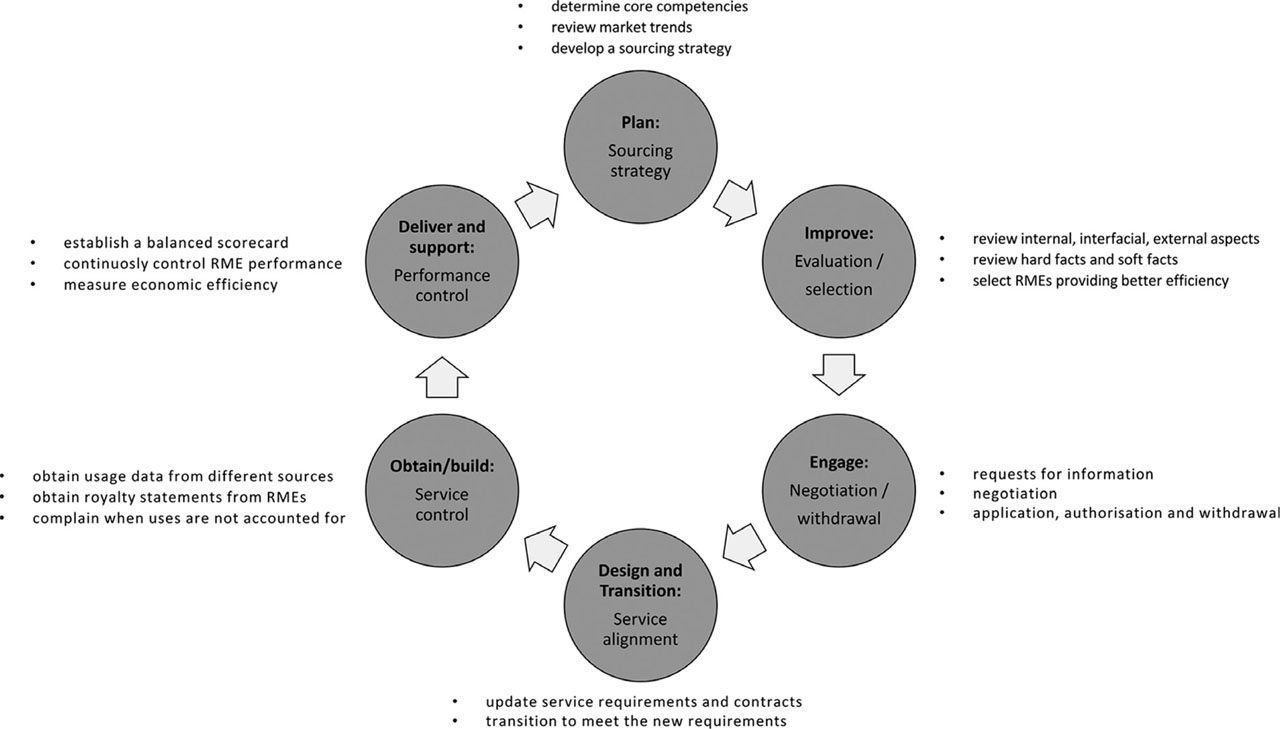
Figure 1
Phases of RMERM. RMERM, RME relationship management; RMEs, rights management entities.
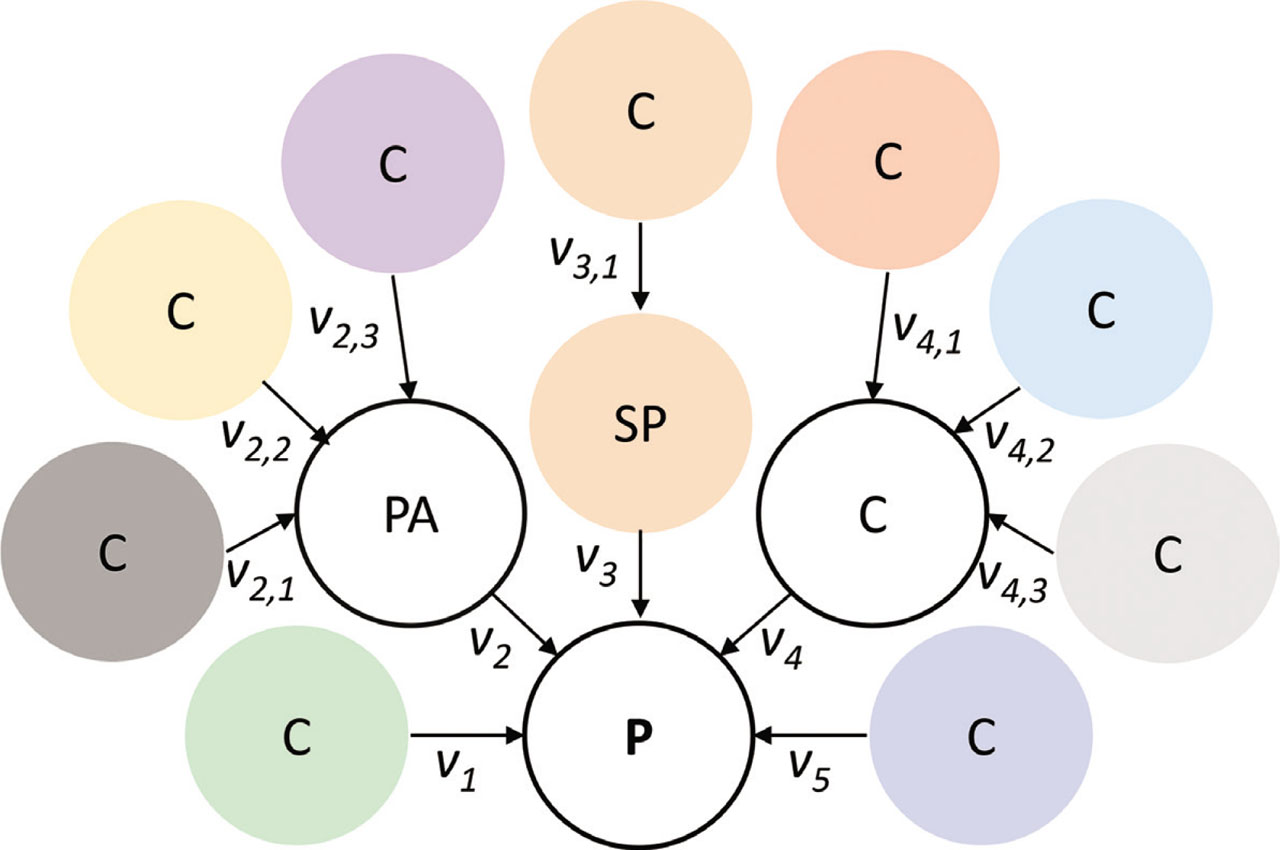
Figure 2
Example of an outsourcing business model for RMERM. PA, publishing administrator; RMERM, RME relationship management; SP, sub-publisher.
Table 3
Factors for improvement of the copyright management chain for a target area
| Publisher | Publisher, RME | RME |
|---|---|---|
| Internal, high influence | Interfacial, medium influence | External, low influence |
| A. Should I invest in restructuring my current copyright management chain, e.g. by establishing a direct relationship with an RME for certain territories/rights categories? | ||
|
|
|
| B. Which factors do I need to review for the evaluation and selection of the best fitting RME-solution for certain territories/right categories? | ||
|
|
|
[i] KPIs, key performance indicators; RME, rights management entities.
Table 4
CMO performance indicators adapted from (adopted from Rochelandet 2003)
| OPTIC: Management ratio | P/C | P = Collected sum |
| NDRAT: Net distribution ratio | (R + F)/P | E = No. of employees |
| COPE: Collected sums per employee | P/E | C = Costs sum |
| COPM: Collected sums per member | P/M | M = No. of members |
| DIPM: Distributable sums per member | R/M | R = Distribution sum |
| NONR: Non-distributed copyrights | Rpot/Reff-1 | F = Funds sum |