
INTRODUCTION
This qualitative study unpacks how repatriated Self-Initiated Expatriates (SIEs) leverage various forms of intelligent career capital (as revised and re-labelled by Arthur, Claman, and DeFillippi, 1995) to establish and launch new small to medium-sized enterprises (SMEs) in the ‘Born Global’ Irish animation industry. “Employment decisions and career narratives have to be contextualised” (Morris, McKinlay and Farrell, 2023, p.357) within the relevant industry, structures, and networks (Eikhof, 2017), and the context of our study features a highly globalised, non-competitive industry practising high-intensity collaboration rather than competition as the prevailing ethos. ‘Born Global’ firms are businesses with “a global niche market focus from day one” (Moen, Sorheim and Erikson, 2008, p. 536). They quickly enter the relevant international market looking for “significant competitive advantage from the use of resources and the sales of outputs in multiple countries” (Oviatt and McDougall, 1994, p.49). Ireland’s animation sector exemplifies a Born Global industry, one that is characterised by rapid internationalisation and reliance on foreign markets and networks (Smith-Auchmuty and O’Connor, 2023). This makes it an ideal context to study how repatriated SIEs apply their career capital (Parker, Khapova and Arthur, 2009), as the urgency to enter international markets makes the ability of the repatriated SIEs to mobilise their international capital and experiences, encompassing three interdependent “ways of knowing” (Knowing-why, Knowing-how and Knowing-whom), a valuable asset for the Born Global firm. This area has not been extensively explored previously.
To address the question, “How does repatriated SIE career capital affect business outcomes within ‘Born Global’ firms?”, this study provides qualitative evidence regarding the influence of repatriated SIEs’ capital mobilisation on their efforts to reestablish careers and businesses in their home country. Drawing from literature in Career Studies, International Business and Human Resource Management, we analyse the capital utilisation of repatriated SIEs through the lens of intelligent career capital (Arthur et al., 1995). The extant and growing SIE literature has concentrated on the act and experience of expatriation, with a notable lacuna in the work on SIE repatriation (Ellis, Thorn and Yao, 2020). With a few exceptions, such as Crowley-Henry, O’Connor and Suarez-Bilbao (2021), there are also limited studies on the host country’s utilisation of repatriated SIEs’ accumulated capital (Israel, Cohen, and Czamanski, 2019). This study addresses this gap by enabling a relational understanding of how repatriated SIEs mobilise their capital within Born Global firms.
SELF-INITIATED EXPATRIATES (SIEs)
Unlike assigned expatriates, SIEs navigate cross-border mobility through self-directed agency, accumulating diverse career capital that enhances adaptability and marketability (Al Ariss, Koall, Ozbilgin, and Suutari, 2012). However, the diversity of terms in the existing literature on international mobility has created conceptual challenges. This issue has been addressed in studies such as Crowley-Henry, O’Connor, and Al Ariss (2016), Cerdin and Selmer (2014) and Andresen, Bergdolt, Margenfeld and Dickmann (2014). Most literature focuses on three main categories of internationally mobile workers: Organisation Assigned Expatriates (AEs), Self-Initiated Expatriates (SIEs), and Skilled Migrants, with SIEs being the central focus of this study.
Assigned Expatriates (AEs) are employees temporarily sent overseas by their home companies, as defined by Alshahrani and Morley (2015) and Brewster and Scullion (1997). They receive organisational support during relocation, their time abroad, and repatriation (Cerdin and Selmer, 2014). This support differentiates AEs from Self-Initiated Expatriates (SIEs) and skilled migrants.
Skilled migrants are individuals who move from developing to developed countries, often facing challenges such as vulnerability, discrimination, underemployment, and limited career agency (O’Connor and Crowley-Henry, 2020; Zikic and Klehe, 2021). Their migration is usually motivated by a desire to improve their material or social conditions for themselves and their families (Zikic, Mansoori, and Voloshyna, 2024). Typically, these migrants settle in their host countries for extended periods or permanently (O’Connor and Crowley-Henry, 2020).
In contrast, Self-Initiated Expatriates (SIEs) (Suutari and Brewster, 2000) are characterised as “endowed with agency” (Al Ariss et al., 2012, p. 94) and make the independent decisions to move abroad for career opportunities, adventure, travel, or lifestyle reasons (Doherty, 2013). SIEs evolved from the Overseas Experience (OE) idea introduced by Inkson and Myers in 1997, emphasising travel, adventure, and personal growth. Initially, the OE concept was not career focused. However, Cerdin and Selmer (2014) later defined four key criteria for SIEs: (1) self-initiated international relocation, (2) intention to seek regular employment, (3) plans for a temporary stay, and (4) possession of skills and/or professional qualifications. These four criteria identify the research population for this study as SIEs. All interviewees possess professional or skilled qualifications, have self-initiated their expatriation, and have sought and obtained employment in the host country, with the intention of eventually repatriating to Ireland.
Upon repatriation, SIEs often face challenges with reintegration. However, they also possess international capital that can fuel entrepreneurial ventures and industry growth, particularly in dynamic sectors like Ireland’s Born Global animation industry (Ryan, Evers, Smith and Andersson, 2019). Despite these repatriation issues and potential advantages, the existing literature on SIEs tends to focus on the act and experience of expatriation, with limited emphasis on repatriation (Ellis et al., 2020). Likewise, although international mobility studies emphasise the role of career capital in shaping SIEs’ decisions and outcomes (Crowley-Henry et al., 2016), the extant literature is less prolific on the capital utilisation of repatriated SIEs (Israel et al., 2019; Oleškevičiūtė, Dickmann, Andresen and Parry, 2022).
CONTEXT
Understanding born globals
The term born global was first coined by the McKinsey Report (Rennie, 1993) to describe highly globalised firms that quickly and successfully engage in foreign exports. They are characterised by their ability to overcome the initial barriers of international market entry without first having a strong presence in their home market, in other words, using various forms of capital as their aid. Referred to as a ‘new breed’ of company, adopting a borderless view of their existing markets, they are found to be innovation-intensive (Andersson and Wictor, 2003; Cavusgil and Knight, 2015) and human capital-intensive (Knight, 2001; Melen and Nordman, 2007), adopting an easily scalable production process (Kudina, 2008; Cannone and Ughetto, 2014). In summary, Knight and Cavusgil (1996, p.11) describe them as “small, (usually) technology-orientated companies that operate in international markets from the earliest days of their establishment”.
The born global entrepreneur possesses a global mindset (‘knowing why’), which encourages internationalisation from the outset (Andersson, 2021). Additional driving factors include their extensive international experience (‘knowing how’), management commitment and market knowledge (‘knowing how’), networking capability (‘knowing whom’), and managing profitability and funding sources (‘knowing how’), which serve as significant markers for born global progression (Rennie, 1993; Smith, 2014).
Irish animation coopetition
The context of our study features a highly globalised, non-competitive industry that practices high-intensity collaboration rather than competition as its prevailing ethos. This is because of the sales strategy within the industry. Animation firms individually pitch for commissions or are sought after by commissioners for their offerings, rather than tendering for projects. Entrepreneurs share capital, in the form of international market knowledge (‘knowing how’), industry networks (‘knowing whom’), funding partnerships and management experience (‘knowing whom’ and ‘how’); therefore, this information expands opportunities for all Irish animation firms, sharing a similar space. While there may be mild competition in the content space and in securing the commissioners’ attention, it is an extremely benign form of rivalry, with extensive collaboration. This behaviour is recognised as coopetition. The term coopetition describes the ironic concept of management that combines competition and cooperation (Brandenburger and Nalebuff, 1996; Golnam, Ritala and Wegmann, 2014). Due to context, the Irish animation industry and company founders represent an under-researched example of an Irish-born Global SIEs, a small ‘novel’ industry operating in a limited domestic market, which drives the need to operate internationally.
Intelligent career framework
The intelligent career framework suggests that an individual’s competencies—specifically their knowledge of why, how, and whom—constitute their career capital across various organisational contexts (Parker et al., 2009). This concept was first introduced by DeFillippi and Arthur (1994), who offered a competency-based perspective on boundaryless careers. They argued that career actors acquire interdependent career competencies, categorised into three forms of knowledge: ‘knowing whom’, ‘knowing why’, and ‘knowing how’, through boundaryless career behaviours. The framework was further developed by Arthur et al. (1995), which shifted the focus from an organisational level to a micro level, emphasising individual experiences. Initially, the three types of knowledge were referred to as the individual’s ‘know-why, know-how, and know-whom’ competencies (DeFillippi and Arthur, 1994). Late studies expressed these as ‘knowing why’, ‘knowing how’, and ‘knowing whom’ (Parker et al., 2009).
The first aspect, ‘knowing why,’ concerns an individual’s motivations and ambitions that drive their career choices. The second, ‘knowing how’, similar to human capital theory, represents the knowledge, skills, and abilities an individual possesses to perform work tasks effectively. Finally, ‘knowing whom’ addresses an individual’s social capital, highlighting the importance of relationships and networks.
METHODOLOGY
Research design
This study adopts a phenomenological paradigm, utilising an inductive and qualitative research approach. It emphasises the importance of understanding human experiences and the contexts in which individuals navigate the world (Lee and Lings, 2008). Context is crucial for valid qualitative studies, and the methodology employed in this research involved a single-case study investigation, with the indigenous Irish animation industry serving as the case in a study unpacking the impact of repatriated career capital in born-global firms. A case study approach is suitable for examining contemporary issues within specific contexts (Yin, 2003).
In this study, we focused on a ‘novel’ research context—the Irish indigenous digital animation production industry—which serves as a concrete example demonstrating the importance of repatriates’ capital mobilisation for Born-Global SMEs. Our research examines the career narratives of 22 repatriated SIEs from 12 Irish animation companies to gain a deeper understanding of the dynamics present within this carefully chosen setting (Eisenhardt, 1989). The approach involved conducting a study of suitable small and medium-sized enterprises (SMEs) within the Irish animation industry, drawing on both primary and secondary information sources. Using an explanatory case study design (Eisenhardt, 1989; Yin, 2003), this study shares how capital is mobilised in the actions of the repatriated SIEs. By analysing a single industry group and adhering to Cerdin and Selmer’s (2014) definition of SIEs, the study explores the mobilisation of intelligent career capital by repatriated SIEs, including their networks and motivations within Irish SMEs, which typically employ fewer than 20 staff.
Data collection
Initially, we created a database of all Irish-based animation companies using Animation Ireland’s website (www.animationIreland.com). Subsequently, we developed a ‘company and founder information profile’ for each company and its founding members based on secondary sources. Following the screening and sourcing process, we identified and interviewed 22 repatriated interviewees, from 12 companies, that met our criteria for SIEs. Considering the Irish animation industry’s overall size, this represents a comprehensive sample population. The profiles of the interviewees are detailed in our study population table (see Table 1).
Table 1:
Born Global SIE Profile
| Pseudonym | Education | Year of Inception | Year of Internationalisation | International Markets | Origin of Founders | Expatriation Host Country | Years Expatriated | No. of Employees |
|---|---|---|---|---|---|---|---|---|
| Jordan | Degree | 2003 | 2005 | Canada, Denmark, Hungary, the UK, Sweden | Irish | Czech Rep. | 2 years | <20 |
| Lola | Degree | 2003 | 2005 | Canada, Denmark, Hungary, the UK, Sweden | Irish | Germany UK | 2 years and 4 months | <20 |
| Blake | Degree and Specialised Certificate | 2002 | 2003 | Australia, Austria, Canada, Finland, France, Germany, Italy, the UK, the USA, Spain, Sweden | Irish | USA | 3 years | <20 |
| Raymond | Degree and Specialised Certificate | 2000 | 2000 | Australia, Canada, the UK, the USA | Irish | USA | 1 year and 6 months | 100+ |
| Drew | Degree (Incomplete) | 1997 | 1997 | Holland, the UK, the USA, Singapore | Irish | USA | 3 years | 20-50 |
| Paul | Degree and Degree | 1999 | 1999 | Belgium, France, Germany, the UK, the USA | Irish | UK | 1 year and 4 months | 100+ |
| Thomas | Degree | 1999 | 1999 | Belgium, France, Germany, the UK, the USA | Irish | UK | 2 years | 100+ |
| Tate | Degree and Masters | 2008 | 2010 | Australia, Canada, Denmark, France, the UK | Irish | UK | 1 year | <20 |
| Michael | Degree | 2002 | 2002 | Australia, Canada, Czech Republic, France, Holland, Iceland, India, Norway, the UK, the USA, Slovenia | Irish | USA | 2 years | 20-50 |
| Aaron | Degree | 2002 | 2002 | Australia, Canada, Czech Republic, France, Holland, Iceland, India, Norway, the UK, the USA, Slovenia | Irish | France | 2 years | 20-50 |
| Jimmy | Degree and Masters | 2002 | 2002 | Australia, Canada, Czech Republic, France, Holland, Iceland, India, Norway, the UK, the USA, Slovenia | Irish | USA | 4 years | 20-50 |
| Gavin | Diploma | 2004 | 2004 | Canada, Germany, the UK, the USA | Irish | UK Australia | 2 years | <20 |
| Sean | Degree | 2004 | 2004 | UK, the USA | Irish | UK | 2 years | <20 |
| Mary | Diploma | 2006 | 2007 | UK, the USA | Irish | UK | 2 years | <20 |
| Sonya | Degree | 2006 | 2007 | USA, Germany & Italy | Irish | USA | 2 years | <20 |
| Andrew | Degree & Masters | 2006 | 2007 | USA, and the UK | Irish | UK | 1.5 years | <20 |
| George | Degree | 2008 | 2010 | USA, and the UK | Irish | USA | 2 years | <20 |
| Kieran | Diploma | 2008 | 2010 | UK, USA, Canada | Irish | USA | 2 years | <20 |
| Audrey | Diploma | 2012 | 2013 | USA, Germany, the UK | Irish | UK | 1 year | <20 |
| Adrian | Degree | 2012 | 2013 | USA, Germany, the UK | Irish | USA | 2 years | <20 |
| Gareth | Degree | 2019 | 2020 | UK, USA, Canada, Germany, Australia | Irish | USA | 1.4 years | <20 |
| Sophie | Diploma | 2019 | 2020 | UK, USA, Canada, Germany, Australia | Irish | USA | 1 year | <20 |
The primary data collection method utilised in this investigation was in-depth interviews. Interviewing is recognised as the most common technique for qualitative research due to its flexibility regarding time and content, allowing customisation to fit any research topic (Lee and Lings, 2008). To ensure the anonymity of interviewees, pseudonyms are used throughout this work (see Table 1).
To source the initial interviewees for the study, the researchers, utilising purposeful sampling (Creswell, 2007), drew on personal contacts they had developed within the Irish animation industry. We judiciously employed non-probability, purposive sampling in selecting our study participants, specifically repatriated SIEs (Saunders, Thornhill and Lewis, 2009). This approach was justified relative to our study’s objectives (Robinson, 2014). The researchers then combined ‘Cold-Calling’ and Snowball sampling (Browne, 2005) to continue the process. For Snowball sampling, the initial interviewees, using their work and social networks, were encouraged to recommend appropriate interviewees for the next round of research interviews (Bryman, 2008). With the ‘Cold Calling’ approach, the researchers utilised a directory from Animation Ireland, cross-referenced with Enterprise Ireland and the Irish Film Board.
Data coding and analysis
The researchers conducted all interviews, which averaged 1 hour and 15 minutes in length. The interviewees were positive contributors, as they were open and keen to share their individual stories. Better still, they were all natural storytellers, and thus, commonly, the interview schedule merely provided a running order for the interviews.
Each interview was recorded and later transcribed verbatim. Data were then organised using NVivo for within-case analysis (Yin, 2003). A case file was created for each firm. Each file consisted of rich narratives, disclosed by founding animators and verified gifted storytellers, and was then rigorously analysed, unveiling the history of events that led to the repatriation of Irish SIEs. Appropriate quotes were then selected to illustrate the unique industry characteristics surrounding the core theme on which the final analysis was based, such as the impact of context on career decisions.
FINDINGS
This section presents the research findings from a small, closely-knit sector of practising Born Global Self-Initiated Expatriates (SIEs) in the animation industry. All interviewees left Ireland due to a lack of opportunities in the struggling Irish animation market (‘knowing why’). They were attracted to major animation studios in countries such as the USA and the UK, where they leveraged their home country-developed skills, including their animation degrees (‘knowing how’), to secure work in these leading studios. Through these positions, the interviewees began building the international experience (‘knowing how’) and networks (‘knowing whom’) necessary for advancing in the industry.
This ‘knowing how’, who and why’ capital, developed in the host country, was later utilised by the SIEs to return to Ireland and establish careers or businesses in the country’s small but revitalised, highly globalised, and high-intensity animation industry. This resurgence was a significant draw for repatriation, encouraging the now experienced SIEs to repatriate. It is important to note that no substantial negative host country factors prompted them to leave the host-country; instead, it was their strong desire to return home and establish an Irish-based animation business (‘knowing why’) motivated their repatriation. Their repatriation involved skills transfers, where they utilised their host country-acquired technical expertise (‘knowing how’) to bring cutting-edge techniques and international artistic influences to the Irish companies. They also utilised their transnational networks (‘knowing whom’) to open new sources of finance, projects, and collaboration. At the same time, they retained connections with their Irish colleagues to facilitate co-productions. The repatriated SIEs returned with a dual identity (‘knowing why’) as local Irish industry insiders, but now with global perspectives, an ideal combination for a born-global industry. A framework of this career path is illustrated in Figure 1 below, and this is unpacked in more detail in the following sections.
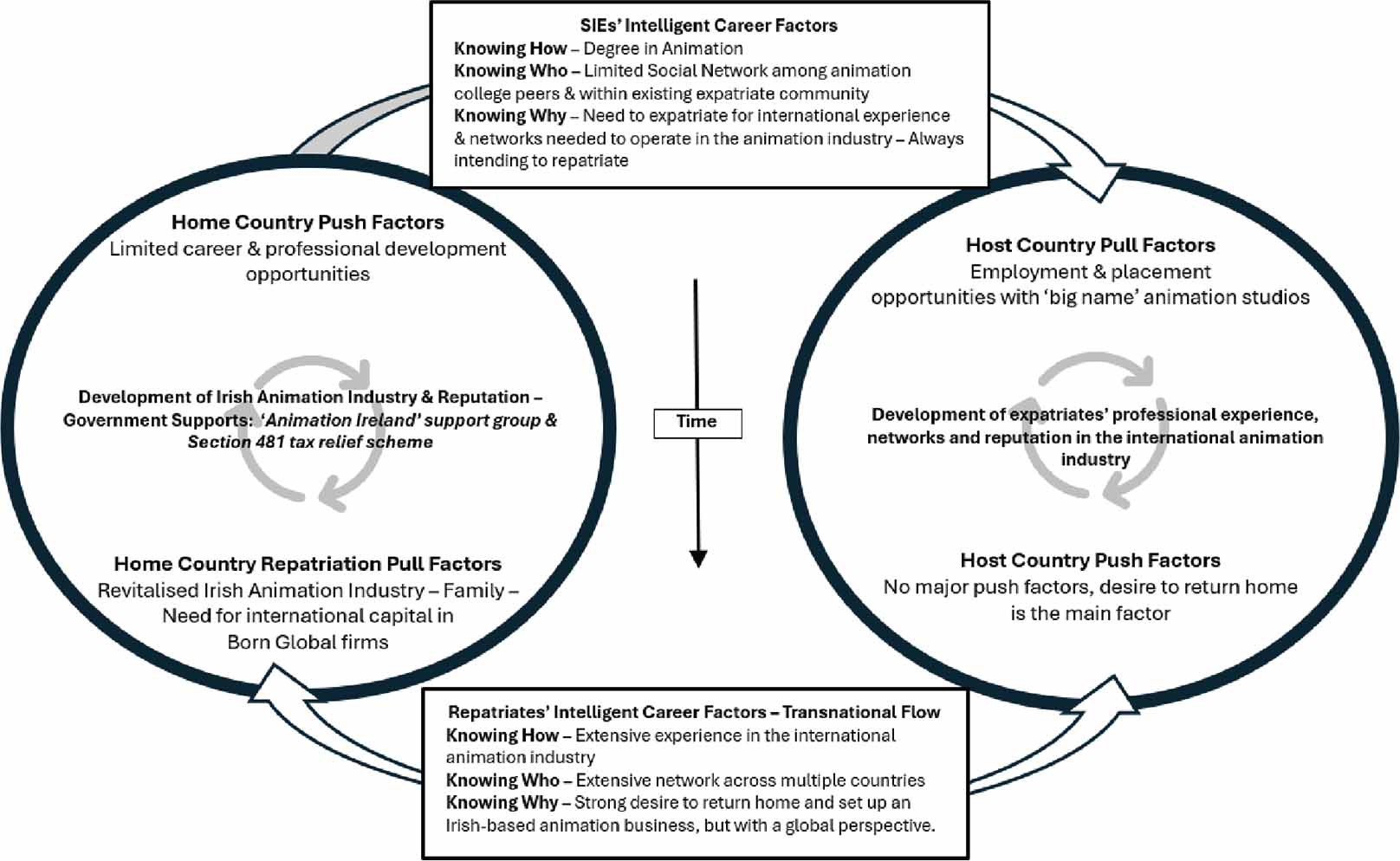
Figure 1:
SIEs’ transnational development & mobilisation of intelligent career factors.
Source: (Created by Authors, 2025).
The animation industry in Ireland practices a benign form of competition and an extremely rare form of collaboration, where the interviewees’ sharing of international market knowledge and intelligence helped expand opportunities for all members of their local network. While this study concentrates on the international transfer and utilisation of various forms of capital by repatriated Irish Born Global SIEs, it is essential to outline the interviewees’ early home country career and capital development, which helps unpack and understand the interviewees’ career motivations, actions and outcomes (Inkson, Dries and Arnold, 2015).
Early capital development
For this study’s sample of SIEs, their story begins with their education. Unsurprisingly, most were graduates from Ballyfermot College of Further Education, located in Dublin, Ireland, which is considered the hub for educating Irish animators in their early-stage career training. Only one of the interviewees had completed a design degree at a different institution, the National College of Art and Design in Dublin, Ireland. Their training and qualifications, such as a degree in classical animation, were to serve as a form of internationally transferable capital, akin to ‘knowing how’. In addition, their initial development of social networks within these Irish educational institutions marked the beginning of their ‘knowing whom’ within the small, close-knit Irish animation industry.
“We used to work in ‘An Other Ltd’ and they [the owners] were in our class. Some of the others in Dublin would have been a few years ahead of us in Ballyfermot… Everyone knows each other… the industry is so small” (Jordan).
The small size of the close-knit Irish animation industry had its downsides, particularly with limited opportunities for professional and career development in what was then (the mid 1990s to early 2000s) a struggling market. This lack of growth and advancement options influenced many recently graduated animators to seek opportunities outside of Ireland.
“Most of my class went off, like me, and got work in London and Australia or wherever and got work for a few years. There wasn’t that much work in Ireland…” (Gavin).
Accompanying these push factors was the attraction of the international animation sector in countries such as the USA and the UK, where career and developmental opportunities in well-known and established animation companies acted as strong pull factors. For some, the choice of the host country was also partly driven by existing ‘knowing whom’ capital.
“The friends that we made in college helped us connect internationally. Some had gone ahead of us abroad and were our door openers. We had them on speed dial.…” (Lola).
The ability to travel to a host country and gain employment in prominent movie and TV studios, such as Pixar-Disney and Warner Bros., was a result of the mobilisation of the value of their transferable ‘knowing how’ capital, including their degrees in classical animation. The international work experience in the host country gave several interviewees their first experiences in the global animation industry. This experience then became an important source of capital, including ‘knowing whom’ (international network), ‘knowing how’ (work experience and reputation), and economic capital (understanding of and access to sources of funding), which would be later mobilised during their repatriation.
“I worked at AN Others, I spent 3 years there, worked on a bunch of their films… It was a brilliant experience… There is no substitute for onsite training and working with other people, all with different ideas and mindsets” (Blake).
The majority of our interviewees (20 out of 22) left Ireland intending to return (‘knowing why’). However, the length of the planned stay in the host country was fluid and dependent on when the participants felt they had gained the necessary experience, network, and other career capital to establish themselves in the international animation industry. The time frame varied from a minimum of one year to a maximum of four years. However, on average, our respondents spent just over two years in the host country.
“Family brought me back home to Ireland again, I always knew a short stint abroad would be worth gold and it was” (Thomas).
The following section will unpack the repatriation process and the support that encourages the respondents within a small niche industry to re-establish themselves back home.
Repatriation and re-establishment
When the individuals felt they had accumulated enough resources to establish themselves in the international animation industry, they chose to return to Ireland (mid-to-late 2000s), where the animation sector had since become revitalised. There was no significant reason compelling them to leave the host country; their motivation (‘knowing why’) stemmed from a desire to return home, rebuild their careers, and start their animation businesses. Moreover, the increasing global success and recognition of the Irish animation sector served as a strong motivation for their return.
“The [Irish] industry had won a lot of awards… like when ‘Give Up Yer Aul Sins’ was Oscar nominated, two out of the three [nominees] were Irish… this helped us return home as we were Irish and we would easily connect again abroad” (Thomas).
A meso-level pull factor, and one that played a significant role in the resurgence of the animation industry, was the government-funded representative body, Animation Ireland. This organisation was tasked with promoting and coordinating the activities of Ireland’s animation enterprises for the international promotion of their collective interests. Animation Ireland provided expert advice and assistance in sales, marketing, networking, and international market development, further adding to the social and cultural capital of the repatriated SIEs, now operating from Ireland but in an international animation market. In the following sections, we unpack the role of capital mobilisation in shaping repatriated SIEs’ business decisions and outcomes in their home country.
Capital mobilisation in the home country
The findings from our study highlight a wide range of capital mobilisation strategies (Al Ariss and Syed, 2011) undertaken by the repatriated SIEs. As SIEs, they lacked organisational support (Cerdin and Selmer, 2014) for their repatriation and were entirely dependent on mobilising their personal ‘knowing how’, ‘whom’ and ‘why’ capitals. In the following sections, we unpack the mobilisation of each of these forms of capital separately. Still, it is essential to recognise that all forms of capital are inherently interconnected in a relational mobilisation of the repatriates’ total capital resources (Al Ariss and Syed, 2011).
Repatriates’ mobilisation of ‘knowing whom’ capital
All of our participants relied significantly on their social networks (‘knowing whom’) during their repatriation and re-establishment processes. Their education, primarily obtained in their home countries, along with their work experience—which was mainly in the host country—contributed to the development of valuable social capital. This social capital was derived from various sources, including previous employment, client referrals from past work, and educational connections formed through their degree studies and training.
“I’d been working at AN Other… I had a lot of connections built in LA, Ireland, all over, and I knew I could use these at any stage to tap into the market… use them as a support while I started my business back in Ireland” (Blake).
For all our participants, ‘knowing whom’ capital emerged as a significant form of capital in the repatriation and reestablishment process. The form of ‘knowing whom’ capital that benefited them the most, unsurprisingly, came from their professional and educational networks.
“We get on very well… We all went to college together… we all had a wealth of different experiences, we worked for lots of different companies. So, we decided to come back [home], pool our talents and set up our own company” (Michael).
The small size of the Irish domestic audience, with its negligible local market potential (Ryan et al., 2019), which initially served as a push factor, was a legacy issue that still faced the repatriated animators. This constraint necessitated the expansion of the participants’ broader international knowledge of capital.
“My main connections are in the States… established from working there for three years… [when] AN Other closed its doors to animation and everybody I know there went to other studios… so all of a sudden you know a bunch of people at several of the main animation companies… I go back there every year and meet them… work with them. We keep that network alive and through that we also meet new people” (Blake).
An important aspect of the repatriates’ use of their ‘knowing whom’ capital was using this social capital to access economic capital. The limited size of the Irish animation sector means that it cannot support all the animation that is produced, so the industry players need to source international funding and support to co-produce most of their projects. Additionally, to to qualify for the EU funding, co-produced projects need participants from a minimum of three EU countries.
“If we wanted to raise a budget of between four or five million or six million to make a feature… you just can’t get all that money in Ireland. The domestic market isn’t strong enough. You have to create international partners to raise money… and that is where your previous connection or previous job gives you the advantage” (Peter).
The SIEs’ use of their international social capital to source economic capital was a vital aspect of the repatriated SIEs’ access to international funding for the development of new businesses and projects, highlighting the relational aspect of the various forms of capital. Following the highlighted successes of the social capital acquired by these successful individuals, we next underline the importance of ‘knowing how’ capital in this setting.
Repatriates’ mobilisation of ‘knowing how’ capital
‘Knowing how’ career capital is closely related to human capital theory, as it embodies the individual’s blend of knowledge, skills, and abilities (Crowley-Henry, Almeida, Bertone, and Gunasekara, 2023), which they mobilise to gain access to positions corresponding to their experience, skills etc. (Zikic, 2015). For example, having English as a native language enabled the Irish expatriates to navigate socio-cultural and structural challenges they may have faced in the UK or the USA (Al Ariss and Syed, 2011).
“With my experience of working with big and small players, like AN Other in Germany and AN Other in the US, I had experience in a wide range of animation projects. This was vital when we set up our own company” (Sonya).
Skills and experience represent another type of ‘knowing how’ capital that participants mobilised when they returned to Ireland. This human capital, acquired from working in animation companies abroad, was utilised to help participants establish themselves and set up businesses in Ireland’s animation sector.
“Our international experience was key, it helped us understand the business, the industry culture, what the industry actually wants and how to tap into those niche opportunities” (Lola).
Winning international awards heightened the industry’s reputation globally and increased international commissions and sales. This is reputational ‘knowing how’ capital in operation, gaining symbolic capital status. As Peter simply described it, “Getting awards, well, that helps… doors were opened by the awards”. Winning awards helped build the international reputation of both the individual company and the overall Irish animation sector. With its coopetition ethos, each award was seen to benefit the common good of all Irish players in the field (O’Gorman and Evers, 2011). Reputation is another crucial form of capital that participants develop from their abilities (‘knowing how’) within the industry.
“My reputation is very important to me… I would be seen as a bit of a perfectionist. But in a small industry like we have in Ireland, where everyone knows everyone, that is not a bad thing” (Sophie).
Ultimately, the participants tapped into an unusual form of capital: the Irish people’s reputation for their unique storytelling talent. However, Paul emphasises the significance of possessing the skills and experience necessary (‘knowing how’) to fulfil this reputation truly.
“When you are abroad, you are always viewed as the ‘Irish storyteller’, this is a big bonus, this is how we are viewed. You are seen to have the artistic skills to do the job, but you have to have the work ethic to back it” (Paul).
Having unpacked the repatriated SIEs’ mobilisation of varied forms of ‘knowing how’ capital, we next examine the role played by economic capital in the repatriates’ career journey.
Repatriates’ ‘knowing why’ capital
A mindset for conducting business in the Irish animation industry, ‘knowing why’, emphasises collaboration, cooperation, and reciprocity among industry participants. Several interviewees described this mindset as one where mutual give-and-take is expected and practised within the industry. This approach has resulted in a near-total absence of opportunistic behaviour that could harm other players in the field (Ryan et al., 2019). As one interviewee reflected, participants noted that the achievements and positive reputation of individual firms contribute to an overall positive image for the entire Irish animation sector.
“It reflects well on us. Any company that performs and does well is seen to raise the profile of every company” (Drew).
This mindset appears to have led to “a common appreciation amongst network members of their duty of care to all network members” (Ryan et al., 2019, p. 18). Vital to the strong collaboration, cooperation and reciprocity that exists within the Irish animation sector is an “appreciation that any benefits of sharing valuable, relevant, and timely international market information and intelligence strongly outweighed corollary advantages of an isolated ‘go-it-alone’ international market development approach” (Ryan et al., 2019, p.16). An essential player in creating this coopetition within the industry has been Animation Ireland, a government-funded representative body, that cultivated close relationships with and among the animation sector in Ireland. Irish government tax incentives also significantly revitalised the animation industry, particularly through Section 481, which promotes investment by offering tax relief to investors. As one of the participants, Tate noted that this initiative “saved” the Irish animation industry. The industry’s resurgence greatly motivated many skilled individuals to return home, leveraging their international knowledge of how, whom and why to develop new businesses in the revitalised animation industry. Aaron highlights the importance of this government support in his decision to repatriate.
“Section 481 (tax incentives) was the incentive, I knew I could still work with these amazing companies and those that I had connected with abroad, but work from home (Ireland), it was the best of both worlds” (Aaron).
In conclusion, the findings and discussion suggest that these Irish-born global SIEs have maximised each opportunity to utilise various forms of capital to begin, grow, and succeed in the global animation industry.
DISCUSSION
The study analyses the repatriation of self-initiated expatriates (SIEs), addressing a gap in the literature that mainly focuses on their experiences abroad (Andresen et al., 2020; Oleškevičiūtė et al., 2022). It enhances understanding of international career capital by examining how repatriated SIEs develop and use their capital in the globalised Irish animation industry. Utilising the intelligent career framework, the research explores the transfer and application of various forms of repatriated SIE capital (Oleškevičiūtė et al., 2022).
Our literature review on careers and expatriation highlighted the common use of human capital in analysing international careers. However, we found it insufficient in fully explaining expatriate career choices and experiences. This study aims to provide a broader perspective by applying the holistic intelligent career framework, thereby enhancing our understanding of how repatriated self-initiated expatriates (SIEs) mobilise capital, compared to studies that focus solely on human capital. While some studies emphasise the role of capital in the growth of Born Global firms, such as Ryan et al. (2019) on social capital, there is a gap in the literature on how repatriated SIEs leverage all forms of their international capital to build and influence home country-based Born Global firms. This paper fills that gap by exploring the impact of repatriated SIE capital on these firms. It demonstrates how this capital enables Born Globals to overcome international market entry barriers, thereby expediting their internationalisation process.
Overall, the repatriation process was successful for all participants in this study, as they effectively settled back home and started new, successful businesses. This finding contrasts with previous studies that have documented the numerous challenges faced by repatriated SIEs and assigned expatriates (AEs), which have been “long discussed in the literature” (Ellis et al., 2020, p. 540) and described as “notoriously troublesome” by Altman and Baruch (2012, p. 244). These findings offer a contrasting perspective to previous studies. Notably, unlike Tharenou and Caulfield (2010), we identified only one case of career shock driving repatriation, where Thomas returned due to family health issues. Additionally, we found no evidence that weak host country embeddedness influenced repatriation intentions (Lin, Zheng, Lu, Liu and Wright, 2019).
At the organisational level, repatriated SIEs, with their international experience and capital, proved to be a valuable source of skills and knowledge. In this study, their use of capital and ability to circumvent conventional, protracted internationalisation processes, driving the internationalisation of Born Global/SMEs (Gittins and Fink, 2015), is crucial. Our findings also unpack how repatriated SIEs, through their capital mobilisation, can drive entrepreneurialism, as well as the SMEs’ internationalisation processes (Gittins and Fink, 2015).
The study also highlights the impact of government strategies, support initiatives, and funded organisations, such as Screen Ireland’s Animation Sector Development Strategy, Animation Ireland, and section 481 tax incentives, which have significantly contributed to the resurgence of the Irish animation industry. This support has motivated many skilled individuals to return to Ireland, where they then leverage their international knowledge to develop new businesses within the revitalised Irish animation sector. By integrating their insights into global animation market trends, advanced animation techniques, and best practices acquired abroad, these returnees have established home-based companies that further enhance the industry’s competitiveness. Their understanding of how to navigate both domestic and international markets enables them to effectively build networks and partnerships, which are crucial for sustaining growth in a born-global company.
Finally, our findings highlighted the limitations of relying solely on human capital in understanding expatriate career decisions. Our study adopts a relational approach using Intelligent Careers’ three ‘ways of knowing’ (Knowing why, Knowing how, Knowing whom), which expands our insights into the capital mobilisation of repatriated SIEs and allows us to move beyond the narrow human capital focus prevalent in much of the SIE literature, thereby enhancing our understanding of the relational impacts on SIE capital and its mobilisation post-repatriation.
CONCLUSION
This study demonstrates the significant influence of repatriated SIEs in the dynamic ‘Born Global’ Irish animation industry. It showcases how they leverage their intelligent career capital (Arthur et al., 1995) to drive SME internationalisation and contribute valuable skills and experience. By highlighting the positive impact of these individuals, this research challenges the previous literature, which has primarily focused on the challenges repatriates face. It offers a new perspective on SIE repatriation, emphasising their potential as valuable assets in the global economy. This study also contributes to a deeper understanding of the ‘intelligent career’ framework within a specific industry context. It highlights its relevance in understanding the career trajectories and contributions of repatriated SIEs.
Notes
[2] Declaration of Interest Statement
There are no relevant financial or non-financial competing interests to report.