
INTRODUCTION
Workplace stress is not just a professional burden—it spills into personal lives, affecting relationships in ways that are often overlooked. Nearly 80% of employees report that job-related stress negatively impacts their romantic relationships, making partners the most affected by work-induced strain (American Psychological Association, 2023). As modern workplaces demand constant connectivity, heightened productivity, and round-the-clock availability, the lines between work and personal life blur, leaving little room for recovery (Valenduc & Vendramin, 2017; Mazmanian et al., 2013; Pfeffer, 2018). While romantic partners are a crucial source of emotional and instrumental support, workplace stress can distort perceptions of this support, leading to misunderstandings, relational strain, and diminished well-being (Bakker, 2009; DeFreese & Mihalik, 2016). This study examines how burnout mediates the relationship between perceived partner stress and romantic partner support (RPS), offering insight into the complex interplay between professional and personal stress.
Although research on resource recovery emphasizes non-work activities such as physical exercise and psychological detachment as essential for stress mitigation (Sonnentag et al., 2017), interpersonal relationships play a similarly critical role in replenishing depleted resources. Romantic partners serve as primary sources of recovery, yet their support is not always perceived accurately. Burnout—characterized by emotional exhaustion, depersonalization, and diminished personal accomplishment—can further complicate these dynamics by distorting how individuals interpret their partner’s support, sometimes perceiving genuine care as intrusive or inadequate (Teles et al., 2020; Juthberg et al., 2008). While existing research has explored work-family conflict as a mechanism linking workplace stress to relational outcomes (Wang et al., 2022), less attention has been given to how burnout influences the perception and effectiveness of romantic partner support, particularly outside the context of parenting.
To address this gap, this study investigates burnout’s mediating role in the relationship between perceived partner stress and RPS, responding to calls for more research on dyadic stress processes (Aktan et al., 2020). By shifting the focus beyond dual-earner parents to non-parental romantic partnerships, this research broadens existing understandings of how workplace stress affects relationship quality. A deeper exploration of these mechanisms is essential, as workplace interventions that target burnout recovery and relationship-based stress management could mitigate stress spillovers and improve relational well-being.
Grounded in Conservation of Resources (COR) theory, this study conceptualizes burnout as a process of resource depletion, wherein individuals facing persistent stress struggle to conserve emotional and relational resources (Hobfoll, 1989). Elevated partner stress exacerbates this depletion, reducing individuals’ capacity for recovery and distorting perceptions of RPS. To address these challenges, workplace interventions such as counseling and flexible work arrangements could play a crucial role in reducing burnout-driven relational strain (Gabriel & Aguinis, 2021). Using partial least squares structural equation modeling (PLS-SEM) with data from 277 full-time employees in long-term romantic relationships, this study provides empirical insights that advance theoretical understanding and inform practical strategies for alleviating stress spillovers while fostering healthier relationships.
LITERATURE REVIEW
Theoretical Framework: Conservation of Resources Theory (COR)
Conservation of Resources (COR) theory is a widely utilized framework for understanding stress, burnout, and recovery processes. Central to COR theory is the principle that individuals strive to acquire, maintain, and protect valuable resources, such as emotional energy, time, and social connections, to navigate stress effectively (Hobfoll, 1989, 2001). Stress arises when these resources are threatened, depleted, or inadequately replenished, setting off a cascade of psychological and behavioral responses (Hobfoll et al., 2018).
Resource Loss and Stress Amplification
The cornerstone of COR theory is that resource loss is more salient than resource gain. This principle explains why individuals experiencing resource depletion—whether due to workplace stress, personal demands, or relational strain—are highly susceptible to stress spirals. These spirals occur when resource loss reduces an individual’s capacity to replenish remaining resources, compounding vulnerability to further losses (Tafvelin et al., 2019). For example, burnout not only drains emotional energy but also diminishes cognitive focus, further impairing recovery efforts.
In organizational settings, the interplay between personal and professional resources is particularly pronounced. Transformational leadership has been identified as a contextual resource that reduces burnout by fostering employee thriving and enhancing personal resource reservoirs, such as openness to experience (Hildenbrand et al., 2018). However, in environments with high resource demands, such as caregiving or teaching, even these contextual supports can become insufficient, leaving individuals at risk for prolonged resource depletion (Wang, 2024).
Resource Recovery and Perceptual Distortions
While COR theory highlights the primacy of resource loss, it also emphasizes the critical role of recovery. Recovery mechanisms, such as social support and adaptive coping strategies, allow individuals to rebuild their resource pool and mitigate the effects of stress. However, burnout fundamentally alters how individuals perceive and utilize these recovery opportunities. Emotional exhaustion and depersonalization distort resource perceptions, causing individuals to undervalue or misinterpret available resources as insufficient or burdensome (Allen, 2023).
For instance, in volunteer settings, adaptability and training have been shown to buffer against burnout by facilitating better resource allocation and reducing resource misinterpretation (Allen, 2023). Similarly, proactive resource-building behaviors, such as investing in personal resilience, can generate resource gains that offset depletion (Otto et al., 2021).
Resource Interactions and the Stress Response
The stress response is shaped by the dynamic interaction between resource availability and depletion. Contextual and personal resources, such as departmental support or emotional resilience, act as buffers that mitigate resource loss and enhance recovery (Barthauer et al., 2020). Conversely, high demands and role ambiguity exacerbate resource depletion, leading to heightened stress and burnout (Maisonneuve et al., 2024). Over time, chronic resource depletion creates a feedback loop that erodes both individual and relational well-being.
Burnout
Burnout is a chronic response to prolonged workplace stress that has not been effectively managed. Characterized by emotional exhaustion, depersonalization, and a diminished sense of personal accomplishment, burnout significantly impacts individual well-being, organizational performance, and interpersonal relationships (Edú-Valsania et al., 2022; Gabriel & Aguinis, 2021). Recent studies underscore the importance of understanding burnout’s multifaceted nature, including its contributing factors, protective mechanisms, and the role of interpersonal dynamics.
Burnout as a Spectrum
Burnout exhibits a spectrum of severity levels, ranging from temporary fatigue that can be remedied with brief periods of rest to chronic, extreme exhaustion that substantially hinders cognitive abilities and reduces involvement in work-related responsibilities (Akirmak & Ayla, 2021). In its most severe forms, symptoms are only alleviated by prolonged rest (Schaufeli et al., 2009). Burnout has adverse effects on both professional efficacy and psychological well-being, often manifesting in migraines, gastrointestinal disturbances, and sleep disruptions. Severe burnout can lead to life-threatening conditions such as heart attacks, type 2 diabetes, and, in extreme cases, premature mortality (Toker & Biron, 2012). Additionally, absenteeism often increases as employees take time off to contend with their deteriorating physical and mental health (Kim et al., 2011). These impacts underscore the urgency of addressing burnout to improve organizational outcomes and individual well-being.
Theoretical Underpinnings of Burnout: Resource Distortion
Within the framework of COR theory, burnout is more than the depletion of key resources—it actively distorts how individuals perceive, prioritize, and utilize remaining resources. Burnout’s hallmark symptoms, such as emotional exhaustion and cynicism, impair cognitive and emotional processing, making individuals less likely to recognize or effectively engage with available resources. Resources that would typically be perceived as supportive—such as acts of service, emotional validation, or even workplace accommodations—are instead viewed as insincere, intrusive, or insufficient (Bakker & Demerouti, 2017).
This perceptual distortion not only reduces the salience of positive resources but also amplifies the visibility of resource threats. For instance, a burnt-out individual may interpret a partner’s attempt to offer emotional support as a criticism of their coping abilities or perceive workplace flexibility as a tacit acknowledgment of their inadequacy. Such distortions exacerbate resource loss spirals, as the inability to utilize positive resources reinforces the individual’s emotional fatigue and reduces their capacity to replenish key reserves (Allen, 2023; Otto et al., 2021).
Burnout and Contextual Influences
The COVID-19 pandemic has further illuminated how contextual factors, such as increased workloads, inadequate social support, and strained workplace environments, magnify these perceptual distortions and resource losses (Ismail & Owaida, 2023; Xiong et al., 2023). Gender and cultural influences further complicate the experience of burnout. Women, for instance, consistently report higher levels of emotional exhaustion compared to men, often due to greater exposure to negative workplace interactions, disproportionate caregiving responsibilities, and limited organizational support (Aldossari & Chaudhry, 2021). During the pandemic, female healthcare workers experienced heightened emotional exhaustion, while male counterparts reported higher depersonalization rates (Brera et al., 2021; Zhang et al., 2022).
Practical Implications of Burnout
Addressing burnout requires a multifaceted approach. At the organizational level, creating psychologically safe environments, promoting equity in workload distribution, and implementing gender-specific interventions are essential (Lyubarova et al., 2023). Individual-level interventions, such as stress management training and resilience-building strategies, can also mitigate burnout’s impact. Importantly, interventions must account for the perceptual distortions caused by burnout, focusing on reframing how individuals engage with and interpret available resources (Aldossari & Chaudhry, 2021; Fiorilli et al., 2022). For example, cognitive behavioral interventions can help reframe negative interpretations of resource availability, improving the efficacy of support systems.
Romantic Partner’s Role in Resources and Demands
The dynamics of romantic partnerships significantly influence partners’ well-being and personal development. Drawing on COR theory, we conceptualize these relationships as contexts where partners engage in ongoing resource exchanges and mutual demands that can impact emotional and cognitive reserves (Hobfoll, 1989). According to COR theory, individuals are motivated to acquire, protect, and conserve resources—defined as valuable assets that help sustain well-being. Within romantic partnerships, partners provide essential resources, including emotional, physical, and cognitive support, that can alleviate work-related stress and help prevent burnout (Ferguson et al., 2016; Lapierre et al., 2018).
A fundamental principle of COR theory is that resource loss is especially powerful in shaping individuals’ emotional experiences, often leading to further depletion in a downward spiral (Hobfoll, 2001). In line with this, witnessing a romantic partner’s stress—particularly at the end of a workday when both partners may be emotionally or mentally fatigued—could act as an additional resource drain for the observing partner, heightening their susceptibility to burnout. Observing a partner’s stress could create a sense of “resource insecurity,” as individuals anticipate the need to expend resources to support their partner, thereby exacerbating their own burnout (Halbesleben et al., 2012). This relationship is expected to be particularly strong when the stress perceived in the partner feels persistent or ongoing, as COR theory posits that repeated or enduring stressors tend to amplify resource depletion.
Moreover, burnout, which can result from prolonged resource loss, may make individuals less receptive to supportive behaviors and more inclined to guard their remaining personal resources to prevent further depletion (Halbesleben & Buckley, 2004; Hobfoll, 1989). When burned out, individuals might view a partner’s attempts at support through a lens of “resource conservation,” interpreting them as an added demand rather than a helpful gesture. This response aligns with findings that people experiencing burnout often adopt a conservation-first perspective, reacting to what might normally be supportive actions as sources of further resource strain. Consequently, burnout can lead individuals to undervalue or even dismiss the support they receive, further depleting relational resources (Maslach et al., 2001).
However, the stress experienced by a partner may, under certain conditions, instigate reciprocal support within the partnership, fostering resilience and buffering against burnout. COR theory posits that resource gains, though beneficial, are generally less impactful than losses, meaning that couples may need to provide significant mutual support to effectively offset or replenish depleted resources. During transient challenges, such as job loss or temporary setbacks, partners may combine resources and jointly address difficulties, which can deepen the bond and bolster individual resilience (Lyons et al., 1998). In these situations, mutual support may prevent resource depletion. Yet, when stress persists over time, the demands on resources can outweigh the benefits of supportive exchanges, reducing relationship satisfaction and intensifying burnout (Xu et al., 2016). This pattern underscores the importance of evaluating both resource gains and losses in understanding burnout within romantic partnerships.
Based on COR theory’s emphasis on resource loss and conservation, as well as the potential resource demands of a partner’s stress, we posit the following hypothesis:
Hypothesis 1: The perceived stress level of one’s romantic partner at the end of the workday will positively impact one’s own perception of burnout.
Romantic Partner Support
Romantic relationships serve as a critical buffer against stress, offering unique emotional, psychological, and practical support tailored to the intimacy of the partnership (Xia et al., 2019). Romantic partner support encompasses multiple dimensions of assistance, categorized using the Support in Intimate Relationships Rating Scale (SIRRS) developed by Dehle et al. (2001). These dimensions include informational support (guidance, advice, feedback), emotional support (comfort and validation), physical comfort, and tangible support (practical assistance). Each type of support offers distinct benefits for mitigating stress and fostering well-being, underscoring the multifaceted role of romantic relationships (Aplin-Houtz, 2023; Neff et al., 2012). However, the unique closeness of romantic relationships can amplify both the positive and negative impacts of such support (Xia et al., 2019).
Support from romantic partners is distinct from other sources, such as friends or colleagues, due to its deeply personal and continuous nature. This support often fosters renewal across cognitive, emotional, and physical dimensions, enhancing resilience against workplace pressures (Meier & Cho, 2019). However, when romantic partners face heightened stress, their ability to provide support may waver, shifting the relationship from a resource to a potential source of strain (Francis et al., 2019).
Stress Dynamics in Romantic Relationships
Romantic partner stress influences relationships through direct and indirect pathways. Directly, stress in a partner can increase relational tension, reducing the perceived availability of support and fostering feelings of isolation. For instance, highly stressed partners may exhibit emotional withdrawal or irritability, diminishing the protective effects of the relationship (Goodboy et al., 2021). Indirectly, burnout acts as a mediator, amplifying these effects through resource depletion. Persistent stress increases demands on an individual’s emotional and cognitive capacities, creating a resource loss spiral where both partners’ ability to cope and recover is compromised (Griep & Bankins, 2022).
The reciprocal nature of romantic support is critical in these dynamics. While one partner’s stress can strain the relationship, the other partner’s capacity to provide support may also be compromised, leading to a cycle of diminished relational resources (Aplin-Houtz et al., 2025; Yan et al., 2022). COR theory highlights how such relational stressors can lead to cascading resource loss, emphasizing the importance of resource management within romantic partnerships (Hobfoll et al., 2018).
Informational Support and Burnout’s Impact
Among the types of romantic partner support, informational support—guidance, advice, and feedback—is especially valuable during life events that involve significant decision-making or problem-solving (Baron et al., 1990). However, individuals experiencing burnout often struggle to process or appreciate informational support due to cognitive fatigue and emotional exhaustion.
Burnout not only depletes cognitive resources but also distorts perceptions of support. Supportive gestures, such as advice or feedback, may be misinterpreted as intrusive or critical, further straining the relationship (Halbesleben & Buckley, 2004). This paradox, where burnout increases the need for support while simultaneously undermining its utility, highlights the complexity of managing relational dynamics during stress (Bakić & Ajduković, 2019).
Resource Dynamics and COR Theory
COR theory provides a framework to understand these complexities. While supportive interactions can act as resource gain mechanisms, replenishing emotional reserves through care and affirmation, resource loss spirals often dominate in strained relationships. Burnout exacerbates these spirals by distorting perceptions of support, causing individuals to undervalue or misinterpret their partner’s efforts (Allen, 2023). In these contexts, the role of informational support becomes even more critical, as it bridges the gap between emotional depletion and problem-solving resources.
Hypothesis 2a: One’s perceived level of burnout will negatively impact the amount of perceived informational support they feel from their romantic partner.
Hypothesis 3b: One’s perceived level of burnout will mediate the relationship between the stress level of one’s romantic partner and the amount of perceived informational support they feel from their romantic partner.
Physical touch is a crucial form of human interaction that strengthens bonds in romantic relationships. Gestures such as holding hands during a movie or offering a comforting hug after a stressful day foster emotional intimacy and mutual understanding, reinforcing the relationship’s supportive foundation (Gallace & Spence, 2010). However, the experience of burnout can profoundly alter how individuals perceive and respond to physical touch. The pervasive fatigue and emotional exhaustion associated with burnout may lead individuals to withdraw from these interactions, perceiving once-comforting gestures as intrusive rather than supportive (Cochrane, 1990; Bakker & Demerouti, 2017).
COR theory provides a framework for understanding this shift. As burnout depletes emotional and psychological resources, individuals often prioritize self-preservation, avoiding interactions that might otherwise require emotional engagement or energy (Hobfoll, 1989). Physical touch, while inherently supportive, may be reinterpreted as an additional demand, particularly when the individual is experiencing relational stress or resource depletion caused by their partner’s stress. For example, a hug offered in a moment of perceived comfort may be rejected due to the individual’s emotional exhaustion, further straining the relationship and diminishing opportunities for recovery (Liu et al., 2021).
The direct effects of burnout on perceptions of physical touch are significant. Individuals experiencing burnout may withdraw from physical contact as a protective mechanism, perceiving it as overwhelming or intrusive (Cochrane, 1990). In this context, physical touch loses its supportive function and may even exacerbate feelings of isolation. However, the relationship between romantic partner stress, burnout, and physical touch is more complex than a direct effect. COR theory suggests that burnout mediates this relationship by creating a resource depletion spiral in which partner stress amplifies the individual’s burnout symptoms, leading to further withdrawal from physical touch support (Bakker & Demerouti, 2017; Xia et al., 2019).
Hypothesis 2b: One’s perceived level of burnout will negatively impact the amount of perceived physical touch support they feel from their romantic partner.
Hypothesis 3b: One’s perceived level of burnout will mediate the relationship between the stress level of one’s romantic partner and the amount of perceived physical touch support they feel from their romantic partner.
Esteem support, which is vital for maintaining self-worth and motivation, frequently weaves into the fabric of daily partner interactions. Affirmations such as “You handled that situation brilliantly!” or “I’m proud of how you’ve been managing things” validate an individual’s self-concept, reinforcing emotional resilience and creating a buffer against external stressors (Taylor & Brown, 1988; Cutrona & Russell, 1990). However, burnout can significantly impair how individuals perceive and internalize such support. Chronic fatigue and decreased professional efficacy, hallmark symptoms of burnout, can produce an emotional filter that twists genuine compliments into hollow words (Leiter & Maslach, 2009). A burnt-out partner may discount affirmations, reasoning, “They don’t really mean that; they are just trying to cheer me up,” further distancing themselves emotionally from their partner (Kille et al., 2017).
Conservation of Resources (COR) theory provides a theoretical basis for understanding how burnout influences perceptions of esteem support. As burnout depletes emotional and cognitive resources, individuals prioritize conserving their remaining energy, often by disengaging from interactions that might otherwise bolster self-esteem (Hobfoll, 1989; Liu et al., 2021). Esteem support, though inherently validating, may be misinterpreted as insincere or burdensome due to the individual’s diminished emotional capacity. This shift not only undermines the protective role of esteem support but also exacerbates the resource depletion cycle, leading to further relational strain.
Burnout exerts its effects on esteem support through both direct and mediated pathways. Directly, individuals experiencing burnout may perceive affirmations from their partner as lacking authenticity, diminishing the effectiveness of esteem support in reinforcing self-worth (Leiter & Maslach, 2009). Indirectly, romantic partner stress amplifies this dynamic by increasing demands on the individual’s emotional and psychological resources, accelerating burnout, and further distorting their perceptions of esteem support (Kille et al., 2017; Liu et al., 2021). COR theory highlights how this cascade of resource loss not only affects the individual’s well-being but also disrupts the relational ecosystem, reducing the effectiveness of partner-provided support.
To address these dynamics, we hypothesize both direct and mediated relationships:
Hypothesis 2c: One’s perceived level of burnout will negatively impact the amount of perceived esteem support they receive from their romantic partner.
Hypothesis 3c: One’s daily perceived level of burnout will mediate the relationship between the stress level of one’s romantic partner and the amount of perceived esteem support they receive from their romantic partner.
Tangible support, conveyed through concrete gestures such as preparing meals, managing household tasks, or offering gifts, is a prominent expression of care and attentiveness in romantic relationships. These acts of service demonstrate a partner’s sensitivity to the needs of the other, reinforcing the relationship’s emotional foundation and fostering a sense of mutual reliance (Gottman, 1999). For instance, a partner who notices their significant other feeling overwhelmed might prepare their favorite meal or handle household chores to ease their stress. However, burnout can profoundly distort how these gestures are perceived. The emotional exhaustion and cynicism associated with burnout may lead individuals to misinterpret these actions as signals of their inadequacy or inability to manage responsibilities, exacerbating self-doubt and relational tension (Bianchi & Laurent, 2015; Maslach & Jackson, 1984).
COR theory provides a framework for understanding this distortion in perception. Burnout, as a manifestation of resource depletion, leaves individuals emotionally fatigued and psychologically vulnerable, heightening their sensitivity to perceived relational disruptions (Hobfoll, 1989). Tangible support, which might otherwise be interpreted as a caring gesture, can be reinterpreted as a critique of one’s competence when resources are depleted. For instance, a partner’s effort to take over household tasks may be viewed by the burnt-out individual as an implicit acknowledgment of their inability to meet expectations, intensifying feelings of inadequacy and cynicism (Maslach & Leiter, 2008).
Burnout’s effects on perceptions of tangible support can operate through both direct and mediated pathways. Directly, burnout may lead individuals to withdraw emotionally or view supportive acts as insincere or critical (Bianchi & Laurent, 2015). Indirectly, romantic partner stress may amplify burnout symptoms, further distorting perceptions of tangible support (Duxbury & Higgins, 2001; Maslach & Leiter, 2008). This resource depletion spiral, as framed by COR theory, highlights how relational stress exacerbates burnout, which in turn erodes the effectiveness of tangible support in reinforcing relational bonds. In relationships where external pressures, such as demanding work environments, are high, these dynamics become especially pronounced, underscoring the importance of understanding tangible support as both a relational and resource-based mechanism (Moen & Roehling, 2005).
Hypothesis 2d: One’s perceived level of burnout will negatively impact the amount of perceived tangible support they discern from their romantic partner.
Hypothesis 3d: One’s perceived level of burnout will mediate the relationship between the perceived stress level of one’s romantic partner at the end of the workday and the amount of perceived tangible support they discern from their romantic partner.
METHOD
Hypothesized Model
To aid in answering the research question How does an individual’s burnout level mediate the relationship between their perception of their romantic partner’s stress and the perceived supportive quality of the relationship? we explored the relationships through the model found in Figure 1.
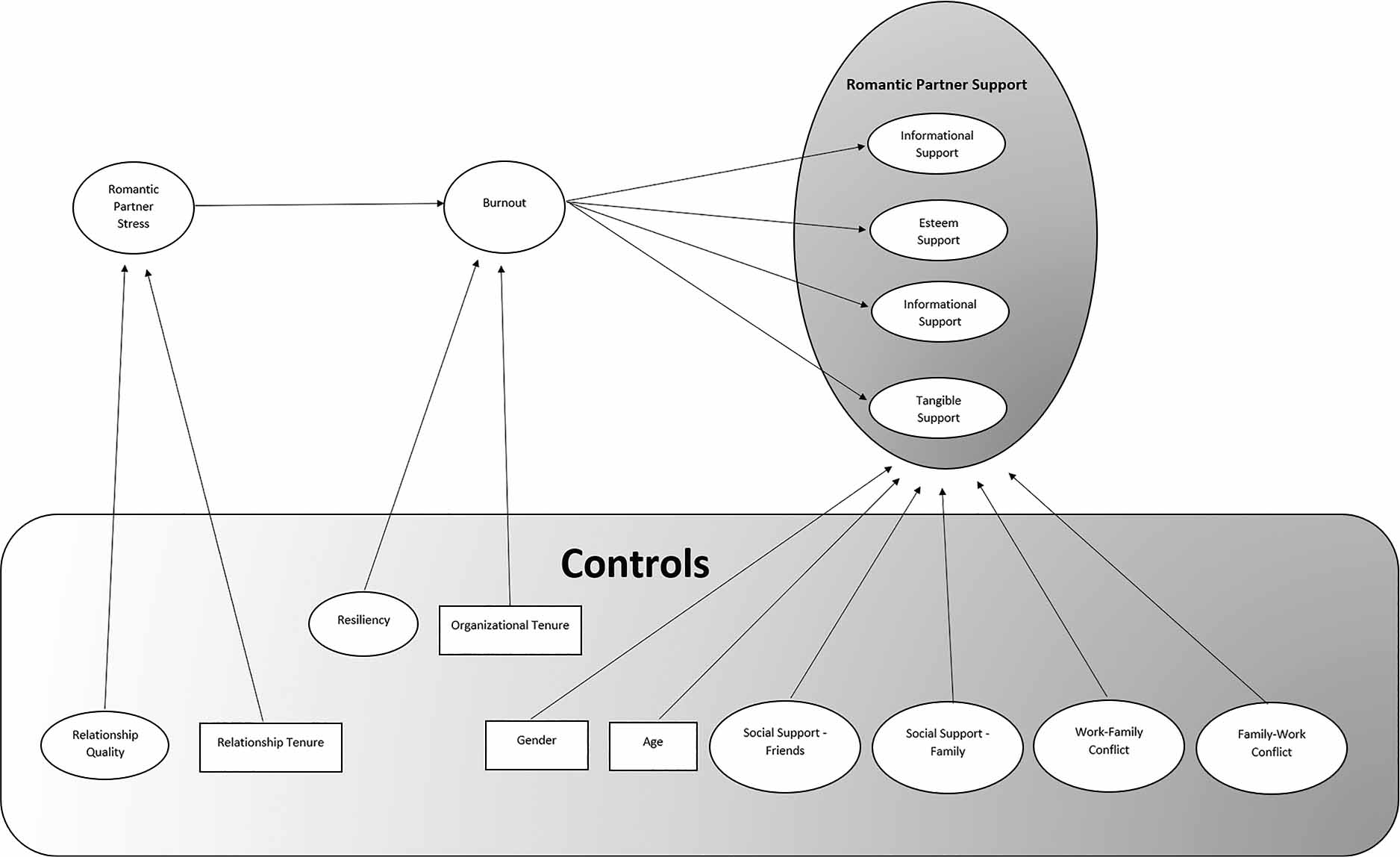
Figure 1:
Conceptual Model for Analysis.
Our model consists of the perception of stress by a romantic partner as the independent variable, burnout as the mediator, the factors of romantic partner support (informational, esteem, physical touch, and tangible support) as the dependent variables, and multiple control variables.
A significant hurdle in researching topics such as the perceived stress of one’s romantic partner, especially in relation to how one’s own burnout colors the perception of romantic partner support, is the difficulty of directly observing and inferring causality. Including multiple control variables in models may obscure direct causal relationships among the primary variables of interest. Spector (2019) notes that under such conditions, attempts at experimental manipulation may introduce artificial elements that do not accurately reflect real-world scenarios, thereby diminishing the practicality of purely causal inference in applied research settings. Consequently, a pseudo-cross-sectional design with two-time sampling was employed in this study to explore the relationships among these variables while enabling preliminary checks on consistency over time. This approach is particularly suitable for exploratory research, as its primary objective is to detect potential associations and establish a foundation for future longitudinal studies.
To further ensure robustness and reliability, two-time sampling was used to examine test-retest reliability across a one-week interval. This design enabled us to assess the stability of our measures for burnout, perceived partner stress, and types of partner support, thereby enhancing the confidence in the reliability of the constructs used. By collecting data at two time points, we also gained preliminary insights into the degree of consistency in these constructs, laying the groundwork for future research that could explore causality with a longitudinal design.
In determining the sample size needed for this study, we conducted a power analysis prior to data collection. Using G*Power (Faul et al., 2009), we calculated the minimum sample size required to achieve statistical significance, based on an expected effect size (F2) of .05 and a statistical power of 80%, following Cohen’s (1992) recommendations. With a model incorporating 10 latent factors influencing outcomes such as turnover intentions, we determined that a minimum sample size of 222 participants would provide adequate power for detecting significant effects. This consideration ensured that the two-time sampling approach remained statistically robust, allowing for the assessment of both cross-sectional relationships and the test-retest reliability of our variables.
Study Design
Our two-wave study design aimed to strengthen construct reliability and minimize common method bias. Data were collected at T1 and T2, with T1 capturing independent variables such as burnout, work-family conflict, and family-work conflict, while T2 focused on the dependent variable (DV), Romantic Partner Support. The temporal separation between predictors and outcomes aligns with quasi-cross-sectional research best practices (Rindfleisch et al., 2008; Ployhart & Vandenberg, 2010), reducing the risk of bias.
In addition to hypothesis testing, T2 data were used to validate the reliability of key constructs. For instance, burnout (r = 0.888) and romantic partner support (r = 0.779) both showed strong consistency across waves. This dual-wave approach, while not fully longitudinal, provides a robust framework for examining relationships between variables by introducing temporal separation and enhancing construct reliability (Hair et al., 2010; Podsakoff et al., 2012).
Participants and Procedures
We used the following inclusion criterion for our sample: (a) currently employed full-time in the US, (b) at least 18 years old, (c)be in a long-term committed relationship (d) and signed up to participate in a Prolific Panel. After receiving institutional review board (IRB) approval, we began data collection attempts. Considering sampling using internet vendor-based sources often results in more consistent composition, respondent integrity, data quality, data structure, and substantive results than non-internet vendor-based sample collection (Smith et al., 2016), we chose to gather data via the third-party company Prolific.
The rationale for sampling only the United States rather than a general population includes the notion that gender roles and romantic partner roles may be culturally specific, and it also addresses Xia et al.’s (2019) limitation of studying spousal support only in the homogenous population of Eastern culture (China). Xia et al. suggested that relationships of the variable of romantic partner support (spousal support) should be explored in Western cultures to determine if the relationships translate between cultures. Further, due to the interest in the overall concept of romantic partner support as a construct, all participants must be in a committed long-term relationship, with legal/formal marriage not being required. Considering that many people choose to cohabitate rather than legally bind their relationships (Hatch, 2017), the construct of romantic partner support likely includes non-married dyads.
In order to gather a sample meeting our inclusion criteria, we first conducted a screening survey for participants who listed that they were in a committed relationship and were employed full-time who were also on Prolific’s panel (N=5,719). In this screening survey, we asked the participants if they met the inclusion criteria for the study and if they would be willing to participate in a series of surveys where they would be sampled twice a day. Participants were paid $0.25 to fill out this screener survey. We capped the maximum number of respondents to 1,000 for this screening survey. From this group, we identified 374 participants who met the criteria. These participants were invited to the full study.
Participants were asked to complete an initial survey with demographics, focal variables in our theoretical model, control variables, and additional variables not included in this study. From April 6 to April 22, 2023, we surveyed our participants two times (one-week gap minimum between each sampling), with each scale/questionnaire answered by the participants once during data collection. The average time of the first sampling was 17.33 minutes, while the second time was 15.60 minutes. The combined and averaged total time of participants’ survey responses was 36.35 Minutes. Once participants completed the measures, they were debriefed and thanked for their participation.
During the initial survey, we captured data from 277 participants (74.064% of the 374 identified from the screening survey). These 277 were invited to take part in the next phase of sampling. During the second sampling, we collected responses from 271 respondents.
General Demographics
Participants in the study (N = 277) had a diverse range of demographic characteristics. The ages ranged from 21 to 81 years, with a mean age of 39.69 years (SD = 9.807) and a relatively homogeneous distribution, as 45.4% of participants fell between the ages of 31 and 40 years. The gender distribution was predominantly male (63.9%), with females accounting for 33.9% of the participants and Non-Binary/Third Gender individuals making up 2.2% of the sample. The racial composition was primarily White or Caucasian (76.5%), with the remaining participants identifying as Asian (5.8%), Black or African American (8.3%), Hispanic, Latino, or Spanish Origin (6.5%), and Multiracial or another (2.9%). Participants’ educational attainment was diverse, with the largest group holding an undergraduate degree (50.9%), followed by high school/GED holders (18.8%), graduate degree holders (24.5%), and doctorate holders (5.4%). Income levels were distributed into two groups: over half (75.9%) of the participants earned $50,000 or more, while the remaining 24.1% earned less than $50,000.
Relationship Demographics
Our study examined the role of romantic partner resources in mitigating burnout, collecting detailed information on participants’ relationship tenure, status, and definitions. Relationship tenure ranged from 0.5 to 45 years, with a mean tenure of 11.782 years (SD = 8.818). Most participants (78.3%) were married, while 21.7% were in long-term relationships.
To ensure precision, we categorized relationships into mutually exclusive groups: legally married, cohabiting, domestic partners, boyfriend/girlfriend, and common-law marriage. These distinctions reflect the importance of relationship definitions in influencing resource availability, support dynamics, and emotional stability (Karney & Bradbury, 1995). For instance, legally married individuals often benefit from greater societal and institutional support, while cohabiting or common-law couples may experience less recognition, which can impact resource exchange and stability (Umberson et al., 2010). In contrast, dating relationships, such as boyfriend/girlfriend, typically exhibit lower resource interdependence compared to legally recognized unions (Kurdek, 2005).
Reporting these distinctions separately allows for a nuanced understanding of how relationship structures moderate stress and support dynamics. Studies suggest that married individuals often report greater resource stability and stress buffering compared to other relationship types (Stanley et al., 2006). This approach aligns with calls in the literature for granular analysis of romantic partnerships and their influence on workplace and personal stress outcomes (Umberson et al., 2010).
Among participants, relationship definitions were predominantly legally married (76.2%), followed by cohabiting (8.3%), domestic partners (6.1%), boyfriend/girlfriend (6.9%), and common-law marriage (2.5%). These distinctions provide critical context for understanding the role of romantic relationships in resource dynamics and burnout mitigation. Please see Table 1 for a detailed breakdown of the sample’s demographics.
Table 1:
Demographics
| Age | N | % | Race | N | % |
|---|---|---|---|---|---|
| 21-25 | 10 | 3.61 | Asian | 16 | 5.80 |
| 26-30 | 35 | 12.63 | Black or African American | 23 | 8.30 |
| 31-35 | 63 | 22.74 | Hispanic, Latino, or Spanish Origin | 18 | 6.50 |
| 36-40 | 63 | 22.74 | White or Caucasian | 212 | 76.50 |
| 41-45 | 39 | 14.08 | Multiracial or another | 8 | 2.90 |
| 46-50 | 29 | 10.47 | Education | N | % |
| 51-55 | 16 | 5.77 | < High School | 1 | 0.40 |
| 56-60 | 14 | 5.05 | High School/GED | 52 | 18.80 |
| 61-65 | 3 | 1.08 | Undergraduate | 141 | 50.90 |
| 66-70 | 4 | 1.44 | Graduate | 68 | 24.50 |
| 71-75 | 0 | 0.00 | Doctorate | 15 | 5.40 |
| 75-81 | 1 | 0.36 | |||
| Income | N | % | |||
| < $20,000 | 1 | 0.40 | |||
| $20,000 to $34,999 | 23 | 8.30 | |||
| $35,000 to $49,999 | 43 | 15.50 | |||
| $50,000 to $74,999 | 85 | 30.70 | |||
| $75,000 to $99,999 | 65 | 23.50 | |||
| $100,000+ | 60 | 21.70 |
Measures
Romantic Partner Stress
Romantic Partner Stress was assessed using a single-item measure adapted from Dehle et al. (2001): “On a scale of 1 to 10, how stressed is your romantic partner when they come home from work?” This item was included at Time 1 (T1) and covered the full range of responses from 1 to 10. The distribution of responses was non-normal, as indicated by a Shapiro-Wilk’s test (w = .962).
Burnout
Burnout was measured using the Oldenburg Burnout Inventory (OLBI; Martin & Hine, 2005), which evaluates two dimensions: exhaustion and disengagement. The data for burnout were normally distributed (w = .991), and the measure showed strong test-retest reliability between T1 and T2, as indicated by a Spearman’s rank-order correlation (r = 0.888, p < .001). This reliability highlights the consistency of burnout levels across time. Hypothesis testing primarily used T1 burnout data, as it best aligned with our focus on how burnout at the individual level mediates the relationship between perceptions of romantic partner stress and relationship quality.
Romantic Partner Support
Romantic Partner Support (RPS) was assessed using the Support in Intimate Relationships Rating Scale (SIRRS; Dehle et al., 2001). The measure evaluates four subdimensions: esteem/emotional support, physical comfort, informational support, and tangible support. The distributions for these factors were non-normal (esteem/emotional: w = .974; physical comfort: w = .954; informational: w = .987; tangible: w = .975). The test-retest reliability of RPS was high at both the overall construct level (r = 0.779) and the factor level (esteem/emotional: r = 0.927; physical comfort: r = 0.819; informational: r = 0.915; tangible: r = 0.853), demonstrating strong consistency across the two data collection waves.
Control Variables
To mitigate potential confounding influences, we included several control variables based on established guidelines (Bernerth & Aguinis, 2016). Controls included age, organizational tenure, gender, and relationship duration, which are known to influence perceptions of romantic partnership dynamics (Brown & Booth, 1996). We also assessed relationship quality using the Marriage/Relationship Scale (MRS; Brkljačić et al., 2019), which was measured at T2 and showed non-normal distribution (w = .852).
Social support from friends and family was controlled using measures by Cohen et al. (2004), both of which demonstrated good test-retest reliability (support from friends: w = .911, r = .65; support from family: w = .869, r = .65). Additionally, we controlled for work-family conflict (WFC) and family-work conflict (FWC) using Bellavia and Frone’s (2005) measures. Both constructs demonstrated strong test-retest reliability (WFC: w = .980, r = .814; FWC: w = .957, r = .662). Finally, individual resiliency was controlled using the Brief Resilience Scale (BRS; Smith et al., 2008), collected at T2 with non-normal data (w = .911).
Details of the variables measured at T1 and T2 are provided in Table 2.
Table 2:
Descriptive Statistics
| Variable Name | # Items | Scale | Source | When Sampled | Mean | SD | Normality | Test-Retest |
|---|---|---|---|---|---|---|---|---|
| Romantic Partner Stress | 1 | 1-10 | Custom Measure | T1 | 4.643 | 2.379 | Non-normal (w = .962) | NA |
| Burnout (OLBI) | 16 | 1-5 | Martin and Hine (2005) | T1,T2 | 2.925 | 0.805 | Normal (w = .991) | 0.888 |
| Romantic Partner Support | 16 | 1-5 | Dehle et al. (2001) | T1,T2 | ||||
| Esteem/Emotional | 4 | 1-5 | 3.193 | 1.025 | Non-normal (w = .974) | 0.927 | ||
| Physical Comfort | 4 | 1-5 | 3.387 | 1.113 | Non-normal (w = .954) | 0.819 | ||
| Informational | 4 | 1-5 | 2.944 | 0.820 | Non-normal (w = .987) | 0.915 | ||
| Tangible | 4 | 1-5 | 3.239 | 1.070 | Non-normal (w = .975) | 0.910 | ||
| Relationship Quality | 15 | 1-5 | Brkljačić et al. (2019) | T1 | 4.173 | 0.874 | Non-normal (w = .852) | NA |
| Support from Friends | 4 | 1-7 | Cohen et al. (2004) | T1,T2 | 5.330 | 1.305 | Normal (w = .911) | 0.720 |
| Support from Family | 4 | 1-7 | Cohen et al. (2004) | T1,T2 | 5.639 | 1.286 | Non-normal (w = .869) | 0.650 |
| Work-Family Conflict | 4 | 1-5 | Bellavia and Frone (2005) | T1,T2 | 2.779 | 0.888 | Normal (w = .980) | 0.814 |
| Family-Work Conflict | 4 | 1-5 | Bellavia and Frone (2005) | T1,T2 | 2.391 | 0.921 | Non-normal (w = .957) | 0.662 |
| Resiliency | 6 | 1-5 | Smith et al. (2008) | T2 | 3.552 | 1.050 | Non-normal (w = .911) | NA |
Data Screening
In our two-wave study of 277 participants, we collected demographic data and responses on burnout, work-family conflict, and social support during the first wave, noting minimal missing values. The second wave focused on partner support and resiliency, with a 5.8% missing rate. Using Little’s MCAR test, we confirmed the data were missing at random (χ2(12)=11.862, p=0.457) and employed the EM method to impute missing values, ensuring minimal impact on our analysis. Additionally, we screened the data for outliers and normality using various statistical tests including cutoffs for skewness or kurtosis, univariate outliers (using z-score and Q-Q plots), and multivariate outliers. After reviewing the potential outlier cases, we determined they were consistent and manipulation-free. We removed no cases.
Analysis of Model
To examine our conceptual model, we chose to use Partial Least Squares Structural Equation Modeling (PLS-SEM) with SmartPLS 4.0.While PLS-SEM shares similarities with traditional covariance-based SEM such as AMOS, it better suits our study for several reasons. First, PLS-SEM excels in predictive-causal analysis, which aligns with our goal of examining the influence of antecedent variables on outcomes (Chin et al., 2003). Additionally, we opted for PLS-SEM due to its ability to handle non-normal data; this was particularly relevant as all but the burnout measure were non-normally distributed, making PLS-SEM a more appropriate choice for our data analysis without violating the assumptions typical of traditional SEM and regression.
Measurement Model Analysis
We excluded 9 items with low factor loadings (<0.7; Gefen et al., 2000) from the analysis. Specifically, BU2, BU5, BU6, BU10, BU11, BU13, and BU14 were removed from the Burnout construct (Disengagement: BU2, BU5, BU6, BU13, BU14; Exhaustion: BU10, BU11), and Info8 and Info9 were excluded from Informational Support. Despite these removals, the remaining 9 items on the Burnout construct sufficiently capture Disengagement and Exhaustion, preserving the theoretical integrity of the Oldenburg Burnout Inventory (OLBI; Demerouti & Bakker, 2008). Research supports that three high-loading items per factor are adequate for construct validity (Hair et al., 2010).
Reliability and validity were confirmed with composite reliability (CR) and Cronbach’s alpha scores above 0.7 (Wasko & Faraj, 2005), and average variance extracted (AVE) values exceeding 0.5 across all variables (e.g., AVE ranged from 0.576 for Informational Support to 0.864 for Social Support - Friends). Discriminant validity was assessed using the Fornell–Larcker criterion, with the square root of AVE for each construct exceeding inter-construct correlations, and the heterotrait–monotrait (HTMT) ratio, where all values were below the 0.90 threshold (Henseler et al., 2015).
A Harman’s single-factor test confirmed that a single factor accounted for less than 23% of the variance, below the 50% threshold, indicating no significant common method bias. Additional discriminant validity checks, including Maximum Shared Squared Variance (MSV = 0.440) and Average Shared Squared Variance (ASV = 0.140), further demonstrated internal consistency over inter-construct overlap. These metrics establish that the measurement model achieves reliability, convergent validity, and discriminant validity. Details of the analysis are presented in Table 3 (factor loadings and reliability) and Table 4 (discriminant validity).
Table 3:
Factor Loadings and Reliability
| Construct | Item | Loading | AVE | CR | Cronbach’s α | R2 | Q2 |
|---|---|---|---|---|---|---|---|
| Burnout | BU1 | 0.715 | 0.612 | 0.917 | 0.894 | 0.253 | 0.209 |
| BU2 | 0.611 | ||||||
| BU3 | 0.849 | ||||||
| BU4 | 0.777 | ||||||
| BU5 | 0.661 | ||||||
| BU6 | 0.602 | ||||||
| BU7 | 0.752 | ||||||
| BU8 | 0.801 | ||||||
| BU9 | 0.768 | ||||||
| BU10 | 0.629 | ||||||
| BU11 | 0.631 | ||||||
| BU12 | 0.800 | ||||||
| BU13 | 0.444 | ||||||
| BU14 | 0.562 | ||||||
| BU15 | 0.722 | ||||||
| BU16 | 0.754 | ||||||
| Social Support - Family | Fam1 | 0.895 | 0.841 | 0.955 | 0.937 | NA | NA |
| Fam2 | 0.924 | ||||||
| Fam3 | 0.938 | ||||||
| Fam4 | 0.911 | ||||||
| Social Support - Friends | Fri1 | 0.926 | 0.864 | 0.962 | 0.947 | NA | NA |
| Fri2 | 0.946 | ||||||
| Fri3 | 0.920 | ||||||
| Fri4 | 0.926 | ||||||
| Relationship Quality | RQ1 | 0.911 | 0.736 | 0.957 | 0.948 | NA | NA |
| RQ2 | 0.904 | ||||||
| RQ3 | 0.859 | ||||||
| RQ4 | 0.852 | ||||||
| RQ5 | 0.903 | ||||||
| RQ6 | 0.778 | ||||||
| RQ7 | 0.856 | ||||||
| RQ8 | 0.789 | ||||||
| Resilience | Resil1 | 0.859 | 0.707 | 0.935 | 0.917 | NA | NA |
| Resil2 | 0.826 | ||||||
| Resil3 | 0.853 | ||||||
| Resil4 | 0.860 | ||||||
| Resil5 | 0.815 | ||||||
| Resil6 | 0.831 | ||||||
| Informational Support | Info1 | 0.796 | 0.576 | 0.924 | 0.906 | 0.108 | 0.026 |
| Info2 | 0.789 | ||||||
| Info3 | 0.808 | ||||||
| Info4 | 0.824 | ||||||
| Info5 | 0.800 | ||||||
| Info6 | 0.829 | ||||||
| Info7 | 0.723 | ||||||
| Info8 | 0.657 | ||||||
| Info9 | 0.562 | ||||||
| Physical Touch Support | PT1 | 0.913 | 0.840 | 0.940 | 0.905 | 0.195 | 0.130 |
| PT2 | 0.921 | ||||||
| PT3 | 0.915 | ||||||
| Esteem Support | Esteem1 | 0.815 | 0.712 | 0.952 | 0.943 | 0.169 | 0.103 |
| Esteem2 | 0.857 | ||||||
| Esteem3 | 0.872 | ||||||
| Esteem4 | 0.856 | ||||||
| Esteem5 | 0.864 | ||||||
| Esteem6 | 0.823 | ||||||
| Esteem7 | 0.846 | ||||||
| Esteem8 | 0.813 | ||||||
| Tangible Support | Tang1 | 0.809 | 0.766 | 0.942 | 0.924 | 0.161 | 0.097 |
| Tang2 | 0.846 | ||||||
| Tang3 | 0.914 | ||||||
| Tang4 | 0.912 | ||||||
| Tang5 | 0.891 | ||||||
| Work-Family Conflict | WFC1 | 0.897 | 0.809 | 0.944 | 0.922 | NA | NA |
| WFC2 | 0.901 | ||||||
| WFC3 | 0.893 | ||||||
| WFC4 | 0.907 | ||||||
| Family-Work Conflict | FWC1 | 0.885 | 0.806 | 0.943 | 0.920 | NA | NA |
| FWC2 | 0.890 | ||||||
| FWC3 | 0.887 | ||||||
| FWC4 | 0.927 |
Table 4:
Discriminate Validity Analysis
| Heterotrait-Monotrait Ratio | ||||||||||||
|---|---|---|---|---|---|---|---|---|---|---|---|---|
| 1 | 2 | 3 | 4 | 5 | 6 | 7 | 8 | 9 | 10 | 11 | 12 | |
| Romantic Partner Support | ||||||||||||
| 1.Informational Support | ||||||||||||
| 2.Esteem Support | 0.700 | |||||||||||
| 3. Physical Touch Support | 0.617 | 0.795 | ||||||||||
| 4. Tangible Support | 0.720 | 0.781 | 0.727 | |||||||||
| 5. Romantic Partner Stress | 0.063 | 0.148 | 0.171 | 0.106 | ||||||||
| 6. Burnout | 0.163 | 0.235 | 0.302 | 0.214 | 0.390 | |||||||
| 7. Family-Work Conflict | 0.151 | 0.146 | 0.190 | 0.056 | 0.380 | 0.382 | ||||||
| 8. Social Support - Family | 0.228 | 0.296 | 0.318 | 0.339 | 0.152 | 0.298 | 0.140 | |||||
| 9. Social Support - Friends | 0.214 | 0.346 | 0.353 | 0.325 | 0.155 | 0.393 | 0.171 | 0.663 | ||||
| 10. Relationship Quality | 0.390 | 0.570 | 0.651 | 0.459 | 0.276 | 0.466 | 0.347 | 0.423 | 0.436 | |||
| 11. Resilience | 0.130 | 0.175 | 0.164 | 0.114 | 0.320 | 0.483 | 0.352 | 0.299 | 0.324 | 0.386 | ||
| 12. Work-Family Conflict | 0.103 | 0.170 | 0.239 | 0.149 | 0.377 | 0.701 | 0.682 | 0.324 | 0.323 | 0.422 | 0.502 | |
| Fornell-larcker Criterion | ||||||||||||
| 1 | 2 | 3 | 4 | 5 | 6 | 7 | 8 | 9 | 10 | 11 | 12 | |
| Romantic Partner Support | ||||||||||||
| 1. Informational Support | 0.759 | |||||||||||
| 2. Esteem Support | 0.654 | 0.844 | ||||||||||
| 3. Physical Touch Support | 0.588 | 0.744 | 0.917 | |||||||||
| 4. Tangible Support | 0.672 | 0.732 | 0.670 | 0.875 | ||||||||
| 5. Romantic Partner Stress | –0.030 | –0.155 | –0.163 | –0.103 | NA | |||||||
| 6. Burnout | –0.142 | –0.230 | –0.275 | –0.195 | 0.368 | 0.782 | ||||||
| 7. Family-Work Conflict | 0.064 | –0.150 | –0.178 | –0.038 | 0.366 | 0.348 | 0.898 | |||||
| 8. Social Support - Family | 0.227 | 0.292 | 0.298 | 0.322 | –0.147 | –0.272 | –0.137 | 0.917 | ||||
| 9. Social Support - Friends | 0.214 | 0.338 | 0.329 | 0.305 | –0.151 | –0.361 | –0.166 | 0.621 | 0.929 | |||
| 10. Relationship Quality | 0.384 | 0.552 | 0.606 | 0.432 | –0.277 | –0.433 | –0.331 | 0.404 | 0.413 | 0.858 | ||
| 11. Resilience | 0.015 | 0.169 | 0.155 | 0.099 | –0.309 | –0.440 | –0.317 | 0.280 | 0.304 | 0.366 | 0.841 | |
| 12. Work-Family Conflict | –0.003 | –0.172 | –0.220 | –0.135 | 0.365 | 0.636 | 0.630 | –0.306 | –0.305 | –0.402 | –0.465 | 0.900 |
Structural Model
In our study, we evaluated the hypothesized model using R2, Q2, and path significance, key criteria in Partial Least Squares Structural Equation Modeling (PLS-SEM). The R2 values for endogenous constructs ranged from 0.108 to 0.253, exceeding the 0.1 threshold for predictive capability (Falk & Miller, 1992), while Q2 values above zero confirmed predictive relevance (Hair et al., 2017). The model’s fit was acceptable, with an SRMR value of 0.066, below the 0.10 threshold for PLS-SEM models (Henseler et al., 2014; Hair et al., 2017). Unlike CovarianceBased SEM (CB-SEM), PLS-SEM does not optimize a global goodness-of-fit criterion, focusing instead on explained variance (R2) and predictive relevance (Q2) (Hair et al., 2017; Sarstedt et al., 2022). Although PLS-SEM’s limitations in assessing global fit are recognized, its SRMR value of 0.066, combined with strong R2 and Q2 metrics, confirms the model’s adequacy for predictive and exploratory research (Henseler et al., 2014; Sarstedt et al., 2022).
RESULTS
We found that an increased perception of a romantic partner’s stress was significantly associated with a higher level of burnout, as indicated by a beta coefficient of 0.256 and a p-value less than 0.001. This reveals the profound interconnectedness in romantic relationships, where the stress of one partner can substantially influence the other’s emotional state. This provides support for hypothesis 1.
Upon further examination of the relationship between burnout and perceived support, it became evident that higher levels of burnout were associated with diminished perceptions of various forms of support. Those with increased burnout reported decreased informational support (β = -0.232, p = 0.021), physical touch support (β = -0.257, p = 0.002), esteem support (β = -0.257, p = 0.001), and tangible support (β = -0.200, p = 0.018). This provides support for hypotheses 2a-d. Please see Table 5 for a list of the significant and nonsignificant paths in the model.
Table 5:
Direct Effects
| β | SD | T | P | |
|---|---|---|---|---|
| Direct Effects | ||||
| H1: Romantic Partner Stress -> Burnout | 0.256 | 0.058 | 4.382 | 0.000 |
| H2a:Burnout -> Informational Support | –0.232 | 0.101 | 2.316 | 0.021 |
| H2b Burnout -> Physical Touch Support | –0.257 | 0.083 | 3.045 | 0.002 |
| H2c Burnout -> Esteem Support | –0.257 | 0.079 | 3.208 | 0.001 |
| H2d Burnout -> Tangible Support | –0.200 | 0.084 | 2.362 | 0.018 |
| Controls | ||||
| Age-> Informational Support | –0.125 | 0.085 | 1.517 | 0.129 |
| Age -> Physical Touch Support | –0.180 | 0.060 | 2.960 | 0.003 |
| Age -> Esteem Support | –0.219 | 0.058 | 3.699 | 0.000 |
| Age -> Tangible Support | –0.190 | 0.062 | 3.036 | 0.002 |
| Gender-> Informational Support | –0.043 | 0.067 | 0.613 | 0.540 |
| Gender -> Physical Touch Support | 0.100 | 0.057 | 1.741 | 0.082 |
| Gender-> Esteem Support | 0.001 | 0.056 | 0.010 | 0.992 |
| Gender -> Tangible Support | 0.013 | 0.070 | 0.192 | 0.847 |
| Organizational Tenure -> Burnout | 0.006 | 0.053 | 0.103 | 0.918 |
| Relationship Tenure -> Romantic Partner Stress | 0.035 | 0.055 | 0.641 | 0.522 |
| Relationship Quality-> Romantic Partner Stress | –0.279 | 0.054 | 5.134 | 0.000 |
| Resilience -> Burnout | –0.296 | 0.057 | 5.131 | 0.000 |
| Family Support-> Informational Support | 0.173 | 0.078 | 2.206 | 0.027 |
| Family Support-> Physical Touch Support | 0.154 | 0.082 | 1.876 | 0.061 |
| Family Support-> Esteem Support | 0.154 | 0.084 | 1.834 | 0.067 |
| Family Support-> Tangible Support | 0.225 | 0.080 | 2.804 | 0.005 |
| Friend Support-> Informational Support | 0.099 | 0.075 | 1.312 | 0.190 |
| Friend Support-> Physical Touch Support | 0.175 | 0.090 | 1.954 | 0.051 |
| Friend Support-> Esteem Support | 0.156 | 0.085 | 1.835 | 0.067 |
| Friend Support-> Tangible Support | 0.122 | 0.083 | 1.457 | 0.145 |
| Work-Family Conflict-> Informational Support | 0.100 | 0.106 | 0.862 | 0.388 |
| Work-Family Conflict-> Physical Touch Support | –0.080 | 0.085 | 0.938 | 0.348 |
| Work-Family Conflict-> Esteem Support | –0.082 | 0.083 | 0.980 | 0.327 |
| Work-Family Conflict-> Tangible Support | 0.070 | 0.089 | 0.753 | 0.452 |
| Family-Work Conflict-> Informational Support | 0.095 | 0.112 | 0.834 | 0.404 |
| Family-Work Conflict-> Physical Touch Support | 0.019 | 0.102 | 0.197 | 0.844 |
| Family-Work Conflict-> Esteem Support | –0.013 | 0.101 | 0.115 | 0.908 |
| Family-Work Conflict-> Tangible Support | –0.062 | 0.107 | 0.553 | 0.580 |
Our analysis of mediation revealed a partial mediation effect. The relationship between romantic partner stress and numerous support dimensions was significantly mediated by burnout. However, there was still a discernible direct influence of romantic partner stress on perceived support independent of burnout.
Among the control variables, several paths demonstrated significant correlations. Family support positively correlated with informational and tangible support (β = 0.173, p = 0.027, = 0.225, p = 0.005, respectively). Resilience exhibited a strong inverse relationship with burnout (β = -0.296, p = 0.001), indicating that individuals with higher levels of resilience experienced lower levels of burnout. Moreover, the quality of the romantic relationship was inversely related to perceived partner stress (β = -0.279, p = 0.001), indicating that individuals in higher-quality relationships tend to perceive less stress from their companions. All other paths were non-significant. Please see Table 5 and Table 6 for significant and nonsignificant paths.
Table 6:
Mediation Effects
| β | SD | T | P | |
|---|---|---|---|---|
| Special Indirect Effects | ||||
| H3a: StressRP -> BU -> Info | –0.055 | 0.028 | 2.002 | 0.045 |
| H3b: StressRP -> BU -> PT | –0.061 | 0.025 | 2.458 | 0.014 |
| H3c: StressRP -> BU -> Est | –0.061 | 0.025 | 2.418 | 0.016 |
| H3d: StressRP -> BU -> Tang | –0.048 | 0.023 | 2.017 | 0.044 |
| Total Effects | ||||
| BU -> Est | –0.268 | 0.064 | 4.202 | 0.000 |
| BU -> Info | –0.191 | 0.089 | 2.135 | 0.033 |
| BU -> PT | –0.291 | 0.061 | 4.757 | 0.000 |
| BU -> Tang | –0.211 | 0.065 | 3.253 | 0.001 |
| StressRP -> BU | 0.239 | 0.058 | 4.150 | 0.000 |
| StressRP -> Est | –0.064 | 0.022 | 2.888 | 0.004 |
| StressRP -> Info | – 0.046 | 0.025 | 1.816 | 0.069 |
| StressRP -> PT | –0.070 | 0.023 | 3.067 | 0.002 |
| StressRP -> Tang | –0.051 | 0.020 | 2.565 | 0.010 |
DISCUSSION
Our study aimed to unravel the complex interplay between an individual’s perception of their romantic partner’s stress at day’s end, their own level of burnout, and the types of support perceived within the relationship. Starting with Hypothesis 1, we explored the direct relationship between perceived partner stress and personal burnout, confirming a significant positive correlation. This supports COR theory, which emphasizes the importance of preserving resources, suggesting that the emotional toll of a partner’s stress can lead to personal resource depletion and burnout (Hobfoll, 1989).
Further analyses under Hypotheses 2a-2d revealed that extensive burnout diminishes an individual’s receptivity to support, correlating with a depletion of personal resources (Halbesleben & Buckley, 2004). Interestingly, these effects of burnout on perceived support showed no cultural boundaries, mirroring findings from both Western and Eastern contexts as discussed by Xia et al. (2019). Hypotheses 3a-d, which considered burnout as a mediator between partner stress and support perception, indicated partial mediation. This suggests additional factors might influence these relationships, consistent with COR theory’s view on cascading resource losses and Social Exchange Theory’s perspective on imbalances in relationship reciprocation affecting support perceptions.
The role of relationship quality was also significant, with stronger partnerships potentially buffering against adverse stress perceptions, as posited by Karney and Bradbury (1995). In contrast, in less robust relationships, perceived partner stress might be exaggerated, leading to a decline in perceived support. Additionally, the study highlighted resilience as a mitigating factor against burnout and its effects, though it was clear that resilience does not function in isolation but interacts with environmental factors to influence stress and support perceptions (Connor & Davidson, 2003).
Our findings also prompted a reevaluation of the traditional roles within support networks. While familial support remains crucial, its focus appears to shift away from areas traditionally covered by romantic partners, such as emotional validation and intimate physical comfort, suggesting a realignment of support roles from family to romantic partners (Gurung et al., 2001). Furthermore, the changing nature of friendships, influenced by evolving social norms, indicates that friendships are becoming more specialized, necessitating reassessment of their role in support systems (Valkenburg & Peter, 2009).
Limitations and Future Research
The cross-sectional nature of this study limits the ability to infer causality between partner support, partner stress, and burnout. Although data were collected at two-time points, the temporal separation primarily served to reduce common method bias rather than to establish causal relationships. While our Harman’s single-factor test indicated that common method bias (CMB) was not a concern in this sample, this method is not a substitution for longitudinal designs, which remain necessary to fully explore the temporal and causal dynamics of these relationships. Future research employing longitudinal designs or experimental methodologies could better explore the directionality of these relationships and the potential for reciprocal associations (Halbesleben & Buckley, 2004; Xu et al., 2016).
This study did not control for supervisor support, a variable known to influence organizational outcomes such as job satisfaction, well-being, and organizational citizenship behaviors through cognitive and affective processes (Chen & Chiu, 2008; Rathi & Lee, 2017). Including supervisor support in future models could provide a more comprehensive understanding of how romantic partner support differs from workplace support in its impact on burnout and stress.
The study measured romantic partner stress using a single-item measure, which, while practical for an exploratory study, may not fully capture the complexity of this construct. Single-item measures are often employed to minimize survey length and participant burden, particularly in initial investigations. However, they may lack the reliability and depth needed to explore multidimensional constructs comprehensively, such as the nuanced interplay between stress and support within romantic relationships (Wanous et al., 1997). This limitation highlights an important avenue for future research, as deeper insights could be gained by employing validated multi-item scales that assess various dimensions of support, such as emotional, instrumental, and informational support.
Additionally, the reliance on individual perceptions of stress and support provides valuable initial insights but offers only a partial perspective on relationship dynamics. Self-reported data are inherently subjective and may reflect biases influenced by individual factors such as mood, personality, or existing levels of burnout (Podsakoff et al., 2003). While this limitation is inherent in many studies of interpersonal relationships, it underscores the need for dyadic data collection in future research. By incorporating responses from both partners, future studies could explore the reciprocal nature of stress and support, offering a more comprehensive understanding of how these interactions influence burnout (Xu et al., 2016). Such an approach could also differentiate between perceived and actual support, addressing discrepancies that may have significant implications for relationship quality and individual well-being.
The possibility of reverse causality between partner stress, perceptions of support, and burnout is a significant consideration. For example, burnout could adversely affect how support is perceived or received by a partner (Halbesleben & Buckley, 2004). Similarly, stress in romantic partners may reduce their ability or willingness to provide support, potentially exacerbating burnout (Xu et al., 2016). Future research should explore these reciprocal dynamics using scales that differentiate between perceived and actual support to offer a more nuanced understanding of these interactions and guide the development of targeted interventions.
Daily Dynamics of Partner Support
While this study focuses on overall romantic partner support, it does not capture the effects of daily exchanges of support and their influence on burnout. Research shows that daily support plays a crucial role in maintaining relationship balance and mitigating stress (Bakker et al., 2005; Ybema et al., 2002). Investigating these daily interactions could provide valuable insights into the mechanisms through which partner support contributes to burnout management and overall well-being.
Managerial Implications
Our study found that the perceived stress of a romantic partner correlates with an individual’s own perception of burnout, significantly impacting their recovery from burnout and occupational well-being. This spillover effect, where stress from one aspect of life affects another, can significantly weaken the perception of support in a relationship, thereby reducing work-related engagement. Supportive relationships can buffer the effects of stress, improving overall well-being and productivity (Snyder & Lopez, 2020). Greenhaus and Powell (2006) found that stress in personal relationships can spill over into work, lowering productivity and job satisfaction. Furthermore, the significant path of the perceived quality of one’s relationship in our results negatively correlates with the perception of a partner’s stress at the end of the work day provides an avenue for potential intervention by managers. Therefore, we recommend implementing assistance strategies that target these personal characteristics. Including relationship therapy in employee health plans can help minimize stress from personal relationships, strengthen support systems at work, and reduce burnout. Research shows that incorporating relationship counseling into health plans reduces stress and improves employee mental health, leading to increased workplace productivity (Claxton et al., 2020).
The cost of offering marriage counseling services can be approximated using average session costs. Traditional in-person marriage counseling costs between $90 and $250 per session, with a mid-range average of around $150 (Cramer, 2024; Panganiban & Fuller, 2023). Online counseling is more economical, ranging from $50 to $100 each session, with an average of $75 (Cramer, 2024). For an employee-sponsored health plan that provides four sessions per year, the yearly cost per participant for in-person therapy is $600, whereas the cost for online counseling is $300 (Cramer, 2024; Panganiban & Fuller, 2023).
Marriage counseling services might provide major financial benefits. Employees dealing with marital troubles frequently report high levels of stress, which leads to increased absenteeism and presenteeism. Counseling can help reduce stress and enhance mental focus, resulting in significant cost savings (American Institute of Stress, 2024). According to the Society for Human Resource Management, investing in employee well-being corresponds with improved productivity levels, since employees who receive personal assistance are better able to focus on their work (Chenoweth, 2024). Furthermore, stress-related health disorders frequently result in increased healthcare costs. The National Alliance on Mental Illness emphasizes that untreated mental health issues can lead to chronic ailments including heart disease and diabetes. Offering marriage therapy can alleviate these symptoms, lowering the company’s overall healthcare costs (NAMI, 2024).
Comprehensive benefits, such as marriage counseling, can help increase employee loyalty and lower turnover rates. According to the Work Institute’s 2024 Retention Report, employee turnover costs anywhere from 33% to 150% of an employee’s annual compensation (Nelms et al., 2024). Employees who feel supported by their employer are more likely to stay, saving the organization significant recruitment and training costs. Employees who believe their employer cares about their well-being are more engaged. According to Gallup research, highly engaged teams are 21% more profitable (Gallup, 2024). Companies that offer marriage therapy can increase employee engagement, which contributes to overall organizational performance. Personal concerns can lead to workplace confrontations that grow into legal challenges, resulting in high legal bills. Marriage counseling can help settle these issues before they affect the workplace, lowering the likelihood of costly legal action (Cramer, 2024; Nelms et al., 2024).
The data that support the findings of this study are available from the corresponding author upon reasonable request.
The authors have no conflicts of interest to declare.
All co-authors have seen and agree with the contents of the manuscript and there is no financial interest to report.