
INTRODUCTION
The years 2019-2022 could be thought of as the pre- and post-COVID-19 period during which significant fluctuations in the extent of flexible (mainly remote) working occurred and when priorities, expectations and norms around work life balance were also said to have shifted (McGuinness, 2023; Vyas, 2022; Chan et al., 2022). In March 2020, the COVID-19 pandemic and resulting measures to slow the spread of the virus sparked huge changes in the working arrangements of entire populations. Within the space of weeks, any workplace or job type that could move online did so as people were mandated or encouraged to work from home (Marcus, 2022; European Commission, 2021). During this time there were increased demands for remote working and for flexibility more broadly as many people reevaluated their work-life balance considerations. With tight labour market conditions in many sectors, employers sought to retain or attract talent through the availability of more employee-led forms of flexibility (McGuinness, 2023; Ghandi, 2022; Torkington, 2021). Legislative provisions at EU level during this period have aimed at regulating remote and hybrid working and encouraging employers to facilitate flexible working arrangements (European Commission, 2022) In sum, due to a combination of social, economic, technological, and legal changes, the period between 2019 and 2022 marked a rapid and significant boost in the availability of flexible working in waged employment.
Self-employed people, and particularly those operating on a solo or freelance basis, are known to generally have access to remote working arrangements as well as high levels of autonomy over working time and conditions (Congregado, Golpe and Parker, 2012; Queralt, 2023). Solo self-employment is unique in how much flexibility it offers and has been an attractive form of income generation for certain sections of the labour market for this reason (Burke, 2019; Congregado et al., 2022). The nature of this flexibility within self-employment is gendered, and it is fairly well established in the literature that self-employment for women – as indeed is the case with their labour market activity more broadly - is related to their household and family status, including with the care of children (Budig, 2006a; 2006b; Carr, 1996; Caputo and Dolinsky, 1998; Hundley, 2000). Growth in solo and part-time forms of self-employment in recent years has been associated with increasing numbers of highly educated, professional or semi-professional women with children opting for freelance work (Bari et al., 2021; Hatfield, 2015; IPSE, 2015). The questions being posed by this paper are; how did the disruption of the COVID-19 period impact trends in flexible working in solo self-employment? and, Did more widespread availability of flexible work in the waged sector alter these trends, both in terms of gender differences in the take up of flexible work and the effect of flexible working factors on self-employment choice? Applying a conceptual framework based on gendered flexibility and divisions of labour and using a sample of self-employed individuals from the Irish Labour Force Survey, this study investigates trends in flexible working within self-employment compared to wage-and-salaried work between 2019 and 2022. Flexible working in this research is perationalized as a set of three variables in the data: part-time work, citing caring reasons for reduced working time, and working from home.
Understanding the effect that increased flexibility in wage-and-salaried work has on self-employment for women is important for two reasons. First, it highlights whether trends in freelance work are linked to changes in conditions within waged employment and the COVID-19 period offers us an opportunity to view this in the context of a ‘rare’ but transformative event (Henningson, 2021). COVID-19 was a ‘rare event’ in that it was time-limited as opposed to continuous but had transformative effects, some of which were lasting, triggering a new status quo or “new normal” within organisations (Henningson, 2021). There have been increases in the availability of some forms of flexible working, greater awareness of the need for flexibility in public and popular discourse and pressure on employers to facilitate hybrid or remote working (Vyas, 2022). It is well known that a layer of the workforce is attracted or pulled into atypical or non-standard forms of work such as freelance self-employment to achieve a level of flexibility unavailable elsewhere (Congregado et al., 2012; Dawson, Henley and Latrielle, 2009; Schippers, 2019). The extent to which this might be linked to, or reflexive of, flexibility trends in the waged sector can add to our knowledge around what motivates freelance workers, whether there are gendered aspects to these motivations and around the forms of flexibility most desired by these labour market groups.
Secondly, we can use this data to get a small insight into whether gendered working trends in solo selfemployment were impacted by the levelling effects of COVID-19. Levelling in this context refers to how some international studies found that divisions of labour within households became more equal during the pandemic period as fathers were more involved with childcare and domestic tasks as a result of working from home (see Chung, Birkett and Seo, 2021; Sevilla and Smith, 2020, for the UK; Petts, Carlson, and Pepin, 2021 for the US; Meekes, Hassink and Kalb, 2023 for the Netherlands; Van Tienoven, Minnen, Glorieux, Laurijssen and te Braak, 2023 for Belgium). Of course, the extent of these effects differs according to whether both parents maintained employment, were ‘furloughed’ or on reduced hours, or were essential on-site workers, yet the common theme across the various studies was that – regardless of any levelling that might have occurred in household task distribution - women undertook the lion’s share of the additional caring responsibilities during the pandemic period. What we don’t know, and what this research seeks to shed light on, is if or how these levelling trends occur among solo self-employed workers.
Levelling has also been used to describe access to remote working, previously the reserve of a small portion of particular sectors and occupations such as freelance work now being more widely available across the labour market (DeSilver, 2020). Again, the ‘rare event’ of COVID-19 allows us to shine light on gender gaps in flexible working with freelance self-employment at a time of transformational change. Data on solo self-employment are analysed to investigate whether and how gender differences in the working arrangements and determinants of self-employment have changed during the pandemic period. Taking an interdisciplinary approach, microeconomic data is used to explore social concepts relating to the gendered division of labour and make an addition to the body of knowledge on freelance self-employment, flexibility, and the labour market effects of COVID-19. Evidence is provided from Ireland, a jurisdiction which is considered as belonging to the broad grouping of ‘liberal’ social and economic regimes in the European context, in common with the UK but which has its own unique features in terms of social and gender role attitudes, demography and labour market (Esping-Anderson, 1990; Hall and Soskice, 2001; Lin, 2018; Murphy, 2021). We expect that gaps in flexible working arrangements between self-employed and employed women will narrow and the impact of flexible working on self-employment choice for women will be reduced, reflecting the levelling effects of greater access to remote working in the waged sector (Silver, 2023). At the same time, it is expected that gender gaps in flexible working among freelance self-employed workers will remain largely unchanged as divisions of labour within homes and differences in the use of flexible working between men and women will be robust to broader changes (Becker, 1985; Folbre, 1994; Hakim, 2000, 2011; Hochschild, 1997; Selvin-Davis, 2024).
This article is structured in the following way. First, the literature is presented, first focusing on self-employment as a flexible work option and then looking at gender implications of COVID-19 from a labour market perspective. Next, concepts and theories pertaining to self-employment motivation, the gendered implications of flexible working and gendered divisions of household and caring labour are presented in terms of how they link to the development of the research hypotheses. A brief overview of Irish context as it relates to women’s employment and self-employment and work-family balance is presented. This is followed by the methodological approach, findings, and discussion.
SELF-EMPLOYMENT AND THE GENDERED NATURE OF FLEXIBILITY
With low barriers to entry and high levels of autonomy over the timing, location, and conditions of work, the concept of flexibility and solo self-employment are closely linked (Goldin and Katz, 2011; Queralt, 2023). These characteristics make self-employment especially appealing to those seeking greater work-life balance and control over their working lives (Dawson et al., 2009; Tremblay and Genin, 2010). Self-employment carries different obligations and entitlements regarding employment benefits, welfare, tax, and conditions of work (Revenue, 2022; EUR-Lex, 2022). As such it can be a more precarious form of work than waged employment, more open to market forces and often less protected in terms of access to social safety nets while at the same time offering work-life balance advantages not available elsewhere (Murgia and Pulignano, 2021; Vierra, 2016). This bifurcation between precarity and flexibility is why solo self-employment offers a useful lens through which to explore certain issues pertaining to the wider labour market and whether there are gender or other category effects.
To the extent that freelance work meaningfully differs in definitional terms from self-employment more broadly, is that it tends to be associated with professional, semi-professional, technical or creative sectors (Vermeylen et al., 2021). This ‘freelance’ category within self-employment is growing, as a section of the workforce with professional qualifications or in higher-level jobs who leave by choice, or are forced out of, standard employment (Miller, 2020; IPSE, 2015). The female self-employment rate has remained relatively steady at around 9% of the EU female labour force for at least the last ten years, and the gender gap in self-employment participation is also wider than in waged employment, at 16% of men compared to 9% of women (Eurostat, 2022; , Erhan, Leikes and Ward, 2015). However, it is within certain categories of self-employment that you see growth in female participation, chiefly solo, ‘white collar’ professional or semi-professional sectors and in part-time freelance work (Eurostat, 2022; Bari, 2021; Hatfield, 2015; IPSE, 2015). There are fewer up-to-date data on the extent to which women are moving from wage-and-salaried work into freelance work. It is likely the case that a consistent portion of female workers opt for self-employment due to a variety of motivating factors of which flexibility is just one of many, such as family connections, social or financial capital or the related desire to be one’s ‘own boss’ (Dawson et al., 2009; Jayasundaram, 2021). Nevertheless, from the international research that is available we can see that there are moves in the direction of part-time solo self-employment in professional, semi-professional or creative sectors, and that women make up an increasing share of this labour market demographic (CEPR, 2022; IPSE, 2021; Bari, 2021; Jayasundaram, 2021). Using UK Office of National Statistics (ONS) data, the magazine ‘Freelance Informer’ found that the industries and sectors that women are moving into on a freelance basis are health, education, services and creative or media industries, reflecting women’s concentration more broadly (Freelance Informer, 2023). To date there is a dearth of data on the extent of horizontal mobility for women from waged work to freelance work across sectors or vertical mobility across occupational levels, for example in occupational downgrading.
What is more widely researched is the connection between social, household and demographic factors with self-employment propensity and the gender differences within (Budig, 2006a, 2006b; Carr, 1996; Drew and Humbert, 2012; Goldin and Katz, 2011; Lewis, 2014; Wellington, 2006). Furthermore, the popular narrative around freelance work for women emphasises the work-life balance aspects and often presents it as a solution for struggling mothers to reconcile income-generating activities with demands of domestic and caring work (Denning, 2020; Quinlan, 2014; Ridout, 2018). Indeed, there appears to be some practical application of this perspective, with trends in solo self-employment and freelance work showing uptakes by the ‘working mother’ demographic; defined as women with children who are part of the paid labour force (Korabik, Lero and Whitehead, 2008). This has been shown in the UK (Fondeville et al., 2015; Hatfield, 2015; Henley, 2015; IPSE, 2021), Ireland (Bari, 2021), and the US (CEPR, 2022). Self-employment take-up for women has also been found to be associated with marriage, cohabitation, and family size (Bruce, 1999; Carr, 1996; Kanji and Vershinina, 2024; Patrick, Stephens and Weinstein, 2016). Self-employed women are driven by choice and opportunity factors such as; technological change, digitisation, and increased opportunities for self-employment work at professional and creative levels as well as structural or constraints-based factors such as the high cost of childcare and rigidity or lack of flexibility in waged employment (Goldin and Katz, 2011; Hagqvist et al., 2018; Morgan Stanley, 2018). However, flexibility and in particular the ability to have control over the location and timing of work has been found to appeal to working mothers to help meet childcare needs (Carr, 1996; Dawson et al., 2009; Felstead and Jewson, 1997; Thompson, Jones-Evans and Kwong, 2009).
The rational-choice economic framework that forms the basis of much econometric work on the subject sees flexibility as a compensating differential; a factor that offsets the downsides of increased precarity or lower average income (Richmond and Slow, 2017; Simon and Way, 2016; Wellington, 2006). As such, some women are seen as having a greater preference or opportunity for this prioritisation of flexibility, chiefly married women with access to the financial resources of the household (Georgellis and Wall, 2005; Patrick et al., 2016). Studies using longitudinal data to view labour market transitions show self-employment to be a popular substitute for part-time employment or inactivity for women with children (Georgellis and Wall, 2005; Kanji and Vershinina, 2021; Lawter, Tuvana and Andreassi, 2016; Patrick et al., 2016).
WOMENS EMPLOYMENT AND SELF-EMPLOYMENT DURING COVID-19
The COVID-19 crisis which began with the global spread of the virus in early 2020 led to state-mandated restrictions on the freedom of movement of citizens in an effort to slow transmission. There were two significant developments from the labour market perspective: one, the rapid transformation in working arrangements for many sectors of the economy and, two, the recessionary impact which was unequally distributed (Eurofound, 2022; OECD, 2021). There were jobs, positions, and sectors well-suited to a move online to fully or partially home-based such as ‘white collar’ administrative, online sales, finance, professional and many public sector roles and those which had to either continue to operate in-person or suffer partial or complete shutdown or closure such as caring sectors, food, retail, or construction (OECD, 2021; Eurostat, 2022). The gendered effects of this crisis therefore hinged around gendered occupational segregation more broadly or on a less gendered, more class-based basis (European Institute for Gender Equality, 2021; Geranios, Kabago and Kim, 2022). Women and men in higher paid, professional sectors were therefore less likely to be impacted by job losses and more likely to be able to work from home while women on the other end of the occupational spectrum who disproportionately make up caring, retail, and healthcare such as nursing experienced different challenges such as a higher rate of infection (Mutambudzi et al., 2021). While the class-based implications of COVID-19 labour market shifts are clear, the changes to the availability of childcare during successive ‘lockdown’ periods had gendered impacts that in many ways cut across socio-economic lines (Fabrizio et al., 2021; Petts et al., 2021). As childcare services and schools closed and travel bans as well as health concerns prevented access by grandparents, working parents found themselves managing paid work and care for children without outside assistance. Again, while there was some evidence of levelling in divisions of household labour during this period, with men increasing their share of unpaid caring and domestic work, overall women shouldered a disproportionate share of the increased childcare burden (Alon et al., 2021; Boll, Muller, Osiander and Schuller, 2024; Buhler et al., 2021; Hupkau and Petrongolo, 2020; Petts et al., 2021). Gender gaps in working hours already present in many countries were exacerbated by the pandemic (Collins, Landivar, Ruppanner and Scarborough, 2021). For example, Boll et al. (2024) using German data during COVID-19 found that fathers who transitioned to working from home were more likely to increase their participation in childcare and that this effect continued after the pandemic was over. However, this small levelling effect was strongest among fathers who were already active in childcare tasks within the home; overall, women did most childcare and household tasks (Boll et al., 2024). Similarly, Petts et al. (2021) found that, in the US, mothers experienced higher rates of employment disruptions compared to fathers, including job losses, reductions in hours, and transitions to part-time work. Mothers in this study were more likely than fathers to take on the primary role of homeschooling children during school closures, regardless of work status.
The self-employed as a specific labour market group experienced sharper work and income losses and fewer income protections during COVID-19 than wage-and-salaried workers (Blundell, Costa Dias, Joyce and Xu, 2021; Mindes, 2021). Travel restrictions altered demand and supply issues curtailed the operating ability of many selfemployed workers. The solo self-employed or freelance worker, being more vulnerable to market shocks were particularly hard-hit especially in creative sectors, ‘offshore’ or international freelancers and those providing services through platform or ‘gig’ workers (Caliendo, Graeber, Kritikos, and Seebauer, 2023; Maurer, Bach and Oertel, 2020). The flexibility provided by solo self-employment also had gendered effects with self-employed women more likely than men to reduce working hours to absorb the increased share of caregiving and domestic responsibilities (Dunn, Munoz and Sayer, 2021; Munoz et al., 2022). The Association for Independent Professional Self-Employed (IPSE) which collects and analyses data on freelancers in the UK reported a drop in numbers of solo self-employed and freelancers in 2020, marking a break to the upward trend for the previous eleven years (IPSE, 2021). The drop in self-employed numbers was however, according to the IPSE, less severe for women than for men, levelling the gender gap in solo self-employment participation slightly during this period (IPSE, 2021). Blundell et al. (2021) found school and childcare closures over the lockdown periods increased pressure on self-employed parents in the UK, with 80% of self-employed women with children being the primary figure in the home responsible for the additional childcare burden (Blundell et al., 2021). What the international research on solo self-employment during COVID-19 shows us is that women with children occupy a particularly precarious position in an already precarious form of work. In the US, increased numbers of freelance or solo self-employed workers were reported between 2019 and 2022, with the highest growth rates from women, who reported becoming self-employed at twice the rate of men during this period (CEPR, 2022). From the data available on trends in self-employment during COVID-19 we can see some evidence of either an upswing in solo self-employment or freelance work for women or at least a lower rate of decline compared to men. There is also evidence to suggest that while there has been some levelling in terms of both self-employment take-up and men’s time in caring roles within the home, divisions of labour in which women shoulder the bulk of domestic and childcare responsibilities remain or have been exacerbated.
THE IRISH CONTEXT
As a labour market context, Ireland has been categorised as a liberal market economy relative to other EU member states and more in line with the US and UK in terms of its flexible labour market, market driven coordination and collective bargaining coverage (Hall and Soskice, 2001; Lin, 2018). This categorisation is of course generalised and dynamic, but it roughly holds when discussing the policy approach to services such as childcare, which is privately rather than state provided, and the management of work-family balance which is left to individuals (IHREC, 2019). A traditionally religious and conservative society, Ireland made rapid cultural and social shifts towards liberalism from around the mid 1990’s, with the accompanying sharp increases in female labour force participation as well as the proportion of lone-parent and same-sex families (Fahey and Field, 2004; Tobin, 2023; O’Dowd, 2020; Russell, McGinnity, Callan and Keane, 2009). That said, the dual-income male primary breadwinner, female primary caregiver household model remains normative (CSO, 2016; McGinnity and Russell, 2007; OECD, 2024). Irish families experience high levels of work-family conflict relative to other OECD member states, associated with economic necessity and/or preference for a dual-income model coupled with expensive and often inadequate childcare provision, with reliance of grandparent and ad hoc childcare commonplace (Lin, 2018; McNally, Share and Murray, 2014; Walsh and Murphy, 2021). In the labour market, women are overrepresented in flexible and part-time roles in sectors such as retail, healthcare and education (Russell et al., 2009).
Women’s self-employment in Ireland has typically mirrored that of other EU member states, with a wide but narrowing gender gap in participation and rates at just under 5 per cent (Bari, 2021; Lawless, Rehill and O’Brien, 2024). Women in self-employment tend to be more highly educated than their male and waged peers, more likely to work in professional and semi-professional sectors and occupations while at the same time more likely to work flexibly, from home and for reasons associated with family and care, and they show a higher rate of exit in-and-out of self-employment compared to men (Bari, 2021; Bari et al., 2021; Lawless et al., 2024).
During COVID-19, Irish women experienced a higher rate of overall job losses compared to men, broadly reflective of international trends, and this was linked to their shouldering of the additional caring load (IBEC, 2021; PwC, 2023). Access to flexible working arrangements in waged employment had become a priority in the years prior to 2020 as a response to broader EU gender equality directions on flexible working, parental, paternity and carers leave (Parent’s Leave and Benefit Act, 2019; Paternity Leave and Benefit Act, 2016). These policy directions were then hastened during and after COVID-19 with legal provisions for the right to request flexible working, remote working and other codes of practice around flexible work (National Remote Work Strategy, 2021; Right to Request Remote Working Bill, 2022). The proportion of workers in waged employment who usually work from home increased from 7.3% in 2019 to 22.5% in 2022 (CSO, 2022).
THEORETICAL FRAMEWORK AND HYPOTHESES
There are two main theories through which labour market behaviour is viewed; choice, whereby people make rational choices under conditions of relative freedom and independence, and constraint, whereby people are constrained by structural circumstances (Crompton and Harris, 1998; McRae, 2003). These alternative viewpoints themselves stem from broadly classical liberal or rationalist approaches compared to more structural or social theoretical frameworks (Blau, 1997; Rottenberg, 1956). In the self-employment literature, these approaches might also be reflected in the terminology around ‘pull’ and ‘push’ factors, with people ‘pulled’ into self-employment by entrepreneurial ambition or opportunity or ‘pushed’ into self-employment because of lack of availability of suitable wage-and-salaried work (Patrick et al., 2016; Dawson et al., 2009; Hughes, 2003). Of course, the lines are not neatly drawn. In the crucial aspect of flexibility, there are mixed viewpoints as to whether flexible working arrangements are themselves a ‘pull’ factor into self-employment from waged work or, alternatively, whether flexibility represents a constraint when women are forced to adapt their working lives around household roles more so than men (Bari et al., 2021; Kanji and Vershinina, 2021; Patrick et al., 2016; Hughes, 2003). In a US study of female professionals, Choi and Kim (2021) found that ‘family-based discrimination experiences’ such as delay in promotion, management questioning their commitment to work, difficulty obtaining flexible hours and loss of opportunities were ‘push factors’ from waged employment into private professional practice (Choi and Kim, 2021, p. 7). Similarly, Patrick et al. (2016), also using US data, showed that workplace inflexibility pushes women into self-employment due to dissatisfaction or constraints in the formal labour market, while the desire for flexibility and autonomy pulls women into this particular career path.
Regardless of whether flexibility is viewed as a pull or push factor, or indeed a combination of the two, what might be at least intuitive is that a shortage of employee-led flexibility in wage-and-salaried work acts as a driver into self-employment. Motivation responses in survey data show that flexible working, work-life balance, and flexible hours are reasons for self-employment choice and that these motivations are more frequently expressed by women compared to men (Dawson et al., 2009; Hughes, 2003; Lim, 2015). As Lim (2015) found, ‘inflexible work causes mothers to leave the labour force’ or to opt for freelance or solo self-employment as an alternative (Lim, 2015, p. 1).
Moreover, while flexibility may represent both a push and a pull factor in women’s labour market choices, it is clear that the availability, type and use of flexible working has gendered implications and that these reflect much broader and more complex theoretical positions about divisions of labour in the home and in society (Becker, 1985; Chung and van der Lippe, 2020; Folbre, 1994; Hakim, 2000; Hochschild, 1997; Walzer, 1998). Divisions of labour in which women undertake more caring and household labour than are ubiquitous across diverse geographical contexts, labour market categories and – while there are pockets of change - are largely robust to broader social and cultural transformations such as women’s share of paid work, emerging technologies and demographic change (Selvin-Davis, 2024; Altman and Humberd, 2023; England, 2010). We consider that it is therefore likely that gendered flexibility was a feature of working patterns among the self-employed during COVID-19.
Increased flexibility in wage-and-salaried work might impact individual decisions into self-employment but is less likely to impact gender differences in flexible working within self-employment. Instead, we expect to see a continuation of the reflection of gendered divisions of household labour as self-employed women utilise flexibility to manage dual or competing roles more so than men during the COVID-19 period within the data.
We have seen from the literature that inflexible working conditions in the waged sector act as a push factor into self-employment for women and, on the other side of the coin, autonomy and control over working hours act as pull factors (Choi and Kim, 2021: Dawson et al., 2009; Hughes, 2003; Patrick et al., 2016). Therefore we would expect that as more women in wage-and-salaried work have access to flexible working arrangements such as remote working, the differences between self-employed and waged employee women would narrow. In addition to this, we expect that flexibility factors known to be significant determinants of self-employed choice for women would become less relevant during COVID-19 as remote working becomes more widely available in wage-and-salaried work. With this in mind, we consider the following hypotheses:
H1. Gender differences in flexible working among the self-employed will remain in place during the COVID-19 period.
H2. Differences in flexible working between self-employed and wage-and-salaried women will narrow during the COVID-19 period.
H3. The effect of flexible working factors on self-employment choice for women will be reduced during the COVID-19 period.
DATA, SAMPLE AND METHODOLOGY
The Labour Force Survey (LFS), formerly the Quarterly National Household Survey (QNHS) is a quarterly nationwide survey of households in Ireland that is designed to represent population estimates (CSO, 2022). From 2018, the number of surveyed households is 32,500 and data is collected continuously via survey questionnaire each week over five successive quarters or ‘waves’. A two-stage sampling design is employed by the CSO, with the first ‘block’ of households selected using Probability Proportionate to Size (PPS) sampling and in the second stage using Simple Random Sampling. The LFS provides information relating to employment status, demographic and family characteristics as well as occupation and industrial sector.
This research uses LFS cross sections from what could be described as the pre, during and post COVID-19 years: 2019, 2020, 2021 and 2022. Sample sizes, population totals and point estimates (%) for all relevant variables used in the analysis are included in Table 1. The primary dependent variable in binary logistic regression analysis is labour status in solo self-employment (1 = self-employed, 0 = in wage-and-salaried employment). As such, the comparison status is current employment in the wage-and-salaried sector, rather than in other forms of employment such as self-employed employers or business owners. The definition of solo self-employment includes all occupations and sectors and therefore could encompass agriculture, independent professional practice, entrepreneurial ventures, consultancy, sub-contracting and what is often termed ‘platform’ or ‘gig’ work. In regression models, professional status and activity in what would be professional, technical, or creative sectors are controlled for to capture the element of advantage, high human capital, or choice which may differentiate freelance workers from other solo self-employed.
Table 1:
% distributions of independent variables 2019-2022 plus Chi Sq and Cramers v effect sizes: solo self-employed by sex
| 2019 | 2020 | 2021 | 2022 | |||||||||||||
|---|---|---|---|---|---|---|---|---|---|---|---|---|---|---|---|---|
| Women | Men | % diff | Effect size | Women | Men | % diff | Effect size | Women | Men | % diff | Effect size | Women | Men | % diff | Effect size | |
| % with children | 63% | 56% | +6% | .120 | 59% | 57% | + 2% | .080 | 58% | 56% | + 2% | .075 | 56% | 51% | + 5% | .130 |
| % in se | 5 | 14 | -9* | .151 | 6 | 16 | -10* | .106 | 5 | 13 | -8* | .145 | 5 | 13 | -8 | .128 |
| p/t work | 45 | 12 | 33* | .345 | 40 | 14 | 26* | .268 | 48 | 18 | 30* | .297 | 47 | 19 | 28 | .290 |
| Wfh | 62 | 53 | 9* | .066 | 64 | 49 | 15* | .109 | 72 | 44 | 28* | .245 | 66 | 50 | 16 | .160 |
| Caring | 32 | 4 | 28* | .293 | 15 | 9 | 6* | .217 | 43 | 13 | 30 | .323 | 49 | 6 | 43 | .343 |
| Married | 65 | 67 | -2* | .012 | 66 | 68 | -2* | .111 | 64 | 68 | -4* | .065 | 51 | 54 | -3 | .120 |
| Children<15 | 42 | 30 | 12* | .062 | 36 | 30 | 6* | .023 | 37 | 30 | 7* | .053 | 38 | 29 | 9 | .091 |
| Children >15 | 20 | 26 | -6* | .110 | 23 | 27 | -4* | .022 | 21 | 25 | -4* | .029 | 18 | 21 | -3 | .017 |
| No children/adult | 37 | 44 | -7* | .052 | 41 | 43 | -2* | .022 | 42 | 44 | -2* | .024 | 44 | 49 | -5 | .025 |
| Occupation 1 | 65 | 31 | 34* | .296 | 61 | 33 | 28* | .251 | 67 | 32 | 35* | .311 | 60 | 35 | 25 | .248 |
| Occupation 2 | 14 | 51 | -37* | .328 | 17 | 51 | -34* | .304 | 9 | 53 | -44* | .389 | 11 | 49 | -38 | .321 |
| Occupation 3 | 22 | 18 | 4* | .044 | 22 | 16 | 6* | .071 | 24 | 15 | 9* | .103 | 29 | 16 | 13 | .087 |
| Sector 1 | 17 | 56 | -39* | .315 | 18 | 55 | -37* | .306 | 15 | 59 | -44* | .355 | 18 | 55 | -37 | .305 |
| Sector 2 | 22 | 25 | -3* | .033 | 23 | 22 | 1 | .007 | 18 | 21 | -3 | .039 | 20 | 22 | -2 | .011 |
| Sector 3 | 31 | 16 | 15* | .162 | 31 | 18 | 13* | .124 | 36 | 17 | 19* | .191 | 33 | 19 | 14 | .132 |
| Sector 4 | 30 | 3 | 27* | .379 | 28 | 4 | 24* | .342 | 31 | 3 | 28* | .404 | 28 | 4 | 24 | .354 |
| Age 20-29 | 7 | 5 | 2 | .065 | 7 | 5 | 2 | .059 | 9 | 4 | 5 | .059 | 9 | 3 | 6 | .045 |
| Age 30-39 | 22 | 13 | 9* | .029 | 15 | 14 | 1 | n/a | 19 | 11 | 8* | .051 | 22 | 12 | 10 | .169 |
| Age 40-49 | 28 | 23 | 5* | .018 | 32 | 23 | 9* | .085 | 29 | 24 | 5 | .022 | 30 | 23 | 7 | .008 |
| Age 50-59 | 25 | 30 | -5* | .056 | 27 | 27 | 0 | n/a | 27 | 26 | 1 | n/a | 21 | 27 | -6 | .148 |
| Age 60-69 | 18 | 29 | -11* | .066 | 19 | 31 | -12 | .107 | 16 | 35 | -19 | .132 | 18 | 35 | -17 | .025 |
| n | 427 | 1371 | 385 | 1179 | 337 | 1099 | 371 | 1045 | ||||||||
| N | 57,666 | 174,636 | 59,087 | 165,422 | 57,610 | 167,968 | 63,987 | 164,986 | ||||||||
1* - = significant at 99% confidence from Chi-square tests on crosstabulations of ‘sex’ and all variables applied
Independent variables include sex (male/female)1, marital status (currently married/not currently married), parental status (children under 15/children 15+/no children)2. All women, regardless of parental status, are included in the analysis rather than limiting the sample to just those with dependent children. While the theoretical framework proposed here emphasises motherhood and rests upon ideas of gendered divisions of household labour and work-family time use preferences, it was felt that a sample that included all women would better reflect the full spectrum of flexible working behaviors. In multivariate models, the decision was taken to control for having children under 15 as an independent variable so that the models can account for the specific effect of motherhood on flexible working while retaining the ability to compare outcomes across the broader female workforce.
Flexible working arrangements are captured by three variables: full-time/part-time work, working from home at least sometimes, and citing caring and/or family responsibilities as a reason for reduced working time. To account for the effects of age on employment and household trends, dummy variables for age in four categories are included in multivariate models. LFS standard individual-level population weighting is applied throughout which adjusts for non-response and to agree with population estimates (CSO, 2019).
The analytic strategy includes observation of descriptive statistics (percentage distributions), non-parametric hypothesis testing (Chi-square and Cramers V) and binary logistic regression models. To isolate the impact of household and flexibility factors on self-employment status, logistic models of self-employment selection are estimated for men and women separately, a strategy used by Carr (1994), Boden (1999), and Curl et al. (2014). Comparing coefficients across models is not without its limitations (chiefly, the effects of unobserved heterogeneity), however the emphasis in the multivariate models here is on identifying patterns as backed up by literature, theory, and descriptive data. The hypotheses are tested through the following methods:
H1 and H2: Observation of frequency data plus Chi-square test for a statistically significant association between the variables and Cramers V to estimate the size of this effect.
H3: Multivariate binary logistic regression models.
FINDINGS
In order to test hypothesis 1, that gender differences in flexible working among the self-employed will remain in place during COVID-19, Table 1, below, presents descriptive statistics in the form of percentage distributions within self-employment for the main independent variables used in the analysis from 2019 to 2022. Chi-square and Cramers V tests on cross tabulations of “sex” with the variables of interest to the hypotheses of the research are applied to ensure statistical significance and effect size.
From the data in Table 1 we can see that the gender gap in self-employment participation is largely unchanging. Weighted population estimates (N) suggest increases in the numbers of women in self-employment, amounting to around an 11% growth in numbers between 2019 and 2022 while for men, the numbers in solo self-employment overall appear to have dropped. This is an interesting finding, suggesting growing popularity of solo self-employment for women during this period in Ireland, in line with similar trends in the UK and US (CEPR, 2022; IPSE, 2021).
In terms of characteristics of solo self-employed women compared to men, we can see that self-employed women are slightly younger on average. Perhaps linked to this lower general age range, self-employed women are more likely than their male counterparts to have dependent children under 15 across all the surveyed years, accounting for between 36-42% of self-employed women during this period. There are some sector/industry trend differences, with women in self-employment more likely to work in professional, scientific, technical, health or education sectors compared to self-employed men who are concentrated in construction, manufacturing, agriculture, and services.
We can see that gender gaps in flexible working among the self-employed have remained wide throughout the period 2019-2022, with some variation according to type of flexibility, as outlined below.
(i) Caring reasons for reduced working time
Chart 1, below, summarises changes in the gender gap in the proportion of self-employed citing caring and family reasons for reduced working time. We can see that in 2020 the gap in caring reasons is narrowed, reflective mostly of a drop in the proportion of women citing these reasons in 2020 compared to other years but also reflected in a more minor way of increases in men citing caring and family responsibilities. While the gap between selfemployed women and men widens again in 2021 and seeming to continue to widen in 2022 with increases in the proportion of women citing caring reasons, there is also evidence of a slightly higher proportion of men with caring and family reasons after 2020. This could point to a levelling effect in terms of divisions of labour in the home as more self-employed men are working part-time for caring and family reasons from 2020 onwards. Women are also seen to be more likely to cite illness or other/personal reasons for part-time work in 2020 compared to other years. Changes to how data was collected by the CSO in 2020 such as a move from face-to-face to telephone interviews might also be a relevant factor in altered responses to survey questions during that time (CSO, 2020).
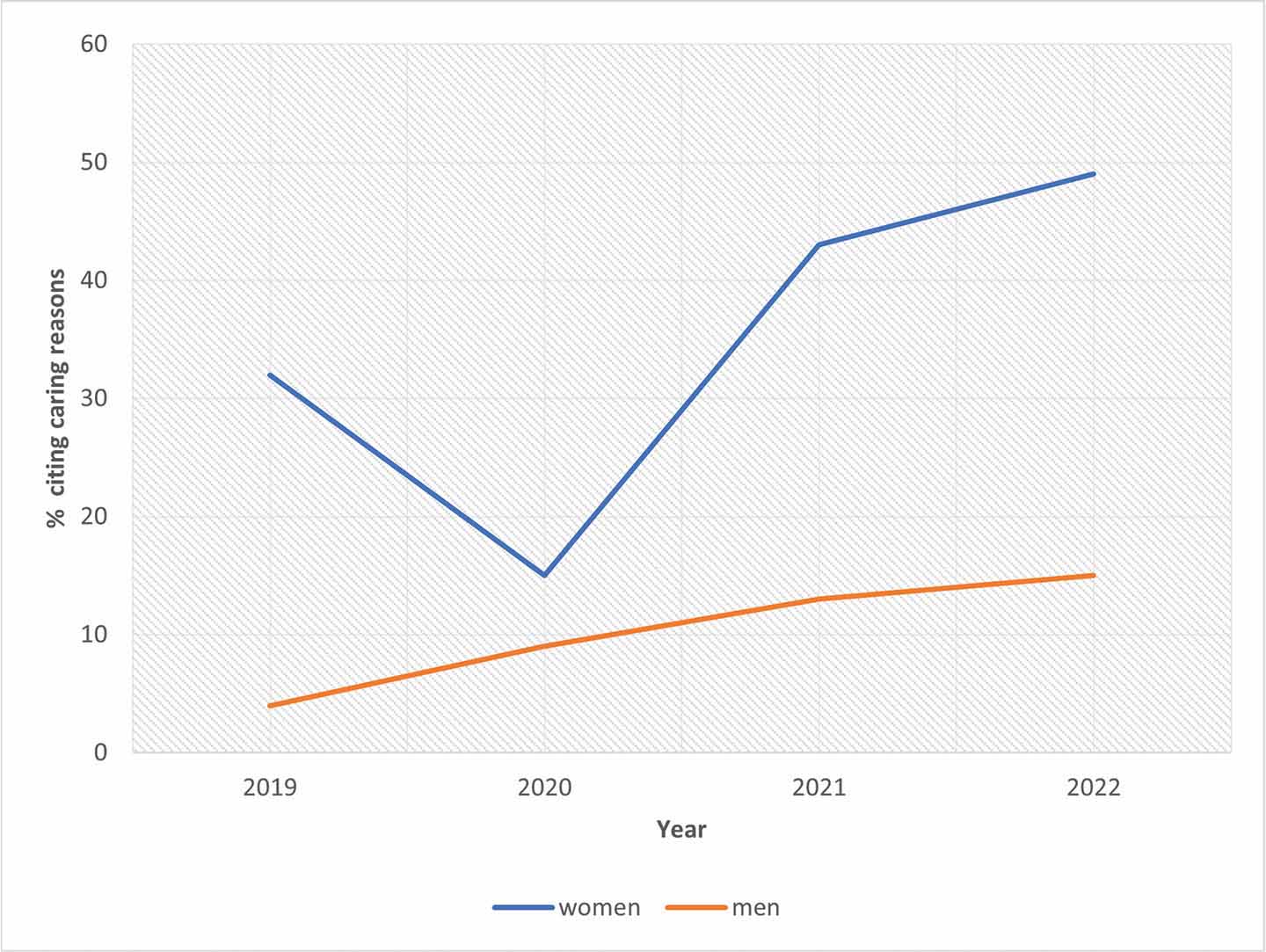
Chart 1:
Caring & family reasons: self-employed women and men.
The data show that the proportion of men citing caring reasons for reduced working time increased in 2021 and 2022, but since the share of self-employed women with caring reasons also increases, the gender gap remains significant. While changes in proportions are noticeable, it is useful to remember that the number of self-employed men working part-time and citing caring and family reasons for doing so in any year remains low.
(ii) Part-time work
Gender gaps in part-time working rates among the solo self-employed have remained reasonably steady throughout the period. There is a slight narrowing of the gap in 2020 as a higher proportion of men report working part-time and a small drop in the proportion of part-time self-employed women. The gender gap widens after 2021 but with some evidence that slightly higher proportions of both women and men are in solo self-employment working part-time.
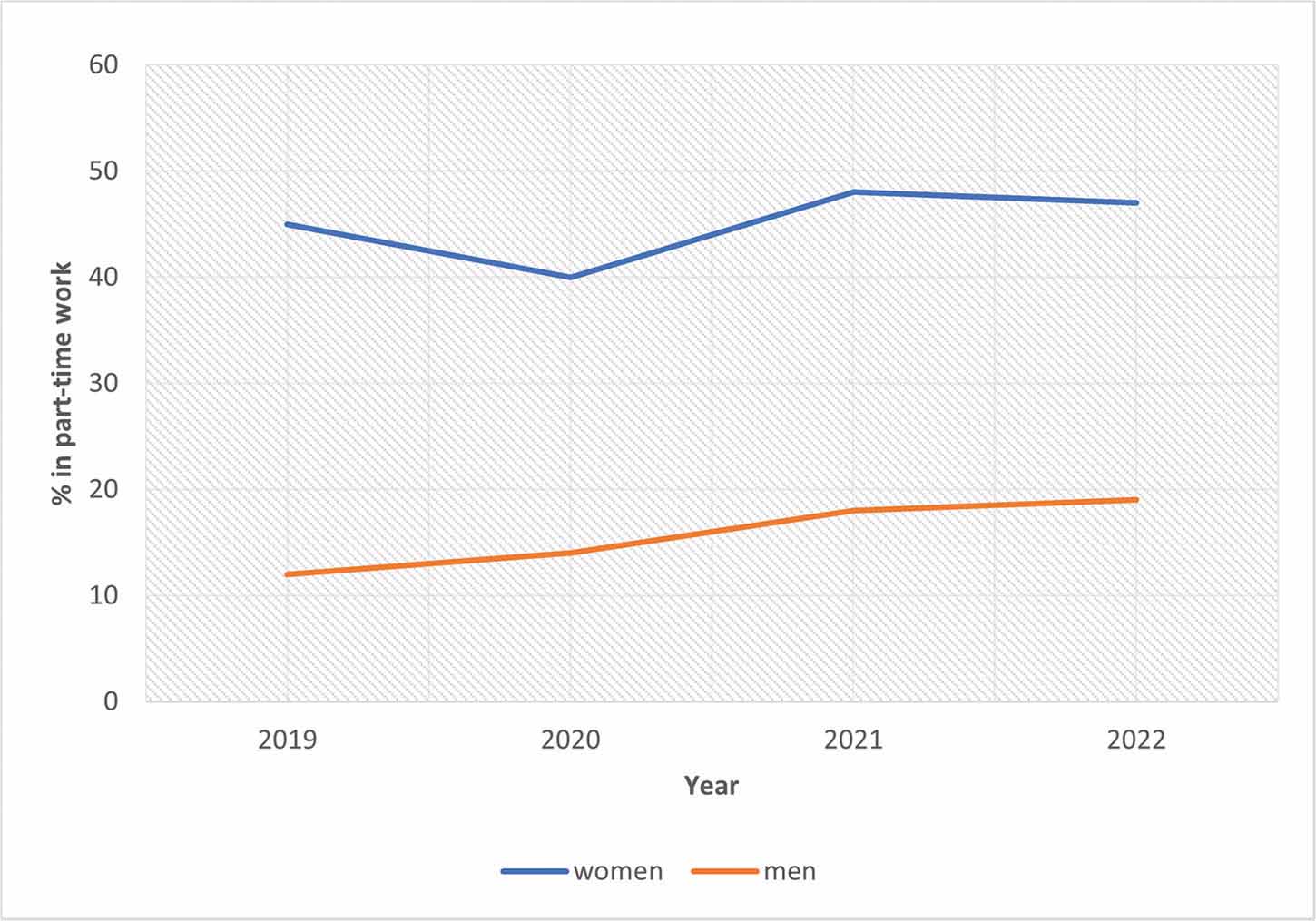
Chart 2:
Part-time work: self-employed women and men.
(iii) Working from home
In 2019, the gender gap in working from home rates among the self-employed was 9 percentage points. This gap began to widen in 2020, peaking at a difference of 28 percentage points in 2021 before beginning to narrow again in 2022. It appears from these data therefore that the COVID-19 period widened gender gaps in working from home rates.
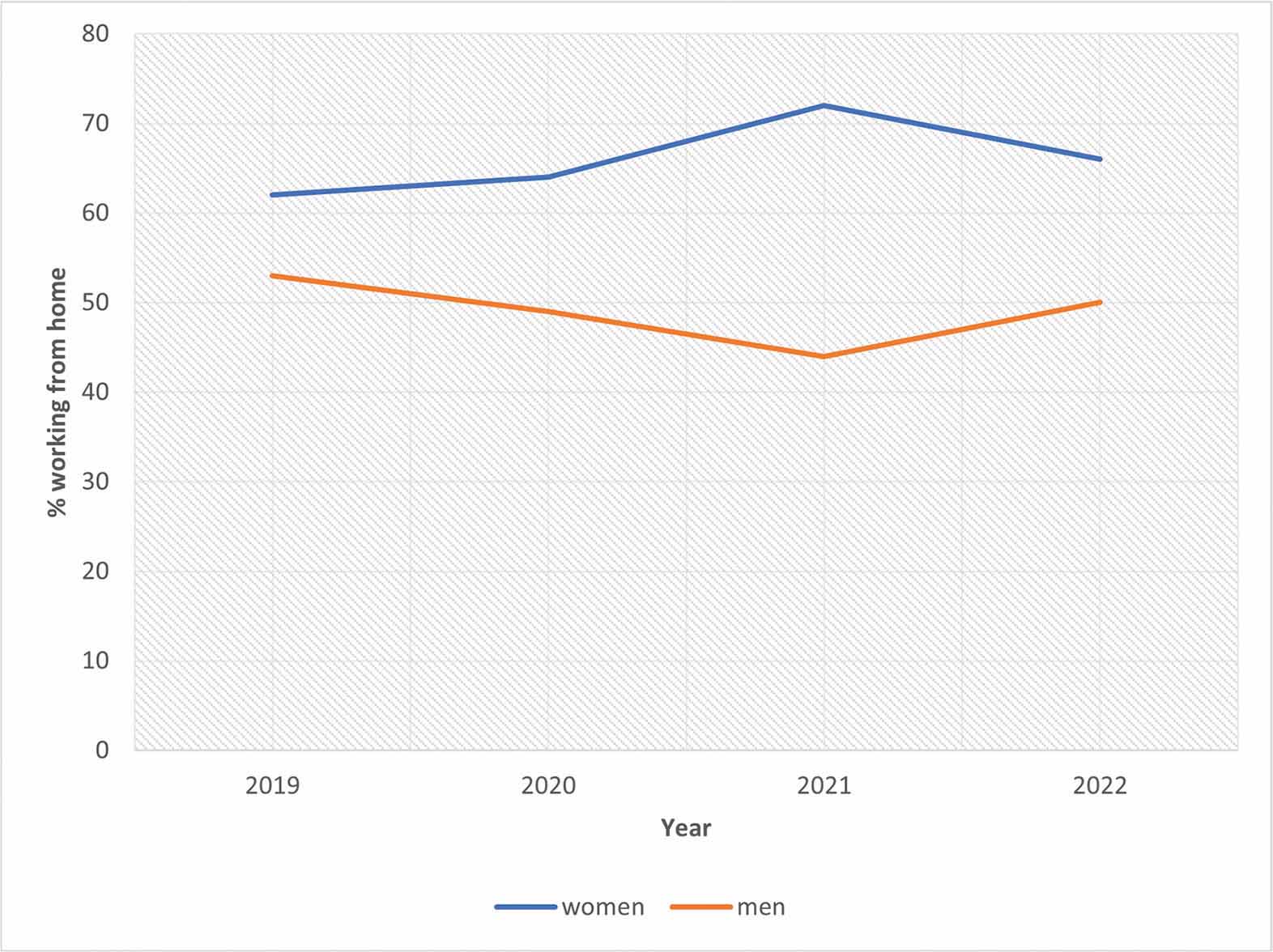
Chart 3:
Working from home: self-employed women and men.
From the results in Table 1 we can therefore see partial support for hypothesis one; that gender differences in flexible working factors among the self-employed remained during the COVID-19 period, but with some narrowing of gaps in caring reasons in 2020.
Turning to the second hypothesis, that differences in flexible working between self-employed and wage-and-salaried women will narrow during the COVID-19 period, Table 2, below, presents the results on the primary variables in the analysis for wage and salaried compared to solo self-employed women.
Table 2:
% distributions of independent variables 2019-2022 plus Chi Sq and Cramers v effect sizes: Self-employed and wage and salaried women
| 2019 | 2020 | 2021 | 2022 | |||||||||||||
|---|---|---|---|---|---|---|---|---|---|---|---|---|---|---|---|---|
| SE women | W&S women | % diff | Effect size | SE women | W&S women | % diff | Effect size | SE women | W&S women | % Diff | Effect size | SE women | W&S women | % diff | Effect size | |
| % with children | 63% | 66% | -3% | .011 | 59% | 68% | -9% | .049 | 58% | 66% | -8% | .052 | 56% | 67% | -11% | .060 |
| % in se | 5 | 6 | 5 | 5 | ||||||||||||
| p/t work | 45 | 27 | 18* | .070 | 40 | 29 | 11* | .064 | 48 | 30 | 18* | .084 | 47 | 30 | 17* | .083 |
| Wfh | 62 | 16 | 46* | .273 | 64 | 79 | -15* | .137 | 72 | 36 | 36* | .167 | 66 | 32 | 34* | .167 |
| Caring | 32 | 17 | 15* | .085 | 15 | 10 | 5 | .007 | 43 | 40 | 3 | .006 | 49 | 43 | 6 | .068 |
| Married | 65 | 58 | 7* | .075 | 66 | 54 | 12* | .059 | 64 | 49 | 15* | .091 | 51 | 48 | 3* | .048 |
| Children<15 | 42 | 40 | 2* | .010 | 36 | 39 | -3* | .007 | 37 | 38 | -1 | .007 | 38 | 38 | 0 | n/a |
| Older/adult | 20 | 26 | -6* | .031 | 23 | 29 | -6* | .017 | 21 | 28 | -7* | .032 | 18 | 29 | -11* | .053 |
| No children | 37 | 33 | 4* | .019 | 41 | 31 | 10* | .044 | 42 | 34 | 8* | .037 | 44 | 33 | 11* | .056 |
| Occ 1 | 65 | 42 | 23* | .032 | 61 | 42 | 19* | .090 | 67 | 44 | 23* | .100 | 60 | 43 | 17* | .086 |
| Occ 2 | 14 | 21 | -7* | .050 | 17 | 22 | -5* | .029 | 9 | 21 | -12* | .091 | 11 | 17 | -6* | .032 |
| Occ 3 | 22 | 36 | -14* | .101 | 22 | 36 | -14* | .068 | 24 | 35 | -11* | .129 | 29 | 40 | -11* | .063 |
| Sector 1 | 17 | 11 | 6* | .046 | 18 | 10 | 8* | .050 | 15 | 11 | 4* | .027 | 18 | 31 | -13* | .047 |
| Sector 2 | 22 | 34 | -12* | .067 | 23 | 32 | -9* | .051 | 18 | 35 | -17* | .071 | 20 | 36 | -16* | .060 |
| Sector 3 | 31 | 16 | 15* | .092 | 31 | 26 | 5* | .081 | 36 | 17 | 19* | .095 | 33 | 22 | 11* | .039 |
| Sector 4 | 30 | 38 | -8* | .042 | 28 | 22 | 6* | .046 | 31 | 37 | -6* | .024 | 28 | 11 | 17* | .087 |
| Age 20-29 | 5 | 23 | -18* | .085 | 5 | 22 | -17* | .086 | 8 | 24 | -16* | .072 | 8 | 24 | -16* | .066 |
| Age 30-39 | 22 | 26 | -4* | .023 | 15 | 26 | -11* | .059 | 19 | 24 | -5* | .026 | 22 | 23 | -1 | .009 |
| Age 40-49 | 28 | 25 | 3 | .007 | 32 | 26 | 6* | .031 | 29 | 26 | 3 | .016 | 30 | 26 | 4* | .019 |
| Age 50-59 | 25 | 18 | 7* | .045 | 27 | 19 | 8* | .049 | 27 | 18 | 9* | .052 | 21 | 19 | 2 | .001 |
| Age 60-69 | 18 | 7 | 11* | .069 | 19 | 6 | 13* | .083 | 16 | 7 | 9* | .047 | 18 | 7 | 11* | .070 |
| n | 427 | 7,002 | 337 | 5,796 | 371 | 6,103 | ||||||||||
| N | 57,666 | 1.79m | 59,087 | 951,399 | 57,610 | 1.08m | 63,987 | 1.1m | ||||||||
1* - = significant at 99% confidence from Chi-square tests on crosstabulations of ‘self-employment/waged work’ and all variables applied
In terms of characteristics, we can see that, on average, self-employed women are older than their employed counterparts. Overall self-employed women are less likely to have children of any age than their wage-and- salaried peers in all the years presented, but in the ‘children under 15’ bracket there is little difference, with between 38-42 percent of both groups having younger children. In terms of occupation level, self-employed women show a significantly higher proportion in those upper level professional and semi-professional occupations across 2019-2022.
The results show significant narrowing of gaps in flexible working between self-employed and employed women but with some variation according to form of flexibility and evidence of an inverse-U shape or petering out of effects after 2021.
(i) Caring reasons for reduced working time
In 2019, the gap in reporting of caring and family reasons for reduced working time between self-employed and wage-and-salaried employee women was fifteen percentage points. This gap was narrowed after 2020, reflective of different trends in each year. In 2020, the parity between self-employed and employee women reflects a sharp drop in self-employed women citing these reasons. In 2021 the proportions of both groups of women citing caring responsibilities grew significantly, with the gap between them remaining small, a pattern which continued into 2022.
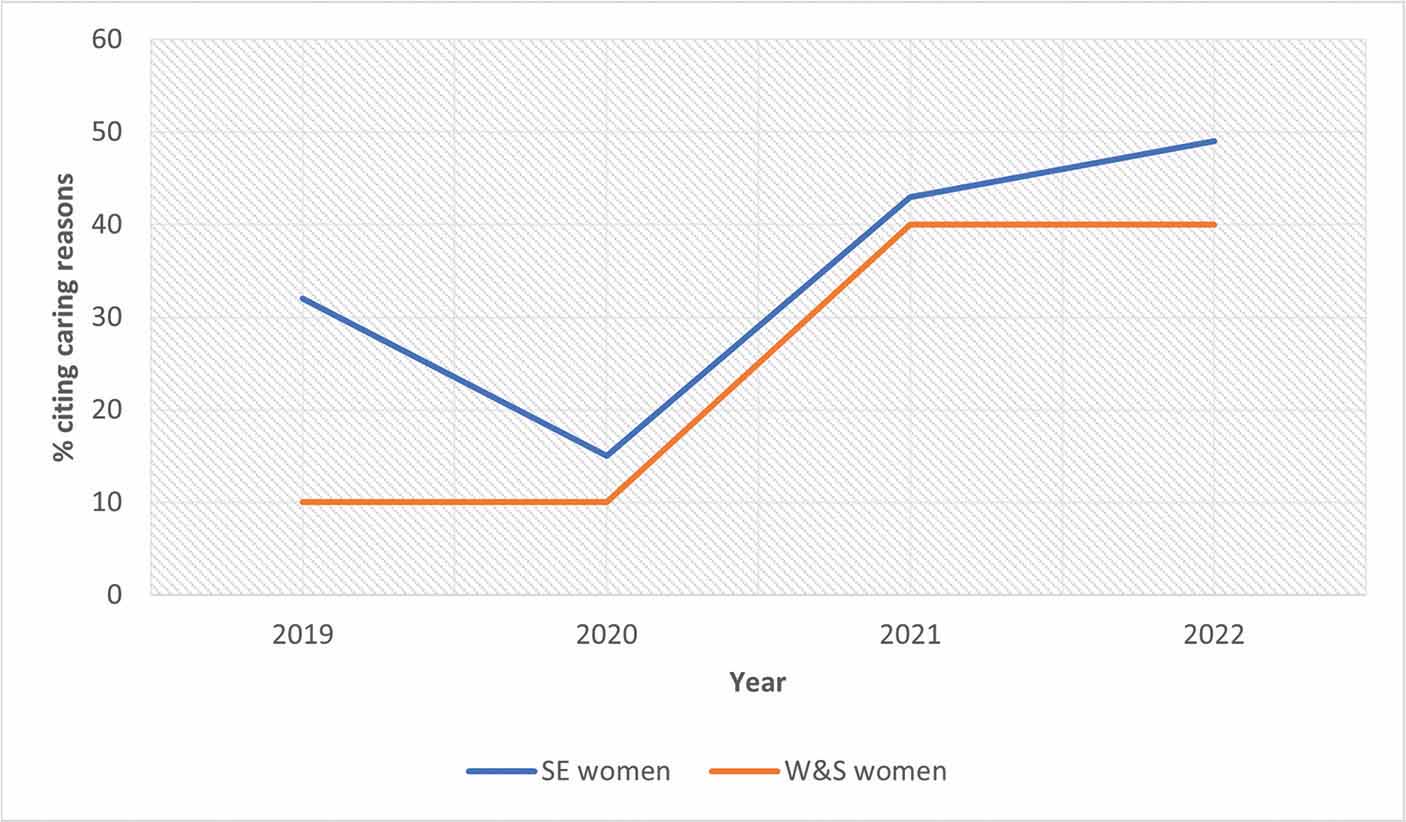
Chart 4:
Caring & family reasons for part-time work: self-employed and employee women.
(ii) Part-time work
We can see some narrowing of the gap in part-time work between self-employed and wage-and-salaried women in 2020, reflective of a slightly lower proportion of self-employed women working part-time than in the previous year. Otherwise, the gap here remains consistent at 17-18 percentage points, with solo self-employed women more likely to work part-time than their waged counterparts.
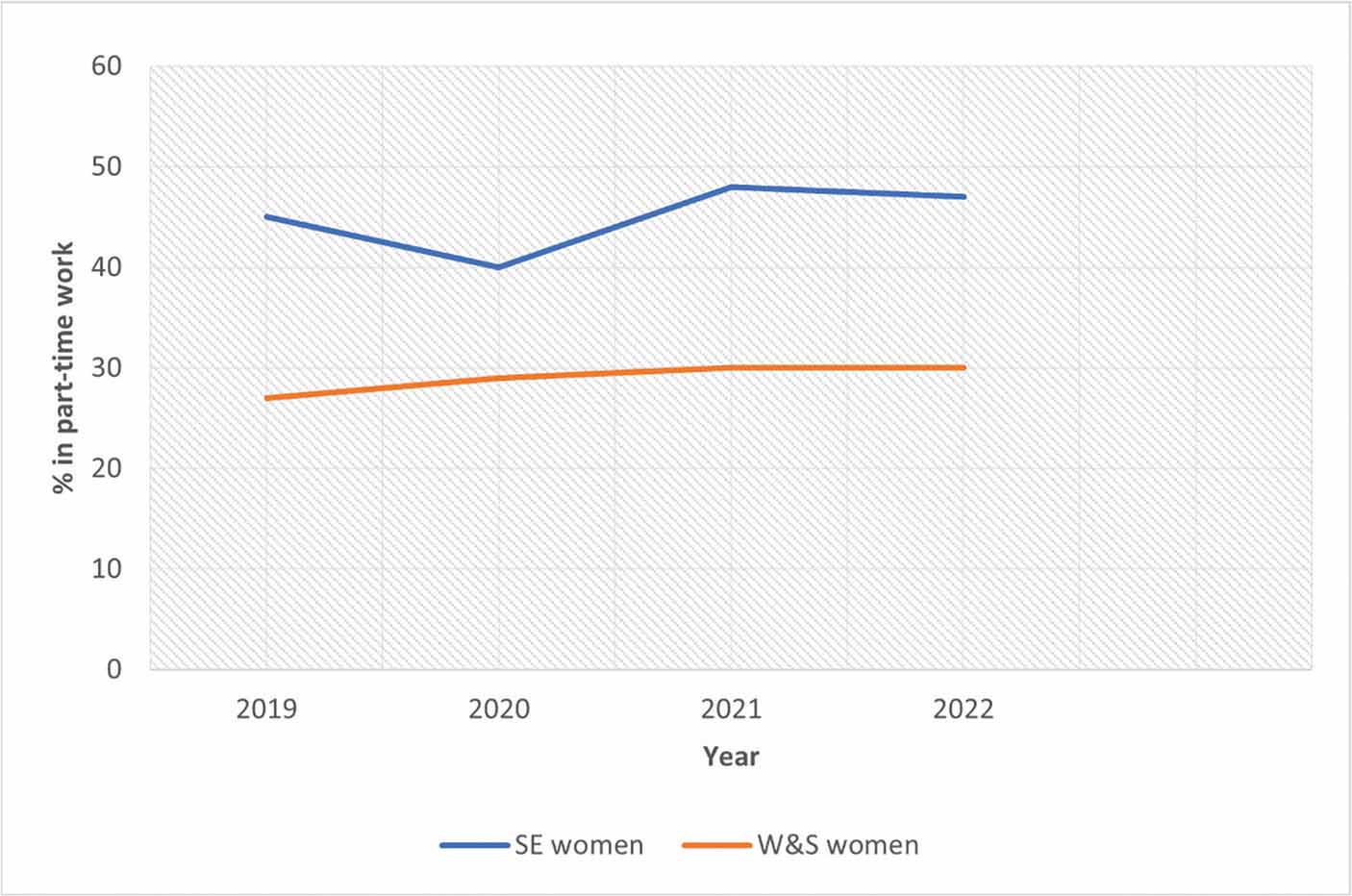
Chart 5:
Part-time work: self-employed and wage & salaried women.
(iii) Working from home
Here we see a dramatic narrowing of differences between self-employed and employee women working from home in 2020. This would be expected as large swathes of wage-and-salaried workers moved online during successive lockdown periods. These trends do begin to return to more normal patterns of difference of remote working between self-employed and wage-and-salaried women after 2021 but still generally narrower gaps reflective of increases in working from home among wage-and-salaried women during and after the COVID-19 period.
From the data on percent distributions on flexibility factors alongside statistical tests we can see partial support for hypothesis two, that differences in flexible working rates between self-employed and wage-and-salaried would narrow during the COVID-19 period. The data shows significant narrowing of gaps in working from home rates as increased numbers of wage-and-salaried women start working remotely, matching their self-employed female peers. On caring and family responsibilities, a narrowing gap here is reflective - in the main - of a drop in selfemployed women citing these reasons for reduced working time. Gaps in part-time work between self-employed and employee women remain steady.
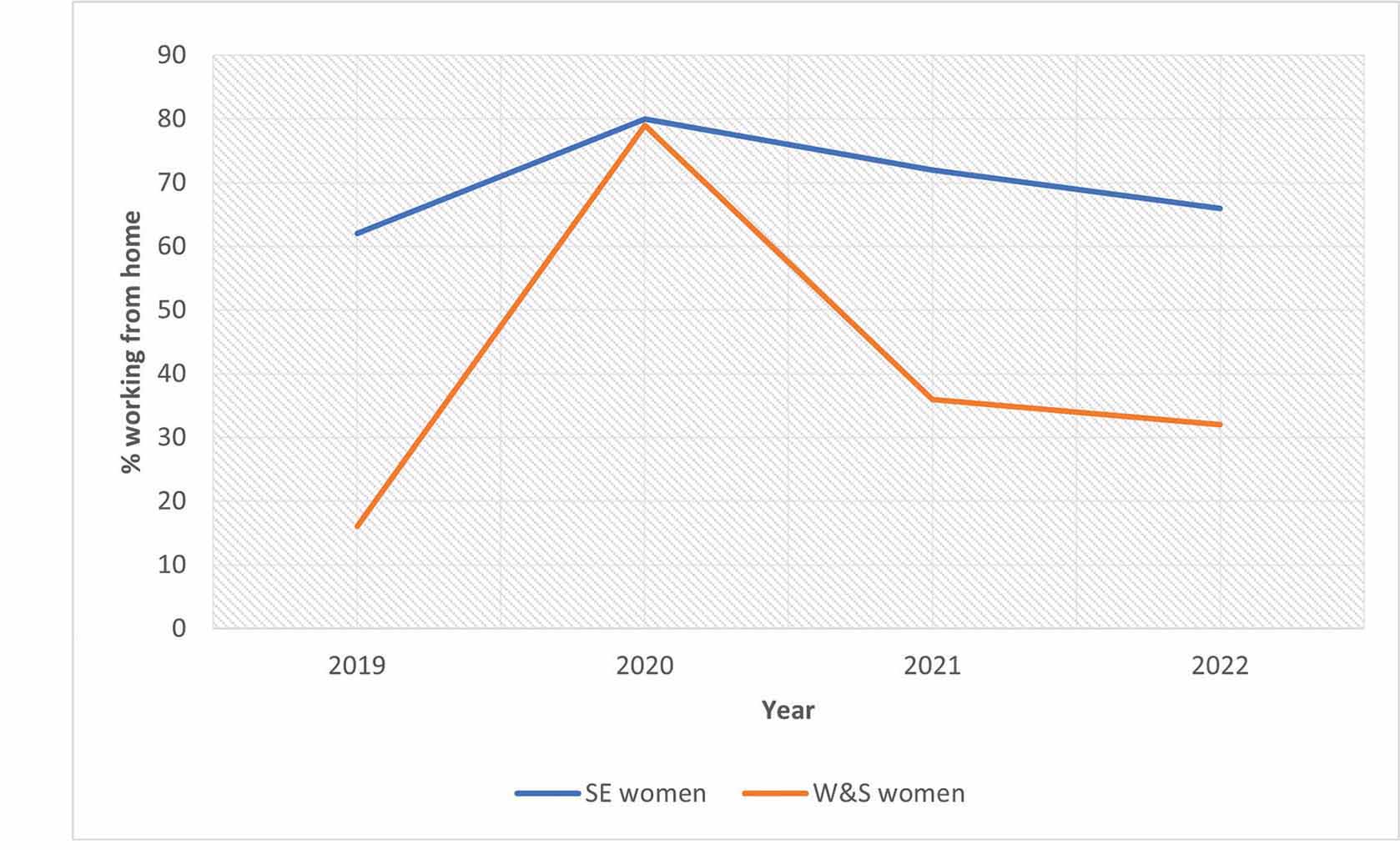
Chart 6:
Working from home: self-employed and wage-and-salaried women.
Next, we address hypothesis 3, that the effect of flexible working factors on self-employment choice for women will be reduced during the COVID-19 period. Table 3, below, presents the results of logistic regression models on the determinants of self-employment over wage-and-salaried work for 2019-2022. The dependent variable is solo self-employed status with the reference category wage-and-salaried work, with the primary independent variables of interest being an interaction term between part-time working and citing caring responsibilities and home working. Age, having children under 15, being married and four broad occupation and sector group dummy variables are included to account for the effect of these factors on the relationship between flexible working and self-employment choice.
Table 3:
Binary logistic regression of flexibility and work-related factors on the choice for solo self-employment for women. DV self-employment/wage- and-salaried work
| 2019 | 2020 | 2021 | 2022 | |
|---|---|---|---|---|
| Constant | -4.429 | -5.021 | -6.811 | -5.553 |
| Int. part-time/caring reasons | 3.274*(.012) | 1.897*(.017) | 3.329*(.015) | 3.168*(.014) |
| Home working | 8.614*(.014) | 2.590* (.011) | 4.672*(.012) | 3.632*(.012) |
| Children <15 | 1.068*(.014) | 1.049* (.011) | .915*(.011) | 1.097*(.015) |
| Married | 1.118*(.012) | .966*(.012) | 1.579*(.010) | 1.184*(.012) |
| Occupation 1 | 1.063*(.019) | 2.906*(.018) | 3.691*(.017) | 2.579*(.017) |
| Occupation 2 | .144*(.024) | 1.374*(.019) | n/a | 1.484*(.018) |
| Sector 1 | 1.986*(.013) | 1.807*(.011) | 1.412* (.015) | 1.886*(.016) |
| Sector 3 | 2.068*(.012) | 1.489*(.014) | 2.345*(.016) | 1.389*(.016) |
| Sector 4 | .709*(.015) | .837*(.014) | 1.340*(.015) | .898*(.015) |
| Age 30-39 | .938*(.022) | .894*(019) | .1444*(.016) | 1.169*(.020) |
| Age 40-49 | 1.234*(.021) | 1.840*(.017) | 2.595*(.012) | 1.575*(.020) |
| Age 50-59 | 2.342*(.021) | 2.989*(.021) | 4.436*(.025) | 1.764*(.020) |
| Age 60-69 | 4.856*(.023) | 7.386*(.021) | 8.775*(.027) | 4.567*(.021) |
| n | 6, 280 | 5, 507 | 5, 6794 | 6, 044 |
1 - Occ (occupation) 1 = professional, senior official, manager, semi-professional, technical occupations; occupation 2 – skilled trades or craft level occupations; occupation 3 = service, manual or elementary level occupations
The results on the coefficients show that caring/family reasons and part-time work is associated with being three times more likely to be in solo self-employment than wage-and-salaried work for women. Reflective of the results from the descriptive analysis and initial hypothesis tests, the results on the flexibility factors in the regression models show an inverse-U shape with the effect of flexibility factors reduced in 2020 but returning to more ‘normal’ trends thereafter. We can see that in 2019 working from home meant a woman was eight times more likely to be in self-employment than in wage-and-salaried work, clearly reflective of the availability of remote working arrangements in solo self-employment compared to the waged sector, or preferences towards same. In 2020 this effect is reduced, with women who work from home being 2.5 times as likely to be in self-employment. In 2021 and 2022 the size of the effect of working from home increases but remains significantly lower than pre-COVID-19, a pattern which, again, is likely to be reflective of the more widespread availability of remote working in the wage-and-salaried sector after this time. Remote working and hybrid working has been one key aspect of employee-led flexibility that organisations have retained where possible, and which is in continued demand.
Chart 7, below, summarises the results of the effect of the two main flexibility factors on self-employment choice for women between 2019 and 2022.
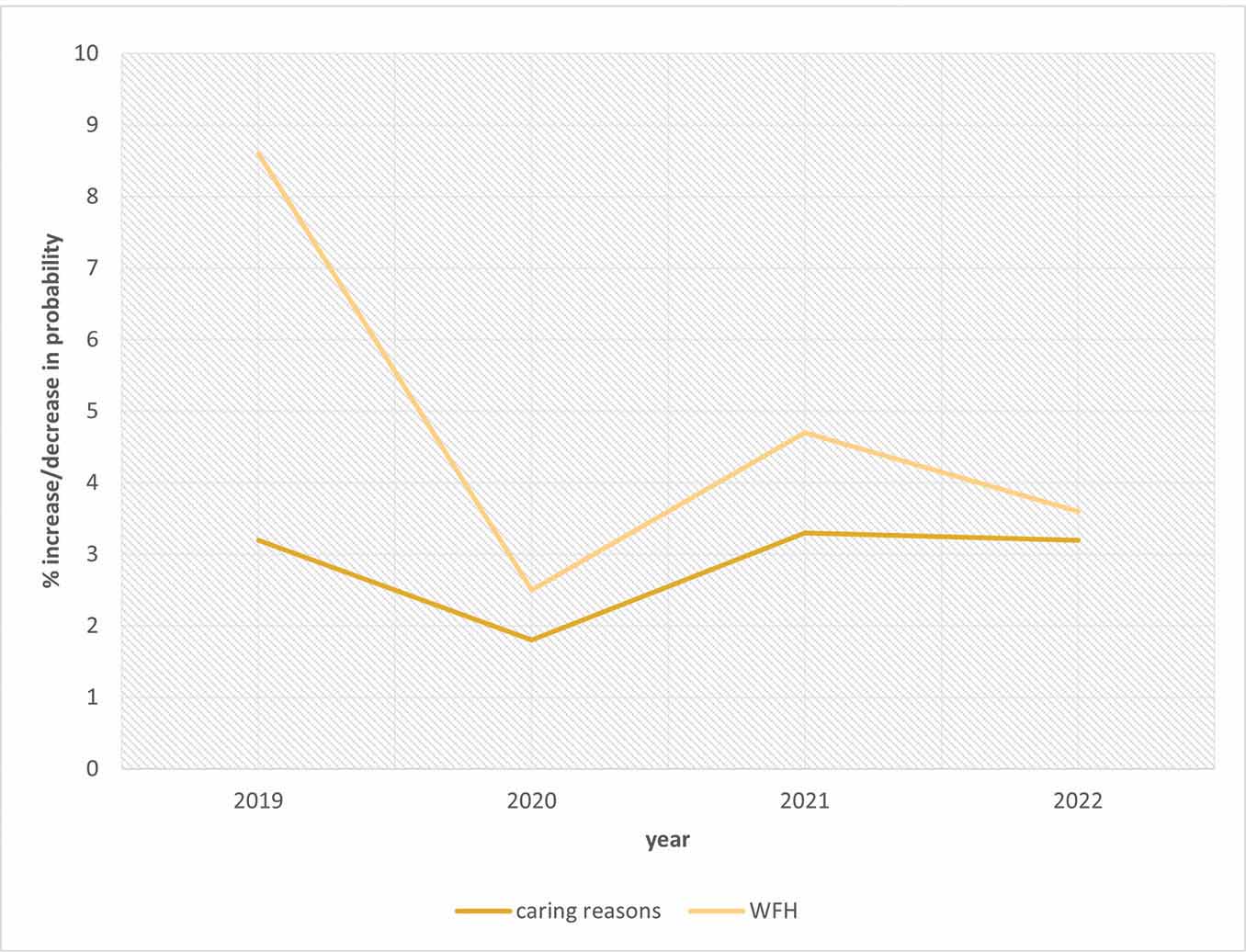
Chart 7:
Summary of effect of main flexibility factors on likehood of self-employment over wage_&_salaried work for women (logit models_.
It must be borne in mind when considering coefficients in multivariate models that patterns observed are conditional on the inclusion of all the various controls and reflect how the relationships apply across the sample after accounting for these factors. Results may be different, for example, if non-professional/service sectors were included as sector/industry controls rather than as a reference category, or if older age groups were referenced rather than the younger 20-29 bracket. Notwithstanding this caveat, the results on the flexibility factor coefficients show support for hypothesis 3, which is that the effect of flexible working factors on self-employment choice for women will be reduced during the COVID-19 period.
DISCUSSION AND CONCLUSION
This study set out to investigate whether increases in the availability of flexible working in the wage-and-salaried sector had any impact on gendered trends within solo self-employment. It had been highlighted in previous research that the flexible working arrangements more readily available in solo self-employment manifested themselves in sex-specific differences as women try to balance paid and unpaid labour to a greater extent than their male counterparts (Bari et al., 2021; Drew and Humbert, 2012). Women in self-employment, and particularly highly educated professional women, had been found to be more likely than both their male and waged-and-salaried peers to have young children, to work part-time and from home for caring and family reasons (Bari et al., 2021). The primary reasoning behind these findings was that the flexibility offered by this type of work was unavailable in comparable waged employment for these women and thus acted as a ‘pull’ factor into self-employment, or indeed a ‘push’ factor due to constraints around gendered divisions of labour (Choi and Kim, 2021; Dawson and Henley, 2009; Georgellis and Wall, 2005; Patrick et al., 2016). Widespread labour market disruption brought about by COVID-19 restrictions between 2020 and 2022 offered the opportunity to explore issues of gendered flexibility in self-employment through a different lens. Rapid increases in the availability of flexible working such as remote and hybrid working not just mandated through successive ‘lockdowns’ but driven by simultaneous demand and supply-side factors arguably created a situation where the flexibility afforded by freelance work might not be such a strong incentive. Might working mothers - a rapidly growing demographic within part-time, solo self-employment prior to the pandemic - now be able to enjoy increased flexibility within the wage-and-salaried sector? Would the levelling out effects of COVID-19 in terms of working flexibility alongside the disruptive effects of increased childcare responsibilities for working parents (albeit for a limited period) impact gendered trends in flexible working within self-employment as fathers, perhaps, take up a larger share of unpaid labour? This research proposed that while there may be some narrowing of the gaps, or levelling, in flexible working arrangements between women in self-employment and wage-and-salaried work during this period, gender differences would remain robust and thus largely unchanged. The theoretical premise behind this proposition was that gendered divisions of labour tend to be resistant to broader changes and women’s preference for flexible working would continue regardless of where that flexibility was available (Becker, 1985; Chung and van der Lippe, 2020; Folbre, 1994; Hakim, 2000; Hochschild, 1997). Furthermore, it was proposed that the level of autonomy over the timing and conditions of work offered by solo self-employment is not matched by remote or hybrid working in the waged sector. Thus, while the pull factor of flexible working into self-employment may be narrowed during this period, it would remain a significant predictor of solo self-employed status for women.
The main findings of this study are as follows. There was a significant narrowing of gender gaps in caring responsibilities among the solo self-employed during 2020, but these began to diverge again thereafter. There is some evidence of slightly higher proportions of solo self-employed men working part-time and citing caring responsibilities after 2020, suggesting an increased take up of domestic and caring work by self-employed men after COVID-19, or at least reporting as such in survey questionnaires after 2020. This provides some evidence of a levelling effect among freelance self-employed, similar to that reported in previous studies of the wider labour market (Andrew et al., 2020; Boll et al., 2024; Chung et al., 2021; Petts et al., 2021). Numbers of self-employed men working part-time and citing caring reasons for doing so remains very low compared to the female group. Moreover, much of the changes in terms of gender gaps in caring and family reasons for part-time work occurred through a fall in reporting on the female side, with women in 2020 more likely to cite illness or ‘other’ reasons.
Differences between self-employed and wage-and-salaried women citing caring responsibilities are substantially narrowed in 2020, 2021 and 2022 compared to the 2019 figures. Again, there seems to be an anomaly in terms of drastically reduced numbers of self-employed women stating caring responsibilities in 2020, numbers which thereafter rise back to normal. This trend is coupled with growing proportions of wage-and-salaried women citing caring reasons for reduced working time after 2020. On the working from home variable, the gap is eliminated in 2020, reflecting large proportions of wage-and-salaried women working remotely due to COVID-19 restrictions, a proportion that drops slightly in 2021 and appears to have remained higher than pre-COVID-19 levels thereafter. On rates of part-time work, while self-employed women were less likely to work part-time in 2020 compared to other years, the gap in part-time work rates between self-employed and wage-and-salaried women remains in place. Coefficients on regression models on the effect of flexibility factors on self-employed status over wage-and-salaried work show that caring reasons and working from home became significantly weaker determinants of self-employed status in 2020. The effects begin to increase thereafter but are yet to reach pre-COVID-19 levels as of 2022.
The findings of this study show that COVID-19 did influence gender differences in flexible working in solo self-employment as increased numbers of self-employed men worked part-time and stated caring reasons for doing so. The narrowing gap in flexible working between self-employed and wage-and-salaried women is mirrored in the effects of flexibility variables on self-employment choice for those years, narrowing in 2020 and beyond. While we can see significant changes occurring in working trends for both groups in 2020 the extent to which shifts in proportions in flexible working among self-employed are responsive to those in wage-and-salaried work is unclear. We can however see a reduction in importance of flexibility factors as a determinant of self-employed status after 2020, reflective, in part at least, of greater availability of remote work in the waged sector. With the data showing increases in the number of women entering solo self-employment in Ireland during this period, and particularly between 2021 and 2022, perhaps other motivations more commonly associated with ‘pull’ factors into self-employment such as business opportunity or autonomy are playing a greater role (Patrick et al., 2016). Care must be taken in drawing such conclusions however, based on the limitations of self-reported survey data and confounding factors in multivariate analysis. In summary, what the data point to is the continuation of relevance of flexible working for the solo self-employed and how that effect is gendered. Self-employed women are more likely than their male or wage-and-salaried peers to work part-time, from home and for reasons associated with caring responsibilities. However, some levelling is evident in terms of slightly raised proportions of self-employed men working part-time for caring and family responsibilities after 2020, in line with findings from other jurisdictions (Boll et al., 2024; Petts et al., 2021).
The flexibility and autonomy of solo self-employment or freelance work appeals to women with caring responsibilities (Bari et al., 2021; Boden, 1999; Carr, 1996; Choi and Kim, 2021; Wellington, 2006). This is likely to remain the case despite greater availability of flexible and remote working in the wage-and-salaried sector. However, the findings suggest that the availability of remote, hybrid and part-time work in high-quality or higher-level wage-and-salaried work may impact individual decisions to pursue solo self-employment. Future research could explore this area further by employing longitudinal data to explore transitions to self-employment from wage-and-salaried work. This would add to our understanding in terms of which occupations and sectors women most commonly leave in favour of the flexibility of solo self-employment or freelance work. Income data could be analysed to highlight gender pay gaps in self-employment; something which would be important considering the tendency towards precarity that characterises this form of work. While this research focused on the 2019-2022 ‘pre and post COVID-19’ period, gendered trends in solo self-employment over a longer time frame would similarly be a useful area for further research. Finally, it is important to note that the association between flexibility in self-employment and working parents, mainly working mothers, does not account for the roughly 30-40 percent of the self-employed who do not have children. The work-family conflict narrative may apply to this group in a different way, or not apply at all, and further research could investigate trends within this group specifically in terms of motivations, working patterns and gender differences. While this research highlighted flexible working patterns between women and men in self-employment and wage-and-salaried work, with parental status as a control variable, further research using split or limited samples could add to our understanding of within-group trends.
The demand for flexible working in the labour market is likely to continue due to changing work cultures, technological advancements, and the impact of the COVID-19 pandemic. Organisations will continue to adopt flexible working strategies such as hybrid, remote and flexible working to meet demand, accommodate employee needs and boost productivity. The future of work will be one where employee-led flexibility is key, and it is therefore pertinent to management and labour economics more broadly that future research explores the changing dynamics of these ‘pull’ factors into self-employment and freelance work. We know that inflexibility, a long hours work culture and the ‘glass ceiling’ effect in wage-and-salaried work act as barriers to women’s progression or even continuation in their work and careers after parenthood (Cotter et al., 2001; Cross and Linehan, 2006; Taparia and Lenka, 2020). It has also been shown that this glass ceiling pushes some women into self-employment or freelance work where greater autonomy and flexibility is on offer, albeit at the cost of increased risk or precarity (Budig, 2006; Choi and Kim, 2021; Lawter et al., 2016; Patrick et al., 2016). There is likely therefore to be some connection between the availability of flexible work in wage-and-salaried employment and individual choice into self-employment as a flexible alternative, especially for women.
Differing working trends between women and men are resilient, in self-employment as in the wider labour market, as women continue to seek and use flexible working strategies to balance the demands of work and home to a greater extent than men. Solo self-employment and freelance work offers a useful lens through which to view gendered trends that themselves speak to broader debates around sex-differences in care, parental experience and household task distribution (Becker, 1985; Folbre, 1994; Hakim, 2000, 2011; Hochschild, 1989, 1997). Understanding the dynamics of flexible work and gendered patterns in solo self-employment is useful in terms of addressing systemic inequalities and fostering a more inclusive workforce. Policies that enhance flexibility in traditional employment, such as remote and hybrid work arrangements, can reduce barriers like the glass ceiling and caregiving challenges that disproportionately affect women. However, the key for ensuring equal opportunities for women in the labour market and the closure of gender and parental pay gaps lies in ensuring that in meeting the demand for control over working time and conditions, the costs associated with this flexibility are minimised (Goldin, 2021). For managers, adopting employee-driven flexibility while ensuring equitable opportunities for career progression is crucial to retaining talent, enhancing productivity, and staying aligned with cultural and technological shifts. This research offers insights for shaping policies and organisational strategies that advance gender equity and respond to this evolving nature of work.
This study used the COVID-19 period as a lens to view this connection at a time of unprecedented acceleration of the availability of flexible working in the wage-and salaried sector. While this provides interesting new insights, it is also a limitation of the research. The COVID-19 era introduced numerous confounding variables that may obscure relationships between variables of interest or impact survey responses, for example as discussed around self-reported reasons for reduced working time. COVID-19 was a novel or ‘rare event’ and as such has limited precedent, making it difficult to discern whether observed patterns are specific to this time period or may occur during other events at different times. That having been acknowledged, this research sought to use the increased availability of flexible working in the wage-and-salaried sector during this time to highlight the impact on known gendered trends in flexible working in self-employment and as such the data available serves this purpose. Additional limitations relate to the cross-sectional nature of the data, which provides merely a snapshot rather than a causal explanation. Of course, we do not really know whether changes in the availability of flexible working impacted trends in self-employment or whether there were multiple confounding factors. Nevertheless, cross-sectional data enable comparisons across different groups within a particular timeframe and this was deemed sufficient for the purposes of the hypotheses being tested here. Using country-specific data for Ireland also comes with its own limitations in terms of generalisability, and further research into gendered flexibility in a multi-country or EU-wide study might be useful. However, Ireland offers an interesting insight into gendered labour market trends both as an example of a liberal or market-based economy within Europe and as a country with high levels of work-family conflict, especially for working mothers (O’Hagan, 2015).
Notes
[20] The term “gender” and “gendered” referred to throughout represents sex differences as categorised as male/female in the data.
[21] These age bands reflect the structure of household composition/child age variables in the Labour Force Survey, with 15 or under typically falling under the legal definition of ‘dependent’ child and children 15+ referring to children aged 16-23 if in full time education (Status of Children Act, 1987).