
Table 1:
Catalogue of Female Professorial Leadership Identities
| Theme | Description | Female Professor identity | Literary Support |
|---|---|---|---|
| Mentor/ Advisor | Sometimes referred to as academic citizenship, professorial leadership includes collective responsibilities, closely associated with helping less experienced colleagues develop through mentoring processes. | Stronger sense of duty among female professors to mentor others. | Slaughter and Leslie, 1997; Macfarlane and Burg, 2019; Meyer, 2012; Rayner et al., 2010 |
| Activities include providing information; mentoring on the rules of the ‘game;’ showing how to strategize research activities; and referrals for opportunities. | Greater engagement with guiding, facilitating, nurturing, encouraging and inspiring activities. | Elacqua et al., 2009; Uslu and Welch, 2018; Kogan, 1999; Meyer, 2012 | |
| Important activity to ensure future Professoriate pipeline, however, mentoring is not seen as strategically central to HEIs. | Reinforces an under-appreciation of the value of mentoring as a key female professorial activity. | Macfarlane and Burg, 2019; Meyer, 2012 | |
| Mentors and mentees usually prefer to associate with others with similar characteristics, such as age, race, and gender. | Female under-representation in the Professoriate makes it less likely to secure a female professor mentor. | Diezmann and Grieshaber, 2019 | |
| Role Model | The Professoriate is expected to be a role model in all facets of the academic role. | Female professors have shown specific capacity to inspire others through teaching and research excellence. | Braun et al., 2016; Macfarlane, 2011; Uslu and Welch, 2018; Evans et al., 2013; Kelliher et al., 2010 |
| A reliable source of information about the group norms and acceptable behaviour from which other academics can draw. | Women may be considered less prototypical than men regarding the Professoriate and leadership; reinforcing an ‘outsider’ perspective. | Hogg et al., 2012; Tharenou, 1994; Zhao ands Jones, 2017; Evans, 2017 | |
| Individuals may see greater potential in their capacity to emulate role models with similar characteristics, such as age, race, and gender. | Under-representation of women in the Professoriate has resulted in fewer female role models for upcoming male and female academics. | Subbaye and Vithal, 2017; Cabrera, 2007; Howe-Walsh and Turnbull, 2016; Gould, 2001 | |
| Guardian | Professors are perceived to be intellectual leaders, with internal and external expert influence; they possess a unique publication-based authority and power that is independent of their management and administrative roles. | The challenge of sustainably exhibiting publication-based authority and power due to leaning towards ‘academic housekeeping’ activities | Macfarlane, 2011; Macfarlane and Burg, 2019; Evans, 2015; Rayner et al., 2010; Oleksiyenko and Ruan, 2019 |
| They have a duty to ensure academic standards, values and traditions are being maintained. | Žydžiūnaitė, 2018; Macfarlane, 2011 | ||
| Belief is that they must guard against an increasingly neo-liberal focus, which overemphasises business modes of productivity so that the development of the next generation of academic leaders remains a central activity of the Professoriate. | Fitzgerald, 2014; Bolden et al., 2012; Macfarlane and Burg, 2019; Ryan and Peters, 2015 | ||
| Ambassador | Professors are expected to be ambassadors for their institutions and departments, representing their national and international interests. They must also be able to engage and communicate with non-academics and the broader community regarding contemporary issues. | While gender does not appear to play a significant role in being an academic ambassador, female professors acknowledge a perceived gender-ambassador role, separate from that of their academic activities. | Uslu and Welch, 2018; Ward, 2003 |
| Advocate | Professors should engage in advocacy for their discipline or profession and promote conceptual and socio-political standpoints; remedy perceived injustices | Evidence of advocacy for gender equality in the Academy. Perceived pressure or a sense of duty to advocate for their gender both inside and outside their university can result in an excessive amount of ‘service work,’ that can impede promotion chances | Fitzgerald, 2014; Macfarlane, 2011; O’Connor, 2015; Oleksiyenko and Ruan, 2019; Acker and Feuerverger, 1996; Grant and Knowles, 2000; Misra, et al, 2011; Diezmann and Grieshaber, 2019 |
| Champion for Colleagues | The Professoriate encourages and develops shared academic values and resists threats to the group’s social identity on issues such as managerialism encroachment on academic values, traditions, and freedoms | By virtue of the under-represented nature of women in senior academic roles, female professors are especially valuable as leaders for other female academics. | Arquisola, 2016; Bolden, et al, 2012; Bengtsen and Barnett, 2017; Oleksiyenko and Ruan, 2019 |
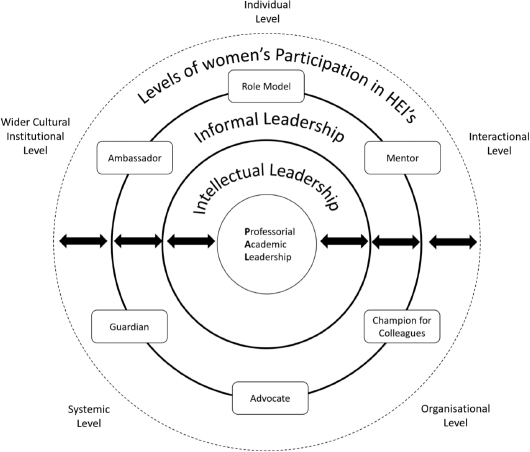
Figure 1.
Informal leadership activities of female professors