
Table 1
Summary of theoretical approaches to national studies of SEs
| Level of analysis | Unit of analysis | Key concepts | Theory Contributions include |
|---|---|---|---|
| Macro | Social economy, institutional context, nation, continent. | Economic development, civil society, type of government. | Approaches to SE (sustainable subsistence, enmeshed focussed, etc.), international comparisons |
| Meso | Organisation / collectives Mission | Mission-relatedness, legal form, forms of capital, traded income, participatory governance. | Typologies of organisations (ENP, PSE, SC, SB), international comparisons. |
| Micro | Individuals: founder, social entrepreneur, activist | Change imperative, individual characteristics, social innovation, social entrepreneurship, change agents. | Types of social entrepreneurs (bricoleur versus activist), approaches to social entrepreneurship. |
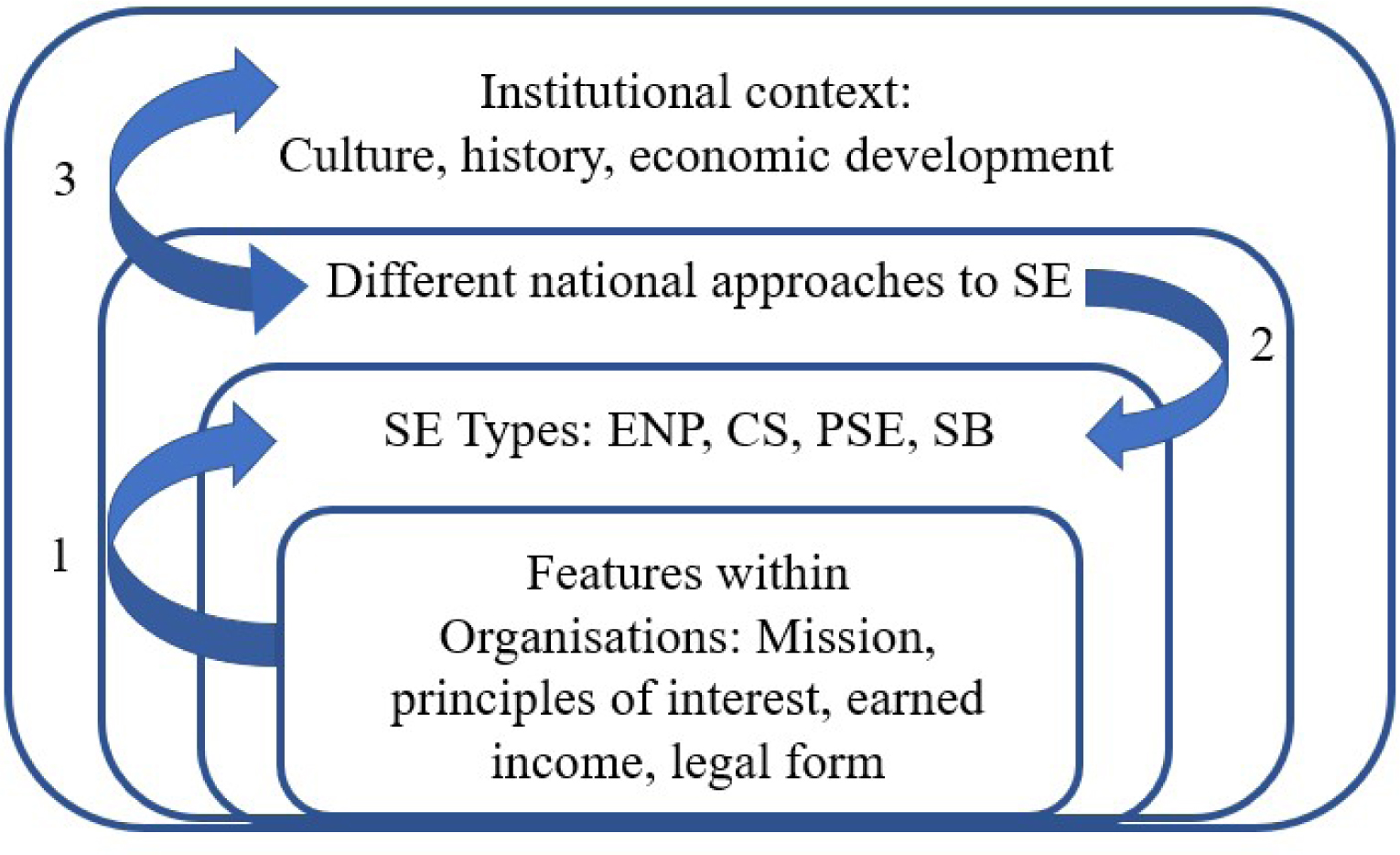
Figure 1:
Model of Embedded Types
Table 2
Four types of SEs in Ireland
| SE Type | SEs in set identifying as this type | Legal form | Example activities |
|---|---|---|---|
| Entrepreneurial Nonprofit (ENP) – Originates in mutual interests. | 28 | Usually a Company Limited by Guarantee, often with Charitable Status. Can also be an unincorporated association or a Designated Activity Company (DAC). | Soup kitchen providing meals for homeless people; training programmes for disadvantaged youth; mobility service for wheelchair users. |
| Public Social Enterprise (PSE) – Originates in general/public interest. | 19 | Usually a Company Limited by Guarantee, often with Charitable Status. Can also be an unincorporated association or a Designated Activity Company (DAC). | Coffee shop for ex-offenders; Knitwear made by Traveller women; craft shop for homeless people. |
| Social Cooperative (SC) – Originates in mutual and market interest. | 2 | Industrial and provident society (co-operative). The SC type is (mostly) linked with one legal form only. | Community owned book shop; Sustainable grocery shop; Community Centre; Group Water Scheme with social purpose. |
| Social Business (SB) – Originates in market interest. | 7 | Any private sector organisational form: sole trader, Partnership, Limited company (limited by share issue), PLC, Industrial and provident society (cooperative). Can apply for BCorp and/or Fairtrade status. | A social purpose App; food production where the farmer is paid a fair wage; sustainable energy technology. |
| Innovative Individual (II) – not in Defourny & Nyssens’ typology because not an org. | 18 | An innovative individual (social entrepreneur) can establish any kind of formal organisation, either private/for profit, or nonprofit. This approach to SE is not linked to any one legal form. | Idea for a social innovation: microcredit lending; organising an annual book festival; removing plastic from the sea and making surfboards. |