
Table 1
Differentiating boards of directors and typical teams
| Board of directors | Typical teams | |
|---|---|---|
| Composition | All non-executive directors, a mix of non-executive and executive directors, or all executive directors | All executives |
| Affiliation | Work for several organisations, possibly full time in one organisation | Work for the same organisation |
| Interaction | Spend relatively little time together | Spend a lot of time together |
| Time and information | Limited time, with information dependence on management | Immersed in day-to-day activities |
| Leaders as members | More likely to have leadership experience | Less likely to have leadership experience |
| Roles | Govern | Manage |
| Authority relationships | Boards have ultimate authority in law, which systemic contextual issues may constrain | CEO has authority under delegations from the board. Other executive team members have more limited authority |
| Accountability | Hold executives to account | Accountable to the board |
| Structure | Horizontal authority structure (Vandewaerde et al., 2011) | Vertical authority structure |
| Average team size | Larger | Smaller |
| Formality | Boards operate formally (see Dynamic) | Managers operate informally (see Dynamic) |
| Dynamic (Brennan et al., 2016, p. 145) | “Rules of the road” | “Rush hour” |
| Socialise | Occasionally | Regularly |
| Familiarity | Do not know each other well | Know each other quite/fairly well |
[i] Source: Adapted from Nadler et al. (2006) and Levrau (2007)
Table 2
Paradoxes of boards of directors
| Role | Conflicting role |
|---|---|
| Boards are collegial groups | More and more discussion is delegated to board committees |
| Boards need to have collegial chemistry | Boards need to be diverse |
| Boards reach consensus fully supported by the whole board | Independent “free thinking” non-executive directors promote critical and constructive dissent |
| Boards engage in collective decision making based on effective group dynamics | Board decisions must be based on a diverse set of individual opinions |
| Boards must work together as a team | Boards must avoid groupthink |
| Truly independent directors | Annual election/ad nutum dismissal (power of dismissal without justification) |
| Boards need to build trust | Boards need to be vigilant on verification |
| Executive directors are peers of non-executive directors on the board | Non-executive directors monitor executives |
| Board members direct | Board members monitor |
| Non-executive directors are advisors/mentors to senior management | Non-executive directors are critical monitors of senior management |
| Board members support executives | Board members challenge executives |
| Boards’ duties and time commitment are increasing exponentially | Remuneration of non-executive directors is not keeping pace |
| Boards take decisions behind closed doors; Confidentially is a legal obligation | Increasing demands for transparency |
| Non-executive directors depend on the CEO for information | Non-executive directors have the same legal responsibilities even though they know less about the company than the executive directors |
| Non-executive directors have less company-specific information than executive directors | If non-executive directors have as much company-specific information as executive directors, they could not do their job (Brennan et al., 2016) |
| The conformance role requires monitoring and scrutiny and is risk-averse | The performance role requires vision, in-depth understanding, and an appetite for risk |
| Directors on a collegial board are equal | Executive directors (e.g., CFO) other than the CEO are day-to-day subordinates to the CEO, yet cannot act as subordinates on the board. |
[i] (Source: Adapted by the author from a wide range of board-of-directors’ literature)
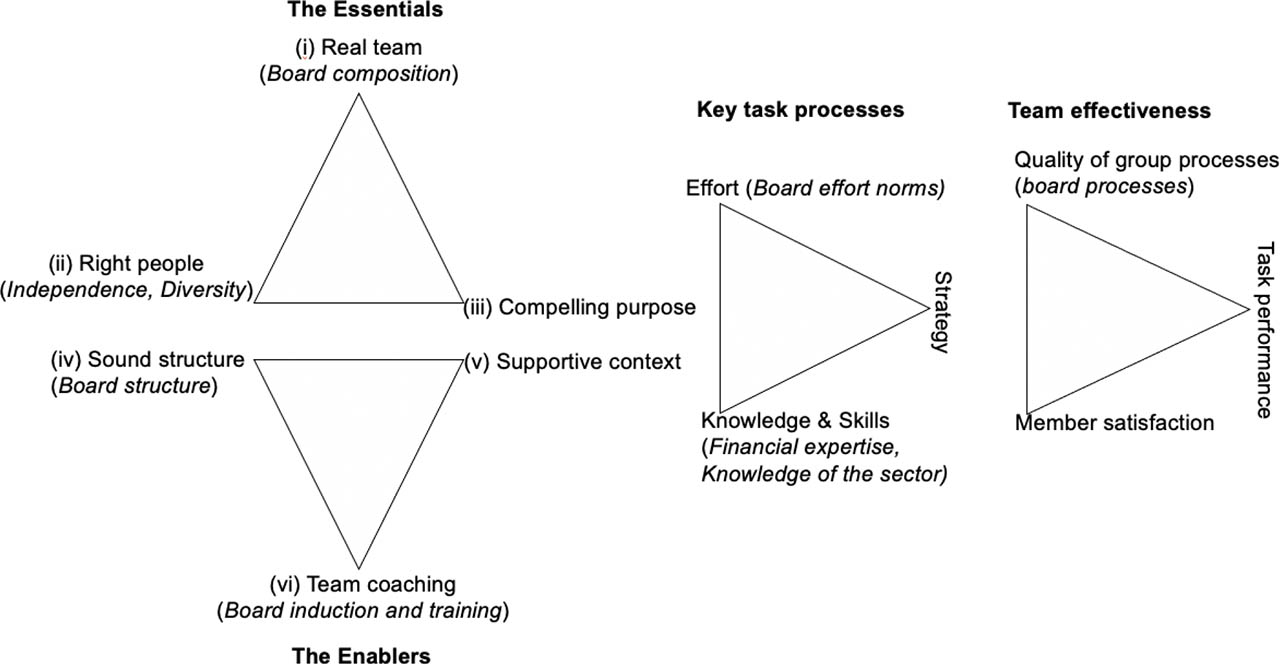
Figure 1
Applying Wageman et al.'s (2005) team diagnostic survey to a board-of-directors’ context (text in italics)
Table 3
Two contrasting board-of-directors’ models
| Forbes and Milliken (1999) model of board-of-director effectiveness | Vandewaerde et al. (2011) model of shared leadership in the boardroom | ||
|---|---|---|---|
| Board characteristics | 1. | Human capital heterogeneity | |
| 1. | Board demography | 2. | Chairman behaviour |
| 2. | Knowledge and skills | 3. | Individual and team conditions: Affective |
| Board processes | 4. | Individual and team conditions: Cognitive | |
| 3. | Cognitive conflict | 5. | Individual and team conditions: Behavioural |
| 4. | Effort norms | 6. | Task complexity |
| 5. | Use of knowledge and skills | 7. | Task interdependence |
| Board-level/Firm-level outcomes | 8. | Shared leadership | |
| 6. | Cohesiveness | 9. | Behavioural control |
| 7. | Task performance (control and service) | 10. | Output control |
| 8. | Firm performance | 11. | Advice |
| 12. | Networking | ||
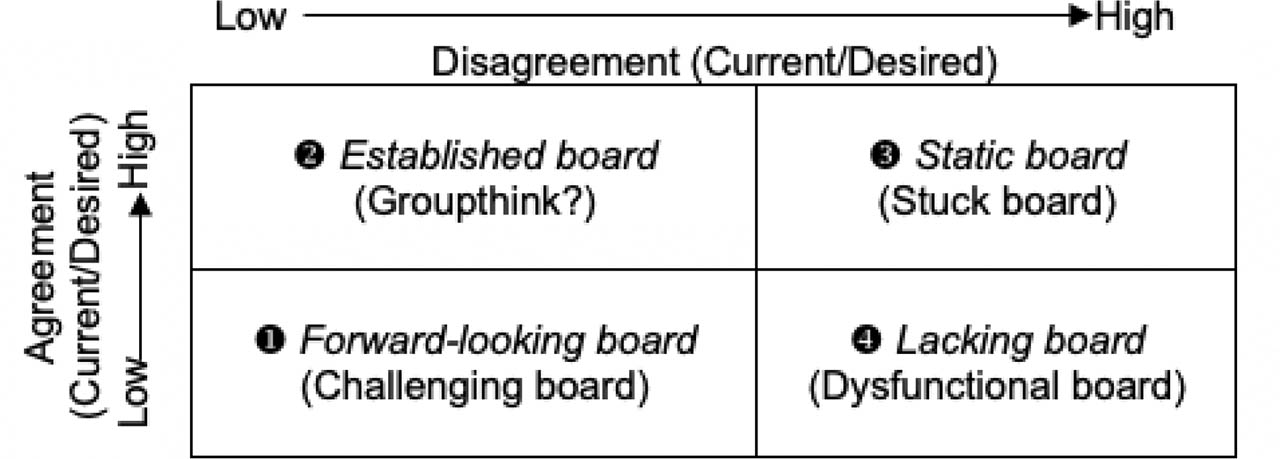
Figure 2
Classifying boards of directors by boardroom conflict/dissent
Source: Compiled from Heemskerk et al. (2017, p. 239)

Figure 3
From board induction to team coaching
Table 4
Questions for future research concerning boards as teams
| Context | When do boards benefit from teamwork versus individualistic behaviour in boardrooms? How does the type of entity (e.g., listed company, non-government organisation, state-owned entity, etc.) influence group behaviour? How does board context influence group behaviour? |
| Boards as teams | What are the unique features of boards as teams? What factors influence boards’ propensity to operate as teams? |
| Board task performance | What board tasks benefit from teamwork? How does teamwork enhance board task performance? How does the need for transparency, accountability, diversity, inclusion impede or enhance teamwork? |
| Board dynamic | How is board dynamic enhanced/diminished by boards working as teams? How do boards operating as teams improve/dis-improve board effectiveness? How do boards’ intragroup dynamics differ from other teams? |
| Psychology | What is the relation between teamwork and groupthink? How do interactions among team members influence cognitive and affective behaviours? How does the team leader (board chair? CEO?) influence board members’ behaviour? |