
Table 1
Participant demographics
| Years of service | < 5 | 5–10 | 11–15 | 16–20 | 21–25 | 26–30 | 31 + |
|---|---|---|---|---|---|---|---|
| Acute | |||||||
| Eye Infirmary | ANM1-F26 | AN2-F42 | AN1-F48 | ||||
| Child Health | AN3-F45 | ||||||
| Cardiac | ANM2-F33 | AN4-F38 | |||||
| Midwife | AN5-F46 | AN6-F26 | ANM3-F54 | ||||
| Neurology | AN7-F30 | ||||||
| Haematology | AN8-F25 | AN9-F34 | ANM4-F39 | ||||
| Anaesthetics | ANM6-M37 | ||||||
| Renal | ANM8-F36 | AN10-F47 | |||||
| AN11-F49 | |||||||
| Orthopaedic | AN12-F43 | ||||||
| Oncology | ANM5-F35 | ||||||
| Surgical | ANM7-F38 | ||||||
| CN9-F27 | CN5-F41 | CN2-F42 | |||||
| CN10-F32 | CN6-F33 | CN3-F39 | CN7-F48 | ||||
| Community | CN1-F48 | CN13-F27 | CN11-F31 | CN16-F42 | CN4-F40 | CN8-F48 | CNM2-F51 |
| CN15-F54 | CN12-F57 | ||||||
| CNM1-F29 | CN14-F35 | CNM3- M50 |
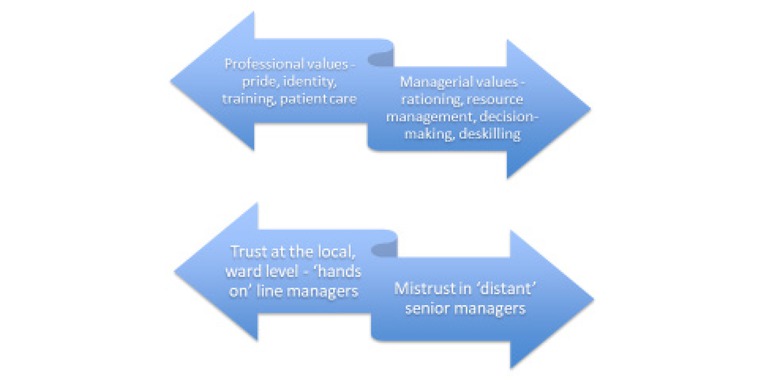
Figure 1
Competing values and conflicting levels of trust
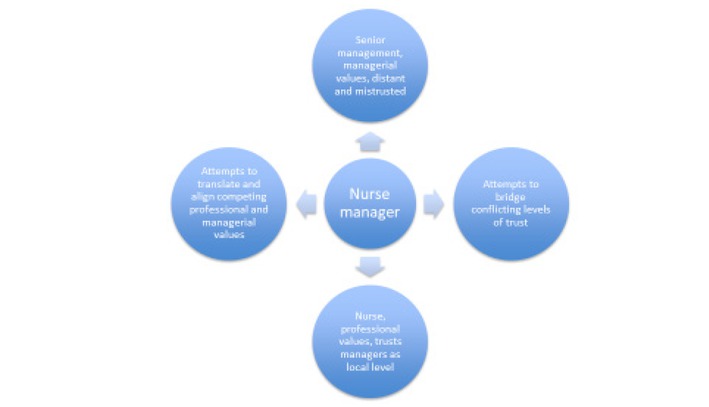
Figure 2
Implications for and central role of nurse manager
Table 2
Professional and managerial values, and trust amongst nursing professionals
| Professional identity |
| • Professional values pride, esteem and autonomy. |
| • Best practice nursing care standards. |
| • Holistic patient care, with positive caring and emotional focus linked to job satisfaction. |
| Training, development and progression |
| • Professional nursing care standards, ‘evidence-based’ best-practice approaches to nursing. |
| • Lack of available resources for training and development – as required by professional bodies. |
| • Training and development becoming more academic, with less focus on ‘beside care’. |
| • Fewer prospects for promotion, with promotion more towards management roles and responsibilities at the expense of professional nursing. |
| Management decision-making |
| • Managerial decision-making and involvement paradox – moving further away from professional nursing role. |
| • Fewer resources available for patient care, professional training and development, and terms and conditions of nursing professionals. |
| • Deskilling through greater use of unqualified and agency nurses. |
| • Emphasis on cost issues as the basis for ‘organisational performance’, rather than quality care. |
| Resource and performance management |
| • Emphasis on cost issues as the basis for ‘organisational performance’. |
| • Greater use of unqualified and agency nurses. |
| • Fewer resources for professional training and development. |
| • Fewer resources available for quality patient care. |
| Trust within immediate ward environment and with line manager |
| • The salience of trust in immediate ward environment, amongst nurse line-manager and nurse colleagues. |
| • Managers outside ward ‘distant’ and removed’ – with limited insight into the impact of decision-making at ward level. |
| • Immediate ward environment: nurse line-manage and colleagues act as the basis for establishing and building trust. |
| • Role of line manager in positively or negatively influencing trust. |
| • Managers outside ward are environment ‘distant’ and removed’, with limited insight into the impact their decision-making has at ward level. |
| Reciprocity |
| • Trust facilitated and established through active communication, engagement and reciprocal gestures demonstrating trust and good faith. |
| Propensity towards trusting others |
| • Propensity to trust and reciprocity linked to previous work history, work experience, training, political views, psychological contract issues, profession, staff association and union membership. |