
Table 1.
Summary observation instrument (moments, criteria, sub-criteria, macro-categories, categories and codes).
| Moment | N | Criterion | N | Sub-criterion | Macrocategories / Categories (codes) |
|---|---|---|---|---|---|
| −1 | 1 | Range of movement | Refers to the optimum move variants available in one position: Closed – there is just one optimum move (CL), Semiopen – 2 optimum moves (SO), Open – more than 2 optimum moves (OP) | ||
| 2 | Existing pressures | No (NN), threat of check (TC), threat of capture (TP), threat of tactical issue (TT) | |||
| 3 | Context of the error | At material advantage (MA), at material disadvantage (MD), at material equality (ME), after final error (AE) | |||
| 4 | Optimal type of movement | Capture (CT), check (CK), counter-attack (CA), build-up (BU), offensive (OF), defensive (DF) | |||
| 5 | Optimal consequence | Checkmate (CH), material (ML), stalemate (SM), crowning (CR), positional advantage (PA) | |||
| 0 | 6 | Type of error | Checkmate: Checkmate potential (CM), checkmate not given (MN); undefended pieces: defencelessness potential (UP), defencelessness not given (DN); tactical motifs: tactical motifs potential (TM), tactical motifs not given (TA); subtle mistake: subtle mistake potential (SU), subtle mistake not given (SG) | ||
| 7 | Seriousness of the error | Mistake (MK), Blunder (BL) | |||
| 8 | Piece from the side of error | Pawn (PN), Knight (KT), Bishop (BS), Rook (RK), Queen (QE), King (KG) | |||
| 8.1 | Piece suitability | The piece moved erroneously suffers the consequence of the error (YS), another piece from the same side (NO) | |||
| 9 | Colour | White (WI), black (BA) | |||
| 10 | Phase | Opening (ON), mid-game (MG), endgame (EN) | |||
| 11 | Zone | Starts: Own start (OS), opponent’s start (ST); flanks: own flanks (FK), opponent’s flanks (FL); centre: own centre (CE), opponent’s centre (OR) | |||
| 12 | Type of movement performed | Capture (CP), check (CC), counter-attack (CN), build-up (BP), offensive (FF), defensive (DV) | |||
| 13 | Specific type of error | 13.1 | Type of checkmate | Weaknesses on square f7-f2 (WF), two pieces on castling (TL), three pieces on castling (TE), king in centre (KC), on edges (KE), elementary endgame (EE) | |
| 13.2 | Reason for capture and defencelessness | Single piece (SP), poorly protected piece (PR), multi-cell count (MC) | |||
| 13.3 | Known tactical motifs | Doubles (DO), spikes (SK), destructions (DE), trapped piece (TR), draw (DW), defensive resource (DR), pawn promotion (PP), other (OT) | |||
| 13.4 | Subtle mistake | King’s security (KS), passed pawn (PD), forced delivery of material (FO), pawn structure (PS), simplification (SF), passed-pawn blocking (BK), dynamic advantage (DY) | |||
| +1 | 14 | Number of different pieces | 1 - 2 (PI), 3 - 5 (PT), +5 (PF) | ||
| 15 | Consequence zone | Starts: Own start (SA), opponent’s start (NT); flanks: own flanks (FN), opponent’s flanks (FS); centre: own centre (CI), opponent’s centre (CU) | |||
| 16 | Number of turns | Turns which take place between the error being detected and it being produced on the board: 1 movement (MO), 2 movements (MT), 3 movements (MH), 4 movements (MF), 5 movements (FM), more than 5 movements (FI), wide open (WO) | |||
| 17 | 17.1 Piece(s) giving | 17.1. 1 | First piece gives | Pawn (PW), knight (NA), bishop (BI), rook (RO), queen (QN), king (KI) | |
| 17.1. 2 | Second piece gives | Pawn (PU), knight (NG), bishop (BH), rook (RU), queen (QI), king (KN) | |||
| 17.2 Piece(s) receiving | 17.2. 1 | First piece receives | Pawn (PV), knight (NI), bishop (BO), rook (RA), queen (QH), king (KM) | ||
| 17.2. 2 | Second piece receives | Pawn (PO), knight (NH), bishop (BB), rook (RR), queen (QM), King (KK) | |||
| 18 | Simultaneity of tactical aspects | Yes: 1 (SI), 2 (TW), 3 + (TH); no: no (SN) | |||
| 19 | Real consequence | Not exploited (NE), exploited (EX) | |||
| 20 | Impact of the error | Definitive (DI), non definitive (NF) | |||
| 21 | Range of movement | Closed (CO), Semi-open (SC), Open (OE) |
Table 2.
Categorisation of errors from the observation instrument.
| Checkmate | Undefended pieces | Tactical motifs | Subtle mistake | |
|---|---|---|---|---|
| Resolution type | Checkmate | Material advantage | Material inequality, boards, sacrifices or defensive resources | Strategic concepts and micro-advantages. |
| Turns | 1 to 5 | 1 to 5 | 1 to 5 | 1 to indefinite. |
| Specific situations | As set out in sub-criterion 13.1 of table 1 | As set out in sub-criterion 13.2 | As set out in sub-criterion 13.3 | As set out in sub-criterion 13.4 |
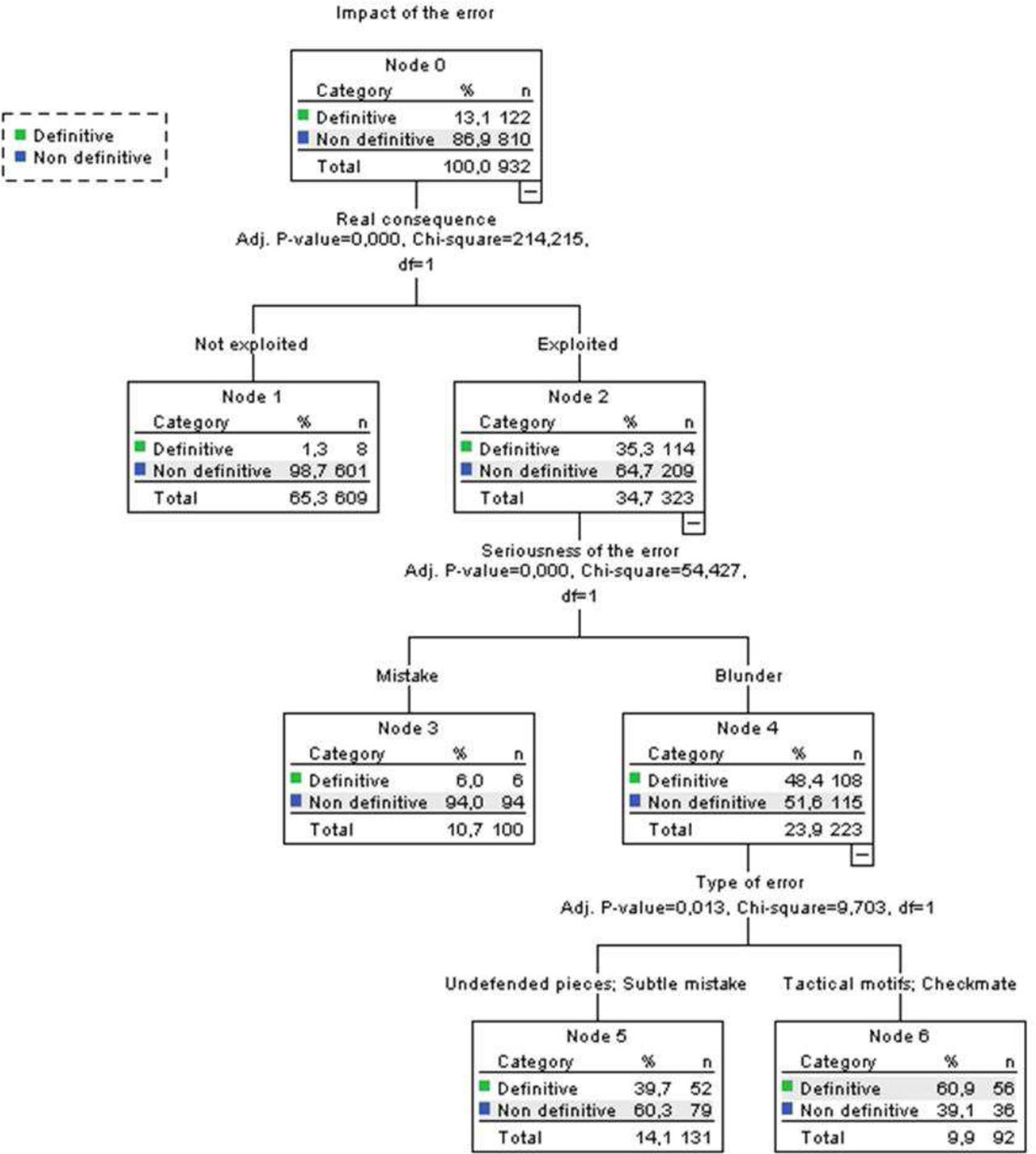
Figure 1.
Decision tree of “cataloguing the error made”.
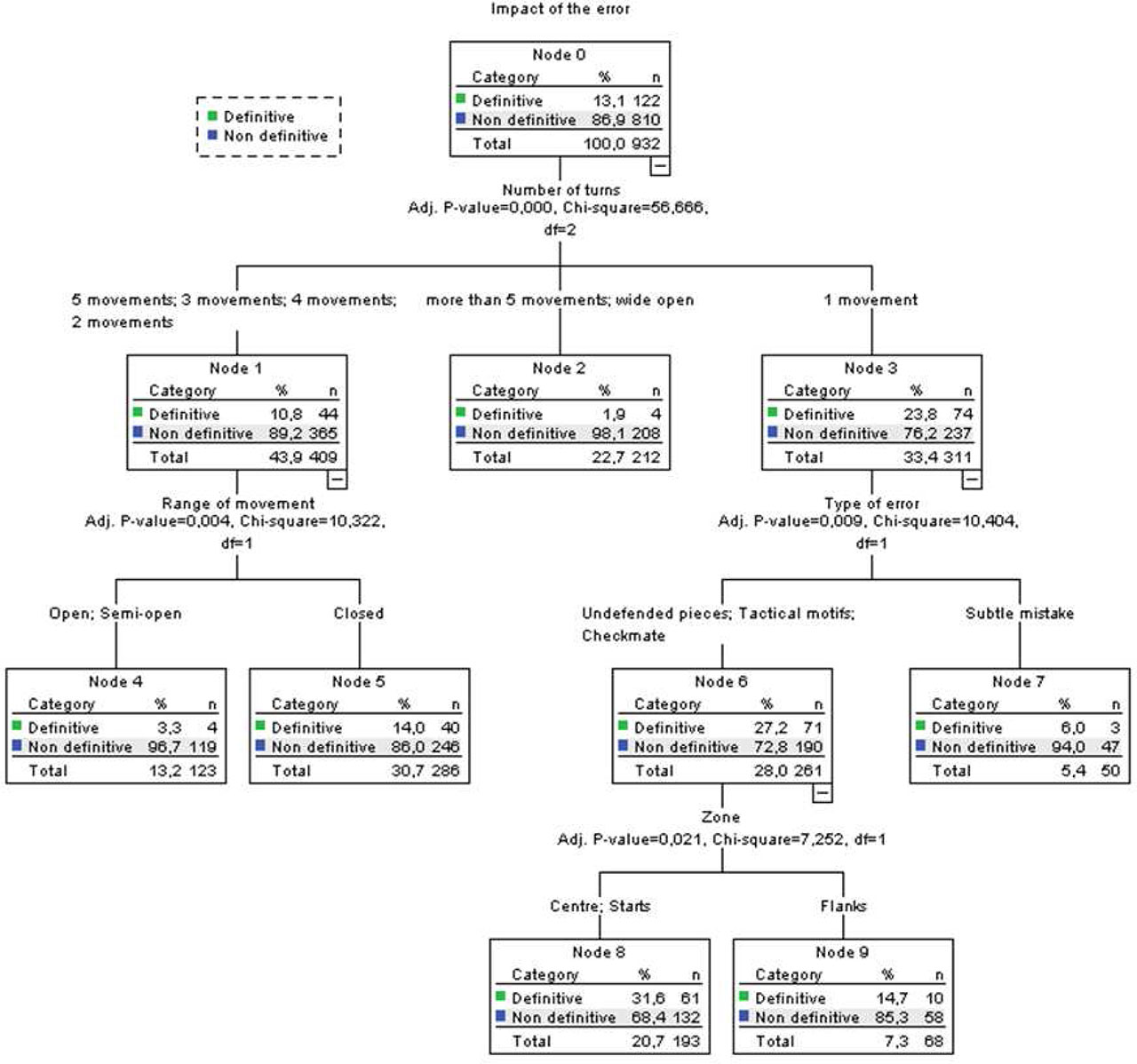
Figure 2.
Decision tree of “disposition of the error made”.