
Table 1.
Key and related search terms used as the search strategy
| Key Search Terms | Related Search Terms |
|---|---|
| depth camera technology | depth camera$ OR 3D camera$ OR depth sensor$ OR time-of-flight camera$ OR range camera$ OR stereo camera$ OR structured light camera$ OR depth-sensing camera$ OR RGB-D camera$ OR infrared camera$ |
| AND | |
| biomechanics in sport | sport$ biomechanics OR biomechanics of sport OR exercise$ biomechanics OR physical activity* analysis OR sport movement$ analysis OR sport$ motion analysis OR athletic performance$ analysis |
| OR | |
| motion capture | motion capture OR motion tracking OR movement$ capture OR kinematic$ tracking OR kinematic$ analysis OR motion$ analysis OR motion sensing OR movement$ tracking |
| OR | |
| application in sport | application$ in sport OR sports technology application$ OR practical use in sport$ OR implementation$ in athletics OR sports-related application$ OR applied sports science OR practical application in sport$ OR integration in athletic training OR “sport-specific application” |
Table 2.
Summary of COSMIN quality of evidence scoring consensus
| Parameter | Quality Rating1 | Quality of Evidence2 | ||||
|---|---|---|---|---|---|---|
| Rater 1 | Rater 2 | Cons.* | Rater 1 | Rater 2 | Cons.* | |
| Structural validity | N | N | ||||
| Internal consistency | N | N | ||||
| Cross-cultural validity | N | N | ||||
| Measurement invariance | N | N | ||||
| Reliability | + | + | + | Moderate | Low | Low |
| Measurement error | + | + | + | Moderate | Moderate | Moderate |
| Criterion validity | ? | + | + | Very Low | Very Low | Very Low |
| Construct validity | + | + | + | Moderate | Low | Moderate |
| Responsiveness | + | ? | + | Moderate | Moderate | Moderate |
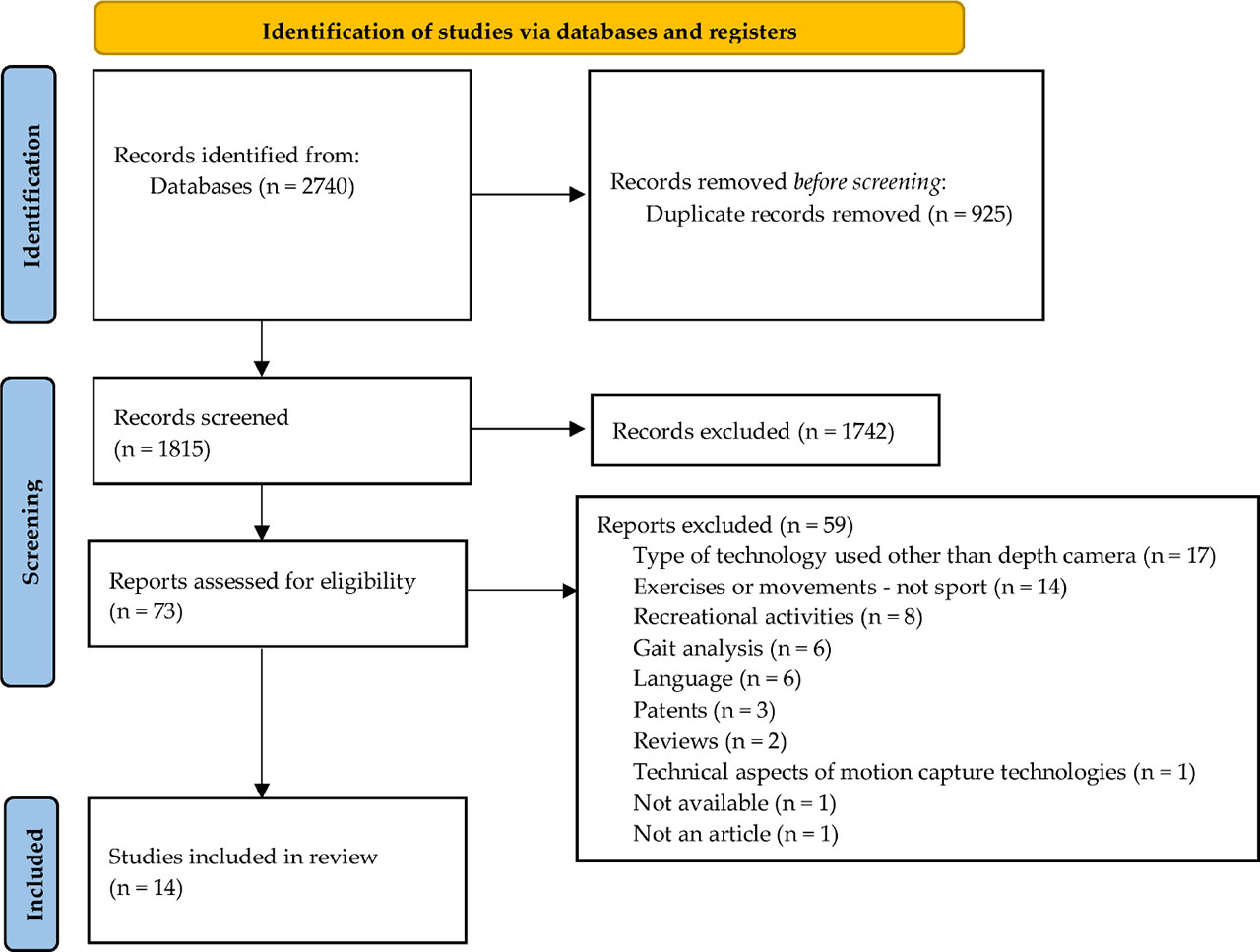
Figure 1.
Flowchart of study selection process based on the PRISMA
Table 3.
Summary of the studies
| Study | Year Published | Purpose | Sport | Depth Camera | What Was Measured | Application | COSMIN Grade |
|---|---|---|---|---|---|---|---|
| An et al., 2017 | 2017 | To obtain a numerical estimate of the feasibility of a dual depth camera system | Running | Two Microsoft Kinect sensors | The left hip and knee analysis included motion (flexion, extension), velocity, acceleration, angular velocity, linear and angular kinematics (displacement), and the centre of mass (COM). | The dual Kinect system allows better tracking of an athlete’s movements due to a better viewing angle. | I |
| Babayan et al., 2015 | 2015 | To introduce an innovative, cost-effective apparatus utilising electronic and electrical components for simulated swimming exercises | Swimming | Microsoft Kinect | The skeletal stream was captured from the depth sensor. The data were used to obtain the X, Y, and Z position coordinates of the joint data points. | Users could improve their swimming abilities and get exercise with this system. | I |
| Bittar et al., 2017 | 2017 | To develop an augmented basketball hoop by integrating sensors, actuators, and computers | Basketball | Microsoft Kinect | Knee flexion, spine tilt during free throws. Detection of throws. The overall score of throws was calculated with the help of Arduino. | Quality assessment of the free throws with real-time feedback | D |
| Chang et al., 2022 | 2022 | To improve Kinect data quality using deep neural networks and achieve precise motion capture | Swimming | Microsoft Kinect | The swimming postures were tracked and detected. The deep-intercepted images were processed to capture postures and movements effectively and to obtain improved outcomes. | Recognising and fixing the bad postures of swimmers in real-time, enhancing training, and assisting coaches during training | I |
| Cunha et al., 2021 | 2021 | To showcase research aimed at designing and implementing a user-friendly, cheap system for real-time performance assessment | Taekwondo | 3D Orbbec Astra Camera | The taekwondo movements of the athlete were measured and collected. | Feedback could refine or enhance an athlete’s techniques, leading to improved performance in less time. Advancing training methods and technological progress during practice | D |
| Cunha et al., 2023 | 2023 | To create a user-friendly, low-cost system and design a technology tool to assess taekwondo athletes’ performance in real time | Taekwondo | 3D Orbbec Astra Camera | Taekwondo-specific movements like Ap Tachagui, Miro Tachagui, and Jirugui were measured. | Evaluating athlete performance through movement analysis during practice | D |
| Emad et al., 2020 | 2020 | To evaluate and improve seven movements of Karate Kata 1 (Heian Shodan) | Karate | Microsoft Kinect sensor | Seven movements from Heian Shodan were recorded (perfect trials and with typical mistakes). | Detection and evaluation of 7 movements in karate kata. In future work, deep learning methods could be used to achieve better results. | I |
| Hwang et al., 2021 | 2021 | To replicate actual motion by gathering subject motion data | Golf | Microsoft Kinect sensor | Measuring and entering data about human bodies to create a human body model that reflected individual body characteristics | A system that uses data from 15 inertial sensors and data from a depth camera to create a motion identical to the real one | I |
| Kaharuddin et al., 2017 | 2017 | To perform a biomechanics analysis on multiple people executing the ‘Jurus Satu’ manoeuvre using the Kinect device | Silat (combat sport) | Kinect sensor | Identification of twenty bodily joints and data extraction during the execution of ‘Juru Satu’ by experienced and inexperienced athletes. | Use of a motion capture system to learn a relatively unknown movement and to provide data on joint kinematic parameters | I |
| Malawski, 2020 | 2020 | To identify lunge actions (footwork training in fencing) and then extract the qualitative characteristics of those actions | Fencing | Microsoft Kinect sensor, Two Point Grey | Real-time analysis of footwork in fencing was considered. Fencers stood and moved sideways with their hand facing their opponent. | Tracking lunges in continuous training (hand timing, duration, and acceleration) and providing real-time feedback | I |
| Nam et al., 2013 | 2013 | To demonstrate the feasibility of golf swing motion tracking using two depth sensors | Golf | FMVU-03MTM-CS cameras | Tracking the movement of the golf club | The system enables the analysis of golf shots using inertial sensors and visual data from a depth camera. | D |
| Pandurevic et al., 2019 | 2019 | To assess movements in sport climbing, understanding technique and performance. This could potentially result in training injury prevention. | Sport climbing | Intel RealSense D435 | Registration and analysis of motion patterns. The possibility to automatically determine joint angles | The data from force sensors and motion capture systems will allow the improvement of technique, performance, and injury prevention. | I |
| Reily et al., 2017 | 2017 | To employ the Microsoft Kinect 2 for the automated evaluation of men’s gymnastics performance on the pommel horse and to validate its efficacy as a training tool for gymnastics coaches | Gymnastics | Microsoft Kinect 2 | The gymnasts’ position and movements during routines were tracked. Analysis of the spin time consistency and an evaluation of the body angle consistency | Automatic performance assessment in men’s pommel horse gymnastics has been confirmed as an effective coaching tool. | I |
| Sri-Iesaranusorn et al., 2021 | 2021 | To determine the factor that will help novice players improve their strokes (differences in consistency of strokes between players at various skill levels) | Table tennis | Infrared (IR) depth sensor | The participants executed ten strokes from each side (forehand and backhand). Three joints (the wrist, the elbow, the shoulder) and the racket centre were monitored by the depth camera. | Video tracking and accelerometers are used to evaluate stroke consistency in table tennis, (monitoring and enhancing beginner’s skills by comparing them to standard players). | I |
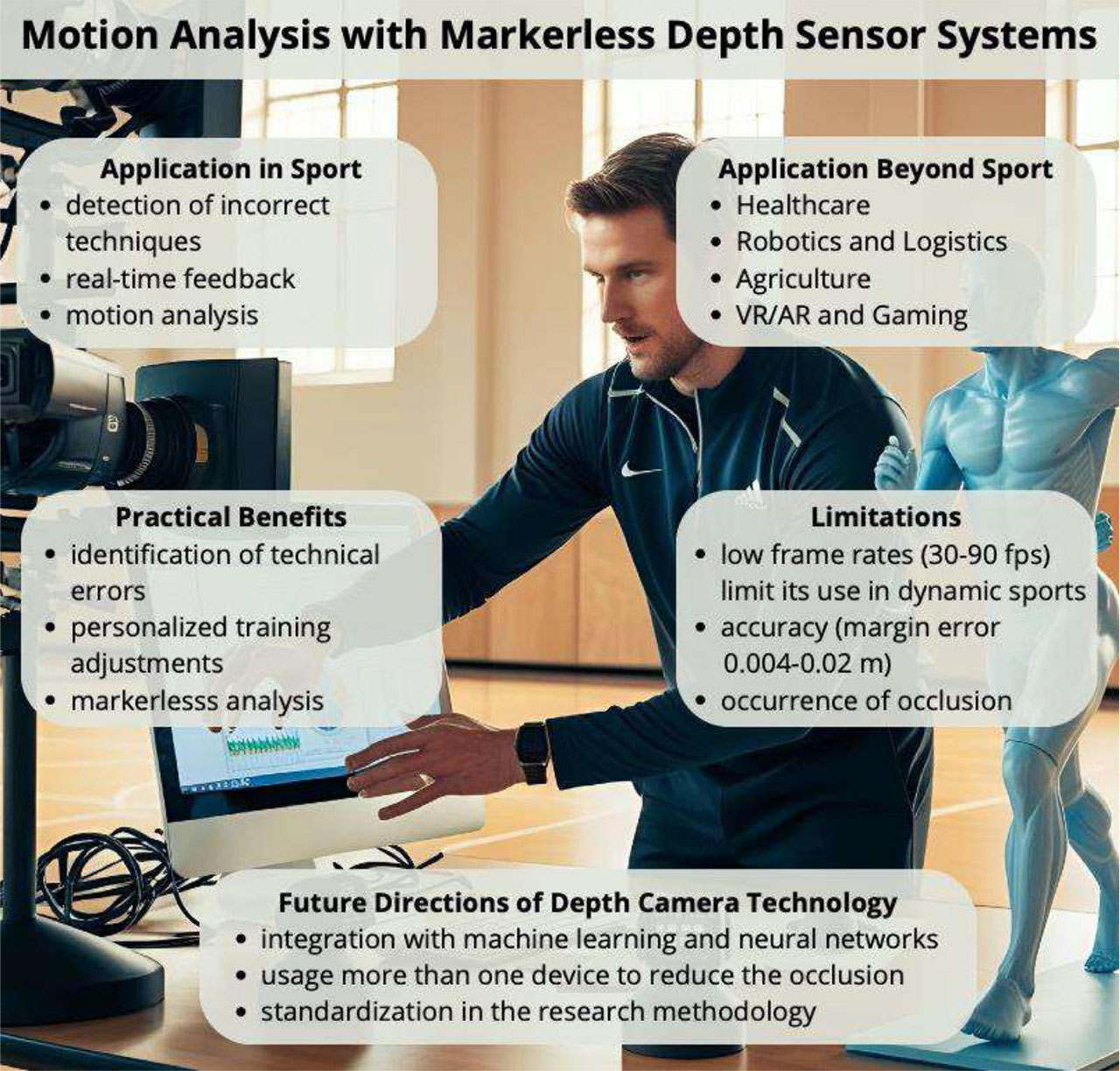
Figure 2.
The past and the future of the depth cameras