
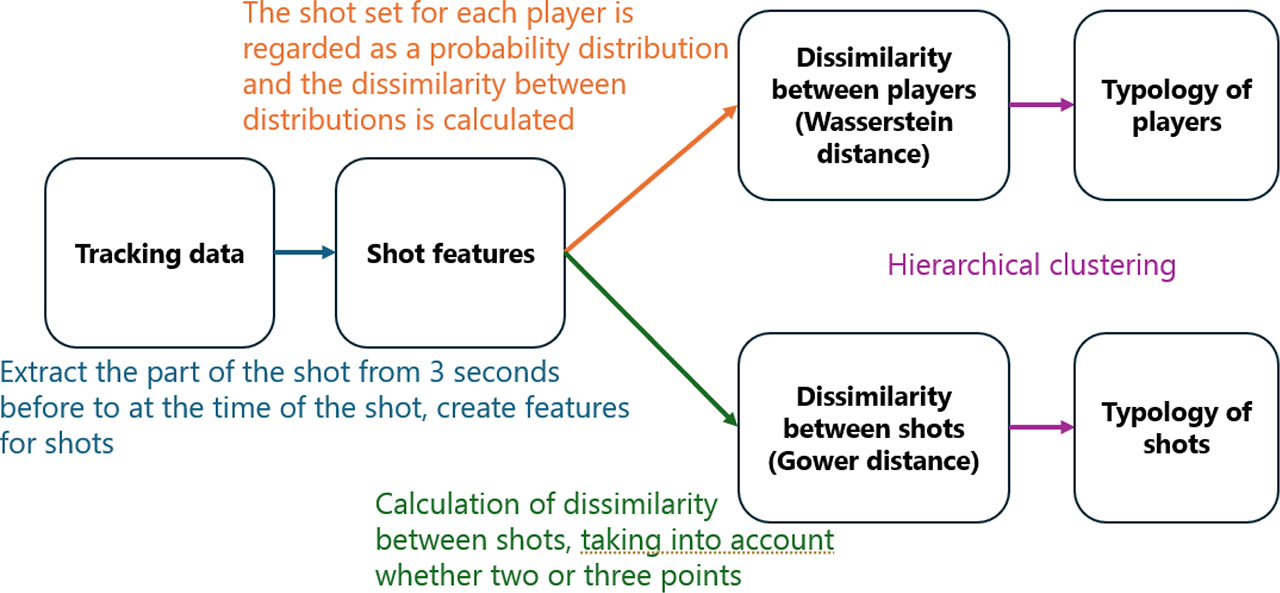
Figure 1:
An overview of the proposed method
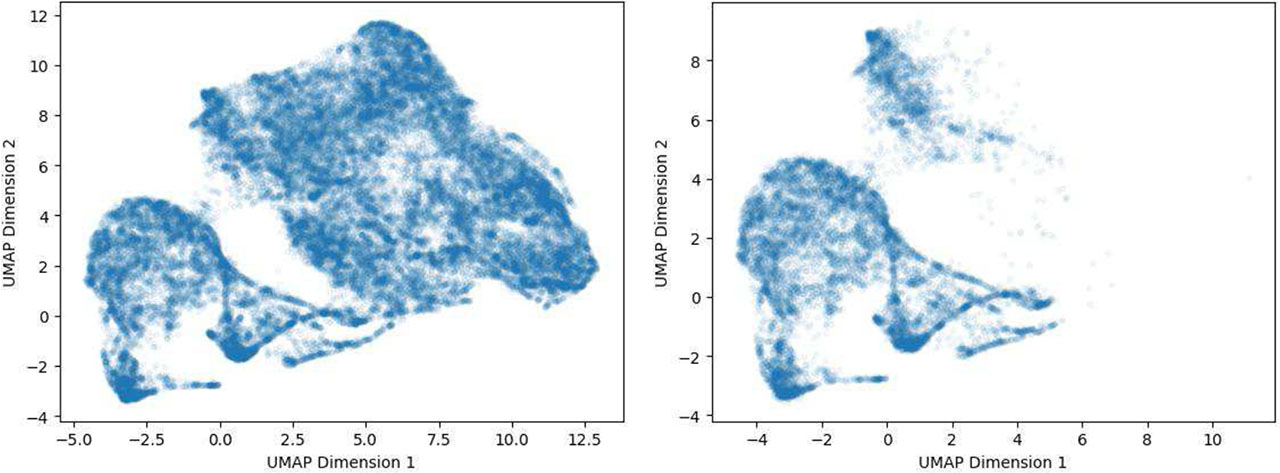
Figure 2:
Scatterplots on the feature space of shots whose features are reduced to two dimensions by UMAP; left: all shots, right: 3-pointers.
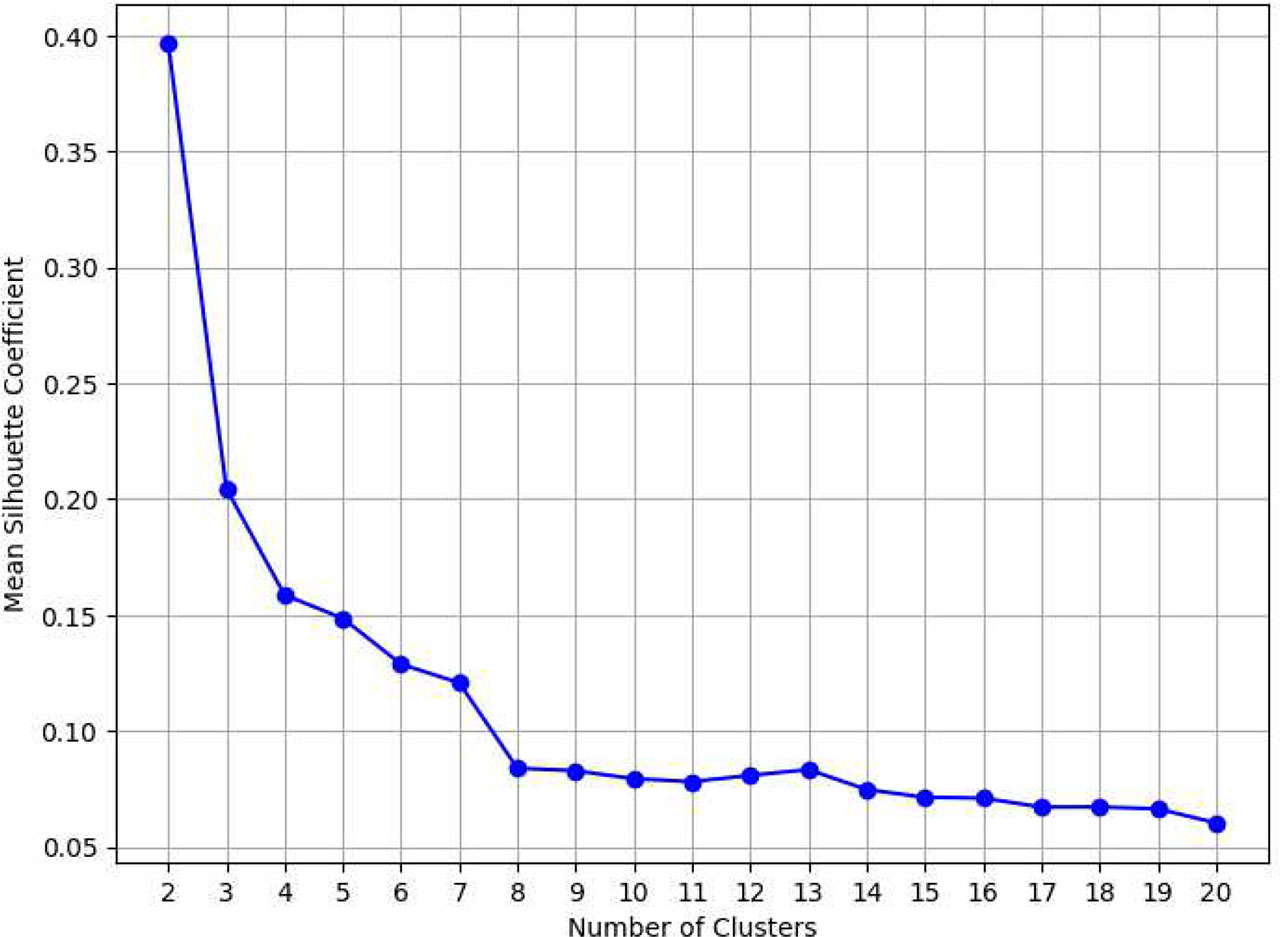
Figure 3:
Mean Silhouette Coefficients in Clustering of Shooting Styles
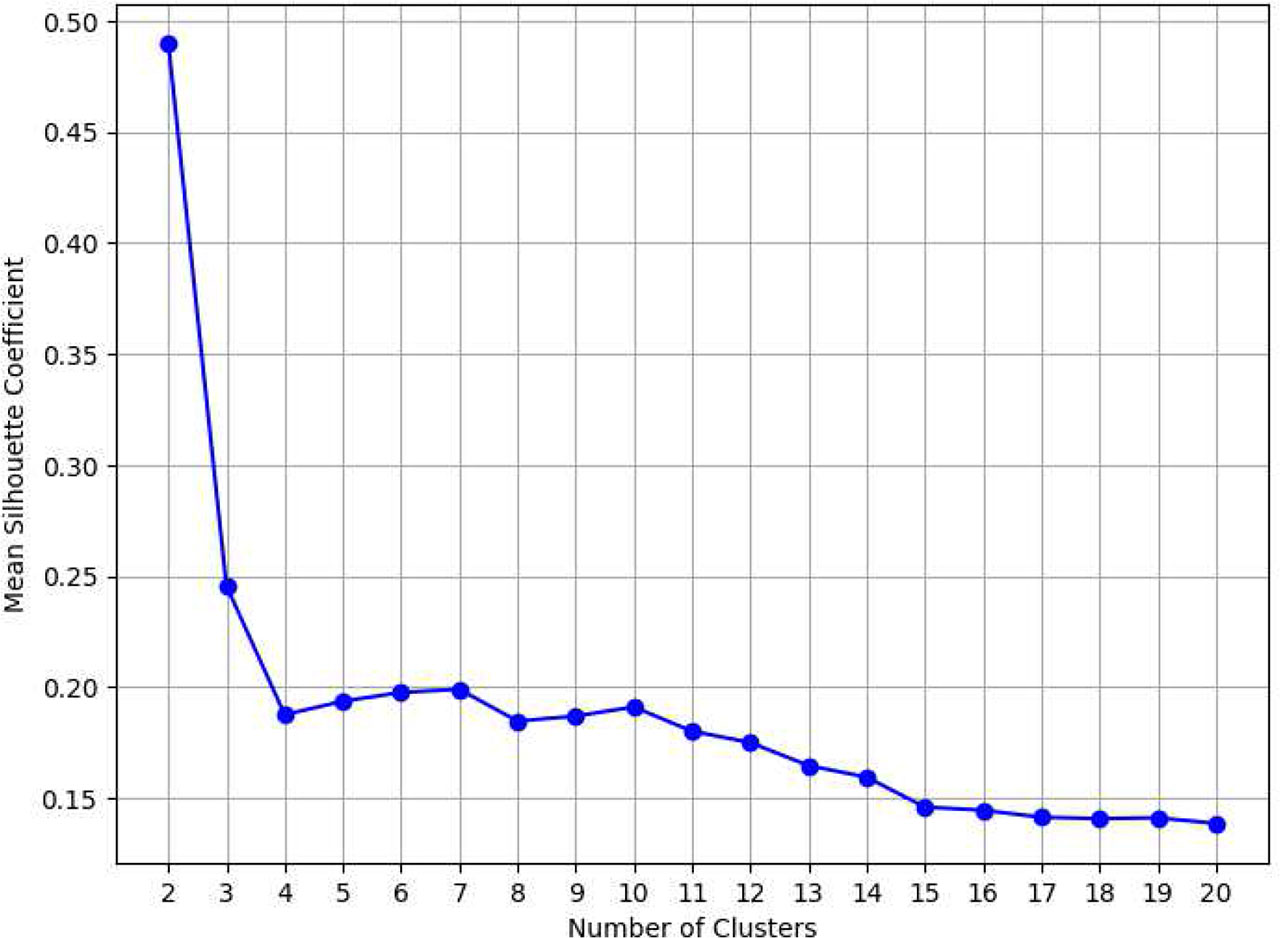
Figure 4:
Mean Silhouette Coefficients in Clustering of the Shots Themselves
Table 1:
Shot features and their units
| Shot Feature | Unit |
|---|---|
| x, y coordinates on the court of the shooter at the time of the shot | meter |
| x, y coordinates on the court of the shooter 1 second before the shot | meter |
| x, y coordinates on the court of the shooter at the time of receiving the ball | meter |
| distance to the rim at the time of the shot | meter |
| distance to the rim 0.5 seconds, 1 second, 1.5 seconds, 2 seconds, 2.5 seconds, and 3 seconds before the shot | meter |
| distance to the rim when the ball was received | meter |
| distance traveled while holding the ball | meter |
| speed at the time of the shot | meter / second |
| time of holding the ball | second |
Table 2:
Shooting Style Cluster Description
| Cluster Name | Description | Mean Height [cm] | Example Players |
|---|---|---|---|
| Close-Range Big | Big Men who attempt most shots from close-range. | 210.6 | Andre Drummond |
| Dwight Howard | |||
| Mid-Range Big | Big Men who can shoot from close-range as well as mid-range. | 209.9 | Pau Gasol |
| LaMarcus Aldridge | |||
| Mid-Range All-Rounder | Players who play offense from mid-range and often shoot from near the high post. | 208.9 | Kevin Garnet |
| Dirk Nowitzki | |||
| Mid-Range Slasher | Players who attack the rim from mid-range through post-play or drive. | 206.5 | Shaun Livingston |
| DeMarcus Cousins | |||
| Driving All-Rounder | Players who begin offense from beyond the arc and aim to shoot from anywhere with their versatile skills. | 198.6 | Stephen Curry |
| Kevin Durant | |||
| Pull-up Ball-Handler | Players who often drive and aim for many pull-up jumpers. | 189.9 | Kyle Lowry |
| Damian Lillard | |||
| Driving Ball-Handler | Players who often drive from the perimeter, but also attempt threes moderately. | 190.7 | Russell Westbrook |
| James Harden | |||
| Stretch Four | Big shooter who often attempts corner threes or threes from the top position. | 205.2 | Nikola Mirotic |
| Meyers Leonard | |||
| Corner Shooter | Shooter attempting mainly three-pointers from the corner. | 198.6 | Patrick Beverley |
| Jason Terry | |||
| Pure Shooter | Shooter who attempts 3-pointers from any location. | 194.4 | Eric Gordon |
| Kyle Korver | |||
| Slashing Finisher | Players who do not shoot many threes and prefer to drive from beyond the arc. | 199.9 | DeMar DeRozan |
| Tony Parker | |||
| Driving Shooter | Similar to Corner Shooter, but shooter with a slight preference for drive. | 201.5 | Klay Thompson |
| Vince Carter | |||
| Stretch All-Rounder | Players who shoot from close-range to midrange, stretch and shoot 3-pointer as well. | 205.7 | Kristaps Porzingis |
| Kevin Love |
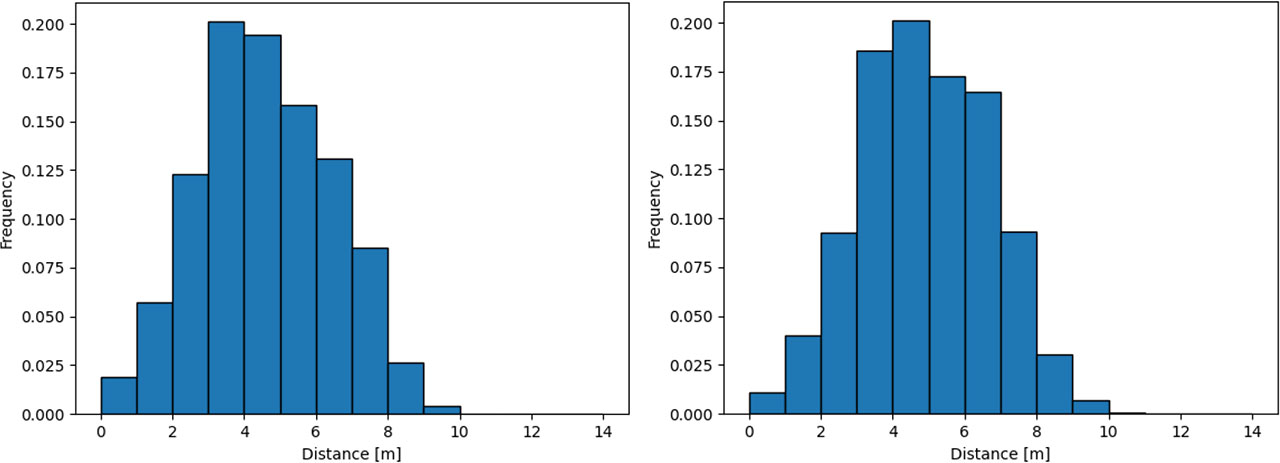
Figure 5:
Distance between the shooter and the rim 3 seconds before shot in two clusters as examples. Normalized frequencies are displayed. On the left is Cluster 1, which tends to have the shortest distance from the rim 3 seconds before the shot. On the right is Cluster 2, which also tends to have a shorter distance from the rim 3 seconds before the shot.
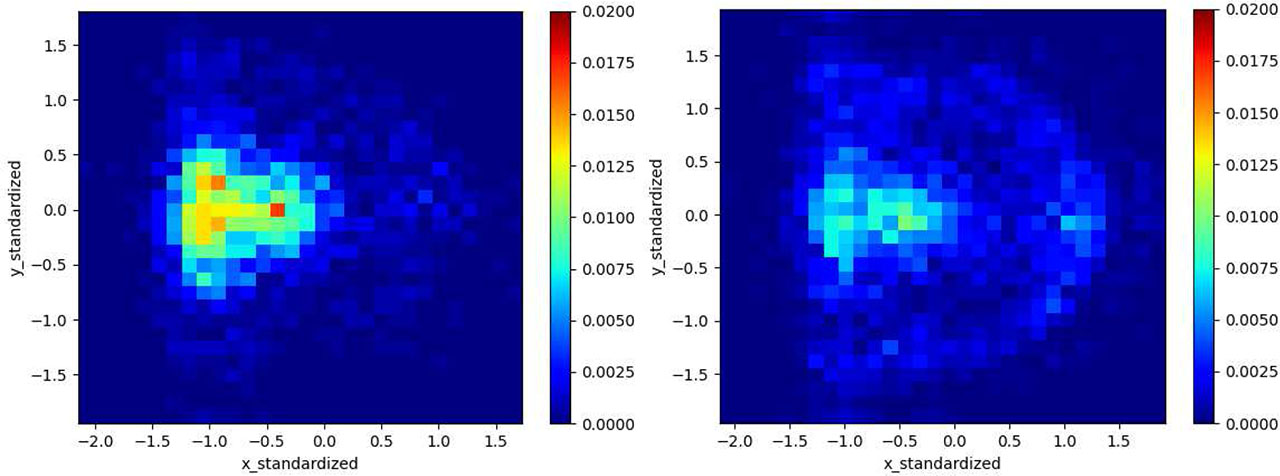
Figure 6:
2D histogram of shot location, in two clusters as examples. Normalized frequencies are displayed. On the left is Cluster 1, with shot locations concentrated near the rim. On the right is Cluster 2, which exhibits shots well distributed from the rim to mid-range.
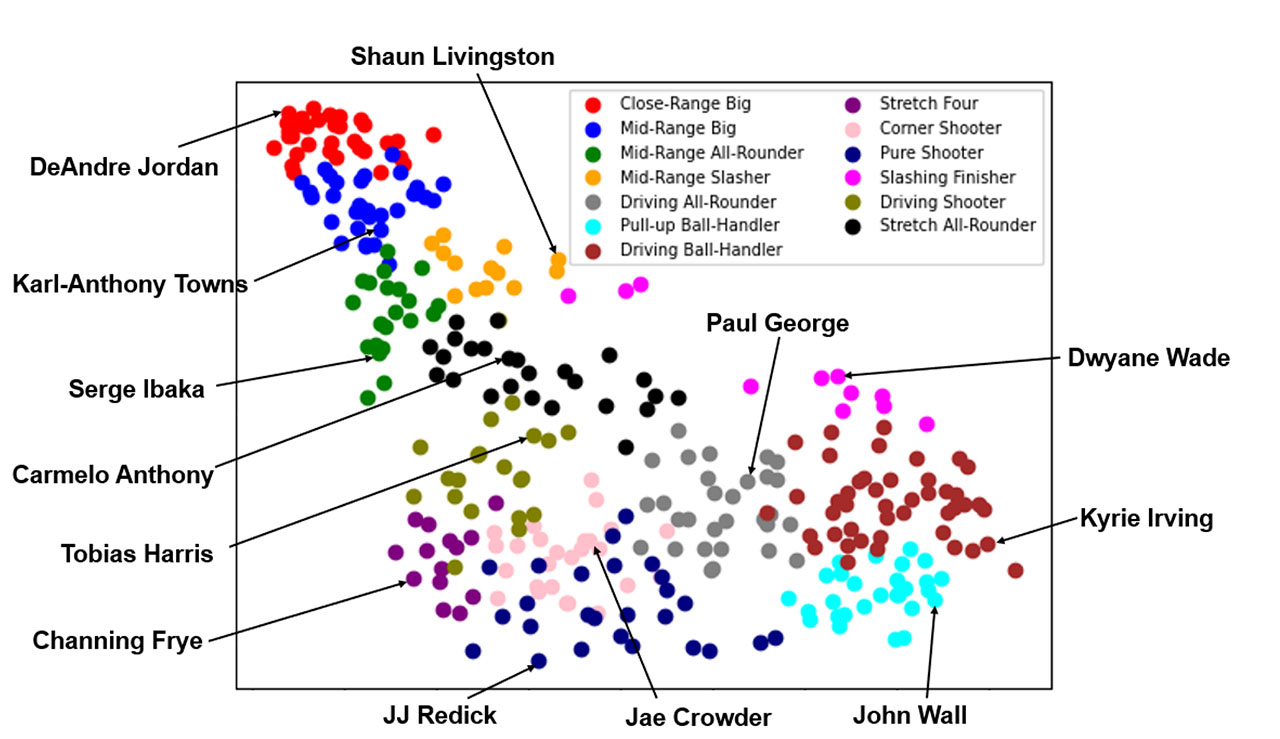
Figure 7:
Visualization of shooting style clusters by t-SNE
Table 3:
Top 5 players for Close-Range Big, Driving All-Rounder, Stretch All-Rounder, Slashing Finisher and Driving Shooter in TS%
| Player Name (Team) | FGA | TS% |
|---|---|---|
| Hassan Whiteside (MIA) | 682 | 62.9 |
| DeAndre Jordan (LAC) | 508 | 62.8 |
| Cole Aldrich (LAC) | 225 | 62.6 |
| Andrew Bogut (GSW) | 279 | 62.3 |
| Steven Adams (OKC) | 426 | 62.1 |
| Player Name (Team) | FGA | TS% |
|---|---|---|
| Stephen Curry (GSW) | 1598 | 66.9 |
| Kevin Durant (OKC) | 1381 | 63.4 |
| Chandler Parsons (DAL) | 651 | 58.9 |
| Omri Casspi (SAC) | 622 | 58.7 |
| Evan Fournier (ORL) | 929 | 58.7 |
| Player Name (Team) | FGA | TS% |
|---|---|---|
| Kawhi Leonard (SAS) | 1090 | 61.6 |
| Draymond Green (GSW) | 819 | 58.7 |
| Mike Scott (ATL) | 376 | 57.5 |
| Chris Bosh (MIA) | 767 | 57.1 |
| Kelly Olynyk (BOS) | 556 | 56.1 |
| Player Name (Team) | FGA | TS% |
|---|---|---|
| Jonathon Simmons (SAS) | 242 | 58.6 |
| DeMar DeRozan (TOR) | 1377 | 55 |
| Tony Parker (SAS) | 710 | 54.6 |
| Donald Sloan (BKN) | 350 | 53.6 |
| James Johnson (TOR) | 240 | 53.2 |
| Player Name (Team) | FGA | TS% |
|---|---|---|
| Klay Thompson (GSW) | 1386 | 59.7 |
| Thabo Sefolosha (ATL) | 372 | 57.8 |
| Alonzo Gee (NOP) | 255 | 57.2 |
| Andre Roberson (OKC) | 777 | 57.1 |
| Andre Iguodala (GSW) | 609 | 56.4 |
Table 4:
Shot cluster names and examples of shots in each cluster. The red and blue lines in the image represent the shooter's trajectory from 3 seconds before the shot to the time of the shot when holding the ball and when not holding the ball, respectively; the lighter the color, the later the time series.
| Cluster Name | Example Images |
|---|---|
| 3-pointer from the right corner or right wing | 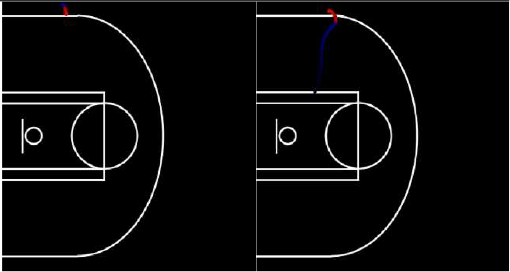 |
| 3-pointer from the left corner | 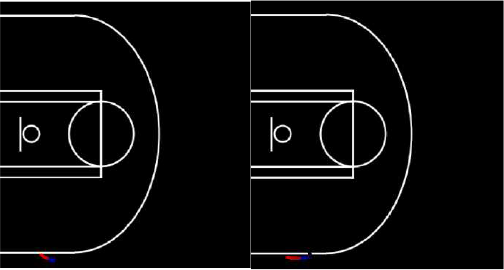 |
| 3-pointer from the top of the key or left wing | 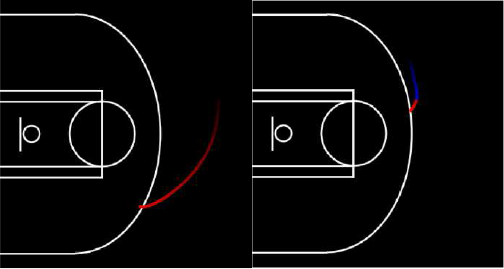 |
| Mid-range shot near the high-post | 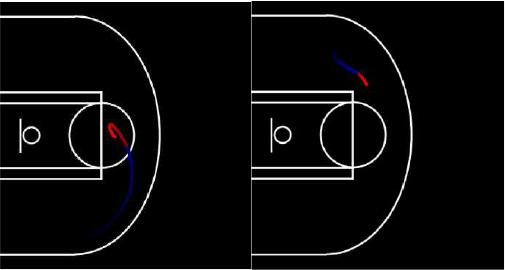 |
| Shot from a mid-post move | 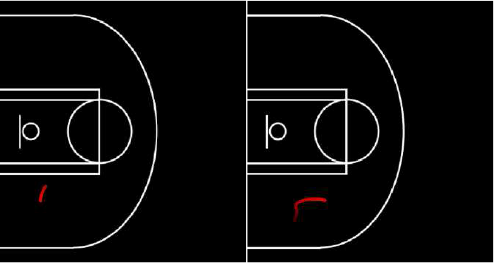 |
| Close-range shot from a post move | 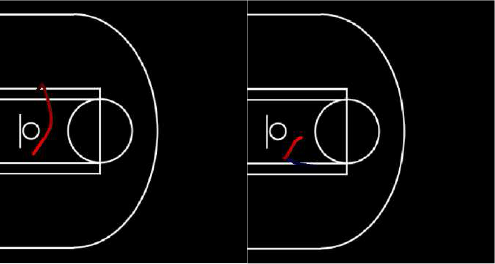 |
| Cutting layup/dunk | 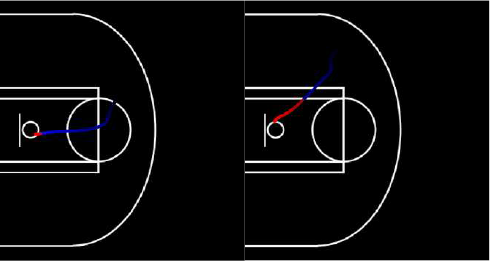 |
| Mid-range shot from the right side | 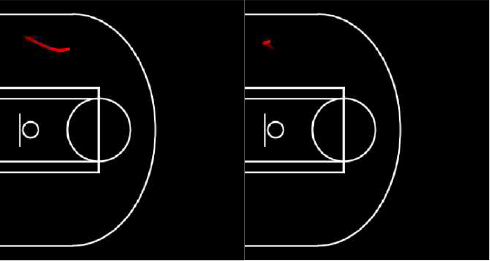 |
| Mid-range shot from the left side | 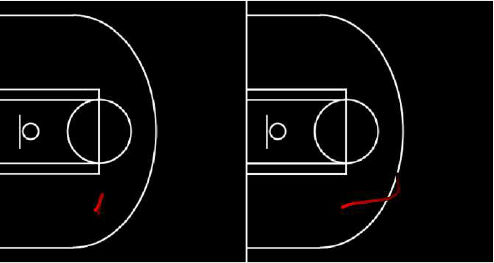 |
| Driving layup/dunk | 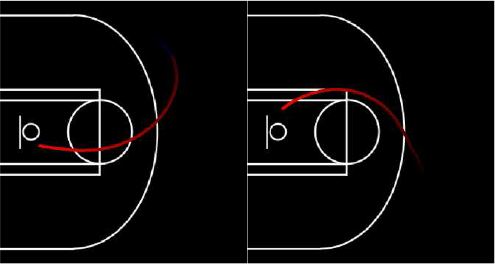 |
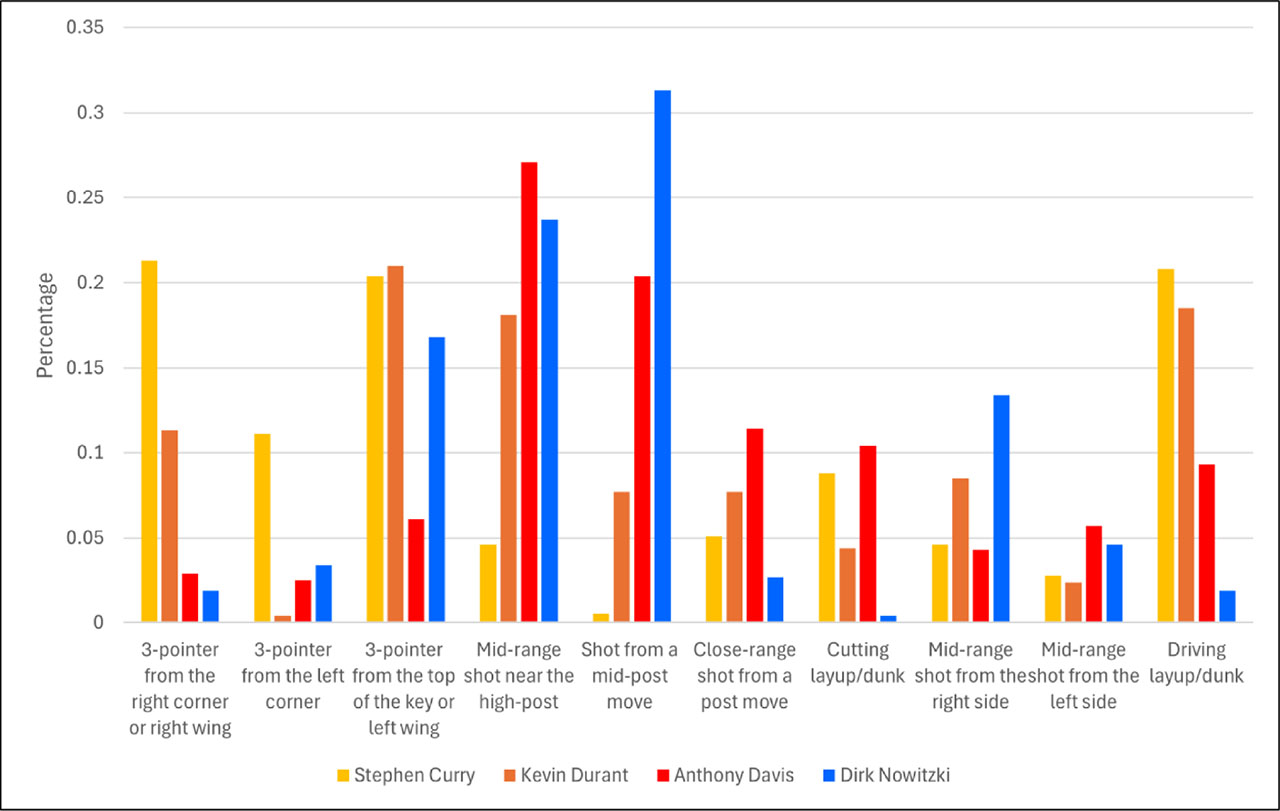
Figure 8:
Percentage of each shot cluster for Stephen Curry, Kevin Durant, Anthony Davis, and Dirk Nowitzki. Note that the total number of shot data is 216, 248, 280, and 262, respectively.