
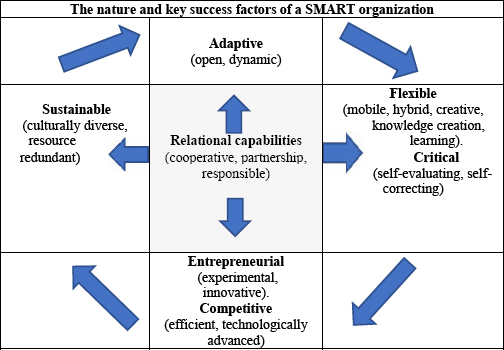
Figure 1.
The nature and key success factors of a SMART organization.
Source: own study.
Table 1.
Relational intelligence (RI) versus quality of relational capital (QRC) of an organization
| Areas of IR construction | The way RI affects the quality of relationships and RC | Manifestations of RI in individual RC areas | Criteria for assessing RI maturity in the RC construction process | Factors/ measures Quality rating (QRC) | |||
|---|---|---|---|---|---|---|---|
| Cooperation | Nature: Direct/indirect; informal/formal; | Persistence and frequency of relationship: Short/long-term; ongoing/cyclical/ one-off; | Degree of transparency of terms and conditions of cooperation, legibility/ethics/ respect vs. formalization, bureaucratization, lack of transparency of activities | Mode of interaction: voluntary/imposed; planned/accidental; | High architectural breadth (number of partners), well matched to the scale and pace of the company’s development, long-term cooperative relationships supplemented by relationships with further new partners as required, close, direct relationships of a voluntary nature preferred, most often initiated by partners, not third parties, high contact intensity, high relationship satisfaction. | Degree of homogeneity Indicates the number of the organization’s partners and its ability to arrive at common solutions with them and to undertake different types of activities together (how similar the partners are in their ways of thinking and acting, how well the organization has selected its partners in terms of how they work together) | Long-term nature of cooperation |
| Values | Openness to cooperation | Matching partners | Understanding interests | Understanding emotions | High willingness to cooperate and share knowledge with various types of partners, both domestic and foreign, also from different industries, symmetry of benefits, conscious selection of partners in terms of organizational culture, resources, market behavior, organizational processes, personality of managers, tradition of cooperation, convergence of goals, proactive customer orientation. | Capacity for symmetry - presents how equally the organization and partners are able to share both costs, benefits as well as responsibilities and power (how well the organization has chosen its partners based on its values) | Confidence in the group |
| Requirements | Critical reflection on requirements | Understanding the requirements | Flexibility of action | Commitment | High openness to bilateral exchange of information, sharing of benefits and losses, changing forms of action according to needs, joint use of available resources, continuous improvement of competences; openness to challenges and market opportunities, implementation of modern technologies, technical culture of employees | Capacity for symbiosis - presents how much the organization and its partners are able to become dependent on each other to achieve a common goal (how well the organization has chosen its partners for their ability to commit and achieve their goals) | Benefits of cooperation |
| Communication | Nature of communication: high quality, multilateral | Communication channels: Modern, supported by IR 4.0 technologies, loT-based, loS-based | Frequency of communication: high | Transparency of communication: clear communication, transparent, understandable to the partners | High openness to informal, close personal relationships, open communication channels, rapid information flow, modern information flow systems | Entropy capability - presents how effectively the organization and its partners are able to communicate with each other; (how aptly it has selected them in terms of communication methods) | Obtaining important information from stakeholders |
| Relationship management | Relations (value of the relationship, sustainability, relationship satisfaction) | Human resources (quantity, quality) | Assets (availability, profitability, modernity) | Processes (flexibility, competitiveness) | Good ability to select the right partners (individuals and organizations). establish and maintain relationships with them in order to organize organizational processes efficiently (good relationship management and accompanying resources). | Capacity for institutionalization -demonstrates the extent to which the organization and its partners are able to jointly develop a satisfactory and mutually respected coherent system of rules for the management of the implemented relationships, e.g., planning, remuneration or production (how well they have selected them with a view to efficient coordination/ management of these relationships). | Significant impact on the quality of processes |
Table 2.
Importance of different stakeholder groups to the company.
| Specification | Statistics | Percentage of high responses (5-7) | |||||
|---|---|---|---|---|---|---|---|
| total | including | ||||||
| M | Me | STD | 6 | 7 | |||
| internal | Employees | 5.34 | 5.00 | 1.40 | 85.0 | 30.3 | 19.4 |
| Management | 5.19 | 6.00 | 1.62 | 74.4 | 29.0 | 21.2 | |
| Owners/shareholders | 5.76 | 6.00 | 1.28 | 88.0 | 34.3 | 31.8 | |
| external | Customers | 5.92 | 6.00 | 1.09 | 90.4 | 33.2 | 36.2 |
| Suppliers | 5.35 | 5.00 | 1.24 | 81.2 | 32.1 | 16.7 | |
| Cooperating parties | 4.37 | 4.00 | 1.39 | 45.7 | 20.1 | 2.4 | |
| Competitors | 4.71 | 5.00 | 1.23 | 67.3 | 23.7 | 2.4 | |
| Social and governmental institutions | 4.10 | 4.00 | 1.61 | 37.6 | 13.1 | 5.8 | |
| Labor market institutions | 3.99 | 4.00 | 1.53 | 38.1 | 10.8 | 3.5 | |
| Financial institutions | 4.26 | 5.00 | 1.59 | 51.7 | 19.3 | 3.7 | |
| R&D sector | 3.76 | 4.00 | 1.51 | 30.5 | 9.1 | 1.7 | |
| Industry/city organizations | 3.71 | 4.00 | 1.61 | 31.4 | 9.8 | 2.3 | |
| Local communities | 3.92 | 4.00 | 1.64 | 35.2 | 12.5 | 4.6 | |
| Media | 3.69 | 4.00 | 1.62 | 31.1 | 9.2 | 2.2 | |
Table 3.
Form of relationship with the organization’s various external stakeholders.
| Stakeholders | CHARACTERISTICS OF SMART ORGANIZATIONS’ RELATIONSHIPS WITH THEIR STAKEHOLDERS | |||||
|---|---|---|---|---|---|---|
| N=327 | ||||||
| Formal (%) | Informal (%) | Long-term (%) | Medium-term (%) | Short-term (%) | Incidental (%) | |
| Customers | 49 | 51 | 48 | 26 | 10.7 | 15.3 |
| Suppliers | 70 | 30 | 51 | 26.2 | 12.8 | 10 |
| Cooperating parties | 49 | 51 | 52 | 22.3 | 8 | 17.7 |
| Competitors | 36.7 | 63.3 | 17.4 | 45.3 | 15.3 | 22 |
| Social and governmental institutions | 42.8 | 57.2 | 25.1 | 29.1 | 24 | 21.8 |
| Labor market institutions | 65.1 | 34.9 | 18 | 26.9 | 30 | 25.1 |
| Financial institutions | 76.4 | 23.6 | 59 | 25.3 | 9.7 | 6 |
| R&D sector | 28.1 | 71.9 | 7.6 | 22.9 | 47.1 | 22.4 |
| Industry / city organizations | 38.5 | 61.5 | 63 | 13.8 | 7.3 | 15.9 |
| Local communities | 41 | 59 | 41.9 | 33.9 | 4.6 | 19.6 |
| Media | 22.6 | 77.4 | 15 | 17.1 | 25.1 | 42.8 |
Table 4.
Forms of relationship with different internal stakeholders of the organization.
| Stakeholders | CHARACTERISTICS OF SMART ORGANIZATIONS’ RELATIONSHIPS WITH THEIR INTERNAL STAKEHOLDERS | |||||
|---|---|---|---|---|---|---|
| N=327 | ||||||
| Formal (%) | Informal (%) | Long-term (%) | Medium-term (%) | Short-term (%) | Incidental (%) | |
| Employees | 64.5 | 35.8 | 44.6 | 39.8 | 10.7 | 4.9 |
| Management | 52 | 48 | 30.9 | 47.7 | 13.8 | 7.6 |
| Owners/shareholders | 80.5 | 19.5 | 73.4 | 24.5 | 2.1 | 0 |
Table 5.
Size of the relational network of the surveyed companies.
| Specification | INDICATORS FOR ASSESSING THE SIZE OF THE RELATIONAL NETWORK OF THE SMART COMPANIES SURVEYED | ||||||
|---|---|---|---|---|---|---|---|
| Total ( N=327) | |||||||
| M | Me | STD | S | No network (%) | has networks | max | |
| Employees | 5.6 | 4.0 | 14.2 | 23.5 | 3.5 | 96.5 | 1000 |
| Management | 0.8 | 1.0 | 1.6 | 63.2 | 34.56 | 65.44 | 230 |
| Owners/shareholders | 1.2 | 1.0 | 1.1 | 10.6 | 4 | 96 | 15 |
| Customers | 115.4 | 60.0 | 204.8 | 20.0 | 7.6 | 92.4 | 10000 |
| Suppliers | 6.0 | 4.0 | 11.1 | 9.7 | 8.6 | 91.4 | 300 |
| Cooperating parties | 1.0 | 0.0 | 2.2 | 13.6 | 53.2 | 46.8 | 90 |
| Competitors | 7.0 | 3.0 | 12.9 | 4.9 | 25.4 | 74.6 | 200 |
| Social and governmental institutions | 1.0 | 0.0 | 2.0 | 4.4 | 56.6 | 43.4 | 20 |
| Financial institutions | 1.2 | 1.0 | 1.3 | 11.0 | 22.3 | 77.7 | 63 |
| R&D sector | 0.4 | 0.0 | 0.8 | 3.4 | 67.3 | 32.7 | 10 |
| Industry/city organizations | 0.6 | 0.0 | 1.1 | 15.0 | 65.1 | 34.9 | 100 |
| Local communities | 7.6 | 0.0 | 56.5 | 24.0 | 60.2 | 39.8 | 3000 |
| Media | 0.6 | 0.0 | 1.2 | 2.1 | 67.9 | 32.1 | 6 |
Table 6.
Basic statistics of RC quality indicators for each stakeholder group
| RC QUALITY INDICATORS OF THE SURVEYED SMART ORGANIZATIONS WITH THEIR STAKEHOLDERS | |||||
|---|---|---|---|---|---|
| Specification | M | Me | STD | S | |
| QRC | RC Quality | 358.84 | 366.00 | 63.95 | -0.20 |
| QRC1 | Employees | 32.16 | 33.00 | 6.49 | -1.30 |
| QRC2 | Management | 30.44 | 33.00 | 9.59 | -1.28 |
| QRC3 | Owners/shareholders | 34.77 | 36.00 | 6.20 | -0.70 |
| TOTAL RC OF SUB-PARTNERS | 97.37 | ||||
| QRC4 | Customers | 33.84 | 34.00 | 5.94 | -0.67 |
| QRC5 | Suppliers | 32.00 | 33.00 | 6.61 | -0.95 |
| QRC6 | Cooperating parties | 26.44 | 26.00 | 8.59 | -0.62 |
| QRC7 | Competitors | 25.52 | 25.00 | 7.37 | -0.38 |
| TOTAL RC OF CONTRACT PARTNERS | 117.8 | ||||
| QRC8 | Social and governmental institutions | 24.13 | 24.00 | 8.23 | -0.45 |
| QRC9 | Financial institutions | 27.59 | 30.00 | 9.49 | -0.83 |
| QRC10 | R&D sector | 22.32 | 24.00 | 8.28 | -0.49 |
| QRC11 | Industry/city organizations | 23.30 | 24.00 | 8.29 | -0.60 |
| QRC12 | Local communities | 24.66 | 24.00 | 8.39 | -0.25 |
| QRC13 | Media | 21.67 | 24.00 | 8.45 | -0.41 |
| TOTAL RC OF INSTITUTIONAL PARTNERS | 143.67 | ||||
Table 7.
Assessment of relational intelligence of surveyed organizations in relation to different stakeholder groups
| MANIFESTATIONS OF THE RELATIONAL INTELLIGENCE OF THE SURVEYED SMART ORGANIZATIONS IN THEIR RELATIONSHIPS WITH THEIR STAKEHOLDERS | |||||||||||||||
|---|---|---|---|---|---|---|---|---|---|---|---|---|---|---|---|
| Stakeholders | Homogeneity | Symmetry | Symbiosis | Entropy | Institutionalization | ||||||||||
| M | Me | STD | M | Me | STD | M | Me | STD | M | Me | STD | M | Me | STD | |
| Employees | 5.36 | 5.00 | 1.25 | 5.50 | 6.00 | 1.24 | 5.61 | 6.00 | 1.18 | 5.10 | 5.00 | 1.42 | 5.33 | 5.00 | 1.39 |
| Management | 5.08 | 5.00 | 1.67 | 5.19 | 6.00 | 1.75 | 5.15 | 6.00 | 1.69 | 4.97 | 5.00 | 1.59 | 5.03 | 5.00 | 1.69 |
| Owners/shareholders | 5.81 | 6.00 | 1.16 | 5.84 | 6.00 | 1.13 | 5.86 | 6.00 | 1.16 | 5.73 | 6,00 | 1.17 | 5.74 | 6.00 | 1.21 |
| Customers | 5.72 | 6.00 | 1.16 | 5.68 | 6.00 | 1.13 | 5.74 | 6.00 | 1.11 | 5.43 | 5.00 | 1.14 | 5.50 | 6.00 | 1.33 |
| Suppliers | 5.40 | 6.00 | 1.24 | 5.42 | 6.00 | 1.35 | 5.47 | 6.00 | 1.22 | 5.18 | 5.00 | 1.25 | 5.21 | 5.00 | 1.27 |
| Cooperating parties | 4.42 | 4.00 | 1.59 | 4.38 | 4.00 | 1.52 | 4.42 | 4.00 | 1.54 | 4.35 | 4.00 | 1.45 | 4.47 | 4.00 | 1.54 |
| Competitors | 4.21 | 4.00 | 1.53 | 4.15 | 4.00 | 1.37 | 4.16 | 4.00 | 1.43 | 4.34 | 5.00 | 1.35 | 4.30 | 4.00 | 1.41 |
| Social and governmental institutions | 4.42 | 4.00 | 1.59 | 4.38 | 4.00 | 1.52 | 4.42 | 4.00 | 1.54 | 4.35 | 4.00 | 1.45 | 4.47 | 4.00 | 1.54 |
| Financial institutions | 4.21 | 4.00 | 1.53 | 4.15 | 4.00 | 1.37 | 4.16 | 4.00 | 1.43 | 4.34 | 5.00 | 1.35 | 4.30 | 4.00 | 1.41 |
| R&D sector | 3.70 | 4.00 | 1.40 | 3.69 | 4.00 | 1.39 | 3.76 | 4.00 | 1.44 | 3.74 | 4.00 | 1.42 | 3.71 | 4.00 | 1.50 |
| Industry/city organizations | 3.90 | 4.00 | 1.42 | 3.87 | 4.00 | 1.47 | 3.98 | 4.00 | 1.44 | 3.86 | 4.00 | 1.41 | 3.86 | 4.00 | 1.51 |
| Local communities | 4.15 | 4.00 | 1.43 | 4.12 | 4.00 | 1.50 | 4.16 | 4.00 | 1.50 | 4.10 | 4.00 | 1.42 | 4.03 | 4.00 | 1.56 |
| Media | 3.68 | 4.00 | 1.56 | 3.65 | 4.00 | 1.49 | 3.69 | 4.00 | 1.43 | 3.59 | 4.00 | 1.46 | 3.53 | 4.00 | 1.52 |
Table 8.
Maturity map of relational intelligence of surveyed smart organizations in relationships with their key stakeholders
| Stakeholders | MANIFESTATIONS OF RI ORGANIZATION SMART2 | ||||
|---|---|---|---|---|---|
| Homogeneity | Symmetry | Symbiosis | Entropy | Institutionalization | |
| Employees | rather high | rather high | high | rather high | rather high |
| Management | rather high | rather high | rather high | rather high | rather high |
| Owners/shareholders | high | high | high | high | high |
| Customers | high | high | high | rather high | rather high |
| Suppliers | rather high | rather high | rather high | rather high | rather high |
| Cooperating parties | medium | medium | medium | medium | medium |
| Competitors | medium | medium | medium | medium | medium |
| Social and governmental institutions | medium | medium | medium | medium | medium |
| Financial institutions | medium | medium | medium | medium | medium |
| R&D sector | medium | medium | medium | medium | medium |
| Industry/city organizations | medium | medium | medium | medium | medium |
| Local communities | medium | medium | medium | medium | medium |
| Media | medium | medium | medium | medium | medium |