
Table 1.
General classification of innovation projects
| Classification criterion | Types of innovation projects | Results/Outcomes/Examples |
|---|---|---|
| 1. Project orientation in the area | Product innovation | The introduction of a new or improved product to the market. This term refers to the novelty and modernity of the manufactured product, which may be created using new designs or raw materials, a new prototype, an enhanced technical specification, or state-of-the-art built-in software. |
| Process innovation | The introduction of new ways and methods of production, which may concern advances in strict technology or in production technology (e.g. infrastructure, informatic systems, or production). | |
| Organizational innovation | The results of innovation projects within an organization are new solutions introduced to increase the efficiency of operations, such as new management methods – for example, just-in-time (JIT) implementation, quality control, business models, implementation methods, organizational structure, or a new salary system. | |
| Marketing | The results of innovation projects within marketing include marketing strategy, packaging design, ad design, website projects, joint advertising projects, implementation of new methods or concepts, and marketing information systems, such as project customer relationship management (CRM). | |
| 2. The originality of changes | Creative (original, inventive, rudimentary, pioneering) | Creative innovations refer to inventions and discoveries that are independent creations of an individual or group, such as the design of a new product, a new technology project, or a new business model. They are equated (associated) with conquering terra incognito (the land of the unknown), paving the main paths of technical civilization and pressing into the gaps of development, i.e. mastering undiscovered fields. |
| Secondary (imitating, modifying, adaptive, reproductive, imitative) | Secondary innovations are “borrowed” innovations, already in use elsewhere. Their methods are reproducible and involve imitation of pre-existing precedents in order to achieve certain benefits (e.g., product or IT system design improvements). | |
| 3. Extent of the effects caused | Strategic innovation | Strategic innovation refers to innovative ventures of a longer-term nature that serve to achieve the strategic goals of the business entity (e.g., radical changes in management, entering a new market, a company merger project, crisis exit strategy projects, diligent business planning, etc.). |
| Tactical or operational innovation | These refer to ongoing changes in products, production technology and work organization, allowing for increased management efficiency in a short period of time (e.g., in a budgeted project, a new website design, etc). | |
| 4. The degree of product change and the degree of manufacturing process change (types of product development projects) | Research or advanced development projects | These projects aim at inventing new science or capturing new know-how for the organization. These projects are precursors to commercial development projects. |
| Breakthrough development projects | These projects create the first generation of an entirely new product and involve significant changes compared to previous products and processes. These projects are likely to create a whole new product family for the organization. | |
| Platform or next generation development projects | These projects provide a basis for a product and process family, and thus establish the basic architecture for derivative follow-up projects. | |
| Derivative development projects | These projects refine and improve select performance dimensions, creating, for example, lower-cost versions of existing products and processes. | |
| 5. The level of technological uncertainty at the time of the project’s initiation | Low-tech projects | These projects are those projects that rely on existing and well-established base technologies to which all industry players have equal access. Although such projects may be very large in scale, no new technology is employed at any stage. There is little or no technological uncertainty prior to the project’s initiation. Most projects in the construction and road-building industries belong to this category. |
| Medium-tech projects | These projects rest mainly on existing base technologies, but incorporate some new technology or feature. Such projects are characterized by a relatively low level of technological uncertainty. The new technology or feature is what usually provides the source of the project’s advantage, thus serving as its key technology. Examples include many industrial projects of incremental innovation, as well as improvements and modifications of existing products. | |
| High-tech projects | These projects are defined as projects in which most of the technologies employed are new, but already in existence, having been developed prior to the project’s initiation. Integrating several new technologies for the first time leads to a high level of technological uncertainty. Many, though not all, projects in the tech industry or the defense industry would normally be characterized as incorporating radically new technologies, thus making these industries the natural home for such projects. | |
| Super High-Tech projects | These projects are based primarily on new, not entirely existent technologies. Some of these technologies are emerging; others are even unknown at the time of the project’s initiation. | |
| 6. Reason for undertaking projects | Demand-driven (ordered, initiated by the market) | Demand-driven innovation is driven by market and non-market needs. An innovation project, in this case, is a response to an existing demand (a new packaging design, a product improvement project, a new communication channel for a project, etc). |
| Supply (not ordered, initiated by science and technology) | Supply-side innovations follow discoveries, inventions and ideas, made by creators (scholars) under the influence of their own curiosity and creative aptitude and individual need for achievement (self-realization). This may include new production technology design or product commercialization projects for markets. | |
| 7. Number of creators | Uncoupled innovations | These are the result of both creative and imitative activities performed by individual rationalizers, who use only their own knowledge and their own financial resources to introduce them. Examples include organizational structure designs and quality policy (quality book). |
| Coupled innovation projects | These are the result of the joint efforts and cooperation of a larger number of people, teams and even multiple institutions, which may collaborate on new product of designs, strategic alliance projects, cooperation network projects, and the like. | |
| 8. Complexity and size of the project | Large | Determining whether a project should be considered large, medium or small depends on the measures adopted and the quantifiable assessment of its creators. This measure could include be the scope of component activities, project duration, number of contractors involved and/or the size of financial outlay. |
| Medium | ||
| Small | ||
| 9. Need for project management | Profitable | Including small B and large R (i.e., limited research and extensive development works). Such projects build on already existing knowledge and are primarily focused on application, with any economic effects achieved in the area of cost savings (e.g., new products from the project, engineering projects, technological projects, and the like). |
| Radical | Associated with both “big B and big R”, these types of projects enrich both theoretical and practical knowledge and involve high industrial research costs and a higher degree of creativity in the results obtained. They may result in a new method for a project, restructuring projects, new business models, etc. | |
| Fundamental | “Big B and small R” – this group includes innovations in the realm of theory, providing the basis for technology development, but only in the future. Such initiatives involve high costs and uncertainty about future economic benefits. Examples include new models of organization, using new ingredients in medicine, new technology in the energy sector, or new diagnostic device designs. |
1 Source: own elaboration based on: Francik (2003, p. 48); Świtalski (2005, pp. 98-99); Wirkus (2006, p. 18); Grudzewski & Hejduk (2008, p. 58); Entekhabi & Arabshahi (2012, pp. 619-622); OECD/Eurostat (2018); Dyduch (2019); Wang et al. (2020); Catto & Maccari (2021).
Table 2.
The general classification of risks in innovation projects
| Author | Types of risk in the innovation projects |
|---|---|
| J. Łunarski (2007) | The author distinguishes risk based on its cause: objective risk (limited to the inability to predict certain phenomena and their probability), subjective risk (results from human estimation of the probability of occurrence of a given event, which is thus subject to human error) and/or intrinsic risk (associated with the functioning of the theory of large numbers). |
| J.A. Keizer, J.I.M. Halman (2009) | The ten most frequently identified categories of risks in the radical innovation project (product) are: product technology (parity in performance compared to other products); commercial viability (clear and reliable volume estimates, sales perspectives being realistic); supply chain (contingency options for suppliers, and appropriate contract arrangements with them); intellectual property (knowledge of relevant patent issues, patent-crossing potential, and trademark registration potential); organization and project management (project mission and goals being clearly specified and feasible); and/or competitors (the new product creating potential barriers for competitors). |
| Ericsson, A. Kastensson (2011), R.F. Miorando et al. (2014) | The researchers distinguish types of risk based on origin: internal and external risk. Internal risks may be related to the project management methodology adopted in the organization; the strategy of implementing innovations in the organization; human resources; organizational culture; and knowledge management. External risks include those related to project stakeholders; the market and competitors; cooperators; and legal changes. |
| R. Muniak (2012) | The author distinguishes the following categories of risk: managerial risk – timely project completion while maintaining other project parameters; technological risk – developing new technological solutions and shortening the time of their implementation; market risk – whether the manufactured product will be accepted and generate revenue as a result |
| Nasalski et al. (2014) | Based on risk sources in innovative projects, the following risk areas can be distinguished: resources; decision-making process; organization; methodology; business; external partners; technology; and finance. Within the category of resources, for example, risk types can include competencies, team motivation, risk of losing key people, and allocation or utilization of resources. |
| Y.V. Lityuga, A. Revutska (2012) | Researchers distinguish the risks of: wrong choices; not providing the innovative project with a sufficient funding level; nonfulfillment of economic agreements (contracts); increased competition; insufficient staffing. They also address marketing risks and risks associated with securing property rights to an innovative project. |
| W. Janasz (2015) | Author distinguishes risks based on their source (area): risk of research and development activities (resulting from uncertainty and postponing effects in time, while also incurring current costs); market risk (as a consequence of the inability to predict how the new project will be received by the market); investment risk (difficulty in determining the correct level of funds allocated to project implementation); and financial risk (regarding the level and speed of circulation of current assets; of particular importance in a global or industry crisis, as the demand for a new project may suddenly collapse). |
| T. Nawrocki (2016) | Author distinguishes risk based on its source: economic risk (identified with the sources of financing an innovative project); time risk (related to continuous technological progress and unlimited global communication, translating into a significant shortening of the life cycle of an innovative project); organizational risk (identified with the way of organizing the work of a team implementing an innovative project); and competition risk. |
| K. Becker, M. Smidt (2015) T. Łopacinski (2018) | Researchers distinguishes risks related to: the product itself, the use of new technologies, the use of design methods, the protection of intellectual property, the uniqueness of the project within the organization, the organizational culture, and the required competencies of the project manager. |
1 Source: Own elaboration based on Belassi et al. (2007); Łada (2007); Lunarski (ed.) (2007, p. 81); Shenhar & Dvir (2008); Kosaroglu & Hunt (2009); Day (2009); Biedenbach (2011); Ericsson & Kastensson (2011); Muniak (2012); Satarek & Zalewska-Traczyk (2013); Miorando et al. (2014); Nasalski et al. (2014); Yim et al. (2015); Becker & Smidt (2015); Janasz (2015); Adner & Kapoor (2016); Nawrocki (2016); Łopacinski (2018); Oehmen et al. (2020); and Catto & Maccari (2021).
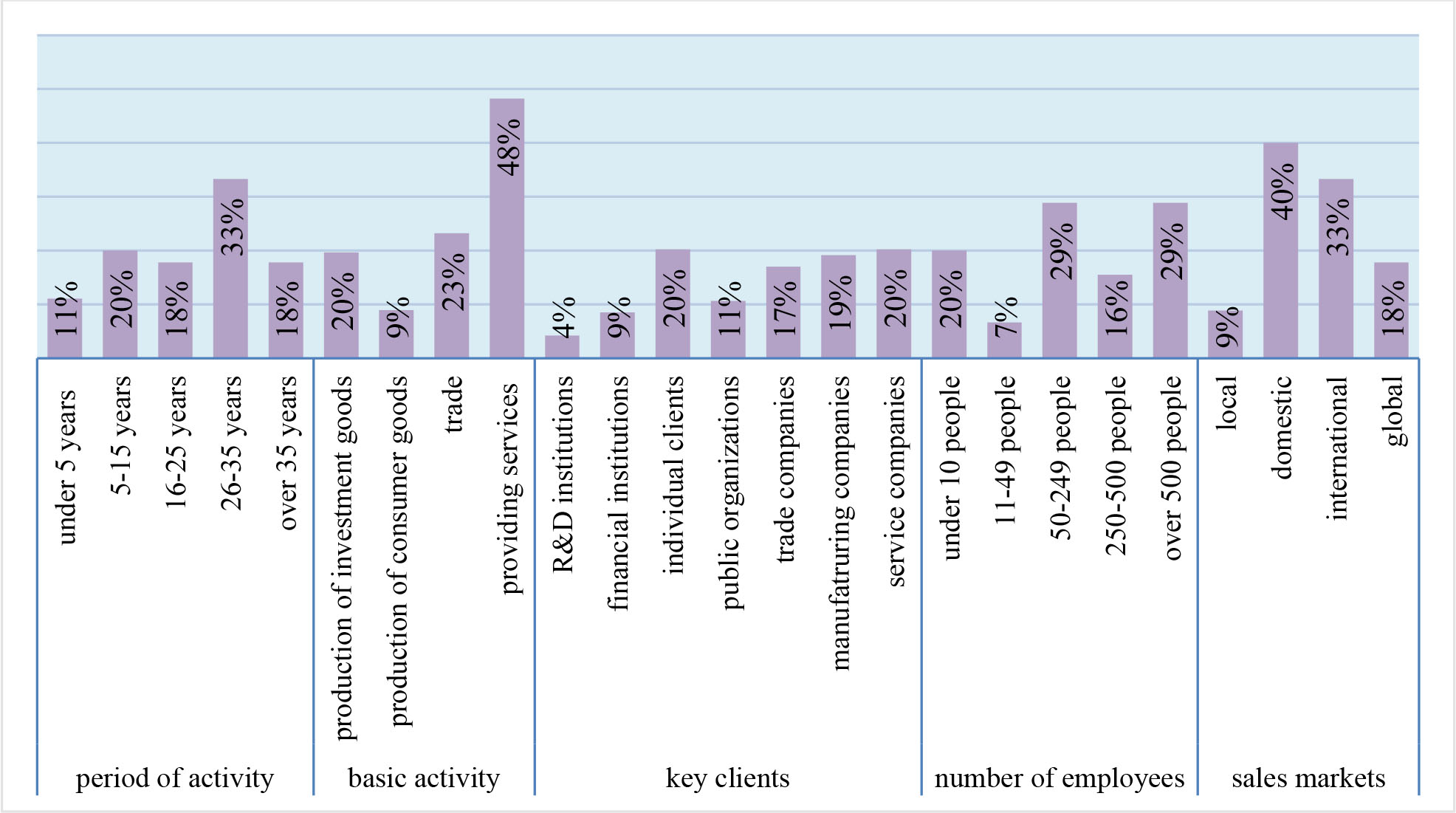
Figure 1.
Characteristics of the organizations researched
Source: own study based on research results.
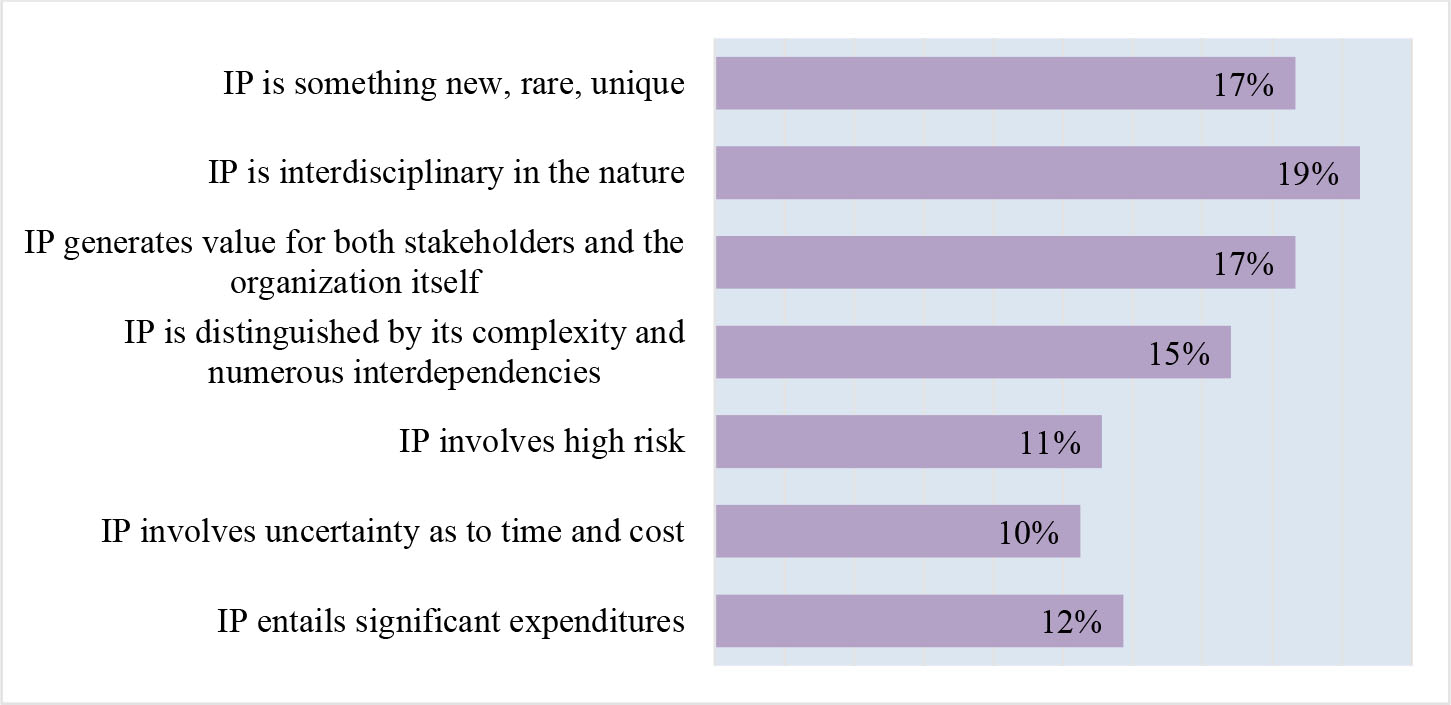
Figure 2.
Main features of innovation projects indicated by the respondents
Source: own study based on research results.
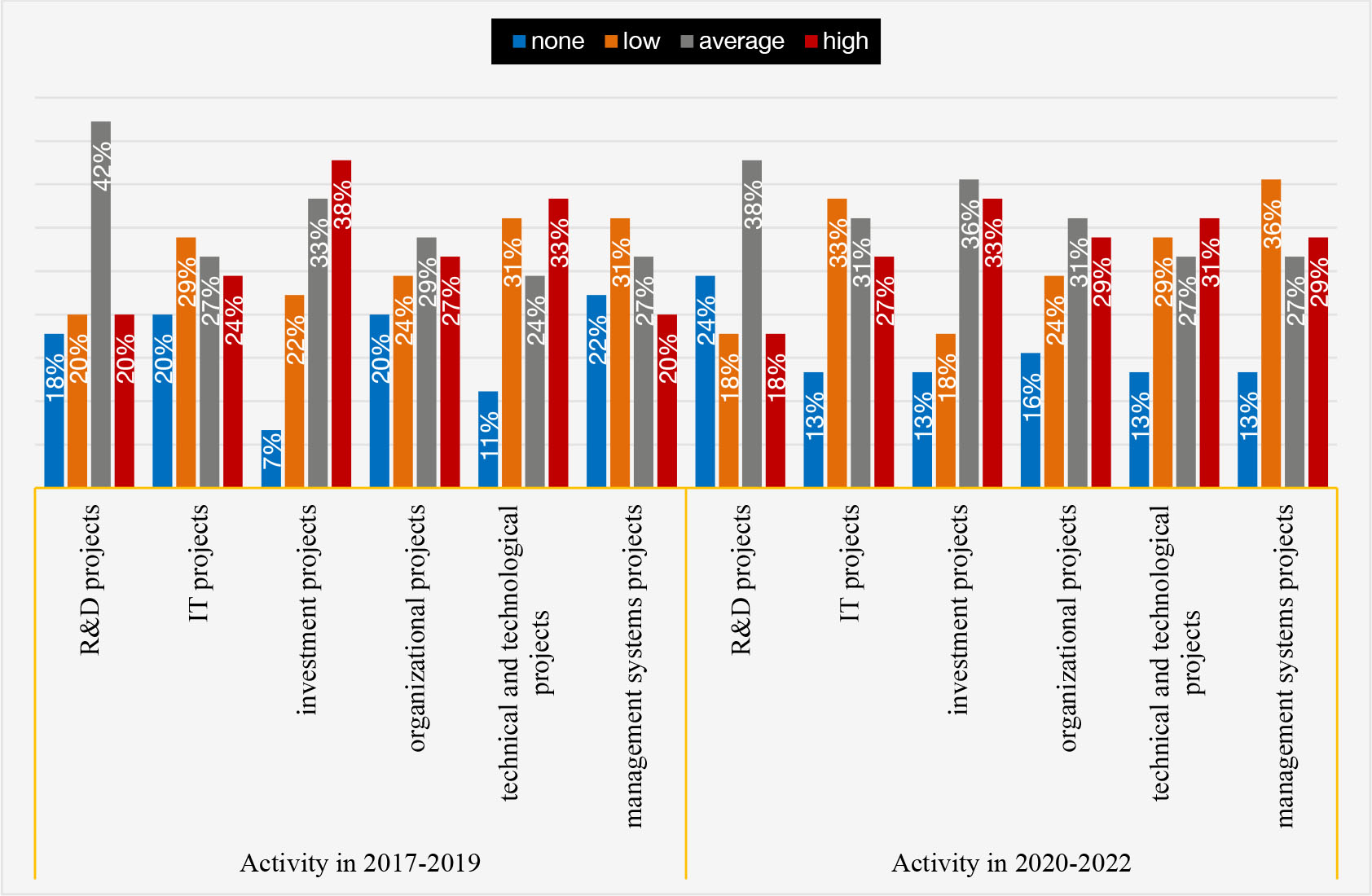
Figure 3.
Implementation activity of projects (in 2017–2019 and 2020–2022) in the surveyed organizations
Source: own study based on research results.
Table 3.
Types of risk in R&D projects
| Types of risk | 0 | 1 | 2 | 3 | 4 | 5 | average |
|---|---|---|---|---|---|---|---|
| market | 4 | 7 | 11 | 9 | 9 | 5 | 2.925 |
| technical and technological | 4 | 5 | 6 | 13 | 12 | 5 | 3.225 |
| regulatory | 4 | 12 | 8 | 10 | 9 | 2 | 2.6 |
| personal | 5 | 3 | 9 | 13 | 13 | 2 | 3.05 |
| organizational | 4 | 8 | 10 | 13 | 9 | 1 | 2.7 |
| material | 4 | 8 | 9 | 12 | 9 | 3 | 2.825 |
| time | 5 | 1 | 7 | 15 | 13 | 4 | 3.3 |
| implementation difficulties | 5 | 5 | 7 | 18 | 8 | 2 | 2.875 |
| financial | 5 | 9 | 4 | 6 | 16 | 5 | 3.1 |
Table 4.
Types of risk in organizational projects
| Types of risk | 0 | 1 | 2 | 3 | 4 | 5 | average |
|---|---|---|---|---|---|---|---|
| formal and legal | 3 | 8 | 9 | 15 | 10 | 0 | 2.775 |
| personal | 3 | 3 | 10 | 14 | 12 | 3 | 3.2 |
| coordination | 4 | 1 | 18 | 12 | 8 | 2 | 2.875 |
| financial | 4 | 7 | 10 | 14 | 7 | 3 | 2.8 |
| time | 2 | 6 | 9 | 10 | 12 | 6 | 3.3 |
| implementation difficulties | 3 | 4 | 7 | 13 | 14 | 4 | 3.325 |
| communication | 2 | 1 | 14 | 16 | 10 | 2 | 3.175 |
| quality | 4 | 3 | 15 | 15 | 5 | 3 | 2.825 |
| security | 6 | 8 | 9 | 11 | 9 | 2 | 2.625 |
Table 5.
Types of risk in technical projects
| Types of risk | 0 | 1 | 2 | 3 | 4 | 5 | average |
|---|---|---|---|---|---|---|---|
| quality | 2 | 7 | 12 | 9 | 11 | 4 | 3.05 |
| time | 1 | 3 | 13 | 13 | 8 | 7 | 3.375 |
| cost | 1 | 6 | 6 | 9 | 16 | 7 | 3.6 |
| market | 2 | 7 | 9 | 8 | 15 | 4 | 3.225 |
| regulatory | 2 | 13 | 8 | 10 | 10 | 2 | 2.725 |
| intellectual property protection | 4 | 7 | 9 | 9 | 12 | 4 | 3 |
| personal | 3 | 4 | 14 | 10 | 11 | 3 | 3.025 |
| limited access | 4 | 5 | 13 | 13 | 10 | 0 | 2.75 |
| implementation difficulties | 1 | 5 | 10 | 19 | 4 | 6 | 3.2 |
| technological | 2 | 6 | 10 | 8 | 12 | 7 | 3.325 |
| security | 4 | 9 | 8 | 13 | 9 | 2 | 2.75 |
| material | 2 | 7 | 14 | 10 | 11 | 1 | 2.85 |
Table 6.
Types of risk in investment projects
| Types of risk | 0 | 1 | 2 | 3 | 4 | 5 | average |
|---|---|---|---|---|---|---|---|
| quality | 3 | 8 | 8 | 13 | 9 | 4 | 2.975 |
| time | 3 | 5 | 6 | 11 | 12 | 8 | 3.45 |
| cost | 2 | 2 | 7 | 11 | 14 | 9 | 3.75 |
| market | 2 | 2 | 12 | 14 | 10 | 5 | 3.325 |
| legal | 2 | 6 | 12 | 8 | 15 | 2 | 3.1 |
| personal | 2 | 2 | 13 | 14 | 10 | 4 | 3.25 |
| material | 2 | 4 | 14 | 15 | 8 | 2 | 2.975 |
| technological | 2 | 5 | 13 | 13 | 10 | 2 | 3 |
| security | 4 | 9 | 7 | 17 | 5 | 3 | 2.725 |
| financial | 2 | 6 | 4 | 9 | 15 | 9 | 3.65 |
| weather conditions | 11 | 7 | 9 | 7 | 10 | 1 | 2.275 |
| coordination | 5 | 6 | 14 | 14 | 5 | 1 | 2.525 |
| inappropriate selection of partners | 5 | 6 | 10 | 14 | 8 | 2 | 2.75 |
| environmental (threats) | 7 | 9 | 10 | 12 | 6 | 1 | 2.35 |
| social (protests) | 12 | 13 | 8 | 8 | 2 | 2 | 1.775 |
Table 7.
Types of risk w IT projects
| Types of risk | 0 | 1 | 2 | 3 | 4 | 5 | weighted average |
|---|---|---|---|---|---|---|---|
| quality | 3 | 7 | 8 | 15 | 8 | 4 | 3 |
| time | 2 | 5 | 8 | 9 | 15 | 6 | 3.45 |
| cost | 4 | 4 | 7 | 12 | 12 | 6 | 3.3 |
| regulatory and legal | 7 | 8 | 10 | 9 | 10 | 1 | 2.5 |
| personal | 3 | 4 | 9 | 10 | 15 | 4 | 3.3 |
| material | 2 | 10 | 10 | 10 | 11 | 2 | 2.85 |
| technological | 3 | 11 | 5 | 9 | 13 | 4 | 3 |
| security | 7 | 7 | 7 | 13 | 8 | 3 | 2.675 |
| financial | 4 | 8 | 7 | 10 | 13 | 3 | 2.975 |
| incompatibility | 3 | 6 | 12 | 15 | 6 | 3 | 2.85 |
| related to the requirements | 3 | 6 | 10 | 10 | 15 | 1 | 3.025 |
| complexity | 2 | 3 | 4 | 17 | 13 | 6 | 3.6 |
| organizational | 3 | 3 | 12 | 17 | 9 | 1 | 2.975 |
Table 8.
Types of risk in management systems of projects
| Types of risk | 0 | 1 | 2 | 3 | 4 | 5 | weighted average |
|---|---|---|---|---|---|---|---|
| quality | 4 | 8 | 10 | 13 | 5 | 5 | 2.8 |
| time | 2 | 6 | 11 | 11 | 11 | 4 | 3.125 |
| cost | 3 | 12 | 7 | 11 | 9 | 3 | 2.75 |
| formal and legal | 4 | 14 | 5 | 9 | 10 | 3 | 2.65 |
| personal | 3 | 1 | 11 | 10 | 15 | 5 | 3.45 |
| security | 4 | 10 | 10 | 11 | 8 | 2 | 2.625 |
| financial | 4 | 8 | 5 | 14 | 14 | 0 | 2.9 |
| coordination | 2 | 4 | 9 | 14 | 12 | 4 | 3.3 |
| implementation difficulties | 4 | 4 | 11 | 14 | 10 | 2 | 2.95 |
| organizational | 3 | 4 | 9 | 13 | 14 | 2 | 3.175 |
| technological | 5 | 9 | 10 | 11 | 9 | 1 | 2.575 |
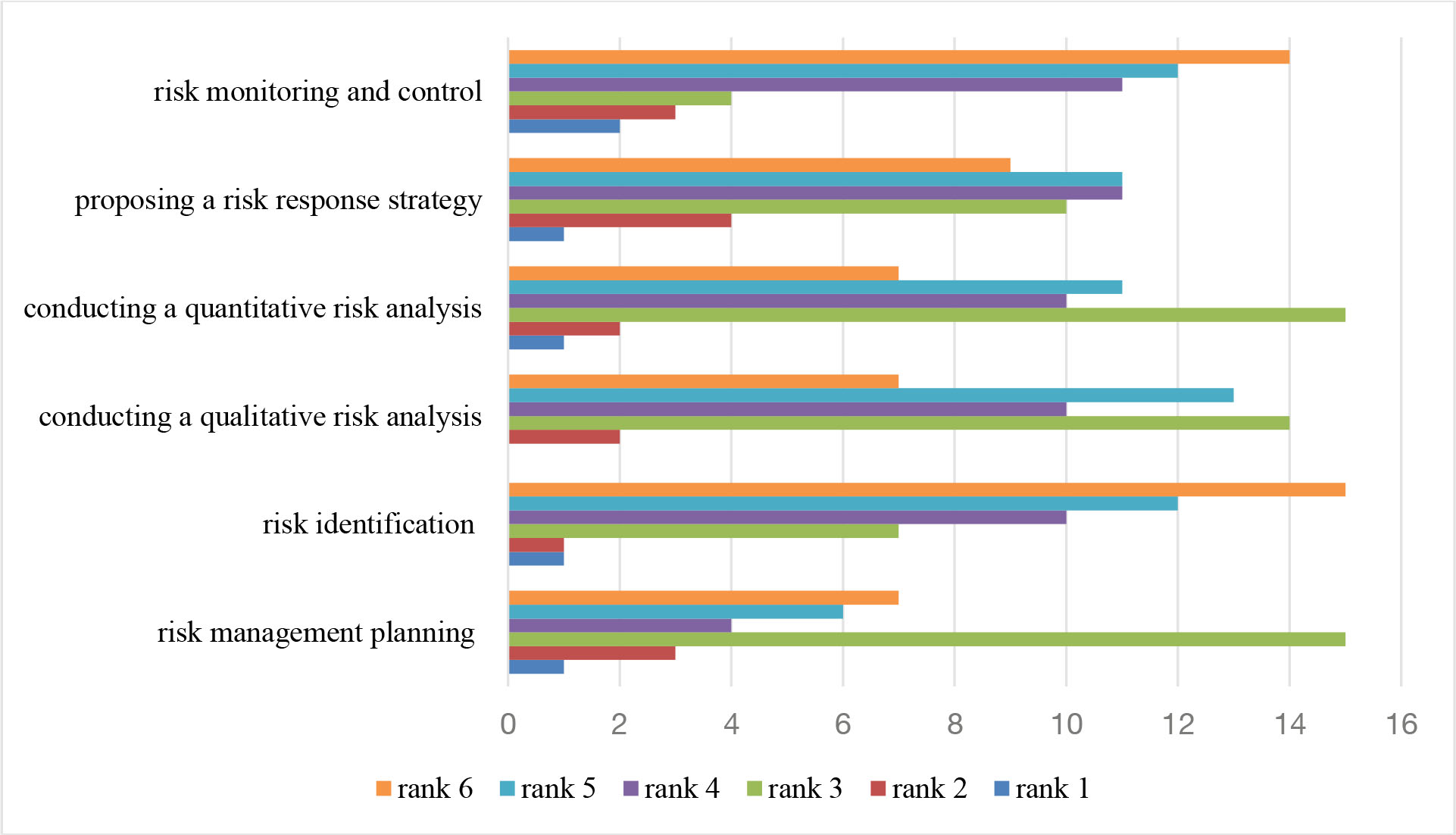
Figure 4.
Assessment of the importance of the stages of the risk management process in innovative projects.
Resource: own analysis based on research results.