
Table 1.
The process of SLR
| Phase I: Setting up assumptions | ||||
| Metasynthesis aim: identification of an integrated model of interorganizational relationships development based on qualitative research. | Research questions: (1) How many and what kind of phases can/should be distinguished? (2) What factors/issues/phenomena trigger or impact changes in the IOR life cycle? (3) Is the development path linear? (4) Is the development path of RLC iterative or rather sequential? (5) What are the general features of RLC? (6) When and how does the life cycle of IOR begin? (7) When and how does the life cycle of IOR end? | |||
| Stage II: Literature collection | ||||
| Data bases: EBSCO, Scopus, JSTOR | ||||
Search terms: 20 pairs of the following search terms:
| ||||
Inclusion criteria:
| Exclusion criteria:
| |||
| Results obtained | Researcher 1 Scopus | Researcher 2 JSTOR | Researcher 3 EBSCO | |
| Database obtained using searching criteria | 6070 | 35 | 4892 | |
| Database obtained using both inclusion and exclusion criteria | 467 | 6 | 156 | |
| Identified works in three academic databases | 629 | |||
| Duplicated works | 82 | |||
| Initial database | 547 | |||
| Phase III: Literature selection & evaluation | ||||
| Selection of works was conducted by reading the titles, abstracts, key words (if available), and conclusion part of the papers gathered in the initial database. | ||||
Selection criteria used to evaluate collected papers**
| ||||
| Results obtained | Researcher 1 | Researcher 2 | Researcher 3 | In total |
| Works marked as selected | 35 | 34 | 32 | 101 |
| Works marked as inspiring | 16 | 42 | 30 | 88 |
| Works marked as not relevant | 126 | 9 | 115 | 340 |
| Duplicated works | 6 | 8 | 4 | 18 |
| Added seminal papers *** | 7 | |||
| Screened database | 108 | |||
| Final database including ONLY works presenting results from qualitative field research processes**** | 18 Batonda & Perry, 2003; Heffernan & Poole, 2004; Lau & Goh, 2005; Duanmu & Fai, 2007; Meng, 2010; Davis & Love, 2011; Ming-Huei & Wen-Chiung, 2011; Lee & Johnsen, 2012; Abosag & Lee, 2013; Baptista, 2013; Plewa et al., 2013; Akrout, 2014; Mandják et al., 2015; Hastings et al., 2016; Panda & Dash, 2016; de Almeida Moraes et al., 2017; Ferreira et al., 2017; Restuccia & Legoux, 2019 | |||
| Phase IV: Literature analysis | ||||
| Conceptual aspects analyzed |
| |||
| Methodological aspects analyzed |
| |||
| Criteria of comparative analysis |
| |||
| Approach to data analysis |
| |||
| Phase V: Reporting | ||||
| Dissemination of findings |
| |||
1 * We take the year 1998 as the threshold as it is acknowledged as the year of the birth of the relational approach in strategic management due to a seminal publication by Dyer and Singh (1998) in AoM (cited 15,096 times as of March 2, 2020 in GoogleScholar.com).
1 ** The analysis covered the title (T), abstract (A), and conclusions (C) of every work from our initial database.
1 *** Following additional SLR methodological assumptions and the specific requirements of the snowball technique, we decided to supplement the final database with the most acknowledged works in a given knowledge area (Akrout & Diallo, 2017; Batonda & Perry, 2003; Dwyer et al., 1987; Ford, 1980; Hagen-Zanker & Mallett, 2013; Ring & Van de Ven, 1994; Waddington et al., 2018; Wilson, 1995).
1 **** As required in the case of metasynthesis: Sandelowski et al., 1997; Zimmer, 2006; Erwin et al. 2011; Melendez-Torres et al., 2015; Garip & Kamal, 2019; Lachal et al., 2017; Finfgeld-Connett, 2010; Dekker & Bekkers, 2015.
1 Source: Author’s own work based on Klimas et al., 2020.
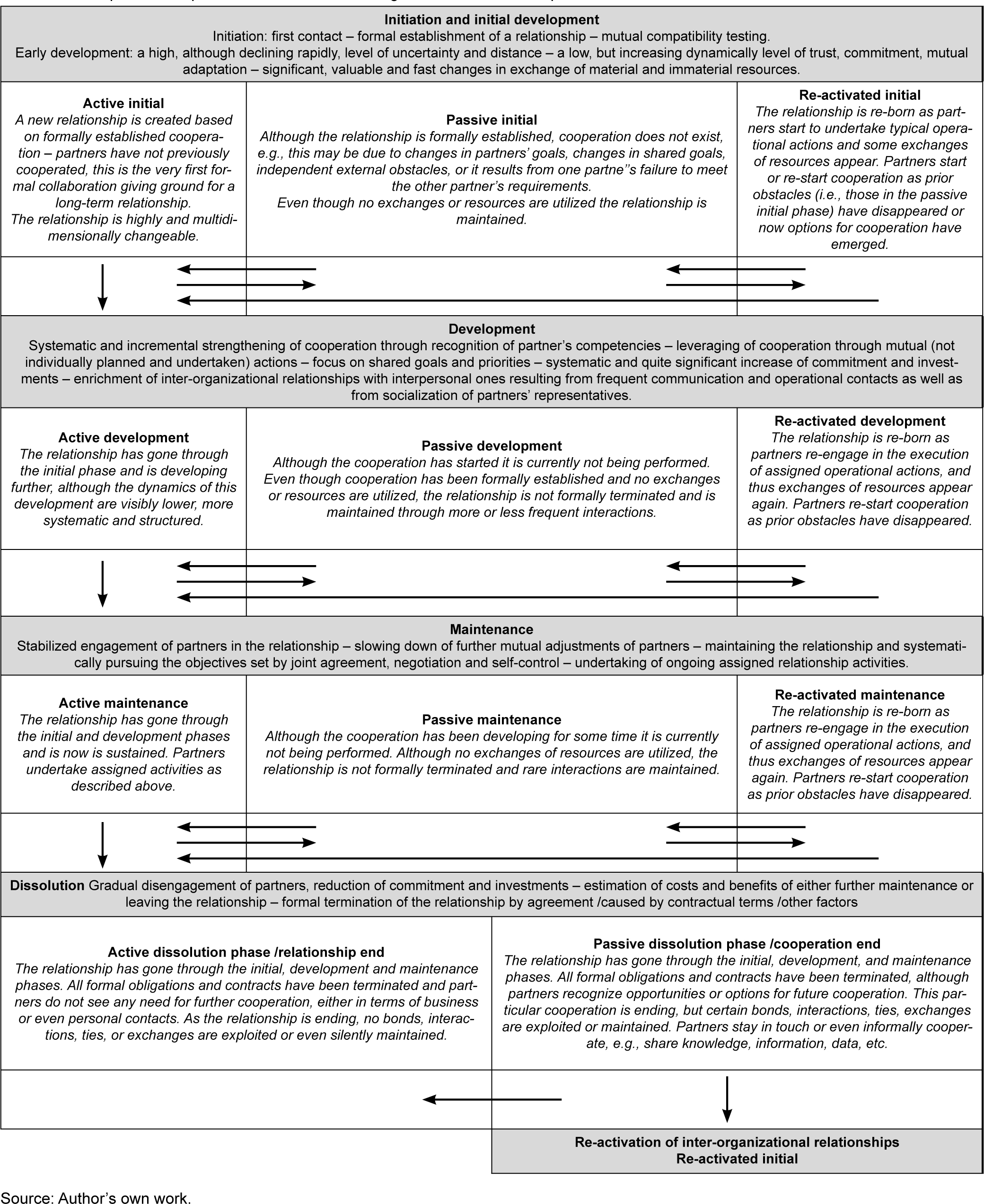
Table 2.
A multipath development framework for inter-organizational relationships
Table A.
Qualitative studies on the relationship life cycle
| Authors | Year | Research subject | Followed approach to RLC | Research method (data collection and analysis) | Sample size | Industry | Relationship research focus / type | Country | Phases | Linearity | RLC process descriptions | Renewal | Pre-relationship phase (-s) | Post-relationship phase (-s) | Time importance | Points of change | Cultural context |
|---|---|---|---|---|---|---|---|---|---|---|---|---|---|---|---|---|---|
| Batonda & Perry | 2003 | Inter-firm network development phases – RLC | Adopted from literature review (e.g., Ford, 1980; Dwyer et al., 1987; Kanter, 1994; Wilson, 1995) | Multiple, in-depth case study (semi-structured interviews) | 12D (24) | Manufacturing & services industries | D /manufacturer – service | Australia-Asia | Searching Starting Development On-going maintenance Termination Dormant and re-activation a | non-L | PR | yes | yes | yes | yes | ||
| Heffernan & Poole | 2004 | Critical prevention factors of relationship deterioration and termination | Adopted from literature review (e.g., Ford, 1982; Dwyer et al., 1987; Wilson, 1995; Ford et al., 1998) | Multiple case study (indepth interviews) | 10D (38) | Universities | D /university – offshore partner | Australia-Asia | Pre-relationship Early interaction Relationship growth Partnership Relationship end | STG | yes | yes | |||||
| Lau & Goh | 2005 | Factors that influence relational change | Based on (Ford, 1980) | Comparative case study (in-depth interviews and unstructured discussions) | 3D (6) | Printed circuit board (PCB) industry | D/buyer – seller | Singapore-German / Taiwan | Pre-relationship Early Development Long-term | STG | yes | yes | yes | yes | |||
| Duanmu & Fai | 2007 | Factors that accelerate or prolong RDP at each phase (according to knowledge transfer) | A priori stated | Multiple, processual case study (semi-structured interviews) | ‘ 16D (32) | Electrical and electronics industry | D /multinational enterprise (MNE) – supplier | China | Initiating Developing Intensifying | STG | yes | ||||||
| Meng | 2010 | Key relationship indicators | Adopted from literature review (Li et al., 2000; SFfC, 2003; Humphreys et al., 2003; Jones & Saad, 2003). | Case study (focus on interview, expert interviews, scoring, Analytic Hierarchy Process) | 2 | Construction | D /supply chain relationship, customer supplier | UK | Level 1 (adversarialism or arm’s length) Level 2 (limited cooperation) Level 3 (short-term collaboration) Level 4 (long-term collaboration) | STG | |||||||
| Davis & Love | 2011 | Key factors of successful relationship development in alliances | Based on (Ford et al., 1998; Wilson, 1995; Pascale, 1997; Thompson & Sanders, 1998; Donaldson et al., 2001; Dwyer et al., 1987; Body et al., 2000) and modified | Multiple case study (indepth interviews) | (49) | Construction | I /supply chain, vary industry practitioners | Australia | Assessment Commitment Enduring | non-L | STG/PH | yes | yes | ||||
| Ming-Huei & Wen-Chiung | 2011 | Factors of key account relationships that differ alignment patterns and drive alignment transitions over time | Based on (Dwyer et al., 1987; Jap & Ganesan, 2000) and modified | Multiple case study (indepth interviews) | 4D (11) | TFT-LCD, gas production, legal service, steel and iron production | D /key account relationships, buyer – seller | Global context | Exploration Build-up Maturity | PH /PR | |||||||
| Lee & Johnsen | 2012 | Characteristics of asymmetric relationships and relationship development stages | Adopted from literature review (e.g., Dwyer et al., 1987; Ford, 1980; Frazier, 1983; Wilson, 1995; Jap & Ganesan, 2000) | Multiple, in-depth case study (semi-structured interviews) | 5 (50) | Electronic | D /customer – supplier relationship | Taiwan | Exploratory Developing Stable | STG | yes | yes | |||||
| Abosag & Lee | 2013 | Variability of key, culturally conditioned relationship factors | Based on (Ford, 1980; Dwyer et al., 1987; Wilson, 1995; Batonda & Perry, 2003) | Longitudinal, multiple case study (in-depth interviews, data collected twice) | 33 | Manufacturing industry | I /only manufacturing industry managers point of view | Saudi Arabia | Pre-relationship Early integration Growth Maintenance Dissolution phase d | non-L | STG / PH | yes | yes | ||||
| Baptista | 2013 | Significant driving forces for long-term relationship development – RDP | Based on (Johanson & Mattsson, 1987; Möller & Wilson, 1988, 1995; Ruekert & Walker, 1987) | Longitudinal, multiple case study (in-depth interviews) | 4D (35) | Mining industry | D/buyer – seller | Portugal | Exchange Adaptation Coordination | PR | yes | ||||||
| Plewa et al. | 2013 | Key success factors of the different relationship phases | Based on (Dwyer et al., 1987; Ford, 1982; Christopher et al., 1991; Tikkanen & Tuominen, 2000; Grayson & Ambler, 1999; Voss & Voss, 1997; Rao & Perry, 2002) | Multiple case study (in-depth semi-structured interviews) | 15D (30) | University – industry (various) | D /university – industry relationship | Australia-German / Holland | Pre-linkage Establishment Engagement Advancement Latent phase | non-L | PH | yes | yes | yes | yes | yes | |
| Akrout | 2014 | How relationship quality dimensions develop in each phase of buyer-seller relationship | Based on (Dwyer et al., 1987) | Multiple case study (in-depth semi-structured interviews) | 39 | Various B2B sectors | I /only French buyers point of view | France | Exploration Expansion Maintenance | L | STG/PH | yes | yes | ||||
| Mandják et al. | 2015 | A role of trust in the birth of business relationships | Based on (Ford, 1980; Dwyer et al. 1987; Levinger, 1980; Huston & Levinger, 1978) | Case study (in-depth interviews) | 1 (25) | Electronic | D /buyer – supplier | Hungary | NA | STG | yes | yes | |||||
| Hastings et al. | 2016 | Critical success criteria for pre-relationships state /early relationships state | Adopted from literature review (e.g., Dwyer et al., 1987; Ford, 2002; Wilson, 1995) | Multiple case study (semi-structured interviews, summative assessment approach) | 4 | Prawn fisheries | D /fishery value chain (assessment) | Australia | NA | non-L | STT/STG | yes | yes | yes | |||
| Panda & Dash | 2016 | The role of control and trust for developing a cooperative VC-entrepreneur relationship | A priori stated | Multiple case study (semi-structured interviews) | 10D (28+20) | Diverse | D /VC-entrepreneur relationships | India | Early phase, Growth phase | STG | yes | yes | |||||
| de Almeida Moraes et al. | 2017 | How firms access and use international partner networks over time in their internationalization processes – RLC | A posteriori – emerges from the research | Longitudinal, multiple case study (interviews) | 4D (16) | IT software | I /only software service firms point of view | Brasil | Pre-relationship Trigger Initial contact Formalization Building personal relationships Local expansion Internationalization b | STG | yes | yes | yes | yes | |||
| Ferreira et al. | 2017 | A phase model for solution relationship development – RLC | Based on (Ford, 1980; Dwyer et al. 1987; Sawhney, 2006; Tuli et al., 2007) | Multiple case study (in-depth interviews) | 9D /4T | Aerospace | D-T /manufacturer – supplier – customer | Global context | Matching Combining Mixing Sharing c | non-L | PH | yes | yes | yes | |||
| Restuccia & Legoux | 2019 | The contingency role of the relationship life-cycle in driving future customer outcomes – RLC | Based on (Dwyer et al., 1987; Jap & Anderson, 2007) | Longitudinal case study (archival sales data, in-depth interviews, longitudinal analysis) | 1 | Printing company | I /only supplier point of view | North America | Exploration Buildup Maturity Decline | STG | yes |
1 NOTE: in the analyzed pool of papers there were 18 publications. Nonetheless, in two articles (i.e., Mandjàk et al., 2015; Hastings et al., 2016) the concept of RLC is presented too briefly to analyze the assumptions, structure, and features of the models mentioned as used in empirical investigation.
1 Abbreviations: RLC – relationship life cycle; RDP – relationship development; IOR – inter-organizational relationship; NA – not applicable model; PR – processes; PH – phases; STT – states; STG – stages.
1 a Originally 6 phases. However, the last phase “Dormant and re-activation” can be divided into two separate phases: dormant and re-activation.
1 b Originally 7 phases. However, depending on results from a given case study, even 10 phases can be distinguished (e.g., “Internationalization” can be divided into two or more phases referring to the phase and scope of internationalization process). Furthermore, the authors emphasize that in some cases, the 5th, 6th and 7th phases can be considered together under an “Expansion” phase.
1 c Originally 4 phases. However, the first phase can be split into the initiation and development phase. Such a distinction is shown as reasoned especially in the case of triadic relationships.