
Table 1.
Advantages and disadvantages of work-life balance in corner planes
| Disadvantages of out of balance | The benefits of a balanced approach | |
|---|---|---|
| Organization | Absence from work | Increase in the productivity and competitiveness of entities |
| Increase in fluctuation in employment | Increase in employee motivation | |
| Less commitment to work | Increase in employee loyalty and their identification with the workplace | |
| Increased stress among employees | Acquiring and retaining better qualified employees | |
| Less concentration and productivity of employees | Reducing stress among employees | |
| Worse relationships at work and with clients | Reduction of costs resulting from employee rotation | |
| Less creativity and innovation of employees | Building a positive image of the entity: socially responsible and family-friendly | |
| Loss of investment in human capital | Increase in the quality of work Increase in the value of the entity over the long term | |
| Employee (his family) | Stress for employees and their families | Increased self-esteem of employees and motivation to work |
| Deterioration of health, including mental health | Reduced stress and disease | |
| Conflicts in the family | Reducing the feeling of guilt due to the lack of time to be with children (family) and/ or to perform professional duties | |
| Worse childcare | ||
| Divorces/one-parent families | Greater satisfaction with the ability to reconcile various components of life (work, family, personal life) Increasing job satisfaction Identification of employees with the workplace | |
| Alcoholism and the increase of addiction | ||
| Increase in civilization diseases | ||
| Lack of sense of security in family and professional life |
1 Source: Own study based on:
Borkowska, S., (2003). Równowaga między pracą i życiem: Unia Europejska-Polska in: S. Borkowska, Programy praca - życie a efektywność firm, p. 16. Warszawa: Instytut Pracy i Spraw Socjalnych. Retrieved from: https://zie.pg.edu.pl/documents/30328766/30681469/REME_5_%282-2013%29-Art3.pdf (12.02.2022).
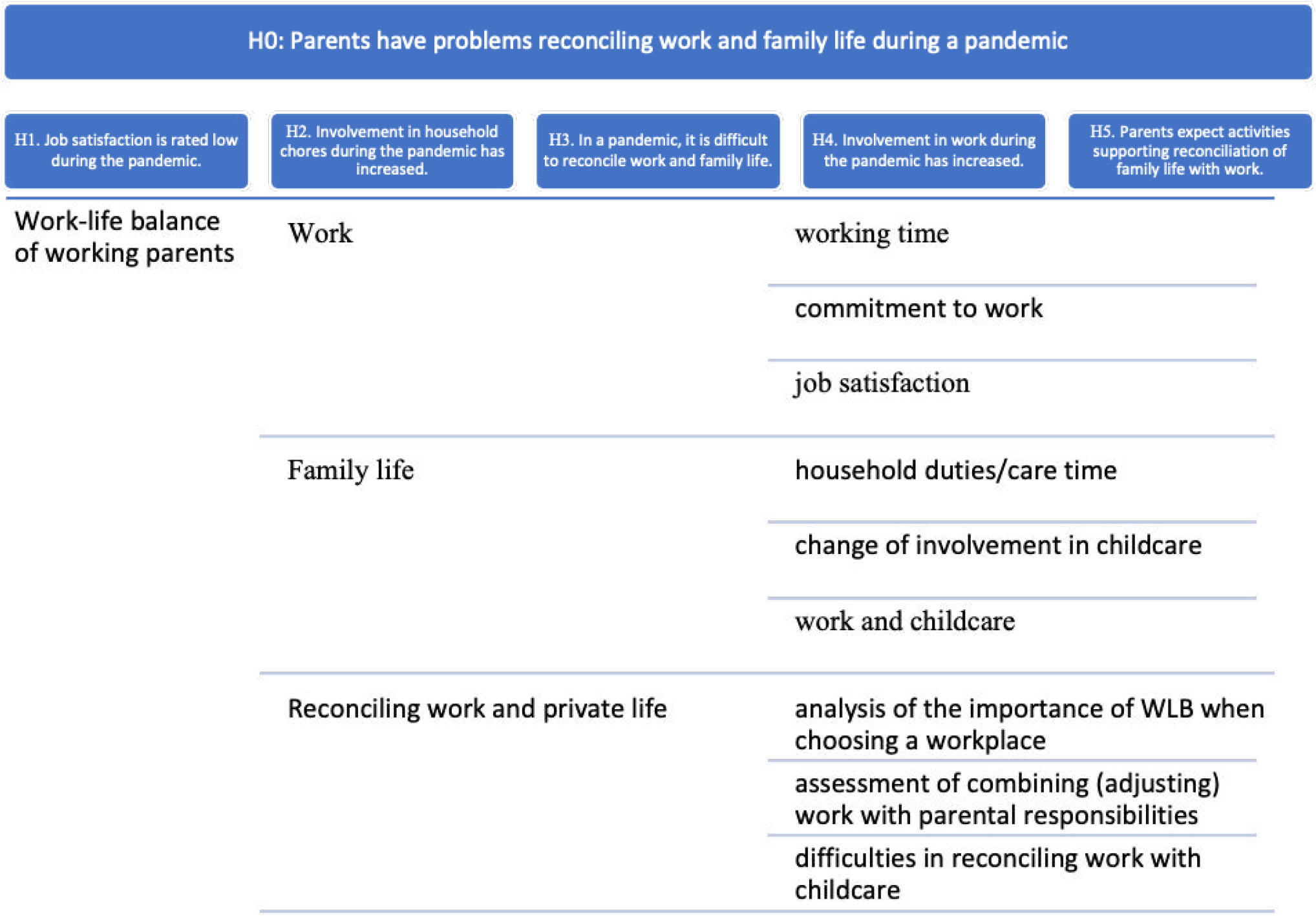
Figure 1.
Framework for the WLB survey of working parents
Source: own study.
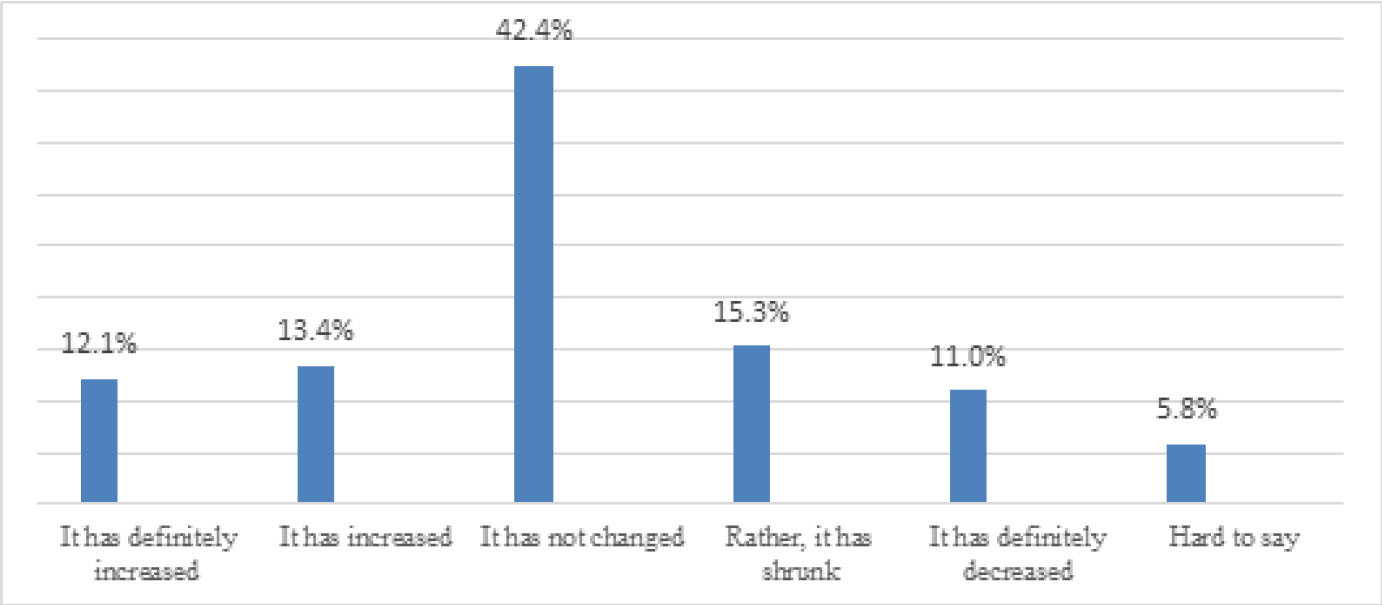
Figure 2.
Work involvement during the pandemic as assessed by working parents during the pandemic (data in %)
Source: own study based on research results.
Table 2.
_Time spent at work during a pandemic compared to pre-pandemic time (age, gender)
| Gender | Age | ||||||
|---|---|---|---|---|---|---|---|
| Total | Female | Male | Up to 30 years | 31-40 years | 41-50 years | Over 50 years | |
| 1 | 4.8% | 4.7% | 5.6% | 8.5% | 5.3% | 4.2% | 3.3% |
| 2 | 9.0% | 8.6% | 12.5% | 11.4% | 9.5% | 8.6% | 6.1% |
| 3 | 38.8% | 38.4% | 42.3% | 36.9% | 39.9% | 38.1% | 33.7% |
| 4 | 21.3% | 21.4% | 20.1% | 21.0% | 20.7% | 21.8% | 22.0% |
| 5 | 26.2% | 26.8% | 19.5% | 22.2% | 24.6% | 27.3% | 35.0% |
| Overall | 7800 | 7063 | 737 | 176 | 3645 | 3733 | 246 |
| Pearson’s chi-square tests | |||||||
| Gender | Age | ||||||
| Chi-square | 28.778 | 33.403 | |||||
| df (degrees of freedom) | 4 | 12 | |||||
| Relevance | .000* | .001* | |||||
Table 3.
Time spent at work during the pandemic compared to the time before the pandemic (number of children upbringing)
| Children upbringing | |||||
|---|---|---|---|---|---|
| Overall | One | Two | Three | Four or more | |
| 1 | 4.8% | 4.3% | 4.7% | 5.6% | 8.0% |
| 2 | 9.0% | 8.6% | 8.8% | 10.7% | 10.5% |
| 3 | 38.8% | 38.6% | 39.0% | 39.1% | 35.4% |
| 4 | 21.3% | 20.8% | 21.4% | 22.5% | 18.1% |
| 5 | 26.2% | 27.8% | 26.1% | 22.2% | 27.8% |
| Overall | 7800 | 2339 | 4201 | 1023 | 237 |
| Pearson’s chi-square tests | |||||
| Children upbringing | |||||
| Chi-square | 23.983 | ||||
| df (degrees of freedom) | 12 | ||||
| Relevance | .020* | ||||
Table 4.
Time spent in work during the pandemic compared to pre-pandemic time (age of children - non-cumulative categories)
| Children’s age | ||||||||
|---|---|---|---|---|---|---|---|---|
| Overall | 0-3 years | 4-5 years | 6-8 years | 9-14 years | 15-18 years | Over 18 years | No data | |
| 1 | 4.8% | 4.9% | 6.3% | 5.6% | 4.6% | 5.5% | 4.5% | 10.0% |
| 2 | 9.0% | 10.8% | 11.2% | 10.7% | 8.6% | 7.1% | 7.4% | 0.0% |
| 3 | 38.8% | 38.7% | 35.4% | 36.8% | 39.6% | 41.4% | 39.2% | 50.0% |
| 4 | 21.3% | 21.9% | 20.7% | 21.2% | 21.8% | 20.7% | 19.1% | 20.0% |
| 5 | 26.2% | 23.6% | 26.4% | 25.8% | 25.4% | 25.3% | 29.8% | 20.0% |
| Overall | 7800 | 775 | 1167 | 3356 | 5644 | 1378 | 650 | 10 |
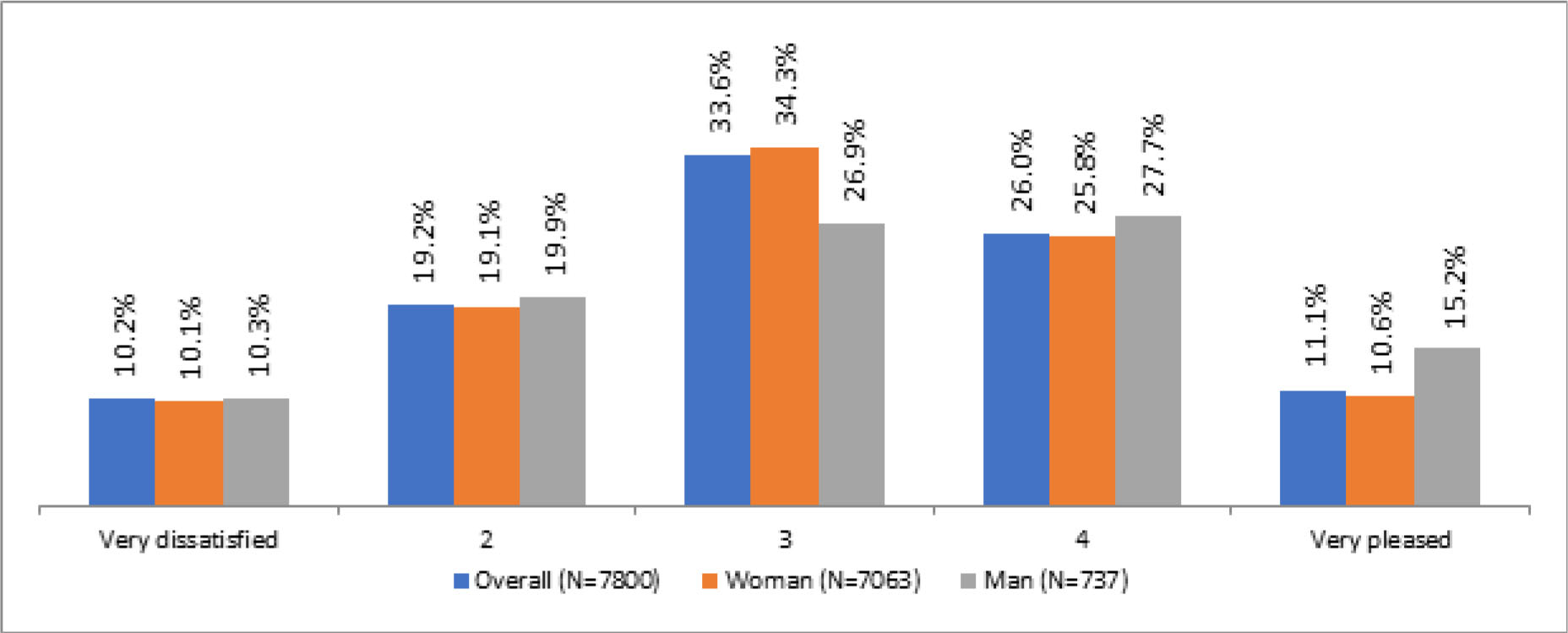
Figure 3.
Satisfaction with working life (by gender)
Note: Satisfaction with working life scale from 1 to 5, where “1” means that you are very dissatisfied, and “5” means that you are very pleased.
Source: own study based on research results.
Table 5.
Satisfaction with working life (gender, age)
| Gender | Age | ||||||
|---|---|---|---|---|---|---|---|
| Total | Female | Male | Up to 30 years | 31-40 years | 41-50 years | Over 50 years | |
| 1 | 10.2% | 10.1% | 10.3% | 16.5% | 11.0% | 9.2% | 8.5% |
| 2 | 19.2% | 19.1% | 19.9% | 21.0% | 19.0% | 19.1% | 22.4% |
| 3 | 33.6% | 34.3% | 26.9% | 21.0% | 33.6% | 34.3% | 31.3% |
| 4 | 26.0% | 25.8% | 27.7% | 19.3% | 26.0% | 26.4% | 23.6% |
| 5 | 11.1% | 10.6% | 15.2% | 22.2% | 10.4% | 10.9% | 14.2% |
| Overall | 7800 | 7063 | 737 | 176 | 3645 | 3733 | 246 |
| Pearson’s chi-square tests | |||||||
| Gender | Age | ||||||
| Chi-square | 24.753 | 51.639 | |||||
| df (degrees of freedom) | 4 | 12 | |||||
| Relevance | .000* | .000* | |||||

Figure 4.
Work satisfaction according to form of employment (average grade on the scale)
Note: Work life satisfaction scale from 1 to 5, where “1” means that you are very dissatisfied, and “5” means that you are very pleased.
Source: own study based on research results.

Figure 5.
Work satisfaction according to employment sector (average score on the scale)
Note: Work life satisfaction scale from 1 to 5, where “1” means that you are very dissatisfied, and “5” means that you are very pleased.
Source: own study based on research results.
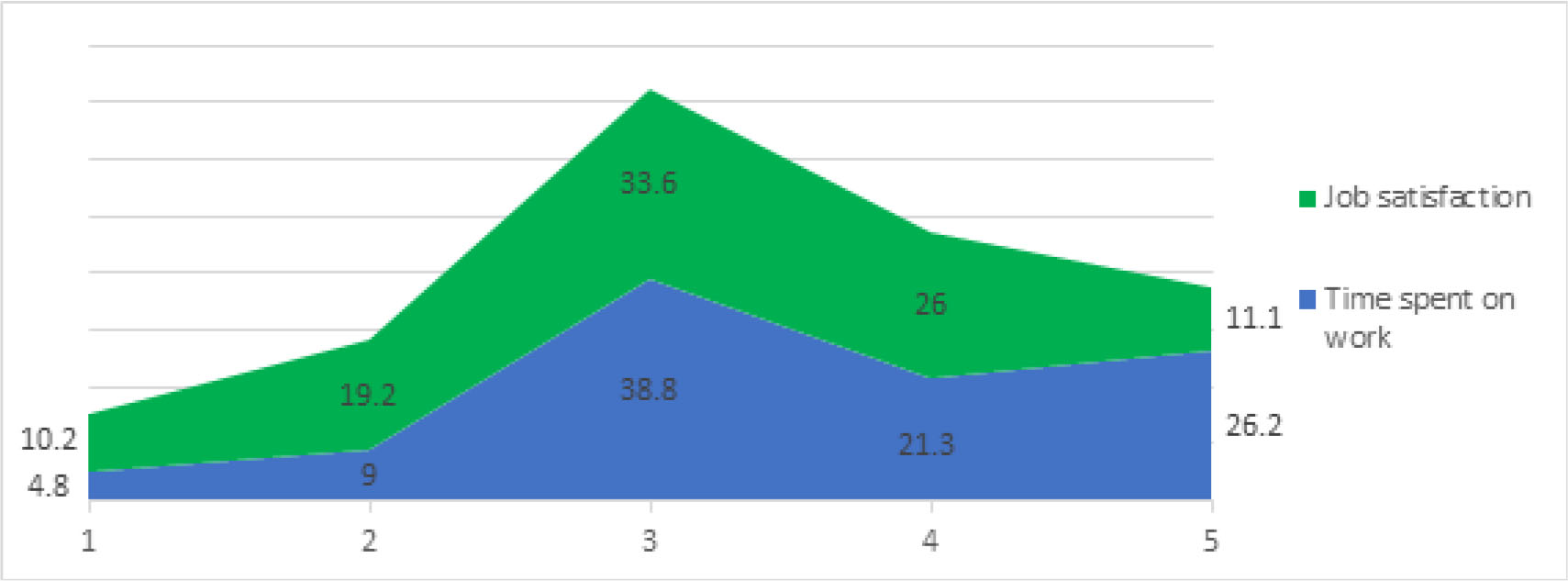
Figure 6.
Comparing the time spent working with job satisfaction
Note: Work life satisfaction scale from 1 to 5, where “1” means that you are very dissatisfied, and “5” means that you are very pleased.
The scale of time spent on work is from 1 to 5, where “1” means that the time spent on work is much shorter, and “5” means that the time spent on work is much longer compared to the time before the pandemic.
Source: own study based on research results.
Table 6.
Assessment of the change in work involvement in the work system statement
| Commitment assessment | Work system | ||||||
|---|---|---|---|---|---|---|---|
| Total | Only in the remote work system | Remote work dominates | Remote work and stationary work at the company’s premises | Stationary work at the company’s headquarters is dominant | Only stationary work at the company’s premises | Another form | |
| It has definitely increased | 12.1% | 16.3% | 16.6% | 11.3% | 10.8% | 9.2% | 11.0% |
| It has increased | 13.4% | 19.4% | 18.2% | 15.4% | 14.6% | 8.2% | 10.5% |
| It is the same | 42.4% | 33.9% | 37.1% | 43.9% | 39.3% | 49.6% | 29.5% |
| Rather, it has decreased | 15.3% | 16.0% | 15.3% | 17.4% | 20.0% | 13.3% | 12.0% |
| It has definitely decreased | 11.0% | 11.0% | 9.5% | 8.4% | 9.6% | 11.6% | 25.0% |
| Hard to say | 5.8% | 3.4% | 3.3% | 3.5% | 5.6% | 8.1% | 12.0% |
| Overall | 7800 | 1551 | 1168 | 735 | 915 | 3231 | 200 |
| Pearson’s chi-square tests | |||||||
| Work system | |||||||
| Chi-square | 433.546 | ||||||
| df (degrees of freedom) | 25 | ||||||
| Relevance | .000* | ||||||
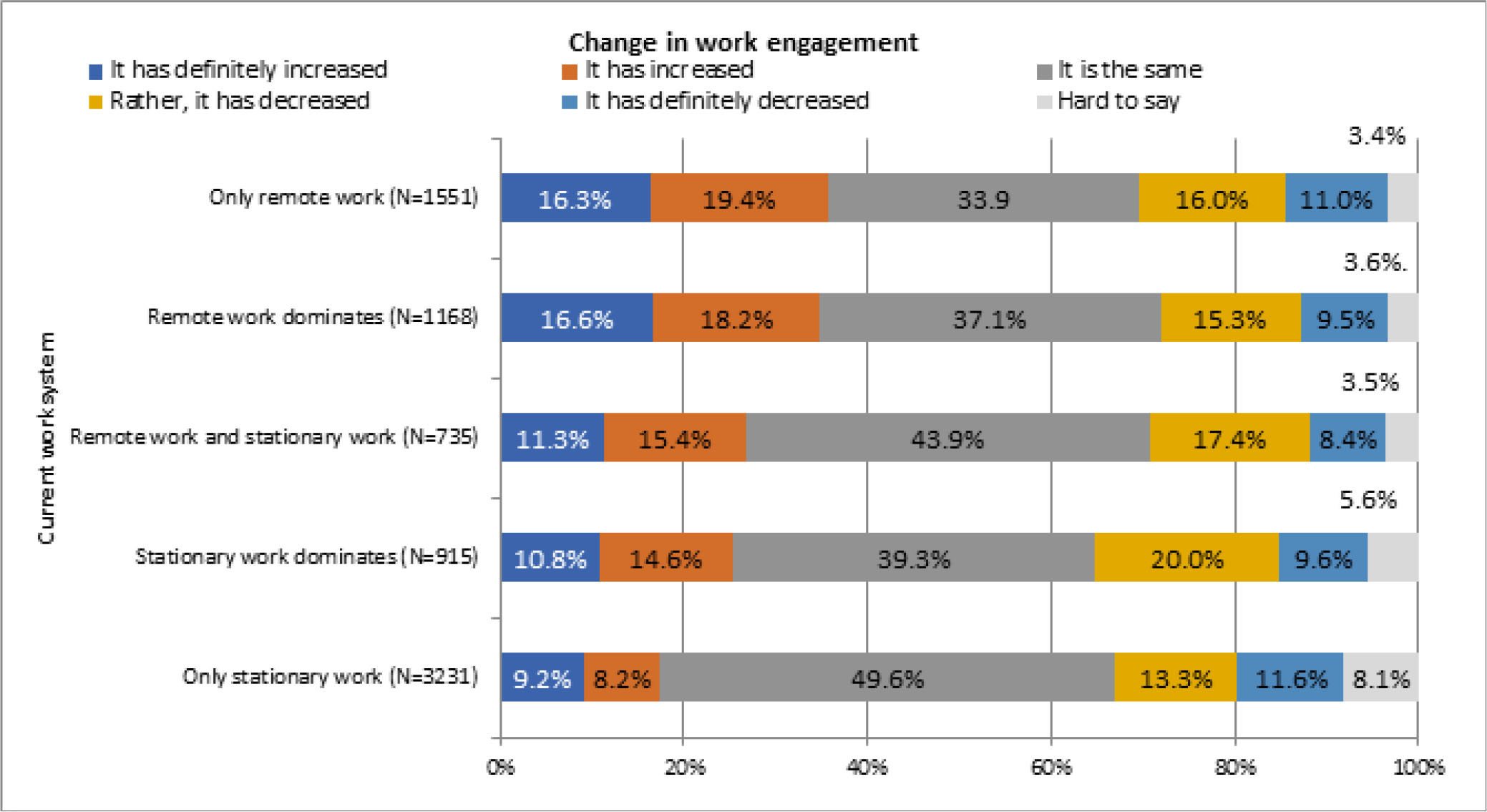
Figure 7.
Assessment of changes in work involvement in comparison with the system of performed work
Source: own study based on research results.
Table 7.
Change in childcare involvement during the pandemic compared to pre-pandemic (gender and age)
| Gender | Age | ||||||
|---|---|---|---|---|---|---|---|
| Total | Female | Male | Up to 30 years | 31-40 years | 41-50 years | Over 50 years | |
| 1 | 3.4% | 3.4% | 3.4% | 8.0% | 3.7% | 2.9% | 3.3% |
| 2 | 8.0% | 8.0% | 7.9% | 9.1% | 8.4% | 7.6% | 6.9% |
| 3 | 26.7% | 26.4% | 30.3% | 30.1% | 26.4% | 26.7% | 29.3% |
| 4 | 29.5% | 29.1% | 33.9% | 22.7% | 29.0% | 30.2% | 31.7% |
| 5 | 32.4% | 33.2% | 24.6% | 30.1% | 32.6% | 32.6% | 28.9% |
| Overall | 7800 | 7063 | 737 | 176 | 3645 | 3733 | 246 |
| Pearson’s chi-square tests | |||||||
| Gender | Age | ||||||
| Chi-square | 24.526 | 23.808 | |||||
| df (degrees of freedom) | 4 | 12 | |||||
| Relevance | .000* | .022* | |||||
Table 8.
Change in childcare involvement during the pandemic compared to pre-pandemic time (education and place of living)
| Education | Place of living | |||||||
|---|---|---|---|---|---|---|---|---|
| less than secondary | secondary education | higher vocational education | higher education | village | city up to 50.000 | city 50.000 -500.000 | city over 500.000 | |
| 1 | 6.8% | 3.6% | 3.0% | 3.2% | 3.8% | 3.4% | 3.6% | 2.9% |
| 2 | 6.1% | 6.7% | 8.6% | 8.2% | 7.4% | 8.0% | 8.1% | 8.3% |
| 3 | 30.2% | 27.8% | 26.2% | 26.4% | 26.3% | 29.0% | 27.1% | 25.6% |
| 4 | 22.3% | 27.7% | 28.6% | 30.4% | 27.7% | 27.8% | 29.1% | 32.1% |
| 5 | 34.5% | 34.3% | 33.5% | 31.7% | 34.7% | 31.8% | 32.2% | 31.1% |
| Overall | 278 | 1200 | 740 | 5582 | 1986 | 1425 | 1713 | 2676 |
| Pearson’s chi-square tests | ||||||||
| Education | Place of living | |||||||
| Chi-square | 28.425 | 23.424 | ||||||
| df (degrees of freedom) | 12 | 12 | ||||||
| Relevance | .005* | .024* | ||||||
Table 9.
Change in childcare involvement during the pandemic compared to before the pandemic (number of children upbringing)
| Children upbringing | |||||
|---|---|---|---|---|---|
| Total | One | Two | Three | Four or more | |
| 1 | 3.4% | 3.3% | 3.4% | 2.4% | 8.4% |
| 2 | 8.0% | 7.4% | 8.2% | 7.9% | 9.7% |
| 3 | 26.7% | 28.1% | 26.5% | 24.1% | 27.8% |
| 4 | 29.5% | 28.6% | 29.7% | 32.4% | 24.1% |
| 5 | 32.4% | 32.7% | 32.2% | 33.1% | 30.0% |
| Overall | 7800 | 2339 | 4201 | 1023 | 237 |
| Pearson’s chi-square tests | |||||
| Children upbringing | |||||
| Chi-square | 34.074 | ||||
| df (degrees of freedom) | 12 | ||||
| Relevance | .001* | ||||
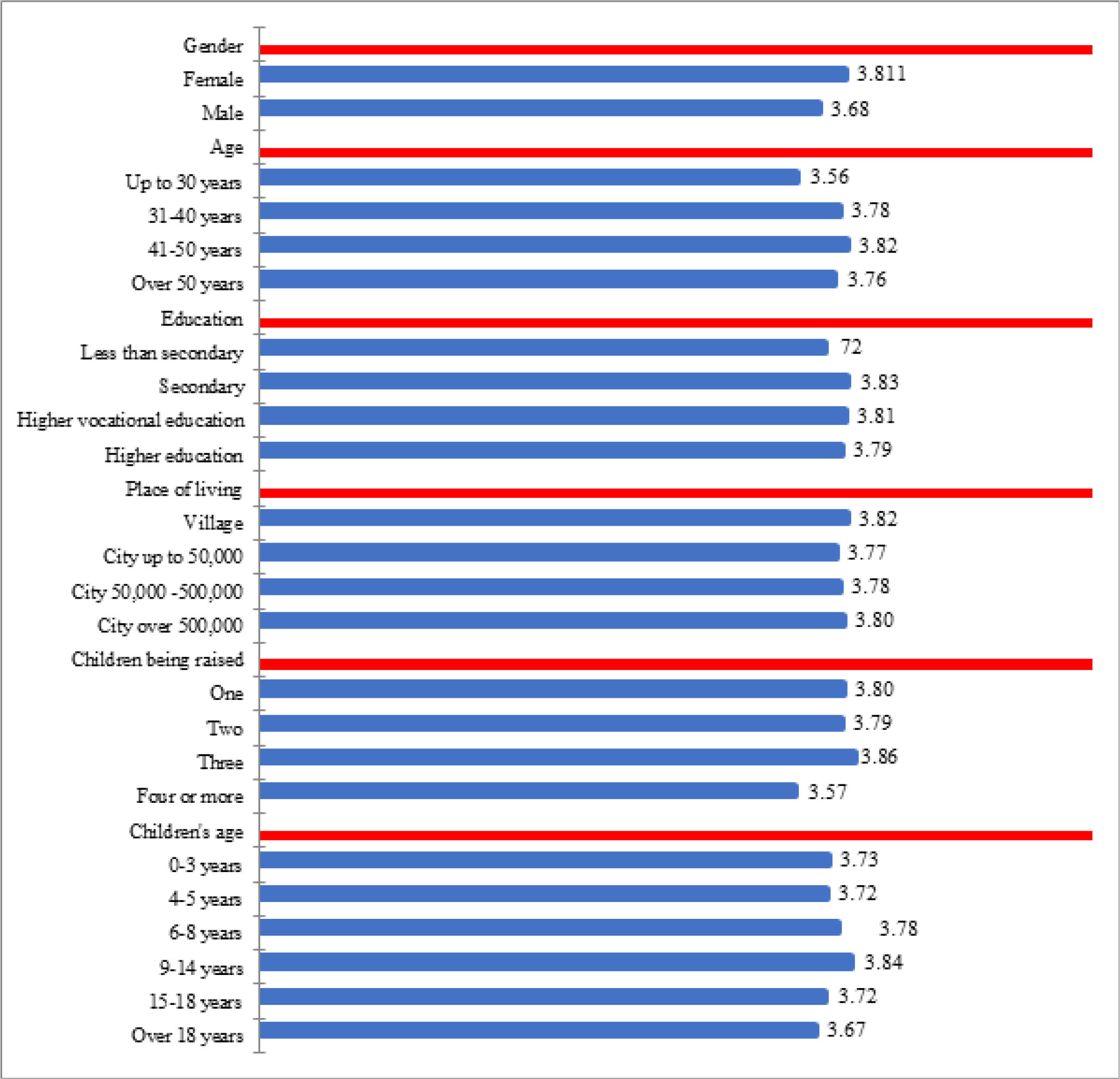
Figure 8.
Change in childcare involvement during the pandemic compared to pre-pandemic (average score).
Note: on the scale from 1 to 5, “1” means that the time spent on work is much shorter, and “5” means that the time spent on work is much longer compared to the time before the pandemic.
Source: own study based on research results.
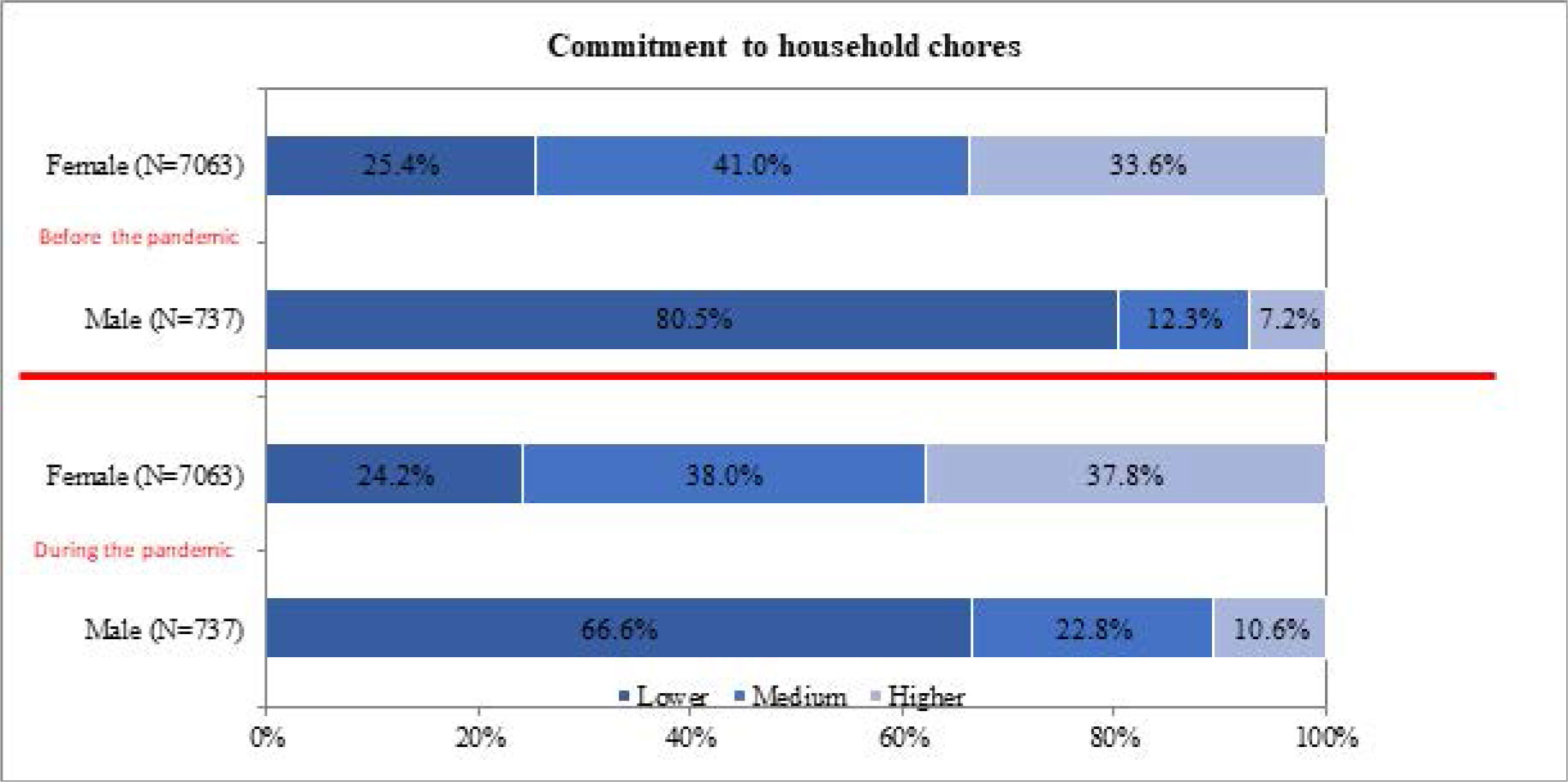
Figure 9.
Commitment to household chores before and since the onset of the pandemic (by gender)
Note: 3 levels of commitment level, i.e., smaller (I dealt with a smaller part of these duties), medium (I dealt with the greater part of these duties), high (only I performed these duties); comparison of pre-pandemic time to pandemic time.
Source: own study based on research results.
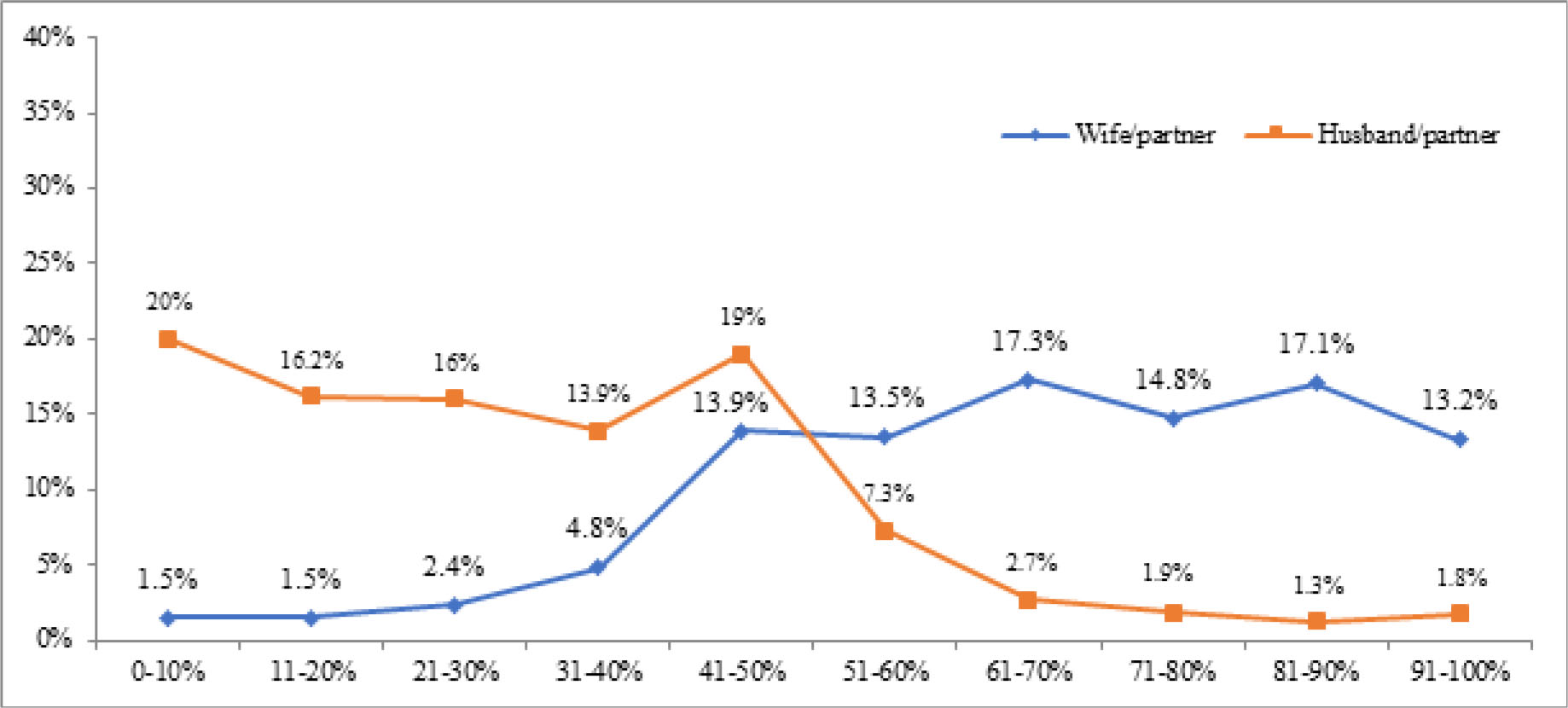
Figure 10.
Assessment of family time spent on caring for children (by gender; cumulative values; N=6688)
Source: own study based on research results.
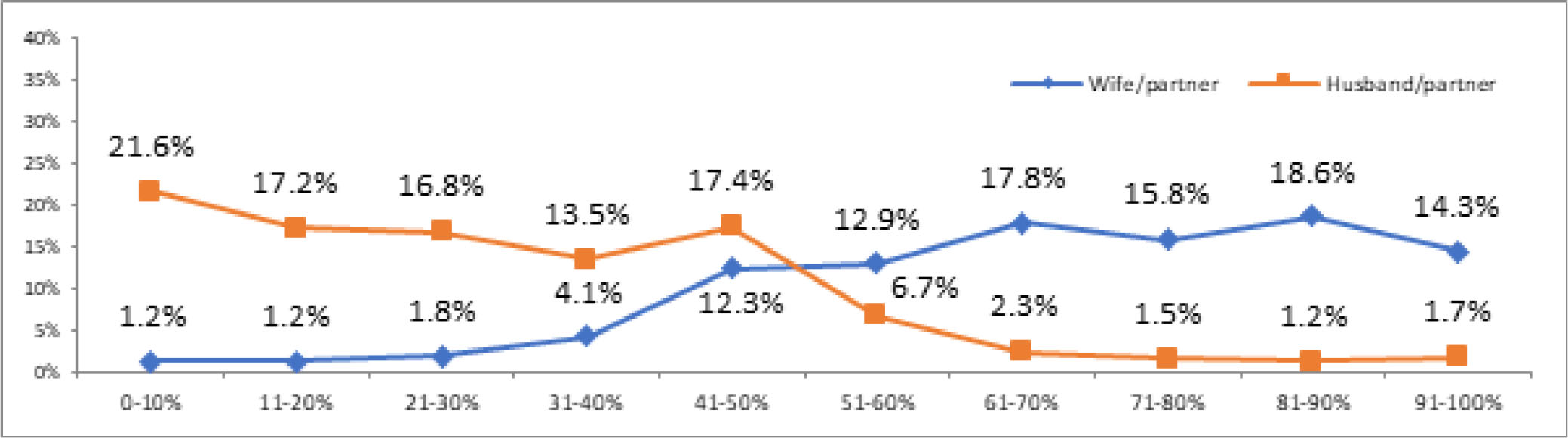
Figure 11.
Assessment of the contribution of time devoted to caring for children in the family in the opinion of women (by gender; cumulative values; N=6045)
Source: own study based on research results.
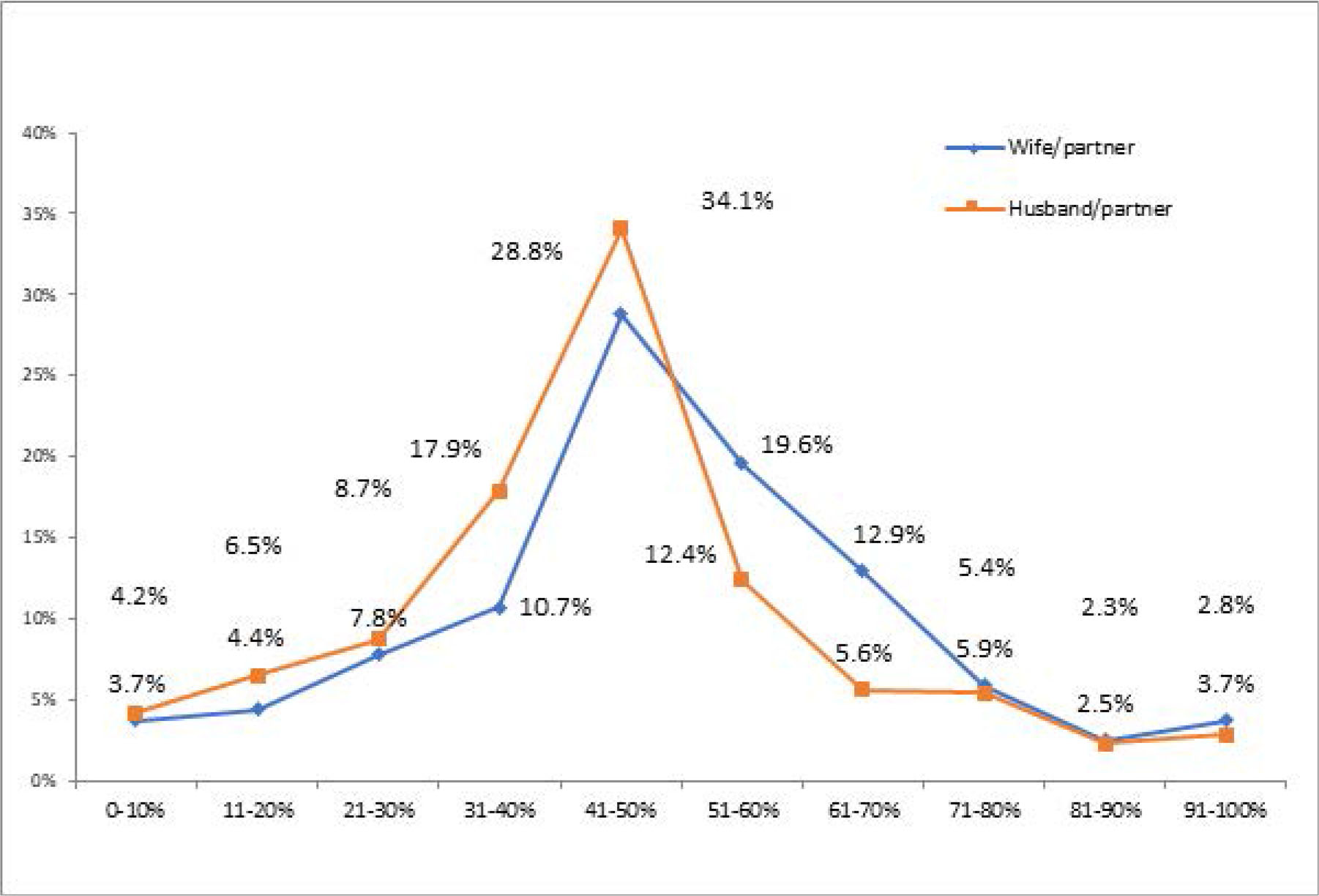
Figure 12.
Assessment of the contribution of time devoted to caring for children in the family in the opinion of men (by gender; cumulative values; N=643)
Source: own study based on research results.
Table 10.
Assessment of childcare conditions in relation to the work performed (assessment according to indications on the list of prepared sentences; gender and age)
| Gender | Age | ||||||
|---|---|---|---|---|---|---|---|
| Total | Female | Male | Up to 30 | 31-40 years | 41-50 years | Over 50 years | |
| I adapt childcare to working conditions | 27.0% | 27.0% | 26.7% | 29.5% | 26.5% | 27.5% | 26.0% |
| I adapt my work to taking care of children | 37.3% | 36.8% | 41.7% | 38.1% | 40.6% | 34.6% | 26.8% |
| Working time - adjusting to the current conditions of functioning of schools and other care and educational institutions | 40.4% | 40.3% | 41.9% | 40.3% | 44.8% | 36.9% | 27.6% |
| I adjust the working time to the working time of other people who look after children | 17.1% | 16.4% | 24.0% | 27.8% | 19.3% | 14.7% | 15.4% |
| Neither sentence fits my situation | 21.6% | 21.6% | 22.0% | 17.6% | 18.3% | 24.5% | 30.1% |
| Overall | 7800 | 7063 | 737 | 176 | 3645 | 3733 | 246 |
Table 11.
Assessment of childcare conditions in relation to the work performed (assessment according to indications on the list of prepared sentences; education and place of residence)
| Education | Place of living | |||||||
|---|---|---|---|---|---|---|---|---|
| Less than secondary | Secondary | Higher vocational education | Higher education | Village | City up to 50.000 | City 50.000-500.000 | City over 500.000 | |
| I adapt childcare to working conditions | 20.9% | 22.1% | 27.0% | 28.4% | 26.5% | 26.8% | 26.5% | 27.8% |
| I adapt my work to taking care of children | 33.1% | 34.4% | 36.2% | 38.2% | 34.3% | 32.8% | 34.0% | 43.9% |
| Working time - adjusting to the current conditions of functioning of schools and other care and educational institutions | 28.8% | 31.7% | 39.6% | 43.0% | 36.5% | 37.3% | 37.5% | 46.9% |
| I adjust the working time to the working time of other people who look after children | 21.2% | 18.8% | 17.6% | 16.5% | 18.4% | 18.7% | 15.9% | 16.2% |
| Neither sentence fits my situation | 34.2% | 30.2% | 22.4% | 19.0% | 24.4% | 23.4% | 24.3% | 16.9% |
| Overall | 278 | 1200 | 740 | 5582 | 1986 | 1425 | 1713 | 2676 |
Table 12.
Assessment of combining work with parental responsibilities (by gender and age)
| Gender | Age | ||||||
|---|---|---|---|---|---|---|---|
| Total | Female | Male | Up to 30 years | 31-40 years | 41-50 years | Over 50 years | |
| 1 | 3.4% | 3.1% | 6.8% | 9.1% | 2.0% | 4.4% | 6.9% |
| 2 | 5.7% | 5.2% | 10.4% | 5.7% | 4.5% | 6.8% | 8.5% |
| 3 | 18.3% | 17.8% | 23.2% | 16.5% | 16.2% | 20.2% | 22.4% |
| 4 | 31.2% | 31.4% | 29.3% | 19.9% | 31.4% | 31.8% | 28.0% |
| 5 | 41.3% | 42.5% | 30.3% | 48.9% | 45.9% | 36.9% | 34.1% |
| Overall | 7800 | 7063 | 737 | 176 | 3645 | 3733 | 246 |
| Pearson’s chi-square tests | |||||||
| Gender | Age | ||||||
| Chi-square | 93.684 | 144.594 | |||||
| df (degrees of freedom) | 4 | 12 | |||||
| Relevance | .000* | .000* | |||||
Table 13.
Assessment of combining work with parental obligations (according to education and place of residence)
| Education | Place of living | |||||||
|---|---|---|---|---|---|---|---|---|
| Less than secondary | Secondary | Higher vocational education | Higher education | Village | City up to 50.000 | City 50.000-500.000 | City over 500.000 | |
| 1 | 9.7% | 4.2% | 3.1% | 3.0% | 3.4% | 3.5% | 4.0% | 3.1% |
| 2 | 8.3% | 4.7% | 6.1% | 5.8% | 5.4% | 5.9% | 5.7% | 5.9% |
| 3 | 20.5% | 20.2% | 19.7% | 17.6% | 19.4% | 21.4% | 18.7% | 15.7% |
| 4 | 24.1% | 26.4% | 27.7% | 33.1% | 29.8% | 28.2% | 32.1% | 33.3% |
| 5 | 37.4% | 44.5% | 43.4% | 40.5% | 42.0% | 41.0% | 39.5% | 42.1% |
| Overall | 278 | 1200 | 740 | 5582 | 1986 | 1425 | 1713 | 2676 |
| Pearson’s chi-square tests | ||||||||
| Education | Place of living | |||||||
| Chi-square | 75.603 | 33.205 | ||||||
| df (degrees of freedom) | 12 | 12 | ||||||
| Relevance | .000* | .001* | ||||||
Table 14.
Assessment of combining work with parental responsibilities (according to the number of children in upbringing)
| Children upbringing | |||||
|---|---|---|---|---|---|
| Overall | One | Two | Three | Four or more | |
| 1 | 3.4% | 4.5% | 3.0% | 2.2% | 6.8% |
| 2 | 5.7% | 6.5% | 5.3% | 5.7% | 5.9% |
| 3 | 18.3% | 19.3% | 18.0% | 18.1% | 14.8% |
| 4 | 31.2% | 30.7% | 32.3% | 28.6% | 27.8% |
| 5 | 41.3% | 38.9% | 41.4% | 45.5% | 44.7% |
| Overall | 7800 | 2339 | 4201 | 1023 | 237 |
| Pearson’s chi-square tests | |||||
| Children upbringing | |||||
| Chi-square | 43.704 | ||||
| df (degrees of freedom) | 12 | ||||
| Relevance | .000* | ||||
Table 15.
Comparison of the degree of satisfaction with working life versus commitment to household chores before the pandemic (assessment of job life satisfaction on a scale*, commitment score on a scale**)
| Satisfaction with working life | Commitment to household chores before the pandemic | |||
|---|---|---|---|---|
| Total | Smaller | Medium | Big | |
| 1 | 10.2% | 9.3% | 9.1% | 12.3% |
| 2 | 19.2% | 17.9% | 19.2% | 20.5% |
| 3 | 33.6% | 31.7% | 35.3% | 33.4% |
| 4 | 26.0% | 27.6% | 26.1% | 24.2% |
| 5 | 11.1% | 13.5% | 10.3% | 9.5% |
| Overall | 7800 | 2388 | 2987 | 2425 |
| Pearson’s chi-square tests | ||||
| Commitment to household chores before the pandemic | ||||
| Chi-square | 49.610 | |||
| df (degrees of freedom) | 8 | |||
| Relevance | .000* | |||
Table 16.
Comparison of the degree of satisfaction with work life versus commitment to household chores since the beginning of the pandemic (work life satisfaction rating on a scale*, commitment rating on a scale**)
| Satisfaction with working life | Commitment to household chores since the start of the pandemic | |||
|---|---|---|---|---|
| Total | Smaller | Medium | Big | |
| 1 | 10.2% | 8.2% | 8.4% | 13.5% |
| 2 | 19.2% | 16.6% | 18.7% | 21.8% |
| 3 | 33.6% | 31.4% | 35.3% | 33.5% |
| 4 | 26.0% | 29.7% | 26.5% | 22.5% |
| 5 | 11.1% | 14.1% | 11.1% | 8.6% |
| Overall | 7800 | 2198 | 2851 | 2751 |
| Pearson’s chi-square tests | ||||
| Commitment to household chores since the start of the pandemic | ||||
| Chi-square | 127.932 | |||
| df (degrees of freedom) | 8 | |||
| Relevance | .000* | |||
Table 17.
Assessment of the adaptation of work to childcare (gender and age)
| Gender | Age | ||||||
|---|---|---|---|---|---|---|---|
| Total | Female | Male | Up to 30 years | 31-40 years | 41-50 years | Over 50 years | |
| Definitely yes | 31.4% | 31.5% | 30.3% | 30.7% | 35.3% | 28.0% | 25.6% |
| Rather yes | 39.4% | 39.4% | 38.9% | 34.7% | 39.3% | 39.6% | 39.0% |
| Rather no | 17.3% | 17.2% | 19.1% | 13.6% | 14.7% | 19.9% | 20.7% |
| Definitely not | 7.2% | 7.2% | 7.6% | 10.8% | 6.1% | 8.0% | 11.0% |
| Hard to say | 4.7% | 4.8% | 4.1% | 10.2% | 4.7% | 4.5% | 3.7% |
| Overall | 7800 | 7063 | 737 | 176 | 3645 | 3733 | 246 |
| Pearson’s chi-square tests | |||||||
| Gender | Age | ||||||
| Chi-square | 2.676 | 97.722 | |||||
| df (degrees of freedom) | 4 | 12 | |||||
| Relevance | .613 | .000* | |||||
Table 18.
Assessment of work adaptation to childcare (education and place of living)
| Education | Place of living | |||||||
|---|---|---|---|---|---|---|---|---|
| Less than secondary | Secondary | Higher vocational education | Higher education | Village | City up to 50.000 | City 50.000-500.000 | City over 500.000 | |
| Definitely yes | 27.3% | 32.2% | 31.9% | 31.3% | 30.3% | 28.1% | 29.1% | 35.4% |
| Rather yes | 33.5% | 31.7% | 38.5% | 41.4% | 37.3% | 38.2% | 37.5% | 42.7% |
| Rather no | 17.6% | 18.0% | 17.6% | 17.2% | 19.2% | 21.0% | 19.0% | 13.0% |
| Definitely not | 11.2% | 10.8% | 9.3% | 6.0% | 7.9% | 7.8% | 9.1% | 5.3% |
| Hard to say | 10.4% | 7.3% | 2.7% | 4.1% | 5.4% | 4.9% | 5.3% | 3.7% |
| Overall | 278 | 1200 | 740 | 5582 | 1986 | 1425 | 1713 | 2676 |
| Pearson’s chi-square tests | ||||||||
| Education | Place of living | |||||||
| Chi-square | 119.250 | 113.991 | ||||||
| df (degrees of freedom) | 12 | 12 | ||||||
| Relevance | .000* | .000* | ||||||
Table 19.
Assessment of the adaptation of work to childcare (number of children in upbringing)
| Children upbringing | |||||
|---|---|---|---|---|---|
| Overall | One | Two | Three | Four or more | |
| Definitely yes | 31.4% | 30.3% | 30.8% | 36.3% | 30.4% |
| Rather yes | 39.4% | 39.0% | 40.2% | 38.5% | 31.6% |
| Rather no | 17.3% | 17.0% | 18.3% | 14.2% | 16.9% |
| Definitely not | 7.2% | 8.2% | 6.7% | 6.1% | 12.2% |
| Hard to say | 4.7% | 5.5% | 4.0% | 5.0% | 8.9% |
| Overall | 7800 | 2339 | 4201 | 1023 | 237 |
| Pearson’s chi-square tests | |||||
| Children upbringing | |||||
| Chi-square | 54.019 | ||||
| df (degrees of freedom) | 12 | ||||
| Relevance | .000* | ||||
Table 20.
Assessment of combining work with childcare (age, gender)
| Gender | Age | ||||||
|---|---|---|---|---|---|---|---|
| Total | Female | Male | Up to 30 years | 31-40 years | 41-50 years | Over 50 years | |
| Yes, ALL the time I work while caring for a child / children | 24.1% | 24.8% | 17.4% | 18.8% | 25.8% | 22.7% | 24.8% |
| Yes, I combine MOST of my working time with childcare | 28.3% | 28.3% | 28.1% | 21.6% | 29.0% | 28.3% | 21.5% |
| Yes, but I combine a SMALL amount of working time with childcare | 22.4% | 21.9% | 27.8% | 22.7% | 21.1% | 23.8% | 21.1% |
| I DO NOT COMBINE working with looking after a child / children | 21.4% | 21.1% | 23.7% | 30.7% | 19.7% | 21.9% | 30.5% |
| Hard to say | 3.8% | 3.9% | 3.0% | 6.2% | 4.4% | 3.2% | 2.0% |
| Overall | 7800 | 7063 | 737 | 176 | 3645 | 3733 | 246 |
| Pearson’s chi-square tests | |||||||
| Gender | Age | ||||||
| Chi-square | 29.369 | 56.297 | |||||
| df (degrees of freedom) | 4 | 12 | |||||
| Relevance | .000* | .000* | |||||
Table 21.
Assessment of combining work with childcare (education, place of living)
| Education | Place of living | |||||||
|---|---|---|---|---|---|---|---|---|
| Less than secondary | Secondary | Higher vocational education | Higher education | Village | City up to 50.000 | City 50.000-500.000 | City over 500.000 | |
| Yes, ALL the time I work with caring for a child / children | 21.9% | 22.7% | 22.7% | 24.7% | 22.4% | 21.5% | 23.6% | 27.1% |
| Yes, I combine MOST of my working time with childcare | 18.0% | 17.4% | 26.2% | 31.4% | 25.5% | 24.5% | 25.9% | 34.0% |
| Yes, but I combine a SMALL amount of working time with childcare | 14.0% | 19.8% | 22.6% | 23.4% | 22.3% | 22.5% | 22.5% | 22.5% |
| I DO NOT COMBINE working with looking after a child / children | 33.5% | 33.0% | 26.2% | 17.6% | 25.3% | 26.7% | 23.8% | 14.1% |
| Hard to say | 12.6% | 7.2% | 2.3% | 2.8% | 4.6% | 4.8% | 4.3% | 2.4% |
| Overall | 278 | 1200 | 740 | 5582 | 1986 | 1425 | 1713 | 2676 |
| Pearson’s chi-square tests | ||||||||
| Education | Place of living | |||||||
| Chi-square | 348.449 | 188.593 | ||||||
| df (degrees of freedom) | 12 | 12 | ||||||
| Relevance | .000* | .000* | ||||||
Table 22.
Assessment of combining work with childcare (number of children in upbringing)
| Children upbringing | |||||
|---|---|---|---|---|---|
| Overall | One | Two | Three | Four or more | |
| Yes, ALL the time I work with caring for a child / children | 24.1% | 24.5% | 23.4% | 25.6% | 27.0% |
| Yes, I combine MOST of my working time with childcare | 28.3% | 26.9% | 29.5% | 27.5% | 24.1% |
| Yes, but I combine a SMALL amount of working time with childcare | 22.4% | 21.3% | 23.4% | 22.7% | 15.6% |
| I DO NOT COMBINE working with looking after a child / children | 21.4% | 23.9% | 20.0% | 20.3% | 24.9% |
| Hard to say | 3.8% | 3.4% | 3.7% | 3.9% | 8.4% |
| Overall | 7800 | 2339 | 4201 | 1023 | 237 |
| Pearson’s chi-square tests | |||||
| Children upbringing | |||||
| Chi-square | 43.749 | ||||
| df (degrees of freedom) | 12 | ||||
| Relevance | .000* | ||||
Table 23.
Assessment of the adaptation of work to childcare in relation to commitment to work
| Commitment to work: | Adapting work to childcare | |||||
|---|---|---|---|---|---|---|
| Overall | Definitely yes | Probably yes | Probably not | Definitely not | Hard to say | |
| It has definitely increased | 12.1% | 12.0% | 12.2% | 11.0% | 15.4% | 11.5% |
| It has increased | 13.4% | 11.7% | 15.3% | 14.0% | 10.8% | 10.9% |
| It is the same | 42.4% | 33.7% | 43.5% | 52.3% | 50.4% | 42.1% |
| It has decreased | 15.3% | 17.9% | 16.5% | 11.6% | 8.0% | 12.0% |
| It has definitely decreased | 11.0% | 19.2% | 7.3% | 5.2% | 9.6% | 10.4% |
| Hard to say | 5.8% | 5.5% | 5.2% | 5.9% | 5.9% | 13.1% |
| Total | 7800 | 2447 | 3070 | 1353 | 564 | 366 |
| Pearson’s chi-square tests | ||||||
| Adapting work to childcare | ||||||
| Chi-square | 424.569 | |||||
| df (degrees of freedom) | 20 | |||||
| Relevance | .000* | |||||
Table 24.
Assessment of the adaptation of work to childcare in comparison with the simultaneous performance of caring and professional duties
| Adaptation of work to care | Combining work with simultaneous (at the same time) performance of duties related to caring for the child / children | |||||
|---|---|---|---|---|---|---|
| Overall | Yes, ALL the time I work with caring for a child / children | Yes, I combine MOST of my working time with child / child care | Yes, but I combine SMALL working time with child / child care | I DO NOT COMBINE working with looking after a child / children | Hard to say | |
| Definitely yes | 31.4% | 53.4% | 33.8% | 18.4% | 18.4% | 23.2% |
| Rather yes | 39.4% | 31.7% | 50.3% | 48.4% | 25.2% | 33.0% |
| Rather no | 17.3% | 7.8% | 10.7% | 24.3% | 29.8% | 16.2% |
| Definitely not | 7.2% | 4.0% | 1.8% | 4.5% | 21.2% | 5.4% |
| Hard to say | 4.7% | 3.1% | 3.3% | 4.4% | 5.5% | 22.2% |
| Total | 7800 | 1879 | 2207 | 1750 | 1667 | 297 |
| Pearson’s chi-square tests | ||||||
| Combining work with simultaneous (at the same time) performance of duties related to caring for the child / children | ||||||
| Chi-square | 1860.465 | |||||
| df (degrees of freedom) | 16 | |||||
| Relevance | .000* | |||||
Table 25.
Assessment of the importance of the possibility of reconciling work and private life when choosing a workplace (gender and age)
| Gender | Age | ||||||
|---|---|---|---|---|---|---|---|
| Total | Female | Male | Up to 30 years | 31-40 years | 41-50 years | Over 50 years | |
| Decisive or very important | 65.6% | 66.6% | 55.4% | 64.2% | 69.0% | 63.1% | 52.0% |
| Important | 25.6% | 25.2% | 30.1% | 15.3% | 23.9% | 27.4% | 31.3% |
| Insignificant / hard to judge | 8.8% | 8.2% | 14.5% | 20.5% | 7.1% | 9.5% | 16.7% |
| Overall | 7800 | 7063 | 737 | 176 | 3645 | 3733 | 246 |
| Pearson’s chi-square tests | |||||||
| Gender | Age | ||||||
| Chi-square | 49.267 | 94.798 | |||||
| df (degrees of freedom) | 2 | 6 | |||||
| Relevance | .000* | .000* | |||||
1 Note: For the purposes of this analysis, the categories of responses have been combined as follows: 1 = Decisive / Dominant and Very important but not conclusive, 2 = Important, 3 = Insignificant + Irrelevant + Difficult to judge + I do not pay attention to it.
Source: own study based on research results.
Table 26.
Assessment of the importance of the possibility of reconciling work and private life when choosing a place of work (education and place of living)
| Education | Place of living | |||||||
|---|---|---|---|---|---|---|---|---|
| Less than secondary | Secondary | Higher vocational education | Higher education | Village | City up to 50.000 | City 50.000-500.000 | City over 500.000 | |
| Decisive or very important | 38.1% | 55.9% | 63.4% | 69.3% | 63.6% | 64.1% | 59.7% | 71.5% |
| Important | 36.7% | 31.1% | 26.2% | 23.8% | 26.5% | 26.0% | 30.1% | 21.9% |
| Insignificant / hard to judge | 25.2% | 13.0% | 10.4% | 6.9% | 9.9% | 9.8% | 10.2% | 6.6% |
| Overall | 278 | 1200 | 740 | 5582 | 1986 | 1425 | 1713 | 2676 |
| Pearson’s chi-square tests | ||||||||
| Education | Place of living | |||||||
| Chi-square | 229.242 | 76.138 | ||||||
| df (degrees of freedom) | 6 | 6 | ||||||
| Relevance | .000* | .000* | ||||||
Table 27.
Assessment of the importance of the possibility of reconciling work and private life when choosing a workplace (number of children during upbringing)
| Children upbringing | |||||
|---|---|---|---|---|---|
| Overall | One | Two | Three | Four or more | |
| Decisive or very important | 65.6% | 64.0% | 65.8% | 70.1% | 56.5% |
| Important | 25.6% | 26.5% | 25.9% | 23.3% | 22.4% |
| Insignificant / hard to judge | 8.8% | 9.5% | 8.3% | 6.6% | 21.1% |
| Overall | 7800 | 2339 | 4201 | 1023 | 237 |
| Pearson’s chi-square tests | |||||
| Children upbringing | |||||
| Chi-square | 59967 | ||||
| df (degrees of freedom) | 6 | ||||
| Relevance | .000* | ||||
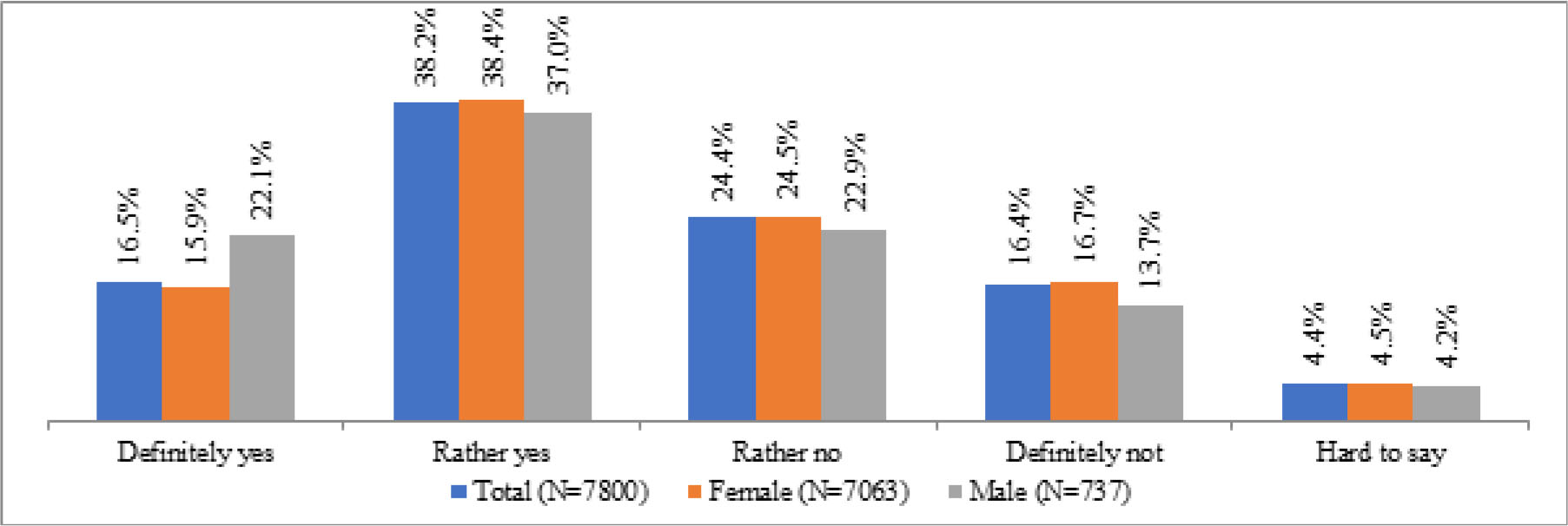
Figure 13.
Assessment of the possibility of separating work and private time (by gender)
Source: own study based on research results.
Table 28.
Assessment of the possibility of separating work and private time (by gender and age)
| Gender | Age | ||||||
|---|---|---|---|---|---|---|---|
| Total | Female | Male | Up to 30 years | 31-40 years | 41-50 years | Over 50 years | |
| Definitely yes | 16.5% | 15.9% | 22.1% | 19.9% | 16.1% | 16.5% | 19.9% |
| Rather yes | 38.2% | 38.4% | 37.0% | 33.0% | 38.6% | 38.4% | 34.6% |
| Rather no | 24.4% | 24.5% | 22.9% | 21.6% | 23.9% | 24.9% | 24.4% |
| Definitely not | 16.4% | 16.7% | 13.7% | 15.9% | 16.7% | 16.3% | 15.9% |
| Hard to say | 4.4% | 4.5% | 4.2% | 9.7% | 4.7% | 3.9% | 5.3% |
| Overall | 7800 | 7063 | 737 | 176 | 3645 | 3733 | 246 |
| Pearson’s chi-square tests | |||||||
| Gender | Age | ||||||
| Chi-square | 20.181 | 21.619 | |||||
| df (degrees of freedom) | 4 | 12 | |||||
| Relevance | .000* | .042* | |||||
Table 29.
Assessment of the possibility of separating work and private time (according to education, place of living)
| Education | Place of living | |||||||
|---|---|---|---|---|---|---|---|---|
| Less than secondary | Secondary | Higher vocational education | Higher education | Village | City up to 50.000 | City 50.000-500.000 | City over 500.000 | |
| Definitely yes | 25.9% | 24.5% | 18.4% | 14.1% | 18.4% | 17.8% | 17.1% | 14.1% |
| Rather yes | 40.6% | 37.8% | 38.0% | 38.2% | 40.2% | 39.8% | 39.2% | 35.3% |
| Rather no | 14.4% | 19.3% | 23.8% | 26.0% | 23.2% | 22.9% | 22.9% | 26.9% |
| Definitely not | 10.4% | 12.8% | 14.3% | 17.8% | 14.2% | 14.2% | 15.4% | 19.9% |
| Hard to say | 8.6% | 5.6% | 5.5% | 3.9% | 4.0% | 5.2% | 5.3% | 3.8% |
| Overall | 278 | 1200 | 740 | 5582 | 1986 | 1425 | 1713 | 2676 |
| Pearson’s chi-square tests | ||||||||
| Education | Place of living | |||||||
| Chi-square | 157.719 | 73.545 | ||||||
| df (degrees of freedom) | 12 | 12 | ||||||
| Relevance | .000* | .000* | ||||||
Table 30.
Assessment of the possibility of separating work and private time (according to the number of children in upbringing)
| Children upbringing | |||||
|---|---|---|---|---|---|
| Overall | One | Two | Three | Four or more | |
| Definitely yes | 16.5% | 18.6% | 15.8% | 15.0% | 16.9% |
| Rather yes | 38.2% | 37.7% | 38.8% | 38.2% | 32.5% |
| Rather no | 24.4% | 22.9% | 25.1% | 24.7% | 24.5% |
| Definitely not | 16.4% | 16.2% | 16.2% | 17.0% | 21.1% |
| Hard to say | 4.4% | 4.7% | 4.1% | 5.1% | 5.1% |
| Overall | 7800 | 2339 | 4201 | 1023 | 237 |
| Pearson’s chi-square tests | |||||
| Children upbringing | |||||
| Chi-square | 20.700 | ||||
| df (degrees of freedom) | 12 | ||||
| Relevance | .055 | ||||
Table 31.
Assessment of the degree of satisfaction with professional life in relation to the need to adapt work to childcare
| Satisfaction with working life | The need to adapt work to childcare | |||||
|---|---|---|---|---|---|---|
| Total | Definitely yes | Rather yes | Rather no | Definitely not | Hard to say | |
| 1 | 10.2% | 15.5% | 5.9% | 6.2% | 15.2% | 16.7% |
| 2 | 19.2% | 21.9% | 19.5% | 17.4% | 14.0% | 13.7% |
| 3 | 33.6% | 30.1% | 35.5% | 35.2% | 32.4% | 36.3% |
| 4 | 26.0% | 21.0% | 29.0% | 29.3% | 24.6% | 24.3% |
| 5 | 11.1% | 11.5% | 10.0% | 12.0% | 13.7% | 9.0% |
| Overall | 7800 | 2447 | 3070 | 1353 | 564 | 366 |
| Pearson’s chi-square tests | ||||||
| The need to adapt work to childcare | ||||||
| Chi-square | 262.083 | |||||
| df (degrees of freedom) | 16 | |||||
| Relevance | .000* | |||||
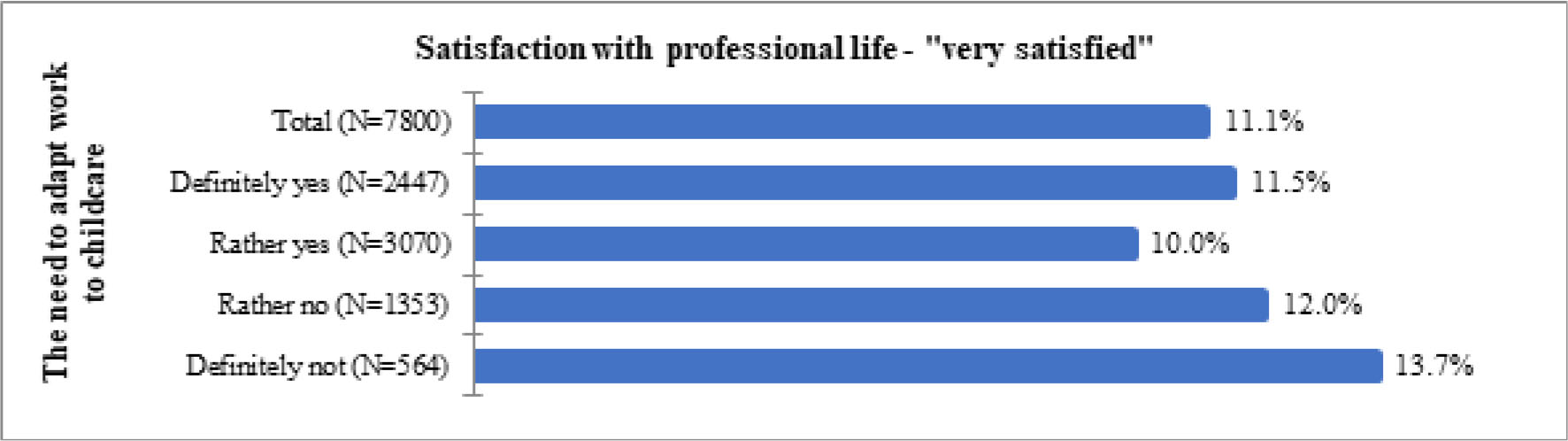
Figure 14.
Those reporting “very satisfied” with professional life’s level of need to adapt their work to taking care of children
Source: own study based on research results.
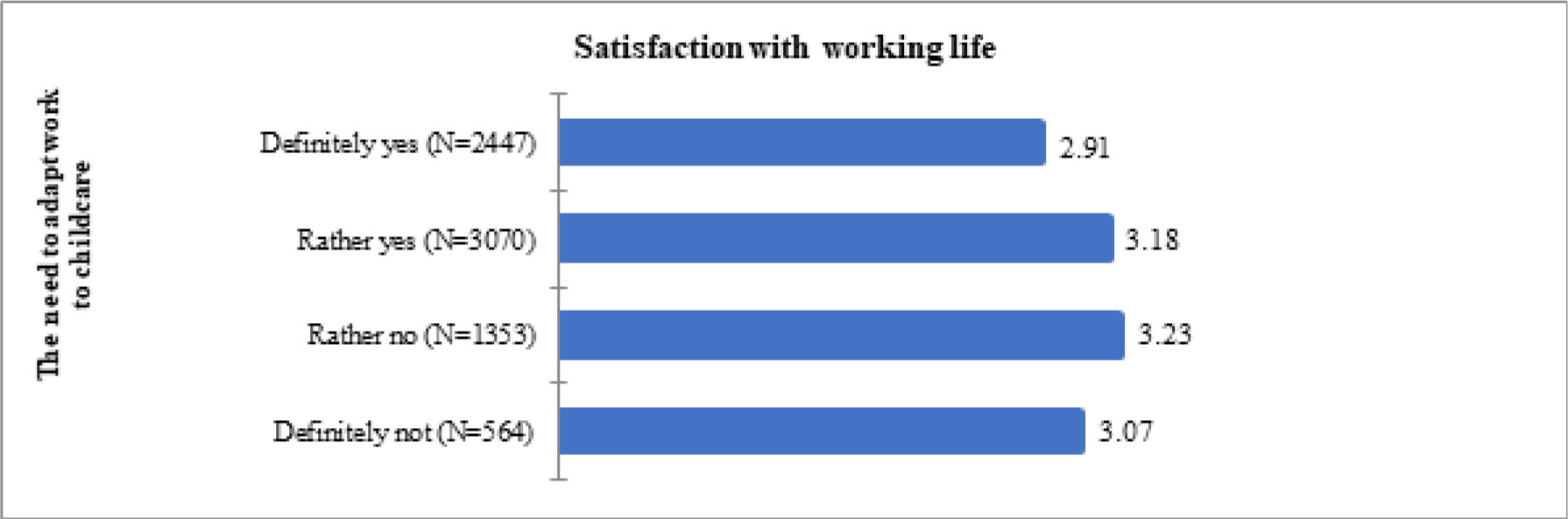
Figure 15.
Assessment of the degree of satisfaction with professional life in relation to responses to the need to adapt work to childcare (average on the scale)
Note: the scale of satisfaction with professional life goes from 1 to 5, where 1 means very dissatisfied and 5 very satisfied.
Source: own study based on research results.
Table 32.
Assessment of the importance in choosing a workplace, the possibility of reconciling work and private life in comparison with adapting work to childcare
| Possibility to combine work with childcare | Adapting work to childcare | |||||
|---|---|---|---|---|---|---|
| Total | Definitely yes | Rather yes | Rather no | Definitely not | Hard to say | |
| The decider / dominant | 32.9% | 49.3% | 28.2% | 20.2% | 22.2% | 26.0% |
| Very important, but not conclusive | 32.7% | 27.6% | 37.3% | 34.7% | 27.3% | 28.4% |
| Important | 25.6% | 18.3% | 27.5% | 32.2% | 29.3% | 29.2% |
| Not so important | 2.1% | 1.5% | 1.7% | 3.4% | 5.0% | 1.4% |
| Irrelevant | 1.0% | 0.4% | 0.7% | 1.5% | 3.7% | 0.8% |
| It’s hard to judge | 4.1% | 2.2% | 3.7% | 5.5% | 6.9% | 10.7% |
| I do not care about this | 1.6% | 0.8% | 0.8% | 2.5% | 5.7% | 3.6% |
| Overall | 7800 | 2447 | 3070 | 1353 | 564 | 366 |
| Pearson’s chi-square tests | ||||||
| Adapting work to child-care | ||||||
| Chi-square | 717.559 | |||||
| df (degrees of freedom) | 24 | |||||
| Relevance | .000* | |||||