
I. Introduction
An endless thirst for faster, more dependable broadband communication channels has been created by the unrelenting advancement of communication technologies. Information theory, a foundational field in communication engineering that aims to decipher the complexities of data transfer within the limited bandwidth available, is at the center of this endeavor [1]. The optimization of broadband communication channel capacity becomes critical as we approach beyond the fifth generation (5G) to meet the growing data demands of an interconnected world [2]. This research endeavors to conduct a thorough investigation of the pivotal elements that mold the utilization of information theory within the framework of broadband communication. Each aspect—from modulation techniques, error correction, and adaptive systems to bandwidth restrictions and channel noise—is carefully examined for how it contributes to reaching the maximum data speeds while guaranteeing dependable and secure transmissions [3]. In addition, the study explores current issues with a view to the future of broadband communication, including the incorporation of machine learning methods, dynamic spectrum availability, and the impact of various network topologies [4]. Knowing the intricacies of information theory is crucial as we move through a time when connectivity is not only a luxury but a need. The purpose of this study is to offer relevant information to network designers, engineers, and policymakers who are responsible for developing communication systems that are dependable, effective, and adaptable enough to evolve in response to user demands and the rapidly evolving field of technology. The next chapters provide a road map for negotiating the tricky nexus between theory and practice in the pursuit of optimal communication channel capacity by revealing the layers of information theory's influence on broadband communication[5]. Thanks to the Internet of Things (IoT), the development of multimedia material, and people's insatiable need for real-time connectivity, data consumption has seen an unparalleled spike in the 21st century. Broadband communication networks, which act as conduits for a wide range of information, have emerged as the lifeline of contemporary civilization in response to this ravenous need. Information theory is the science that not only holds the keys to the mysteries of data transmission but also plays a crucial role in the search for high-capacity and efficient communication channels[6].
In light of this, the planned study objective to address the following research inquiries:
A. What are the key factors influencing the optimization of broadband communication channel capacity, and how do they interrelate within the framework of information theory?
B. How can the model and analysis of the intricate and dynamic interactions between these aspects be done using the Fuzzy Decision-Making Trial and Evaluation Laboratory (DEMATEL) technique?
C. Considering uncertainties and imprecisions inherent in the broadband communication domain?
To summaries, the following are the main research contributions from this study's modeling and literature sections:
1) In this study a comprehensive literature review was conducted on the application of information theory in Broadband Communication channel capacity Moreover, the authors detailed a study of the previous research on Broadband Communication channel capacity and identified the research gap. This research gap is from both the modeling and literature side.
2) To clarify and quantify the interdependencies among crucial aspects influencing the application of information theory in maximizing broadband communication channel capacity, this research will use using the DEMATEL (Fuzzy Decision-Making Trial and Evaluation Laboratory) method.
3) This research aims to clarify the complex links and causalities among the identified components by a thorough analysis utilizing fuzzy set theory, offering a nuanced knowledge of their impact on the overall performance of broadband communication networks.
The paper is structured into several key sections. It begins with an Abstract summarizing the study's purpose and findings, followed by an (1) Introduction that outlines the significance and objectives of the research. Next, the (2) Literature Review examines existing studies and identifies research gaps. The (3) Research Methodology details the use of the Fuzzy DEMATEL approach to analyze and rank enablers, with the (4) Results and Discussion section presenting the findings. The paper concludes with (5) Study Implications, followed by a (6) Conclusion summarizing the key insights.
II. Literature review
The appetite for fast data speeds, low latency, and dependable connectivity has caused the broadband communication landscape to expand at an unprecedented rate[7]. Information theory, a discipline that offers a theoretical framework for comprehending and enhancing the efficiency of data transmission, is fundamental to optimizing broadband communication networks[8]. This literature review's objective is to examine the corpus of knowledge. that currently exists on the use of information theory to optimize the capacity of broadband communication channels by looking at important aspects, difficulties, and developments[9].
A. Proposed Factors
This study proposed success factors affecting on application of information theory in Broadband Communication channel capacity. The detail of these factors is given below.
Bandwidth enhancement (C1) The bandwidth of broadband communication channels is limited. When maximizing data transmission rates within this constrained bandwidth, information theory helps take interference and channel noise into account[10]. Channel Access Protocols (C2) Multiple users may require simultaneous channel access in broadband communication networks. Frequency Division Multiple Access (FDMA) and Time Division Multiple Access (TDMA) are two examples of, two successful multiple access protocols that guarantee fair and effective utilization of the available bandwidth, are designed using information theory[11].Data Rate and Transmission Efficiency (C3) Enhancing transmission efficiency and obtaining greater data rates can be accomplished with the help of information theory. The efficiency with The capacity of a communication channel is determined by what data can be encoded and sent. To increase data speeds, sophisticated coding systems and modulation techniques are applied [1]. Modulation Schemes (C4) Broadband communication uses many modulation algorithms to send data over the channel. The selection of suitable modulation schemes to get the desired data rate while taking the constraints and features of the channel into account is guided by information theory[12]. Multipath and Fading (C5) Multipath propagation and fading, in which signals take several pathways and face fluctuations in signal strength, are common occurrences in broadband communication networks. By using methods like diversity reception and equalization, information theory aids in when creating communication systems that can control and mitigate the impacts of multipath and fading[13]. Channel Coding and Error Correction (C6) When creating error repair codes to restore data that was corrupted during transmission, information theory plays a crucial role. For dependable data transfer in broadband communication, when errors are more likely to occur, channel coding becomes essential[1]. Capacity Planning (C7) Capacity planning for broadband communication systems is aided by information theory. Through an awareness of the basic constraints imposed by channel capacity, network operators are able to plan for future growth and allocate resources optimally[14]. Power Consumption Considerations (C8) Reducing power usage is essential for mobile and battery-operated devices. Information theory aids in the design of energy-efficient communication systems by taking power consumption, signal quality, and data rate tradeoffs into account[15].Adaptive Systems (C9) The construction of adaptive systems which may dynamically modify their parameters in response to shifting channel conditions is facilitated by information theory. This flexibility is necessary to maximize performance in a variety of situations[16]. Regulatory and Standardization Aspects (C10) In broadband communication, regulatory requirements compliance is essential. Achieving these standards, guaranteeing interoperability, and making effective use of the available frequency spectrum all depend on information theory considerations [17]. Channel Noise and Distortion (C11) Information theory addresses how distortion and noise affect signals that are sent. Signal quality in broadband communication can be weakened by noise coming from a variety of sources, including other electrical equipment and environmental factors. To lessen these impacts, strategies like modulation schemes and error-correcting codes are used [18]. Quality of Service (QoS) Requirements (C12) In order to satisfy particular QoS criteria in broadband communication, information theory principles are utilized. This entails adjusting latency, jitter, and reliability factors according to the type of data being transferred for example (voice, video, or data)[19]. Diversity Techniques (C13) In broadband communication, diversity techniques like spatial and frequency diversity are used to counteract fading and enhance reliability. The application of these methods to improve signal robustness is guided by information theory[20]. Security Considerations (C14) Ensuring the security of transmitted data also involves the application of information theory principles. Sensitive data is protected and communications are kept secure with the use of cryptographic techniques grounded in information theory[21].Dynamic Spectrum Access (C15) Information theory is used by cognitive radio and dynamic spectrum access to intelligently distribute spectrum resources based on current channel circumstances. This dynamic allocation helps prevent interference and improves spectrum efficiency[22]. MIMO Systems (C16) Multiple antennas are used by MIMO systems for both transmitting and receiving. MIMO systems are designed using the principles of information theory to take advantage of spatial diversity, boost data rates, and expand the overall capacity of broadband communication channels[23]. Propagation Characteristics (C17) Signal intensity is affected by the communication channel's propagation properties, such as route loss and attenuation. To get over these propagation obstacles, transmission characteristics and antenna layouts are optimized using information theory[24]. Network Topology and Architecture (C18) The communication network's architecture and topology have an impact on how well data is transmitted. Network designs that support seamless connectivity and high-capacity broadband communication can be designed with the help of information theory[25].
TABLE I.
Summary of identified enablers
| Categories | Enablers | Sources |
|---|---|---|
| C1 | Bandwidth enhancement | [26] |
| C2 | Channel Access Protocols | [27] |
| C3 | Data Rate and Transmission Efficiency | [28] |
| C4 | Modulation Schemes | [29] |
| C5 | Multipath and fading | [30] |
| C6 | Channel Coding and Error Correction | [31] |
| C7 | Capacity Planning | [32] |
| C8 | Power Consumption Considerations | [33] |
| C9 | Adaptive Systems | [34] |
| C10 | Regulatory and Standardization Aspects | [35] |
| C11 | Channel Noise and Distortion | [36] |
| C12 | Quality of Service (QoS) Requirements | [37] |
| C13 | Diversity Techniques | [38] |
| C14 | Security Considerations | [39] |
| C15 | Dynamic Spectrum Access | [40] |
| C16 | MIMO (Multiple Input Multiple Output) | [41] |
| C17 | Propagation Characteristics | [42] |
| C18 | Network Topology and Architecture | [43] |
III. Research Methodology
The research methodology employed in this study is grounded in the Fuzzy Decision-Making Trial and Evaluation Laboratory (Fuzzy DEMATEL) technique, designed to analyze the interdependencies among enablers influencing broadband communication channel capacity within the framework of information theory [44] [45]. The methodology begins with the identification of 18 critical enablers derived from a comprehensive review of 118 scholarly articles, followed by expert evaluation to assess the influence relationships among these factors. A panel of fifteen domain experts—five from academia and ten from industry—each with a minimum of five years of experience, participated in the assessment. Experts evaluated the degree of influence each enabler exerts on the others using a five-point linguistic scale: No Influence (NI), Very Low Influence (VL), Low Influence (L), "High Influence (H), and Very High Influence (VHI). These linguistic terms were mapped to Triangular Fuzzy Numbers (TFNs) as follows: (0, 0.1, 0.3) for NI, (0.1, 0.3, 0.5) for VL, (0.3, 0.5, 0.7) for L, (0.5, 0.7, 0.9) for H, and (0.7, 0.9, 1) for VHI.
To handle the fuzziness and uncertainty inherent in expert judgments, the Convert Fuzzy Data into Crisp Scores (CFCS) method was applied for defuzzification. The process begins with normalization of the lower, medium, and upper values of the TFNs. For a given fuzzy number pij, qij, rij representing the influence of enabler i on enabler j, the left-normalized value xls and right-normalized value xrs are computed using the equations:
Where l = 0 and m = 0 are the lower and upper bounds of the normalization range. The total normalized crisp value is then calculated as:
Followed by the computation of the crisp value:
This yields a crisp direct relation matrix from the aggregated fuzzy assessments. The next step involves constructing the normalized direct relation matrix \( X \), using the formula:
Where Y is the aggregated crisp matrix and n=18 is the number of enablers. Subsequently, the total relation matrix T is computed as:
Where I is the identity matrix. This matrix captures both direct and indirect influences among enablers. The sum of rows R and sum of columns S are then derived from T as:
The prominence of each enabler is determined by R+S, indicating its overall influence within the system, while the net effect R–S identifies whether an enabler belongs to the cause group (if R–S>0) or the effect group (if R–S<0). These values are used to construct the causal diagram (Figure 1), which visually represents the interrelationships and categorizes enablers based on their roles in influencing broadband channel capacity. This systematic approach enables a nuanced understanding of the structural dynamics among the identified factors, supporting strategic decision-making in communication network design and optimization.
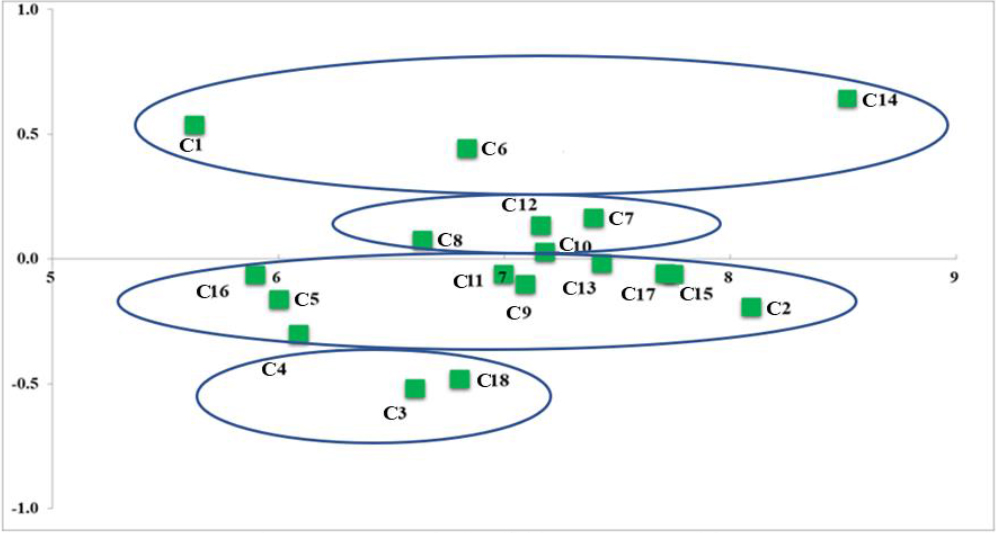
Figure 1
Causes and effects for facilitator.
IV. Results and Discussions
The results of this study are derived from the Fuzzy DEMATEL analysis, which systematically evaluates the interdependencies and relative influence of 18 enablers affecting the optimization of broadband communication channel capacity within the framework of information theory. The analysis begins with the aggregation of expert judgments from fifteen domain specialists, five from academia and ten from industry, each with a minimum of five years of experience in communication systems. These experts assessed the pairwise influence among the identified enablers using a five-point linguistic scale: No Influence (NI), Very Low Influence (VL), Low Influence (L), High Influence (H), and Very High Influence (VHI), as detailed in Table 2. These linguistic terms were converted into Triangular Fuzzy Numbers (TFNs) to handle uncertainty and imprecision in human judgment.
The fuzzy assessments were defuzzified using the Convert Fuzzy Data into Crisp Scores (CFCS) method, which involves normalization, left and right normalized value computation, total normalized crisp value derivation, and final crisp score calculation. This process yielded a crisp direct relation matrix, which was then normalized to form the initial direct-relation matrix \( X \), as shown in Table 5. The normalization was performed using the formula:
Where Y is the aggregated crisp matrix. Subsequently, the total relation matrix T was computed using the equation:
This matrix captures both direct and indirect influences among the 18 enablers, reflecting the complex network of interactions within the broadband communication system. From the total relation matrix, the sum of rows and the sum of columns were calculated for each enabler. These values are crucial for determining the prominence and causal role of each enabler.
The prominence of an enabler is given by R+S, indicating its overall influence within the system, while the net effect R–S determines whether it belongs to the cause group (if R–S > 0 or the effect group (if R–S < 0. As shown in Table 4, Security Considerations (C14) emerged as the most influential enabler with the highest prominence value of R+S=8.522 and a net effect of R–S=0.6422, placing it firmly in the cause group. This indicates that Security Considerations exert a strong driving influence on other enablers, such as Channel Access Protocols, Modulation Schemes, and QoS Requirements. The growing importance of security in broadband systems especially with the proliferation of IoT, cloud services, and cyber-physical systems—underscores its foundational role in ensuring reliable and trustworthy communication.
Second in ranking is Channel Access Protocols (C2) with R+S=8.095, although it falls into the effect group R–S=–0.1939, suggesting it is significantly influenced by other factors while also playing a critical role in system performance. This reflects the dependency of access protocols on higher-level design choices such as security policies, propagation conditions, and regulatory standards. Nevertheless, its high prominence confirms its operational centrality in managing shared bandwidth and minimizing interference in multi-user environments.
Third is Propagation Characteristics (C17) with R+S=7.75 and R–S= –0.061, placing it in the effect group. Despite being influenced by other system-level decisions, propagation characteristics such as path loss, attenuation, and multipath effects are fundamental physical constraints that directly affect signal integrity and achievable data rates. Their high ranking reaffirms the importance of environmental and topological factors in real-world deployment scenarios.
Other notable cause-group enablers include Bandwidth Enhancement (C1), Channel Coding and Error Correction (C6), Capacity Planning (C7), Power Consumption Considerations (C8), Quality of Service Requirements (C12), and Regulatory and Standardization Aspects (C10). These factors, characterized by positive R–S values, act as drivers that influence the configuration and performance of the broader system. For instance, effective capacity planning and regulatory compliance set the foundational rules within which technical implementations must operate.
In contrast, the effect group includes enablers such as MIMO Systems (C16), Modulation Schemes (C4), Adaptive Systems (C9), and Network Topology and Architecture (C18), which, while essential for performance, are largely shaped by the decisions made in the cause group. This hierarchical relationship is visualized in Figure 1, the causal diagram, where the horizontal axis represents R+S (prominence) and the vertical axis represents R–S (causal direction). The clustering of enablers reveals that strategic and foundational factors (like security and regulations) form the core drivers, while technological implementations respond to these constraints.
The findings challenge traditional assumptions that focus solely on physical-layer optimizations (e.g., modulation, MIMO) as primary levers for capacity enhancement. Instead, they highlight that non-technical and cross-layer factors particularly security and access control are now central to the effective application of information theory in broadband systems. This shift reflects the evolving nature of communication networks, where trust, reliability, and dynamic access are as critical as spectral efficiency.
Moreover, the robustness of the Fuzzy DEMATEL approach is evident in its ability to model uncertainty and expert subjectivity while producing a clear, quantifiable ranking. The use of TFNs and CFCS ensures that linguistic assessments are transformed into reliable numerical values, enhancing the validity of the outcomes.
The results demonstrate that optimizing broadband channel capacity is not merely a technical challenge but a systemic one, requiring a holistic understanding of interdependencies among diverse enablers. The prioritization of Security Considerations, Channel Access Protocols, and Propagation Characteristics provides a strategic roadmap for researchers and practitioners aiming to enhance network performance in nextgeneration communication systems. These insights are particularly relevant for 5G/6G, IoT, and cognitive radio networks, where dynamic, secure, and adaptive communication is paramount.
V. Study Implication
A. Theoretical implication
The utilization of Fuzzy DEMATEL presents opportunities for further investigation into the amalgamation of fuzzy set theory and information theory. Theoretical implications facilitate the exploration of increasingly sophisticated models that may effectively encompass the intricacies of communication networks, while also considering uncertainties and the ability to adapt to future technological improvements. Information theory, a fundamental principle in communication engineering, conventionally focuses on accurate and predictable connections. The theoretical significance of using Fuzzy DEMATEL resides in the incorporation of uncertainty into models of information theory. This deviation from deterministic models enhances the inclusiveness and accuracy of portraying the dynamic characteristics of broadband communication.
B. Managerial implication
Fuzzy DEMATEL offers a methodical approach to ranking the parameters that impact the capacity of broadband communication channels. Managers can utilize the calculated priority values to efficiently distribute resources, concentrating on the most crucial aspects that have a substantial influence on system performance. This prioritization facilitates the optimization of investments in technology, infrastructure, and human resources. It provides managers with guidance for making educated decisions on the adoption and integration of technology. Managers can strategically deploy technologies like adaptive modulation, error correction codes, and machine learning integration by comprehending the interdependencies across components. This guarantees that the implementation of technology is in line with the main objective of maximizing channel capacity.
VI. Conclusions
This study presents a comprehensive analysis of the enablers influencing broadband communication channel capacity through an integrative application of information theory and the Fuzzy DEMATEL method. Based on a systematic review of 118 scholarly articles, 18 critical enablers were identified, encompassing technical, regulatory, and strategic dimensions such as Bandwidth Enhancement, Channel Access Protocols, Security Considerations, and Propagation Characteristics. These enablers were evaluated by a panel of 15 domain experts using linguistic variables converted into Triangular Fuzzy Numbers (TFNs) to account for uncertainty in human judgment. The CFCS defuzzification technique was applied to transform fuzzy assessments into crisp values, followed by the construction of a normalized direct relation matrix and computation of the total relation matrix using matrix algebra. The resulting prominence (R+S) and net influence (R-S) values revealed that Security Considerations (C14), Channel Access Protocols (C2), and Propagation Characteristics (C17) are the most influential enablers, with C14 emerging as the top priority due to its strong causal impact. The causal diagram further classified enablers into cause and effect groups, highlighting the central role of security and access control in driving system performance. This research fills a critical gap by introducing an enabler-to-enabler interrelationship model, offering IT managers and network designers a strategic framework for prioritizing investments and optimizing channel capacity in next-generation communication systems.
Appendices
Appendix
TABLE II.
The linguistic perspective matrix by expert
| C1 | C2 | C3 | C4 | C5 | C6 | C7 | C8 | C9 | C10 | C11 | C12 | C13 | C14 | C15 | C16 | C17 | C18 | |
|---|---|---|---|---|---|---|---|---|---|---|---|---|---|---|---|---|---|---|
| C1 | 1 | I | VHI | VL | VL | VL | VL | I | HI | I | VHI | VHI | VL | VL | VL | NI | VL | HI |
| C2 | NI | 1 | HI | HI | HI | VL | HI | VL | VL | VL | VL | VL | VL | VL | HI | HI | HI | I |
| C3 | NI | VL | 1 | I | I | NI | HI | I | VL | VL | VL | VL | VHI | VL | NI | NI | HI | I |
| C4 | VL | NI | HI | 1 | HI | VL | HI | HI | VL | VL | VL | VL | NI | NI | I | NI | I | I |
| C5 | VL | I | HI | HI | 1 | NI | VL | VL | VL | VL | VL | NI | NI | NI | NI | NI | NI | NI |
| C6 | NI | I | I | VL | VL | 1 | VHI | HI | VHI | HI | I | NI | I | I | HI | I | HI | VHI |
| C7 | I | HI | I | VL | I | VL | 1 | I | I | VL | HI | I | VL | I | HI | NI | VL | I |
| C8 | NI | I | VL | VHI | VHI | I | VL | 1 | NI | NI | NI | NI | NI | NI | NI | NI | NI | HI |
| C9 | VL | HI | I | I | HI | HI | I | I | 1 | I | I | VL | I | I | I | HI | HI | HI |
| C10 | I | I | HI | VL | I | I | HI | I | I | 1 | VL | NI | VL | HI | HI | I | I | VHI |
| C11 | VL | VL | HI | I | VHI | I | VHI | I | I | HI | 1 | VL | HI | VL | I | I | VL | I |
| C12 | I | VHI | VL | I | VHI | VL | HI | HI | HI | I | HI | 1 | VHI | HI | VL | VL | I | HI |
| C13 | VL | I | NI | HI | I | HI | I | VL | I | VHI | I | I | 1 | VHI | HI | HI | HI | I |
| C14 | I | VL | I | VL | VL | I | VL | I | VL | I | VHI | VHI | VL | 1 | I | I | VHI | VL |
| C15 | I | HI | VL | I | VHI | I | HI | HI | VL | VL | HI | HI | I | I | 1 | VL | I | VHI |
| C16 | NI | VL | I | HI | I | VL | VHI | VL | NI | I | I | HI | HI | HI | VL | 1 | VL | I |
| C17 | NI | VL | I | NI | VL | I | I | HI | I | VL | I | I | I | I | I | VL | 1 | VL |
| C18 | HI | NI | VL | VL | VL | VHI | VL | I | HI | I | VL | I | I | VL | HI | HI | I | 10 |
TABLE III.
Total crisp value of cause and effect
| Enablers | R | S | R+S | R-S | Ranking | |
|---|---|---|---|---|---|---|
| C1 | Bandwidth enhancement | 3.0827 | 2.5458 | 5.628 | 0.5369 | 18 |
| C2 | Channel Access Protocols | 3.9505 | 4.1445 | 8.095 | -0.1939 | 2 |
| C3 | Data Rate and Transmission Efficiency | 3.0434 | 3.5622 | 6.606 | -0.5188 | 14 |
| C4 | Modulation Schemes | 2.8949 | 3.1966 | 6.092 | -0.3017 | 15 |
| C5 | Multipath and fading | 2.9203 | 3.0832 | 6.004 | -0.1628 | 16 |
| C6 | Channel Coding and Error Correction | 3.6401 | 3.1975 | 6.838 | 0.4426 | 11 |
| C7 | Capacity Planning | 3.7801 | 3.6155 | 7.396 | 0.1646 | 6 |
| C8 | Power Consumption Considerations | 3.3575 | 3.2819 | 6.639 | 0.0755 | 13 |
| C9 | Adaptive Systems | 3.4971 | 3.5978 | 7.095 | -0.1007 | 9 |
| C10 | Regulatory and Standardization Aspects | 3.6044 | 3.5766 | 7.181 | 0.0278 | 7 |
| C11 | Channel Noise and Distortion | 3.468 | 3.5302 | 6.998 | -0.0622 | 10 |
| C12 | Quality of Service (QoS) Requirements | 3.6493 | 3.5144 | 7.164 | 0.1348 | 8 |
| C13 | Diversity Techniques | 3.7062 | 3.7251 | 7.431 | -0.0188 | 5 |
| C14 | Security Considerations | 4.5819 | 3.9397 | 8.522 | 0.6422 | 1 |
| C15 | Dynamic Spectrum Access | 3.8274 | 3.8867 | 7.714 | -0.0592 | 4 |
| C16 | MIMO (Multiple Input Multiple Output) | 2.9187 | 2.9814 | 5.9 | -0.0627 | 17 |
| C17 | Propagation Characteristics | 3.8443 | 3.9053 | 7.75 | -0.061 | 3 |
| C18 | Network Topology and Architecture | 3.1602 | 3.6427 | 6.803 | -0.4825 | 12 |
TABLE IV.
Normalized direct relation matrix
| C1 | C2 | C3 | C4 | C5 | C6 | C7 | C8 | C9 | C10 | C11 | C12 | C13 | C14 | C15 | C16 | C17 | C18 | |
|---|---|---|---|---|---|---|---|---|---|---|---|---|---|---|---|---|---|---|
| C1 | 1.1997 | 0.2063 | 0.1704 | 0.1513 | 0.1490 | 0.1490 | 0.1655 | 0.1577 | 0.1708 | 0.1654 | 0.1704 | 0.1688 | 0.1755 | 0.1919 | 0.1865 | 0.1483 | 0.1773 | 0.1789 |
| C2 | 0.1475 | 1.3015 | 0.2265 | 0.2036 | 0.1917 | 0.1881 | 0.2272 | 0.1912 | 0.2265 | 0.2220 | 0.2130 | 0.2180 | 0.2402 | 0.2475 | 0.2512 | 0.1798 | 0.2477 | 0.2275 |
| C3 | 0.1152 | 0.1936 | 1.2347 | 0.1756 | 0.1701 | 0.1370 | 0.1711 | 0.1681 | 0.1630 | 0.1603 | 0.1645 | 0.1576 | 0.1774 | 0.1756 | 0.1750 | 0.1430 | 0.1904 | 0.1713 |
| C4 | 0.1111 | 0.1796 | 0.1852 | 1.2138 | 0.1709 | 0.1337 | 0.1686 | 0.1676 | 0.1517 | 0.1511 | 0.1554 | 0.1522 | 0.1544 | 0.1716 | 0.1662 | 0.1313 | 0.1709 | 0.1597 |
| C5 | 0.1177 | 0.1872 | 0.1801 | 0.1708 | 1.2106 | 0.1395 | 0.1645 | 0.1647 | 0.1568 | 0.1535 | 0.1567 | 0.1558 | 0.1571 | 0.1718 | 0.1703 | 0.1309 | 0.1722 | 0.1601 |
| C6 | 0.1404 | 0.2273 | 0.1908 | 0.1750 | 0.1686 | 1.2430 | 0.2200 | 0.1990 | 0.2228 | 0.2086 | 0.1970 | 0.1940 | 0.2057 | 0.2214 | 0.2144 | 0.1754 | 0.2216 | 0.2151 |
| C7 | 0.1483 | 0.2499 | 0.2116 | 0.1885 | 0.1866 | 0.2021 | 1.2662 | 0.2030 | 0.2102 | 0.2057 | 0.2114 | 0.2010 | 0.2169 | 0.2291 | 0.2242 | 0.1826 | 0.2302 | 0.2127 |
| C8 | 0.1364 | 0.2142 | 0.1957 | 0.1841 | 0.1775 | 0.1755 | 0.2011 | 1.2332 | 0.1801 | 0.1840 | 0.1839 | 0.1795 | 0.1833 | 0.1981 | 0.1924 | 0.1619 | 0.1908 | 0.1859 |
| C9 | 0.1362 | 0.2306 | 0.1882 | 0.1621 | 0.1594 | 0.1831 | 0.1918 | 0.1744 | 1.2557 | 0.2030 | 0.1961 | 0.1908 | 0.2039 | 0.2187 | 0.2191 | 0.1600 | 0.2222 | 0.2018 |
| C10 | 0.1383 | 0.2400 | 0.1942 | 0.1640 | 0.1645 | 0.1874 | 0.1991 | 0.1750 | 0.2196 | 1.2595 | 0.1949 | 0.1968 | 0.2164 | 0.2302 | 0.2235 | 0.1627 | 0.2318 | 0.2067 |
| C11 | 0.1342 | 0.2294 | 0.1844 | 0.1584 | 0.1581 | 0.1721 | 0.2002 | 0.1692 | 0.1954 | 0.1928 | 1.2507 | 0.2095 | 0.2142 | 0.2176 | 0.2208 | 0.1524 | 0.2065 | 0.2019 |
| C12 | 0.1412 | 0.2425 | 0.1898 | 0.1676 | 0.1660 | 0.1806 | 0.1998 | 0.1785 | 0.2084 | 0.2049 | 0.2241 | 1.2581 | 0.2276 | 0.2341 | 0.2380 | 0.1614 | 0.2203 | 0.2063 |
| C13 | 0.1401 | 0.2574 | 0.2026 | 0.1830 | 0.1747 | 0.1812 | 0.2060 | 0.1741 | 0.2021 | 0.2107 | 0.2091 | 0.2146 | 1.2702 | 0.2360 | 0.2298 | 0.1672 | 0.2377 | 0.2099 |
| C14 | 0.1996 | 0.3023 | 0.2556 | 0.2283 | 0.1992 | 0.2369 | 0.2635 | 0.2389 | 0.2667 | 0.2638 | 0.2592 | 0.2539 | 0.2712 | 1.3207 | 0.2790 | 0.2015 | 0.2812 | 0.2603 |
| C15 | 0.1623 | 0.2571 | 0.2064 | 0.1836 | 0.1778 | 0.1898 | 0.2133 | 0.1862 | 0.2243 | 0.2170 | 0.2154 | 0.2159 | 0.2265 | 0.2432 | 1.2801 | 0.1729 | 0.2332 | 0.2223 |
| C16 | 0.1174 | 0.1772 | 0.1510 | 0.1370 | 0.1327 | 0.1633 | 0.1665 | 0.1503 | 0.1587 | 0.1701 | 0.1549 | 0.1617 | 0.1633 | 0.1842 | 0.1701 | 1.2086 | 0.1810 | 0.1708 |
| C17 | 0.1405 | 0.2587 | 0.2143 | 0.1957 | 0.1842 | 0.1915 | 0.2159 | 0.1934 | 0.2226 | 0.2224 | 0.2120 | 0.2078 | 0.2351 | 0.2383 | 0.2313 | 0.1848 | 1.2839 | 0.2120 |
| C18 | 0.1198 | 0.1899 | 0.1806 | 0.1545 | 0.1415 | 0.1438 | 0.1753 | 0.1574 | 0.1624 | 0.1818 | 0.1616 | 0.1786 | 0.1860 | 0.2097 | 0.2148 | 0.1567 | 0.2063 | 1.2395 |
TABLE V.
Results for relation matrix
| C1 | C2 | C3 | C4 | C5 | C6 | C7 | C8 | C9 | C10 | C11 | C12 | C13 | C14 | C15 | C16 | C17 | C18 | |
|---|---|---|---|---|---|---|---|---|---|---|---|---|---|---|---|---|---|---|
| C1 | 0.1997 | 0.2063 | 0.1704 | 0.1513 | 0.1490 | 0.1490 | 0.1655 | 0.1577 | 0.1708 | 0.1654 | 0.1704 | 0.1688 | 0.1755 | 0.1919 | 0.1865 | 0.1483 | 0.1773 | 0.1789 |
| C2 | 0.1475 | 0.3015 | 0.2265 | 0.2036 | 0.1917 | 0.1881 | 0.2272 | 0.1912 | 0.2265 | 0.2220 | 0.2130 | 0.2180 | 0.2402 | 0.2475 | 0.2512 | 0.1798 | 0.2477 | 0.2275 |
| C3 | 0 | 0.1936 | 0.2347 | 0.1756 | 0.1701 | 0 | 0.1711 | 0.1681 | 0.1630 | 0.1603 | 0.1645 | 0.1576 | 0.1774 | 0.1756 | 0.1750 | 0.1430 | 0.1904 | 0.1713 |
| C4 | 0 | 0.1796 | 0.1852 | 0.2138 | 0.1709 | 0 | 0.1686 | 0.1676 | 0.1517 | 0.1511 | 0.1554 | 0.1522 | 0.1544 | 0.1716 | 0.1662 | 0 | 0.1709 | 0.1597 |
| C5 | 0 | 0.1872 | 0.1801 | 0.1708 | 0.2106 | 0 | 0.1645 | 0.1647 | 0.1568 | 0.1535 | 0.1567 | 0.1558 | 0.1571 | 0.1718 | 0.1703 | 0 | 0.1722 | 0.1601 |
| C6 | 0 | 0.2273 | 0.1908 | 0.1750 | 0.1686 | 0.2430 | 0.2200 | 0.1990 | 0.2228 | 0.2086 | 0.1970 | 0.1940 | 0.2057 | 0.2214 | 0.2144 | 0.1754 | 0.2216 | 0.2151 |
| C7 | 0.1483 | 0.2499 | 0.2116 | 0.1885 | 0.1866 | 0.2021 | 0.2662 | 0.2030 | 0.2102 | 0.2057 | 0.2114 | 0.2010 | 0.2169 | 0.2291 | 0.2242 | 0.1826 | 0.2302 | 0.2127 |
| C8 | 0 | 0.2142 | 0.1957 | 0.1841 | 0.1775 | 0.1755 | 0.2011 | 0.2332 | 0.1801 | 0.1840 | 0.1839 | 0.1795 | 0.1833 | 0.1981 | 0.1924 | 0.1619 | 0.1908 | 0.1859 |
| C9 | 0 | 0.2306 | 0.1882 | 0.1621 | 0.1594 | 0.1831 | 0.1918 | 0.1744 | 0.2557 | 0.2030 | 0.1961 | 0.1908 | 0.2039 | 0.2187 | 0.2191 | 0.1600 | 0.2222 | 0.2018 |
| C10 | 0 | 0.2400 | 0.1942 | 0.1640 | 0.1645 | 0.1874 | 0.1991 | 0.1750 | 0.2196 | 0.2595 | 0.1949 | 0.1968 | 0.2164 | 0.2302 | 0.2235 | 0.1627 | 0.2318 | 0.2067 |
| C11 | 0 | 0.2294 | 0.1844 | 0.1584 | 0.1581 | 0.1721 | 0.2002 | 0.1692 | 0.1954 | 0.1928 | 0.2507 | 0.2095 | 0.2142 | 0.2176 | 0.2208 | 0.1524 | 0.2065 | 0.2019 |
| C12 | 0 | 0.2425 | 0.1898 | 0.1676 | 0.1660 | 0.1806 | 0.1998 | 0.1785 | 0.2084 | 0.2049 | 0.2241 | 0.2581 | 0.2276 | 0.2341 | 0.2380 | 0.1614 | 0.2203 | 0.2063 |
| C13 | 0 | 0.2574 | 0.2026 | 0.1830 | 0.1747 | 0.1812 | 0.2060 | 0.1741 | 0.2021 | 0.2107 | 0.2091 | 0.2146 | 0.2702 | 0.2360 | 0.2298 | 0.1672 | 0.2377 | 0.2099 |
| C14 | 0.1996 | 0.3023 | 0.2556 | 0.2283 | 0.1992 | 0.2369 | 0.2635 | 0.2389 | 0.2667 | 0.2638 | 0.2592 | 0.2539 | 0.2712 | 0.3207 | 0.2790 | 0.2015 | 0.2812 | 0.2603 |
| C15 | 0.1623 | 0.2571 | 0.2064 | 0.1836 | 0.1778 | 0.1898 | 0.2133 | 0.1862 | 0.2243 | 0.2170 | 0.2154 | 0.2159 | 0.2265 | 0.2432 | 0.2801 | 0.1729 | 0.2332 | 0.2223 |
| C16 | 0 | 0.1772 | 0.1510 | 0 | 0 | 0.1633 | 0.1665 | 0.1503 | 0.1587 | 0.1701 | 0.1549 | 0.1617 | 0.1633 | 0.1842 | 0.1701 | 0.2086 | 0.1810 | 0.1708 |
| C17 | 0 | 0.2587 | 0.2143 | 0.1957 | 0.1842 | 0.1915 | 0.2159 | 0.1934 | 0.2226 | 0.2224 | 0.2120 | 0.2078 | 0.2351 | 0.2383 | 0.2313 | 0.1848 | 0.2839 | 0.2120 |
| C18 | 0 | 0.1899 | 0.1806 | 0.1545 | 0 | 0.1438 | 0.1753 | 0.1574 | 0.1624 | 0.1818 | 0.1616 | 0.1786 | 0.1860 | 0.2097 | 0.2148 | 0.1567 | 0.2063 | 0.2395 |