
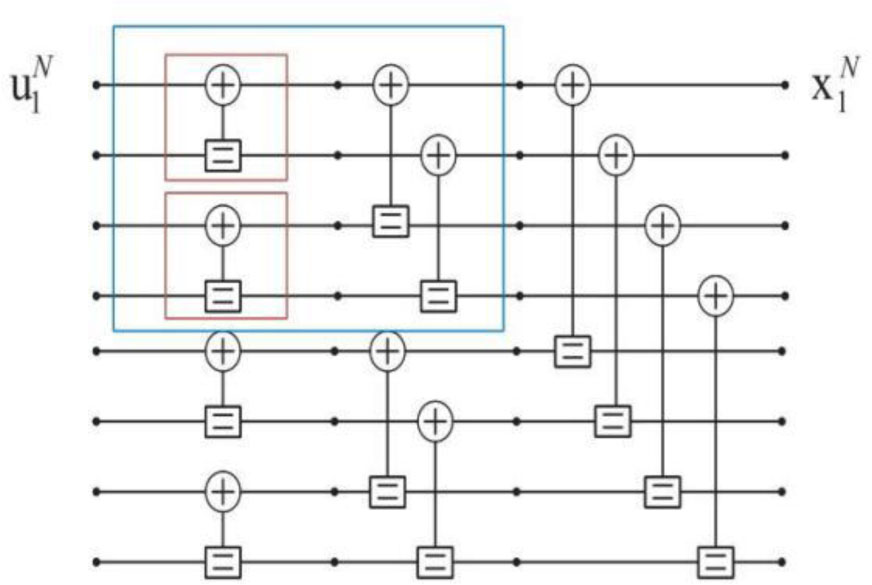
Figure 1.
Structure of polar code
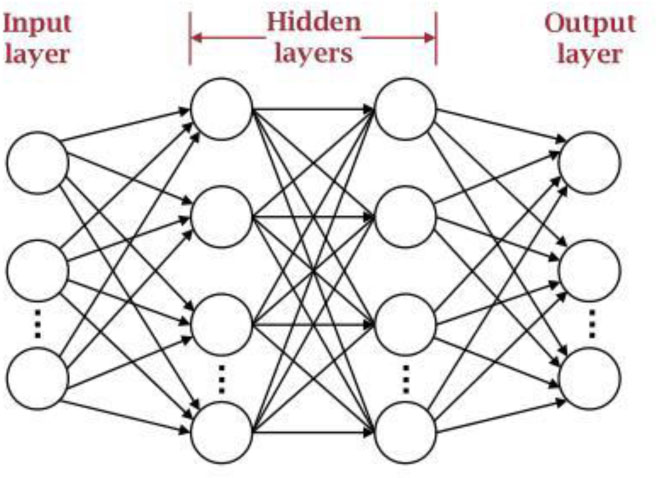
Figure 2.
Multi-layer structure of deep neural network

Figure 3.
Block diagram of neural network based decoder system
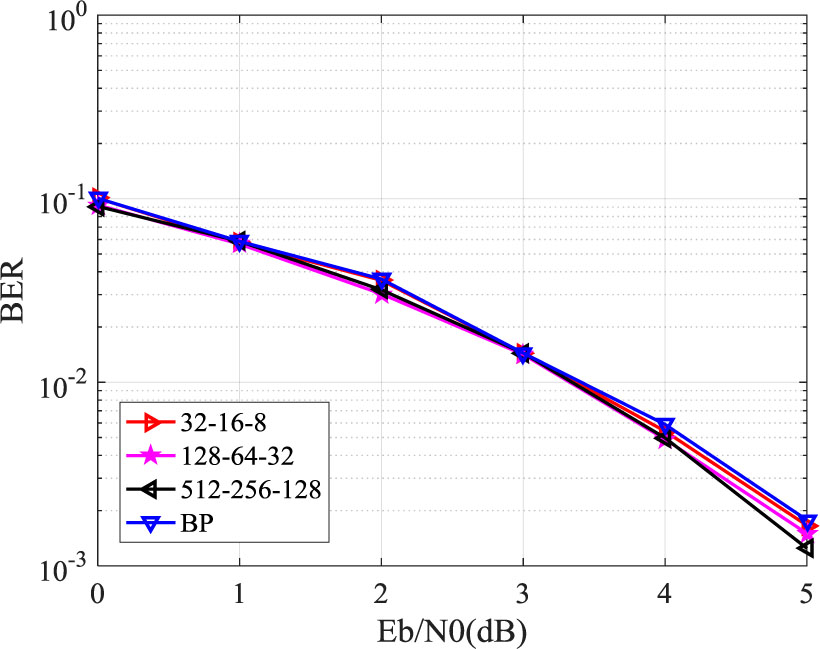
Figure 4.
Performance of different network structures at N=8
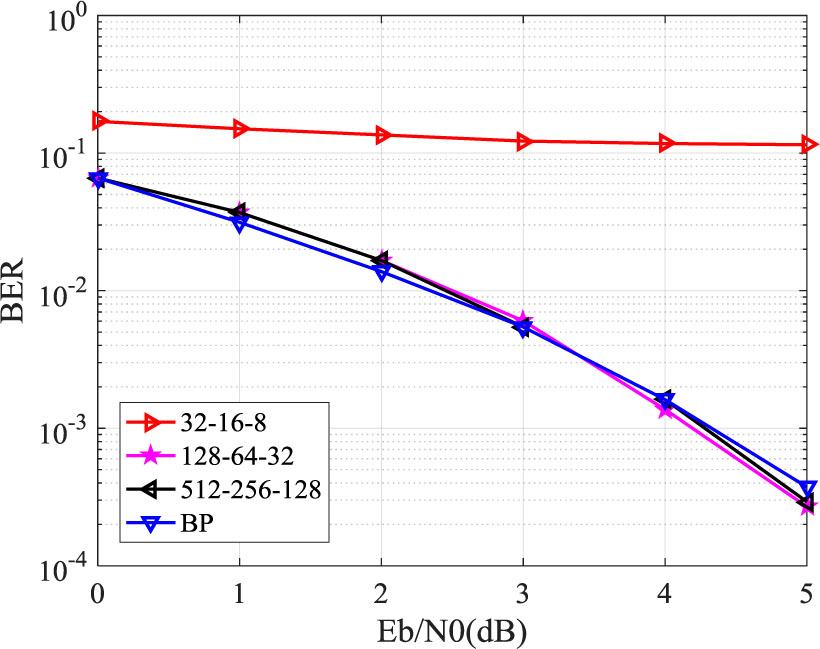
Figure 5.
Performance of different network structures at N=16
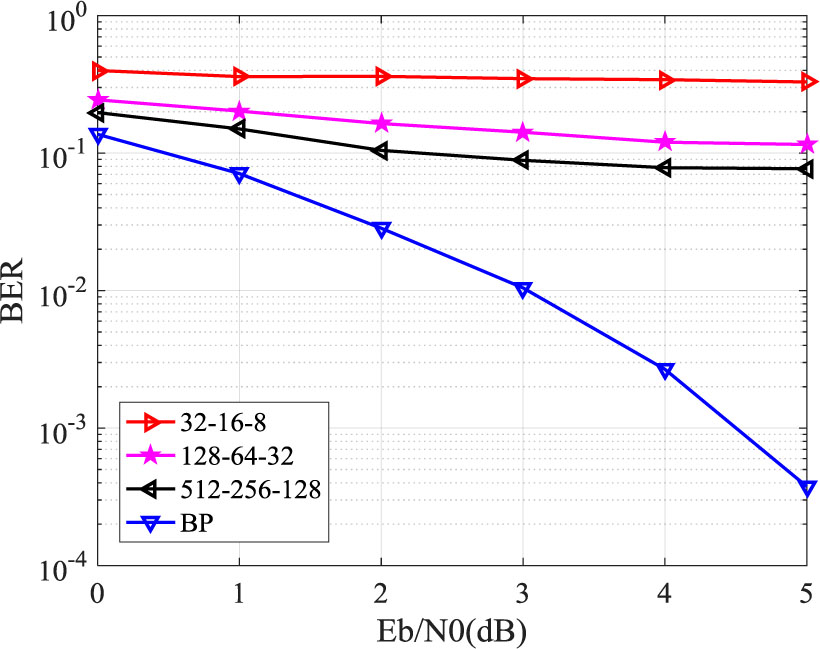
Figure 6.
Performance of different network structures at N=32
TABLE I.
Parameters Settings
| Parameters | Value |
|---|---|
| code length | 8, 16, 32 |
| code rate | 0.5 |
| batchsize | 512 |
| learning rate | 0.001 |
| training set size | 106 |
| epoch | 103 |
| network structure | 32-16-8, 128-64-32, 512-256-128 |
TABLE II.
Network Structure
| 32-16-8 | 128-64-32 | 512-256-128 | |
|---|---|---|---|
| N=8 | 1024 | 11752 | 169846 |
| N=16 | 1352 | 13488 | 174992 |
| N=32 | 1352 | 13488 | 174992 |
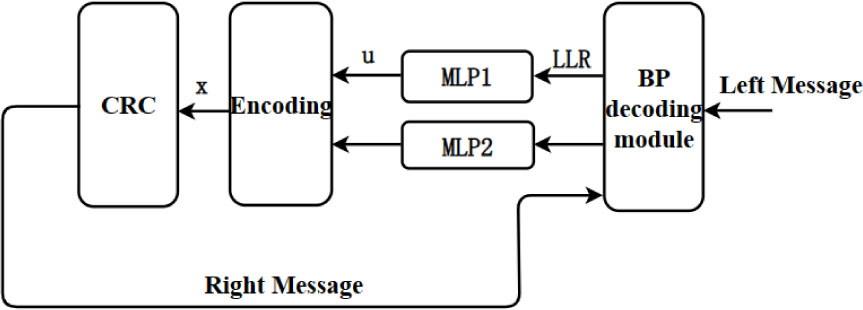
Figure 7.
Structure diagram of the proposed MLP-BP
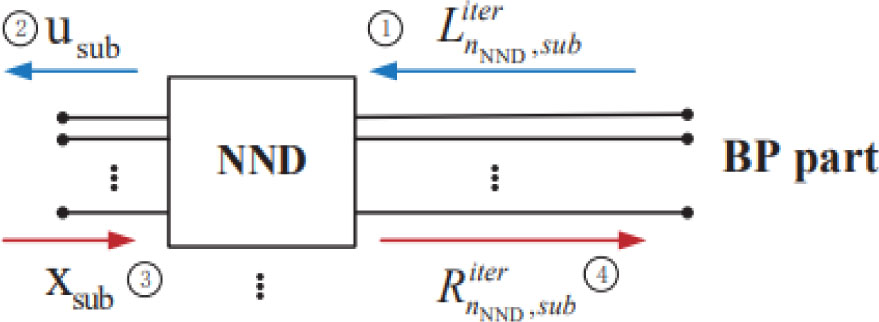
Figure 8.
Interaction of BP and DNN blocks
Algorithm 1:
Proposed MLP-BP decoding algorithm
| 1: Enter. y0, y1, ⋯ yN−1 |
| 2: Output. u0, u1, ⋯ uN−1 |
| 3: Initialization: Initialization using (2) LLR(yj) |
| 4. for iter ←1 to itermax do |
| 5. for i ←n + 1 to nNND do |
| 6: Update using equation (3), |
| 7. end for |
| 8: After reaching NND use the sub-block NNDsub to calculate usub |
| 9: usub After recoding to get xsub |
| 10: if after encoding xsub by CRC checksum do |
| 11: Using equation (7) yields, |
| 12. end if |
| 13: Retransmission |
| 14. for i ← nNND to n do |
| 15: Update using equation (3) |
| 16: end for |
| 17: end for |
TABLE III.
Polar(32,16) Divided into Two Parts
| Partition | Information bits | Code Rate |
|---|---|---|
| [0–15] | {11,12,14,15} | 0.25 |
| [16–31] | {19,21,22,23,24,25,26,27,28,29,30,31} | 0.75 |
TABLE IV.
Polar(32,16) Divided into Four Parts
| Partitioning | Information bits | Relative Location | Code Rate |
|---|---|---|---|
| [0–7] | None | None | 0 |
| [8–15] | {11,12,13,14} | {3,5,6,7} | 0.5 |
| [16–23] | {19,21,22,23} | {3,5,6,7} | 0.5 |
| [24–31] | {24,25,26,27,28,29,30,31} | {0,1,2,3,4,5,6,7} | 1 |
TABLE V.
Parameter Setting
| Set options | Value |
|---|---|
| Test platform | Tensorflow |
| Encoding | Polar(32,16), (64,128) |
| Signal to noise ratio | 1~5dB |
| loss function | Cross Entropy Loss |
| Optimizer | Adam |
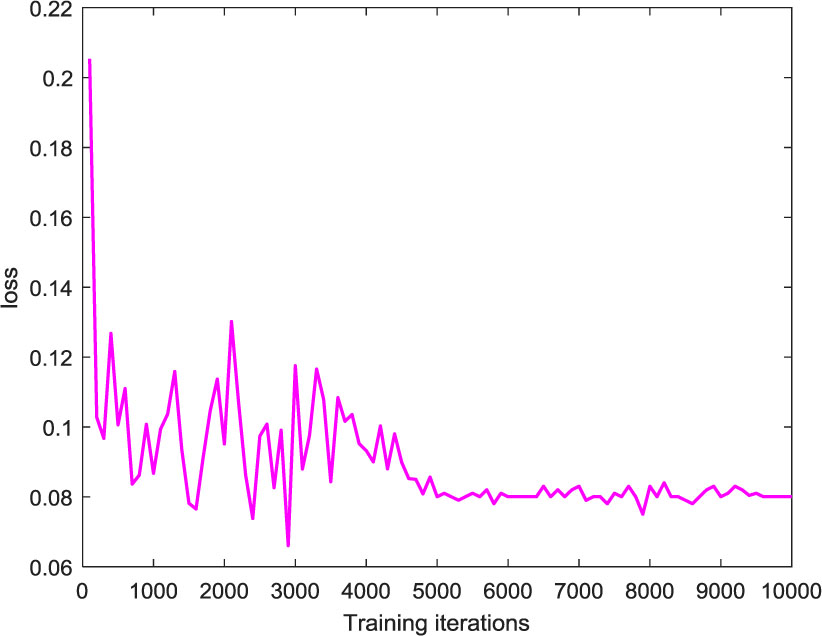
Figure 9.
Change of MLP-BP training loss value when N=128
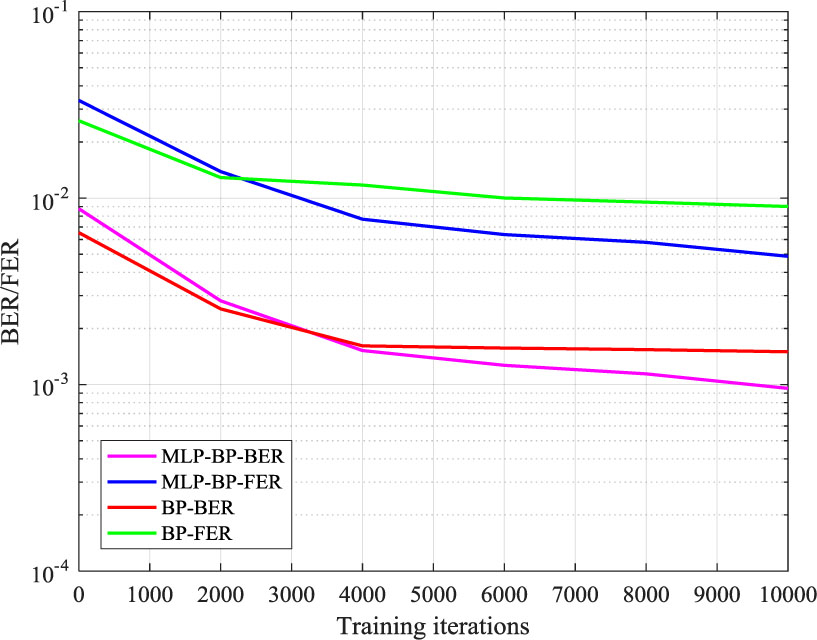
Figure 10.
Evolution of MLP-BP and BP BER when N=128
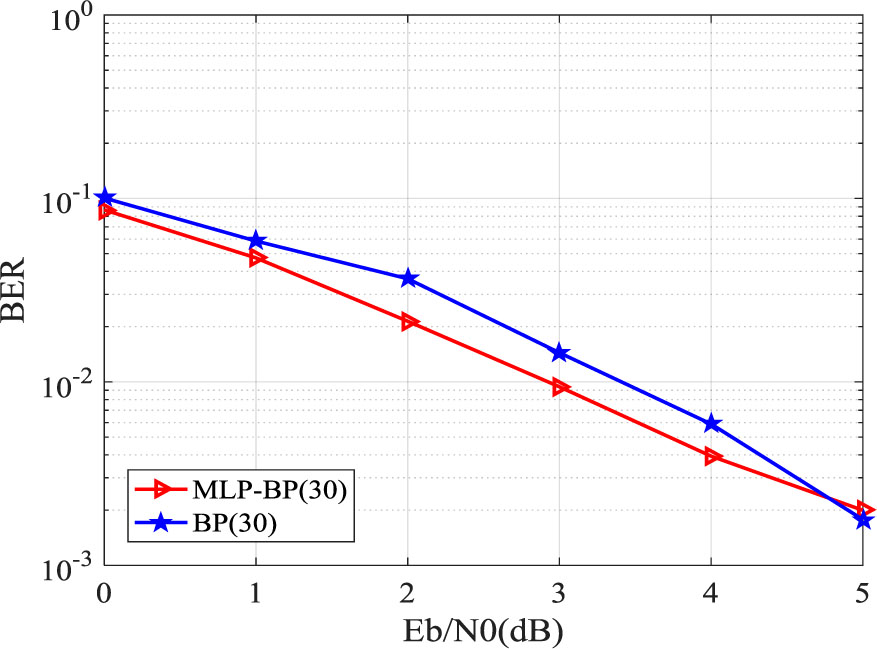
Figure 11.
BER performance comparison of two decoding methods at N=32
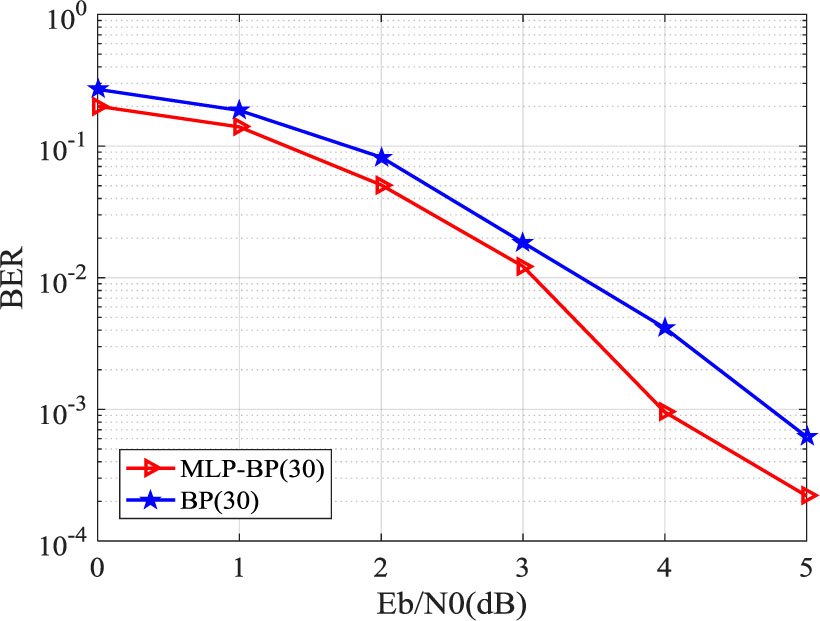
Figure 12.
BER performance comparison of two decoding methods at N=128