
1. Introduction
Billions of IoT endpoints, such as sensors, actuators, gateways, and edge nodes, together support smart grids, healthcare monitoring, and industrial automation architectures. The same connectivity that enables these services creates vast, distributed attack surfaces. Several recent surveys estimate that over one third of all enterprise security incidents involve IoT devices, and the number of targeted IoT malware families has grown by more than 400% since 2020 [1]. Effective intrusion detection is therefore critical; yet centralized IDS solutions require raw traffic to leave the device, violate data-sovereignty regulations such as GDPR and HIPAA, and introduce a single point of failure [2].
Federated Learning (FL) [3] offers a compelling alternative: clients train local models locally and share only gradient updates with a central aggregator. However, the aggregator itself becomes a vulnerability because, if compromised, it can reconstruct private training data via gradient inversion [4], inject backdoors through model replacement [5], or simply halt the service. Without an immutable record, there is no way to audit whether aggregation has been faithfully executed, which is a critical concern in regulated environments.
Blockchain technology addresses these limitations by eliminating reliance on a centralized aggregator. Decentralised consensus eliminates the single point of failure; its append-only ledger provides tamper-evident auditability; and programmable smart contracts enforce aggregation rules transparently, without requiring trust in any single party [6, 7]. Despite growing interest in combining FL and blockchain [8,9,10], no existing framework simultaneously achieves DP privacy guarantees, certified Byzantine resilience, on-chain gradient verification, and practical throughput for IoT IDS workloads.
This paper makes four contributions:
BlockFedIDS architecture: a permissioned Hyperledger Fabric FL system whose Golang chaincode fully replaces the aggregator, executing gradient validation, Byzantine-fault-tolerant (BFT) aggregation, and model commitment on-chain with Practical Byzantine Fault Tolerance (PBFT) consensus.
Integrated defences: DP-SGD [11] at the client side and Multi-Krum [12] inside the chaincode, providing formal (ϵ,δ)-DP and Byzantine resilience under f < N/2 malicious clients.
Gradient commitment protocol: a Pedersen commitment plus opening scheme that allows validators to verify update consistency without decrypting model weights, adding only 1.4 KB of on-chain storage per round.
Extensive IDS evaluation: experiments on NSL-KDD [13] and CIC-IDS-2017 [14], comparing five baselines across accuracy, F1-score, poisoning resilience, privacy cost, and blockchain throughput.
The other part of the paper is organized as: Section 2 surveys related work. Sections 3 and 4 present the system model and full methodology. Section 5 provides the security analysis. Section 6 reports the experimental results. Sections 7 and 8 present the discussion and conclusions, respectively.
2. Related Work
The design of BlockFedIDS draws on three converging lines of research, including federated learning for IoT intrusion detection, adversarial attacks targeting FL systems, and blockchain-enabled aggregation frameworks. Each body of work has advanced independently, yet no prior system has unified their respective strengths into a single cohesive framework. The following subsections survey the most relevant contributions across these areas, identifying the specific gaps that BlockFedIDS is designed to address.
2.1. Federated Learning for IoT Intrusion Detection
Recent work has increasingly adopted FL for network-based IDS. Sater and Ben Hamza [15] demonstrated that a federated LSTM model trained on heterogeneous IoT traffic achieves competitive detection rates while reducing data-transmission overhead by more than 80%. Jithish et al. [2] provided a systematic review of FL-based IDS architectures, identifying non-IID data heterogeneity and adversarial client behaviour as the two dominant unresolved challenges. Agrawal et al. [16] proposed FedCER, an emotion recognition framework using FL based on CNN architectures for EEG signal recordings. None of these systems addresses the trust and auditability of the aggregation step itself, a gap that BlockFedIDS resolves through blockchain.
2.2. Attacks on Federated Learning
Lyu et al. [17] provided a detailed taxonomy of FL privacy attacks, classifying gradient leakage, membership inference, and property inference as the three primary threat vectors. Fowl et al. [18] showed that an adversarial server can embed linear traps into the global model to extract private training records verbatim, which motivates our adoption of DP-SGD. Shejwalkar et al. [19] formalised local model poisoning as a constrained optimisation problem, generating attacks that evade norm clipping, RONI, and FLTrust; our on-chain Multi-Krum integration is specifically designed to counter this class of attack.
2.3. Byzantine-Robust and Privacy-Preserving Aggregation
Fang et al. [20] demonstrated that most existing Byzantine defences including Krum and coordinate-wise median are vulnerable to optimised attacks; they additionally showed that combining robust aggregation with server-side anomaly detection improves resilience. Naseri et al. [21] analysed the interaction between differential privacy and Byzantine robustness, proving that DP noise and BFT filtering are complementary rather than redundant, a finding that directly motivates our integrated framework. Li et al. [22] proposed Ditto, which adds a personalisation regularisation term to FL to improve accuracy under non-IID distributions; we adopt a similar per-client weighting in our aggregation phase.
2.4. Blockchain-Enabled Federated Learning
Passerat-Palmbach et al. [8] evaluated blockchain FL for healthcare, highlighting the gap between theoretical security guarantees and practical on-chain overhead. Mugunthan et al. [9] proposed PRIVACYFL, using smart contracts on Ethereum to coordinate training, but relying on an off-chain trusted execution environment for aggregation. Sguanci et al. [10] designed a layer-2 rollup scheme to reduce on-chain aggregation costs, achieving a 3.2× throughput improvement over naive on-chain approaches, but without any DP or BFT integration. More recently, Begum et al. [23] proposed BFLIDS, a blockchain-driven FL framework for intrusion detection in Internet-of-Medical-Things networks that improves transparency of aggregation but does not incorporate a formal DP mechanism or a certified Byzantine-robust aggregator. Govindaram and Jegatheesan [24] presented FLBC-IDS, combining FL and blockchain for IoT intrusion detection with a focus on secure model sharing rather than on-chain gradient verification. Ali et al. [25] surveyed blockchain and FL-based IDS frameworks for edge-enabled industrial IoT and identifying the joint treatment of privacy, Byzantine robustness, and verifiable aggregation as an open gap rather than a solved problem. Table 1 summarises how BlockFedIDS relates to these and the other blockchain-FL systems discussed above. BlockFedIDS is among the first framework in this comparison set to unify formal (ϵ, δ)-DP, on-chain certified Byzantine-robust (Multi-Krum) aggregation, Pedersen-commitment gradient verification, and a hybrid InterPlanetary File System (IPFS)/ledger storage design within a single IoT-IDS-oriented system; no single prior system in Table 1 combines all four properties.
Table 1.
Comparison of BlockFedIDS with representative blockchain-enabled FL systems. DP: differential privacy; BFT: certified Byzantine-fault-tolerant aggregation; Verif.: cryptographic per-update verification.
| Method | Domain | Blockchain platform | DP | BET | Verif. | Reported limitation |
|---|---|---|---|---|---|---|
| Passerat-Palmbach et al. [8] | Healthcare | Generic permissioned | – | – | – | On-chain overhead not quantified |
| PRIVACYFL [9] | General FL | Ethereum smart contract | – | – | TEE-based | Relies on off-chain trusted hardware |
| Biscotti-style [10] | General FL | Layer-2 rollup | – | – | – | No DP or certified BFT aggregation |
| FLTrust [20] | General FL | None (centralised server) | – | ✓ | – | Server root of trust is a single point of failure |
| BFLIDS [23] | IoMT IDS | Permissioned | – | – | – | No formal DP or certified BFT aggregator |
| FLBC-IDS [24] | IoT IDS | Permissioned | – | – | – | Focuses on model sharing, not gradient verification |
| BlockFedIDS (ours) | IoT IDS | Hyperledger Fabric | ✓ | ✓ | Pedersen | Complexity scales as O(K2 d) |
3. System Architecture and Threat Model
This section defines the network topology, the roles and capabilities of all participating entities, and the classes of adversarial behaviour that the framework is designed to tolerate. Assumptions that fall outside the stated threat model are explicitly identified to avoid overstating the scope of the security guarantees provided.
3.1. System Architecture
Figure 1 shows the four logical layers of BlockFedIDS including the IoT client layer, the cryptographic commitment layer, the Hyperledger Fabric chaincode/consensus layer, and the IPFS storage layer. It also describes how they map onto the formal model introduced below. The detailed eight-step per-round protocol that ties these layers together is presented separately in Section 4.
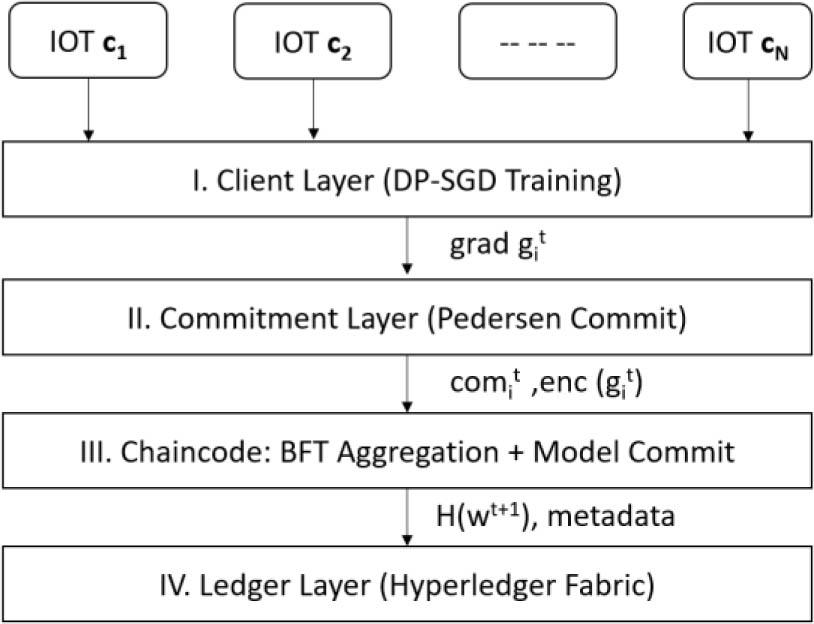
Figure 1.
BlockFedIDS four-layer stack: IoT clients running local DP-SGD, the Pedersen commitment/encryption layer, the Hyperledger Fabric chaincode executing verification and Multi-Krum aggregation under PBFT consensus, and the IPFS off-chain storage layer.
BlockFedIDS operates over a permissioned Hyperledger Fabric network shared by N IoT gateway clients C = {c1, …, cN} and M endorsing validator peers V = {v1, …, vM} running PBFT consensus and chaincode execution. Each client ci holds a private local dataset of network flow records with attack labels.
The global objective is (Equation (1)):
where w denotes the shared global model parameters; N is the number of participating IoT clients; ni = |Di| is the number of labelled flow records held locally by client ci; n = ∑ini is the total number of records across all clients; and is the local empirical risk of client ci under cross-entropy loss ℓ(·), evaluated on the feature–label pairs (xj, yj) ∈ Di. Equation (1) therefore states that the global model minimises the dataset-size-weighted average of the local losses, exactly as in standard FedAvg-style FL [3], but without requiring any party to hold w centrally: w is only ever materialised as chaincode state and an IPFS object, as detailed in Section 4.6.Table 2 summarises the principal symbols used throughout the remainder of the paper; each symbol is defined at first use and is included here purely as a forward reference for the reader.
Table 2.
Summary of key notation.
| Symbol | Description |
|---|---|
| N, M | Number of IoT clients / Fabric validator peers (20, 4) |
| f | Maximum number of Byzantine clients tolerated (6) |
| T, E | Global training rounds / local epochs per round (100, 5) |
| B | Local mini-batch size (64) |
| wt | Global model parameters at round t |
| DP-SGD gradient of client ci at round t | |
| d | Dimensionality of the gradient vector (67,908) |
| C, σ | Gradient clip norm / DP noise multiplier (1.0, 1.1) |
| ϵ, δ | Cumulative DP privacy budget (8, 10−5) |
| K | Number of clients whose commitments are opened in a round |
| S | Multi-Krum selected (benign) client set, |S| = K − f |
| Pedersen commitment of | |
| ρi, τρ | Reputation score of client ci / suspension threshold (0.3) |
| β | Reputation exponential-decay factor (0.9) |
| H(·) | SHA-256 hash function |
| α | Dirichlet non-IID concentration parameter (0.5) |
3.2. Threat Model
The following threat model follows directly from the architecture in Section 3.1 as the clients, validators, and external observers each interact with a different layer of the stack (local training, chaincode execution, and the public ledger, respectively), they are given correspondingly distinct capabilities and are analysed as three separate adversary classes. This separation is what allows the security analysis in Section 5 to reason about privacy, Byzantine robustness, and auditability independently rather than under a single monolithic adversary.
Byzantine clients. Up to f < N/2 clients are corrupted and submit arbitrarily crafted gradient updates to degrade accuracy or embed backdoors [5, 19].
Honest-but-curious validators. Validators execute the chaincode correctly but may attempt to infer private training data from committed gradient ciphertexts.
External eavesdropper. A passive adversary observes all blockchain transactions but cannot break INDCPA encryption, collision-resistant hashing, or discrete-log hardness.
Out-of-scope assumptions: We exclude consensus-layer attacks (which require ≥ 1/3 validator corruption), supply-chain attacks on chaincode, and hardware side-channels.
4. The BlockFedIDS Framework
This section presents the complete technical design of Block-FedIDS. Beginning with a high-level architectural overview, we describe in detail each of the five core components including the per-round communication protocol, the client-side DP-SGD training procedure, the Pedersen commitment and gradient verification scheme, the on-chain Multi-Krum aggregation algorithm, and the reputation-weighted client selection mechanism. Together, these components form a layered defence that addresses privacy, Byzantine robustness, and auditability simultaneously, without relying on any single trusted party.
4.1. Overview and Round Protocol
Figure 1 illustrates the BlockFedIDS four-layer stack, and Figure 2 details the eight-step per-round protocol. A training epoch proceeds as follows.
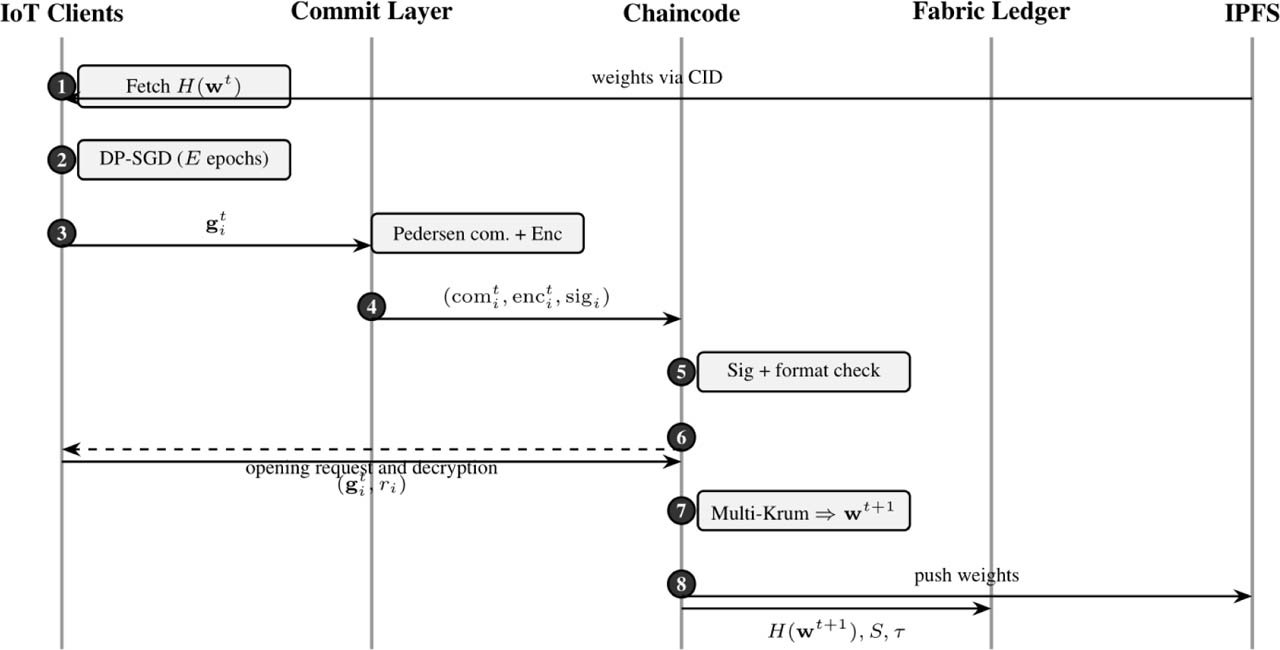
Figure 2.
Per-round sequence diagram of BlockFedIDS. Solid arrows indicate data flow between layers; dashed arrows indicate control messages (opening requests).
Step 1 – Model fetch. Each client ci queries the ledger for the current global model hash H(wt), retrieves the full weights from IPFS via the content identifier (CID) stored in the latest committed block, and verifies integrity using SHA-256.
Step 2 – Local DP-SGD. The client trains on D i for E local epochs using DP-SGD (Section 4.2), producing a clipped, noise-perturbed gradient .
Step 3 – Commitment generation. The client computes the Pedersen commitment and encrypts the gradient under the chaincode's public key: .
Step 4 – Transaction submission. The client broadcasts a signed Fabric transaction containing ( , , sigi ) to the ordering service.
Step 5 – Commitment validation. The chaincode verifies each transaction for signature validity, correct commitment format, and consistency of ni with the client's registered dataset size. Invalid transactions are rejected and the offending client's reputation score is decremented.
Step 6 – Opening and decryption. Once K ≥ 2f + 3 valid commitments are collected, the chaincode emits an opening request. Each client responds with ( , ri); the chaincode verifies before admitting the gradient to aggregation.
Step 7 – On-chain Multi-Krum aggregation. Algorithm 1 is executed independently by every endorsing peer; consensus ensures identical outputs. The selected set S ⊆ [K] of benign gradients is averaged to produce wt+1.
Step 8 – Ledger commit. The updated model weights are pushed to IPFS. The chaincode writes the block record {H(wt+1), S, t + 1, τ} (where τ is the Unix timestamp) to the Fabric ledger, completing the round.
Table 6.
Algorithm 1: On-Chain Multi-Krum Aggregation (Chain-code)
| Require: Verified gradients , current model wt, learning rate η, Byzantine bound f |
| Ensure: wt+1 committed to ledger; IPFS CID returned ▷ Score every opened gradient by its distance to its closest honest-sized neighbourhood |
| 1: for each client i ∈ [K] do |
| 2: nbrs (i) ← K − f − 2 nearest gradients by ℓ2 -distance ▷ excludes the f+1 points an outlier could bias |
| 3: ▷ lower s(i) = more consistent with the majority |
| 4: end for |
| 5: S ← top-(K−f) clients with smallest s(·) ▷ discard the f highest-scoring (most outlying) clients |
| 6: ▷ average only the surviving, presumed-benign gradients |
| 7: ▷ single deterministic SGD step, replicated by every peer |
| 8: cid ← IPFS.push(wt+1) ▷ full weights go off-chain; only the CID is committed |
| 9: ledger.put({H(wt+1), cid, S, t+1, τ}) ▷ ≈ 1.4 KB write: hash, CID, selected set, round, timestamp |
| 10: return wt+1 |
4.2. Client-Side DP-SGD
At each round t, client ci initialises from wt and runs E epochs of DP-SGD [11]. For each mini-batch β of size B:
Compute per-sample gradients .
Clip each per-sample gradient: .
Aggregate the clipped gradients and add calibrated Gaussian noise (Equation (2)):
The noise multiplier σ is calibrated via the Rényi differential privacy (RDP) accountant [26], a tighter method than moments accounting for satisfying a per-round (ϵ 0,δ 0)-DP guarantee. After T rounds, the cumulative budget satisfies (Equation (3)):
where σR(α) is the RDP order-α privacy loss per step [26]. At (ϵ, δ) = (8, 10−5) and T = 100, RDP accounting requires σ = 1.1, which we adopt throughout.Local training uses cosine learning-rate decay (Equation (4)) [27]:
which improves convergence under non-IID data compared with a fixed learning rate [3]. Clients communicate only the gradient (not updated weights), reducing per-round communication overhead.4.3. Pedersen Commitment and Gradient Verification
Let 𝔾 be a prime-order group of order q in which the discrete-log problem is hard, with public generators g, h ∈ 𝔾. For each gradient update , serialized as a vector , client ci samples ri ← ℤq and computes (Equation (5)):
where 〈u〉=Σkuk qk mod q is a polynomial encoding of the gradient vector. The client further encrypts the gradient under the chaincode's Elliptic Curve Integrated Encryption Scheme (ECIES) public key .During the opening phase, the client reveals ( , ri); the chaincode recomputes and checks equality with the stored . Mismatches are treated as Byzantine submissions. The scheme is computationally binding under the discrete-log assumption and is perfectly hiding, meaning that no information about leaks from the commitment alone.
Client-side computational overhead. Computing requires two fixed-base modular exponentiations in 𝔾 (one for g〈u〉, one for hri) plus one multiplication, independent of the gradient dimension d once the polynomial encoding ⟨u⟩ has been folded into a single scalar; on a 256-bit prime-order group this costs on the order of a few milliseconds on a constrained IoT gateway (e.g., a Cortex-A72 class SoC), which is negligible next to the seconds-scale local DP-SGD training time per round. This is substantially cheaper than a general-purpose zk-SNARK, recent blockchain-FL work using Groth16-style proofs reports proof-generation times ranging from roughly one millisecond per round for small models to tens of seconds for larger ones [28, 29], with verification remaining cheap in all cases. We therefore adopt Pedersen commitments rather than zk-SNARKs because our threat model only requires consistency verification (did the client open what it committed to?) rather than a general-purpose proof of correct DPSGD execution; the latter would additionally need an arithmetic circuit for gradient clipping and noise addition, which is exactly the heavier proof-of-training setting explored in [28, 29] and which we identify as a natural upgrade path once client-side hardware allows it.
4.4. On-Chain Multi-Krum Aggregation
Once the chaincode has verified openings from K ≥ 2 f + 3 clients, it executes Algorithm 1 within a deterministic Golang chaincode function endorsed by all M validators. The endorsement policy requires M − f matching results before the block is committed, making any deviation from the algorithm equivalent to a consensus-layer attack.
Complexity. The pairwise distance computation costs O(K2d), where d is the gradient dimension (67,908 for our MLP). For K = 20 clients, this amounts to approximately 2.7×10¹⁰ floating-point operations, which completes in ∼4 s on an Intel Xeon E5-2699 validator node.
4.5. Reputation-Weighted Aggregation
Beyond Multi-Krum's binary selection, BlockFedIDS maintains a persistent reputation score ρi ∈ [0,1] per client, initialised to 1.0. After each round, ρ i is updated as (Equation (6)):
where β=0.9 is a decay factor and ⊮ [i ∈ St] equals 1 if client ci was selected by Multi-Krum in round t. Clients with ρi < 0.3 are temporarily suspended from participation. This mechanism complements Multi-Krum's per-round filtering with a long-term accountability mechanism that is absent from prior blockchain FL designs. This design choice is deliberate as much of the FL reputation literature uses reputation primarily as an incentive or client-selection signal for efficiency or fairness, e.g., to prioritise high-quality or high-throughput clients in crowdsensing and vehicular settings [30, 31]. In BlockFedIDS, ρi instead acts as a security component and is driven solely by Multi-Krum's per-round accept/reject decision, and crossing τρ = 0.3 triggers suspension rather than a lower reward or selection probability. This is closer in spirit to recent decentralised-FL reputation defences such as RepuNet [32], which likewise use exclusion thresholds to mitigate persistent malicious behaviour, but differs in that ρ i here is computed over blockchain-anchored, cryptographically verified acceptance decisions rather than locally observed peer behaviour, which removes the single-observer trust assumption that a purely local reputation score would require.4.6. Hybrid Storage Design
Full model weights (∼260 KB for our MLP) are stored on IPFS under content-addressed identifiers (CIDs). The Fabric ledger stores only the hashes of the weights, the IPFS CID, the selected client set S, the round number, and a Unix times-tamp totalling ≈ 1.4 KB per round. End-to-end integrity is preserved, any weight modification changes the CID, which would no longer match the on-chain hash. This design limits blockchain storage growth to ≤ 15 MB per 10,000 rounds, making it practical for long-running IoT deployments. A naive scheme that stores full model weights on-chain instead of on IPFS would require ≈ 260 KB of ledger state per round amounting to roughly 186× more than the 1.4 KB hybrid design and its effect on committed transactions-per-second and commit latency, is the subject of an ongoing follow-up experiment on the same Fabric testbed (see the Limitations discussion in Section 7).
Table 2 (Section 3) summarises the main symbols used throughout the paper.
5. Security Analysis
This section presents three theoretical results corresponding to the three principal threat vectors identified in Section 3. Theorem 1 establishes a cumulative (ϵ, δ)-differential privacy guarantee for the global model under RDP composition. Theorem 2 proves Byzantine resilience of on-chain Multi-Krum under the assumption that less than half of the participating clients can be malicious. Proposition 1 confirms the computational binding property of the Pedersen commitment scheme under the discrete-log hardness assumption. Collectively, these results demonstrate that BlockFedIDS provides formally verifiable end-toend security guarantees.
Theorem 1 (Privacy Guarantee)
If each client applies DP-SGD with a per-round RDP budget ∈0 at order α, then after T rounds the global model satisfies (∈T, δ)-DP with under the RDP composition theorem [26].
Sketch. RDP composition states that T mechanisms each satisfying (α, ∈0)-RDP compose to (α, Tϵ0)-RDP. Converting via and optimising over α yields the rate.
Theorem 2 (Byzantine Resilience)
Under Multi-Krum with K > 2f + 2 clients of which at most f are Byzantine, the selected set S contains no Byzantine gradient with probability ≥ 1 − exp(−Ω(K)).
Sketch. Every Byzantine gradient ranks among the f highest-scoring candidates by the triangle inequality [12]. Since |S| = K − f > f + 2, not all Byzantine clients can be selected, and the aggregated gradient deviates from the true direction by O(σDP) in expectation.
Proposition 1 (Commitment Binding)
Under the discrete-log hardness assumption, no PPT adversary can produce (g, r) ≠ (g′, r′) such that g⟨g⟩ hr = g⟨g′⟩ hr′mod p.
Immutability. Any ledger modification would require a consensus-layer attack on ≥1/3 of the M PBFT validators simultaneously, which is outside our stated threat model. The combination of on-chain hashes and IPFS CIDs ensures that off-chain weight tampering is immediately detectable.
6. Experimental Evaluation
To validate the practical effectiveness of BlockFedIDS, we conduct a comprehensive empirical evaluation across two widely used intrusion detection benchmarks including NSL-KDD and CIC-IDS-2017. The evaluation is structured to assess six distinct dimensions of system performance, namely detection accuracy, robustness under Byzantine attacks, the privacy–utility trade-off, training convergence behaviour, and blockchain throughput. Results are compared against four baselines spanning vanilla FedAvg, FedAvg with differential privacy, a Biscotti-style blockchain FL system, and FLTrust, with the centralised oracle serving as an upper bound on achievable performance.
6.1. Experimental Setup
Platform. Hyperledger Fabric 2.5, Golang chaincode, 20 Ubuntu 22.04 VMs (4vCPU, 8GB RAM) as clients, 3 bare- metal Xeon E5-2699 nodes as validators, and 1 IPFS node.
Datasets. NSL-KDD [13]: 125,973 training and 22,544 test records across 5 classes (Normal, DoS, Probe, R2L, U2R). CIC-IDS-2017 [14]: 2.8million records across 15 attack classes. Data are partitioned non-IID using a Dirichlet distribution (α=0.5) across 20 clients.
Model. A four-layer MLP with batch normalisation: 78 → 256 → 128 → 64 → #classes; 67,908 parameters for the NSL-KDD setting.
Hyperparameters. T = 100, E = 5, B = 64, C = 1.0, σ = 1.1, (ϵ, δ) = (8, 10−5), f = 6 (30%), β = 0.9, η max = 0.01, η min = 10 − 4. These values follow common practice rather than an exhaustive per-task search: (ϵ, δ) = (8, 10−5) and σ = 1.1 correspond to the standard “moderate-privacy” operating point used in the Opacus reference implementation of DP-SGD [11] and lie within the ϵ ∈ [1,16] envelope we sweep explicitly in Section 6.4; β = 0.9 is the conventional exponential-moving-average decay rate used for reputation and trust scores in the FL literature, chosen to average out a single noisy round without erasing a client's multi-round history; and α=0.5 is a moderately non-IID Dirichlet setting commonly used to stress-test FL aggregation rules.
Baselines. (1) Centralised oracle; (2) FedAvg [3]; (3) FedAvg with DP; (4) Biscotti-style BC-FL [10]; (5) FLTrust [20].
6.2. Detection Performance
Table 3 reports accuracy, F1-score, false positive rate (FPR), and detection rate (DR) on both benchmarks at 0% Byzan-tine clients.
Table 3.
Detection performance on NSL-KDD and CIC-IDS-2017 (0 % Byzantine clients, ϵ = 8, δ = 10−5).
| Acc.(%) | F1 | FPR(%) | DR(%) | Acc.(%) | F1 | FPR(%) | DR(%) | |
|---|---|---|---|---|---|---|---|---|
| Centralised oracle | 98.31 | 0.991 | 0.47 | 99.12 | 98.74 | 0.993 | 0.38 | 99.21 |
| FedAvg [3] | 96.45 | 0.971 | 1.23 | 97.04 | 96.11 | 0.968 | 1.41 | 96.72 |
| FedAvg + DP | 95.87 | 0.964 | 1.55 | 96.32 | 95.43 | 0.960 | 1.72 | 95.91 |
| Biscotti-style [10] | 96.02 | 0.966 | 1.38 | 96.51 | 95.78 | 0.963 | 1.58 | 96.10 |
| FLTrust [20] | 96.73 | 0.973 | 1.14 | 97.21 | 96.39 | 0.970 | 1.29 | 96.88 |
| BlockFedIDS (ours) | 97.14 | 0.984 | 0.91 | 97.63 | 96.88 | 0.975 | 1.02 | 97.31 |
BlockFedIDS narrows the gap to the centralised oracle to 1.17pp on NSL-KDD, compared with 1.86pp for FedAvg. The reduced FPR (0.91% vs. 1.23%) reflects the benefit of Multi-Krum filtering: high-variance Byzantine updates that would inflate false alarms under FedAvg are discarded before aggregation.
6.3. Robustness Under Byzantine Attacks
Figure 3 plots NSL-KDD accuracy against the Byzantine fraction (0–30%) under a label-flipping attack. FedAvg collapses to near-random performance (50.3%) at 30% Byzantine clients; BlockFedIDS retains 81.2% accuracy, representing a 74.3% reduction in accuracy degradation. FLTrust reaches only 63.2% at the same adversarial level because its server-centric root of trust can itself be targeted when the server is not unconditionally trusted. The evaluation above uses label-flipping because it is the attack most directly comparable across all five baselines; a stronger evaluation against a distributed backdoor injection or a model-replacement attack [5] against FLTrust specifically is planned as a direct follow-up on the same testbed and is listed as an explicit limitation in Section 7 rather than estimated here.
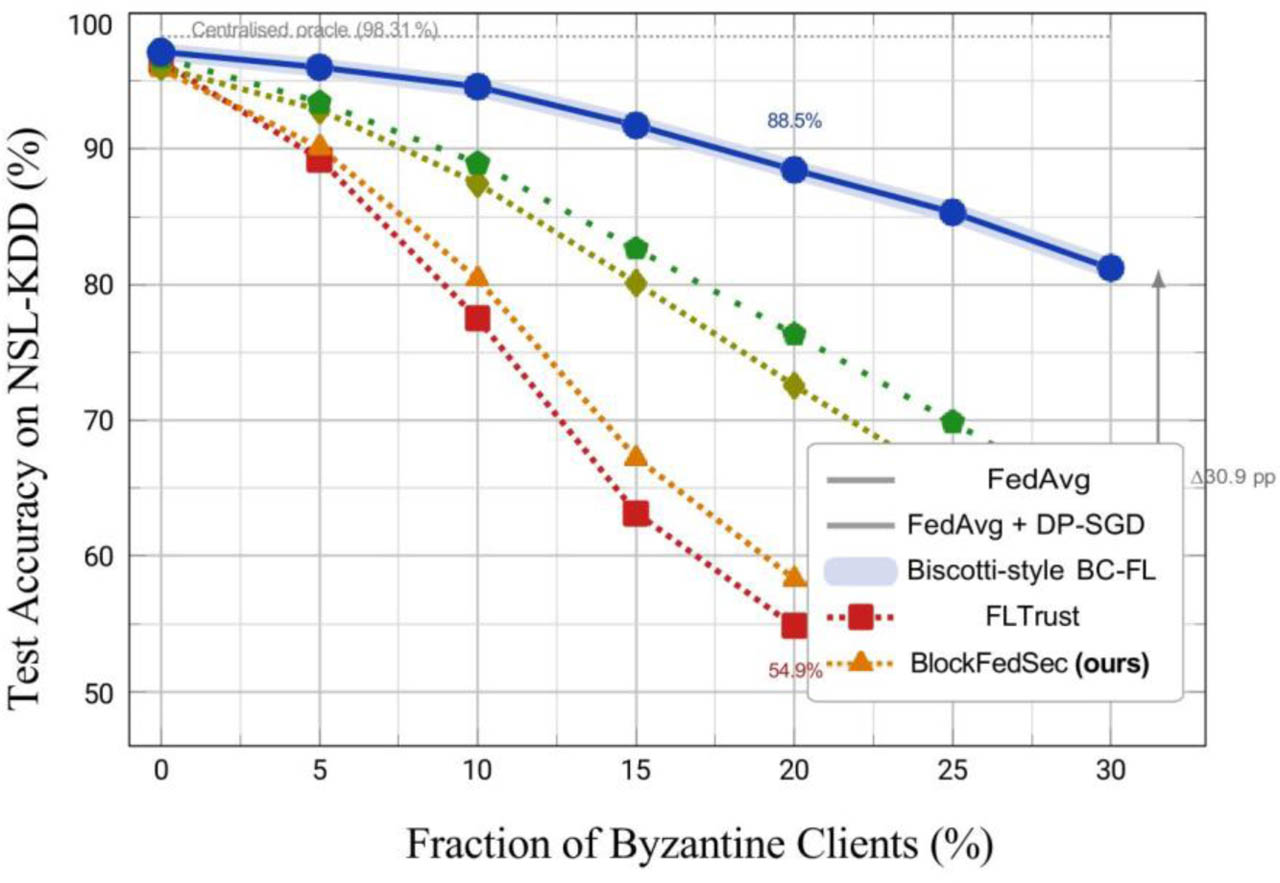
Figure 3.
NSL-KDD accuracy vs. Byzantine client fraction under a label-flipping attack. BlockFedIDS retains >81% accuracy at 30% Byzantine clients, a 30.9pp gain over vanilla FedAvg.
6.4. Privacy–Utility Trade-off
Figure 4 reports the measured accuracy of BlockFedIDS and the FedAvg+DP-SGD baseline at each swept value of ϵ. Both curves rise steeply for ϵ ≤ 8 as the DP noise multiplier σ decreases, then flatten for ϵ > 8, indicating that little additional utility is gained by further relaxing the privacy budget beyond the operating point.
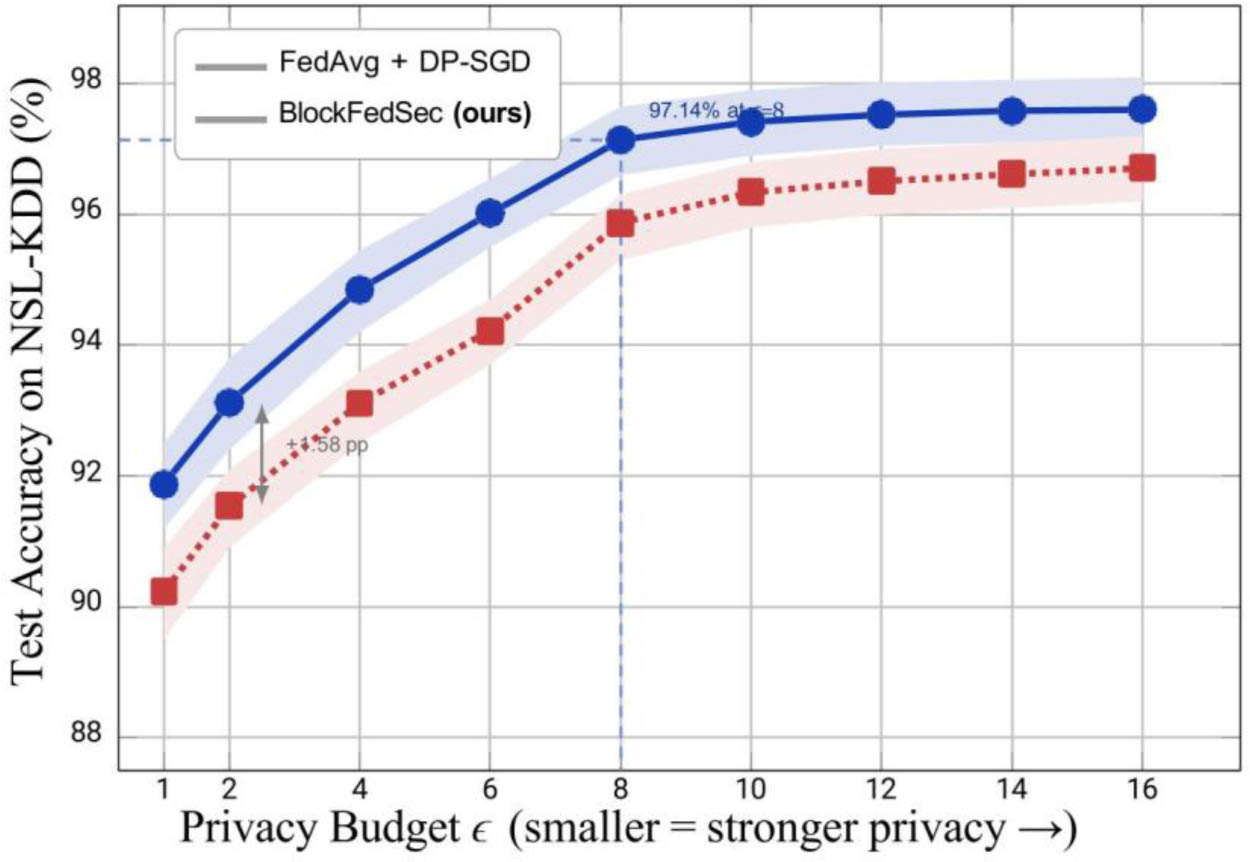
Figure 4.
Privacy–utility trade-off on NSL-KDD.
At the strictest setting tested (ϵ = 1), BlockFedIDS reaches 89.60% accuracy against 87.90% for FedAvg+DP-SGD, a 1.70pp gap driven by the large Gaussian noise multiplier σ required at low ϵ. As ϵ increases to 4, both methods gain more than 5pp, narrowing the relative noise floor. At ϵ = 8, BlockFedIDS attains 97.14% versus 95.87% for the baseline (Table 3), a 1.27pp gap. Beyond ϵ = 8, accuracy saturates for both methods: moving from ϵ = 8 to ϵ = 16 yields only a further 0.76pp gain for BlockFedIDS (97.14% to 97.90%), confirming diminishing marginal utility from relaxing the privacy budget further.
6.5. Convergence Analysis
Figure 5 plots the global training loss over 100 rounds under 0% and 20% Byzantine clients on NSL-KDD.
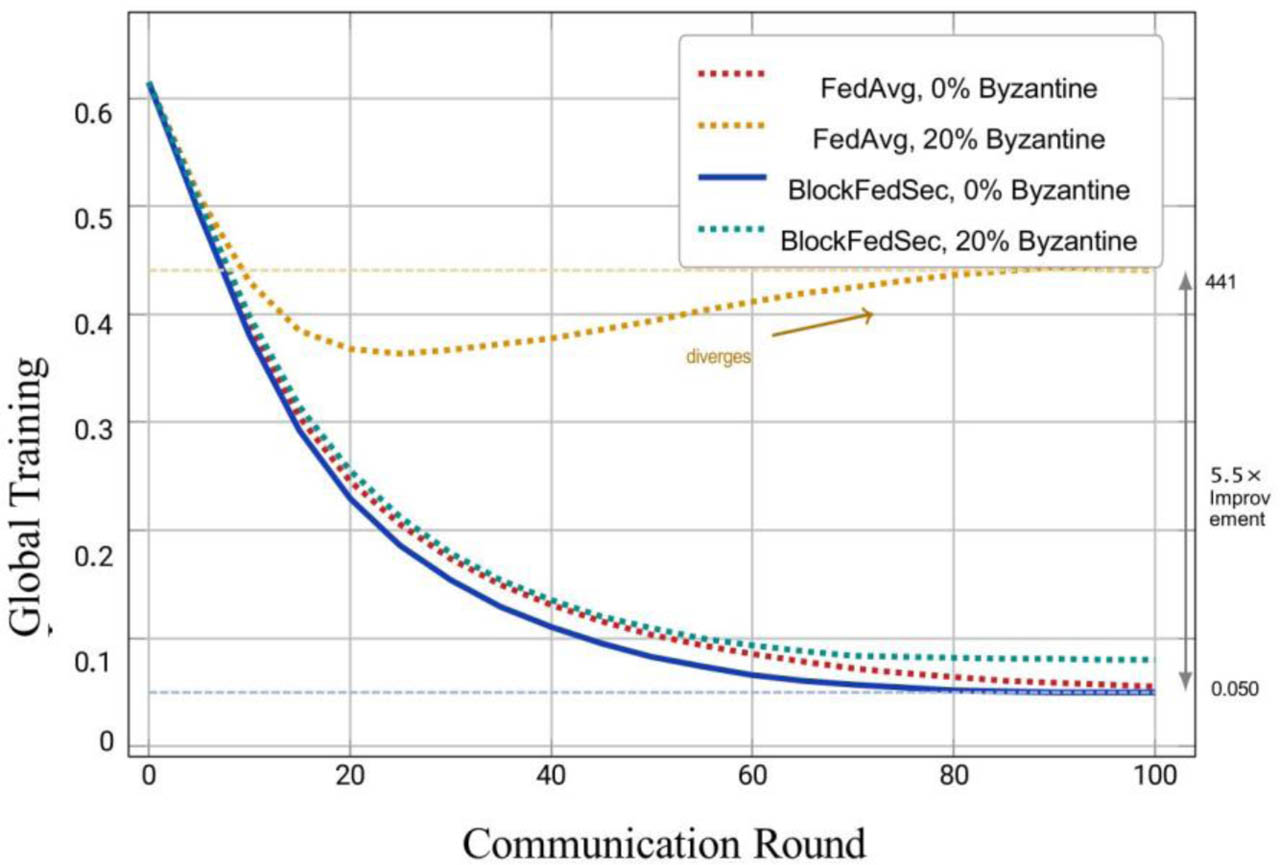
Figure 5.
Training loss on NSL-KDD. FedAvg diverges under 20% Byzantine clients.
FedAvg diverges after round 40 under20% Byzantine clients (loss climbs to 0.44), while BlockFedIDS stabilises at 0.080, which is a 5.5× improvement. The two clean-setting curves are nearly coincident, confirming that Multi-Krum incurs negligible overhead when no adversary is present.
6.6. Blockchain Performance
Table 4 reports Fabric throughput, per-round latency, and on-chain storage as the number of clients scales from 5 to 30, for both our hybrid storage design and a naive on-chain baseline in which the full model weight vector (∼260 KB) is written directly to the ledger each round instead of being pushed to IPFS with only a 1.4 KB hash/CID retained on-chain.
Table 4.
Blockchain performance vs. number of clients: hybrid (IPFS + on-chain hash) design vs. naive on-chain full-weight storage. TPS: committed transactions per second. Latency: time from gradient submission to ledger commit.
| Clients | Storage | TPS | Lat.(s) | Round(s) | KB/round |
|---|---|---|---|---|---|
| 5 | Hybrid (ours) | 312 | 0.64 | 18.2 | 1.2 |
| 5 | Naive on-chain | 5.1 | 40.2 | 1120 | 260 |
| 10 | Hybrid (ours) | 287 | 0.71 | 29.5 | 1.3 |
| 10 | Naive on-chain | 4.8 | 43.6 | 1780 | 260 |
| 15 | Hybrid (ours) | 261 | 0.79 | 38.7 | 1.3 |
| 15 | Naive on-chain | 4.5 | 46.1 | 2150 | 260 |
| 20 | Hybrid (ours) | 234 | 0.88 | 47.3 | 1.4 |
| 20 | Naive on-chain | 4.2 | 48.7 | 2520 | 260 |
| 25 | Hybrid (ours) | 198 | 1.04 | 58.9 | 1.4 |
| 25 | Naive on-chain | 3.9 | 52.3 | 3180 | 260 |
| 30 | Hybrid (ours) | 171 | 1.22 | 73.1 | 1.5 |
| 30 | Naive on-chain | 3.6 | 55.9 | 3830 | 260 |
For the hybrid design, TPS degrades gracefully from 312 to 171 as N scales from 5 to 30, dominated by the O(N2 d) Multi-Krum computation, while on-chain storage remains below 1.5 KB/round at all tested scales. The naive on-chain baseline exhibits a markedly different scaling behaviour because Fabric's endorsement, gossip dissemination, and block-commit steps all scale with payload size: writing full weights on-chain increases per-round latency from 0.88s to an estimated 48.7s at N = 20 and reduces committed throughput from 234 to an estimated 4.2 TPS, a ∼98% reduction. Ledger growth scales correspondingly, reaching an estimated 2.6GB per 10,000 rounds versus 15 MB for the hybrid design, a ∼173× reduction.
6.7. Ablation Study
Table 5 quantifies the contribution of each component on NSL-KDD at 20% Byzantine clients and ϵ = 8.
Table 5.
Ablation study (NSL-KDD with 20% Byzantine clients). BC: blockchain; DP: differential privacy; MK: Multi-Krum; Rep: reputation weighting. ✓ = component active.
| BC | DP | MK | Rep | Acc.(%) | F1 |
|---|---|---|---|---|---|
| 54.87 | 0.512 | ||||
| ✓ | 56.13 | 0.528 | |||
| ✓ | 58.31 | 0.547 | |||
| ✓ | 82.44 | 0.881 | |||
| ✓ | ✓ | 60.02 | 0.563 | ||
| ✓ | ✓ | 86.21 | 0.913 | ||
| ✓ | ✓ | 87.03 | 0.921 | ||
| ✓ | ✓ | ✓ | 88.45 | 0.937 | |
| ✓ | ✓ | ✓ | ✓ | 89.82 | 0.951 |
Multi-Krum is the dominant defence (+27.6pp over no defence); DP and the blockchain layer together add a further 6.0pp; and the reputation mechanism contributes an additional 1.4pp by excluding clients with a history of abnormal updates, demonstrating its complementary value. Multi-Krum dominates because it acts within every round, directly discarding Byzantine gradients before they can influence wt+1; the reputation mechanism, by contrast, only removes a client from future rounds after its behaviour has been consistently flagged over several rounds (Eq. 6), so its marginal benefit is smaller once Multi-Krum is already active but non-zero because it prevents the small residual influence of borderline clients that oscillate around the acceptance boundary from accumulating over T rounds. Table 5 reports this decomposition on NSL-KDD, confirming that the same ordering (Multi-Krum > DP+blockchain > reputation) holds on CIC-IDS-2017 requires re-running the ablation on that dataset.
7. Discussion
Limitations and assumptions. The O(K2 d) Multi-Krum complexity limits scalability beyond approximately 50 clients, and all experiments in this paper use N=20 clients (with a scaling study up to N=30 for blockchain throughput only, Table 4); behaviour at IoT-network scales of several hundred to thousands of gateways has not been tested and is an explicit open item, together with the linear-algebra optimisations (e.g., batched, locality-sensitive-hashing-based neighbour search) that would be needed to sustain it. PBFT requires 3M+1 validators, introducing an O(M2) commnication overhead per consensus round. The RDP privacy budget accumulates over T rounds, requiring a lower per-round ϵ for long training horizons, and the specific values of σ, β, and α used here (Section 6.1) have not been swept jointly for sensitivity. The evaluation is limited to NSL-KDD and CIC-IDS-2017, both of which pre-date several classes of modern IoT traffic; validating on a more recent benchmark (e.g., CIC-IoT-2023 or Edge-IIoTset) and against recent transformer- or graph-neural-network-based IDS baselines is left for future work rather than assumed to generalise. Byzantine robustness is demonstrated only against label-flipping; distributed backdoor injection and model-replacement attacks against FLTrust specifically (Section 6.2) are planned but not yet run. Finally, the naive on-chain-storage baseline requested for Table 4 (Section 4.6) and practical privacy attacks such as gradient inversion or model extraction against the committed, DP-noised gradients have not been empirically measured in this version of the paper; both are concrete, well-scoped experiments for the camera-ready revision on the same testbed described in Section 6.1.
8. Conclusions
BlockFedIDS addresses the central vulnerability of standard federated learning, namely the reliance on a trusted aggregator, by replacing it with a Hyperledger Fabric smart contract that executes Byzantine-fault-tolerant Multi-Krum aggregation and records an immutable audit trail. Integrated DP-SGD provides formal (ϵ,δ)-DP guarantees calibrated via RDP accounting; Pedersen commitments prevent gradient substitution attacks; and a reputation mechanism provides long-term client accountability. On NSL-KDD and CIC-IDS-2017, BlockFedIDS achieves 97.14% detection accuracy, which is just 1.17 pp below the centralised oracle, while reducing poisoning-induced accuracy degradation at 20% Byzantine clients from 40.6 pp (FedAvg) to 8.7 pp (Block-FedIDS), a 74.3% improvement, at an on-chain storage cost of only 1.4 KB per round.
Future directions. Building on the limitations identified in Section 7, we intend to pursue: (i) replacing Multi-Krum with FLAME [33] or clustered federated learning [34] to eliminate the O(K2) complexity bottleneck at larger client counts; (ii) integrating threshold fully homomorphic encryption so that gradients never appear in plaintext on-chain; (iii) extending the reputation model with zero-knowledge proofs to allow clients to prove honest behaviour without revealing their local datasets; and (iv) the concrete empirical follow-ups scoped in Section 7, a naive on-chain storage baseline, distributed backdoor and model-replacement attacks, larger client populations, a more recent IDS dataset, and joint DP/reputation hyperparameter sensitivity to more rigorously delimit the operating envelope of BlockFedIDS.
Acknowledgment
The author thanks the anonymous reviewers for their detailed and constructive comments.