Introduction
The family Poaceae includes rice (Oryza sativa L.), one of the most important cereal crops worldwide in terms of both production and human nutrition. Rice serves as the primary staple food for more than two-thirds of the global population, particularly in Asia, where nearly 90 % of global rice production and consumption occur (Bridge et al., 1990; Abodolereza & Racionzer, 2009). India ranks first among the world's leading producers, consumers, and exporters of rice (Anonymous, 2022). Within India, Bihar is a major rice-growing state, producing approximately 7.06 million tonnes annually from more than 3 million hectares; however, rice productivity in Bihar remains below the national average.
Rice productivity is constrained by multiple biotic and abiotic stresses, among which plant-parasitic nematodes (PPNs) constitute a major yield-limiting factor. Globally, PPN's are responsible for approximately 21.3 % yield losses, accounting for economic losses of about 102,039.79 million (USD 1.58 billion) (Kumar et al., 2020). Nematode-induced crop losses are reported to be considerably higher in developing countries (14.6 %) than in industrialized nations (8.8 %) (Sasser & Freckman, 1987). The impact of phytonematodes on rice production is therefore a growing concern for global food security (Jones et al., 2013).
PPNs are microscopic, worm-like, multicellular organisms characterized by bilateral symmetry and a pseudocoelomic body cavity. These nematodes primarily parasitize plant roots, although certain species may also attack stems, leaves, and other vegetative parts. They complete their parasitic life cycle by extracting cell sap from host tissues. The semi-aquatic nature of rice makes it particularly vulnerable to infestation by diverse phytonematode species, resulting in significant yield losses across different agro-climatic regions. Several PPNs have been reported to infest rice, with Meloidogyne spp. being the most prevalent, followed by Ditylenchus spp. and others (Prasad et al., 1992).
Among these, the rice root-knot nematode (Meloidogyne graminicola) is one of the most destructive species, capable of causing yield losses exceeding 50 % under various rice-growing ecosys-tems (Lorenzana et al., 1999; Kumar et al., 2020). This nematode is a serious parasite of upland, lowland, and deep-water rice. It is well adapted to flooded conditions, surviving for extended periods in waterlogged soils either as eggs within egg masses or as juveniles. The infective second-stage juveniles penetrate rice roots near the root cap region and migrate into the vascular tissues, where they induce the formation of specialized feeding structures known as giant cells. This activity results in the development of characteristic hook or horseshoe-shaped galls at the root tips, leading to impaired nutrient uptake and stunted plant growth. Above-ground symptoms include chlorosis, patchy growth, stunting, and ultimately significant yield reduction (Kyndt et al., 2014). The nematode feeding cells function as a continuous nutrient source throughout the parasite's life cycle, facilitating its growth and reproduction.
Despite the economic importance of rice and the damaging effects of PPNs, information on the occurrence and distribution of plant nematodes associated with rice in Bihar remains limited. However, a study has reported the distribution of PPNs in rice fields of the southeastern region (Agro-climatic Zone IIIA) of Bihar, high-lighting the need for further systematic investigations across other rice-growing areas of the state.
Materials and Methods
Location of survey and sample collection
The survey was conducted during the rice-growing season in the major rice-producing areas of Agro-climatic Zone IIIA of Bihar, India. Six districts, Sheikhpura, Lakhisarai, Jamui, Munger, Banka, and Bhagalpur, were selected for the study, all of which have a long history of rice cultivation. From each district, two blocks were selected for survey and sampling. From each block, a total of six samples were collected, comprising three soil samples and three corresponding plant (root) samples, following a random sampling approach. Soil samples (200 g each) were collected from the rhizosphere at a depth of approximately 20 cm from three locations within each block. Root samples were collected from the same plants from which soil samples were obtained. In total, 78 samples were collected, consisting of 39 soil samples and 39 root samples. All soil and root samples were placed in properly labeled polythene bags and stored in a refrigerator at cool temperatures to prevent desiccation and loss of nematodes prior to analysis. The samples were subsequently processed in the Nematology Laboratory of the Department of Entomology, Bihar Agricultural College, Sabour.
Extraction of plant parasitic nematodes from plant and soil materials
For the extraction of nematodes from plant tissues, 10 g of rice roots were washed thoroughly under running water to remove adhering soil particles. The roots were cut into 1 – 2 cm segments and macerated briefly in a blender. Nematodes were extracted from the macerated root material using the Modified Baermann Funnel Technique (Baermann, 1917). The nematode suspension was collected in 100 ml of water, and population counts were determined from three 10 ml subsamples. PPN's were extracted from soil samples using Cobb's Decanting and Sieving Method (Cobb, 1918). A composite sample of 100 cm3 soil was prepared from three randomly collected subsamples from each block. The soil was placed in a plastic container, mixed thoroughly with water, and allowed to stand for 15 – 20 seconds to permit the heavier soil particles to settle. The soil water suspension was then passed sequentially through a series of sieves with mesh sizes of 20, 60, 350, and 400 to recover nematodes of different sizes. The nematodes retained on the sieves were collected and brought to a final volume of 100 ml. Nematode counts were performed by withdrawing 10-ml aliquots from the thoroughly mixed suspension, with counts repeated 3 times to obtain a mean population density. The mean number of nematodes recovered from root and soil samples was used to estimate population density and for subsequent community analysis.
Nematodes were identified up to the genus level under an Olympus stereozoom microscope using standard morphological and taxonomic characters, following the identification keys described by Siddiqi (2000).
The formulas used for community analysis are summarised in the list of formulas.
Statistical analysis
The recorded observations were analyzed using one-way analysis of variance (ANOVA) under a completely randomized design (CRD). Statistical significance was evaluated at the 5 % (P < 0.05) and 1 % (P < 0.01) probability levels.
Ethical Approval and/or Informed Consent
No studies involving human participants or animals were conducted in this research; therefore, ethical approval was not applicable.
Results
Three genera of PPN's, Meloidogyne, Hirshmanniella, and Helicotylenchus, were recovered from rice root samples collected across the surveyed fields (Fig. 1). Among these, Meloidogyne was the most prevalent genus, followed by Hirshmanniella and Helicotylenchus. Root samples were collected from 13 blocks to assess the distribution of PPN's. The mean population density of Meloidogyne per 10 gm of rice roots was highest in Halsi and Jagdishpur blocks (146.6 and 146.9) and lowest in Jamui block (46.5) (Table 1). In contrast, the population densities of Hirshmanniella and Helicotylenchus did not differ significantly among the surveyed blocks. The mean population of Hirshmanniella ranged from 13.1 to 36.9, while that of Helicotylenchus ranged from 16.4 to 36.9 across blocks.
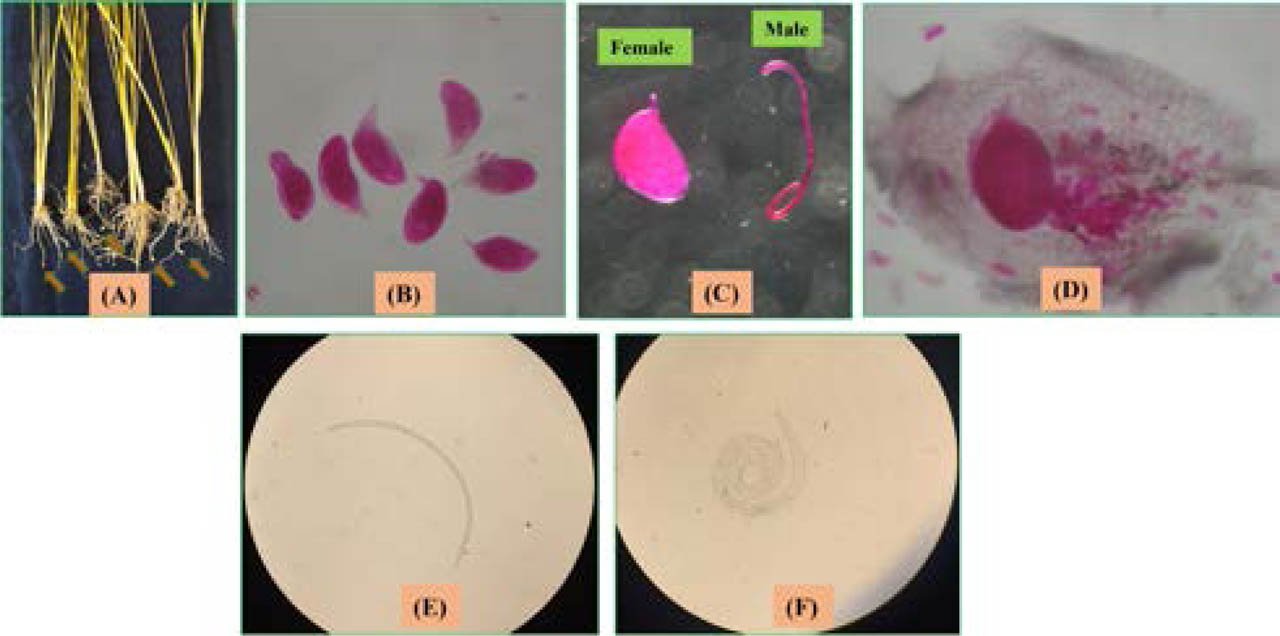
Fig. 1.
Gall formation on rice root by root knot nematode, Meloidogyne sp. (arrow indicated) (A), Immature stages of female of Meloidogyne sp. (B), Mature stage of female and male (C), Female of Meloidogyne sp. with eggmasses (D), Adult of Hirshmanniella sp. (E), and Adult of Helicotylenchus sp. (F).
Table 1.
Average number of plant parasitic nematodes (root samples) in surveyed blocks of rice fields of zone III A region, Bihar. The values of the number of plant parasitic nematodes are the mean of three replicates.
| Meloidogyne sp. | Hirshmanniella sp. | Helicotylenchus sp. | |
|---|---|---|---|
| Sheikhpura | 123.4 | 33.2 | 23.1 |
| Chewara | 103.3 | 16.9 | 26.5 |
| Halsi | 146.6 | 23.1 | 16.6 |
| Ramgarh Chowk | 106.8 | 36.5 | 23.1 |
| Jamui | 46.5 | 33.4 | 36.8 |
| Barhat | 56.6 | 33.4 | 23.6 |
| Munger | 53.2 | 36.9 | 23.4 |
| Tarapur | 116.7 | 16.4 | 36.9 |
| Rajoun | 123.5 | 13.1 | 23.2 |
| Sambhuganj | 103.1 | 16.6 | 16.4 |
| Jagdishpur | 146.9 | 23.4 | 26.8 |
| Shakhund | 76.6 | 13.5 | 23.5 |
| Sabour | 116.8 | 13.6 | 16.4 |
| C. D. | 11.2 | 6.2 | 5.1 |
| SE(m) | 3.8 | 2.1 | 1.7 |
| SE(d) | 5.4 | 3.0 | 2.4 |
| C. V. | 6.5 | 15.7 | 12.4 |
A total of nine genera of PPN's were identified from soil samples collected from rice fields, namely Meloidogyne, Hirshmanniella, Helicotylenchus, Hoplolaimus, Tylenchorhynchus, Criconemoides, Xiphinema, Longidorus, and Trichodorus. Among these, Meloidogyne was the dominant genus in soil samples. The mean population density of root-knot nematodes per 100 CC of soil was highest in Chewara blocks (83.2) (Table 2), while the lowest density was recorded in Jagdishpur (36.8). The remaining nematode genera were detected at comparatively lower densities, ranging from 13.1 to 36.7.
Table 2.
Average number of plant parasitic nematodes (soil samples) in surveyed blocks of rice fields of zone III A region, Bihar. The values of the number of plant-parasitic nematodes are the mean of three replicates.
| Meloidogyne sp. | Hirshmanniella sp. | Helicotylenchus sp. | Hoplolaimus sp. | Tylenchorhynchus sp. | Criconemoides sp. | Xiphinema sp. | Longidorus sp. | Trichodorus sp. | |
|---|---|---|---|---|---|---|---|---|---|
| Sheikhpura | 66.6 | 13.2 | 13.2 | 13.2 | 13.1 | 23.5 | 13.1 | 13.1 | 13.1 |
| Chewara | 83.2 | 16.4 | 13.2 | 23.4 | 23.2 | 33.4 | 23.2 | 23.5 | 23.4 |
| Halsi | 73.5 | 16.7 | 16.4 | 16.6 | 13.4 | 36.2 | 13.4 | 13.4 | 26.6 |
| Ramgarh Chowk | 46.4 | 36.5 | 13.1 | 33.1 | 16.5 | 23.4 | 16.6 | 16.4 | 36.4 |
| Jamui | 76.8 | 16.4 | 16.4 | 13.4 | 26.6 | 33.5 | 33.4 | 13.2 | 16.5 |
| Barhat | 66.7 | 23.4 | 13.6 | 16.8 | 23.4 | 16.8 | 16.7 | 23.2 | 13.2 |
| Munger | 43.1 | 23.6 | 13.4 | 13.5 | 13.2 | 26.4 | 13.9 | 13.4 | 13.4 |
| Tarapur | 63.6 | 33.4 | 23.8 | 16.4 | 23.2 | 26.6 | 16.4 | 33.6 | 13.1 |
| Rajoun | 56.9 | 13.8 | 13.5 | 13.2 | 13.4 | 16.4 | 23.8 | 26.4 | 13.6 |
| Sambhuganj | 53.7 | 16.6 | 16.8 | 23.3 | 23.4 | 33.2 | 23.4 | 16.5 | 23.4 |
| Jagdishpur | 36.8 | 13.4 | 13.4 | 13.5 | 13.5 | 23.4 | 13.1 | 23.6 | 13.5 |
| Shakhund | 46.9 | 36.7 | 23.4 | 16.4 | 26.4 | 13.5 | 16.4 | 13.4 | 16.7 |
| Sabour | 43.2 | 16.3 | 16.5 | 16.7 | 23.1 | 16.9 | 13.1 | 13.8 | 16.8 |
| C. D. | 7.6 | 5.0 | 4.3 | 5.7 | 3.9 | 3.5 | 3.5 | 3.7 | 3.7 |
| SE(m) | 2.6 | 1.7 | 1.4 | 1.9 | 1.3 | 1.2 | 1.2 | 1.2 | 1.2 |
| SE(d) | 3.6 | 2.4 | 2.1 | 2.7 | 1.9 | 1.7 | 1.7 | 1.8 | 1.7 |
| C. V. | 7.7 | 14.1 | 16.3 | 19.1 | 12.0 | 8.5 | 11.4 | 12.0 | 11.8 |
Community analysis of PPN's was conducted using a total of 78 root and soil samples. In root samples, Meloidogyne exhibited the highest absolute frequency (89.74 %), followed by Hirshmanniella (79.49 %) and Helicotylenchus (66.67 %) (Fig. 2A). Similarly, Meloidogyne showed the highest relative frequency (38.04 %), compared with Hirshmanniella (33.70 %) and Helicotylenchus (28.26 %) (Fig. 2B). The absolute density of Meloidogyne was markedly higher (1.02) than that of Hirshmanniella and Helicotylenchus (0.24 each) (Fig. 2C). A comparable trend was observed for relative density, with Meloidogyne accounting for 67.80 % of the total nematode population, while Hirshmanniella contributed 15.90 % (Fig. 2D). The prominence value was highest for Meloidogyne (96.15 %), whereas lower values were recorded for Hirshmanniella (21.22 %) and Helicotylenchus (19.92 %) (Fig. 2E). Likewise, Meloidogyne exhibited the highest relative prominence value (70.03 %), while Helicotylenchus showed the lowest (14.51 %) (Fig. 2F).
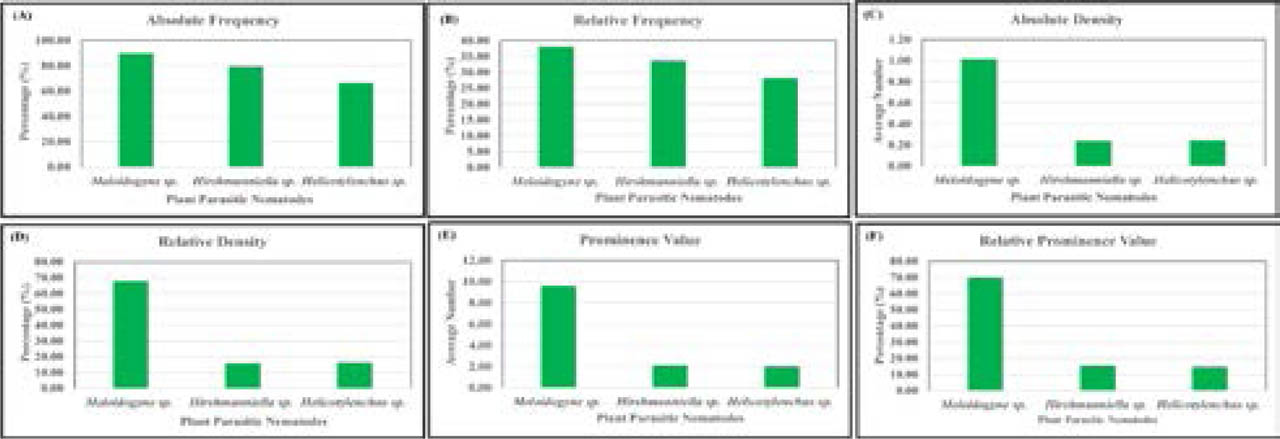
Fig. 2.
Community analysis of plant-parasitic nematodes (root samples). Absolute frequency (A), Relative frequency (B), Absolute density (C), Relative density (D), Prominence value (E) and Relative prominence value (F).
Community analysis of soil samples revealed a similar pattern. Meloidogyne showed the highest absolute frequency (89.74 %), followed by Hirshmanniella (71.79 %) and Hoplolaimus (64.10 %) (Fig. 3A). The lowest absolute frequency was observed for Trichodorus (23.08 %). In terms of relative frequency, Meloidogyne again dominated (21.47 %), whereas Trichodorus contributed the least (5.52 %) (Fig. 3B). The highest absolute density was recorded for Meloidogyne, while the lowest densities were observed for Longidorus and Trichodorus (0.19 each) (Fig. 3C). Relative density analysis showed that Meloidogyne accounted for 27.35 % of the total nematode population, whereas Helicotylenchus had a lower relative density (7.47 %) (Fig. 3D). Prominence value analysis further confirmed the dominance of Meloidogyne (26.97 %), while Trichodorus exhibited the lowest value (8.87 %) (Fig. 3E). Similarly, the highest relative prominence value was observed in Meloidogyne (36.11 %), and the lowest in Trichodorus (5.82 %) (Fig. 3F).
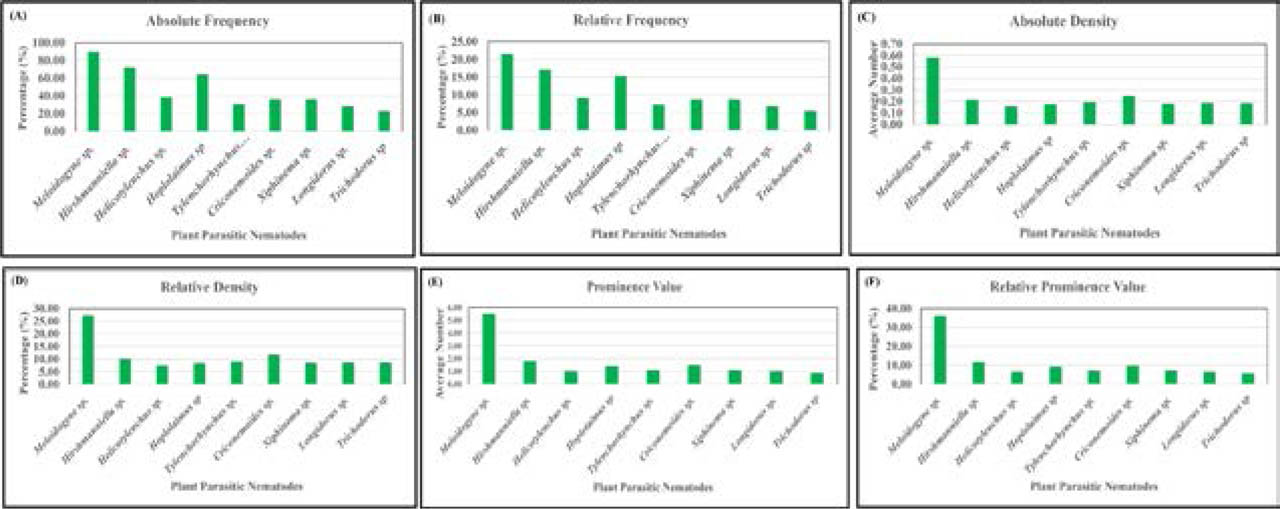
Fig. 3.
Community analysis of plant-parasitic nematodes (soil samples). Absolute frequency (A), Relative frequency (B), Absolute density (C), Relative density (D), Prominence value (E) and Relative prominence value (F).
Discussion
Rice is the primary source of dietary calories for a large proportion of Bihar's population; however, its productivity remains suboptimal. Among the biotic constraints, PPNs constitute a major yet often overlooked threat to rice production due to their microscopic size and cryptic nature. Symptoms caused by PPN infestation frequently resemble those associated with water stress or nutrient deficiencies, leading to underdiagnosis in farmers' fields. Therefore, understanding the distribution and population dynamics of PPNs is essential for farmers, extension personnel, and policymakers to design effective nematode management strategies. Despite their economic importance, information on the occurrence and spatial distribution of nematodes associated with rice cultivation in Bihar is limited. Consequently, the present study was undertaken in the rice-growing areas of agro-climatic zone IIIA of Bihar to elucidate nematode diversity, distribution patterns, and quantitative parameters associated with the rice ecosystem.
The present investigation documented the occurrence of nine genera of PPNs in rice fields of agro-climatic zone IIIA, namely Meloidogyne, Hirshmanniella, Helicotylenchus, Hoplolaimus, Tylenchorhynchus, Criconemoides, Xiphinema, Longidorus, and Trichodorus. Among these, Meloidogyne emerged as the predominant genus, indicating a potential risk to rice productivity in the region. The nematode community structure varied between root and soil samples, reflecting differences in habitat preference and feeding behavior. Similar patterns of dominance have been reported by Pervez et al. (2022), who observed Meloidogyne graminicola as the predominant species in integrated pest management fields under a rice–wheat cropping system in Gautam Buddh Nagar, Uttar Pradesh. In contrast, Aphelenchoides besseyi was more prevalent in Rohtak, Haryana. The predominance of Meloidogyne spp. in both root and soil samples in the present study is consistent with these earlier observations.
Khan (2005) reported the presence of fifteen PPN species in a jute-rice cropping system, including M. graminicola, Hirshmanniella oryzae, H. mucronata, Hoplolaimus indicus, Pratylenchus coffeae, and P. brachyurus in rice, many of which were associated with substantial yield losses. In the present study, three genera, Meloidogyne, Hirshmanniella, and Helicotylenchus, were consistently detected in root samples, while soil samples harbored a broader diversity comprising nine nematode genera. These findings under-score the importance of soil as a reservoir for nematode diversity and highlight the need for soil-based diagnostic approaches in rice ecosystems. Musarrat et al. (2016) further emphasized the complexity of rice nematode communities by reporting 39 nematode genera across herbivorous, fungivorous, bacterivorous, omnivorous, and predatory groups, indicating a highly dynamic soil food web.
PPN's are characterized by slow movement and aggregated distribution patterns, which prevent rapid epidemic development. Instead, they cause chronic yield losses that intensify gradually over successive cropping seasons. Continuous rice monoculture, as commonly practiced in the region, favours the build-up of nematode populations, leading to a progressive increase in disease severity over time. These findings highlight the need for long-term nematode management strategies, including crop rotation, resistant varieties, and integrated nematode management practices, to sustain rice productivity in Bihar.
Conclusion
The present investigation on the occurrence and distribution of PPN's elucidated their association with rice cultivation in agro-climatic zone IIIA of Bihar. Community analysis clearly revealed the predominance of Meloidogyne spp. in the surveyed rice fields, highlighting the urgent need for region-specific, sustainable management strategies to effectively suppress this economically important nematode. Although other plant-parasitic nematode genera, including Hirshmanniella, Helicotylenchus, Hoplolaimus, Tylenchorhynchus, Criconemoides, Xiphinema, Longidorus, and Trichodorus, were detected at comparatively lower population densities, their gradual build-up over time cannot be overlooked. Therefore, integrated nematode management approaches should consider the entire nematode complex rather than focusing solely on the dominant species. Overall, the widespread occurrence and higher frequency of root-knot nematode (Meloidogyne spp.) in both root and soil samples underscore its major role in limiting rice productivity in the region.
Acknowledgment
The authors sincerely acknowledge the financial support provided by the Directorate of Research, Bihar Agricultural University, Sabour, under Project Code: SNP/CP/Kh/2024-05. The authors sincerely thank Dr. Kiran Kumari, Chairman, Department of Entomology, Bihar Agricultural College, Sabour, for her valuable technical support and constructive inputs in shaping this research manuscript. The authors also express their profound gratitude to Dr. D. R. Singh, Hon'ble Vice-Chancellor, Bihar Agricultural University, Sabour, Bhagalpur, India, for his constant encouragement, valuable guidance, and support throughout the preparation of this manuscript.