Introduction
Ascaris lumbricoides is a parasitic worm classified among the soil-transmitted helminths (STHs). Human infection occurs through contact with its eggs, which commonly develop and persist in the warm, moist soils of tropical and subtropical regions (Bethony et al., 2006). Transmission of A. lumbricoides is primarily through the fecal-oral route. This may be direct or indirect through secondary sources such as food, water, vegetables, fruits, contaminated hands and other objects (Singh & Idris, 2016; Onyido et al., 2016; Egbuche et al., 2024; Egbuche et al., 2025).
Infection with A. lumbricoides (Ascariasis) is associated with a wide range of health complications, particularly in children. Clinical manifestations often become evident only when the intensity of infection is high (Hotez et al., 2008). The infection can lead to intestinal obstruction, anemia, and malnutrition (Hotez et al., 2006), and in severe cases, may result in complications such as pancreatitis, as well as intestinal and biliary obstructions requiring surgical intervention (Lee et al., 2012). Heavy infections can further cause malnourishment, physical weakness, and cognitive disability (Hotez et al., 2008). Among children, A. lumbricoides infection is strongly linked to malnutrition (Crompton et al., 2022), poor school performance (Miguel et al., 2003; WHO, 2024), anemia and stunted growth (Stoltzfus et al., 1997), as well as cognitive impairment (Pabalan et al., 2018). Consequently, it is regarded as one of the world's leading causes of physical and intellectual retardation (Bethony et al., 2006; WHO, 2024). In addition, A. lumbricoides infections can also have significant economic and social impacts, particularly in rural and resource-poor communities (WHO, 2024).
Ascariasis is highly endemic in Nigeria, with varying temporal and spatial prevalence: 11.75 % in Kebbi State (Galamaji et al., 2019), 27 % in Benue State (Okoh et al., 2021), over 60 % in Ebonyi State (Anorue et al., 2023), and 21 % in Adamawa State (Musa et al., 2024). In Anambra State, Nigeria, Ascariasis is a public health concern, with a 35.4 % prevalence recently reported in Anam (Nnatuanya et al., 2025). Across various study populations investigated for soil-transmitted helminth infections, A. lumbricoides has consistently been reported as the most prevalent species, though rates vary. For instance, it accounted for 3.9 % out of an overall prevalence of 4.1 % in Njikoka LGA (Egbuche et al., 2025), 16.9 % out of 35.2 % in Anaocha LGA (Aribodor et al., 2025), 33.7 % out of 38.1 % in Mgbakwu, Awka North LGA (Egbuche et al., 2024), 17.2 % out of 44.2 % in Orumba North LGA (Nwankwo et al., 2021), and 22 % out of 42 % in Nnewi North LGA (Ukibe et al., 2018), among other reports. The highest prevalence occurs in areas where sanitation is inadequate and water supplies are unsafe (WHO, 2024).
Despite the persistence and high prevalence of A. lumbricoides infections in Anambra State, a significant gap remains, as the prevalence and intensity of the infection in many communities are yet to be adequately documented. One such community of interest is Aguleri, a major agrarian area in the state that encompasses both rural and urban settings. Its geographic location, ecological conditions, and socioeconomic characteristics make it particularly conducive to the transmission of the disease. This study aims to fill the gap by providing prevalence and intensity data on Ascariasis, needed to design effective control strategies and improve the health and well-being of people living in the area. Furthermore, research on A. lumbricoides infection has largely focused on pre-school and school-aged children. Little or no attention has been paid to the adult population, who could serve as a source of infection and reinfection in children (Egbuche et al., 2025). Therefore, the present study adopted a community-based survey approach to ensure the inclusion of individuals across all socio-demographic groups, thereby enabling an assessment of the contribution of adults and other population groups to the occurrence of ascariasis. The overall aim of this study was to investigate the status of ascariasis in Aguleri, Anambra State, Nigeria.
Materials and Methods
Study Area
The study was conducted in Aguleri, the largest town in Anambra East LGA, Anambra State, Nigeria, with the coordinates: Latitude 6°20′N to 6°42′N and Longitude 6°50′E to 6°56′E. Major settlements in the study area where stool samples were collected are indicated by red circles in Figure 1. The boundary communities captured in Figure 1 are Umueze Anam, Obodola, and Oroma Otu in Anambra West LGA; Isinyi-Nando and Igbariam in Anambra East LGA; and Anaku and Igbakwu in Ayamelum LGA, all located in Anambra State. Aguleri is characterized by a diverse topography and covers an area of approximately 380 square kilometers, with an estimated population of 900,000 people. Aguleri is currently divided into three main quarters: Igboezunu, Ivite, and Enugwu na Eziagulu (Ugwu na Adegbe), with component families present in both Aguleri Uno and Aguleri Otu. The town is recognized as a significant agricultural hub in Anambra State, with a predominantly lush, fertile landscape that supports agriculture, the mainstay of the local economy. Aguleri experiences a tropical rainforest climate typical of southeastern Nigeria, with temperature, rainfall and humidity ranges of 26.2°C – 30.3°C, 0mm – 680.8mm and 64 % – 88 %, respectively (Egbuche et al., 2020). The climate is marked by two distinct seasons: the wet season (April – October) and the dry season (November – March). The town is blessed with significant river systems, and the confluence of the Omambala (River Anambra) and Ezu rivers is located there (Fig. 1). The rivers provide water for domestic use and serve as important transportation routes in that area. The river is susceptible to pollution from agricultural runoff, industrial discharge, open defecation and domestic waste, which facilitates the transmission of parasitic diseases associated with poverty, poor sanitation and the unavailability of clean water. Health facilities in Aguleri include: Immaculate Heart Specialist Hospital Aguleri, Solution General Hospital Enugwu-Otu Aguleri, Psychiatric Hospital Igboezunu Aguleri, a number of Private Hospitals and Primary Health Centers (PHCs). There are several Basic schools and several secondary schools in Aguleri.
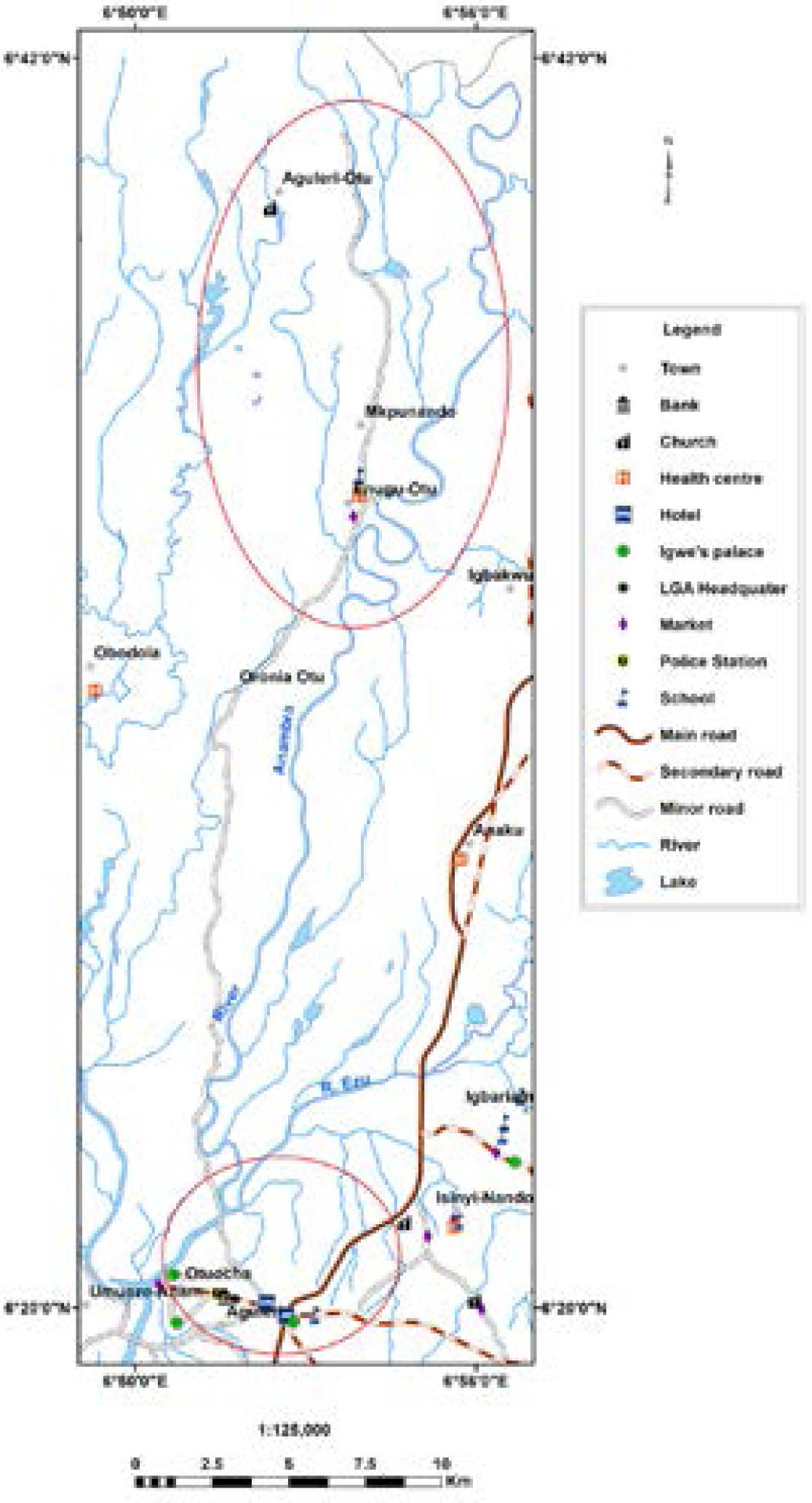
Fig. 1.
Map of the study area.
The study area is a large expanse of land and water bodies that stretched from Latitude 6°20′N to 6°42′N and Longitude 6°50′E to 6°56′E. Major settlements in the study area where stool samples were collected are indicated by red circles. The boundary communities captured are Umueze Anam, Obodola, and Oroma Otu (spelt Oronia otu in the reference map) in Anambra West LGA; Isinyi-Nando and Igbariam in Anambra East LGA; and Anaku and Igbakwu in Ayamelum LGA, all located in Anambra State.
Study Design
This study used a community-based, cross-sectional survey approach over a six-month period (Dec 2024 – May 2025). The study involved the collection and parasitological examination of stool samples to determine Ascariasis prevalence and intensity.
Study Population
The study population included individuals with diverse socio-demographic characteristics who were inhabitants of the study area and had stayed or lived there for up to six months before the commencement of the study.
Sample Size Determination
The minimum sample size for this study was determined using the Charan & Biswas (2013) method for sample size calculation in cross-sectional studies. Thus
Where, Z = value for selected alpha level of 0.025 in each tail = 1.96
P (prevalence) = 0.354 (Nnatuanya et al., 2025), based on the most recent report on A. lumbricoides prevalence in a location geographically close to and with a similar ecological setting as the present study area in Anambra State.
q = 1 - p = 0.646
d = acceptable margin of error for proportion being estimated = 0.05.
The calculation done was as follows:
Therefore, the minimum sample size calculated was approximately 352, but an additional 10 participants were included to account for potential non-response or incomplete data, bringing the total sample size to 362.
Selection of Study Participants
The study participants were selected using stratified and convenient sampling methods. Each quarter (Ivite, Igboezunu, Enugwu na Eziagulu) and region (Aguleri Uno and Aguleri Otu) were considered, thereby giving a total of six (6) strata for the study area (i. e., 3 quarters × 2 regions = 6 strata). Thus, the following strata were used in the study: Enugwu na Eziagulu Uno, Ivite Aguleri Otu, Igboezunu Aguleri Otu, Ivite Aguleri Uno, Enugwu na Eziagulu Otu and Igboezunu Aguleri Uno. These strata were defined to facilitate understanding of the epidemiological distribution of the disease rather than for strict geographical divisions. To ensure representation across strata while maintaining the required sample size, the population proportions in each stratum were considered. This approach influenced the potential for equal representation; however, the emphasis was on proportional inclusion, ensuring that each stratum contributed to the sample in proportion to its relative size in the population. In each stratum, a convenient sampling method was used to select participants mobilized at the Primary Health Centers, marketplaces, schools, pharmacies and drug stores of each stratum, as the case may be. Selection of participants was based on age and gender proportions for each stratum.
Inclusion criteria
All residents of diverse social classes who were born and bred in the study area, or have lived for not less than six months, and gave their consent to participate in the study.
Exclusion criteria
Those who were not residents of Aguleri and/or had not lived in the study area for up to 6 months were excluded from the study. Individuals over 80 years of age and those who had taken anti-helminthic medication within the past three months, prior to the commencement of the study, were excluded.
Collection of Stool Samples
A day before the collection of stool samples, a well-labeled, transparent, sterile specimen container was provided to each study participant or their guardian. An applicator stick and a clean, plain paper were also given to them. The participants were instructed on how to produce stool samples early the next morning, which was the sample pick-up day. The instructions given to the participants included: washing of hands thoroughly with soap and water, passing of stool on a clean plain paper lined on the floor or on a clean bowl (whichever is convenient), using the applicator stick provided with the container to collect a small amount of stool (about 1 – 2 teaspoons), covering the sample container and tightening the lid to submit. The stool samples were collected and preserved in an ice bag stacked with ice cubes within 10 minutes of collection, then transported to the Parasitology and Entomology laboratory of Nnamdi Azikiwe University, Awka, in 50 minutes for immediate processing. Collection was done in batches over a period of six months to ensure efficiency.
Parasitological Examination of Stool Specimens
Each stool specimen was examined both macroscopically and microscopically. In stool macroscopy, the color, consistency and presence of mucus, blood, worm segments and adult worms were examined in the stool specimen. Stool microscopy to detect A. lumbricoides eggs or ova was done using direct (saline) wet mount, iodine wet mount and Kato-Katz techniques.
Microscopy of stool sample using Direct (Saline) and Iodine Wet Mount techniques
Direct (saline) and Iodine Wet Mounts were carried out following the standard of Cheesbrough (2009). Using an applicator stick, a small portion of the sample was emulsified in a drop of 0.85 % normal saline and placed on a clean glass slide. A second slide was prepared by mixing another small portion of the stool sample in a drop of Lugol's iodine solution (diluted). Each preparation was covered with a clean coverslip and examined with a light microscope. The 10× objective was used first to locate the parasite elements, and then the 40× objective to identify the ova and larvae of A. lumbricoides.
Microscopy of stool sample using the Kato-Katz technique
Following the manufacturer's instructions, approximately 3 grams of each stool sample were deposited onto absorbent paper and spread out using an applicator stick. A mesh gauze screen was placed over the loosened stool sample, and with the right amount of pressure, debris was allowed to filter through. The applicator stick was used to collect and transfer the sieved feces to fill the hole in the standard 41.7 mg template on a clean, grease-free glass slide, while ensuring that no air bubbles were trapped. The feces in the hole were smoothed, and excess feces were removed with a spatula. The template was lifted up cautiously and placed in a bucket filled with a concentrated detergent mixed with water. The stool sample was covered with a cellophane piece soaked in a methylene blue-glycerol solution overnight and gently pressed onto a different glass slide to spread the sample evenly in a circular shape. The glass slide was carefully slid to the side to prevent tearing the cellophane. The prepared slides were allowed to stand for 30 to 60 minutes to allow for proper clearing, after which they were placed on the microscope with the clear side facing up. It was viewed using the 10× and 40× objectives of the light microscope. The identified A. lumbricoides eggs were counted and documented in each positive sample. Each egg observed was counted, and the egg count per gram (EPG) of stool was calculated by multiplying the number of eggs by 24 (as per the 41.7 mg template standard). This helped determine the intensity of infection based on the WHO (2024) classification for light, moderate, or heavy worm burdens. To ensure accuracy, each slide was independently read by two trained personnel, one at a time.
Statistical Analysis
The data obtained were analyzed using Chi-square analysis and ANOVA in the Statistical Package for the Social Sciences (SPSS), Version 25.0. Significance level was set at 5 %. The chi-square test was used to compare the prevalence of A. lumbricoides infection across categories of the variables investigated. One-way Analysis of Variance (ANOVA) was used to compare the intensity of infection (mean egg count) among various categories of the variables investigated.
Ethical Approval and/or Informed Consent
Ethical Approval
This study involved human participants, and all procedures were in accordance with the ethical standards of the institutional ethics committee and the 1964 Helsinki Declaration and its later amendments. This Research has complied with all relevant national regulations and institutional policies, and is in accordance with the tenets of the Helsinki Declaration. It has been approved by the Health Research Ethics Committee of Chukwuemeka Odumegwu Ojukwu University Teaching Hospital (COOUTH), Amaku, Awka, Anambra State, Nigeria. The Ethical approval Reference number is COOUTH/HREC/ETH.C/VOL.1/FN:04/406.
Advocacy Visit
Prior to the commencement of the study, advocacy visits were made to relevant Community and Institutional stakeholders to obtain their support and cooperation. These visits included consultations with the Traditional Rulers of the Aguleri communities, the President-General (PG) of Aguleri, Head Teachers of the selected schools, Heads of Health Departments, Directors of Pharmacies, Owners of Chemists' shops, and market heads. During these meetings, the study's purpose, objectives, and procedures were clearly explained, and the significance of the research for public health intervention was emphasized.
Informed Consent
All study participants were fully informed about the nature of the research, including their right to decline participation or withdraw at any point without any negative consequences. To maintain ethical standards, oral informed consent was obtained from each participant before the collection of socio-demographic data and stool samples. For minors, consent was obtained from their parents or guardians, with the children's assent. Confidentiality of all responses and sample results was strictly maintained throughout the study.
Results
Prevalence of Ascariasis
A total of 362 stool specimens were subjected to parasitological examination for detection of diagnostic stages of A. lumbricoides. Macroscopic examination for consistency showed that 61.9 % (n = 224) of the stool specimens were formed, 27.9 % (n = 101) were soft, 5.5 % (n = 20) were loose, and 4.7 % (n = 17) were watery. There was a presence of mucus in 6.1 % (n = 22) of the stool specimens. No worm (full or the segment) was observed in the macroscopic examination.
An overall prevalence of Ascaris lumbricoides infection of 38.1% (n = 138) was recorded in this study (Table 1). Based on the study sites (regarded as strata), the highest prevalence (47.5 %; n = 28) was observed in Ivite Aguleri Uno, while the lowest prevalence (28.6 %; n = 8) was observed in Ivite Aguleri Otu. However, there was no significant difference in prevalence across the study sites (P = 0.378). Prevalence stratified by gender was 43.7 % (n = 76) for males and 33 % (n = 62) for females. The difference in prevalence based on gender was statistically significant (P = 0.0364). Age group with the highest (49 %; n = 47) prevalence of A. lumbricoides infection was ‘< 5 years’, whereas the age group 16 – 25 years recorded the least (25.4 %; n = 16) prevalence. The age-based difference in prevalence was statistically significant (P = 0.013). Occupation-wise, Farmers had the highest prevalence (55.9 %; n = 19), while students had the lowest (15.1 %; n = 8). There was a significant difference in the prevalence of A. lumbricoides infection by occupation (P = 0.002). Considering the highest level of educational qualification attained by the study participants, the highest (46.4 %; n = 78) and lowest (26 %; n = 33) prevalence were observed among participants with nursery and secondary qualifications, respectively. Analysis of prevalence by highest level of educational qualification showed statistically significant differences (P = 0.002).
Table 1.
Prevalence of soil-transmitted helminth infections in Aguleri.
| Variable | Category | Number examined | Number positive | Prevalence (%) | P value |
|---|---|---|---|---|---|
| Overall | - | 362 | 138 | 38.1 | - |
| Species | Ascaris lumbricoides | 362 | 138 | 38.1 | - |
| Study sites | Enugwu na Eziagulu Uno | 90 | 35 | 38.9 | 0.378 |
| Ivite Aguleri Otu | 28 | 8 | 28.6 | ||
| Igboezunu Aguleri Otu | 45 | 14 | 31.1 | ||
| Ivite Aguleri Uno | 59 | 28 | 47.5 | ||
| Enugwu na Eziagulu Otu | 36 | 11 | 30.6 | ||
| Igboezunu Aguleri Uno | 104 | 42 | 40.4 | ||
| Gender | Male | 174 | 76 | 43.7 | 0.036 |
| Female | 188 | 62 | 33.0 | ||
| Age (years) | < 5 | 96 | 47 | 49.0 | 0.013 |
| 5 – 15 | 131 | 44 | 33.6 | ||
| 16 – 25 | 63 | 16 | 25.4 | ||
| 26 – 35 | 45 | 22 | 48.9 | ||
| 36 – 45 (up to 58 years) | 27 | 9 | 27.3 | ||
| Occupation | Pupils | 149 | 59 | 39.6 | 0.002 |
| Students | 53 | 8 | 15.1 | ||
| Traders | 22 | 11 | 50.0 | ||
| Farmer | 34 | 19 | 55.9 | ||
| Fisherman | 11 | 6 | 54.5 | ||
| Others | 93 | 35 | 37.6 | ||
| Education | Nursery | 168 | 78 | 46.4 | 0.002 |
| Primary | 67 | 27 | 40.3 | ||
| Secondary | 127 | 33 | 26.0 |
Intensity of Ascariasis (Table 2)
Among infected individuals, the mean egg count was 192.5 ± 71.1 eggs per gram of feces (EPG), ranging from 24 to 3000 EPG. Considering different study sites (strata), mean egg count was highest (636 ± 328.1 EPG) in Ivite Aguleri Uno, and lowest (42 ± 11.5 EPG) in Enugwu na Eziagulu Otu. However, the difference in mean intensity among different study sites was not statistically significant (P = 0.068). In terms of age, males had a higher mean egg count (267.6 ± 129.1 EPG) than their female counterparts (48 ± 528 EPG), but the difference was not statistically significant (P = 0.257). Mean egg count recorded based on Age showed that the age range ‘5 – 15 years’ had the highest value, 394.5 ± 214.2 EPG, while the age range ‘16 – 25 years’ had the lowest value, 52 ± 15.7 EPG. Nevertheless, the differences observed in the mean egg count stratified by age were not statistically significant (P = 0.427). Mean egg count for various occupations showed that ‘pupils’ had the highest, 314.3 ± 165.1 EPG, while Traders had the least, 24 ± 0 EPG; though the difference was not statistically significant (P = 0.818). Based on the highest level of educational qualifications of the participants, there was the highest mean egg count, 336 ± 296.1 EPG, among participants with ‘primary education’. Least egg count, 84 ± 20.4 EPG, was recorded among participants with ‘secondary education’; the difference, however, was not statistically significant (P = 0.512).
Table 2.
Intensity of soil-transmitted helminth infections in Aguleri.
| Range | Mean | ||||
|---|---|---|---|---|---|
| Overall | Ascaris lumbricoides | 138 | 24.0 – 3000.0 | 192.5±71.1 | |
| Study sites | Enugwu na Eziagulu Uno | 35 | 24.0 – 360.0 | 127.4±31.4a | 0.068 |
| Ivite Aguleri Otu | 8 | 24.0 – 72.0 | 48.0±13.9a | ||
| Igboezunu Aguleri Otu | 14 | 24.0 – 192.0 | 91.2±29.8a | ||
| Ivite Aguleri Uno | 28 | 24.0 – 3000.0 | 636.0±328.1a | ||
| Enugwu na Eziagulu Otu | 11 | 24.0 – 72.0 | 42.0±11.5a | ||
| Igboezunu Aguleri Uno | 42 | 24.0 – 120.0 | 56.0±8.3a | ||
| Gender | Male | 76 | 24.0 – 3000.0 | 267.6±129.1a | 0.257 |
| Female | 62 | 24.0 – 528.0 | 104.3±26.2a | ||
| Age (years) | < 5 | 47 | 24.0 – 528.0 | 117.2±34.9a | 0.427 |
| 5 – 15 | 44 | 24.0 – 3000.0 | 394.5±214.2a | ||
| 16 – 25 | 16 | 24.0 – 120.0 | 52.0±15.7a | ||
| 26 – 35 | 22 | 24.0 – 144.0 | 69.0±16.0a | ||
| 36 – 45 (up to 58 years) | 9 | 72.0 – 264.0 | 152.0±57.7a | ||
| Occupation | Pupils | 59 | 24.0 – 3000.0 | 314.3±165.1a | 0.818 |
| Students | 8 | 24.0 – 120.0 | 56.0±32.0a | ||
| Traders | 11 | 24.0 – 24.0 | 24.0±0.0a | ||
| Farmer | 19 | 24.0 – 264.0 | 93.0±27.8a | ||
| Fisherman | 6 | 24.0 – 72.0 | 72.0±0.0a | ||
| Others | 35 | 24.0 – 528.0 | 145.8±43.1a | ||
| Education | Nursery | 78 | 24.0 – 2064.0 | 187.7±73.6a | 0.512 |
| Primary | 27 | 24.0 – 3000.0 | 336.0±296.1a | ||
| Secondary | 33 | 24.0 – 264.0 | 84.0±20.4a |
Discussion
This study investigated the status of ascariasis in Aguleri, Anambra State, Nigeria. Unlike previous studies that relied solely on the Kato-Katz technique, we employed adjunct diagnostic methods, including saline and iodine wet mounts, to enhance detection sensitivity, particularly for stool samples with low STH infection levels. An overall prevalence of A. lumbricoides infection of 38.1 % was recorded, indicating that the infection constitutes a public health concern in the study area. The observed prevalence aligns with some current, recent and past findings from other endemic regions in Nigeria and Sub-Saharan Africa (Egbuche et al., 2025; Nnatuanya et al., 2025; Aribordor et al., 2025; Egbuche et al., 2024; Musa et al., 2024; Anorue et al., 2023; Okafor et al., 2023; Ahanonu et al., 2023; Okoh et al., 2021; Galamaji et al., 2019; Karshima, 2018; Yaro et al., 2018; Okeke and Ubachukwu, 2015; Aribordor et al., 2012). Persistence of A. lumbricoides infection in the study area can be attributed to gaps in STH intervention coverage and compliance, specifically: poor WASH (water, sanitation, and hygiene) practices, irregular Mass Drug Administration (MDA) campaigns, and open defecation (Chidozie et al., 2025; Egbuche et al., 2025; Egbuche et al., 2024). Other possible reasons include the predominance of fecal–oral transmission pathways and the resilience of A. lumbricoides eggs in soil.
In this study, more than half of the participants (61.9 %) produced ‘formed stool samples’, while ‘loose’ and ‘watery’ stools accounted for the remainder, indicating that the majority of participants may not have been experiencing acute gastrointestinal symptoms at the time of collection. Meanwhile, mucus was present in 6.1 % of samples, which may suggest underlying intestinal irritation, inflammation, or mild enteric infection conditions commonly associated with helminth-induced mucosal irritation (Wang et al., 2008). Importantly, no visible adult worms were observed macroscopically, which is consistent with existing literature stating that adult worms rarely appear in stool samples unless infections are severe or treatment has recently induced worm expulsion (Requena-Méndez et al., 2013). A. lumbricoides inhabit the intestinal lumen, where they attach to the mucosa or freely move, and typically do not pass whole into stool except during massive infections or post-deworming. Therefore, the absence of visible adult worms in this study aligns with the fact that adult worms rarely pass intact unless present in large infections.
The prevalence of A. lumbricoides infections varied across the six study sites (strata) surveyed, with Ivite Aguleri Uno recording the highest prevalence at 47.5 %, and Ivite Aguleri Otu showing the lowest at 28.6 %. Despite this apparent variation, the differences were not statistically significant, suggesting a relatively uniform transmission pattern and infection status across the study sites. This uniformity may be attributed to the shared environmental, socioeconomic, ecological and cultural conditions prevalent through-out different quarters of Aguleri and communities in Anambra East LGA at large. These communities typically engage in similar occupations such as subsistence farming and fishing, share common water, sanitation and hygiene challenges, and exhibit comparable health-seeking behaviors. These shared factors are likely to foster equally conducive environments for the persistence and transmission of Ascaris infection across the region. This indicates that the risk of exposure to Ascaris infection is uniformly high across different sites within a given study area. Furthermore, studies such as those by Karshima and Yaro et al. (2018) have noted similar patterns of non-significant variation in prevalence within closely linked communities, emphasizing the importance of implementing area-wide deworming and sanitation interventions rather than targeting only perceived high-prevalence zones.
In this study, males exhibited a significantly higher prevalence of A. lumbricoides infection (43.7 %) than females (33 %), with the difference statistically significant (P = 0.036). This finding suggests that gender could play a role in exposure risk, largely attributed to behavior. The result corroborates the findings of Usang et al. (2025), who reported a higher prevalence of STH infections among male children in Calabar, attributing this to greater involvement in outdoor activities such as farming, fishing, and other forms of physical labor, which increase contact with contaminated soil. In this study, the higher risk of A. lumbricoides infection among males may be due to their outdoor activities and lower adherence to hygiene practices, such as handwashing after defecation or before eating. Chopra et al. (2022) and Getaneh et al. (2022) had earlier noted that the above-mentioned factors compound the infection risk among males. The statistically significant P-value reinforces the conclusion that the difference in prevalence between genders is not due to chance. Instead, it reflects real and measurable disparities in exposure and susceptibility. This has important implications for public health interventions, highlighting the need for gender-sensitive deworming campaigns and health education programs that target boys and men with specific messages on hygiene, behavior modification, and risk reduction.
The analysis revealed that children under 5 years recorded the highest prevalence of A. lumbricoides infection (49 %). In contrast, the lowest prevalence was observed in the 16 – 25 age group (25.4 %), and this irregular variation across age categories was found to be statistically significant (P = 0.013). This finding suggests that both very young children and specific adult age groups are particularly vulnerable to Ascaris infection, though likely for different reasons. In children under 5, the high prevalence may be due to immature immunity, frequent contact with contaminated surfaces during play, poor hand hygiene, and inadequate supervision/care (Egbuche et al., 2025). This aligns with the findings of Lubis et al. (2025), who reported a strong association between young age and higher risk of STH-related anemia and malnutrition in Calabar, Nigeria. The relatively low prevalence in the 16 – 25-year age group could be attributed to greater school attendance during this phase of life and better hygiene awareness, especially among those receiving secondary or tertiary education. This implies that age-specific interventions should not focus solely on school-age children but also address preschoolers and high-risk adult populations.
This study revealed that farmers (55.9 %) and fishermen (54.5 %) had the highest prevalence of Ascaris infection, whereas students recorded the lowest prevalence (15.1 %). This difference was statistically significant (P = 0.002), suggesting occupation-specific risk exposures, thereby indicating that occupation plays a critical role in Ascariasis transmission. The high prevalence among farmers and fishermen can be attributed to their frequent contact with soil and water sources (often without adequate protective measures, such as the the use of gloves and good hygiene practices) that may be contaminated with infective helminth stages. This finding is consistent with previous studies in Southern Ethiopia, where Zerdo et al. (2022) observed higher infection rates among agricultural workers, and in India, where Chopra et al. (2022) reported that daily exposure to contaminated environments significantly increased the risk of infection among low-income, outdoor workers. The lower prevalence among students may reflect the benefits of school-based deworming programs, improved hygiene education and lower occupational exposure. These findings underscore the need for occupation-targeted interventions, such as sensitization, health education, provision of personal protective equipment, and environmental sanitation, especially among adult populations engaged in high-risk jobs. This finding from our current study also highlights the importance of broadening deworming strategies beyond school-aged children to include at-risk adult populations. In the Aguleri community, achieving this goal will first require addressing key challenges that currently limit coverage, even among schoolchildren, namely, the unavailability of government-supplied antihelminthic drugs and limited contributions from philanthropic sources (Chidozie et al., 2025).
The results show a clear direct relationship between educational qualification/attainment and the prevalence of Ascariasis. Participants with nursery-level education recorded the highest prevalence (46.4 %), whereas those with secondary education had the lowest prevalence (26 %). The observed difference was statistically significant (P = 0.002), suggesting a strong association between educational level and risk of A. lumbricoides infection. This finding highlights the critical role of education in disease prevention, particularly regarding personal hygiene, sanitation, and health-seeking behavior. Individuals with lower educational attainment may lack adequate knowledge about modes of transmission and effective preventive measures, leading to higher susceptibility to infection. This is consistent with findings by Amazigo et al. (2021), who emphasized that community knowledge and awareness are pivotal to controlling neglected tropical diseases, especially in rural and underserved populations. Furthermore, the relationship between low education and high STH prevalence has been documented in other Nigerian studies, Egbuche et al. (2025) and Karshima (2018), reinforcing the need to integrate health education into early childhood and adult literacy programs. These findings underscore that education is not only a protective factor but also a strategic entry point for sustainable Ascariasis control, particularly in endemic communities like Aguleri, which comprises both rural and urban populations.
The mean egg count among infected individuals was 192.5 ± 71.1 eggs per gram (EPG), within a wide range (24 – 3000 EPG), indicating variation in worm burden. All infection intensities fell within the range of light infection (1 – 4999 EPG) according to the WHO (2024) classification.
In this study, the mean egg count varied across the different study sites, with Ivite Aguleri Uno recording the highest intensity (636 ± 328.1 EPG). In contrast, Enugwu na Eziagulu Otu recorded the lowest (42 ± 11.5 EPG). Although this variation suggests differences in transmission intensity between communities (strata/site), it was not statistically significant (P = 0.068). Site-specific variation is critical in understanding localized risk patterns. This current study was undertaken in six (6) sites with slightly different micro-ecological conditions but the same cultural practices, and included individuals exhibiting similar levels of hygiene behavior and practices. The study observed the communal sharing of a cup for drinking in public places. Even though households in low-lying or flood-prone areas may experience more favorable conditions for the development and survival of A. lumbricoides eggs and larvae in the soil, and with increasing likelihood of transmission, people who live in different regions and quarters of Aguleri have similar behavior and undergo daily internal migration for farming, market, ceremonies and other local activities. These result in equal risk of infection and similar parasite loads, corroborating the findings of Freeman et al. (2019) and Chami et al. (2019), who stated that variations in cultural practices around sanitation and water source contamination can significantly influence community-level worm burdens.
Notably, WHO (2020) highlights that environmental factors (such as soil type, moisture, and temperature), individual and community hygiene behaviors, access to sanitation, and historical deworming interventions play pivotal roles in shaping the distribution and intensity of helminth infections, even within relatively small geographic regions. In our study area, Aguleri, the existing Mass Drug Administration (MDA) delivered by Community Directed Distributors (CDDs) is irregular. At the same time, WASH practices exhibit a mosaic pattern across the six sites (Chidozie et al., 2025). This could also contribute to similar levels of infection intensity across the sites. Techaglin et al. (2019) added that an equal risk of infection and similar parasite loads necessitate mandatory deworming and health education that considers all residents as eligible.
The study revealed that males had a higher mean egg count (267.6 ± 129.1 EPG) compared to females (104.3 ± 26.2 EPG), although this difference was not statistically significant (P = 0.257). A similar trend was reported by Ajibola & Hassan (2016), who observed that males often exhibited higher infection intensities, possibly due to increased or more frequent environmental exposure through recreational activities and occupational roles. However, the absence of statistical significance in this study suggests that infection intensity is not inherently determined by gender. Rather, it could be influenced by the degree of exposure to contaminated environments and uptake of treatment, irrespective of gender. Once A. lumbricoides gains access to a host, the intensity of infection may escalate based on immunological, environmental and behavioral risk factors rather than biological sex differences.
In this study, the age group ‘5 – 15 years’ recorded the highest mean egg count (394.5 ± 214.2 EPG), whereas individuals aged ‘16 – 25 years’ had the lowest mean intensity (52 ± 15.7 EPG). However, this difference was not statistically significant (P = 0.427). Regardless, the elevated egg burden among children aged ‘5 – 15 years’ is noteworthy, as this group corresponds to the school-aged population that is typically the focus of routine mass deworming programs. These findings suggest that despite ongoing deworming efforts, reinfection rates may be high or treatment coverage and adherence may be inconsistent (Egbuche et al., 2025; Chidozie et al., 2025). Age-related trends have been observed in other studies. For example, Hotez et al. (2008) reported that children tend to exhibit higher worm burdens due to increased exposure through outdoor activities, poor hygiene practices, and limited awareness of infection prevention. Nevertheless, the lack of statistical significance in the present study implies that the intensity of Ascariasis is not solely age-dependent. Rather, it reflects a combination of environmental exposure, behavioral risk factors, and possibly the frequency and quality of intervention programs. The intensity of A. lumbricoides infection varied across occupational groups. Pupils had the highest worm burden (314.3 ± 165.1 EPG), while traders recorded the lowest intensity (24 ± 0 EPG). Although these differences were not statistically significant (P = 0.818), the observed trend suggests that occupations associated with greater exposure to contaminated environments may be associated with higher worm loads. Children in school-aged groups, often classified as pupils, are particularly vulnerable due to their frequent outdoor play, sand-eating, contact with contaminated soil, and sometimes inadequate personal hygiene practices. Their exposure is further compounded by poor sanitation. Yet their worm burden is maintained at the same level as that of other occupational groups, probably due to the fact that they are the major target of the deworming exercise. Conversely, traders, who typically operate in more structured, less environmentally exposed settings such as markets and shops, had the lowest egg counts, likely due to reduced direct contact with soil or water. However, they can get infected from asymptomatic food handlers whom they patronize. Even the people they have handshakes with and the fruits and vegetables they handle in the market, while maintaining poor hygiene, can get them infected, and everyone is carrying the same worm load.
The findings, especially of the intensity results in this current study, align with the statement from Mogaji et al. (2025), who emphasized that frequent exposure to untreated or contaminated environments, whether through occupation, domestic chores, or recreational activities, is a key determinant of both the acquisition and intensity of soil-transmitted helminth infections. This shows the importance of tailoring deworming strategies and health interventions not only to prevalence but also to exposure patterns unique to each occupational group.
In this study, participants with only primary education exhibited the highest mean egg count (336 ± 296.1 EPG), whereas those with secondary education had the lowest (84 ± 20.4 EPG). The observed difference was not statistically significant (P = 0.512), and this trend does not indicate an effect of education on the intensity of infection. On the contrary, previous studies have supported this inverse relationship between education and parasitic infection intensity. Karshima (2018) and Getaneh et al. (2022) observed that lower educational attainment was associated with higher helminth burden, particularly in rural and underserved populations. In addition, Tadesse et al. (2024) noted that Education can influence hygiene awareness and shape attitudes toward the use of toilets, handwashing, and food safety, all of which are critical for reducing exposure to the infective stages of helminths in the environment. Regardless, the current study finds that education level does not affect worm burden once an individual is infected.
Conclusion
This study established that Ascariasis remains a public health problem in Aguleri, Anambra East LGA, with a prevalence of 38.1 %. There is a relatively uniform pattern of Ascariasis transmission across different quarters and regions of Aguleri. The A. lumbricoides infection rate was significantly associated with age, gender, education, and occupation, with the highest prevalence recorded among males, children under 5, farmers, fishermen, and participants with no formal/nursery education. Adult population, 26 – 35 years old, also recorded a very high prevalence of Ascaris infection, second to children under five years. Though the prevalence varied significantly across age, gender, occupation and education categories, it was at the same intensity in all categories of each variable studied.
Acknowledgement
We sincerely thank the Traditional rulers of Aguleri communities, the President General, and all other stakeholders for permitting us to conduct this research in their locality. We are grateful to the members of staff and management of all health facilities in Aguleri for their cooperation and assistance in the collection of stool specimens. We also appreciate Mr. Benjamin Umeanor and Brenda Ikpeoha of the Parasitology and Entomology Department, Awka, Nigeria, for providing Technical support in the examination of the stool specimens.