Table 1.
Collections of Neoechinorhynchus iraqensis from Abu mullet Planiliza abu (Heckel) in Al-Gharraf River, Thi Qar Province, Southern Iraq. Extreme parameters are bolded.
| No. | Months (Years) | Number examined fish | Number infected fish | Number of parasites | Percentage of infection | Intensity of infection |
|---|---|---|---|---|---|---|
| 1 | Dec 2022 | 23 | - | - | - | - |
| 2 | Jan 2023 | 8 | 3 | 12 | 37.5 | 4.0 |
| 3 | Feb 2023 | 16 | 2 | 4 | 12.5 | 2.0 |
| 4 | Mar 2023 | 10 | 7 | 15 | 70.0* | 21.4 |
| 5 | Apr 2023 | 22 | 12 | 44 | 54.5 | 3.7 |
| 6 | May 2023 | 103 | 76 | 464 | 73.8 | 6.1 |
| 7 | Jun 2023 | 174 | 94 | 262 | 54.0 | 2.8 |
| 8 | Jul 2023 | 94 | 39 | 69 | 41.5 | 1.8 |
| 9 | Aug 2023 | 96 | 4 | 4 | 4.16 | 1.0 |
| 10 | Sep 2023 | 90 | 13 | 13 | 14.1 | 1.0 |
| 11 | Oct 2023 | 106 | - | - | - | - |
| 12 | Nov 2023 | 71 | 17 | 30 | 23.9 | 1.8 |
| 13 | Dec 2023 | 71 | 7 | 12 | 9.9 | 1.7 |
| Total or mean | 884 | 274 | 929 | 31.0 | 3.4 | |
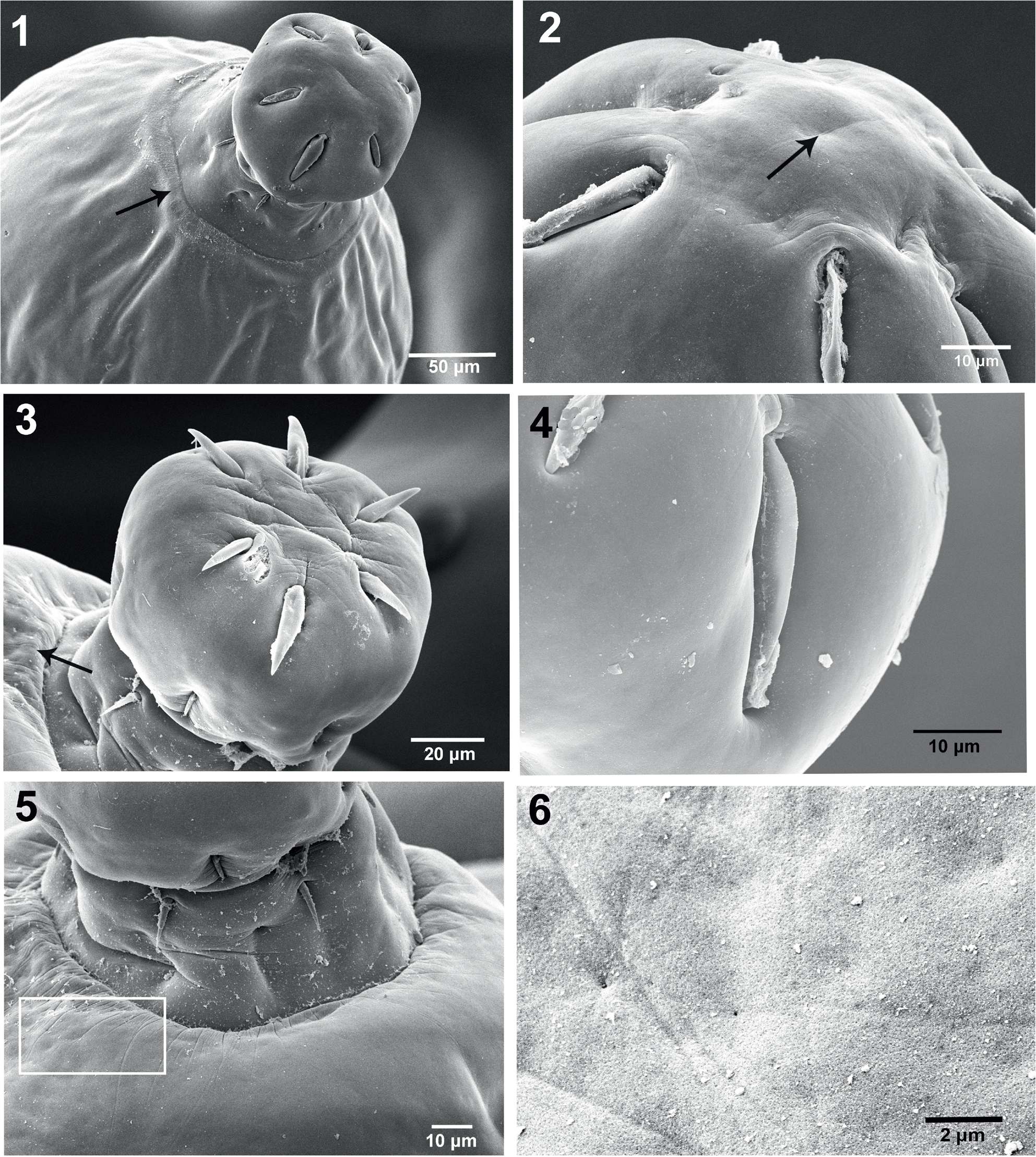
Figs. 1–6.
SEM images of specimens of Neoechinorhynchus iraqensis collected from Planiliza abu in the Al-Gharraf River, Thi Qar Province, southern Iraq.
Fig. 1. A near apical perspective of the proboscis with deeply imbedded apical hooks, two sensory pores on the neck and a prominent cuticular thickening forming the girdle (arrow). Fig. 2. The apical end of a proboscis showing the indentation marking the apical organ. Fig. 3. A proboscis showing various sizes of apical hooks in 2 circles and part of the girdle (arrow). Fig. 4. An example of an anterior hook deeply embedded in the proboscis. Fig. 5. The posterior part of a proboscis and neck with sensory pores and an inset magnifying part of the girdle. Fig. 6. Inset from Figure 5 showing pores and radiating stellate indentations emanating from this cuticular layer of the girdle as well as prevalent micropores.
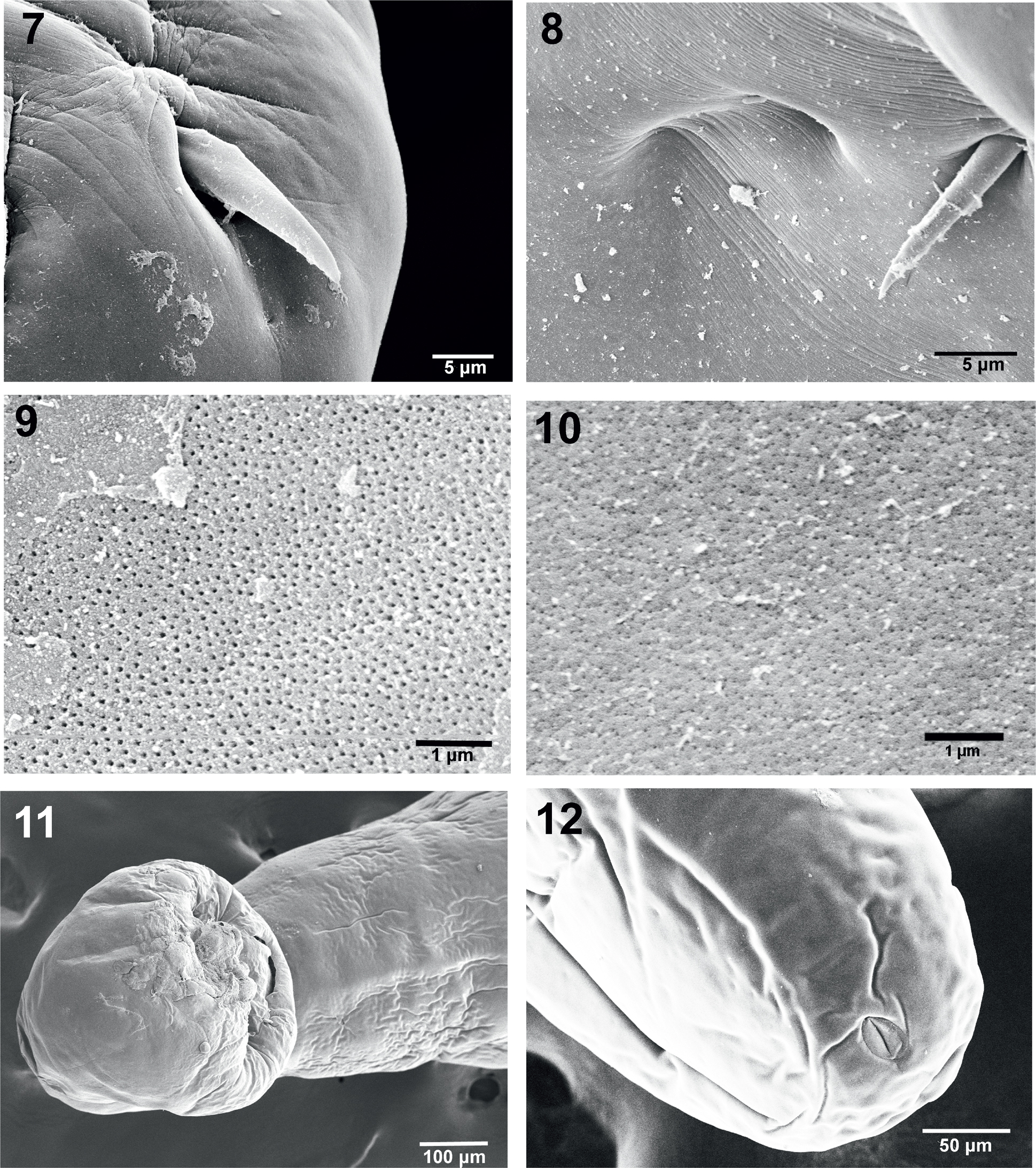
Figs. 7–12.
SEM images of specimens of Neoechinorhynchus iraqensis collected from Planiliza abu in the Al-Gharraf River, Thi Qar Province, southern Iraq.
Fig. 7. A partially embedded posterior hook of one female. Fig. 8. A close up of two adjacent micropores just posterior to the posterior hook within the proboscis-neck continuous cuticular contour lines. Fig. 9. Micropores from the proboscis. Fig. 10. Micropores from the posterior trunk. Compare the two sets of micropores for size and distribution. Fig. 11. A ventral perspective of the bursa. Fig. 12. The posterior end of a female showing the sub-ventral position of the gonopore.
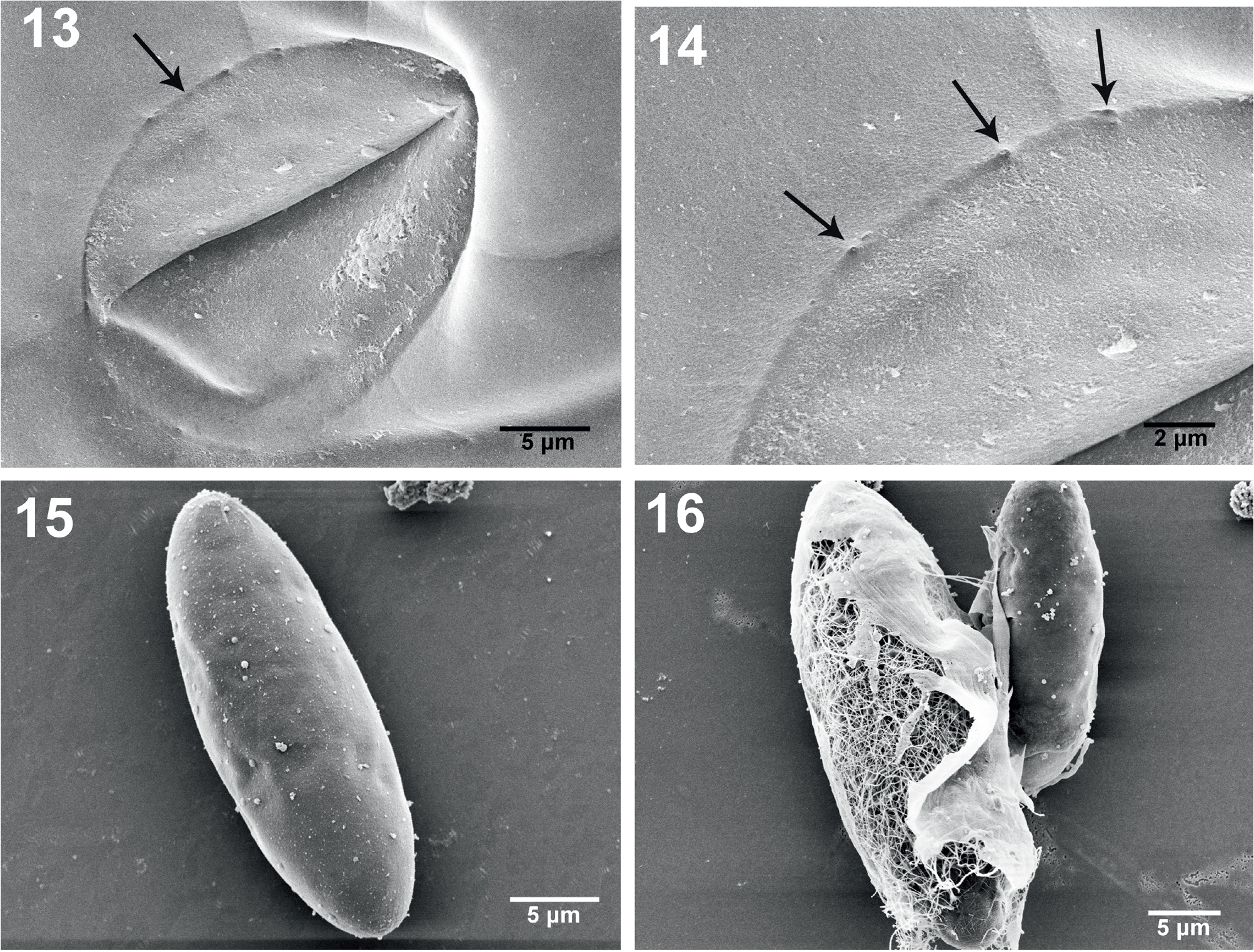
Figs. 13–16.
SEM images of specimens of Neoechinorhynchus iraqensis collected from Planiliza abu in the Al-Gharraf River, Thi Qar Province, southern Iraq.
Fig. 13. A high magnification of a female gonopore showing the thick lips and a peripheral ovoid indentation (arrow). Fig. 14. A higher magnification of part of the ovoid indentation around the gonopore in Figure 13 showing sensory pores (arrows). Fig. 15. A ripe egg. Fig. 16. A ripe egg teased to show an extensive network of fibrils.
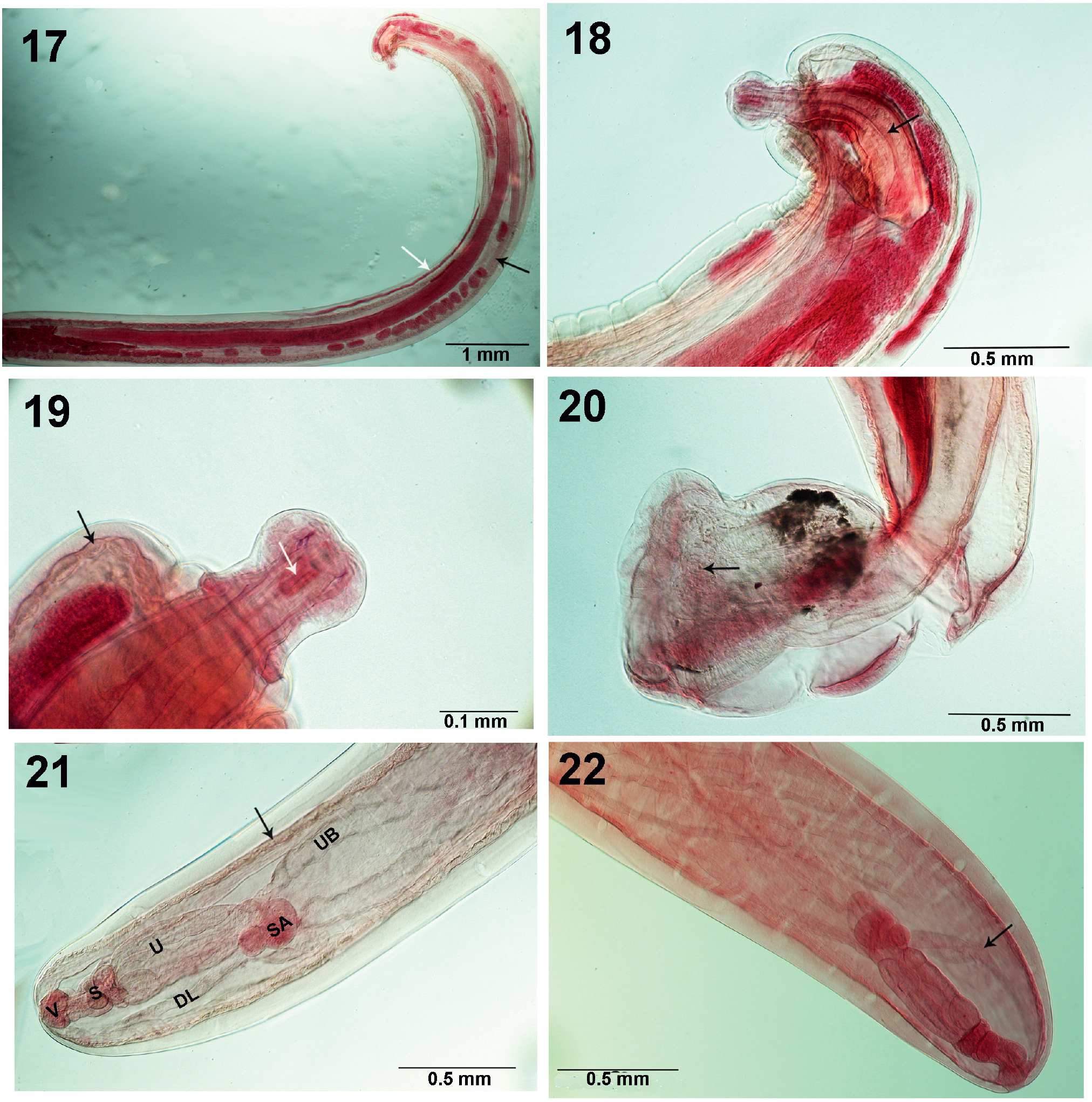
Figs. 17–22.
Light microscope images of specimens of Neoechinorhynchus iraqensis collected from Planiliza abu in the Al-Gharraf River, Thi Qar Province, southern Iraq.
Fig. 17. Anterior part of a female specimen showing the proportional sizes of the proboscis, giant hypodermal nuclei (white arrow), and lemnisci (black arrow to smaller lemniscus). Fig. 18. A higher magnification of the anterior end of a female specimen showing the proboscis, curved receptacle, triangulate cephalic ganglion and apical sensory cord (arrow). Fig. 19. The proboscis, apical organ (white arrow) and beady body wall lining (black arrow) in 1 female specimen. Fig. 20. The bursa with possible sensory cells (arrow). Fig. 21. A female reproductive system showing vagina (V), sphincter (S), uterus (U), selective apparatus (SA), uterine bell (UB) primary dorsal bundle of ligaments (DL) (below) and the beady inner lining of the body wall (arrow). Fig. 22. Another perspective of a female reproductive system emphasizing the bundles of ligaments. The primary dorsal bundle is marked with an arrow.
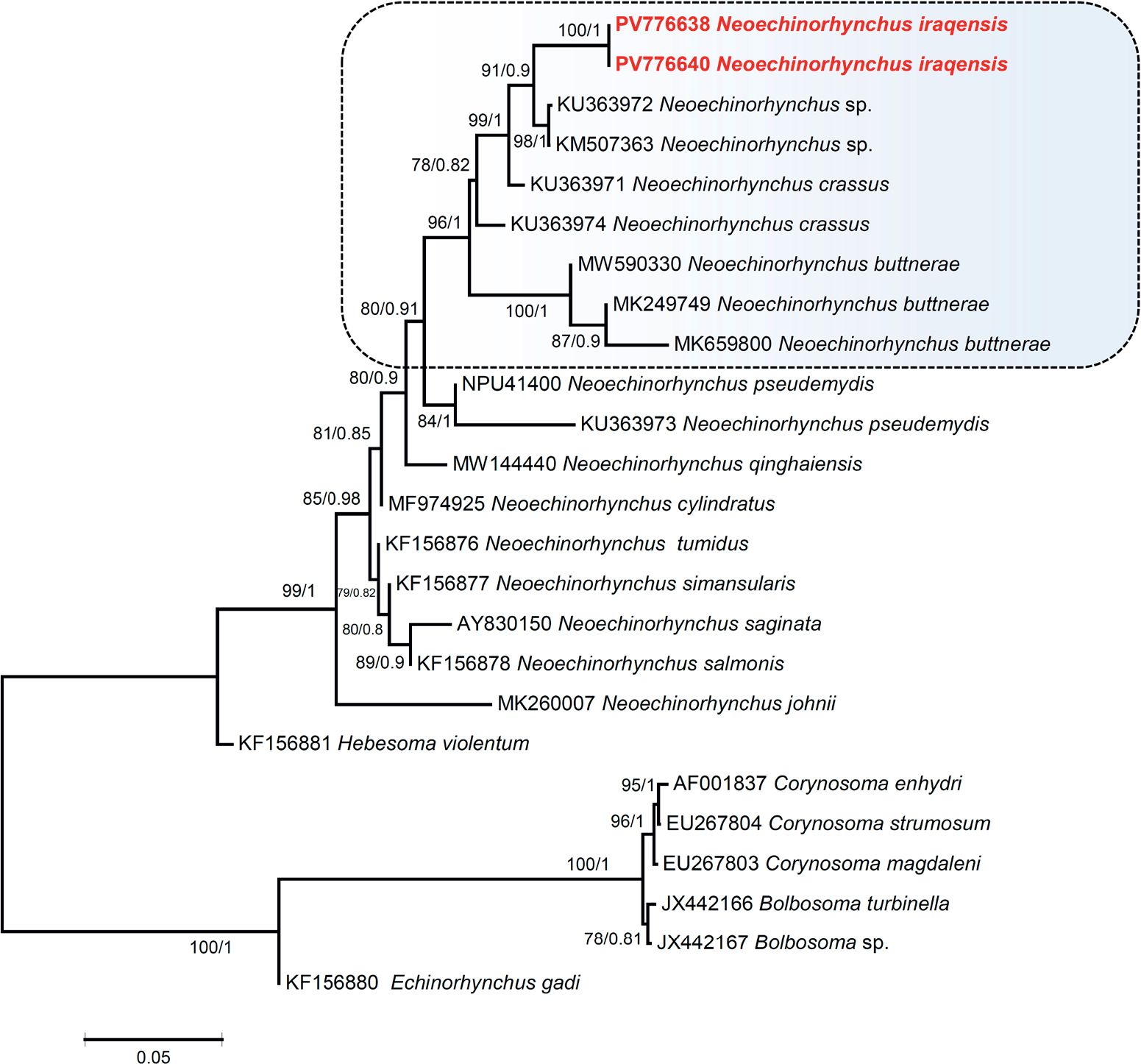
Fig. 23.
Phylogenetic trees obtained of the 18S rDNA sequences of acanthocephalan species.
Values on nodes are shown as maximum likelihood/Bayesian inference, the species names are shown next to the GenBank accession numbers, and the scale bars represent substitutions per site. Species sequenced in the present study are shown in bold red.
Table 2.
Neoechinorhynchus species information used for the phylogenetic analysis based on the 18S gene sequences for species that are present in the clade of Neoechinorhynchus iraqensis. The species sequenced during this study is shown in bold.
| Species | Host | Host origin | GenBank accession nos. | References |
|---|---|---|---|---|
| Neoechinorhynchus sp. GL-2015 | Capoeta aculeata | Iran | KU363972 | M. Adel and M. Dadar 2016 (Unpubl. data) |
| Neoechinorhynchus sp. XL-2014 | Data not available | China | KM507363 | X. Liu et al., 2014 (Unpubl. data) |
| Neoechinorhynchus crassus | Capoeta aculeata | Iran | KU363971 KU363974 | M. Adel and M. Dadar, 2016 (Unpubl. data) |
| Neoechinorhynchus iraqensis | Planiliza abu | Iraq | PV776638, PV776640 | Present study |