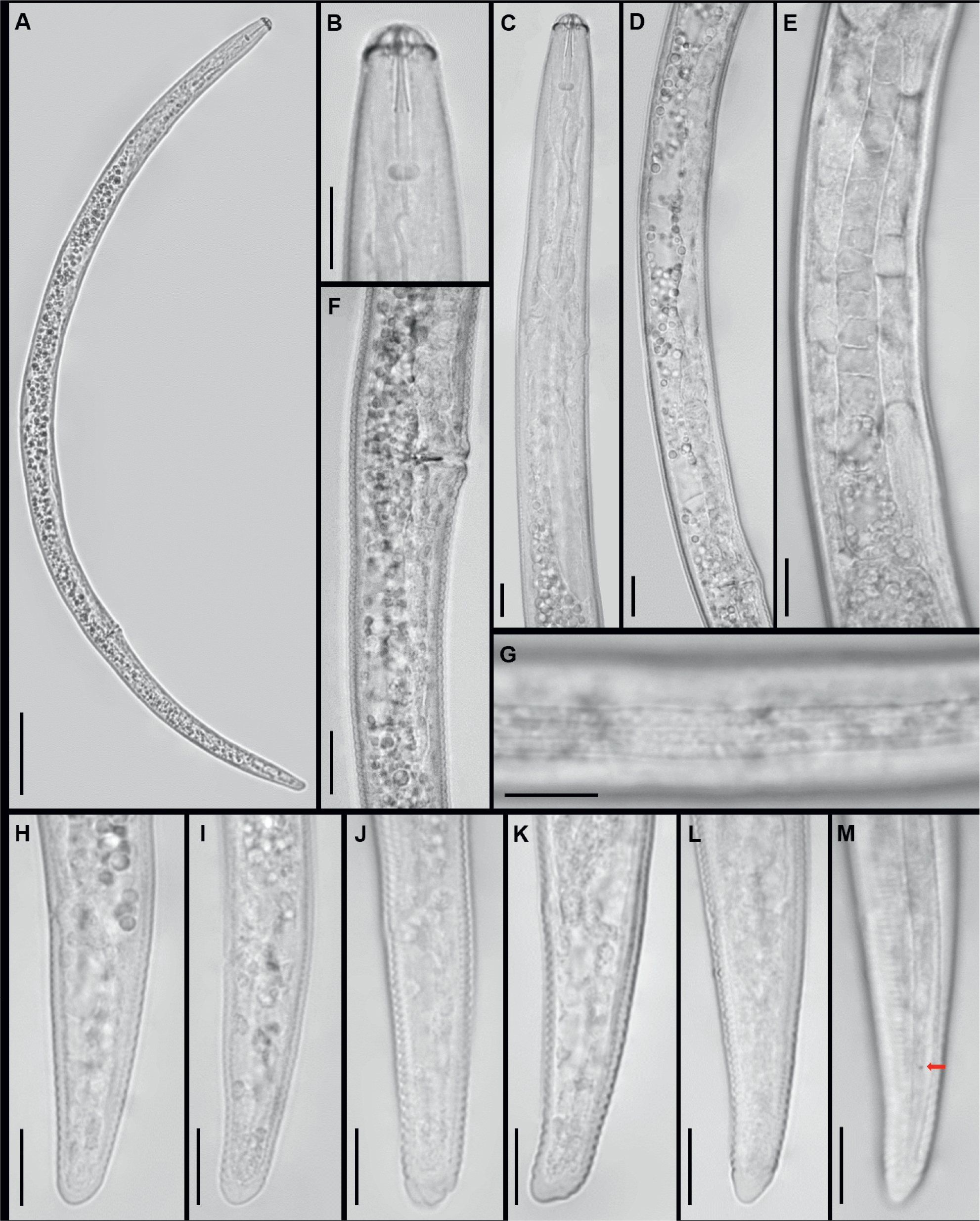
Fig 1.
Females of Pratylenchus parazeae from Vietnam under the light microscope. A: entire body; B-C: anterior region; D: vulval region; E: ovary; F: post-vulval uterine sac; G: lateral field at midbody; H-M: tail region. (Arrows point to phasmids; scale bars: A=50 μm; B-M=10μm).
Table 1.
Measurements of Pratylenchusparazeae from Vietnam and China. All measurements are in μm (except for ratio) and in the form: mean±s.d. (range)
| Characters | Vinh Phuc, Vietnam | Baise city, Guangxi, China | Laibin city, Guangxi, China | Hechi city, Guangxi, China | Laibin city, Guangxi, China |
|---|---|---|---|---|---|
| This study | Wang et al., 2015 | Wang et al., 2015 | Wang et al., 2015 | Wu et al., 2019 | |
| n | 26 | 20 | 20 | 20 | 12 |
| L | 576±33 (519-638) | 588±38 (528–683) | 628±43 (532–705) | 649±26 (600–697) | 605 (486-686) |
| Lip height | 3±0.3 (2.6-3.3) | 2.9±0.2 (2.5–3.2) | 2.5±0.2 (2.2–3.0) | 2.8±0.2 (2.5–3.4) | - |
| Lip width | 7.6±0.3 (7.1-8.6) | 8.6±0.4 (8–9.2) | 8.6±0.3 (8.0–9.1) | 8.6±0.3 (7.8–9.1) | - |
| Stylet length | 17.4±0.3 (16.9-18.2) | 17.3±0.4 (16.7–18.1) | 17.7±0.4 (17.0–18.5) | 18.3±0.3 (17.7–19.2) | 18.3 (16.5-19.2) |
| Shaft length | 8.9±0.4 (8.5-9.8) | 9.1±0.3 (8.3–9.7) | 9.5±0.3 (8.6–10.0) | 9.8±0.2 (9.5–10.5) | - |
| Knob height | 2.2±0.2 (1.8-2.5) | 2.3±0.2 (2.0–2.5) | 2.3±0.2 (2.0–2.7) | 2.4±0.1 (2.1–2.6) | - |
| Knob width | 4±0.3 (3.6-4.7) | 4.1±0.2 (3.9–4.5) | 4.3±0.3 (3.9–4.7) | 4.2±0.2 (3.8–4.6) | - |
| DGO | 3.6±0.3 (3-4) | 3.1±0.3 (2.5–3.7) | 3.0±0.3 (2.6–3.4) | 3.1±0.3 (2.6–3.6) | - |
| Anterior end to center of median bulb | 59±3 (52-66) | 60±4 (52–67) | 56±3 (52–62) | 60±2 (55–65) | - |
| Median bulb length | 12.9±0.9 (11.3-14.8) | 13.7±0.8 (12.8–15.3) | 13.5±0.6 (12.6–14.7) | 14.7±0.7 (13.9–15.8) | - |
| Median bulb width | 10±0.8 (8.6-11.7) | 10.4±0.9 (9.1–11.8) | 10.8±0.4 (10–11.3) | 11.1±0.4 — (10.8–11.9) | - |
| Anterior end to nerve ring | 72±3 (67-78) | - | - | - | - |
| Anterior end to excretory pore | 87±5 (78-97) | 84±4 (76–90) | 94±6 (82–103) | 93±5 (78–99) | - |
| Anterior end to cardia | 96±5 (86-105) | 93±5 (84–103) | 90±4 (85–99) | 93±4 (86–102) | - |
| Anterior end to end of pharyngeal gland | 137±7 (122-148) | 130±6 (117–139) | 140±9 (123–158) | 137±8 (125–158) | - |
| Pharyngeal overlapping | 41±4 (33-47) | 38±4 (29–44) | 50±9 (31–66) | 44±7 (34–66) | - |
| Cuticle annuli width | 1.3±0.2 (1-1.7) | - | - | - | - |
| Max. body diam. | 22±3 (17.7-27) | 24±2 (19.3–27) | 21±1.3 (18.7–24) | 24±2 (21–26) | 28 (24-33) |
| Vulval body diam. | 20±2 (16.7-24) | 22±1 (20–24) | 21±1 (18.2–23) | 23±2 (20–26) | - |
| Anterior genital tract length | 159±26 (121-218) | 177±38 (118–263) | 145±20 (115–204) | 165±27 (133–243) | - |
| Post-uterine sac | 43±5 (34-50) | 41±6 (36–53) | 40±4 (33–49) | 50±6 (42–61) | - |
| Vulva to anus distance | 118±14 (93-147) | 121±11 (107–152) | 130±12 (106–151) | 152±12 (134–176) | - |
| Anal body diam. | 12.6±1.2 (10.7-16.1) | 14.1±1.4 (12.2–16.2) | 14.1±0.7 (13.0–15.3) | 15.3±0.7 (13.7–16.1) | - |
| Tail length | 36±3 (32-41.9) | 37±3 (32–42) | 38±2 (33–42) | 40±3 (35–44) | 9.0 (8.1-9.2) |
| No. of tail annuli | 27±3 (23-34) | 25±2 (22–28) | 29±2 (25–33) | 32±3 (25–36) | - |
| Lateral field width | 6.4±1 (5.3-9.2) | 6±0.6 (5.1–7.1) | 6.0±0.6 (5.2–7.3) | 6.8±1.0 (5.7–7.6) | - |
| Phasmid from tail terminus | 17.4±2.1 (15.2-19.9) | 17.7±2.1 (15.2–21) | 18.9±2.4 (16.2–24) | 21±1.2 (18.9–24) | - |
| V% | 73±2 (70-75) | 73±1 (71–75) | 73±1 (72–74) | 71±1 (69–73) | 72 (71-74) |
| a | 26±3 (22-30) | 25±2 (22–28) | 30±2 (26–34) | 27±2 (24–30) | 26 (23-29) |
| b | 6±0.3 (5.5-6.5) | 6.4±0.5 (5.6–7.7) | 7.0±0.5 (6.2–7.9) | 7.0±0.4 (6.1–7.7) | 6.3 (5.5-7.5) |
| b' | 4.2±0.2 (3.8-4.5) | 4.5±0.3 (4.1–5.2) | 4.5±0.3 (3.7–5.2) | 4.7±0.3 (4.1–5.3) | - |
| c | 16.1±0.9 (14.7-17.7) | 15.9±1.1 (13.5–17.3) | 16.8±1.1 (14.6–18.6) | 16.5±1.1 (15.3–19.6) | 16.7 (13.1-20.0) |
| c' | 2.9±0.3 (2.4-3.3) | 2.6±0.2 (2.3–3.1) | 2.7±0.2 (2.3–3.0) | 2.6±0.2 (2.3–3.0) | - |
| E.P. (%) | 15.2±0.9 (13.2-16.3) | 14.3±0.8 (12.9–15.6) | 15.0±0.5 (14.0–16.1) | 14.3±0.7 (12.4–15.5) | - |
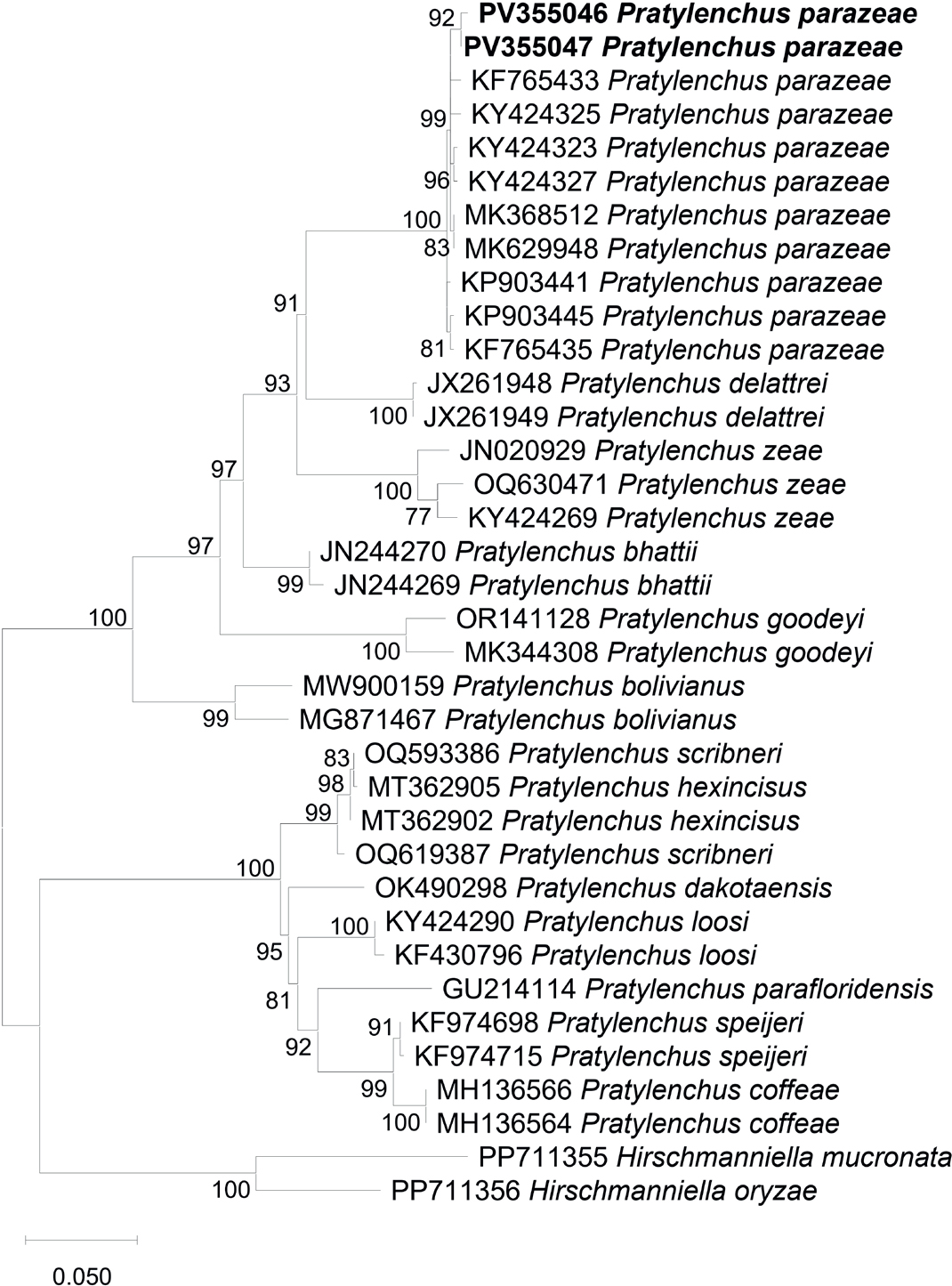
Fig 2.
Phylogenetic relationships of Pratylenchus parazeae and related species based on the D2-D3 segment of 28S rDNA region, inferred using the Maximum Likelihood (ML) method with the K2+G+I model (BIC = 9596.839, AICc = 8978.033; lnL = –4412.786; +I = 0.40; +G = 1.23; R = 2.19; base frequencies: A = 0.25, T = 0.25, C = 0.25, G = 0.25). Numbers on branches represent bootstrap values from 1,000 replicates. Sequences generated in this study are indicated in bold.
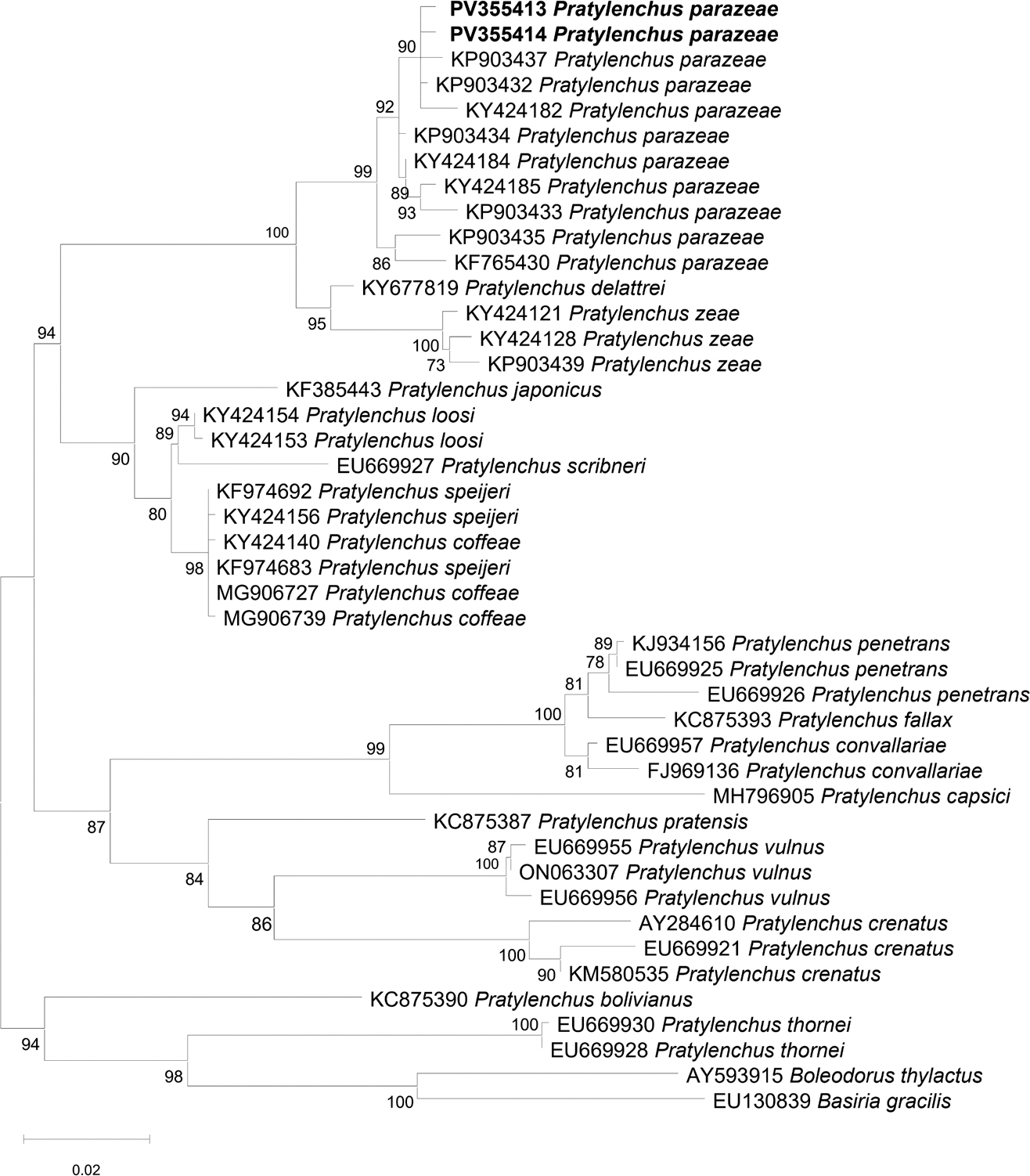
Fig 3.
Phylogenetic relationships of Pratylenchus parazeae and other Pratylenchus species based on the 18S rDNA region, inferred using the Maximum Likelihood (ML) method with the K2+G+I model (BIC = 10340.526, AICc = 9590.047; lnL = -4706.815; +I = 0.53; +G = 0.85; R = 1.79; base frequencies: A = 0.25, T = 0.25, C = 0.25, G = 0.25). Bootstrap values from 1,000 replicates are shown on branches. Sequences from this study are highlighted in bold.